
Normal view

Received yesterday — 16 May 2026 Latin America Reports
  • ✇Latin America Reports
  • US allegedly planning to indict Cuban revolutionary leader Raúl Castro Raphael McMahon
    The U.S. plans to charge the 94-year-old former President of Cuba Raúl Castro with crimes relating to Cuba’s destruction of two planes in 1996, according to anonymous officials cited by CBS News. Although a spokesperson of the U.S. Justice Department declined to comment on the matter, Florida’s Attorney General announced in March that the southern American state would reopen an investigation into Raúl Castro’s involvement in the 1996 incident.  The revelation comes amidst growing tensions
     

US allegedly planning to indict Cuban revolutionary leader Raúl Castro

15 May 2026 at 20:39

The U.S. plans to charge the 94-year-old former President of Cuba Raúl Castro with crimes relating to Cuba’s destruction of two planes in 1996, according to anonymous officials cited by CBS News.

Although a spokesperson of the U.S. Justice Department declined to comment on the matter, Florida’s Attorney General announced in March that the southern American state would reopen an investigation into Raúl Castro’s involvement in the 1996 incident. 

The revelation comes amidst growing tensions between the U.S. and Cuba, as the Trump administration continues to increase punitive sanctions against the island’s economy and threaten the leadership with political regime change. 

Castro, who is the younger brother of revolutionary icon Fidel Castro, served as president from 2008 to 2018. Although no longer head of state, Rául Castro remains an influential figure in Cuban politics: he retains the title of Army General and his grandson, Raúl Guillermo Rodríguez Castro, is allegedly a leading figure in ongoing negotiations between the U.S. and Cuba. 

Republican lawmakers, particularly those with connections to the sizable Cuban-American community in Florida such as Carlos Giménez and Mario Díaz-Balart, have repeatedly called for Castro to be indicted. A grand jury would have to issue the indictment after being presented with evidence. 

In February 1996, two planes belonging to the Miami-based group Hermanos al Rescate (Brothers to the Rescue) – an activist group which aided refugees fleeing from Cuba to the U.S. by boat – were shot down by the Cuban Air Force.

The issue of whether or not the planes were in international or Cuban airspace is still debated. 

Four people died as a result of the attack and, in March 1996, the U.S. government under President Bill Clinton signed the Helms-Burton act into law

The act strengthened economic sanctions against the Cuban government and stipulated that the U.S. commercial embargo on Cuba could only be lifted after Cuba became a democracy under non-Castro leadership. 

Although Fidel Castro was President of Cuba in 1996, several U.S. members of Congress have argued that Raúl must have been responsible for the order to shoot down the planes as he was Cuba’s defense minister at the time. 

Independent Mexico-based Cuban journalist Jorge Alfonso Pita told Latin America Reports about the potential implications of the U.S.’s supposed intention to indict. 

“I don’t believe this accusation is intended to lead to Raúl Castro being prosecuted,” argued Alfonso. “It seems like a gesture to appease the Cuban-American and Republican lobby, so that Trump and Rubio can say ‘we won’t allow impunity’ while they sit down to negotiate with El Cangrejo [Fidel Castro’s grandson] and Cuban intelligence.”

The move to indict the younger Castro may, however, not be purely symbolic; the capture and subsequent extradition of former Venezuelan President Nicolás Maduro to the U.S. in January demonstrates the Trump administration is willing to both charge foreign leaders and bring them to trial. 

Maduro is now facing federal charges related to “narco-terrorism” while in custody in New York. 

Latin America Reports reached out to Cuban officials for comment on the potential indictment, but they declined. 

Featured Image: Former U.S. President Barack Obama and then Cuban President Raúl Castro in the Estadio Latinoamericano in Havana, during the former’s historic visit to the island.  

Image Credit: White House via Wikimedia Commons

License: Creative Commons Licenses

The post US allegedly planning to indict Cuban revolutionary leader Raúl Castro appeared first on Latin America Reports.

  • ✇Latin America Reports
  • Cuban energy minister announces country has run out of fuel oil and diesel  Raphael McMahon
    Cuba has “absolutely no fuel oil and absolutely no diesel”, according to the country’s Energy Minister, Vicente de la O Levy. His comments, made to state-run media on Wednesday, underline the severity of Cuba’s energy crisis, which has been intensified by a near-total U.S. blockade on fuel imports since January.  The effects of the fuel shortages were felt immediately, with widespread power outages on Wednesday night sparking protests in Havana. Though the protests soon dissipated, large s
     

Cuban energy minister announces country has run out of fuel oil and diesel 

15 May 2026 at 19:21

Cuba has “absolutely no fuel oil and absolutely no diesel”, according to the country’s Energy Minister, Vicente de la O Levy.

His comments, made to state-run media on Wednesday, underline the severity of Cuba’s energy crisis, which has been intensified by a near-total U.S. blockade on fuel imports since January. 

The effects of the fuel shortages were felt immediately, with widespread power outages on Wednesday night sparking protests in Havana. Though the protests soon dissipated, large sections of eastern Cuba remained in darkness on Thursday. 

While Cuba has domestic reserves of natural gas and crude oil, it lacks the money to maintain or upgrade its refineries, which are necessary to convert high-viscosity crude oil into fuel oil, essential to electricity generation. 

“Cuba is open to anyone that wants to sell us fuel”, Levy implored.

However, Cuba has largely been cut off from international oil imports by the U.S., which threatened to impose tariffs on any country supplying oil to Cuba and severed Venezuelan oil supplies to the Cuban state.

Despite this, Russia sent an oil tanker to help alleviate the crisis in March and China has also helped Cuba mitigate its reliance on imported fuel by helping install solar parks across the island. 

Nevertheless, it is unclear if any country would be willing to provide Cuba with enough oil to sustain its national grid indefinitely. There is also no guarantee that the U.S. would allow new foreign oil imports to arrive. 

The U.S. is reportedly considering sending the island a humanitarian aid package worth US$100 million to ease the effect of its own oil blockade of the island, with CIA Director John Ratcliffe visiting Havana yesterday to discuss “intelligence cooperation, economic stability, and security issues”. 

Ratcliffe is likely the first CIA Director to visit the island since 1953, as the U.S. and Cuba have been staunch geopolitical adversaries since the triumph of the Cuban Revolution in 1959. 

Although the two nations are involved in official diplomatic negotiations, tensions between Washington and Havana have been rising dramatically. The North American superpower has repeatedly threatened the Cuban leadership with political regime change and has ratcheted up punitive sanctions against officials and economic entities deemed to be linked to the Cuban regime. 

Although the U.S. claims its measures are solely targeted at the Cuban government, the punitive measures have contributed to an economic and humanitarian crisis that is harming many ordinary Cubans, with hospitals, schools and workplaces facing shortened operating hours because of power cuts. 

Critics of the Cuban regime, however, argue that the energy shortages and the humanitarian suffering in the Caribbean nation are a result of the political leadership’s authoritarianism, economic mismanagement and corruption.

Featured Image: An oil refinery near Regla, Cuba 

Image Credit: Marcel601 via Wikimedia Commons

License: Creative Commons Licenses

The post Cuban energy minister announces country has run out of fuel oil and diesel  appeared first on Latin America Reports.
  • ✇Latin America Reports
  • Another political prisoner dies in custody in Venezuela  Julio Blanca
    Caracas, Venezuela — Another political prisoner in Venezuela has died, NGO Foro Penal reported last Saturday. The news came just days after the Venezuelan government admitted that another political prisoner, Víctor Hugo Quero Nava, had died months earlier from medical complications while in state custody.  The deaths bring renewed attention to the plight of over 450 political prisoners that remain behind bars months after U.S. special forces captured strongman Nicolás Maduro.  José Man
     

Another political prisoner dies in custody in Venezuela 

15 May 2026 at 18:53

Caracas, Venezuela — Another political prisoner in Venezuela has died, NGO Foro Penal reported last Saturday.

The news came just days after the Venezuelan government admitted that another political prisoner, Víctor Hugo Quero Nava, had died months earlier from medical complications while in state custody. 

The deaths bring renewed attention to the plight of over 450 political prisoners that remain behind bars months after U.S. special forces captured strongman Nicolás Maduro. 

José Manuel García Sabino, 31, was a former councilman from the northeastern city of Anaco and part of the ruling United Socialist Party of Venezuela (PSUV).

Before being jailed, he had denounced corruption inside the Mayor’s Office and the City Council to the disparagement of party officials. 

Local news outlets reported that García Sabino died on May 9 inside a police station. 

Initial reports indicated that he had taken his own life by self strangulation. However, after conducting a forensic examination, authorities determined that the cause of death was mechanical asphyxiation, leading the case to be classified as a homicide.

The Scientific, Penal, and Criminal Investigations Corps (CICPC) arrested 12 officers from the Anaco Municipal Police for their alleged involvement in the case. Following a hearing, six officers were detained.

In addition, they ordered the removal of Pedro Parra, who had served as director of the local police agency since 2022 and is now in custody.

García Sabino, the former councilman, was arrested on February 23 related to an investigation into alleged fraud involving an informal savings scheme known as Susú, used for the purchase of motorcycles.

That same day, his wife, Scarlet Ortiz, was also arrested related to the fraud investigation. Following García Sabino’s death, Ortiz was released from prison, where she had reportedly given birth to the couple’s child while she was being held. 

La esposa del exconcejal José García Sabino, asesinado en el retén de Polianaco, en El Tigre, estado Anzoátegui, fue liberada la noche de este martes. Scarlet Ortiz estaba recluida desde el 23 de febrero y dio a luz mientras era procesada por estafa agravada.

🎤 @susanaquijadac pic.twitter.com/8IBDNyXOV7

— El Noticiero Televen (@El_Noticiero) May 13, 2026

She posted a message on social media thanking God for her freedom and her lawyers for their efforts.

So far this year, the Venezuelan Prison Observatory has reported 16 deaths of detainees in state custody.

These deaths occurred amid deplorable conditions such as medical neglect, overcrowding, violence, institutional opacity, and the absence of basic safeguards for life.

The observatory stated on X that “behind this figure are men who fell ill without medical care, prisoners who died in overcrowded cells and prisons, families forced to pay for medicine, food, and supplies, and a state that maintains absolute control over these people but does not guarantee their lives.”

They are demanding that authorities conduct thorough and impartial investigations into the deaths.

Featured image: José Manuel García Sabino

The post Another political prisoner dies in custody in Venezuela  appeared first on Latin America Reports.

In conversation with Claudia López, Colombian presidential candidate and ex-mayor of Bogotá

15 May 2026 at 18:40

Less than three weeks before Colombians head to the polls in presidential elections, centrist candidate Claudia Lopez’s odds at victory are slim, to say the least.

Since winning the primary contest to lead the Consultation of Solutions (Consulta de las Soluciones) bloc in March, the silver-haired former mayor of Bogotá has been criss-crossing the country to win over moderate voters.

But the latest polls report the 56-year-old’s share of the vote as being in the low single digits.

Dressed in her signature gilet and sipping from a mug of coffee, the former Harvard University guest lecturer says in flawless English that she wants to do the interview in Spanish – “I need to get people to vote for me,” she jokes. 

With little to lose, López speaks candidly about her time in office, her views on other politicians, and her experience on the campaign trail.

Watch the full interview here

Reflections on her mayorship

López, who steered Bogotá through the Covid-19 pandemic and a mass wave of anti-government protests, speaks proudly of her stint as mayor from 2020 to 2024.

The presidential hopeful rattles off a list of her achievements in office: her management of the Covid-19 pandemic, lifting 600,000 women out of poverty, and rolling out Bogotá’s public bicycle network.

López also speaks candidly about the problems during her mayorship, which spanned the administrations of presidents Iván Duque and Gustavo Petro.

“Interestingly, I ended up having an easier relationship with President Duque, a right-winger, than with my left-wing president, whom I voted for,” says López. 

López, who publicly backed Petro’s candidacy, describes friction between the national government and the mayor’s office.

“President Petro is an effusive leader, but he is too effusive, very machista, and I, well, I don’t agree with that; if there’s one thing I can’t stand in my life, it’s the abuse of power.”

On the campaign trail

Today, the former senator finds herself trying to carve out a place in a noisy election cycle marked by political extremes and polarization.

Her coalition’s platform is based on three pillars: security and territorial governance; equality and social justice; and regional development without corruption.

López’s shift to the center has drawn some criticism, including from voters who note the former Green Alliance member’s u-turn on key environmental issues like fracking.

Last year, she declared: “If god gave us oil, coal, and gas, that is what we will use.”

“I maintain this stance,” insists López, adding she opposes the Petro administration’s pause on all oil and gas exploration. “Stopping gas exploration means halting Colombia’s energy transition – it’s a mistake.”

López argues the policy has damaged the economy and reduced funds for investment and development. 

Instead, she backs a gradual transition: “I estimate that the transition in Colombia from fossil fuels to cleaner energy sources will take us about 25 years, give or take.”

The candidate believes in preserving biodiversity, saying she would not authorize mineral exploration in the country’s forests or protected areas, marking a softer stance than some of her opponents.

Among her rivals, López is especially critical of right-wing criminal defense attorney Abelardo de la Espriella.

“He is the only candidate – let’s put it this way – whom I would absolutely never vote for. He is a defender of mobsters. He is a shadowy character,” says López.

De la Espriella notoriously represented figures linked to paramilitary death squads, the head of the worst pyramid scheme in Colombian history, and Alex Saab, considered the frontman for corruption schemes by former Venezuelan dictator Nicolas Maduro. 

López argues that he is an Uribista – a supporter of the politics of right-wing ex-president Álvaro Uribe – but is on a different “side of the coin” to Uribe’s chosen candidate, Paloma Valencia.

“Paloma is definitely a supporter of Uribe, but she’s never exactly been a defender of mobsters,” explains López.

The ex-mayor refused to rule out voting for Valencia or for leftist candidate Ivan Cepeda, the two frontrunners alongside de la Espriella.

But López, a lesbian woman, is staunchly critical of Valencia’s stance on LGBTQ+ rights. The candidate for Uribe’s Democratic Center (Centro Democrático) party opposes adoption by same-sex couples while her party has blocked bans on conversion therapy. 

She is particularly critical of Juan Daniel Oviedo, a gay politician, for agreeing to be Valencia’s running mate in March. 

“I regret that Juan Daniel Oviedo feels compelled to play along with that anti-rights agenda. In fact, I believe he is the only person who has been told to his face that he is not considered an equal human being, that he is not considered a citizen with the same rights, and that they do not trust him to raise a child,” says López.

Despite her objections to Valencia, López says she still will not rule out voting for her in the second round, citing the improbable possibility that Paloma faces de la Espriella in a run-off.

But the former mayor maintains she would not endorse Valencia and Oviedo in any eventuality: “I wouldn’t campaign for them, ask anyone to vote for them, or endorse them.”

Looking to the future

Finally, faced with nearly impossible odds in May’s elections, López projects a springy optimism about her political future.

“I’m very happy with the campaign I’ve run, and I’m very grateful to the Colombian people,” says the candidate, stressing that it is just her first stab at the presidency.

“Ours is a new grassroots movement; we only just collected the signatures last year, so I feel grateful, happy, and very excited, and I’m going to continue in politics and continue working to build Colombian social democracy.”

This article originally appeared on The Bogotá Post and was republished with permission.

Featured image description: Claudia Lopez.

Featured image credit: Billy Ramsey.

The post In conversation with Claudia López, Colombian presidential candidate and ex-mayor of Bogotá appeared first on Latin America Reports.

Received — 15 May 2026 Latin America Reports
  • ✇Latin America Reports
  • Venezuela contradicts Colombia claims about military strikes near border Amelia Makstutis
    Medellín, Colombia – The Venezuelan government on Wednesday published a declaration saying it regretted recent violence in the Catatumbo region of Colombia just days after Bogotá announced bombing in cooperation with Caracas. The statement muddies the waters about whether or not Venezuela was involved in the military operations against the National Liberation Army (ELN) rebels near the two countries’ joint border, which allegedly killed 7 guerrilla fighters.  “The Bolivarian Republic of Ve
     

Venezuela contradicts Colombia claims about military strikes near border

14 May 2026 at 23:23

Medellín, Colombia – The Venezuelan government on Wednesday published a declaration saying it regretted recent violence in the Catatumbo region of Colombia just days after Bogotá announced bombing in cooperation with Caracas.

The statement muddies the waters about whether or not Venezuela was involved in the military operations against the National Liberation Army (ELN) rebels near the two countries’ joint border, which allegedly killed 7 guerrilla fighters. 

“The Bolivarian Republic of Venezuela expresses its profound concern and regrets the escalation of violence in the border region of Catatumbo,” read a statement shared on X by Foreign Minister Yvan Gil.

The declaration came after Colombian President Gustavo Petro said on Monday that he had ordered the bombing in cooperation with Venezuela. 

“I gave the order to bomb the ELN camp in accordance with the agreement reached with the Bolivarian government of Venezuela,” wrote Petro on X.

Petro appeared to allude to an agreement with Caracas to cooperate on tackling cross-border crime following his visit to Venezuela in April. 

But Caracas appeared to wash its hands of the recent bombing operation; while it did not directly acknowledge the bombing or Petro’s statement, its declaration said that it “rejects any armed action that compromises the peace, stability, and security of border communities.” 

It added that the only way to preserve peace and stability in the region is through “mechanisms of understanding and mutual respect, avoiding actions that can aggravate tensions or generate greater risks for border populations, who for decades have faced the consequences of a conflict out of their control.”

Since last year, Catatumbo has been the site of what has been described as “the most serious humanitarian crisis of recent times” in Colombia. In January 2025, a family of three, including a nine-month-old baby, was killed, marking the collapse of fragile peace pacts between the ELN and the Frente 33 – a dissident faction of the demobilized FARC rebels – and triggering a humanitarian crisis on a scale not seen in the country for over a decade.

The Red Cross said that 2025 was one of the most complicated years for humanitarian conditions in Colombia: more than 235,000 people were individually displaced, over 176,000 people have been unable to move freely because of armed conflict, and there has also been a sharp increase in cases of mass displacements.

Venezuela’s statement highlights the cross-border nature of the conflict, noting that the country “has historically suffered the consequences of Colombian internal conflict.” Colombian armed groups like the ELN and dissident FARC factions have traditionally had a significant presence in Venezuela and were known to have ties to the Nicolás Maduro regime.

But both the interim government under Delcy Rodríguez and Petro have been under pressure from the White House to confront guerrilla groups.

This article originally appeared on The Bogotá Post and was re-published with permission.

Featured image description: Colombian President Gustavo Petro and Venezuelan Interim President Delcy Rodríguez at a meeting in Caracas on April 24, 2026.

Image courtesy of: Colombian President’s Office.

The post Venezuela contradicts Colombia claims about military strikes near border appeared first on Latin America Reports.

  • ✇Latin America Reports
  • Fresh concerns over Peru democracy after authorities charge leading presidential candidate John Boscawen
    Bogotá, Colombia – Peru’s presidential election has been upturned by news that the country’s public prosecutor is seeking a jail term for Roberto Sánchez, one of two candidates set to compete in next month’s run-off. The public prosecutor announced on Tuesday it is seeking a five year and four month jail term for alleged irregularities in campaign donations to the Together for Peru (Juntos por el Perú) party between 2020 and 2021.  The announcement has fuelled existing concerns about the i
     

Fresh concerns over Peru democracy after authorities charge leading presidential candidate

14 May 2026 at 22:50

Bogotá, Colombia – Peru’s presidential election has been upturned by news that the country’s public prosecutor is seeking a jail term for Roberto Sánchez, one of two candidates set to compete in next month’s run-off.

The public prosecutor announced on Tuesday it is seeking a five year and four month jail term for alleged irregularities in campaign donations to the Together for Peru (Juntos por el Perú) party between 2020 and 2021. 

The announcement has fuelled existing concerns about the integrity of the elections and the state of Peru’s democracy, which has faced a spate of crises in recent years.

If successfully prosecuted, Sánchez would be unable to stand in the election set for June 7. 

The candidate denies the accusations, saying, “I proved that I never made personal use of the party’s financial resources, and that is why the alleged fraud as a serious crime was dismissed by the Judiciary through a court ruling.”

The timing of the release of the documents, leaked to the press on May 12 and formally unsealed the next day, has raised suspicions in some quarters of attempted electoral manipulation. The documents show that the prosecutor’s resolution was issued on January 15 but was only made public this week, as Sánchez closes in on advancing to run-off elections following a lengthy vote count.

Jo-Marie Burt, from the Washington Office on Latin America (WOLA), says the charges may signal that an elite coalition in congress is seeking to subvert the election process to avoid the chance of Sánchez coming to power.

“One cannot help but see this as a politically motivated move designed to remove him as a viable candidate,” she told Latin America Reports

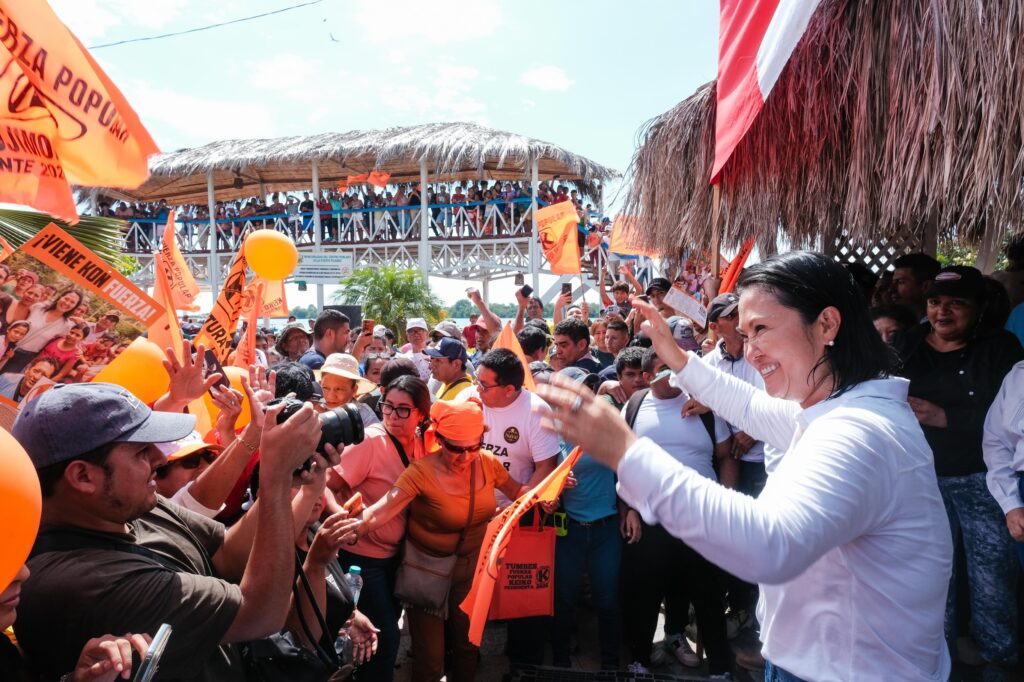
Sánchez, a leftist former trade minister, is set to face off with Keiko Fujimori, the right-wing politician who has dominated the political scene in Peru for a decade but has been defeated in each of the last three presidential run-offs. 

Keiko Fujimori greets supporters. Image credit: Keiko Fujimori via Facebook.

WOLA’s Burt sees the hand of Keiko Fujimori behind this intervention: “The [prosecutor’s office] is now run by people who are closely allied with Keiko Fujimori and her allies. Hence the concern that this action against Sánchez is politically motivated.”

The public prosecutor’s decision to seek a jail term for Sánchez is just the latest in a series of moves which have fuelled concerns about the integrity of Peru’s judiciary.

While the prosecutor’s office is technically independent from the executive and legislative branches, it has been clouded by accusations of politicization since the accession of Attorney General Tomás Gálvez, considered an ally of Fujimori.

In November last year the UN Special Rapporteur on the independence of judiciary and lawyers, Margaret Satterthwaite, raised concerns about the ousting of Attorney General Delia Espinoza, who had been actively pursuing investigations into links between organized crime and legislators.

“Judicial independence is not optional. It is the foundation of democracy,” she said, after congress voted to bar Espinoza from office for ten years.

Espinoza’s replacement by Gálvez – who has been under investigation for links to organized crime in the Cuellos Blancos del Puerto influence peddling scandal – deepened fears for the integrity of the judiciary in Peru. In January this year, he announced that three major corruption investigation units, including the one investigating the Cuellos Blancos case, were being closed down.

Peru’s National Human Rights Coordinator claimed at the time this “constitutes an institutional breakdown that seriously weakens the fight against impunity by jeopardizing ongoing investigations.”

Featured image description: Roberto Sánchez at a campaign rally.

Featured image credit: Roberto Sánchez via Facebook.

The post Fresh concerns over Peru democracy after authorities charge leading presidential candidate appeared first on Latin America Reports.

Received — 14 May 2026 Latin America Reports

In less than a year, 1 in 5 minors in Colombia suffered online sexual violence, UNICEF, ECPAT, and INTERPOL warn

14 May 2026 at 17:52

Bogotá, Colombia – Around 21% of Colombian minors aged between 12 and 17 have been victims of online sexual abuse in the past year, according to a report published last week by UNICEF-Innocenti, ECPAT International, and INTERPOL. 

The report, “Disrupting Harm,” covered 25 countries including Colombia and examines how technology use, including new tools like artificial intelligence (AI) are helping to facilitate online abuse. 

The investigation was made between 2023 and 2025, and the results are alarming: around 860,000 Colombian adolescents experienced some type of digital sexual abuse or exploitation in just one year (2024) . 

Data also pointed to gender and economic disparities. A quarter of young women surveyed said they’d been victims of this type of abuse or exploitation while 17% of young men said the same. In poorer, rural areas of the country, 29% of minor respondents said they’d been victimized while 17% living in urban areas said they had been. 

In addition to social dynamics in Colombia, including deep-rooted “machismo”, prevalent domestic and gender based violence, and extreme wealth inequality, technology is increasingly becoming a factor in the abuse of children. 

According to a 2025 study by the Communications Regulation Commission (CRC), during the past year, 81% of teenagers between 14 and 17, and 55% of pre-adolescents aged 10 to 13, reported having their own cell phones. 

Experts say that since the pandemic, interactions among children and adolescents have increased significantly. Cell phones have become a ‘fundamental’ tool for maintaining social status and escaping reality, especially for those facing family problems.

“It is essential that children do not fear being punished or having their phones taken away for responding to a message. We saw in the study that this is one of their biggest fears: losing their connection to the rest of the world,” Camila Perera, a specialist at the Office of Research and Data for UNICEF Innocenti, told Latin America Reports.

Nearly half of the reported cases of abuse happened on social media platforms such as Facebook (80%), WhatsApp (30%), and Instagram (17%), while 14% were linked to online gaming networks.

In addition, 2% of victims reported that artificial intelligence was used to create fake explicit content using their faces – highlighting a newer phenomenon that became widely discussed last year after Elon Musk’s AI chatbot Grok began creating millions of sexualized images of people online. 

With the introduction of such technologies, regulators and parents are struggling to keep up. 

“Minors, with their superior digital skills, moved much faster than any safety measures could. While they advance, protection protocols simply cannot keep up,” Fabio González Florez, Project Leader at ECPAT International, told Latin America Reports.

“There is a serious obligation to stay informed, and that doesn’t require a postgraduate degree. Tutorials are everywhere, and every platform offers parental controls that we must learn to use,” he added.

A stranger behind a screen? The ‘real’ danger

Contrary to popular belief, the threat is not always an anonymous hacker hiding in the dark; in fact, only 30% of victims met their aggressor online.

In half of the documented cases, children were abused by someone they already knew, including family members, neighbors, and classmates. Due to this approach, some of the minors can’t recognize the abuse or feel safe enough to ask for help.

“There’s a common expression: ‘stranger danger’, the idea that we must only be looking for outsiders. However, the majority of the abusers are actually the ones close to the family,” stated González.

The findings are also exposing another difficult situation: one in five cases of online sexual abuse against a minor was made by another minor. It was found that some victims will look to target or recruit their peers to re-victimize in exchange for incentives or “freedom.”

The report also highlights that victims often suffer from severe mental health issues, including anxiety, depression and propensity to self harm. 

Even if many minors prefer to remain silent, when they decide to speak out, they usually look for their mothers, siblings, or a friend. This is a message about the importance of creating trust-based relationships with children.

“Beyond digital parenting, we must ensure the kids see their parents as sources of protection. They need to be someone they can talk to about sexuality, consent, and limits without being judged,” Perera recommended. “It is about being a source of trust so they can come to us with their doubts and curiosities.”

Despite existing channels in Colombia, such as the ICBF’s 141 line or the National Police’s “¡A Denunciar!” portal, the study found that formal reporting is almost non-existent between minor victims.

Protection measures: Are they enough?

With increased connectivity via the internet, the threat landscape for online abusers of Colombian children expands immensely. 

“Our obligation is to work with our 196 member countries; also, we have specific resolutions focused on child protection,” a member of INTERPOL, who requested anonymity because of the sensitivity of their work, told Latin America Reports. “Another critical measure is urging countries to adopt protocols to detect and block URLs containing sexual abuse and exploitation material to prevent the commercialization of such content.”

However, risks remain in an increasingly interconnected world: “A single image of a Colombian child can be reproduced globally across time and geography; therefore, the response to protect them must be a national priority”, the INTERPOL member said. 

Finally, the investigation calls on digital companies to contribute to risk reduction by incorporating prevention into platform design and improving safety measures. The research is also looking for new prevention tools for transforming both physical and digital spaces and eliminating the conditions that facilitate violence.

This issue requires concrete actions from all sectors: the protection system, families, and technology companies.

Featured image credit: UNICEF

The post In less than a year, 1 in 5 minors in Colombia suffered online sexual violence, UNICEF, ECPAT, and INTERPOL warn appeared first on Latin America Reports.

The science and education budget cuts that led hundreds of thousands of Argentines to protest this week

13 May 2026 at 18:48

Buenos Aires, Argentina — Thousands of professors, administrative staff, students, and graduates marched across Argentina on Tuesday to demand that the government comply with a university funding law approved last August. 

It was the fourth such “Federal University March”, brought about because of persistent budget cuts to higher education and the sciences since Javier Milei became president in 2023. Since then, government budget allocations to national universities fell 45.6%, the National Inter-University Council (CIN) reported. 

Under current law, the government has adjusted for inflation professors salaries and operating costs, leading to a surge of resignations and other teachers forced to find additional jobs. Although Congress passed the public university funding bill in August 2025, Milei quickly vetoed it, citing his commitment to a zero-deficit policy. 

Read more: Despite large protests, Argentina’s Javier Milei vetoed university spending bill

By September, lawmakers in both chambers rejected the veto, officially enacting the bill into law.

Nevertheless, the president has effectively stalled its implementation via decree, arguing that the law remains on hold until specific funding sources are identified. 

In late March, a federal court ordered the government to comply with a segment of the norm that granted a salary raise for university staff, which was considered the most urgent item in the bill.

In an attempt to dodge its obligations, the government has appealed to the courts and a lower appeals court has just granted the administration’s request to elevate the case to the Supreme Court and suspend the law’s implementation in the meantime. Final word on the matter now lies with the country’s highest tribunal. 

Despite Tuesday’s mass mobilization that gathered over 600,000 people in the capital Buenos Aires and nearly 1 million across Argentina, the University of Buenos Aires (UBA) said that the government decided to double down. 

“You could have a hundred thousand, a million or five million people on the streets, but the budget restriction will continue,” said Alejandro Álvarez, the Undersecretary of University Policies. 

A day before the march, whose slogan called on Milei to “Comply with the law, do not mortgage the future,” the president’s administration cut more projects, including $5.3 billion pesos (US$3.8 million) destined for university building maintenance and $2 billion pesos (US$1.4 million) in science scholarships. Between education, science, technology and direct transfers, the administration has cut over $110 billion pesos (US$79 million). 

Before Milei took office, higher education funding accounted for 0.72% of the Gross Domestic Product (GDP) in 2023; it’s currently around 0.47% of GDP. 

The impact is stark, and nowadays, some of Argentina’s best public universities are being pushed to the brink, according to their faculties. Universities have complained about deteriorating facilities, rationing electricity, faculty salary cuts and a drop in extracurricular activities, among other things. 

Signs from protesters urging Milei to comply with the university funding bill. Image credit: Governor of the Buenos Aires Province Axel Kicillof via X.

Historic lows and the “brain drain” threat

The current higher education budget is at a two-decade low, plunging funding below levels witnessed during the 1989 hyperinflation crisis (0.44% of GDP) and approaching the absolute minimums recorded during Argentina’s military dictatorship, according to a report by the Ibero-American Center for Research in Science, Technology, and Innovation (CiiCTi).

One of the most pressing medium-term challenges is the retention of academic staff. Faculty salaries have plummeted by 32% since Milei’s La Libertad Avanza administration took office, prompting approximately 10,000 resignations, according to CIN data. 

The exodus has left vacant teaching positions in areas deemed highly strategic for the government’s own economic model, including sectors like energy, technology, and mining.

At the University of Buenos Aires alone, the Faculty of Exact and Natural Sciences reported the loss of 438 professors and researchers between December 2023 and April 2026.

“We are losing one every two days,” a faculty member who asked not to be named for fear of retribution, told Argentina Reports. The Engineering department saw an additional 342 departures.

A historic setback: Funding drops below 2002 and 1976 levels

The situation is equally critical for science and technology, where analysts warn of a virtual dismantling of the country’s research matrix. 

Federal spending on science and technology fell by 39.3% during the first quarter compared to the same period in 2023, projecting a real-term decline of 47.7% by the end of the three-year cycle, the CiiCTi report noted. 

This sustained budgetary squeeze will reduce the sector’s funding to just 0.149% of GDP, the lowest level recorded since historical recording began in 1972.

To grasp the magnitude of the fiscal adjustment, the current level of funding pierces the floors seen during the worst phase of the 2002 economic collapse (0.177% of GDP) and the onset of the military dictatorship in 1976 (0.194% of GDP). 

These official figures also confirm the government’s failure to meet the targets set by the suspended science funding law, which legally required the state to invest 0.520% of GDP in the sector this year.

An ideological debate over the role of public education

Beyond a 40.3% drop in the purchasing power of salaries and scholarships at Argentina’s National Scientific and Technical Research Council (CONICET) since November 2023, the funds required to keep research projects active are virtually paralyzed.

The Agencia I+D+i, the country’s main innovation and development agency, has suffered a severe 86.3% cut over the last three years. 

This is compounded by the financial asphyxiation of cutting-edge institutions: the National Space Activities Commission (CONAE)—key to Argentina’s participation in NASA’s Artemis mission—faces a 61.2% cut, while the National Atomic Energy Commission (CNEA) and the National Agricultural Technology Institute (INTA) have seen their budgets slashed by nearly 47%.

Featured image: Hundreds of thousands of people gathered in Buenos Aires and other parts of Argentina on May 12 to protest budget cuts to the higher education system.

Image credit: Governor of the Buenos Aires Province Axel Kicillof via X.

The post The science and education budget cuts that led hundreds of thousands of Argentines to protest this week appeared first on Argentina Reports.

The post The science and education budget cuts that led hundreds of thousands of Argentines to protest this week appeared first on Latin America Reports.

❌
Latin America Reports