Although new DSLR shipments were way down in 2025, dropping from just under a million units in 2024 to under 700,000 in 2025, that hasn't stopped used DSLR cameras from selling in big numbers.
[Read More]
Although new DSLR shipments were way down in 2025, dropping from just under a million units in 2024 to under 700,000 in 2025, that hasn't stopped used DSLR cameras from selling in big numbers.
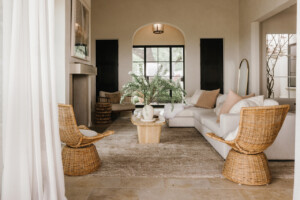
Spring is the season of renewal. An opportunity for a fresh start. Walking outside on the first warm and sunny day of the year—and seeing neighbors out and about, too—can feel like a collective sigh of relief. With winter’s chill behind us, spring invites us to lighten up, especially in our homes. The time has come to put away the heavy knits and faux furs and break out the gingham tablecloths and pastel throw pillows. Spring has finally arrived, and we’re ready for a refresh.
Spring is the season of renewal. An opportunity for a fresh start. Walking outside on the first warm and sunny day of the year—and seeing neighbors out and about, too—can feel like a collective sigh of relief. With winter’s chill behind us, spring invites us to lighten up, especially in our homes. The time has come to put away the heavy knits and faux furs and break out the gingham tablecloths and pastel throw pillows. Spring has finally arrived, and we’re ready for a refresh.
7 Spring Home Decor Trends for the Ultimate Refresh
We spoke with several interior designers to get the scoop on what spring home decor trends they’re seeing and loving this season. It’s a dreamy mix of soft colors, trending patterns, cozy textures, and a dash of the unexpected. Read on to learn how to give your home a fresh start with this season’s latest interior trends.
Stripes and Gingham
One of the biggest decor trends of the year is playing with patterns. Gingham and stripes are everywhere this spring, and Elizabeth Vergara, founder and CEO of Vergara Homes is happy to hop on the trend. “This spring, I can see gingham and stripes coming back in a huge way,” she shares. “I would incorporate these patterns into my home through table runners, pillow cases, and throws. I try to make small shifts in my home so they can easily be switched out once the season changes or the trend passes.”
The best part about patterns is that they work in every room. If your spring refresh is in the living room, try adding a few gingham pillows to the sofa. Want to refresh the bedroom? Add a new set of striped sheets to your bed. Hosting a spring dinner party? Include gingham in your tablescape with patterned napkins or a tablecloth.
Florals for spring aren’t exactly groundbreaking, but it truly wouldn’t be the season without them. “Adding seasonal florals such as tulips, daffodils, and flowering branches in soft pastels or bright, cheerful tones can instantly brighten your home and make it feel fresh,” Ashley Gallion, Founder of Ashley Ayers Interiors, shares. “You can easily pull playful spring accents in smaller accessories such as pillows or vases.”
Whether you decorate with fresh or faux florals, be generous. Now is the time to place vases full of blooms at the center of your coffee table, dining table, kitchen island, and mantle, all at once!
A spring home refresh doesn’t require a full-blown renovation, of course, and swapping out accents like pillows and throws is a perfect way to welcome the season. “One very easy change for spring is to swap out your heavy winter throw blankets for lighter spring-inspired throws in pretty florals or light and bright plaids,” Laura Medicus, Interior Designer and Owner of Laura Medicus Interiors, says. Looking to add some fun patterns to your space? This is the way to do it. “Hop on the gingham trend with one or two soft-colored gingham pillows!” Medicus continues.
A spring home refresh is not only about how your home looks, but how it feels. Outdated art and photos can bring the vibe down, so take some time to check in with what you have displayed. “One easy way to refresh your home for spring is to update your framed photos or art to go with the seasons,” Erin Greene, Interior Designer at Erin Greene Designs, notes.
Take a look at your walls and notice if any frames need updating or art that needs refreshing. Winter is generally for darker, moodier art, while spring lends itself to art that’s soft and light. Pick photos and art that feel like spring. To get the most bang for your buck, Greene recommends digital frames. “I particularly love this HD framed canvas from Frameology because it’s a great way to make digital art look more luxurious,” she says. “You can frame art that captures springtime vibes, then once fall rolls around, swap out that art to represent autumn instead.”
Sarah Goesling, owner and principal, and Rebecca Goesling, Director of Design at Goesling Group, know a thing or two about trending colors for spring. “For springtime, we’re loving pops of color like citrus or spicy orange, whether saturating the whole room in a fresh coat of paint or adding an unexpected ceiling moment,” they share. “Our advice for ceilings is to try a bolder contrast in a smaller space for some drama. Ceilings are a great way to experiment with color if you’re not ready to fully commit to walls just yet.”
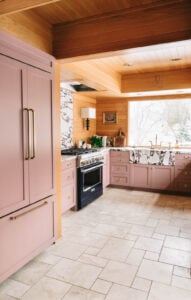
Even if you’re not ready to pick up a paintbrush this season, adding pops of color through accents and decor is a great way to sprinkle some fresh energy into your space. “Other color ideas we’re enjoying are creamy apricot, asparagus green, bubblegum pink with a violet undertone, frosty translucent blues, and scarlet in high lacquer,” they continue.
“Other ways to refresh your space include incorporating some fun vintage pieces,” Goesling shares. “We always love sourcing unique finds from estate sales or local artisans. Other details like fringe, raw materials, and handcrafted items are also having a moment.”
Good design takes time, and pieces that are lived in, well-worn and have a story to tell are becoming more and more popular. Interior trends this year are less about curating a home that looks like it belongs in a showroom and more about curating a space you love, regardless of trends. Spring is the ideal time to rearrange a room, bring in new pieces, and experiment with your design style. Shopping secondhand is a fantastic way to create a space that feels like it was collected over time, instead of all at once.
Spring beckons us to start living outside again. Decks, patios, porches, and backyards are ready to be revived! “Spring is usually when we realize how heavy everything started to feel over winter, so we try to lighten it up by taking away a few layers, bringing in airier materials, and making our outdoor space feel usable again,” Barrett Oswald, Principal Designer at Barrett Oswald Designs, says.
As you refresh your outdoor space, Oswald recommends adding new exterior pillows, updating greenery, and checking on your lantern lights. “A few small changes can make a big impact,” she states.
Certain small rituals shape how your home feels, and lighting a candle is one of them. It’s something I reach for almost without thinking, but I notice the shift right away. The right scent can make a space feel calmer, more grounded, a little more like somewhere you actually want to be.
But not all candles are created with that same intention. Many are made with ingredients you wouldn’t choose if you knew what was in them. And if it’s something you’re lighting regularly, that matters.
A
Certain small rituals shape how your home feels, and lighting a candle is one of them. It’s something I reach for almost without thinking, but I notice the shift right away. The right scent can make a space feel calmer, more grounded, a little more like somewhere you actually want to be.
But not all candles are created with that same intention. Many are made with ingredients you wouldn’t choose if you knew what was in them. And if it’s something you’re lighting regularly, that matters.
A candle should elevate your space—not compromise it.
What Is a Non-Toxic Candle?
Not all candles are created with the same level of care. Many contain ingredients like paraffin wax (a petroleum byproduct) and synthetic fragrances that can release unwanted chemicals into your space.
Non-toxic candles take a different approach. They’re made with cleaner-burning waxes—like soy, beeswax, or coconut—and use more thoughtful fragrance sources, so what you’re lighting actually aligns with the environment you’re trying to create.
How to Find the Best Non-Toxic Candles
If you’re trying to choose a better candle, a few details make all the difference. Start with the wax. Soy, beeswax, and coconut wax tend to burn cleaner than paraffin, which is derived from petroleum.
Next, look at fragrance. Candles scented with essential oils or botanical blends are generally a better option than those made with synthetic fragrance, which can contain phthalates. And don’t overlook the wick—opt for paper or 100% cotton, which burn more cleanly than metal-core alternatives.
How to Spot Greenwashing
“Clean” and “non-toxic” are everywhere in candle marketing, but they’re not regulated terms, meaning they don’t always mean much.
The easiest way to cut through it is to look for transparency. Turn the candle over, check the ingredient list, and see what the brand is actually telling you. If that information is hard to find—or overly vague—that’s worth noting.
It’s also important to look beyond the packaging. A minimalist label or elevated design can make a candle feel clean, but aesthetics don’t guarantee better ingredients. The brands worth buying from are the ones that are clear about what they use, how they source it, and why it matters.
We know this can feel like a lot to sort through—but it doesn’t have to be. Ahead, the non-toxic candles we actually reach for: clean-burning, beautifully scented, and worth lighting every day.
The Best Non-Toxic Candles to Shop Right Now
If you’re looking for a candle that feels as good as it smells, start here. These are the ones we reach for on repeat—clean-burning, well-balanced, and worth lighting every day.
If you’re buying one candle this season, make it this one. Casa Zuma’s Daybreak strikes that rare balance of feeling elevated and effortless—clean-burning, beautifully layered, and subtle enough to light every day without overwhelming a space. It’s the kind of scent that makes your home feel instantly more considered, without trying too hard.
“I don’t say this lightly—this is the candle I’ve been telling everyone about. It’s fresh, green, and just unexpected enough to stand out from the usual florals and woods. It’s the one I keep coming back to, and the one I’ve started gifting on repeat.” – Isabelle Eyman, Editorial Strategist
Scent notes: tomato leaf, citrus, green herbs
Wax: soy blend
Why I love it: unique, fresh, and instantly mood-shifting
Ever since the pandemic, interior trends have been leaning towards bold, maximalist styles and colors. Lockdown taught us collectively that life is short, and more time spent at home has invited many to throw caution to the wind. If this is where we’re spending a large amount of our time, we should really love the space we’re inhabiting. Right? Say goodbye to sad beige and millennial gray—whimsy, playfulness, and color are in. The brighter, the better!
Ahead, I chatted with designers to get
Ever since the pandemic, interior trends have been leaning towards bold, maximalist styles and colors. Lockdown taught us collectively that life is short, and more time spent at home has invited many to throw caution to the wind. If this is where we’re spending a large amount of our time, we should really love the space we’re inhabiting. Right? Say goodbye to sad beige and millennial gray—whimsy, playfulness, and color are in. The brighter, the better!
Ahead, I chatted with designers to get their take on bright paint colors—how to choose them, where to paint, trending colors, and perhaps most importantly, how to get over any hesitancy when working with vibrant hues.
Choosing the right color for your home is a very personal decision. Lesley Myrick of Lesley Myrick Interior Design always starts her design process with the client, and never a trend. “A vibrant paint color has to be a commitment color, something you’ll still love when the design world moves on to the next thing,” she says. Myrick suggests paying attention to the colors you like to wear, what colors are already present in the room, and what the light is doing between 8 am and 8 pm.
“Vibrant color is high impact, which means it can’t be an afterthought. It has to be rooted in something specific and personal. Otherwise, you end up with a room that just looks loud instead of layered,” she continues.
In short, pick a color you love. Be sure it plays well with the other items in your space. Take the time to see how the light affects the paint color throughout the day. Have fun!
What Rooms Are Best for Vibrant Paint Colors?
Bright paint colors will energize a space, so opting for rooms that are lively, or are perhaps in need of some zest will work well. “A small space is the best place to go bold, because the color wraps around you and creates a complete mood,” Myrick says. “A powder room in a deep, glossy green or a saturated blue is going to be the most memorable room in the house.”
“I always recommend an entry way or hallway as great spaces to introduce vibrancy,” Daniele Doerge, a color expert from California Paints, shares. “From there, I love dining rooms and living rooms for vibrant tones as well. These areas are natural spaces to gather, and having a strong color can feel inviting and expressive.”
Myrick agrees. “Dining rooms are another natural fit, especially because you typically use them at night, when rich color looks its absolute best in low light,” she adds.
Hesitant to Use Vibrant Bright Colors in Your Home?
Neutrals can feel safe, and especially if you have maximalist tendencies, even a bit boring. But covering a room in a bright blue, cheery yellow, or bold chartreuse requires a healthy dose of courage. It’s totally normal to feel hesitant. Both Myrick and Doerge have a few tips to help calm your nerves.
Test Out Paint Samples
“First, paint is the least permanent design decision you will ever make,” Myrick reassures. “If you hate it in three years, you paint over it—that’s it. A bold color is not the irreversible commitment people think it is.” She also suggests getting large samples, painting them on two different walls, and living with them for a few days to make an informed decision. “Look at them in morning light, afternoon light, and at night. The same color will shift dramatically depending on the room and the time of day,” she shares.
Start Small
“Try painting cabinets or an interior door, or even add in an accent wall to see how you feel with the color,” Doerge recommends. “I also advise people to pair bold colors with some sort of grounded neutral or texture—whether that’s furniture, decor, or rugs.”
Go Bold or Go Home
Finally, Myrick recommends digging your heels in and committing with your full chest. “The half-hearted vibrant color, the one that felt ‘safer’ than the bold choice you loved, always disappoints. If you’re going to go bold, go all the way,” she urges.
What Bright Paint Colors Are Big Right Now?
Even though vibrant colors are inherently energizing, the right bold color can still feel calming and intentional. Colors inspired by nature are always a wise choice. “We’re seeing some trends towards vibrant colors rooted in nature—think golden yellows, clay-inspired corals, and lush greens that feel bright but still grounded,” Doerge shares.
If there’s one thing designers agree on, it’s this: the color you love is always the right choice. Bright paint colors aren’t a trend to chase or a risk to manage — they’re an invitation to make your home feel more like you. Start with the room that needs the most life. Paint a large sample. Live with it for a few days. And when you find the one that makes you feel something every time you walk in? Commit all the way. The half-hearted choice always disappoints. The bold one never does.
This post was last updated on May 22, 2026, to include new insights.
SINGAPORE, June 3 — Singapore residents born in 2025 can expect to live an average of 83.9 years, according to new figures released by the Department of Statistics (SingStat).According to CNA, the preliminary data, reported today, shows life expectancy edging up by 0.2 years from 2024 and continuing a decade‑long upward trend. Singapore’s average lifespan has climbed from 82.9 years in 2015, surpassing the pre‑pandemic high of 83.7 years recorded in 2019. For r
SINGAPORE, June 3 — Singapore residents born in 2025 can expect to live an average of 83.9 years, according to new figures released by the Department of Statistics (SingStat).
According to CNA, the preliminary data, reported today, shows life expectancy edging up by 0.2 years from 2024 and continuing a decade‑long upward trend. Singapore’s average lifespan has climbed from 82.9 years in 2015, surpassing the pre‑pandemic high of 83.7 years recorded in 2019.
For residents aged 65, the projected lifespan rose to 86.6 years, also an increase of 0.2 years from the previous year. SingStat noted that the figures reflect how long people would live if current mortality patterns remain unchanged, and do not account for future shifts in health outcomes.
Life expectancy for men at birth reached 81.8 years in 2025, up 0.3 years from 2024 and 1.3 years higher than a decade ago. Women continued to outlive men, with life expectancy rising to 86.0 years, an improvement of 0.2 years from the previous year.
At age 65, men are expected to live to 84.9 years, while women are projected to reach 88.1 years — both showing steady gains since 2015.
The report also highlighted better long‑term survival prospects for newborns. Among boys born in 2025, the share expected to reach age 65 increased to 90.3 per cent, while those projected to live to 85 rose to 47.6 per cent. For girls, the corresponding figures climbed to 94.4 per cent and 64.3 per cent respectively.
Headed to their first championship final in more than 25 years, the New York Knicks have a deep celebrity following and lots of brand love to cash in on.
Headed to their first championship final in more than 25 years, the New York Knicks have a deep celebrity following and lots of brand love to cash in on.
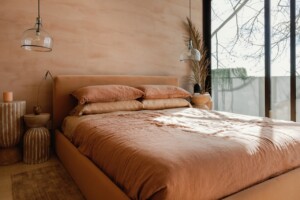
If your bedroom feels cramped, cluttered, or smaller than it should, the solution usually isn’t more space—it’s a few smarter design decisions. The way your furniture is arranged, how your eye moves through the room, and even the scale of your lighting can make a noticeable difference in how spacious it feels.
We’re all drawn to those impossibly charming spaces: the Paris apartment, the cozy but perfectly arranged bedroom, and the ones that feel light-filled and effortless even when they’re
If your bedroom feels cramped, cluttered, or smaller than it should, the solution usually isn’t more space—it’s a few smarter design decisions. The way your furniture is arranged, how your eye moves through the room, and even the scale of your lighting can make a noticeable difference in how spacious it feels.
We’re all drawn to those impossibly charming spaces: the Paris apartment, the cozy but perfectly arranged bedroom, and the ones that feel light-filled and effortless even when they’re not especially big. The fact that they work has nothing to do with square footage. Instead, it’s because everything inside them feels considered.
That’s the shift: creating a bedroom that feels bigger is about how the space functions—and how it makes you feel when you’re in it. The easiest solve? Remove what’s getting in the way.
Small Shifts That Make Your Bedroom Feel Bigger—Fast
Sure, it’s subtle, but in practice, it’s what changes everything. If your bedroom feels smaller than it should, a few thoughtful shifts can change how the entire space reads—fast. Start here:
1. Leave at least one area intentionally open. A room feels bigger when not every corner is trying to do something.
2. Remove one piece of furniture you don’t actually need. If it’s not essential, it’s taking up visual space.
3. Choose fewer, better-proportioned pieces. Oversized furniture closes a room in faster than you think.
4. Keep surfaces intentionally clear. Not empty—just free of anything that doesn’t need to be there.
5. Use lighting that gives the room breathing room. Think slimmer lamps, sconces, or anything that doesn’t crowd the surface it sits on.
6. Draw the eye upward. Artwork, vertical lines, or even higher curtain placement can subtly expand the space.
7. Let your bed have space on at least one side. Even a small gap can make the layout feel more open.
8. Stick to a more tonal color palette. When colors flow, the eye moves more easily—and the room feels larger.
9. Use mirrors to reflect light, not just fill a wall. Placement matters more than size.
10. Keep sightlines clear from the doorway inward. What you see first shapes how spacious the room feels.
These shifts might feel small, but they’re the same principles designers use to make a space feel considered, balanced, and more expansive. To take it a step further, I asked designers how they approach small bedrooms. Take out your notepad (and prepare your Pinterest board). These small bedroom design tips are gold.
9 Designer-Approved Ways to Make a Bedroom Feel Bigger
1. Start With Less Than You Think You Need
The fastest way to make a small bedroom feel bigger is to remove what isn’t essential.
It sounds obvious, but it’s where most spaces go wrong—trying to fit in one more chair, one more surface, one more piece that doesn’t quite have a role. As designer Katie Raffetto puts it, “less is more,” especially in a bedroom.
If it’s not helping you sleep, store, or soften the space, it’s likely adding visual noise.
Strip the room back to what you actually use—a bed, a place to set things down, lighting that works—and let everything else be intentional.
A bedroom feels bigger the moment it stops trying to be anything other than a bedroom.
2. Rethink the Scale of Your Furniture
In a small bedroom, the issue isn’t always how much you have—it’s how much space your furniture takes up.
A queen bed might feel like the default, but if it leaves you with barely any room to move, it’s working against the space. The same goes for bulky nightstands, oversized dressers, or anything that sits heavy in the room. Even creating space on just one side of the bed can make the entire layout feel more open.
Designer Cameron Johnson refers to this as “space engineering”—making decisions that create room around your furniture, not just filling the room with it. Sometimes that means choosing a smaller bed, a narrower nightstand, or a piece that can serve more than one function.
3. Use Color to Your Advantage (Not Just for Aesthetics)
Color doesn’t just change how a room looks—it changes how it feels. In smaller bedrooms, there’s often a tendency to default to all white in hopes of making the space feel bigger. But according to Raffetto, leaning into deeper, more saturated tones can actually create the opposite effect—in a good way. “Dark colors allow you to lean into the coziness,” she says, turning the room into something that feels intentional rather than constrained.
The key is consistency. When your palette feels cohesive—whether it’s light and tonal or rich and layered—the eye moves more fluidly through the space. And that sense of visual continuity can make a room feel larger, not smaller. A room feels bigger when your eye isn’t constantly stopping to process contrast.
4. Keep Your Sightlines Clear
What you see first when you walk into your bedroom sets the tone for how the entire space feels. If your line of sight is blocked—by bulky furniture, clutter, or awkward layout—the room immediately reads as smaller. But when that path is open, even a compact space can feel noticeably more expansive.
Designers often think about this as creating a clear visual entry point. The less your eye has to work to understand the space, the bigger it feels.
5. Draw the Eye Upward
One of the simplest ways to make a bedroom feel bigger is to change where the eye goes. When everything sits at the same level—low furniture, low art placement, nothing pulling your gaze upward—the room can start to feel compressed. Designers counter this by using vertical space to create a sense of expansion.
That might look like hanging artwork slightly higher than expected, extending the visual height of your headboard, or mounting curtains closer to the ceiling to elongate the walls. As Johnson notes, even something as simple as placing art above the bed can help “extend the headboard” and shift how the room is perceived.
It’s a subtle trick, but it works: when your eye travels up, the room opens with it.
6. Use Mirrors With Intention
Mirrors are often recommended for small spaces—but how you use them matters more than simply having one.
Placed thoughtfully, a mirror can reflect natural light, extend a sightline, or create the illusion of depth. Placed randomly, it just becomes another object on the wall. Again, you’re not filling the space for the sake of it. The goal is to amplify what’s already working.
7. Choose Pieces That Do More Than One Thing
In a smaller bedroom, every piece should earn its place. When square footage is limited, adding more furniture isn’t the answer—choosing smarter furniture is. Pieces that can serve multiple functions allow you to get what you need from the space without visually crowding it.
Raffetto suggests something as simple as placing a dresser next to the bed so it doubles as a nightstand. Johnson echoes this approach, pointing to bed frames with built-in storage as a way to eliminate the need for additional pieces.
Lighting has a bigger impact on how spacious a room feels than most people realize. Oversized lamps and bulky fixtures can take over a surface, making everything around them feel tighter. Raffetto recommends choosing streamlined lighting—slimmer lamps or wall-mounted sconces—that give your furniture room to breathe.
It’s also about placement. When light is distributed thoughtfully, it softens the edges of the room and reduces visual clutter. When it’s not, even a well-designed space can start to feel crowded.
Editing a room down is only half the equation. The other half is knowing when it feels complete.
A space can be minimal and still feel unfinished. The difference comes down to how the elements work together. When a room feels resolved, your eye isn’t jumping from object to object or looking for what’s missing—it can settle.
Designers create this sense of closure through a few intentional choices: curtains that frame the room, a rug that grounds the bed, and a mirror that reflects light into the space. Not more pieces—just the right ones, placed with purpose.
The One Thing That Makes a Bedroom Feel Smaller
Most bedrooms don’t feel small because of their size. They feel small because too many things are competing for attention. When every surface is filled, every corner is doing something, and every piece of furniture is slightly too big or slightly out of place, the room starts to feel visually crowded—even if there’s technically enough space.
Designers think about this differently. It’s about centering in on what the room doesn’t need. Because the moment your eye has space to move—to land, to rest—the entire room opens up.
This post was last updated on April 8, 2026, to include new insights.

 Login
Login












:max_bytes(150000):strip_icc():format(jpeg)/Lobster-Caviar-Corn-Dog-060426-1-8b02b59cd40c49b49973ee98f56f6082.jpg)
