The Black Skimmer’s Latin name is Rynchops niger
Ryn = Nose or Beak Chops = Cut off
They leave a lasting impression – these comical, gregarious shorebirds.
Black skimmers gather in large social colonies on flat, sandy Atlantic beaches. Lined up, each one facing into the wind. As I sit and watch, I’m struck by the effort in scattering, the whole flock taking to the air, swerving, banking, veering on long wings each time beach walkers pass through. It wouldn’t take a significan
They leave a lasting impression – these comical, gregarious shorebirds.
Black skimmers gather in large social colonies on flat, sandy Atlantic beaches. Lined up, each one facing into the wind. As I sit and watch, I’m struck by the effort in scattering, the whole flock taking to the air, swerving, banking, veering on long wings each time beach walkers pass through. It wouldn’t take a significant arc in a person’s path to avoid them and allow them to rest, to conserve their precious energy.
Their brilliantly colored orange and black bills, with the top abruptly shorter than the bottom, are their hallmark.
With this feature, they are uniquely equipped for “tactile foraging.” They skim the surface of the ocean with their lower bill stuck straight down into the water.
Image from birdz-world.blogspot.com
When they feel a fish hit their bill, they snap their mouth shut with such speed as to catch the minnow without slowing their flight. Just a quick nod of their head as they grab their prey. Have you ever tried to catch a minnow in your hands? Then you can appreciate their extraordinary feats.
Black skimmers’ long, forked wings allow for efficient gliding. Their cat-like, vertical pupils enable them to see through the glare of the sun and in the dark of night. If you ever have the opportunity to watch a skimmer, take the time to be awe-struck.
If you’re interested in purchasing or licensing any images you see here, please email me at SNewenham at exploringnaturephotos.com, and I’ll make it happen.
Subscribe here to receive an email whenever a new blog posts.
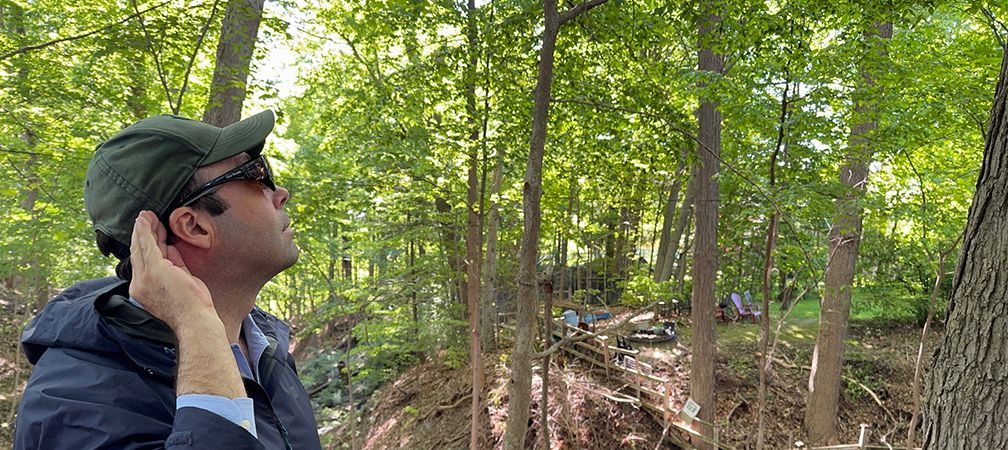
The first time someone called me a birder, I was startled, not only because I’m completely Blind. I had accumulated bits of knowledge here and there over the years and felt smug when I could identify birds by their songs, but I’d never studied, and it had never even occurred to me to go on an outing. Birders get up early, which wasn’t my habit, and I believed falsely that birding was entirely centred on vision. While some are, many birders I’ve spoken to describe listening as one of the key tool
The first time someone called me a birder, I was startled, not only because I’m completely Blind. I had accumulated bits of knowledge here and there over the years and felt smug when I could identify birds by their songs, but I’d never studied, and it had never even occurred to me to go on an outing. Birders get up early, which wasn’t my habit, and I believed falsely that birding was entirely centred on vision. While some are, many birders I’ve spoken to describe listening as one of the key tools in finding birds to identify, especially in high summer when the foliage is at maximum density.
So on a sunny day in late summer, I accompanied Steve Garrett of the Toronto Ornithological Club (TOC), a Nature Network member group, to hear what was to be heard in Toronto’s High Park (mostly it was goldfinches and chickadees). We had our expectations set appropriately, as anyone who can distinguish a house sparrow from a bluejay can tell you, late summer isn’t the best time for birding.
Despite the season, I learned a lot. I got acquainted with the Merlin Bird ID app, and grilled Steve about birders and their ways.
Things I learned:
A “spark bird” is the bird that first catches someone’s attention and turns them into a birder
A “lifer” is a first-ever sighting of a bird that a birder may have been chasing for years
And the best way to get a bird to stop singing is by turning on your ID app microphone
Steve told me the image of the classic birder has changed. The classic birder, armed with field glasses and reference manuals, isn’t quite as conspicuous anymore, because the smart phone offers options both for viewing, photographing, identifying and documenting.
Also, the idea of who a birder is has consciously shifted. “The birding community has followed the cultural shift towards diversity, equity and inclusion,” Steve told me. “When it was founded, way back in 1934, the Toronto Ornithological Club was exclusively men. Of course that’s not true anymore, and we’re actively interested in including people with a wide range of ages, backgrounds and abilities.”
This led to a discussion about an event involving the TOC and a group of Blind adults brought together by Balance for Blind Adults. One participant was Alex Bulmer, a Blind actor and director, who lives near High Park.
Alex, who lost her sight in her 20s, explained that one of the biggest barriers for Blind birding is access. “It’s one thing to walk down the street,” she says, “That’s good, cause there’re birds out on the street in the city and you can travel with your cane or your dog down the street, but you’re limited. Unless you can get into a woodland or a place that’s less navigable, I mean I can’t get into the depths of High Park with my cane or my dog, I just can’t without a sighted guide.”
I also think it’s important to tackle a common myth. Blind people have better hearing than sighted people. My conclusion is that, as a Blind person, I’m no more likely to excel at a hearing test than anyone else, but also as a Blind person, I rely heavily on sounds around me to make my way through the world and perceive what I can about it. This means that I often notice sounds my sighted friends don’t, not because I have quantitatively better hearing, but because I give more energy to processing what I hear.
Technology has also changed birding for Blind people. Gone are the days when sighted birders carried around reference books or paper journals. As a Blind person it’s all about the phone now. And as a totally Blind person, I rely on the voiceover feature on my iPhone which reads screen text aloud as synthetic speech. If an app developer has built accessibility features into their app, my experience will be as smooth as anyone else’s.
I’ve appreciated the opportunity the Merlin Bird ID app gives me to participate in community science by sharing recordings with research databases. Jim Halilton, a retired Blind tech user, became interested in identifying birds through a course called Birdability: Birding By Ear, designed and offered by Birds Canada. I asked him about the Merlin ID app. “It has helped me answer bird-song questions which I have had for decades. since having this app, and recognizing more birds as a result, I now pay more attention to birds I hear, to try to identify those I have not heard before.”
As a Blind birder I won’t be taking photos of birds, but learning their songs and calls helps me fill in the auditory landscape in a way that centres nature rather than just the human-made sounds I hear in my urban life. That persistent trill in my backyard, I discovered, is not a dying squirrel but a dark-eyed junco; I looked it up.
I don’t know what I expected from a sandy spit of coral thirty miles off the coast of Belize, but it wasn’t this! This lush thirteen-and-a-half-acre island is a vibrant, flourishing, diverse patch of nature. What a week!
Looking north at Long Caye, one of five cayes on Glover’s Reef Atoll.
Atoll: A ring-shaped island, including a coral rim that encircles a lagoon. There may be coral islands or cays on the rim. Most of the approximately 440 atolls in the world are in the Pacific Ocean. Atolls ar
I don’t know what I expected from a sandy spit of coral thirty miles off the coast of Belize, but it wasn’t this! This lush thirteen-and-a-half-acre island is a vibrant, flourishing, diverse patch of nature. What a week!
Looking north at Long Caye, one of five cayes on Glover’s Reef Atoll.
Atoll: A ring-shaped island, including a coral rim that encircles a lagoon. There may be coral islands or cays on the rim. Most of the approximately 440 atolls in the world are in the Pacific Ocean. Atolls are formed by the sinking of a volcanic island around which a coral fringing reef has formed. Over eons, the volcanic island erodes and subsides completely beneath the ocean. Eventually, the reef and the small coral islets on top of it are all that is left of the original island, and a lagoon has taken the place of the former volcano.
The western half of the caye is an undeveloped palm forest bisected by nature trails. Every time I walk these paths, I see something new that fascinates me.
Hermit crabs are everywhere, constantly crossing the trails hauling their shells on their backs. At my approach, they recoil into their mobile homes with varying degrees of success.
They outgrow the snail shells that they’ve commandeered and have to make do until they find a bigger, more suitable one. Whenever I notice a large, empty whelk snail shell, I pick it up and carry it with me until I see the right-sized crab in a too-small shell. I place the empty shell next to the crab and step away. The grateful animal will inspect the gift and then quickly make a move.
The locals say that hermit crabs are barometers of the weather; when it’s going to rain, they go up (with a perplexing ability to climb!), and when it’s going to be windy, they dig in and disappear.
I also see lizards on every walk. The anoles live in the trees and understory, basking in every bit of sunlight. Adorable tiny brown anoles, the length of my thumbnail, with adorable teensy feet and a tail equal to the length of their bodies, must’ve hatched yesterday!
The island’s iguanas, mostly spiny-tailed iguanas with a rare green-tailed iguana, are out on the south rock walls, even on gray days. Once I spot one, the others materialize from their camouflage in striking numbers!
How many iguanas can you find? They blend in so well. I circled the first one to get you started. (Answer image at the end of this blog)
When the sun is out, and they’ve charged their batteries, they are along the trails and in the bushes and trees, too.One iguana didn’t flinch as I approached. He was like, “I own this trail, go find your own.” I obliged.
Magnificent frigatebirds flock over the caye, resting on the wind, going nowhere. Great-tailed grackles’ constant chatter fills the air.
A couple of brown pelicans rest on the caye and fish these waters, as do a pair of resident osprey.
Each morning, about twenty minutes before the first rays of sun begin to push back the night, the osprey start calling back and forth in a high-pitched volley reminiscent of raucous gulls. We called them the island roosters for the way they celebrate the start of each new day. Ospreys are adept fish eagles, always announcing their fishing successes and perching on their same favorite branch to pick apart their meal. (Such a courtesy to photographers!).
A green heron hunts a conch pile left by migrant fishermen. Ruddy turnstones walk the sargassum piles, feasting on tiny arthropods. A yellow-crowned night-heron has been regularly spotted in the mangroves near here, but has eluded me all week.
As I’m heading to look for songbirds in the brilliant orange scarlet cordia blooms, a white-crowned pigeon streaks past me, followed instantly by a merlin in hot pursuit. Just a flash and they were gone. Later, I would watch a pair of merlins soaring, dipping, diving, veering like fighter jets they are.
Years ago, a previous landowner purchased a few gibnuts, large, native, ground-dwelling rodents with dots and stripes on their sides, at a local meat market and set them free on the caye. They’ve since established a breeding population here. I set out to try to find one of these nocturnal, exotic guinea pigs. I noticed what I thought might be gibnut tracks and excitedly went to share my discovery with a fellow traveler. His face fell when I described the track pattern as being similar to a rabbit’s. “There’s a rabbit on the island,” he reluctantly responded, not wanting to stifle my enthusiasm. What?!? Yeah, the same story as the gibnut. Three domestic rabbits from a meat market were neutered and set free here. One remains.
Like cats respond to “Here kitty, kitty, kitty” or “pspsspspss”, rabbits respond to a speedy, high-pitched “bunny-bunny-bunny!” And so it was the next day when I saw a black and white rabbit resting under a deck. I called, and out he hopped!
Towards the end of the week, I did find several gibnut tracks, but unfortunately, never the animal itself, despite some nighttime exploring with my headlamp.
On the last day, an early trail walk finally revealed hummingbirds. Green-breasted mango hummingbirds! A male feeding at the scarlet cordia and a female with a dramatic white belly cut by a stark black stripe flitting around the buttonwood. I’ve never seen these birds before. Black and white on a hummingbird is so exotic!
The yellow-crowned night heron eluded me on the caye all week. Serendipitously, when we docked back on the mainland, there in the marina, perched out on a palm branch, sat a yellow-crowned night heron!
Other scenes from around Long Caye.
Spider Lily
If you’re interested in purchasing or licensing any images you see here, please email me at SNewenham at exploringnaturephotos.com, and I’ll make it happen.
Subscribe here to receive an email whenever a new blog posts.

 Login
Login