Critically endangered Tapanuli orangutan population falls after heavy rain and landslides, fuelled by climate crisis, in North SumatraExtreme rainfall and landslides fuelled by the climate crisis killed 7% of the remaining population of the world’s rarest great ape, a study has found, prompting fears for the species’ survival.The research suggests 58 out of the remaining 800 critically endangered Tapanuli orangutans (Pongo tapanuliensis) were killed after more than 1,000mm (39in) of rain fell ov
Critically endangered Tapanuli orangutan population falls after heavy rain and landslides, fuelled by climate crisis, in North Sumatra
Extreme rainfall and landslides fuelled by the climate crisis killed 7% of the remaining population of the world’s rarest great ape, a study has found, prompting fears for the species’ survival.
The research suggests 58 out of the remaining 800 critically endangered Tapanuli orangutans (Pongo tapanuliensis) were killed after more than 1,000mm (39in) of rain fell over four days in Indonesia’s North Sumatra province in November 2025. This equates to 11% of the local population and 7% of the entire species.
Authorities are cracking down on photographers and videographers traveling in Bali on tourist visas -- even if they are not getting paid for their images.
[Read More]
Authorities are cracking down on photographers and videographers traveling in Bali on tourist visas -- even if they are not getting paid for their images.
In November 2025, Cyclone Senyar generated extreme rainfall in parts of Sumatra, Indonesia, triggering thousands of landslides. Our new paper in the journal Current Biology demonstrates that these landslides might have a devastating impact on a critically endangered population of Tapanuli orangutan.
In November 2025, Cyclone Senyar brought extreme rainfall to large parts of Sumatra in Indonesia. I have written about this on previous occasions – the rainfall triggered vast numbers of lan
In November 2025, Cyclone Senyar generated extreme rainfall in parts of Sumatra, Indonesia, triggering thousands of landslides. Our new paper in the journal Current Biology demonstrates that these landslides might have a devastating impact on a critically endangered population of Tapanuli orangutan.
In my line of work, we often focus on the landslide impacts on the landscape, on human lives and on infrastructure. We rarely consider the impacts on th eanimal population. This is certainly a weakness that the Cyclone Senyar event brings to focus.
Part of the area devastated by the landslides is that slopes around the Batang Toru rover, an area of forest that is home to a rare species of orangutang. These great apes, Pongo tapanuliensis, live in a habitat known as the West Block of Tapanuli. There are only 800 individuals left in the wild, a situation that is highly precarious. The loss of even a small number of adults could tip the species towards extinction.
I was a part of a consortium of scientists that considered the landslide impacts of Cyclone Senyar on the habitat of these orangutangs. The results have just been published in the journal Current Biology (Meijaard et al. 2026) – the paper is open access and published under a creative commons license.
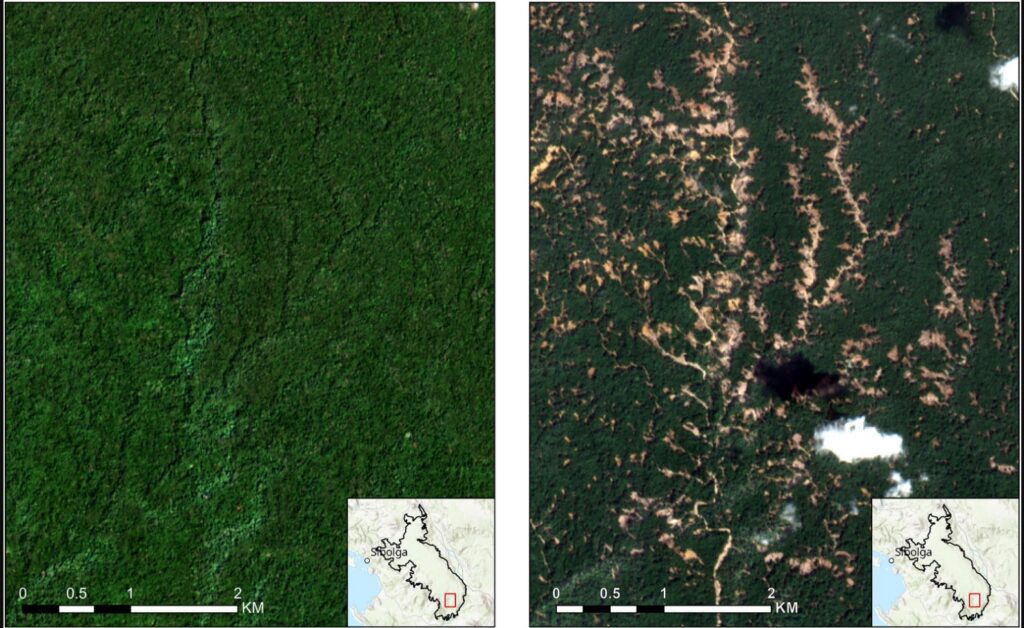
This image, from the paper, shows the landslide impacts of Cyclone Senyar:-
Before and after satellite imagery of the impacts of Cyclone Senyar. From: Meijaard et al. (2026).
In the study area of 71,161 hectares, the mapping indicates that there were 50, 185 individual landslides, covering a surface area of 8,303 hectares. This is about 11% of the forested area. We then estimate the likely loss of the orangutang population, which is likely to be in the range of 18-120 individuals, with a central estimate of 58 individuals. This is likely to have been a devastating loss for this highly endangered population.
This level of habitat loss might also be placing a severe pressure on the remaining population, so further fatalities are very possible through, for example, reduced food availability.
The intensity of the rainfall was almost certainly supercharged by climate change. The impacts of Cyclone Senyar are being replicated widely – and of course we are now in the northern hemisphere tropical cyclone season again.
Our paper makes some policy recommendations for this population of orangutans. First, the government of Indonesia needs to permanently protect this area of forest against mining , palm oil and hydropower developments. Ideally, the protected area should be expanded. Second, Indonesia needs support for biodiversity-recovery, hazard forecasting and ecological restoration planning.
A new UN study has named Hong Kong’s data centres as some of the most carbon-intensive in the world, blaming the city’s heavy dependence on a fossil-fuel-powered energy grid.
A government data centre in Cheung Sha Wan. Photo: Googlemaps.
The report, titled “Environmental Cost of AI’s Energy Use,” examined the global carbon, land and water impacts of the infrastructure powering AI, saying that by 2030, data centres could consume 945 terawatt-hours.
That is “nearly triple the combined a
A new UN study has named Hong Kong’s data centres as some of the most carbon-intensive in the world, blaming the city’s heavy dependence on a fossil-fuel-powered energy grid.
A government data centre in Cheung Sha Wan. Photo: Googlemaps.
The report, titled “Environmental Cost of AI’s Energy Use,” examined the global carbon, land and water impacts of the infrastructure powering AI, saying that by 2030, data centres could consume 945 terawatt-hours.
That is “nearly triple the combined annual electricity use of Pakistan, Bangladesh, and Nigeria, countries collectively home to more than 650 million people,” according to a UN press release.
Lamma power station. File photo: Tom Grundy/HKFP.
“Indonesia, India, and Hong Kong (SAR) are among the most carbon-intensive grids with carbon footprints 62%, 51%, and 43% higher than the global average, respectively. Poland and Mainland China rank lower with carbon intensities at 30% and 21% higher than the global average,” the UN University’s Institute for Water, Environment and Health said in a report on Wednesday.
In comparison, the carbon footprint of electricity in the US, Germany, and Italy is 18 per cent, 24 per cent, and 32 per cent below the global average, respectively.
Energy in Hong Kong is 67 per cent derived from fossil fuels, 32 per cent from nuclear and just 1 per cent from renewables, the report said.
Energy sources for countries and territories across the world. Photo: UN.
There is also a water footprint for cooling heat-intensive data centres, as well as a land footprint. “AI-related water consumption could equal the basic annual domestic needs of 1.3 billion people by the end of the decade, while its land footprint may exceed 14,500 square kilometres – roughly twice the size of the Jakarta metropolitan area,” the UN said.
However, Hong Kong was ranked among the lightest for water and land consumption, mostly because its energy mix does not rely on renewable energy sources, which require large amounts land.
The environmental cost of data centres. Photo: UN.
As a trade and logistics hub, with around 300 internet service providers, Hong Kong remains a prime location for data centres. Its telecommunication networks connect to 12 external submarine optical fibre cable systems, with more under construction, according to the city’s Digital Policy Office.
The government is building a new 110,00 square metre data facility in Sandy Ridge, 90 per cent of which will be dedicated to data centres, according to a government press release in March.
Daily AI use, not training
The UN report said that day-to-day use of AI models accounted for around 80 to 90 per cent of total energy demand, as opposed to just model training. It cited the case of ChatGPT, which was processing around 2.5 billion prompts per day, with image generation requiring a thousand times more energy than a simple text query.
“China’s DeepSeek, launched in January 2025, attracted more than 20 million daily active users within three weeks, and had about 125 million monthly active users by mid-2025,” the report said.
An aerial view of Alibaba’s Zhangbei data centre cluster in Hebei, China. Data sources: Epoch AI; Sentinel-2 false-colour imagery, February 2026. Photo UN.
According to the Digital Policy Office website, “data centre operators are all striving to enhance energy efficiency , so as to reduce their power consumption, their operating expense and also their environmental impacts.”
It cites existing policies by the Electrical and Mechanical Services Department (EMSD), which set rules for ensuring the energy efficiency of buildings and regulate the use of fresh water in cooling towers for air conditioning systems.
The EMSD’s Green Data Centres Practice Guide lays out initiatives for efficient data centre design, procurement, operations and disposal, whilst also promoting the use of assessment tools to measure environmental impacts.
JAKARTA, June 4 — For the past century, the Blue-fronted Lorikeet was one of Indonesia’s most elusive birds, known only from a 2014 photographic record and a handful of museum specimens, with a lingering hope that it had not vanished. After days of climbing through sharp limestone, biting insects and difficult mountain terrain, a flash of green feathers high on Buru’s highest peak showed that this dazzlingly colourful parrot was still there.Endemic to the islan
JAKARTA, June 4 — For the past century, the Blue-fronted Lorikeet was one of Indonesia’s most elusive birds, known only from a 2014 photographic record and a handful of museum specimens, with a lingering hope that it had not vanished. After days of climbing through sharp limestone, biting insects and difficult mountain terrain, a flash of green feathers high on Buru’s highest peak showed that this dazzlingly colourful parrot was still there.
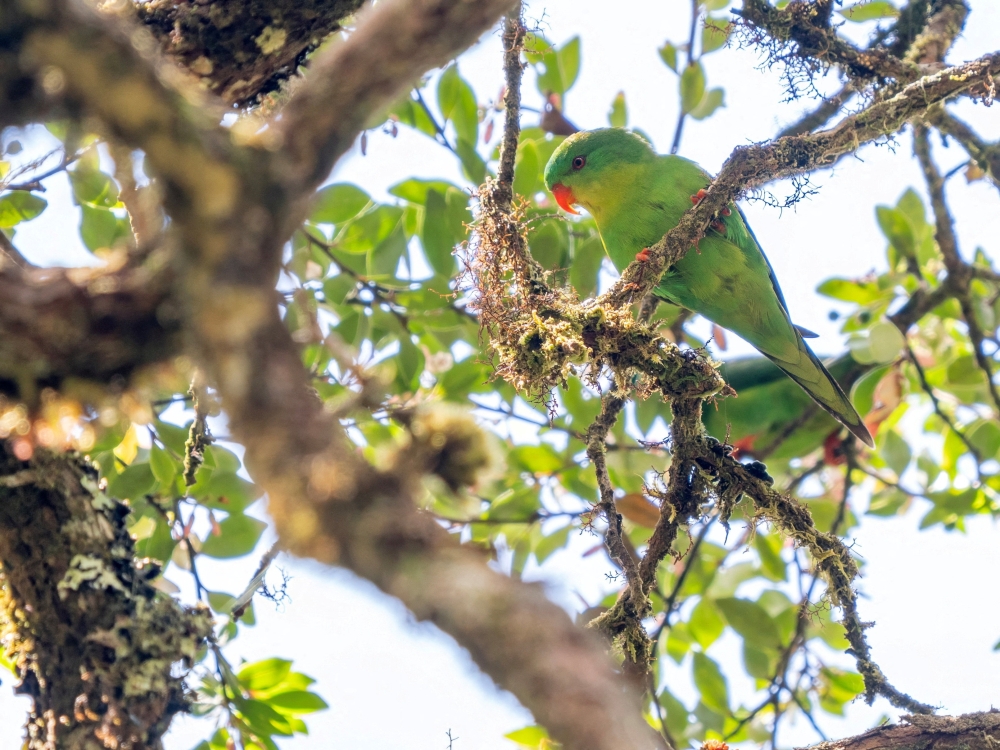
Endemic to the island of Buru - meaning it is found nowhere else on Earth - the small bird was spotted in April during an expedition led by an Indonesian mountaineering group. The team photographed the bird for the first time in 12 years and captured the first sound recordings of its high-pitched calls - sounds birds often use to keep contact in the forest canopy.
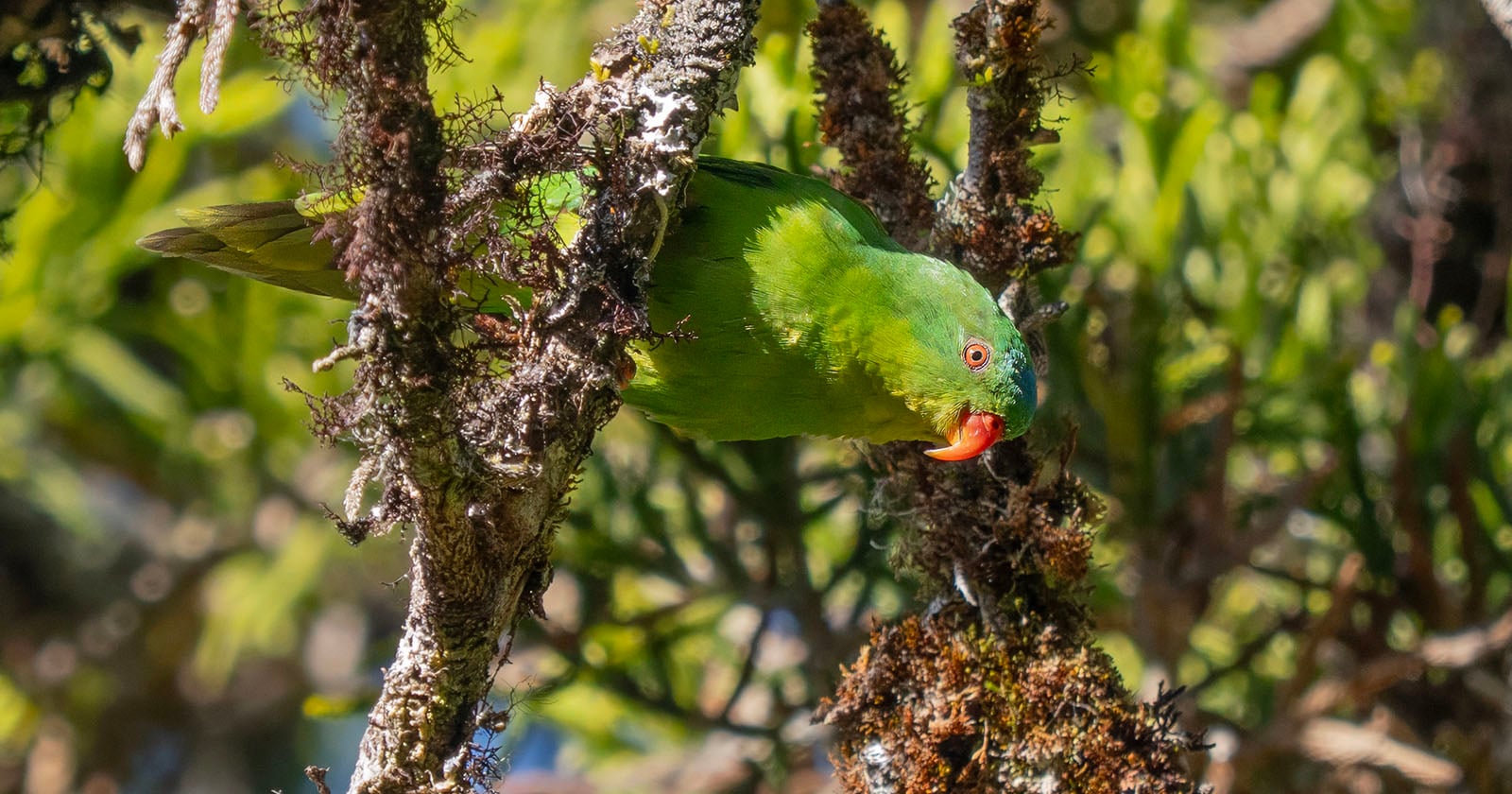
The lorikeet’s bright green body, orange bill, blue hindcrown and pointed tail helped the team identify it.
The team was looking specifically for this species, but the odds felt slim.
“When you are looking for a bird that has only been documented once in the past century it feels like a long shot,” said John Mittermeier, director of the Search for Lost Birds at the American Bird Conservancy conservation group.
First described from seven specimens collected in the 1920s, the Blue-fronted Lorikeet has been one of Indonesia’s avian mysteries. The bird went unrecorded for nearly 90 years despite searches in lowland and mid-elevation forests, before being photographed in 2014.
There was a long-held suspicion that the parrot may not have been gone, but rather living higher up in the mountains than searchers had managed to look. The highlands landscape where the lorikeet was found had remained largely inaccessible until recently, when local climbers mapped a route into the mountains.
Mittermeier said steep limestone terrain, cliffs, sharp boulders and no water make the area difficult to access.
“There are no other birds on the island that look like the lorikeets, so when we saw them we knew immediately what they were,” Mittermeier said.
“We saw at least nine during the trip,” Mittermeier added.
James Eaton, a birder involved in the expedition, said the rain, jagged limestone, river torrents and lack of trails meant anyone trying to reach the peak needed “a strong - or crazy - reason to even attempt it.”
“This bird was our reason for doing so,” Eaton said.
After a gruelling week, “to actually photograph our holy grail suddenly made all the hardships disappear - it’s a feeling adrenaline junkies would know well,” Eaton said.
The sighting capped years of preparation for Eaton.
“It makes all the researching, reading, plotting - some of which are years in the making, totally justified - it makes you feel alive, a justification for your dedication,” Eaton said.
The Blue-fronted Lorikeet was listed as Data Deficient by the IUCN Red List and recognised in 2024 as a lost species by the Search for Lost Birds, a global partnership between American Bird Conservancy, Re:wild and BirdLife International.
Mittermeier said further work is needed to learn the bird’s population size and possible threats.
“A finding like this ... is the first step to being able to protect it,” Mittermeier said.
For Eaton, the rediscovery was a reminder of the beauty and surprise still far from public view.
Amid unrelenting negative news, Eaton said, “these moments of joy and discovery are a healthy reminder of what a beautiful world is there.”
“This small green parrot,” Eaton said, “it was here long before humans stepped foot on the island, just like birds living in your garden at home - they have more right to be there than you or I.” — Reuters
KUALA LUMPUR, June 2 — National men’s singles shuttler Leong Jun Hao pulled off an upset by defeating world number 11 Kodai Naraoka of Japan in the opening round of the Indonesia Open at Istora Senayan, Jakarta, today.The world number 27 secured a 21-17, 21-17 victory in 50 minutes to advance to the second round of the prestigious Super 1000 tournament.The win marked Jun Hao’s fifth victory over Naraoka in their seven career meetings.Jun Hao will next face eithe
KUALA LUMPUR, June 2 — National men’s singles shuttler Leong Jun Hao pulled off an upset by defeating world number 11 Kodai Naraoka of Japan in the opening round of the Indonesia Open at Istora Senayan, Jakarta, today.
The world number 27 secured a 21-17, 21-17 victory in 50 minutes to advance to the second round of the prestigious Super 1000 tournament.
The win marked Jun Hao’s fifth victory over Naraoka in their seven career meetings.
Jun Hao will next face either third seed Anders Antonsen of Denmark or France’s Alex Lanier for a place in the quarter-finals.
Malaysia also had reason to cheer in the men’s doubles when world number eight pair Goh Sze Fei-Nur Izzuddin Rumsani advanced to the second round after overcoming Singapore’s Wesley Koh Eng Keat-Junsuke Kubo in straight games.
The independent pair won 21-17, 21-16 and will next take on either England’s Ben Lane-Sean Vendy or Japan’s Takumi Nomura-Yuichi Shimogami in the second round.
However, it was a disappointing day for Nur Mohd Azriyn Ayub Azriyn-Tan Wee Kiong, who bowed out in the first round after suffering an 18-21, 10-21 defeat to India’s Hariharan Amsakarunan-M R Arjun.
Also enduring an early exit were mixed doubles pair Jimmy Wong-Cheng Su Yin, who fell 19-21, 18-21 to China’s world number one Feng Yan Zhe-Huang Dong Ping in a 45-minute contest.
The first-round action will continue tomorrow with several Malaysian representatives set to begin their campaigns, including top men’s doubles pair Aaron Chia-Soh Wooi Yik and women’s doubles pair Pearly Tan-M. Thinaah. — Bernama
Nancy, a Filipino domestic worker in Hong Kong, squints her eyes for the camera as her right arm holds her employers’ younger daughter tight. The toddler beams, legs thrown around her nanny’s hips. “My baby,” Nancy sobs as she scrolls through old pictures with one hand, while dabbing her wrinkled face with a crumpled white tissue with the other.
Migrant domestic worker Nancy says she lost her job after having a heart attack. Photo: Raquel Carvalho/HKFP.
When she started working for the fa
Nancy, a Filipino domestic worker in Hong Kong, squints her eyes for the camera as her right arm holds her employers’ younger daughter tight. The toddler beams, legs thrown around her nanny’s hips. “My baby,” Nancy sobs as she scrolls through old pictures with one hand, while dabbing her wrinkled face with a crumpled white tissue with the other.
Migrant domestic worker Nancy says she lost her job after having a heart attack. Photo: Raquel Carvalho/HKFP.
When she started working for the family, the girl in the photo had not yet been born. Nancy was there for every milestone – from her first tentative steps to the day she left for university in England.
💡HKFP grants anonymity to known sources under tightly controlled, limited circumstances defined in our Ethics Code. Among the reasons senior editors may approve the use of anonymity for sources are threats to safety, job security or fears of reprisals.
“I couldn’t take longer holidays because she would often get sick while I was away,” recalled Nancy, whose name has been changed due to ongoing legal claims. “I sometimes even put her before my own children.”
In Hong Kong, workers like Nancy are legally required to live in their employers’ homes, where they often work excessive hours and only have one day off per week. But for the most part, Nancy said, she was treated “like family.”
Nancy, a domestic worker from the Philippines, worked for her Hong Kong employers for over two decades. Photo: Raquel Carvalho/HKFP.
Everything changed in 2024. While helping to fold a bed, she felt a sudden pressure around her chest. Nancy stopped for a few seconds, massaged it, and carried on working: “I wasn’t feeling good, but I tried to ignore it.”
A few days later, after cleaning up piles of dust and hanging fresh curtains, Nancy started to feel more pain and found it hard to breathe.
It seemed as if an invisible hand was squeezing her heart. She finished work and took the subway to Admiralty, then a taxi to a public hospital in Wan Chai, where tests revealed that she had suffered a heart attack.
After telling Nancy she needed surgery, doctors contacted her employer, who claimed she no longer worked for them, and there was nothing they could do for her. Under the harsh light of her hospital room, Nancy was stunned. “I cried so much that day,” she said, noting that she had not even been served with a termination letter.
Hong Kong is home to over 377,000 migrant domestic workers – most of whom are from the Philippines and Indonesia. Photo: Raquel Carvalho/HKFP.
Interviews with 14 migrant domestic workers from the Philippines and Indonesia diagnosed with critical illnesses in Hong Kong, Singapore, Taiwan, and Malaysia show how sick migrant women are often fired – sometimes illegally – or coerced into resigning.
While some are pushed into shelters or face salary cuts, most are forced to return home. For many, that means losing access to public medical care in the countries where they worked, cutting them off from more sophisticated treatments that could prolong and even save their lives. Three of the women we interviewed have passed away in recent months.
‘Almost like a death sentence’
While comprehensive data is scarce, HKFP compiled official records along with statistics from five non-profits and informal support groups in Hong Kong, shedding light on an underreported issue that has rarely been addressed by authorities either in the destination or countries of origin. Analysed data suggests that, in Hong Kong alone, over 700 migrant women faced serious illnesses such as cancer and heart disease in the past five years. At least 245 have died during the same period.
“[A] lot of workers who are diagnosed with a serious illness are terminated by their employer. Technically, it’s illegal, it’s potentially disability discrimination.”
Rachel Li, Help for Domestic Workers
A stocky woman with thick, short hair, Nancy fights back tears when she recalls that the couple who employed her, a wealthy businessman and a banker, never visited her or showed any concern during the five nights she was hospitalised. According to a spokesperson for Hong Kong’s Labour Department, employers have the obligation to provide free medical treatment to their foreign domestic workers, irrespective of whether the illness or injury is work-related.
Nancy left the hospital with a warning that she should undergo immediate surgery, as a blood clot could trigger another heart attack. More vulnerable than ever, she felt that she could not return to her home of two decades. Instead, Nancy went to a boarding house – cheap accommodation used by migrant workers – in Wan Chai and then to the Labour Department to file a claim against her employer.
Rachel Li, head of case management and research at the Hong Kong charity HELP for Domestic Workers, says that many domestic workers are wrongfully fired after receiving a serious diagnosis. Photo: Raquel Carvalho/HKFP.
In Hong Kong, wrongfully dismissed migrant women have legal recourse, but it can be an uphill battle. “The issue we see is that a lot of workers who are diagnosed with a serious illness are terminated by their employer[s]. Technically, it’s illegal, it’s potentially disability discrimination,” said Rachel Li, head of case management and research at the Hong Kong charity HELP for Domestic Workers.
According to the city’s regulations, an employer is prohibited from terminating the contract of an employee on their paid sick day, unless it involves serious misconduct. In cases where such protection does not apply, the only other piece of legislation migrant workers can turn to is Hong Kong’s Disability Discrimination Ordinance, which states that it is unlawful to fire an employee on the grounds of their disability, including an illness.
While labour claims cover only contract breaches such as unpaid wages and sick leave, a successful discrimination case can yield higher compensation. “But filing a disability claim is an extremely long process,” Li noted, and eventual compensation may take years.
Driven by poverty and lack of job opportunities back home, thousands of women from Indonesia and the Philippines arrive every year in Hong Kong. Photo: Raquel Carvalho/HKFP.
Even if a worker is wrongfully dismissed and their claim is legitimate, they lose their visa status as well as discounted access to public health care in the city. Exceptions are made on a case-by-case basis. “We’ve had so many clients [with] heart problems or cancer or other forms of serious illness who are stuck in Hong Kong because they have a claim, but then they cannot access health care,” Li said. “Then their situation deteriorates. It’s almost like a death sentence.”
Fired over diagnosis
From January 2019 to August 2025, HELP, one of the local non-profits that contributed to HKFP’s database, supported 62 women facing a range of health problems. At least 13 women were wrongfully dismissed or fired as a consequence of their diagnosis.
According to records, only five filed discrimination complaints. Li said that, even when workers are unlawfully terminated, a significant number settle their cases out of court and many choose not to pursue claims due to financial reasons.
Chloe Martin is a programme manager at the non-profit Stop Trafficking of People (STOP). Photo: Raquel Carvalho/HKFP.
Chloe Martin, programme manager at local non-profit Stop Trafficking of People (STOP), agreed that “the process of seeking redress can come at a high personal cost.”
Martin said the cases involving medical care support were too many to count, adding that STOP was “regularly approached by migrant domestic workers for advice [about] not being allowed to take time off when sick, having their wages unpaid or deducted more than the permitted 20 per cent for sick leave.”
In May last year, Siti Kodijah, a domestic worker from Indonesia in Hong Kong, could barely move her hands or legs. She did not know where the pain was coming from. Siti asked her employer to see a doctor, but instead of comforting words, she claimed she got scolded.
Siti Kodijah returned to Indonesia last year, after being diagnosed with Lupus in Hong Kong. Photo: Raquel Carvalho/HKFP.
With the help of one of her employer’s relatives, the 43-year-old was sent to the hospital in an ambulance the following day. After being diagnosed with Lupus – an autoimmune disease that can cause fatigue, joint pain, skin issues, and affect major organs – she lost her job.
Forced into a shelter, Siti filed a labour claim against her employer. By August, she was on a plane back home, having settled her case for HK$7,000. “It basically just covered my return ticket, but I could not get more medical care in Hong Kong,” she said.
Her husband, daughter, sister, and nephew collected her at Jakarta’s airport, where she arrived in a wheelchair. “I’m so happy that she is here with us now,” said Siti’s 17-year-old daughter, who dreams of becoming a mechanical engineer.
Siti Kodijah (right) and her daughter meet at Soekarno-Hatta International Airport, near Jakarta, in August 2025. Photo: Raquel Carvalho/HKFP.
Siti Kodijah (in a wheelchair) arrives from Hong Kong at Soekarno-Hatta International Airport, near Jakarta, Indonesia, in August 2025. Photo: Raquel Carvalho/HKFP.
With her husband only working as a part-time delivery driver, Siti worries about her health and her daughter’s future. “Perhaps she will get a job in Japan as a factory worker,” Siti said. “But if it’s as a helper, I won’t let her go.”
Begging to remain employed
Some domestic workers reach private agreements with their employers. HKFP spoke with one Filipino woman who received chemotherapy treatments for breast cancer while continuing to work without a salary for more than three years. “It’s OK because I was allowed to stay in Hong Kong,” the 52-year-old said. “If I chose to leave, who was going to employ me with this problem?”
Others in Hong Kong reported not being allowed to attend medical appointments during weekdays or take sick leave, which led in some cases to postponing and even forgoing medical tests and treatments.
For migrant domestic workers in Hong Kong, Sunday is often their only weekly day off. Photo: Raquel Carvalho/HKFP.
Nicole, a 42-year-old Filipino migrant woman who was diagnosed with breast cancer in 2024, said that her employer attempted to break her contract while she was undergoing treatment. “I knelt down, begging her not to cancel my visa,” she recalled.
A soft-spoken woman who requested that her real name be withheld for fear of losing her job, Nicole has tried to hide the toll that the illness has taken on her from everyone, including her employer and her family back home. Concealing the traces of eight cycles of chemotherapy, she often wears a short, light-brown wig that frames her small face. In all her Facebook photos, Nicole poses with a grin.
“I knelt down, begging her not to cancel my visa.. Our family is so poor, I would not be able to afford treatment, even in the Philippines.”
NICOLE, DOMESTIC WORKER
She has been able to maintain her contract by doing all her work chores as usual, sometimes with no food provided. She has also attended her medical appointments and treatments alone.
On a late winter afternoon, HKFP accompanied Nicole to a clinic in Kowloon, where she was due for a breast scan. Nicole was wearing a red sweatshirt and tracksuit bottoms, with a knit black beanie covering her wig. After elbowing her way into a commercial building, she patiently waited for the lift that took her to a clinic with a bright white reception counter. The hardest part, Nicole said – eyes fixed on her hands – was not having to bear it all by herself, but her employer’s constant negative comments.
On her way out of the clinic, all she could think about was rushing back home. “I really need to keep my job,” she explained. “Our family is so poor, I would not be able to afford treatment, even in the Philippines.”
Dozens of sick domestic workers in the city have turned to the Filipino Migrants Cancer Support Society, a community group in Hong Kong that organises sharing sessions, provides food, and other forms of support. They handled 211 cases from January 2012 to May 2026 – most of which were recorded in the past five years. According to their estimates, less than 10 per cent received full support from employers during diagnosis and treatment, and at least 55 women have died since reaching out.
Janice Valencia (second from the right) is a domestic worker and chairperson of the community group Filipino Migrants Cancer Support Society in Hong Kong. Photo: Raquel Carvalho/HKFP.
“Not all employers are bad. But we see many workers getting fired or being treated unfairly when they are very desperate,” said Janice Valencia, a domestic worker and chairperson of the group.
Research suggests that employers in Hong Kong support the idea that migrant domestic workers should have the same social services as residents. In a recent study by social enterprise Migrasia, only 27 per cent of employers disagreed or strongly disagreed with that.
The group said it received help requests from more than 70 migrant workers across Asia and the Gulf, who faced serious illnesses or injuries, over the past five years.
Employers struggle for alternatives
Some employers do want to support their domestic workers, but they often have a hard time finding workable solutions.
Mary, whose name has been changed, said that when she was diagnosed with stage 3 Hodgkin’s lymphoma in 2022, a form of blood cancer, her employers worried about how to support her while both worked full-time and had a nine-year-old boy to look after.
“They felt very sorry for me, but of course they were concerned about their child too,” she said.
Mary said that her Hong Kong employers tried to support her and let her stay in the city to receive treatment before returning to the Philippines. Photo: Raquel Carvalho/HKFP.
After reaching out to a church-run organisation in the city, she suggested moving to a shelter. Her employers agreed to let her live outside, which is illegal in Hong Kong, and they kept her work contract, so she could continue receiving medical health care in the city. “They made a big decision with their heart… I know it was also hard for them,” she said.
While going through treatment in Hong Kong, Mary once met her employer near an MTR exit and saw how much she was struggling. “I used to be the one reminding her to brush her hair before leaving for work,” she said, smiling affectionately.
By the end of the year, Mary had 12 rounds of chemotherapy and five scans. She then agreed to break her contract and returned to the Philippines.
Speaking from the kitchen of her uncle’s house in a quiet neighbourhood in Davao City, Mindanao, Mary said she got about 20,000 Philippine pesos (HK$2,540) from the Philippine government. Although she was supported by various relatives, Mary went for months last year without receiving the treatment she needed, due to financial reasons.
“My chemo drugs are not available in [Davao City’s public hospital], and if I buy those drugs outside, it’s very expensive. I can’t afford it,” she said in November. Each vial costs about 9,800 Philippine pesos (HK$1,245). Doctors ordered six rounds of chemo, with two vials per session, which corresponded to about HK$14,940 in total.
Mary received treatment in Davao City, Mindanao, after returning to her home country. Photo: Raquel Carvalho/HKFP.
Mary, a former migrant domestic worker, holds the phone she used in Hong Kong, where she was diagnosed with cancer. Photo: Raquel Carvalho/HKFP.
Mary eventually moved to a boarding house to be near the hospital while receiving radiation therapy, but her condition started worsening. “I lost weight and can’t eat properly… I don’t have a taste for any food,” she said in a text message in February. She also described an episode when she only remembered falling asleep for an afternoon nap and then waking up in an emergency room.
On April 6 this year, she passed away. Her family printed a large poster of Mary in a white blazer, short-haired and with a broad smile, her bust framed by white and purple orchids, a candle and a dove, announcing her “sudden passing”. The funeral service took place 10 days later.
Despite the challenges she faced, Mary never once blamed her Hong Kong employers. “[They] did what they could,” the 48-year-old said.
Indonesian domestic workers gather on their day off in a park. File photo: Robert Godden.
“Migrants often have poorer outcomes in terms of recovery from cancer,” scholars Margo Turnbull and Ivy Wu wrote in a paper published last year. In places like Hong Kong, they added, “relatively little is known about the long-term health needs of these women as they age or if they are diagnosed with serious illnesses.”
There were 377,200 migrant domestic workers in Hong Kong as of the end of October, according to an Immigration Department spokesperson. About 55 per cent hailed from the Philippines, 43 per cent from Indonesia, and the rest from countries including India, Thailand, and Sri Lanka.
Zivya Syifa Husnayain, vice-consul for information and sociocultural affairs at the Indonesian Consulate General in Hong Kong, said that, from 2021 to 2025, the consulate received over 100 reports annually of domestic workers facing illness. About 40 passed away annually due to “various causes while working as a foreign domestic worker.”
A domestic worker protest. File photo: Tom Grundy/HKFP.
She noted that the consulate regularly organises events to explain their rights. “Our foreign domestic workers in Hong Kong are relatively better protected in terms of healthcare compared to their counterparts in other parts of the world,” she said.
The Filipino authorities did not respond to repeated requests for comment.
Singapore: Sent home at a moment’s notice
Long working hours in dual-salary households, limited child care options and ageing populations have exacerbated the need for migrant workers. But despite providing essential care, foreign domestic workers in cities such as Hong Kong and Singapore still lack the protection afforded to other residents. They remain legally tethered to a single employer, and barred from gaining permanent residence.
Singapore. File photo: Tom Grundy/HKFP.
In Singapore, one of the world’s wealthiest cities, migrant domestic workers who face critical illnesses are often fired with no way to fight back.
“Employers are able to cancel their work permits and send them home at a moment’s notice,” said Jaya Kumar, senior manager of research and advocacy at Singapore-based charity Humanitarian Organisation for Migration Economics. “Migrant domestic workers do not have recourse if they have been dismissed because they are sick,” she noted.
As of June 2025, official figures showed there were 308,700 foreign domestic workers in the city-state. Most of them were from Indonesia, the Philippines, and Myanmar. For these women, usually their families’ sole breadwinners, recruitment debts and low pay often leave little room to save. Singapore does not have a minimum wage for foreign domestic workers, while Hong Kong has recently increased it to HK$5,100 per month.
Catherine Ventic, 47, worked for a family living in a penthouse in Singapore for over a year. She felt the first symptoms in August 2022, when she started having what she thought was “heavy menstruation”. After seeing two doctors who said it was a hormonal issue, she was advised to get a Pap smear, a test used to screen for cervical cancer.
Catherine Ventic, a former domestic worker in Singapore, has struggled to make ends meet since returning to the Philippines. Photo: Raquel Carvalho/HKFP.
During a medical examination in 2023, she was sent to the emergency services of the Singapore General Hospital. In three days, she was diagnosed with cervical cancer.
“I was heartbroken. I knew that Singapore is a bit advanced and [thought] I would have been taken care of if I stayed there.”
CATHERINE Ventic, DOMESTIC WORKER
Ventic said that her employers worried about the medical costs they would have to incur, despite having medical insurance. Employers in Singapore are required to purchase hospitalisation insurance for foreign domestic workers that covers at least S$60,000 (HK$370,000) per year. But without medical subsidies, this ceiling can be quickly breached, and outpatient costs such as chemotherapy are not covered.
Catherine Ventic was forced to return to Cebu Island, in the Philippines, after being diagnosed with cervical cancer in Singapore. Former migrant women often face long journeys to reach large hospitals. Photo: Raquel Carvalho/HKFP.
Ventic was given 7,000 Singaporean dollars (HK$42,586) and a plane ticket back home. “I’m lucky that my employer gave me some money because there are others who are sent home without even a cent,” the single mother of two said. But “I was heartbroken. I knew that Singapore is a bit advanced and [thought] I would have been taken care of if I stayed there.”
Explore the immersive 360-degree video on YouTube.
Without any savings, Ventic knew that the amount of money she was given would not be enough to cover her treatment and expenses back home. “I respected her decision to send me home, but in the back of my mind, I was so worried.”
Catherine Ventic. Photo: Raquel Carvalho/HKFP.
Catherine Ventic still has cash and cards from her time as a domestic worker in Singapore. Photo: Raquel Carvalho/HKFP.
With the support of friends from Singapore, together with assistance from the Filipino government and a local congressman, Ventic was treated in Cebu City, more than a four-hour drive from her home on the island’s southeastern coast. Her latest biopsy came back negative, but she did not finish the six-month course of oral chemotherapy prescribed by doctors due to financial reasons.
Ventic now lives with her daughter, granddaughter and other relatives in her family home in Cebu, where she runs a small corner shop from her patio, while juggling a job as a social media manager. She also has a small online ticketing business, takes occasional food orders, and makes bouquets.
Catherine Ventic, a single mother of two, holds a photo of her eldest daughter taken to mark her university graduation in 2017. Photo: Raquel Carvalho/HKFP.
In recent months, Ventic noticed bleeding again. Already stretched from paying her youngest daughter’s university fees, she has put off a medical appointment until she has saved enough. “There are so many bills to pay,” Ventic said.
Robina Navato, from the Philippines, was also diagnosed with cervical cancer while working in Singapore in 2023. When she realised that she had no option but to return home after nearly three decades, Navato feared she could not sustain herself. “I didn’t think that my employers would look after me, and I also wanted to be close to my family,” she said. But “I hadn’t saved enough and, in the Philippines, cancer is for rich people because the treatment is very expensive.”
Robina Navato, from the Philippines, was diagnosed with cervical cancer while working in Singapore in 2023. Photo: Raquel Carvalho/HKFP.
Navato, who has recently gone through another cycle of chemotherapy treatments, has received support from fundraising initiatives and friends in Singapore. She also runs a small corner shop, which covers her daily expenses. But she worries about others who return home critically ill.
Explore the immersive 360-degree video on YouTube.
Migrant women are often from rural parts of their home countries, facing journeys of hours or days to reach large hospitals. Many cannot afford transport, accommodation, or food. Even when they have access to public healthcare and qualify for discounted rates, former migrant workers are then left to navigate strained systems that sometimes lack the medication and specialists they need.
Robina Navato runs a small corner shop to cover her daily expenses while she undergoes treatment. Photo: Raquel Carvalho/HKFP.
Robina Navato used to volunteer on her days off in Singapore, helping other domestic workers, and now runs TikTok live sessions. Photo: Raquel Carvalho/HKFP.
“[The government] always says that migrant domestic workers are the modern heroes of the Philippines, but when we get sick, we don’t know where to get help,” Navato said, adding that she only received 20,000 pesos (HK$2,540) in financial assistance from the government. Her initial radiation and chemotherapy treatment cost over 500,000 pesos (HK$63,554).
Unless their case goes viral, Navato said that most sick migrant workers are on their own. “I can go to the mayor’s office, but the queue will start at 4am. How many people are waiting for that help? Then they might give 1,000 (HK$127) or 2,000 pesos (HK$254). It happened to my sister.”
Explore the immersive 360-degree video on YouTube.
Back in the single-storey house that she shares with her 11-year-old grandson and a small dog, Navato is navigating physical pain while missing the life she left behind in Singapore, where she used to spend her days off volunteering in support of fellow workers.
Despite her illness, she has remained active within the community. When she has the energy, Navato goes live on TikTok and takes questions from domestic workers scattered across the globe. “I did not expect to come home like this,” she said. But “I try to respond and help as much as I can.”
What can be done?
The real number of domestic workers who get sick while working overseas and face infringements on their rights is impossible to ascertain, and the numbers available are only conservative estimates.
Many women never report their cases to the authorities or seek help from support groups due to fear of losing their jobs, lack of knowledge, language barriers, and even shame.
Data analysed by HKFP largely involved Filipino and Indonesian domestic workers, whereas cases involving smaller minorities in Hong Kong are even more likely to go unreported.
A group of individuals in Singapore launched the Criticare Fund for Migrant Workers to support those facing critical illness. “[It] provides immediate relief, but that in itself is not enough,” said Vincent Ng, the fund’s secretariat lead. “There needs to be some kind of policy reform that has subsidised rates for domestic workers.”
Migrant domestic workers in Singapore meet at Orchard Road’s Lucky Plaza shopping mall. Photo: Raquel Carvalho/HKFP.
Ng’s group, which estimates that over 400 female migrant workers under 49 years old develop cancer every year in Singapore, calls for improved insurance. They also advocate for the city-state to create an endowment fund for migrant workers.
Kumar said that “sometimes, employers step in to try and raise funds to cover medical costs, but this can only go so far.” She argued that “given the extensive contributions that migrant workers make to Singapore, they should be entitled to subsidies so that they have the chance to seek treatment – or part of it – in Singapore.”
A spokeswoman for Singapore’s Ministry of Manpower said the mandatory insurance provisions, which were increased in 2023, covered 99 per cent of inpatient and day surgery bills of migrant domestic workers in public healthcare institutions.
“We will continue to review this periodically as needs evolve,” she said, adding that it collaborates with local organisations to ensure affordable healthcare for foreign domestic workers.
Cynthia Abdon-Tellez is the founder of Bethune House, a shelter that has supported dozens of women facing critical illnesses and injuries. Photo: Raquel Carvalho/HKFP.
In Hong Kong, Cynthia Abdon-Tellez, the founder of Bethune House, a shelter that has supported dozens of women facing critical illness and injuries, urged authorities to ensure continued healthcare coverage for migrant workers while labour and legal disputes are pending.
More comprehensive insurance is also needed, as the current mandatory policy only covers work-related injuries. “It’s something for the government to consider whether they can subsidise employers because I don’t think it’s fair to shift the burden entirely on [them],” case manager Li said.
She noted there is a lack of alternatives for low and mid-income families in Hong Kong. When domestic workers face critical illness, Li said, “there’s absolutely no policy, no support for employers and workers… This is a policy-level issue that needs to be addressed.”
PathFinders, which supports migrant mothers in the city, released a report last year that suggested allowing employers to hire a temporary replacement while their original worker is on maternity leave. This idea, CEO Catherine Gurtin said, could also help to address some of the challenges faced by employers whose workers are seriously ill and need treatment.
A spokesperson for the Labour Department said the “government is firmly committed to protecting the rights and benefits of foreign domestic workers in Hong Kong.”
The spokesperson noted that there is a 24-hour hotline available to them and that they may seek free advice from the department’s branches across the city. Those “who suspect they have been denied or deprived of statutory entitlements are strongly encouraged to report their cases to the Labour Department,” he said.
Nancy has filed labour and discrimination claims against her employer after losing her job in Hong Kong. Photo: Raquel Carvalho/HKFP.
Nancy’s employer is currently being investigated by the Hong Kong authorities, while her labour and discrimination claims are still ongoing. Since having a heart attack, she has lived in two shelters run by non-profits and has yet to receive the surgery she needs. “I am so tired, I just want to go home,” she said from the airport before leaving Hong Kong this spring. Advocates in the city are continuing to pursue her cases.
After 22 years working for the same household, Nancy did not expect to be abandoned in her hour of need and so close to retirement. She flew out of the city with a small beige backpack sitting at her feet and countless memories from her time with her former employers.
Nancy, who is now looking after her husband, also struggling with chronic illness, has yet to come to terms with the fact that she lost a family: “Sometimes I still cry thinking about them.”
Reporting was supported by the International Women’s Media Foundation’s Kim Wall Memorial Fund. A shorter version of this piece was published in The Telegraph.
JAKARTA, June 13 — Indonesia’s decision to raise the BI-Rate and increase non-subsidised fuel prices within days highlights the government’s effort to support the rupiah and ease fiscal pressures, although the measures are expected to add pressure on households and businesses, analysts say.University of Indonesia administrative science lecturer Dr Muhammad Ramaditya said the measures reflected efforts to address key vulnerabilities facing Southeast Asia’s largest
JAKARTA, June 13 — Indonesia’s decision to raise the BI-Rate and increase non-subsidised fuel prices within days highlights the government’s effort to support the rupiah and ease fiscal pressures, although the measures are expected to add pressure on households and businesses, analysts say.
University of Indonesia administrative science lecturer Dr Muhammad Ramaditya said the measures reflected efforts to address key vulnerabilities facing Southeast Asia’s largest economy, namely currency weakness and fiscal pressures.
“The primary objective of the 5.50 per cent rate is currency defence. By widening the yield differential against foreign assets, Indonesia becomes more attractive to global investors, while high-yielding domestic instruments such as Bank Indonesia Rupiah Securities and government bonds help attract capital inflows and support the rupiah,” he told Bernama.
Bank Indonesia (BI) on Tuesday raised the BI-Rate by 25 basis points to 5.50 per cent, citing the need to safeguard rupiah stability after the currency weakened beyond 18,000 per US dollar.
The rupiah has since recovered to around 17,900 per US dollar from levels above 18,000 earlier this week, suggesting the rate hike has helped improve market sentiment.
A day later, state-owned energy company Pertamina increased prices of non-subsidised fuels, with Pertamax (RON 92) rising to Rp16,250 (about RM3.64) per litre from Rp12,300 and Pertamax Green 95 to Rp17,000 (about RM3.81) from Rp12,900. Subsidised fuels, including Pertalite (RON 90) and Bio Solar, remained unchanged.
Ramaditya said maintaining rupiah stability was crucial as Indonesia remained dependent on imports of industrial raw materials, electronics and food commodities such as wheat and soybeans.
He said a weaker rupiah would raise the cost of imported goods and raw materials, potentially triggering broader inflationary pressures that could hurt consumers more severely than higher interest rates.
The economist also viewed the fuel price adjustment as a step towards reducing pressure on the state budget by allowing non-subsidised fuels such as RON 92 and RON 95 to move closer to market prices.
He said the policy would allow the government to preserve funds for targeted social assistance programmes, infrastructure development and subsidies for lower-income groups that depend on subsidised fuel.
However, Ramaditya acknowledged that the two policies could also create competing pressures on the economy, with higher fuel prices likely to increase transportation and logistics costs while higher borrowing costs could weigh on household spending and business activity.
Concerns over rising living costs were reflected in demonstrations by student groups in Central Jakarta on Friday, where protesters criticised several government economic policies, including the recent fuel price increase.
Meanwhile, Bank Muamalat Malaysia Bhd chief economist Dr Mohd Afzanizam Abdul Rashid said the BI-Rate increase was necessary after the rupiah weakened beyond 18,000 per US dollar, surpassing levels recorded during the 1997–1998 Asian financial crisis.
He said the move was aimed at preventing further depreciation of the rupiah, but noted that Indonesia’s situation was unique as investor confidence had also been influenced by perceptions that economic policies were becoming more interventionist and populist.
Mohd Afzanizam said concerns over governance and transparency had also affected sentiment among foreign investors, pointing to MSCI’s recent review of Indonesian-listed companies that resulted in several firms being removed from its benchmark index.
Taken together, the analysts said, the measures reflected efforts to stabilise the rupiah and manage fiscal pressures, although higher fuel and borrowing costs could weigh on household spending and business activity in the near term. — Bernama
JAKARTA, June 3 — Indonesian officials arrested today the former head of the country’s free school meals programme, blighted by mass food poisonings and corruption claims, a day after he was fired.The much-hyped billion-dollar feeding scheme was the flagship policy of President Prabowo Subianto’s 2024 election campaign.Prabowo fired Dadan Hindayana, an entomologist who had led the National Nutrition Agency since its inception in August 2024, along with two deputi
JAKARTA, June 3 — Indonesian officials arrested today the former head of the country’s free school meals programme, blighted by mass food poisonings and corruption claims, a day after he was fired.
The much-hyped billion-dollar feeding scheme was the flagship policy of President Prabowo Subianto’s 2024 election campaign.
Prabowo fired Dadan Hindayana, an entomologist who had led the National Nutrition Agency since its inception in August 2024, along with two deputies yesterday. All three were taken into custody in Jakarta today.
They stand accused of “crimes in the management” of the programme, Syarief Sulaeman Nahdi of the attorney general’s office told reporters.
Authorities earlier raided the nutrition agency’s office as well as the homes of the three defendants, Syarief said.
The government says the programme has provided meals to more than 61 million people by March, but tens of thousands of people have fallen ill since it was rolled out in January last year.
Critics have called for the scheme to be suspended over hygiene concerns and accusations of corruption.
Last month, anti-graft watchdog Indonesia Corruption Watch filed a complaint against Dadan citing alleged budget irregularities.
Syarief said today that foundations appointed by the three defendants to oversee kitchens were allegedly “used as vehicles for crimes”.
“Those foundations received billions of rupiahs in incentives every day, and those foundations were affiliated, owned by” the suspects, he added.
The trio are also accused of overseeing illicit procurement of electric motorbikes, shoes, tablets and television sets.
If found guilty, they could face life imprisonment.
The free meal scheme had a goal of reaching at least 82.9 million children and pregnant and breastfeeding women — nearly one-third of the country’s population.
More than 20 per cent of children in Indonesia are affected by stunting caused by severe malnutrition.
The programme was among the first budget items to be cut back as Jakarta moved to counter the economic impact of the Middle East war.
Dadan, who just Tuesday attended an official event by Prabowo’s side, told parliament last year the programme was responsible for at least 11,000 poisoning cases, with over 600 people hospitalised.
Prabowo has also acknowledged problems and vowed to discipline anyone found guilty of wrongdoing.
Announcing Dadan’s dismissal yesterday, State Secretary Prasetyo Hadi said that “throughout the ongoing evaluation process, all programmes of the National Nutrition Agency will continue to run as they should”. — AFP
People told not to enter damaged buildings for fear of aftershocks from magnitude-7.8 quakeAt least 37 people have died and hundreds have been injured after a magnitude-7.8 earthquake shook part of the southern Philippines early on Monday, collapsing buildings and triggering tsunami alerts.The quake hit early in the morning about 20km (12.4 miles) off the coast of Sarangani province, with tremors felt strongly across Mindanao and 420km away in the city of Manado on the Indonesian island of Sulaw
People told not to enter damaged buildings for fear of aftershocks from magnitude-7.8 quake
At least 37 people have died and hundreds have been injured after a magnitude-7.8 earthquake shook part of the southern Philippines early on Monday, collapsing buildings and triggering tsunami alerts.
The quake hit early in the morning about 20km (12.4 miles) off the coast of Sarangani province, with tremors felt strongly across Mindanao and 420km away in the city of Manado on the Indonesian island of Sulawesi.
After only a single sighting for a century, Indonesia's exceedingly rare, beautiful Blue-fronted Lorikeet (Charmosynopsis toxopei) has been found again. Before the new sighting, the bird was last seen in 2014, prior to which it had not been seen since the 1920s.
[Read More]
After only a single sighting for a century, Indonesia's exceedingly rare, beautiful Blue-fronted Lorikeet (Charmosynopsis toxopei) has been found again. Before the new sighting, the bird was last seen in 2014, prior to which it had not been seen since the 1920s.

 Login
Login