Normal view

A deep-ocean climate plan wins rare EPA approval, but is sinking plants in the sea the answer?

Innovators who are working on ways to pull carbon dioxide out of the atmosphere to fight climate change are having a tough time lately.

Their biggest supporter, Microsoft, recently began telling partners that it is pausing its carbon removal purchases. To get a sense of how big of a deal this is, look at the numbers: The tech company alone has purchased approximately 80% of the contracted cumulative volume of carbon removals to date. Its retrenchment is viewed as potentially a major blow to the sector.

However, there may be a bright spot for this industry, and it comes from an unexpected source: The U.S. Environmental Protection Agency quietly decided in March to grant a research permit under the Marine Protection, Research, and Sanctuaries Act to a Houston-based carbon removal startup.

The company, Carboniferous, aims to assess the potential to durably lock up greenhouse gases by harvesting plants that took in carbon dioxide on land and sinking them to the bottom of the ocean.

This approach is often called “ocean biomass sinking,” or marine anoxic carbon storage.

Ocean biomass sinking is one of several carbon removal approaches involving the ocean known as “marine carbon dioxide removal.” Other marine approaches include adding alkaline materials that react with seawater to increase the uptake of carbon dioxide, seeding oceans with iron to stimulate the growth of phytoplankton that can take up carbon dioxide, and farming seaweed to also take up carbon dioxide and sink it.

A crane on a ship hoists large bales.
In the Mediterranean Sea, the Israeli company Rewind has a pilot project that buries biomass bundles beneath seafloor sediments, where the lack of oxygen slows decomposition. Used with permissions from Rewind

The Intergovernmental Panel on Climate Change, which compiles research on climate change from scientists around the world, calls carbon dioxide removal “unavoidable” if the world hopes to keep rising temperatures in check and achieving the targets of the Paris climate agreement.

But is sinking biomass in the ocean the answer?

I am the co-founding director of the Institute for Responsible Carbon Removal at American University, and I have reviewed several of these projects. I see both pros and cons to ocean carbon removal techniques.

How ocean biomass sinking works

Carboniferous plans to carry out its field experiment in the Orca Basin off the coast of Louisiana. The basin is anoxic, meaning devoid of oxygen, and has a higher concentration of salt that most seawater. The EPA permit lets the company sink 20 burlap sacks containing sugarcane residue and monitoring equipment to the bottom of the sea there to study what happens.

Globally, land vegetation, including trees and crops, sequesters approximately 60 billion tons of carbon per year. However, a large portion of this carbon is quickly released back into the atmosphere – often within months to years – when the vegetation dies and decomposes, or is burned.

Ocean biomass sinking aims to lock up that carbon on the ocean floor in low-oxygen areas, where decomposition is much slower. Anaerobic processes, such as fermentation, may leave the biomass largely intact for centuries or millennia. Colder water environments can also slow the rate of biomass decay.

An illustration of carbon storage.
Plant residue can be sunk into oxic and anoxic regions of the seafloor, with different results. Both become dissolved inorganic carbon (DIC), methane (CH4) and dissolved organic matter (DOM). This carbon eventually reaches the ocean surface and atmosphere, but the process can take hundreds of years from anoxic environments, which lack oxygen (O2). M. R. Raven, et al., 2024, CC BY

The concerns

Two questions that arise are whether this approach would be effective at the scale needed and what risks it might pose to ocean ecosystems.

Recent studies have estimated that ocean biomass storage projects could durably store somewhere between 0.1 and 1 gigatons of carbon dioxide annually. That sounds like a lot, but humanity may need to remove 7 to 9 gigatons of carbon dioxide each year from the atmosphere by the middle of the century and up to 20 gigatons per year by 2100 to meet global climate goals and avoid dangerously high temperatures.

A bigger concern is that substantially increasing organic matter in deep ocean environments might stimulate the growth of anaerobic bacteria, which can produce methane, a potent greenhouse gas that could offset much of the benefits of this approach.

Proponents of ocean biomass storage counter that the absence of vertical mixing among the water layers in ocean ecosystems would prevent any additional methane releases from ultimately escaping to the atmosphere. Further research is clearly required to know the risks.

Ocean biomass storage might also pose environmental and economic risks. As biomass descends in the water column, it has the potential to release particulates or organic matter, which could alter the activities of microbes as well as the food supply and oxygen in the ocean mesopelagic zone. The zone is a busy region of high productivity and home to a million undescribed species. The result could harm commercial fisheries and other species.

It’s also unclear how seafloor communities, such as bacteria, other microbes and fungi, might respond to the introduction of massive amounts of biomass.

And the introduction of large amounts of additional biomass in deep-ocean regions might attract species that feed on dead plant material, or their predators, which could alter species interactions in ecosystems that scientists know very little about. Those effects could be further exacerbated by decaying biomass reducing oxygen in seafloor environments and potentially increasing the release of hydrogen sulfide, methane, nitrous oxide and nitrogen and phosphorus compounds.

Sinking seaweed in the ocean to store carbon.

Other ways to store carbon in the oceans

Carboniferous is not the only company focused on ocean biomass storage. Israel-based Rewind is currently experimenting with burying waste plant matter from farms and cities in an anoxic Black Sea region off the coast of Romania, as well as beneath seabed sediments in the Mediterranean Sea off the coast of Haifa in Israel. The company believes that it could sink 1 million tons of biomass residue annually by 2030.

Another Israeli company, BlueGreen Water Technologies, takes a very different approach. Instead of collecting biomass from terrestrial sources, it uses a solution of hydrogen peroxide to kill, and ultimately sink, toxic harmful algal blooms made up of cyanobacteria, also known as blue-green algae. This approach may also eliminate blooms that can devastate aquatic environments by creating low-oxygen dead zones. And because algae sequester substantial amounts of carbon, the company claims that this approach could also remove billions of tons of carbon from the atmosphere in ocean and freshwater ecosystems.

The world’s oceans are by far Earth’s largest carbon sink, storing roughly 50 times more carbon than the atmosphere and 20 times more than terrestrial forests and soils combined. This provides a compelling case to explore marine carbon removal options.

However, as is the case with all marine-based approaches, ocean biomass storage raises an array of questions that need to be resolved before the world can consider deploying it on a large scale. Carboniferous’ research program is one piece of this puzzle.

The Conversation

Wil Burns does not work for, consult, own shares in or receive funding from any company or organization that would benefit from this article, and has disclosed no relevant affiliations beyond their academic appointment.
Uncovering coded antisemitism online takes both human expertise and AI automation

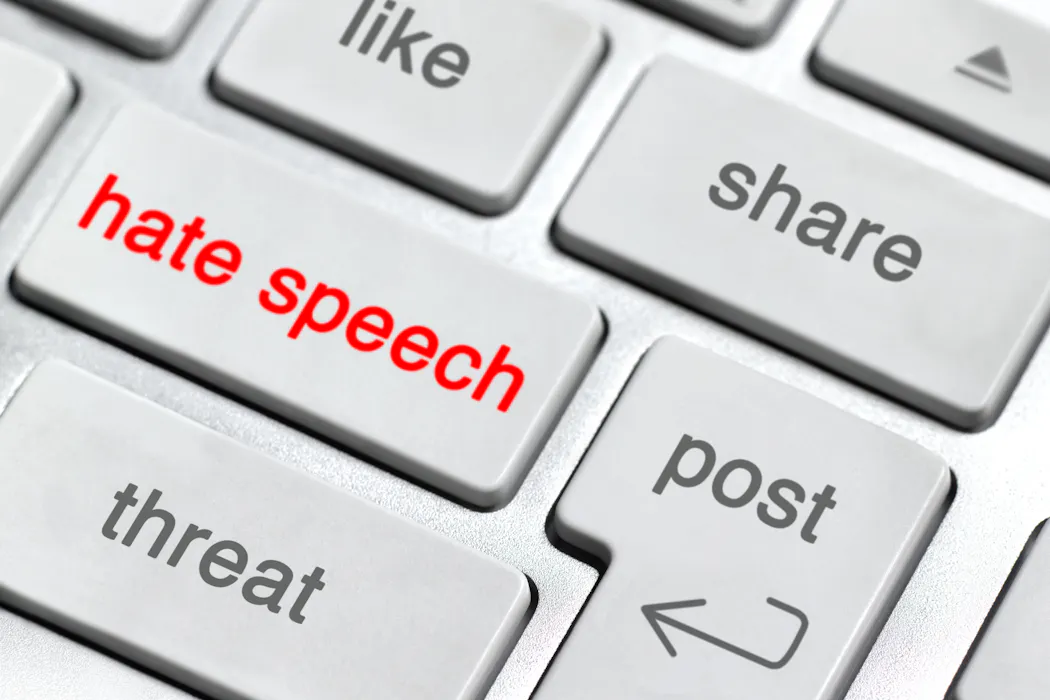
The volume of social media posts makes content moderation challenging – especially when it comes to more subtle hate speech. Peter Dazeley/The Image Bank via Getty Images

This article includes examples of antisemitic hate speech.

The men accused of carrying out high-profile antisemitic attacks in the United States in recent years shared an important characteristic: They posted hate speech on their social media accounts beforehand.

The FBI said the man who drove his truck into a synagogue outside Detroit in March 2026 posted on Facebook that “Israel is a cancerous/malignant growth” and “Israel is pure evil.” The online footprint of the gunman charged with shooting and killing two Israeli Embassy staffers at the Capital Jewish Museum in May 2025 contained anti-Israel comments. The shooter sentenced to death for killing 11 worshippers at the Tree of Life synagogue in Pittsburgh in October 2018 frequently used antisemitic hate speech in his social media.

Hate speech uses feelings, emotions and attitudes that seek to dehumanize individuals or groups. At times, animosity is clear. But it can also take a more hidden form, using code words or terms understood only by like-minded people. Coded hate speech can evade online content censors and recruit people who might balk at more clearly discriminatory speech.

There are an estimated 5.7 billion social media accounts worldwide. Even when hate speech is explicit, content moderators struggle with the volume and deciding how much to monitor users’ speech. There are also alternative – some argue extremist – sites that limit content moderation, including 4chan, BitChute, Gab, GETTR, Parler, Rumble and Truth Social.

We are a group of interdisciplinary researchers at American University who study the rhetorical strategies behind overt and coded hate speech on social media. Our Unmasking Antisemitism project uses artificial intelligence, qualitative analysis and survey experiments to develop studies and tools to detect both types of terms. This article discusses examples of antisemitic hate speech that are disturbing but illustrate types of terms and how to counter this dangerous influence.

Two types of hate speech

To understand the difference between direct and coded hate speech, consider shooter Robert Bowers’ language before the Tree of Life massacre. On Gab, he used older, virulently antisemitic slurs such as “kike,” a “highly offensive term used to insult and denigrate people of Jewish faith or ethnicity that is widely considered to be a form of hate speech,” according to the American Jewish Committee.

A tree stands in front of a fence covered with lit-up signs, standing in front of a few buildings at night.
A fence outside the Tree of Life synagogue, site of the 2018 mass killing, holds artwork from schoolchildren on April 21, 2003, in Pittsburgh, Pa. Jahi Chikwendiu/The Washington Post via Getty Images

Other extremist terms are just as offensive but less obvious, such as “oven dodger,” which Bowers also used on Gab: a reference to how German Nazis systematically exterminated Jews during the Holocaust. Like overt phrases, coded terms often draw on older, well-researched antisemitic tropes, such as “Jews have too much power,” repacking them in new words and phrases.

They can also have double meanings, which makes hate speech harder to moderate. The original definition of “globalist” refers to a person who believes that policies should be planned with the whole world’s interest in mind rather than just one country. But globalist also has an antisemitic connotation.

As the American Jewish Committee “Translate Hate” glossary puts it, antisemites often use “globalist” to disparage Jews, promoting a conspiracy theory that “Jewish people do not have allegiance to their countries of origin, like the United States, but to some worldwide order – like a global economy or international political system – that will enhance their control over the world’s banks, governments and media.” This repackages long-standing Nazi and Soviet propaganda about Jews based on historical antisemitic tropes.

How terms develop

In the early days of social media, companies responded to criticism of the more hateful content on their platforms by using a combination of AI and human analysis to moderate content. The automated tools use natural language processing to analyze context, detect slurs and flag content. Human workers analyze more complex language, such as irony and slang.

A dark photograph shows a handful of people sitting at large computer screens in a room with a large windows.
Content moderators work at a Facebook office in Austin, Texas, in 2019. Ilana Panich-Linsman for The Washington Post via Getty Images

But keeping up with the volume of posts is challenging, especially for more subtle hate speech. Our team’s goals are to identify coded antisemitic terms, understand how they develop, and create technology to track them.

The key is to understand that hate terms have a life cycle. Some take a path toward more public use, while others disappear.

New terms tend to emerge from a small set of people considered leaders or influencers in antisemitic circles online. In some cases, their communities adopt the term and normalize it; other times, it’s dropped from use.

The term “cultural Marxism,” which has its origins in the antisemitic belief that Jewish intellectuals seek to subvert Western culture, was adopted into wider use. “Jew jab,” on the other hand – a white supremacist conspiracy theory claiming that COVID-19 vaccines were a Jewish plot to harm people – soon disappeared.

Tracking hate

In our initial pilot project we started with 46 antisemitic terms, both overt and coded, from the American Jewish Committee’s glossary. We entered the terms in Pyrra, now called Alert Media – a private software company that allows users to scrape posts from a collection of social media sites.

Researchers trained in definitions of antisemitism, historical antisemitic tropes and hate speech detection identified 24 additional terms. White supremacists use the symbol “1488,” for example, to identify each other. The first part, “14,” references the “14-word” slogan of white supremacist leader David Lane. The “88” stands for “Heil Hitler,” based on “h” being the eighth letter of the alphabet. Other coded terms are less well known, such as “DOTR” or “Day of the Rope,” a reference to the 1978 book “The Turner Diaries,” which was written under a pseudonym by neo-Nazi William Pierce.

To track which coded terms have spread to the general public, we scrutinized mainstream media content and ran survey experiments to see whether people recognized them. We also developed an AI software tool designed to automatically track how coded language evolves. The app is trained on data from Pyrra and learns to identify new antisemitic terms based on the context in which they appear.

First, the app identifies distinctive terms based on how frequently they appear in each post, versus how rare they are on the platform in general. To find out whether these terms have an antisemitic connotation, we encode their context, such as other words in the post, and calculate whether it is close to the context of already known antisemitic terminology. Some of the terms our app has identified are explicit, while others are coded.

This approach can also be applied to hate speech targeted at other groups, such as Latinos, LGBTQ+ people and women. We aim to create a tool kit that can be distributed to nonprofit groups, think tanks and policymakers considering legislative efforts to curb hate speech.

Humans and machines

Given the massive number of posts on social media every day, our work illustrates how detecting new hate speech requires an interdisciplinary group of researchers working with machines.

One academic discipline working independently is too siloed, and humans alone can’t handle the scale. But machines alone can’t understand sophisticated human language, slang or context.

History shows that at every moment of profound technological change in our communication systems, incidents targeting Jews or other minority groups go up dramatically. This era’s technical innovation is unprecedented – but unfortunately, hate speech now travels around the globe almost instantly. Technology may be part of the problem, but its immense power can be harnessed to create a solution.

The Conversation

We received internal funding for this project from American University as part of its Signature Research Initiative.

We analysed the TikTok history of 142 men. Here’s what it taught us about the manosphere

Sarazh Izmailov/Pexels, The Conversation, CC BY-SA

Interest in the manosphere has recently surged yet again, with the recent Louis Theroux documentary catapulting the term “manosphere” back to the forefront of our cultural psyche.

The term has become a catchall for the most inflammatory content and communities in young men’s digital worlds. Alarm bells are ringing, but our understanding of what the manosphere actually is – where it begins and ends – has more questions than answers.

As concern grows, so does the ambiguity around how to define the manosphere and how young men actually experience it. Our policy responses, interventions and public discourse assume it’s one thing, one ideology, populated by one type of young man: a singular algorithmic journey from loneliness to radicalisation. It isn’t, and overlooking the complexity and nuance misses large parts of the problem.

So what is it instead? Our new research answers this question.

Simulations vs reality

Addressing ambiguity matters, whether you’re a researcher trying to measure the full spectrum of harm being experienced, or part of a community trying to talk about it with sons, brothers and friends. You cannot diagnose a problem without truly understanding it, and that means going into these online ecosystems to explore their bounds.

Previous research has included the use of dummy accounts to simulate internet use. These have been criticised by social media companies, who say the simulations don’t reflect the real experiences of users on their apps.

In response, our new research looked at the real TikTok viewing histories of 142 young men across Australia, the United States and the United Kingdom. We watched what they watched, 2,000 videos over the past month, and built a framework to map the full spectrum of masculinity content that young men encounter online.

It’s the first time academic research has used real user data in this space. It means we can respond to what young men and boys are actually seeing, rather than simulations of user experiences and what we think they’re seeing.

Almost half of the videos we analysed (44%) contained masculinity-related themes. Masculinity content fell into three distinct categories. Understanding these categories, how they escalate and who’s watching it makes tailored intervention possible, from policymakers to support services, and even the platforms themselves.


Read more: How boys get sucked into the manosphere


Beginning the journey

The journey can start somewhere ordinary. Three videos. Same young man. Same day. Same algorithm.

In the first video, a young, buff man located in a gym, demonstrating to his audience the correct technique when completing the “perfect lying tricep extension”.

We called this tier “cultural touchpoints”. It includes gym, sport, fashion and dating tips content. It made up 38% of what young men in our study watched, making it the most common type of content.

On the surface, none of it raises alarm. But it quietly sets a norm. One type of male body, one set of male interests, one way of moving through the world.

Travelling deeper

In the second video, a shirtless young man delivers a motivational-style speech about gym and discipline. He argues that physical commitment produces results in other areas of life, such as earning admiration from his girlfriend and becoming a “superhero” to his future children.

We called this tier “masculine status” content. It constituted 6% of the videos we analysed.

Outwardly, it looks like self-improvement, motivational and informative content with messages of discipline, ambition, levelling up as a man.

Underneath, the rigid moulds become clear: muscularity, emotional suppression, financial abundance, the “high-value” male archetype.

Women are framed as rewards to be earned. The content is ideologically hardened, but also easy to miss.

The destination

In the third video, a male creator sarcastically warns his audience against peptides. He then proceeds to list the side-effects of “getting leaner, shredded and getting more bitches”, while showing the vials to the audience.

We called this tier “degrading health” content. It made up less than 1% of content.

Most of it violates TikTok’s own community guidelines prohibiting the promotion of peptide hormones, testosterone boosters, and content that demeans, endangers or advocates for self-harm.

This category includes overt misogyny and graphic depictions of violence against women.

It’s infrequent, but not isolated. This content sits at the end of a journey that began with a tricep extension tutorial.

Three videos. Three very different messages about masculinity and health. This is how the manosphere finds young men: through platforms they’re already on, creators they already follow and in a cultural language they appreciate.

Cultural touchpoints lay the foundation that make messages of misogyny, risk-taking, violence and hate not just palatable, but reasonable. Ideological shifts happen because it feels like much of the same.

Exploiting insecurities

The manosphere doesn’t create these pressures – it finds genuine unmet needs and exploits them for profit and views. Often girls, women and other minority groups are at the receiving end of that harm, as well as the boys and men themselves.

Our broader framework, in which these classifications are a part, gives researchers, regulators, and platforms a tool to identify and intervene across the full spectrum of young men’s digital lives, not just at the extremes.

Current moderation and regulation approaches are reactive. Content is removed once platform guidelines are violated, but often that comes too late, after thousands if not millions of users have already seen it.

This research makes early and tailored intervention possible, disrupting the masculinity content pipeline at different points along the spectrum, before young men reach the most extreme end.

For example, tech companies could embed this classification framework into the design of recommender systems to ensure an age appropriate user experience. Cultural touchpoint content may be appropriate for a 16-year-old, but masculine status and degrading health videos may not be, and thus should not be recommended to them. Our work provides a defensible evidenced standard for appropriate moderation and digital platform design.

Lastly, it helps create a shared language and collective understanding of the manosphere. We can talk about masculinity content in a way that aligns with young men’s actual digital experiences, and to build solutions that fit the problem.

The manosphere has spent years speaking directly to young men’s fears and insecurities, building narratives that are fluent, persuasive and hard to counter. We need to be just as fluent, delivering effective responses and alternative narratives grounded in what young men actually see, watch and feel.

This research is the first attempt to do that. Now we need to use these insights to expand our evidence on the manosphere’s harm, develop tailored solutions, call for platform reform and develop community resources to help protect the men and boys exposed to this content online.

The Conversation

Krista Fisher is affiliated with the Movember Institute of Men's Health. Krista Fisher had support from the Polarization & Extremism Research & Innovation Lab (PERIL) and Diverting Hate when conducting this research.

Emily Lewis is affiliated with the Movember Institute of Men’s Health.

Zac Seidler has been awarded an National Health and Medical Research Council Investigator Grant. He is also the Global Director of Research with the Movember Institute of Men's Health. He advises government on men's suicide, masculinities, violence prevention and social media policy.

Cynthia Miller-Idriss and Ruben Benakovic do not work for, consult, own shares in or receive funding from any company or organisation that would benefit from this article, and have disclosed no relevant affiliations beyond their academic appointment.

Where will money for the ‘Anti-Weaponization Fund’ come from? This man has been warning of Judgment Fund abuse for years

A big pot of taxpayer money likely destined for Donald Trump's allies has created an uproar. Mensent Photography/Getty Images

The creation of an “Anti-Weaponization Fund” at the Department of Justice may have shocked a lot of people, but not Paul Figley, a legal scholar and former DOJ staffer who has spent years warning that taxpayer money could be used by an administration for political ends in just this way.

The fund, the result of a settlement of legal claims by Donald Trump and his family against the IRS, aims to compensate those who “suffered weaponization and lawfare” at the hands of the federal government. It has already been called a “slush fund” by the New York Times editorial board, which noted – as many have – that it’s likely to pay much of its US$1.8 billion funding to Trump allies who rioted at the U.S. Capitol on Jan. 6, 2021.

The money comes from what’s called the Judgment Fund, set up in the Department of Treasury by Congress in the 1950s to pay legal judgments and settlements involving the federal government. In doing so, Congress gave away a portion of its foundational, constitutional role: The power to control government spending. Figley, who worked at the Department of Justice and is also an emeritus professor of legal rhetoric at American University Washington College of Law, has warned Congress and others that by putting decisions about such huge payouts in the hands of the executive branch, the fund would inevitably be hijacked for political purposes. Naomi Schalit, The Conversation’s politics and legal affairs editor, spoke with Figley.

What is the Judgment Fund, and why was it created?

The Judgment Fund is a permanent, indefinite appropriation that Congress established to pay most judgments and settlements against the federal government. Prior to 1956, whenever a judgment or settlement was agreed upon or finalized, Congress would have to appropriate money to pay it. That meant the administration and Congress would have to go through kind of a karaoke: “Here’s a new settlement, here’s why it should be approved.” “OK, we approve it.” And it took up a lot of time and didn’t produce much good effect.

So the old General Accounting Office recommended that Congress set up a system that would pay some claims automatically, and in 1956, Congress established the Judgment Fund. It allows payment of settlements and judgments if those payments were final and not authorized or provided for by some other legally available appropriation.

Former Department of Justice lawyer Paul Figley spent years warning that presidents could use the little-known Judgment Fund as a political piggy bank.

Congress essentially handed over responsibility for paying for settlements and judgments, which was taking up a lot of time, to the executive branch?

Yes, the Department of Justice would do the paperwork and say this is final, or this is an appropriate settlement, send that to Treasury, Treasury then certifies that it was properly documented, and then orders the payment.

From the constitutional perspective, it appears that Congress was getting rid of an annoying thing that it had to do, but wasn’t it also giving away its power of the purse?

Yes, but only in a limited way to begin with. When the Judgment Fund was first established, any settlement or judgment that could go through the process had to be less than US$100,000. That worked so well that Congress increased the amount a couple of times, and then ultimately in 1977 said there’s no cap. It’s a permanent indefinite appropriation, and once it was established, nobody ever has to go back to Congress to ask that it be updated or refilled. It works automatically.

You’ve written and given testimony about concerns you have with the Judgment Fund, over quite a few years and spanning several administrations. What are those concerns?

The concern is that under our system, Congress should be responsible for – and is responsible for – appropriating money.

Are you worried that this fund can be abused?

It has been. For many, many years, it wasn’t abused very often. Occasionally, it was used for political purposes in the foreign policy context. President George H. W. Bush used it in 1991 to settle a claim with Iran for arms that had not been delivered. The Clinton administration used it to settle a similar claim with Pakistan in 1998. The Obama administration secretly paid Iran $1.7 billion for arms that the U.S. had not delivered, and $1.3 billion of that came from the Judgment Fund. Those all had a political context, and while they were arguably good decisions, they were decisions that, absent the Judgment Fund, would have had to go through Congress and have money appropriated after, perhaps, debate and discussion.

The Obama administration also went much further in litigation involving claims of civil rights violations by the Department of Agriculture.

The Obama administration’s use of the Judgment Fund in class action suits for discrimination in Department of Agriculture civil loan programs struck me as really bad policy. After class action suits by Hispanic and female farmers had largely failed, the Obama administration announced that it had created a new program, the Hispanic or women farmers and ranchers claims process. This new program was funded with $1.3 billion from the Judgment Fund and open to people who had not been involved in the litigation. It was unilaterally created without congressional input or an appropriation. It wasn’t illegal, but it was using the Judgment Fund in a way that Congress had certainly never anticipated.

When that happened, my antenna went up, because for many years I was at the Department of Justice defending cases involving the Judgment Fund in cases alleging wrongful acts or omissions by federal employees. I defended suits brought against the government for auto accidents, medical malpractice, flood cases, wild animals, a wide range of things. Seeing the potential for abuse, I started suggesting that Congress amend the Judgment Fund to cap any settlement at $500 million. Above that cap, you’d have to go to Congress.

That hasn’t happened.

The administration’s Todd Blanche, acting head of DOJ, and Vice President JD Vance are grilled on May 19, 2026, over the $1.8 billion fund.

What did you think when you first heard about the establishment of this $1.776 billion pot, using the Judgment Fund, to compensate the so-called victims of lawfare?

I was surprised. I always expected someone would do this kind of a thing again, but I had not foreseen this one coming. And then I thought I was right: We should have amended the Judgment Fund.

The Obama administration had manipulated the fund to create the Women and Hispanic Farmers and Ranchers Claims Process without congressional input or approval. Having seen that blueprint, the Trump administration has similarly manipulated the fund to create the Anti-Weaponization Fund without congressional input or approval.

In each case, the administration believes that the people that are being compensated are worthy and should get compensation, even though they would have a lot more difficulty getting it without the creation of such a thing.

Rioters taking over the steps of a large, columned building.
Donald Trump-aligned rioters take over the steps of the Capitol on Jan. 6, 2021, as Congress works to certify the Electoral College votes. Bill Clark/CQ-Roll Call, Inc via Getty Images

Now that it’s been used twice, unless Congress steps in, I have no doubt this scheme will be used again by another administration. It’s bad government; it’s not how our system was set up. Congress has the power of the purse. Congress, rather than the executive, has the authority to create and fund programs. The executive branch should not have it own source of funds. The Judgment Fund should not be used as an executive branch piggy bank.

Has it occurred to you to say I told you so?

Yes. I called my daughter – she appreciates certain gallows humor – and I told her that just what I’d predicted had happened. She said, “Well, aren’t you happy about that?” and I said, “Well, I’m not happy that it happened, but I’m happy that I saw it and have been out preaching about it – with remarkable lack of success.”

The Conversation

Paul Figley does not work for, consult, own shares in or receive funding from any company or organization that would benefit from this article, and has disclosed no relevant affiliations beyond their academic appointment.

Trump-Xi summit: Cautious progress on trade, ties and some ‘win-wins’

President Donald Trump departed China on May 15, 2026, after a two-day summit with Chinese leader Xi Jinping that was scrutinized from every angle for clues on where the relationship is heading.

Trump hailed the trip as “incredible,” while Xi remarked that it marked a “new bilateral relationship.” Other observers were a little less enthusiastic, noting that no major breakthroughs were evident at the highly anticipated meeting of the world’s two most powerful political leaders.

The Conversation turned to Yan Bennett, an expert in U.S.-China relations and author of “American Policy Discourses on China,” to provide her three big takeaways from the summit.

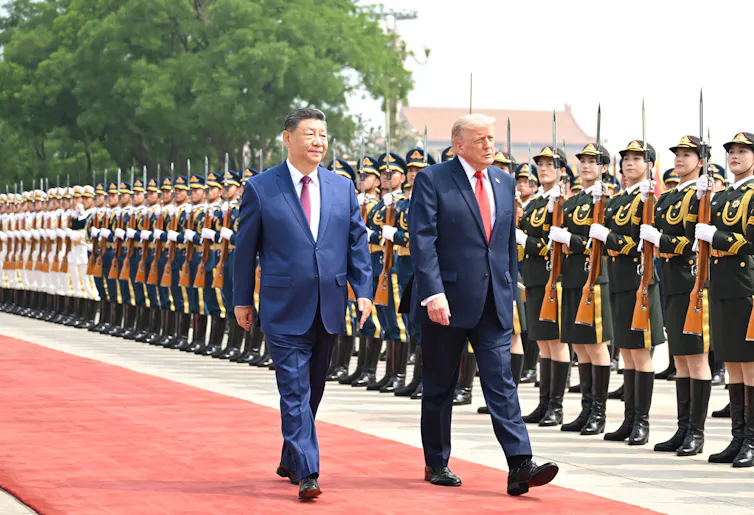
Two men in suits walk past a line of military dressed people.
Xi and Trump: Marching to the same tune? Li Xiang/Xinhua via Getty Images

Taiwan: Tough(ish) talk but status quo in place

No one really expected there to be movement on Taiwan – which mainland China lays claims over – although it is clear that Beijing would like the United States to make a firmer stance against the island moving toward a declaration of independence, or for the U.S. to expressly demand reunification.

So what we got was Beijing reiterating that Taiwan remained a priority and a core interest. Xi did this on the first day of the summit, noting that the Taiwan “question” remained “the most important issue in China-U.S. relations,” and that any mishandling of it could lead to “clashes and even conflicts.”

But this was aimed at two things. First, Xi has a domestic audience he needs to address, and Taiwan has long been important to Chinese rhetoric. The Chinese Communist Party has around 100 million members, many of whom would have expected Xi to talk tough on Taiwan – and it was those people he was largely talking to.

But he was also signaling to the U.S. that it shouldn’t support Taiwanese independence. And that won’t ruffle any feathers in Washington. Indeed, the 2025 National Security Strategy stressed that the U.S. opposed unilateral action on Taiwan from “either party” – a signal to Beijing that it opposed Taiwan declaring independence.

A group of people in army fatigues walk past a large missile launcher.
Taiwanese soldiers walk past a Sky Sword II Land-based Air Defense Missile in Taichung on Jan. 27, 2026. I-Hwa Cheng / AFP via Getty Images

Trump did mention arms deals to Taiwan. But the U.S.’s declaratory policy since the Reagan administration is that it doesn’t allow Beijing to enter discussions about what weapons Washington sells to Taiwan. And that hasn’t changed at all, nor has the U.S.’s treaty commitment to Taiwan since 1979 that requires the U.S. to provide Taiwan with defensive weapons to maintain a sufficient self-defense capability.

Rhetoric aside, everyone is happy with the status quo on Taiwan – it is in no one’s interest for it to change.

But talk of Taiwan has been muddied a little by Xi’s determination to modernize the People’s Liberation Army. The Chinese president has laid out a series of benchmarks including that the PLA should be capable of invading Taiwan by 2027. This has been misinterpreted in the U.S. under the so-called “Davidson window” – a concept that has it that China is intent on invading by that time.

In reality, China is nowhere near able to do so. It doesn’t have a “blue water navy” able to operate without port assistance, and the island is incredibly difficult to invade – it only has two places where you can land, and only at certain times of the year. It is also very mountainous. Taiwan is also slowly building its defenses – and learning a lot from Ukraine’s war with Russia – with the intention of becoming “indigestable” to China.

Xi’s modernization timeline also states that the PLA should be a “world class military” – taken to be a peer to the U.S. – by 2049. But the fact that it spends more on internal security than it does on defense indicates where the CCP’s true interests lay – in domestic security rather than external capabilities.

Trade: Tamped down expectations

The big picture is that the U.S. and China have been trying to restabilize what was until fairly recently a very good relationship in terms of economic ties.

Both sides have clear priorities to that extent. China wants to regain the American market it had in the 1990s and early 2000s – and certainly reverse the trend since 2018’s trade war.

Trump since his first administration has made it clear that he sees Chinese control over supply chains and the trade imbalance as a national security issue. Washington also wants to address unfair trade practices, such as the requirement that American companies hand over blueprints, trade secrets, customer lists, marketing plans and more to operate.

So what was achieved in the summit? On the surface, very little. There was some movement on sales of U.S. beef to China. And Trump announced that Beijing would buy 200 aircraft from Boeing – lower than the 500 that had been earlier touted in media reports. And several Chinese companies agreed to buy Nvidia microchips – a continuation of a process that began in late 2025.

That doesn’t seem much, and it was telling that Trump himself wasn’t being very “Trumpian” on what could be achieved during the summit. He wasn’t promising the moon.

But importantly, Xi and Trump agreed to establish a Board of Trade and Board of Investment – intended to create a pathway forward to more trade in the months to come.

A group of people wearing suits stand in a hall.
Tim Cook andJensen Huang, CEOs of Apple and Nvidia walk through the Great Hall of the People in Beijing. Johannes Neudecker/picture alliance via Getty Images

A lot of focus will be on technology. China is about 18 months behind the U.S. in microchip development. Some have questioned whether U.S. companies should be selling chips to China, amid fears that China could steal the intellectual property and be able to use higher-technology chips for defense reasons. The U.S. position is it can’t allow Huawei – China’s telecom giant – to take over the whole Chinese market, so it will only allow the sale of what it considers appropriate-level Nvidia chips.

Military matters: Washington wants to talk

During the Cold War, the Soviet Union and the U.S. always kept the military lines of communications open to avert a catastrophic incident. This hasn’t been the case with Beijing and Washington. We saw that in 2001 when a U.S. aircraft collided with a Chinese jet; and again over the “Chinese spy balloon incident” in 2023.

Washington is seeking to open up a line of communication on military matters, and that is probably why U.S. Secretary of Defense Pete Hegseth was there in Beijing. Indeed, it is highly unusual for a defense secretary to be at such a summit.

A man chuckles surrounded by other people
US Secretary of Defense Pete Hegseth attends a state banquet at the Great Hall of the People in Beijing on May 14, 2026. Brendan Smialowski/ AFP via Getty Images

Not that Trump believes he needs China’s help on military matters. He made that clear when asked about possible Beijing assistance prior to the summit.

In fact, little news came out of the summit on Iran. China has criticized the U.S. over the war, but has also quietly been telling Tehran to stop bombing Gulf countries.

Despite some commentary suggesting that Beijing benefits from the U.S. being bogged down in the Middle East, what Xi will want is a resolution before the economic fallout bites in China.

China’s stockpile of Iranian oil will only last a few more weeks and then oil price rises will hit China like a brick.

The Conversation

Yan Bennett has a contract position at the U.S. Department of State’s Foreign Service Institute, working to educate U.S. diplomats on transnational matters. Her views are her own and do not represent that of the U.S government.

❌
Subscriptions