Normal view

AI-generated fantasies of US intervention reveal how desperation has narrowed Cuba’s political horizons

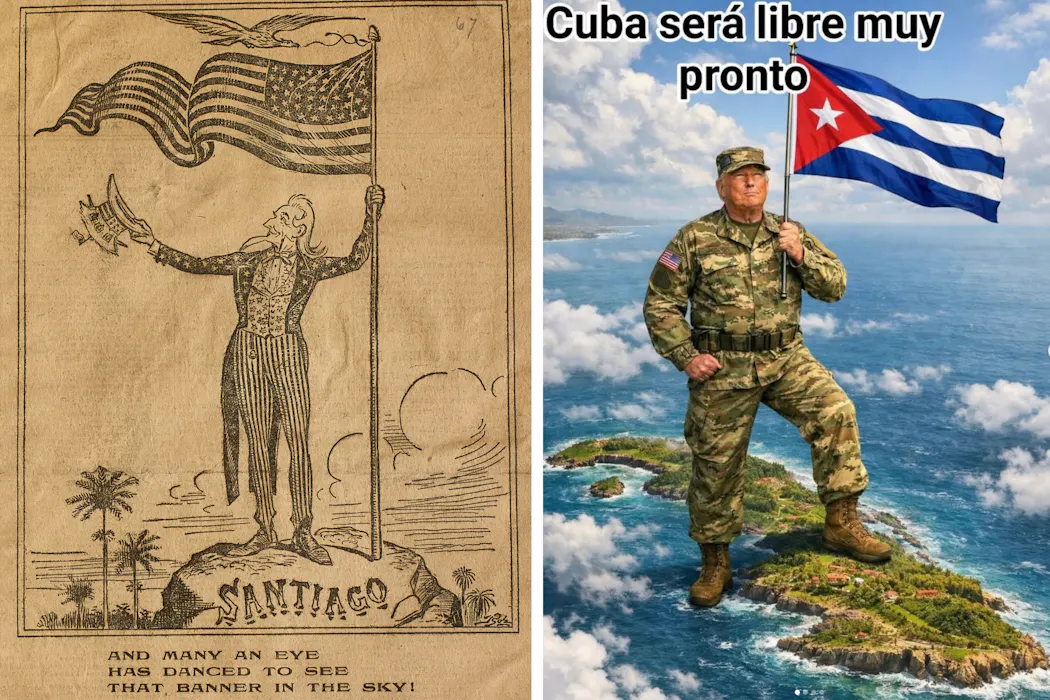
Cuba's American liberators, depicted on the left in a political cartoon from 1898 and on the right in an AI image. Cartoon: Blanche S. Crawford, Cartoon History of the Spanish American War (Scrapbook, 1898), 48. AI image: screenshot from Instagram. Images for this article sourced by Jorge Damian de la Paz.

Ever since U.S. commandos successfully removed Nicolás Maduro from power in Venezuela on Jan. 3, 2026, speculation has been growing that “Cuba could be next” on the list of the Trump administration’s targets.

“We’ll take over Cuba almost immediately,” President Donald Trump mused during a speech in Florida on May 1. “On the way back from Iran, we’ll have … the USS Abraham Lincoln come right by Cuba, stop about 100 yards offshore, and they’ll say, ‘Thank you very much, we give up.’”

It’s hard to say whether such remarks are just bluster. While the White House has been trying to coerce Cuban authorities into negotiated political and economic concessions through a de facto oil blockade since January, Trump has also reportedly grown frustrated by the Cuban government’s ability to outlast months of sustained U.S. pressure.

That has not stopped many Cubans and Cuban Americans from eagerly predicting a military operation’s success or insisting that such a U.S. action is necessary.

Their tool of choice? Not battle plans or political manifestos, but artificial intelligence. For weeks, Cuban social media feeds and WhatsApp groups have been filled with armchair fantasies of deliverance from communist rule made with tools like Midjourney, DALL-E, Runway and ChatGPT. In some clips and images, the island nation is represented as a female captive or a child being freed by an American protector. In others, magically renovated cityscapes feature statues and portraits erected in Trump’s honor, replacing revolutionary iconography.

It is easy to dismiss such animations as online trolling. But as a historian of Cuba, I noticed something troubling when my colleague Jorge Damian de la Paz sent me a selection of these digital illustrations and reels. Their visual language eerily mirrors classic U.S. political cartoons during Cuba’s final war for independence against Spain in the late 19th century. That imagery went on to justify U.S. meddling in Cuban affairs for decades.

A fraught history

In the 1890s, American illustrators at publications such as Puck, Judge and Harper’s Weekly similarly portrayed Cuba as a feminized victim: weak, vulnerable, often racialized as nonwhite and incapable of securing freedom on her own. They imagined grateful tropical citizens celebrating future American liberators for defeating their Spanish overlords and bestowing the benefits of “civilization” on Caribbean life.

Such tropes were not innocent. They helped generate the cultural consensus that legitimized U.S. intervention in the Cuban war in 1898 – known by most Americans as the Spanish-American War. They also shaped Cuba’s postwar order: four years of U.S. military occupation, an imposed amendment to Cuba’s first constitution authorizing future American military action to preserve stability, and decades of political and economic dependence on the United States.

Taking their cue from heroes of the independence struggle such as José Martí, many Cubans grew to resent this asymmetrical relationship with the North, even as they fell in love with imported American consumer products and cultural pastimes. Especially by the 1930s and 1940s, mainstream political movements on the island all sought to, at a minimum, rebalance the extent of U.S. influence over Cuban life. Their failure to do so was part of what propelled Fidel Castro’s radical nationalist revolution to power in 1959.

Reversing course

But today, formal and informal polling suggests that significant numbers of Cubans and Cuban Americans seem willing to welcome, or at least tolerate, the explicit U.S. intervention that most of their forefathers rejected.

AI-generated expressions of these views do not appear to be coming from staunchly anti-communist exiles in South Florida alone. Comments and reposts suggest they are resonating among Cubans living on the island, many of whom are desperate for “something, anything” to put an end to the worsening blackouts, shortages and societal paralysis that have made daily life feel like purgatory.

If a U.S. military operation is the only way to escape, one friend in Havana told me, “que sea rápido” – let it be over quickly.

What’s distinct about AI is that it is providing this fatalism with a visual vocabulary rooted in imperial attitudes from the 1890s. This makes sense when you consider how the technology works: Generative AI systems have been trained on enormous, often U.S.-centric archives of historical photographs and other materials. They easily reproduce the old cultural and political prejudices seen in these digital repositories.

As a result, image and video generators appear to be spitting 19th-century American discourses back at 21st-century Cuban users. The most extreme iterations of the imagery even resurrect a long-dormant idea from more than a century ago: the outright annexation of the island as a U.S. state. In so doing, AI provides narrative fuel for the Trump administration’s efforts to rewind the clock to an era when Washington condescendingly treated Latin America as its “backyard.”

Deprivation and desperation

The depth of Cuba’s predicament today helps explain why these images are going viral.

Long before the Trump administration cut off oil supplies, Cubans were enduring their worst economic, political and social crisis in three decades. Botched internal reform efforts, repression of dissent, and mass migration profoundly eroded faith in Cuba’s Communist Party leadership and institutions in recent years. This has been particularly true since the island’s tourist-heavy economy was hit hard by COVID-19 and 2021 mass protests rocked more than 50 towns and cities.

Of course, plenty of Cubans in Cuba still blame the long-standing U.S sanctions regime, and Trump’s unprecedented additions to it, for many of their problems. Not all are willing to accept change at any cost.

But Cuban officials’ defense of national sovereignty in the face of mounting U.S. threats rings increasingly hollow. Cuba hasn’t held a truly competitive election in nearly 80 years and has been ruled by a one-party state for 65. Under those circumstances, political independence does not rest on the consent of the governed. It’s also hard for a country to claim sovereignty when its economy relies so strongly on external patrons, such as Russia, China, Venezuela (until January) and even the United States. Despite the embargo, Cuban Americans send hundreds of millions of dollars in remittances, food, medicines and other goods annually.

The seduction of rescue

Yet even if fantasies of rescue are understandable, they should be deeply concerning to anyone who cares about Cuba’s future.

The danger posed by AI images is not simply that they normalize the idea of a U.S. military intervention that could cost Cuban lives. It is that they replace deeper civic imagination with spectacle and clickbait.

AI is offering visions of liberation without requiring Cubans to grapple with the far more difficult dilemmas that any real transition would entail. Those questions include how to rebuild institutions, restore trust, confront inequality, reconstruct the economy, forge reconciliation and negotiate competing political visions after decades of polarization and authoritarianism.

Prolonged desperation, coupled with authorities’ stubborn refusal to open the island’s political and economic systems, has narrowed some Cubans’ political horizons to the point where they outsource their own salvation rather than imagine it from the bottom up.

The coming weeks may determine whether digital fantasies turn into concrete policy or remain wishful thinking. But one thing is certain: AI images of U.S. military intervention in Cuba reveal that many Cubans and Cuban Americans have given up on defining change on Cuban terms. That choice could mean the difference between a Cuba that once again becomes a U.S. client state and one where Cubans reclaim ownership of their nation’s future.

The Conversation

Michael J. Bustamante does not work for, consult, own shares in or receive funding from any company or organization that would benefit from this article, and has disclosed no relevant affiliations beyond their academic appointment.
For 2 centuries, Latter-day Saints have revered religious freedom – but their definition is evolving

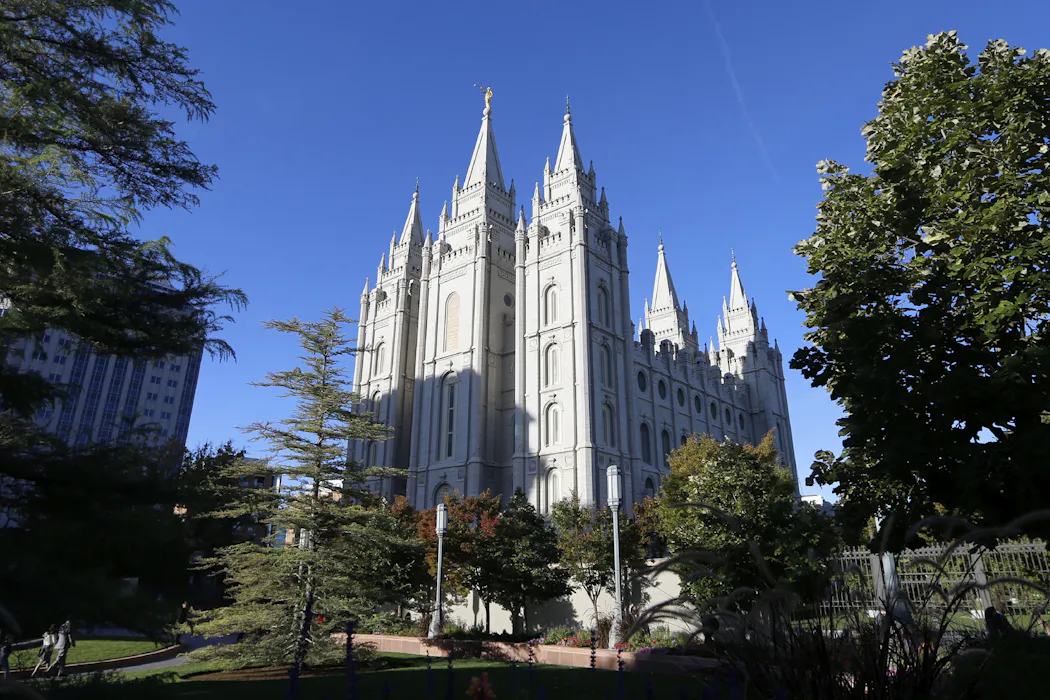
Leaders of the Church of Jesus Christ of Latter-day Saints have called for a fast on July 5, 2026, to give thanks for religious liberty. AP Photo/Rick Bowmer

On July 5, 2026, the Church of Jesus Christ of Latter-day Saints is encouraging its American members to participate in a special fast: a day to “express gratitude for religious liberty and to pray that it be strengthened throughout the world,” in the words of its top three leaders.

The fast will coincide with the United States’ semiquincentennial celebrations. For Latter-day Saints, the 250th anniversary commemorations are not merely a historic milestone for the country, but an opportunity to reflect on their faith’s relationship to the American experiment. In the church’s early decades, that relationship often tested the boundaries of religious liberty – and the church’s own understanding of that principle has been evolving ever since.

Divine plan

From the faith’s beginnings in the 1830s, founder Joseph Smith frequently emphasized the significance of religious liberty. In one 1843 sermon, for example, Smith explained that “civil and religious liberty … were diffused into my soul by my grandfathers,” both of whom had fought in the war of independence.

A formal painted portrait of a young man in a white shirt with a large collar and a black jacket.
Joseph Smith published the Book of Mormon in 1830. Wikimedia Commons

Smith’s personal connection to the Revolution and the nation’s founding documents were central to the faith’s developing theology. Latter-day Saints believe that their church is a restoration of Jesus’ “only true and living church,” and that America’s founding helped make that possible. In other words, Mormonism exists because of the United States, specifically its tradition of religious freedom enshrined in the Constitution’s First Amendment.

According to this logic, America’s founding was a crucial part of God’s divine plan, accomplished by chosen servants. Its founding documents are treated with reverence, especially the Constitution.

One of Smith’s own revelations declared that God “established the Constitution of this land, by the hands of wise men whom I raised up unto this very purpose,” suggesting divine intervention.

‘Kingdom of God’

However, Latter-day Saints soon came to doubt whether the United States was truly a land of religious freedom.

Early on, the small Mormon church faced persecution – especially in Missouri and Illinois, where state-sanctioned mobs forced members to flee. After Smith was killed by a mob in 1844, his successor, Brigham Young, decided to lead Latter-day Saints outside the country’s borders into present-day Utah, which was then northern Mexico.

Yet on their path to the Great Basin region, the federal government enlisted a group of church members to serve in the Mexican-American War. Known as the Mormon Battalion, they marched into Mexican territory under an American flag with only 13 stars. It was a symbolic protest: the U.S. they hoped to represent was the one that existed during the American Revolution, not the one with 28 states that had chased them out. They saw their own church, not the current government, as the revolutionaries’ true inheritor.

A faintly colored illustration of a small city nestled between dramatic mountains.
An 1863 depiction of Salt Lake City, which had been founded about 15 years earlier. Wikimedia Commons

Once the war was over, the U.S. annexed much of Mexico’s land, including the Utah region. For about two decades the church had latitude to establish what it called its “Kingdom of God” in the West, in line with church doctrine. But the federal government soon cracked down, particularly on the church’s commitment at the time to polygamy and theocracy: beliefs that Mormons insisted were protected by the First Amendment.

The ensuing legal and political battles lasted for four decades, testing the boundaries of American religious liberty. Only after the Supreme Court ruled against a church member with two wives in 1879, and Congress passed legislation to further enforce anti-polygamy laws, did the church publicly forfeit the practice in 1890.

Yet even amid these struggles, Latter-day Saint devotion to the founding generation continued. In 1877, for example, Wilford Woodruff, who later became president of the church, declared that he had received a vision of the signers of the Declaration of Independence. The signers “gathered around me, wanting to know why we did not redeem them” by offering them Latter-day Saint ordinances for the deceased.

A black and white photo of a tall building with sharp spires, and a striped flag with stars.
An American flag draped over the Salt Lake Temple in 1896, the year Utah became a state. Charles Ellis Johnson/Wikimedia Commons

Though Woodruff’s vision has become the subject of Mormon folklore, it represents how deeply a certain strain of Americanism became woven into church culture in the 19th century. Just as Smith’s revelations had done a generation before, this vision and the sentiments behind it elevated the Declaration of Independence and the U.S. Constitution to quasi-scripture.

Shifting focus

During the 20th century the church continued to “Americanize,” such as by embracing U.S. capitalism and participating in the two-party system. Talk about religious freedom shifted away from primarily seeking protection for religious minorities toward protection for their own theological commitments as part of a Christian mainstream.

Ezra Taft Benson, then president of the church, delivered an address in 1987 on the Constitution’s sacred significance.

By the mid-1900s, church leaders had embraced a conservative view of politics and law that championed limited government. Paralleling broader American attitudes during the Cold War, which pitted “godless” Soviet communism against American democracy and freedom of religion, Latter-day Saints used the language of religious freedom to advocate for their own interpretations of religion’s role in the public square.

Latter-day Saint leaders’ list of perceived threats evolved from New Deal legislation and civil rights protections to abortion, the Equal Rights Amendment and, finally, homosexuality – similar to other conservative Christian groups’ concerns. The church got involved in a number of legal cases and campaigns opposing same-sex unions.

Since the 2015 Supreme Court decision in Obergefell v. Hodges, which legalized same-sex marriage across the United States, the church’s public policy stance has focused on compromise, balancing protection of religious liberties with protection against discrimination for LGBTQ+ people in housing and employment.

Dallin Oaks, a former Utah Supreme Court justice who is now president of the church, delivered a landmark speech on religious liberty at the University of Virginia in 2021.

A global church

What becomes clear across the past two centuries is that definitions of religious freedom have substantially changed, including for Latter-day Saints. In the 19th century, church members focused on protecting all minority religious groups like themselves against the Protestant majority. Today, the church’s messaging on religious freedom, at least in the United States, usually concerns protecting beliefs that clash with secular progressivism and LGBTQ+ protections. Overall, its approach has largely aligned with the religious right.

Equally significant, a majority of the church’s members now live outside the United States, and it is eager to present an image that is less American and more universal. Instead of elevating the Declaration of Independence and the Constitution as quasi-scripture, leaders tend to highlight principles of religious freedom that are applicable across the globe.

The July fast will highlight “the importance of the Declaration of Independence and the Constitution and how these documents support religious freedom,” but it will also call for expanding liberty around the world. The day will be an opportunity for Latter-day Saints to reflect on their own place in the American story – a place that is still being defined.

This article has been updated to clarify how Joseph Smith was killed.

The Conversation

The authors do not work for, consult, own shares in or receive funding from any company or organization that would benefit from this article, and have disclosed no relevant affiliations beyond their academic appointment.

The ‘warrior ethos’ promises victory — history says it leads to defeat

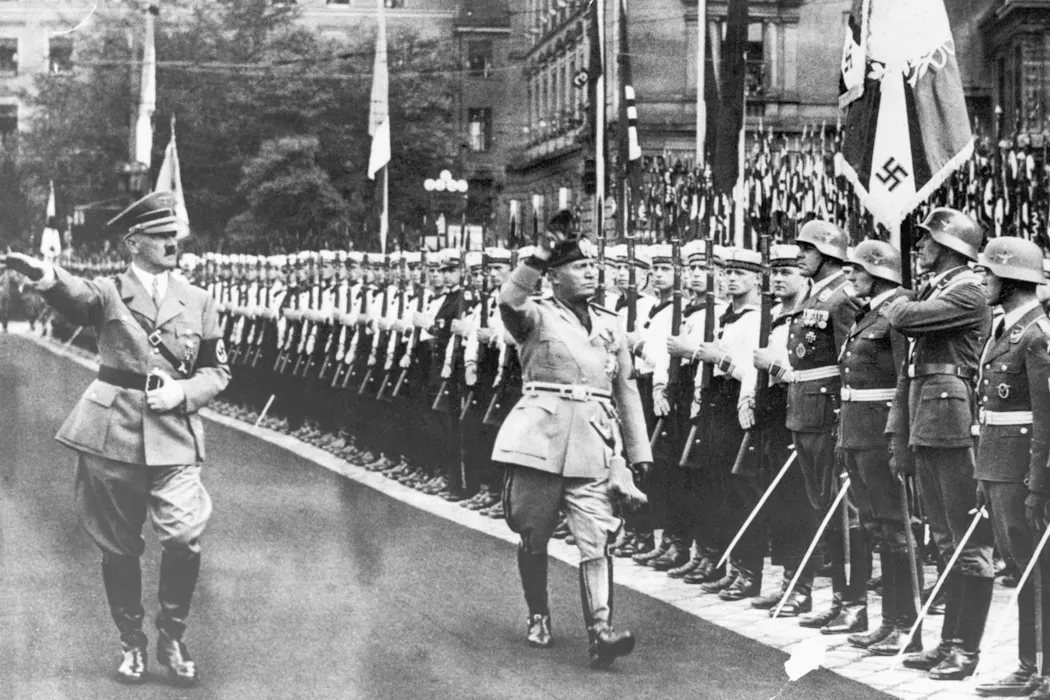
Hitler and Mussolini salute Nazi troops in 1937. Bettmann/Getty Images

At Marine Corps Base Quantico in September 2025, Defense Secretary Pete Hegseth promised assembled generals “maximum lethality” and no “stupid rules of engagement.” Under his leadership, the newly rebranded Department of War would “untie the hands of our warfighters to intimidate, demoralize, hunt, and kill.” Troops would be held to the “highest male standard,” he said. “Weak men won’t qualify.”

Hegseth also restricted anonymous whistleblower and discrimination complaints and limited how long past misconduct can be held against a service member, weakening internal rules and oversight processes the military had built over decades.

Months later, with the Iran war underway, he told reporters at a Pentagon briefing that the U.S. was “punching (Iran) while they’re down, which is exactly how it should be.” He has also said the U.S. will give “no quarter, no mercy” to its enemies, language legal experts say can constitute a war crime under international law.

Hegseth calls his military doctrine the “warrior ethos.”

Historians of fascism have catalogued similar rhetorical patterns — strongman posturing, contempt for constraint — for decades.

I’m a historian of race and nationalism and author of “Blood, Oil and the Axis,” a book about World War II and nationalism in Iraq and Syria. I’ve studied how fascist regimes fight. At its core, fascism is ultranationalism fused with a cult of masculine strength, racial hierarchy, paranoia about socialism and contempt for democracy. It also has a theory of war: Victory belongs to the ruthless and the ideologically pure. Rules are for the weak.

Nazi Germany, fascist Italy and Imperial Japan all built their military strategies on some version of this ideology in the run-up to the Second World War. And in each case, the strategy failed, undone by its own contradictions.

The fascist theory of war

Democracies don’t necessarily fight clean wars. During World War II, the Allies firebombed cities, created internment camps and dropped atomic bombs.

What distinguishes fascist powers from democracies is their contempt for rules based on their sense of superiority. In 1933, Adolf Hitler’s propaganda minister Joseph Goebbels announced that the Nazis would claim the absolute right to override democratic constraints. “This contemptible parliamentarianism … is gone,” he said.

Italian dictator Benito Mussolini said it more bluntly in 1936: “We do not argue with those who disagree with us, we destroy them.”

But rules of engagement function as a control system that ties tactical decisions to strategy, law and the risk of escalation. Discarding them tends to produce the atrocities and strategic blowback that lose wars.

Democratic procedure does similar work: Political scientists who studied 197 conflicts from 1816 to 1987 found that democracies won about 76% of their conflicts and non-democracies 46%, in large part because accountable leaders and public access to information force a government to notice when a plan isn’t working.

A fascist regime that treats democratic constraints as obstacles is likely to decide inconvenient information is an obstacle too. Because of this, in fascist governments, loyalists rank higher than experts. Fascist systems don’t remove people for being wrong; they remove them for insufficient loyalty. The man who tells the leader what he wants to hear rises. The man whose report contradicts the leader’s views endangers himself.

Benito Mussolini stands beside Adolf Hitler as they watch a military parade
Benito Mussolini, Adolf Hitler, King Victor Emmanuel III and Queen Elena watch a parade held in Hitler’s honor in 1938. Behind them, from left: Joachim von Ribbentrop, Galeazzo Ciano, Joseph Goebbels and Rudolf Hess. Bettmann/Getty Images

The closed circuit

Consider Joachim von Ribbentrop.

Before becoming Hitler’s foreign minister, he was a wine salesman whose years in Canada became his qualification for understanding America. He attached himself to Hitler and was rewarded with a top seat in his government, where Ribbentrop’s signature contribution was overruling the diplomats who warned that Americans would fight if pushed too far by the Axis.

The Nazi view prevailed: Americans were too racially mixed, too soft, too consumed by money to be dangerous. When Germany declared war on the U.S. four days after Pearl Harbor, it did so partly on that disdain for what Hitler called a “mongrel nation.” Ribbentrop was among the most consequentially wrong foreign ministers in modern history – he’d also misjudged Britain’s willingness to join the war over the invasion of Poland – still, he kept his job.

The ideology that produced Ribbentrop’s overconfidence also produced the Nazi theory of the Eastern Front: that Slavic peoples – fundamentally inferior and tainted by Bolshevism – would collapse within weeks. But the Red Army didn’t collapse. Hitler fired the officers who reported as much and demanded more of the same operations that had already failed. Operation Barbarossa, which was supposed to take weeks, stretched to years.

Attempting to match Hitler’s conquests and assert dominance over the Mediterranean, Mussolini invaded Greece in October 1940 with shorthanded divisions, in mountain terrain and at the start of winter, because he believed Italian spirit would overwhelm Greek resistance in two weeks. His generals had doubts, but many did not express them. The Greeks counterattacked, but Mussolini blamed his generals’ “insufficient will,” the only kind of failure his theory allowed. Germany had to intervene.

What the leader said happened

Connected to the fascist superiority complex is a contempt for feedback, creating a closed information system that can’t register failure, tolerate disagreement or revise a plan. Strategy requires accurate reporting, even when the news is bad, and the willingness to be wrong. Fascist regimes punish the first and refuse the second.

German high command was still reporting a controlled advance in November 1942 when its 6th Army, some 330,000 soldiers, was being encircled at Stalingrad. Hitler had declared the city practically taken; the press never reported the Soviet counteroffensive that surrounded it. When the remnants finally surrendered on Feb. 2, 1943, it was a turning point in the war – Germany’s first catastrophic defeat on the Eastern Front, from which the Wehrmacht never recovered.

Mussolini bragged about his mighty army of 8 million soldiers while 3.5 million – the real number – were being routed on three fronts in as many years.

Imperial Japan fused racial supremacy with a military code that forbade surrender and treated anyone who did as subhuman. Loyalty to the emperor was absolute; questioning his depiction of reality was betrayal.

In that environment, officers had every incentive to lie up the chain of command when reality on the ground did not match what leaders wanted to hear. For example, after the Battle of Midway, a catastrophic defeat for Japan in June 1942, naval headquarters filed reports that bore little resemblance to what happened. Later that year, the Imperial Navy told Tokyo they had sunk twelve American ships near today’s Taiwan when they had merely damaged two.

Two years of retreat later, the kamikaze program – which sent some 3,900 pilots to their deaths in suicidal crashes against Allied ships – was the logical conclusion: Let pilots prove their loyalty by dying.

The Conversation

John Broich does not work for, consult, own shares in or receive funding from any company or organization that would benefit from this article, and has disclosed no relevant affiliations beyond their academic appointment.

US indictment of Raúl Castro comes amid a long history of American aggression against Cuba

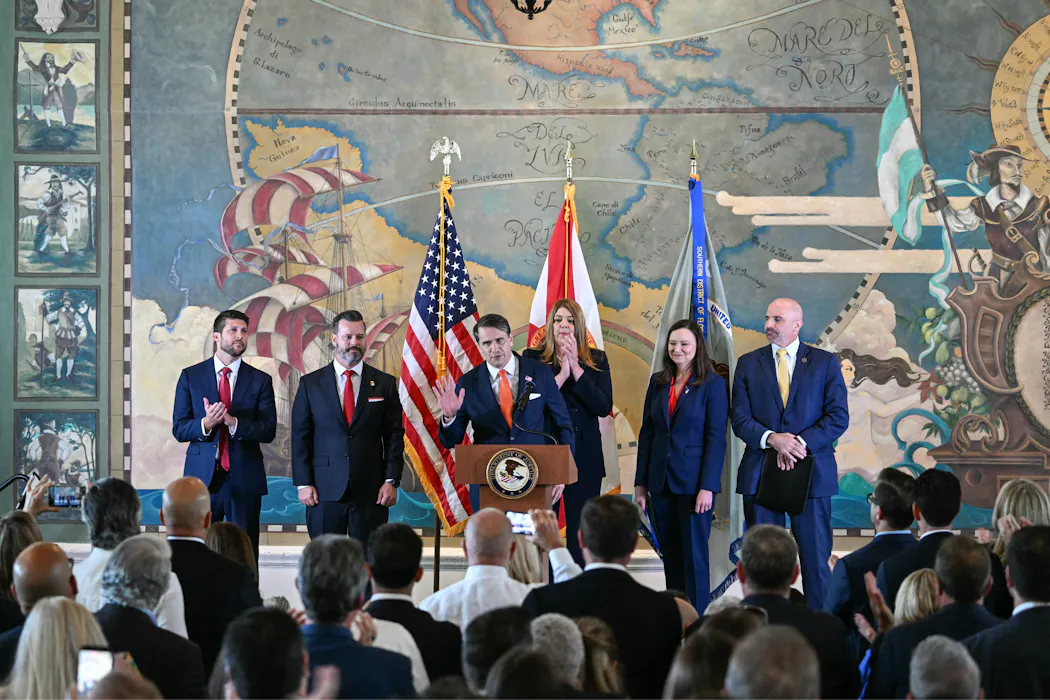
Acting U.S. Attorney General Todd Blanche announces the indictment of former Cuban President Raúl Castro, in Miami, Fla., on May 20, 2026. Chandan Khanna/AFP via Getty Images

The Trump administration on May 20, 2026, indicted former Cuban President Raúl Castro for murder, based on the downing of two planes near the Cuban coastline in 1996 that killed four people.

As a historian of Latin America and U.S. foreign policy, I believe the indictment may be the prelude to direct U.S. military action against Cuba.

Before Castro, the last U.S. indictment of a Latin American leader occurred in January 2026, when a U.S. attorney appointed by President Donald Trump charged Venezuela’s Nicolás Maduro with narco-terrorism. Those charges were promptly followed by U.S. military strikes on Venezuela and the abduction of Maduro.

Since January, the U.S. has ended the flow of Venezuelan oil to Cuba and has used economic and military pressure to prevent other nations from trading with the island. And Trump recently threatened a “friendly takeover” of Cuba.

I believe that what’s missing from most recent analysis of this situation is the history of U.S. aggression against Cuba. This is essential context for understanding the Trump administration’s recent escalations.

‘Striking at Cuba constantly’

In 1823, U.S. Secretary of State John Quincy Adams identified Cuba as “an object of transcendent importance to the political and commercial interests of our Union.” The 1959 Cuban Revolution that overthrew U.S.-backed dictator Fulgencio Batista and replaced him with Fidel Castro, brother of Raúl, directly challenged those interests by asserting political autonomy and expropriating private property.

State Department officials observed that “the majority of Cubans support Castro” because of the government’s redistributive measures and its “real honesty, courtesy, and idealism.” One official warned “that if the Cuban revolution is successful other countries in Latin America and perhaps elsewhere will use it as a model and we should decide whether or not we wish to have the Cuban revolution succeed.”

They decided quickly. By December 1959, President Dwight Eisenhower’s CIA director had approved plans to overthrow the Castro government. U.S. policy thereafter included direct sponsorship and safe haven for Cuban paramilitary groups.

Several men in a black and white photo inspect the wreckage of a plane.
An American plane is shot down on Playa Girón during the Bay of Pigs invasion in April 1961. Keystone-France/Gamma-Keystone via Getty Images

The CIA-led Bay of Pigs invasion in April 1961 is only the most famous episode. The U.S. trained 1,400 Cuban exiles to invade Cuba, hoping to ignite a nationwide rebellion. Instead, Cubans rallied behind the government.

Though U.S. analysts often criticize the invasion because it failed, it was also a major crime under international law. Several hundred Cubans were killed.

Fear of a repeat invasion also led Soviet premier Nikita Khrushchev to send nuclear missiles to Cuba, precipitating the Cuban missile crisis of October 1962 that nearly led to nuclear war.

Longtime CIA official Richard Helms later testified that in the early 1960s, “We had task forces that were striking at Cuba constantly. We were attempting to blow up power plants, we were attempting to ruin sugar mills, we were attempting to do all kinds of things during this period. This was a matter of American Government policy.”

In 1976, Luis Posada Carriles and Orlando Bosch, two Cuban exiles, planned the bombing of a Cuban civilian airliner near Barbados that killed all 73 people aboard.

“The C.I.A. taught us everything,” Posada Carriles said later. “They taught us explosives, how to kill, bomb, trained us in acts of sabotage.”

Both men were given refuge in the United States for the rest of their lives.

The Bay of Pigs invasion and the airline bombing violate the core principles of international law, including prohibitions on the unprovoked “threat or use of force” and collective punishment. The U.S. government itself defines “international terrorism” as “violent acts” intended “to influence the policy of a government by intimidation or coercion” or to “intimidate or coerce a civilian population.”

By that definition, its Cuba policy qualifies.

By ‘every possible means’

Another U.S. method of striking at Cuba was through economic sanctions, first imposed on the country in 1960. That year, a State Department official wrote that “every possible means should be undertaken promptly to weaken the economic life of Cuba” so as “to bring about hunger, desperation and overthrow of government.” The logic of collective punishment was clear: make Cubans suffer enough that they rebel against Castro.

Three billboards of three men appear on a weathered wall outdoors.
Images of Cuban President Miguel Díaz-Canel, Raúl Castro and Fidel Castro adorn the state building in Havana, Cuba, on May 20, 2026. AP Photo/Ramon Espinosa

This policy is now more aggressive than ever. The tightening of U.S. sanctions since Trump’s first term has reduced Cuba’s income from tourism, remittances and overseas medical missions. Now, by choking off the supply of fuel, the U.S. has critically weakened the healthcare and sanitation systems that depend on electricity.

Medical professionals and United Nations observers have described scenes of ventilators and incubators left without power, pharmacies empty and healthcare workers forced into “horrible decisions” about who lives and dies. A recent medical study reported a 148% increase in infant mortality between 2018 and 2025, meaning that about 1,800 infants died who otherwise would have lived.

‘I was trained as a terrorist by the United States’

The focus of the recent U.S. indictment against Raúl Castro was the incident on Feb. 24, 1996, when the Cuban military, which was headed by Castro, shot down those two planes.

The planes were operated by Brothers to the Rescue, an anti-Castro group of Cuban exiles who said they were aiding Cuban emigres trying to reach Florida. The group’s head, and one of the surviving pilots that day, was José Basulto, a veteran CIA asset and participant in the Bay of Pigs invasion.

In 1962, Basulto fired a cannon and machine gun “16 times” at a Cuban hotel, he later recounted. “I was trained as a terrorist by the United States,” Basulto once told an interviewer.

Basulto’s plane had entered Cuban airspace on Feb. 24, as a U.S. customs service specialist later testified. Correspondence from the day shows that Basulto did so knowingly. The previous July, he had told a TV audience, “We want confrontation.”

While the Cuban military could have deescalated the situation more carefully that day, Cuba had been trying for months to stop the violations of its airspace.

I believe indicting Cuban officials over the incident is disingenuous, given the provocations by Brothers to the Rescue and U.S. actions against Cuba, which are in direct violation of international and U.S. laws that prohibit threats, nondefensive violence and collective punishment.

The Conversation

Kevin A. Young does not work for, consult, own shares in or receive funding from any company or organization that would benefit from this article, and has disclosed no relevant affiliations beyond their academic appointment.

Most Americans broadly support public education for undocumented students – regardless of their political affiliation and religion

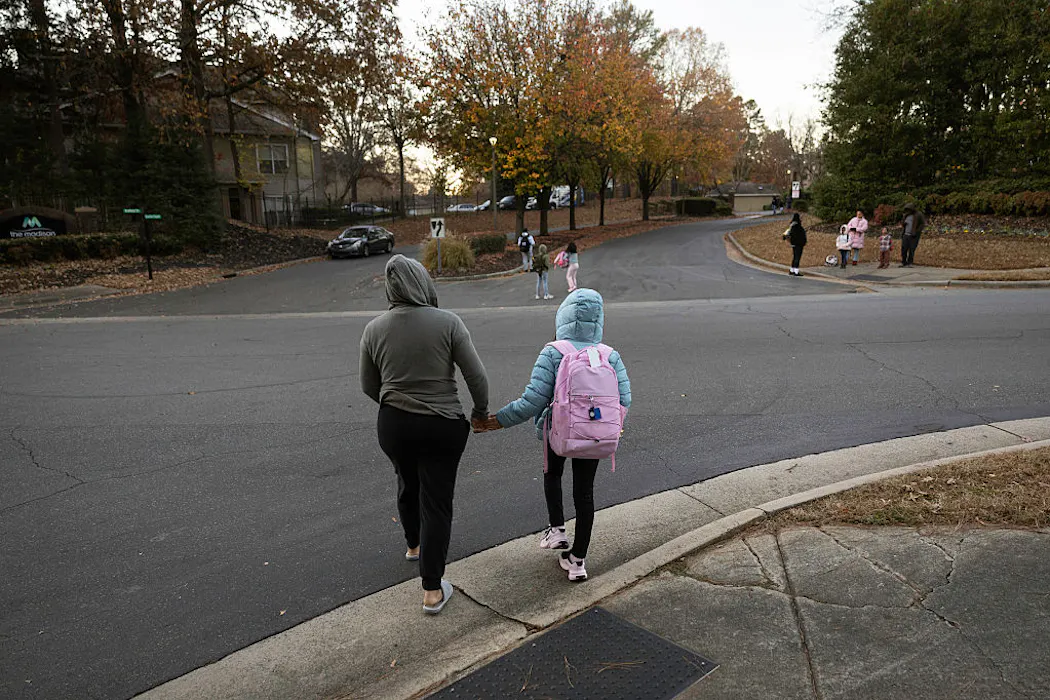
An undocumented Honduran immigrant walks her child to a school bus stop in November 2025 at an unspecified location in the U.S. John Moore/Getty Images

All public schools in the U.S. must provide an education to all students, regardless of their immigration status.

In 1982, the U.S. Supreme Court affirmed the right of immigrant students in Texas to attend school free of charge, regardless of their citizenship, in Plyler v. Doe. Texas had passed a law in 1975 that allowed public school districts to charge these students tuition, or not let them attend altogether. This law was repealed following the Supreme Court decision.

As scholars of history and education, we are particularly interested in understanding how Americans feel about this policy, which has been in place for four decades.

Some legislators in states like Ohio, Idaho and Oklahoma have unsuccessfully tried to make it harder for immigrant students to attend public school, by proposing that all public school students must share their immigration status prior to enrolling in school.

Tennessee considered a bill in 2025 and 2026 that would allow public school districts to not admit undocumented students. Though the bill passed the state Senate, it did not ultimately pass the House.

In March 2026, Republican representatives led a Congressional hearing focused on Plyer’s negative effects on U.S. schools and students, such as straining schools’ funding and available resources. The conservative think tank Heritage Foundation has called on all state legislators to propose laws that would challenge undocumented students’ right to attend public schools free of charge.

But what do most Americans actually think about undocumented students attending public schools? According to our recent survey, which is in the process of publication, most Americans broadly support public education for undocumented children.

A white sign with black writing says 'Hands off our immigrant students'
All immigrant children have the right to attend public school, though there have been some state efforts to challenge this. Tyler Russell/Connecticut Public via Getty Images

Who supports public school for all?

In mid-April 2026, with support from the Public Religion Research Institute – an organization that supports public scholarship on the beliefs of the American public – two colleagues and I worked with Ipsos to survey a nationally representative random sample of more than 1,500 Americans about their views on public education and immigration. It was a diverse cross section of people who held a range of political beliefs and affiliations.

We asked respondents whether they agreed with the statement: “I believe all children, regardless of immigration status, should have the right to public education.”

We found that there were obvious differences between survey respondents’ views, depending on their political affiliation. For instance, of the survey respondents who voted for former Vice President Kamala Harris in 2024, 95.7% of people agreed with the statement. Only 48.8% of survey respondents who voted for President Donald Trump agreed with the statement.

Similarly, 57.5% of Republicans overall agreed with the statement, while 93.9% of Democrats did.

But other than this political divide, we found strong support for universal education across all ages, ethnicity and faiths, with 75.5% of all Americans agreeing with the statement.

The survey revealed strong support for universal education, with 75.5% of all Americans agreeing with the statement. Among Hispanics and Latinos, nearly 86.9% supported the policy, along with 86.7% of African Americans, 77.7% of Asians Asian Americans and 69.9% of non-Hispanic white people.

In each income bracket, there was over 70% of support for free public education for all. Wealthier Americans – those making more than US$150,000 a year – supported this policy least, at 70.4%. More than 77% of those making under $150,000 supported it. Those making under $25,000 a year supported it by 82%.

Among age groups, American adults between 18-29 had the highest support for undocumented immigrant children attending public school, at 81.4%. Americans we surveyed over the age of 60, meanwhile, had the least support for the policy, at 71.5%.

Our survey showed that even looking at educational levels, there was little difference, with every group supporting public education for all students at 73% or more.

Across a range of faiths, people tended to support public education for all students, including undocumented immigrants. We found that 92.9% of Muslims, 82.2% of unaffiliated respondents, 81.1% of Jewish respondents, 79.5% of Catholics and 72.6% of mainline Protestants supported the idea of undocumented students attending school for free.

Evangelical Protestants were the outliers, with only 59.9% agreeing with this policy.

A shift in public opinion

While our data shows that today there’s widespread support for immigrant kids attending public school, these attitudes have shifted over time.

We can compare these numbers with polling about past state legislation, such as California’s Proposition 187, which passed in 1994.

Almost 60% of the state voted that year to bar undocumented students from public education. A federal court struck down the law in 1998 as unconstitutional.

While little other public polling exists showing how people feel about the Supreme Court’s Plyler ruling, there is data on a related question about undocumented immigrants who came to the country as children, often known as Dreamers. There seems to have been a shift since the ‘90s in public opinion toward supporting undocumented students. Much of this may have been due to the strong advocacy of Dreamers themselves.

In 2020, Pew Research found 74% of Americans think that people who were brought to the U.S. as young children without legal authorization should be allowed to legally stay in the country. Approximately 91% of Democrats said they thought Dreamers should be able to remain in the U.S., while 54% of Republicans said the same.

At 57.5%, Republicans’ support for public education for undocumented children might seem low. However, it does correlate with other recent polling from the University of Massachusetts-Amherst that shows 91% of Republicans support Trump’s overall immigration policies.

Even as political parties may play a role influencing views toward immigration, as a whole, Americans overwhelmingly support public education for all children.

The Conversation

The authors do not work for, consult, own shares in or receive funding from any company or organization that would benefit from this article, and have disclosed no relevant affiliations beyond their academic appointment.

US indictment of Raúl Castro comes amid a long history of American aggression against Cuba

Acting U.S. Attorney General Todd Blanche announces the indictment of former Cuban President Raúl Castro, in Miami, Fla., on May 20, 2026. Chandan Khanna/AFP via Getty Images

The Trump administration on May 20, 2026, indicted former Cuban President Raúl Castro for murder, based on the downing of two planes near the Cuban coastline in 1996 that killed four people.

As a historian of Latin America and U.S. foreign policy, I believe the indictment may be the prelude to direct U.S. military action against Cuba.

Before Castro, the last U.S. indictment of a Latin American leader occurred in January 2026, when a U.S. attorney appointed by President Donald Trump charged Venezuela’s Nicolás Maduro with narco-terrorism. Those charges were promptly followed by U.S. military strikes on Venezuela and the abduction of Maduro.

Since January, the U.S. has ended the flow of Venezuelan oil to Cuba and has used economic and military pressure to prevent other nations from trading with the island. And Trump recently threatened a “friendly takeover” of Cuba.

I believe that what’s missing from most recent analysis of this situation is the history of U.S. aggression against Cuba. This is essential context for understanding the Trump administration’s recent escalations.

‘Striking at Cuba constantly’

In 1823, U.S. Secretary of State John Quincy Adams identified Cuba as “an object of transcendent importance to the political and commercial interests of our Union.” The 1959 Cuban Revolution that overthrew U.S.-backed dictator Fulgencio Batista and replaced him with Fidel Castro, brother of Raúl, directly challenged those interests by asserting political autonomy and expropriating private property.

State Department officials observed that “the majority of Cubans support Castro” because of the government’s redistributive measures and its “real honesty, courtesy, and idealism.” One official warned “that if the Cuban revolution is successful other countries in Latin America and perhaps elsewhere will use it as a model and we should decide whether or not we wish to have the Cuban revolution succeed.”

They decided quickly. By December 1959, President Dwight Eisenhower’s CIA director had approved plans to overthrow the Castro government. U.S. policy thereafter included direct sponsorship and safe haven for Cuban paramilitary groups.

Several men in a black and white photo inspect the wreckage of a plane.
An American plane is shot down on Playa Girón during the Bay of Pigs invasion in April 1961. Keystone-France/Gamma-Keystone via Getty Images

The CIA-led Bay of Pigs invasion in April 1961 is only the most famous episode. The U.S. trained 1,400 Cuban exiles to invade Cuba, hoping to ignite a nationwide rebellion. Instead, Cubans rallied behind the government.

Though U.S. analysts often criticize the invasion because it failed, it was also a major crime under international law. Several hundred Cubans were killed.

Fear of a repeat invasion also led Soviet premier Nikita Khrushchev to send nuclear missiles to Cuba, precipitating the Cuban missile crisis of October 1962 that nearly led to nuclear war.

Longtime CIA official Richard Helms later testified that in the early 1960s, “We had task forces that were striking at Cuba constantly. We were attempting to blow up power plants, we were attempting to ruin sugar mills, we were attempting to do all kinds of things during this period. This was a matter of American Government policy.”

In 1976, Luis Posada Carriles and Orlando Bosch, two Cuban exiles, planned the bombing of a Cuban civilian airliner near Barbados that killed all 73 people aboard.

“The C.I.A. taught us everything,” Posada Carriles said later. “They taught us explosives, how to kill, bomb, trained us in acts of sabotage.”

Both men were given refuge in the United States for the rest of their lives.

The Bay of Pigs invasion and the airline bombing violate the core principles of international law, including prohibitions on the unprovoked “threat or use of force” and collective punishment. The U.S. government itself defines “international terrorism” as “violent acts” intended “to influence the policy of a government by intimidation or coercion” or to “intimidate or coerce a civilian population.”

By that definition, its Cuba policy qualifies.

By ‘every possible means’

Another U.S. method of striking at Cuba was through economic sanctions, first imposed on the country in 1960. That year, a State Department official wrote that “every possible means should be undertaken promptly to weaken the economic life of Cuba” so as “to bring about hunger, desperation and overthrow of government.” The logic of collective punishment was clear: make Cubans suffer enough that they rebel against Castro.

Three billboards of three men appear on a weathered wall outdoors.
Images of Cuban President Miguel Díaz-Canel, Raúl Castro and Fidel Castro adorn the state building in Havana, Cuba, on May 20, 2026. AP Photo/Ramon Espinosa

This policy is now more aggressive than ever. The tightening of U.S. sanctions since Trump’s first term has reduced Cuba’s income from tourism, remittances and overseas medical missions. Now, by choking off the supply of fuel, the U.S. has critically weakened the healthcare and sanitation systems that depend on electricity.

Medical professionals and United Nations observers have described scenes of ventilators and incubators left without power, pharmacies empty and healthcare workers forced into “horrible decisions” about who lives and dies. A recent medical study reported a 148% increase in infant mortality between 2018 and 2025, meaning that about 1,800 infants died who otherwise would have lived.

‘I was trained as a terrorist by the United States’

The focus of the recent U.S. indictment against Raúl Castro was the incident on Feb. 24, 1996, when the Cuban military, which was headed by Castro, shot down those two planes.

The planes were operated by Brothers to the Rescue, an anti-Castro group of Cuban exiles who said they were aiding Cuban emigres trying to reach Florida. The group’s head, and one of the surviving pilots that day, was José Basulto, a veteran CIA asset and participant in the Bay of Pigs invasion.

In 1962, Basulto fired a cannon and machine gun “16 times” at a Cuban hotel, he later recounted. “I was trained as a terrorist by the United States,” Basulto once told an interviewer.

Basulto’s plane had entered Cuban airspace on Feb. 24, as a U.S. customs service specialist later testified. Correspondence from the day shows that Basulto did so knowingly. The previous July, he had told a TV audience, “We want confrontation.”

While the Cuban military could have deescalated the situation more carefully that day, Cuba had been trying for months to stop the violations of its airspace.

I believe indicting Cuban officials over the incident is disingenuous, given the provocations by Brothers to the Rescue and U.S. actions against Cuba, which are in direct violation of international and U.S. laws that prohibit threats, nondefensive violence and collective punishment.

The Conversation

Kevin A. Young does not work for, consult, own shares in or receive funding from any company or organization that would benefit from this article, and has disclosed no relevant affiliations beyond their academic appointment.
❌
Subscriptions