Normal view

Battleground state with few combatants – why Pennsylvania’s primaries lack competition

Pennsylvania is only 1 of 13 American states that holds closed primary elections. REBECCA DROKE/AFP Collection via Getty Images

At a time when hard-fought primary elections in Georgia, Kentucky and Indiana and Ohio are making national news, perennial battleground Pennsylvania seems to be nodding through one of the sleepiest primary seasons in a long time.

I’m an associate professor of political science at the University of Pittsburgh. My research focuses on how political institutions like political parties and state and local governments affect political representation.

In statewide races, only the Republican lieutenant governor slot is contested, a race between GOP-endorsed attorney Jason Richey and newcomer John Ventre. In the state Senate, less than a third of incumbents drew a challenger. Only 21 of the 203 state Assembly seats see an incumbent facing an in-party challenge. So why does Pennsylvania, usually a hotbed of political strife, appear to be sitting this midterm primary season out?

Uncontested primaries are normal

According to political scientists Shigeo Hirano and James M. Snyder Jr., uncontested primaries, and uncontested elections in general, are normal – and can even be a good thing. They argue it’s because high quality candidates do not tend to draw a challenge. This means that an uncontested primary signifies the district has no potential candidates who both want the job and think they can win against the incumbent.

The biggest reason challengers stay home is because of a well-dug-in incumbent, and Pennsylvania had plenty of those this cycle. Unlike in Indiana, no wave of anti-establishment energy is giving long-shot challengers a fighting chance.

A man in a suit stands in front of a microphone outside.
Pennsylvania Rep. Brian Fitzpatrick, a Republican, protested against the government shutdown in January 2026. Mark Makela/Stringer Collection via Getty Images

Interestingly, the moderate Trump foe and incumbent Brian Fitzpatrick, a Republican state representative from Bucks County, managed to avoid a primary challenge this year. Fitzpatrick was one of only two Republicans to vote against the H.R. 1 Act – also known as President Donald J. Trump’s “One Big Beautiful Bill.”

The only other dissenting vote came from Kentucky’s Thomas Massie — and the President responded by personally recruiting a primary challenger to run against him.

Why Pennsylvania’s Fitzpatrick got a pass

So how did Fitzpatrick manage to avoid Trump’s notice? It helps to compare his political fortunes with Massie’s.

Massie’s district is solidly red. He typically wins at least 60% of his general election vote. In 2024, no Democrat even ran against him.

Fitzpatrick, on the other hand, hails from a decidedly “purple” district where the vote could go in either party’s direction. He rarely wins more than 55% of the vote, and is perennially on the list of the most at-risk Republican incumbents.

In other words, in a midterm election in which Republicans face strong competition and fear losing the House of Representatives, Republicans need Fitzpatrick more than they need Massie. Without Fitzpatrick, his district is much more likely to fall in the Democratic column. Without Massie, Republicans can still expect to keep the seat red.

Pennsylvania parties hold the key

Pennsylvania incumbents have mostly been able to avoid finding themselves part of a larger conflict.

Some of the most contested primaries this election cycle stem from disputes centered on President Trump’s push for Republican-led states to redraw their congressional district lines. But the Commonwealth of Pennsylvania, with its closely divided state legislature, is not going to change its electoral map anytime soon. So the Commonwealth was left out of partisan gerrymandering disputes.

Pennsylvania remains one of only 13 American states that holds closed primary elections. That means voters must already be registered as party members to vote in that party’s primary. In an open, or even semi-open, primary state like Michigan and Iowa, potential challengers can try to win a primary election by relying on new voters choosing to align with the party only for that election day, or even for that specific election.

Three young women hold signs about voting while standing outside.
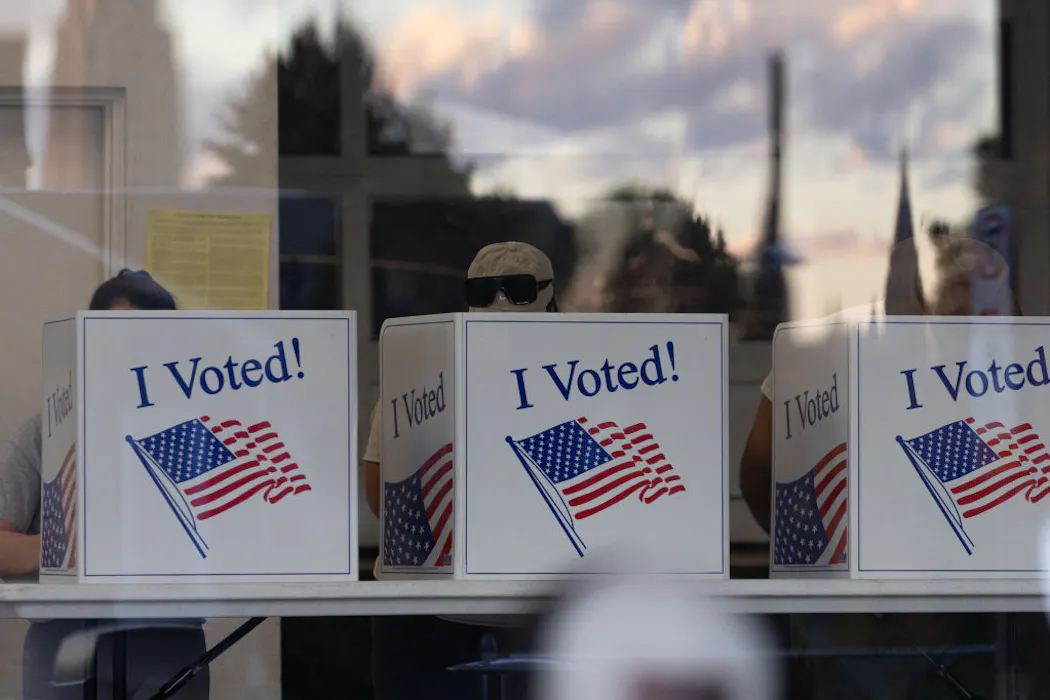
In order to vote in Pennsylvania’s primary on May 19, 2026, voters must already be registered as members within their party. ANGELA WEISS/AFP Collection via Getty Images

A closed party system gives party regulars, and the party organization itself, enormous sway over who gets nominated. Potential candidates in closed-party states are much better off working within the party organization and waiting for an incumbent to step down before throwing their hats in the ring.

Pennsylvania is a closed-party state and a swing state. In an election cycle in which political parties from West Virginia’s Republicans to California’s Democrats seem to be turning on their own members, Democrats and Republicans in the Commonwealth of Pennsylvania have managed to keep their parties more unified.

The desire for party fealty is strong, but not as strong as the need to win in the general election. Pennsylvania parties are powerful, and they are staying cautious until November. An uncontested primary, in other words, isn’t a sign of apathy. In Pennsylvania, it’s strategy.

The Conversation

Kristin Kanthak does not work for, consult, own shares in or receive funding from any company or organization that would benefit from this article, and has disclosed no relevant affiliations beyond their academic appointment.
Racial gerrymandering may be here to stay

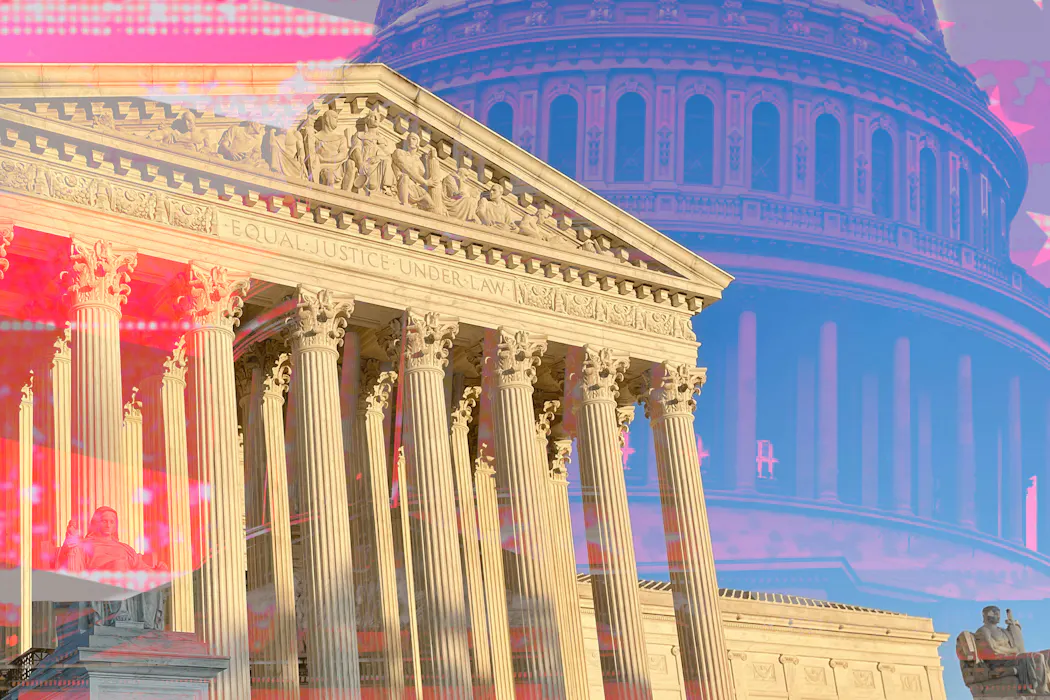
A recent Supreme Court decision is sparking a major push for partisan redistricting. Douglas Rissing, iStock/Getty Images Plus

The outrage was swift and severe when the U.S. Supreme Court, by an ideologically divided 6-3 vote, recently struck down Louisiana’s majority Black congressional district as an unconstitutional racial gerrymander. Critics lambasted the court for gutting the Voting Rights Act, the federal law that had until recently garnered strong bipartisan support and had ensured Black political representation in the South for more than half a century.

Many analysts see Jim Crow-era disenfranchisement of Black voters on the horizon.

Whether Louisiana v. Callais will wreak this kind of havoc remains to be seen, although some Southern states have already begun to redraw their legislative districts, aiming to ensure Republican control. Several Black legislators – all Democrats – are expected to lose their seats in the upcoming midterm elections. Democrats are threatening to retaliate with their own redistricting plans.

Because of a 2019 decision by the court, such political gerrymanders, where a legislative district is crafted to ensure partisan control, cannot be challenged under federal law. Both parties had taken full advantage of that ruling.

Prior to the Callais ruling, however, legislators had to be sure that when they sought partisan control of a district, they did not excessively dilute the voting power of minority residents. Multiple lawsuits had challenged political gerrymanders on exactly these grounds.

After Callais, that guardrail is gone. Indeed, lest they provoke the same type of litigation faced by Louisiana, state legislators must now ignore the race of voters altogether. From here on out, gerrymandering is fine, but only if it’s race-neutral.

This does not mean, however, that the race-blind mapmaking process envisioned by the Supreme Court majority will manifest. Based on our recently published research, it may, in fact, be just the opposite.

Race, we found, is – at least in the South – a more reliable predictor of how someone will vote than their party identification. And that makes race, we believe, a potentially irresistible lure for those designing congressional districts.

Three men in suits with the one on the left, who is Black, swearing an oath with his right hand raised.
In 1972, Andrew Young, left, was the first Black person to be elected to Congress from the deep South since Reconstruction. AP Photo

Race a more reliable predictor

We are both political scientists – one of us an expert on Congress and national elections and the other a constitutional law and Supreme Court scholar. In Southern states, race and political party overlap significantly, with the vast majority of Black voters favoring Democrats and most white voters favoring Republicans. And in our study, we document that in this region, mapmakers actually have an incentive to take race into account when conducting a political gerrymander.

Political gerrymandering is the process of drawing electoral districts to favor one party over another. In most states, the responsibility for drawing districts rests with the state legislature. Thus, the party that controls state legislatures very often controls elections – at both the state and congressional level.

The goal of partisan redistricting is to maximize the chance that candidates from that political party will win elections. Our study shows that using both the race and party of voters to redraw districts, rather than just party alone, better ensures partisan advantage.

The research we conducted was motivated by a claim made by Justice Samuel Alito in another recent racial gerrymandering case decided by the Supreme Court, Alexander vs. South Carolina NAACP. He argued in the court’s majority opinion that when drawing districts to favor one party, mapmakers would need to look only at voters’ party affiliation – their race would be irrelevant to ensuring partisan control.

It is a straightforward, seemingly sensible claim. It is also wrong.

Our study uses an original dataset of precinct-level election results in South Carolina from 2010 to 2020 to explore how well a precinct’s racial and partisan composition before redistricting predicts how it votes over the following decade.

What we found reveals a more complicated picture than Alito – and the subsequent Callais decision – presumes.

A precinct’s Democratic and Republican vote share prior to redistricting was the strongest predictor of future election results. But there are two problems with relying on only such partisan data when gerrymandering a district.

First, our analysis showed that roughly a quarter of a precinct’s voters in the next election did not follow what the partisan data predicted – a sizable amount, given the supposed ease of gerrymandering by party.

Second, precinct election results are surprisingly volatile. Our analysis shows that the effect of preredistricting partisanship varies with election cycles, national conditions, gradual changes in party coalitions and other factors. A precinct that leaned Republican in the election before redistricting may vote very differently in a midterm wave year when the president is unpopular, precisely the type of election coming in November.

By comparison, the analysis shows that voters’ race is a more reliable predictor than their party of how they will vote in the next election. Consequently, it seems that, at least in Southern states, legislators have a genuine, data-driven incentive to use racial data when drawing partisan districts.

A man with white hair and glasses who looks stern and is pointing at someone not in the photo.
Republicans in South Carolina want to draw a new congressional map, and it could eliminate the district that has for decades elected Democrat Jim Clyburn. Kevin Wolf/AP Photo

Will race still affect political gerrymanders?

Consider this redistricting scenario: South Carolina’s Republican-led legislature wants to flip the state’s lone Democratic congressional seat – long held by prominent African American U.S. Rep. Jim Clyburn – for the 2026 midterms. A simple approach is to identify those who voted for Donald Trump in 2024 and then just redraw the district to add enough of those voters to ensure Republican control.

The plan backfires, however. Not only does Clyburn hold his seat, but a neighboring district also elects a Democrat. What went wrong?

Simply put, the legislature failed to realize that past partisan returns are an imperfect predictor of future voting behavior.

A heavily Democratic area that is predominantly Black will vote Democratic far more consistently than a heavily Democratic area that is predominantly white. Two precincts that look identical on a partisan map can behave very differently at the ballot box. And a legislature that fails to take this into account has taken an unreliable route to partisan advantage.

If Republican legislators want to oust Democratic officials, the most reliable route is to oust from a district the minority Democratic voters who would have elected them.

This is not to suggest that legislators should use race in this way. It certainly smacks of racism and echoes the type of electoral machinations used during Jim Crow. But that analogy is not exactly on point. The approach we identified targets the power of Black voters not because they are Black, but because they are such reliable Democrats.

To many, that may be a difference that makes no difference. More litigation over gerrymanders is inevitable. If litigants can demonstrate that race was a “predominant” factor that “drove” redistricting, or that mapmakers purposefully attempted to diminish the power of Black voters because of their race, legal liability can still follow.

Voting rights advocates should be aware of the temptation legislators may have to let race affect their political gerrymanders.

Perhaps minority voters are as free from invidious discrimination as Alito’s majority opinion in the Callais case suggests. This does not mean, however, that those charged with ensuring all voters are fairly represented in American democracy will be colorblind. Our findings show that race could easily remain embedded in the political gerrymandering landscape, despite vehement claims to the contrary.

The Conversation

Jordan Ragusa has served as an expert witness in racial gerrymandering litigation, most notably in Alexander v. South Carolina State Conference of the NAACP. He also serves on the advisory board of Charleston Civil Rights and Civics (C3), an educational non-profit that fosters civic engagement and civil rights awareness among high school students

Claire B. Wofford does not work for, consult, own shares in or receive funding from any company or organization that would benefit from this article, and has disclosed no relevant affiliations beyond their academic appointment.

How Fox News viewership increases belief in the anti-immigrant great replacement theory

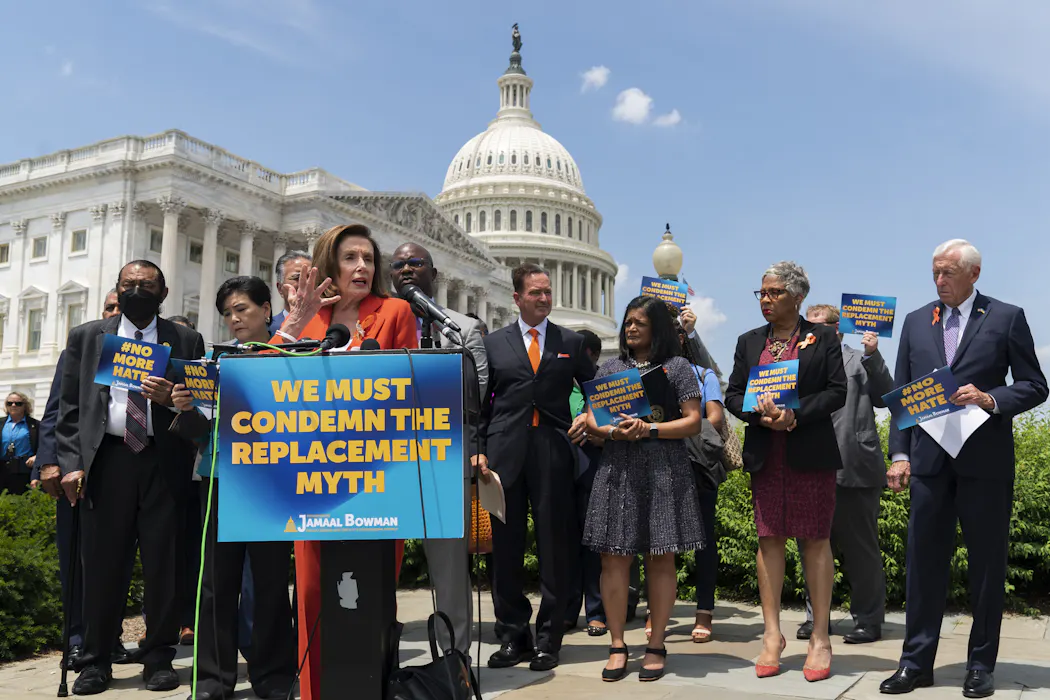
House Speaker Nancy Pelosi speaks on Capitol Hill on June 8, 2022, about a resolution condemning the great replacement theory. AP Photo/Manuel Balce Ceneta

During a Washington Nationals baseball game on May 17, 2026, three people unfurled a large banner from the upper deck of Nationals Park displaying a link to a white nationalist website.

The website, warning of the replacement of whites by people of color, called for the deportation of 100 million people from the United States.

The disturbing incident reflects the broader ascendance of the “great replacement theory,” the xenophobic conspiracy theory asserting that shadowy elites are embracing permissive immigration policies to replace native-born white Americans with immigrants of color.

Prominent Republicans, including President Donald Trump, Speaker of the House Mike Johnson and conservative podcaster Tucker Carlson, have echoed ideas associated with the great replacement theory. And conservative media outlets, such as Fox News, have disseminated them to millions of viewers.

But are the xenophobic ideas recently expressed at Nationals Park limited to a small number of extremists, or are they also endorsed by the broader public? If the latter, how do political and media elites contribute to their spread?

To answer these questions, our team has conducted several nationally representative surveys that ask Americans about their support for key tenets of the great replacement theory.

New immigrants as a threat

We consistently found that a substantial minority of Americans agree with the sentiment that new immigrants threaten the political, cultural and economic power of white Americans. In our latest poll of 1,000 Americans fielded in March 2026, 36% agreed with the statement: “Native-born Americans are losing their economic, political, and cultural influence in this country because of the growing population of immigrants.”

A notable number of Americans – 26% – also believed political elites are trying to “replace” the existing white population, agreeing with the statement: “There are people who secretly work to make sure immigrants will eventually replace real Americans.”

Support for these beliefs is concentrated most heavily among white Americans, Republicans, conservatives and self-identifying members of Donald Trump’s Make America Great Again movement. Indeed, more than 3 in 4 members of the MAGA movement and close to 6 in 10 Republicans agreed with the statement: “Immigrants invade and colonize the United States.”

But what explains this spread of the great replacement theory?

In our newly published, peer-reviewed study, we used nationally representative panel survey data that tracked over 500 white Americans over time to attempt to answer this question.

We found that white Americans who identified as Republican, who are conservatives and who have negative views of people from other racial backgrounds are all more likely to express support for key tenets of the great replacement theory. Moreover, we uncovered clear evidence that white Americans who watch Fox News are also more likely to agree with the conspiracy theory.

Given the popularity of Fox News, we believe this latter point deserved further investigation. As detailed in our paper, while 39% of all white Americans agree that immigrants invade and colonize the U.S., 61% of white Americans who watch Fox News agree with this view. Even when taking into account partisan identification, ideology, racial attitudes and demographic characteristics, Fox News viewership remains significantly associated with more support for the great replacement theory.

Additionally, because we tracked white Americans over time, we could observe changes in their support for the conspiracy theory in response to variations in their viewership of Fox News. Simply put, the more Fox News programming that a white American watches, the more likely they are to adopt the conspiracy theory.

A Black man wearing sunglasses speaks outdoors in front of a lecturn.
House Majority Whip Jim Clyburn delivers remarks on the mass shooting at the Tops Grocery Store in Buffalo, N.Y., and the rise in replacement theory rhetoric, on May 19, 2022, in Washington, D.C. Anna Moneymaker/Getty Images

Links to political violence

Our research builds on decades of work showing that public opinion is strongly influenced by media consumption. Recent scholarship, in particular, highlights the influence of Fox News on public opinion. It shows how exposure to Fox News leads Americans to express more conservative attitudes about the COVID-19 pandemic, immigration policies and criminal justice issues.

Given the attention that Fox News hosts, elected officials and pundits dedicate to the great replacement theory, our results suggest that this coverage has indeed influenced the views of white Americans. The great replacement theory is no longer purely on the fringes of society.

In our view, this is troubling, not only because the conspiracy theory treats immigration as an existential issue — where the stakes are framed as the very preservation of one’s self and country — but also because the theory is also linked to numerous instances of political violence directed at people of color and religious minorities.

As America approaches its 250th birthday, the nation will no doubt continue to grapple with the topic of immigration, race and what it means to be an American.

While there’s plenty of room for disagreement over immigration policy, conspiracy theories make it much harder to find common ground or craft political compromises. What we’ve found is that when prominent media embrace conspiracy theorizing, increased public endorsement of conspiracies will follow.

The Conversation

Jesse Rhodes receives funding from the National Science Foundation, the Spencer Foundation, and Demos.

Tatishe Nteta receives funding from the Russell Sage Foundation.

Adam Eichen does not work for, consult, own shares in or receive funding from any company or organization that would benefit from this article, and has disclosed no relevant affiliations beyond their academic appointment.
Why a growing number of Trump supporters are experiencing voter’s remorse

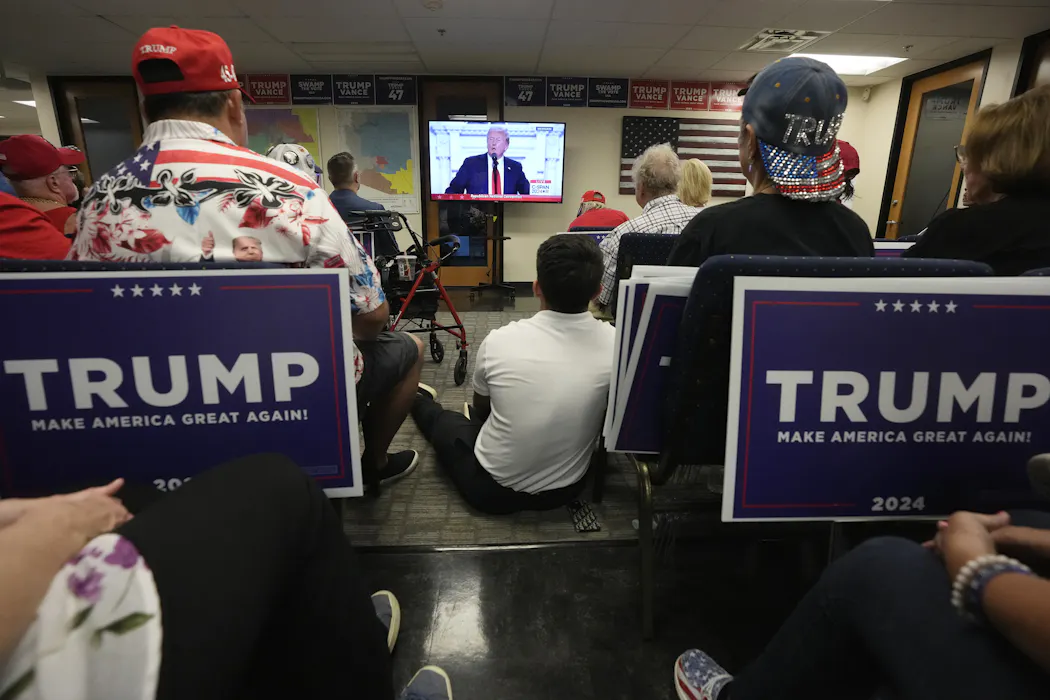
Phoenix residents watch presidential candidate Donald Trump speak at the Republican National Convention on July 18, 2024. AP Photo/Ross D. Franklin

In recent months, some prominent conservatives and erstwhile allies of President Donald Trump – former U.S. Rep. Marjorie Taylor Greene and journalist Megyn Kelly, for example – have voiced their displeasure with him on several issues. They range from Trump’s handling of the Iran war and the economy to the release of information concerning his relationship with convicted sex offender Jeffrey Epstein.

Most notably, political commentator Tucker Carlson, once one of Trump’s most stalwart loyalists, expressed remorse for his previous support for the president, declaring in April 2026, “It’s not enough to say, well, I changed my mind – or like, oh, this is bad, I’m out.” Carlson said he will be “tormented” by his support for Trump “for a long time” and that he is “sorry for misleading people.”

Growing unease with the Trump administration among these former allies comes amid some of the worst polling of Trump’s career. According to data compiled by pollster G. Elliott Morris, Trump’s popularity has been steadily declining over the past year. Americans are seriously questioning his handling of key issues, such as inflation, immigration, jobs and foreign affairs.

But beyond former prominent Trump allies, are there other Trump supporters having second thoughts about their votes in the 2024 presidential election? To answer this question, we conducted a nationally representative poll of 1,000 U.S. adults who were recruited from an online panel maintained by YouGov, a survey research firm.

We asked self-identified Trump voters about their votes in the 2024 election. Our results suggest that a growing number of them – especially moderates, African Americans and young people – are experiencing voter’s remorse.

A hand picks up a sticker off a table.
In our poll, roughly one-third of political moderates and African Americans who voted for Trump in 2024 said they would vote otherwise if the election were held again. AP Photo/George Walker IV, File

Support for Trump remains strong

To be clear, our survey shows that most Trump voters remain in the president’s camp.

We found that 84% of 2024 Trump voters say they would vote for Trump if given the chance to vote again in the 2024 election. That’s down 2 percentage points since we previously asked this question in July 2025.

Over 90% of members of Trump’s core base of voters – including 93% of self-identified Republican Trump voters, 95% of self-identified conservative Trump voters and 92% of Trump voters over age 55 – said they would vote for Trump as they did in 2024 if given a second chance.

Regretful Trump voters

But some groups of Trump voters are having second thoughts. The most regretful are those with whom Trump made significant gains in 2024. They include political independents, African Americans, younger people and those with more education.

Roughly 3 in 10 2024 Trump voters who identify as political moderates and African Americans said they would vote differently if the election were held again. And roughly a quarter of young and middle-aged Trump voters also suggested they would not vote for Trump if they could redo their 2024 vote.

Twenty percent of Trump supporters with postgraduate degrees expressed a reluctance to vote for Trump if given a second opportunity. Voters with some college experience and those making less than $40,000 annually reported the same sentiment in similar percentages.

Perhaps most politically perilous, 31% of independents who voted for Trump in 2024 would not vote for him again in an election do-over.

Several people wearing baseball hats watch a man speak on TV.
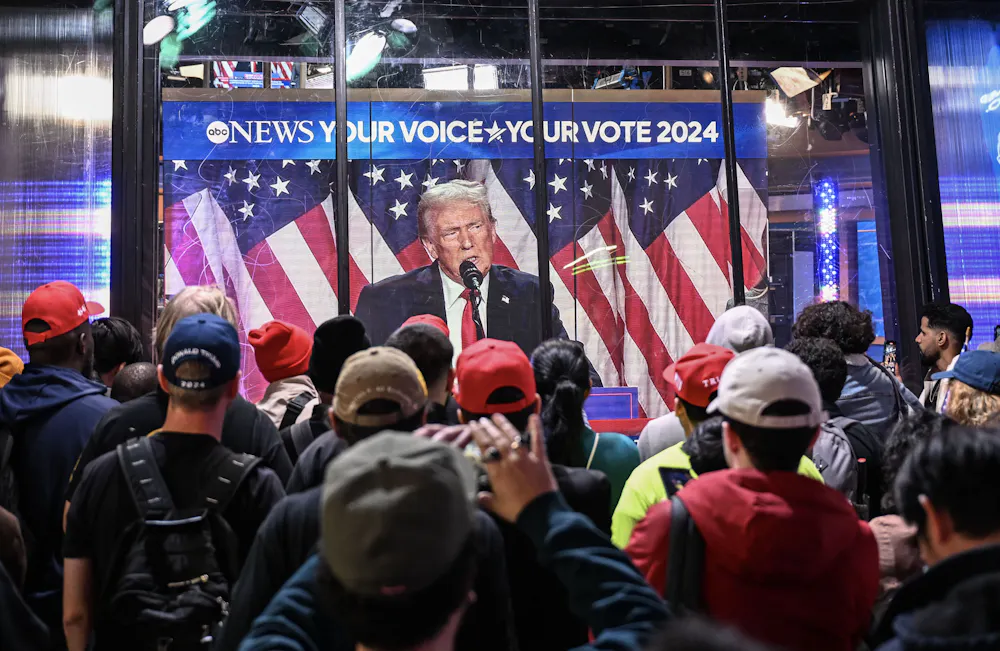
New York City residents watch Donald Trump speak as votes are tallied for the presidential election on Nov. 6, 2024. Fatih Aktas/Anadolu via Getty Images

Cracks in the coalition

What is pushing Trump voters away from the president?

There is no single cause, but our results suggest that negative perceptions of Trump’s performance on high-profile issues are playing a big role. A substantial portion of Trump voters who give the president a negative grade on the economy (22%), the Epstein files (37%) and the Iran war (49%) say they would not vote for him in an election redo.

Our results suggest that cracks are forming in the Trump coalition and that they are concentrated among the groups that before 2024 were less likely to vote for the president.

Trump may take solace in the continued loyalty of his strongest supporters. But in a close election every vote counts, and lingering dissatisfaction could undermine Republicans’ ability to mobilize key swing voters.

As Republicans face the electorate in upcoming midterms, Trump and the GOP will have to work to reclaim the support of regretful voters. Failure to do so could cost Republicans Congress in 2026 and, ultimately, the presidency in 2028.

The Conversation

Jesse Rhodes has received funding from the National Science Foundation, the Spencer Foundation, Demos, and the University of Massachusetts Amherst.

Adam Eichen and Tatishe Nteta do not work for, consult, own shares in or receive funding from any company or organization that would benefit from this article, and have disclosed no relevant affiliations beyond their academic appointment.

❌
Subscriptions