Normal view

Racial gerrymandering may be here to stay

A recent Supreme Court decision is sparking a major push for partisan redistricting. Douglas Rissing, iStock/Getty Images Plus

The outrage was swift and severe when the U.S. Supreme Court, by an ideologically divided 6-3 vote, recently struck down Louisiana’s majority Black congressional district as an unconstitutional racial gerrymander. Critics lambasted the court for gutting the Voting Rights Act, the federal law that had until recently garnered strong bipartisan support and had ensured Black political representation in the South for more than half a century.

Many analysts see Jim Crow-era disenfranchisement of Black voters on the horizon.

Whether Louisiana v. Callais will wreak this kind of havoc remains to be seen, although some Southern states have already begun to redraw their legislative districts, aiming to ensure Republican control. Several Black legislators – all Democrats – are expected to lose their seats in the upcoming midterm elections. Democrats are threatening to retaliate with their own redistricting plans.

Because of a 2019 decision by the court, such political gerrymanders, where a legislative district is crafted to ensure partisan control, cannot be challenged under federal law. Both parties had taken full advantage of that ruling.

Prior to the Callais ruling, however, legislators had to be sure that when they sought partisan control of a district, they did not excessively dilute the voting power of minority residents. Multiple lawsuits had challenged political gerrymanders on exactly these grounds.

After Callais, that guardrail is gone. Indeed, lest they provoke the same type of litigation faced by Louisiana, state legislators must now ignore the race of voters altogether. From here on out, gerrymandering is fine, but only if it’s race-neutral.

This does not mean, however, that the race-blind mapmaking process envisioned by the Supreme Court majority will manifest. Based on our recently published research, it may, in fact, be just the opposite.

Race, we found, is – at least in the South – a more reliable predictor of how someone will vote than their party identification. And that makes race, we believe, a potentially irresistible lure for those designing congressional districts.

Three men in suits with the one on the left, who is Black, swearing an oath with his right hand raised.
In 1972, Andrew Young, left, was the first Black person to be elected to Congress from the deep South since Reconstruction. AP Photo

Race a more reliable predictor

We are both political scientists – one of us an expert on Congress and national elections and the other a constitutional law and Supreme Court scholar. In Southern states, race and political party overlap significantly, with the vast majority of Black voters favoring Democrats and most white voters favoring Republicans. And in our study, we document that in this region, mapmakers actually have an incentive to take race into account when conducting a political gerrymander.

Political gerrymandering is the process of drawing electoral districts to favor one party over another. In most states, the responsibility for drawing districts rests with the state legislature. Thus, the party that controls state legislatures very often controls elections – at both the state and congressional level.

The goal of partisan redistricting is to maximize the chance that candidates from that political party will win elections. Our study shows that using both the race and party of voters to redraw districts, rather than just party alone, better ensures partisan advantage.

The research we conducted was motivated by a claim made by Justice Samuel Alito in another recent racial gerrymandering case decided by the Supreme Court, Alexander vs. South Carolina NAACP. He argued in the court’s majority opinion that when drawing districts to favor one party, mapmakers would need to look only at voters’ party affiliation – their race would be irrelevant to ensuring partisan control.

It is a straightforward, seemingly sensible claim. It is also wrong.

Our study uses an original dataset of precinct-level election results in South Carolina from 2010 to 2020 to explore how well a precinct’s racial and partisan composition before redistricting predicts how it votes over the following decade.

What we found reveals a more complicated picture than Alito – and the subsequent Callais decision – presumes.

A precinct’s Democratic and Republican vote share prior to redistricting was the strongest predictor of future election results. But there are two problems with relying on only such partisan data when gerrymandering a district.

First, our analysis showed that roughly a quarter of a precinct’s voters in the next election did not follow what the partisan data predicted – a sizable amount, given the supposed ease of gerrymandering by party.

Second, precinct election results are surprisingly volatile. Our analysis shows that the effect of preredistricting partisanship varies with election cycles, national conditions, gradual changes in party coalitions and other factors. A precinct that leaned Republican in the election before redistricting may vote very differently in a midterm wave year when the president is unpopular, precisely the type of election coming in November.

By comparison, the analysis shows that voters’ race is a more reliable predictor than their party of how they will vote in the next election. Consequently, it seems that, at least in Southern states, legislators have a genuine, data-driven incentive to use racial data when drawing partisan districts.

A man with white hair and glasses who looks stern and is pointing at someone not in the photo.
Republicans in South Carolina want to draw a new congressional map, and it could eliminate the district that has for decades elected Democrat Jim Clyburn. Kevin Wolf/AP Photo

Will race still affect political gerrymanders?

Consider this redistricting scenario: South Carolina’s Republican-led legislature wants to flip the state’s lone Democratic congressional seat – long held by prominent African American U.S. Rep. Jim Clyburn – for the 2026 midterms. A simple approach is to identify those who voted for Donald Trump in 2024 and then just redraw the district to add enough of those voters to ensure Republican control.

The plan backfires, however. Not only does Clyburn hold his seat, but a neighboring district also elects a Democrat. What went wrong?

Simply put, the legislature failed to realize that past partisan returns are an imperfect predictor of future voting behavior.

A heavily Democratic area that is predominantly Black will vote Democratic far more consistently than a heavily Democratic area that is predominantly white. Two precincts that look identical on a partisan map can behave very differently at the ballot box. And a legislature that fails to take this into account has taken an unreliable route to partisan advantage.

If Republican legislators want to oust Democratic officials, the most reliable route is to oust from a district the minority Democratic voters who would have elected them.

This is not to suggest that legislators should use race in this way. It certainly smacks of racism and echoes the type of electoral machinations used during Jim Crow. But that analogy is not exactly on point. The approach we identified targets the power of Black voters not because they are Black, but because they are such reliable Democrats.

To many, that may be a difference that makes no difference. More litigation over gerrymanders is inevitable. If litigants can demonstrate that race was a “predominant” factor that “drove” redistricting, or that mapmakers purposefully attempted to diminish the power of Black voters because of their race, legal liability can still follow.

Voting rights advocates should be aware of the temptation legislators may have to let race affect their political gerrymanders.

Perhaps minority voters are as free from invidious discrimination as Alito’s majority opinion in the Callais case suggests. This does not mean, however, that those charged with ensuring all voters are fairly represented in American democracy will be colorblind. Our findings show that race could easily remain embedded in the political gerrymandering landscape, despite vehement claims to the contrary.

The Conversation

Jordan Ragusa has served as an expert witness in racial gerrymandering litigation, most notably in Alexander v. South Carolina State Conference of the NAACP. He also serves on the advisory board of Charleston Civil Rights and Civics (C3), an educational non-profit that fosters civic engagement and civil rights awareness among high school students

Claire B. Wofford does not work for, consult, own shares in or receive funding from any company or organization that would benefit from this article, and has disclosed no relevant affiliations beyond their academic appointment.

Inflation and immigration fears threaten to dampen Miami’s economic benefits from the World Cup

U.S. host cities are concerned that predictions for attendance and spending at the 2026 World Cup may not materialize. DeFodi Images/DeFodi Images via Getty Images

When the U.S. last hosted the World Cup in 1994, the event drew unexpectedly large crowds. At that time, soccer wasn’t as popular among Americans as it is now, so expectations for attendance had been fairly low.

So as the U.S. prepared to host the World Cup again in 2026, expectations for tourism were high.

But in the run-up to this year’s World Cup, the ongoing war in Iran has resulted in soaring inflation and high fuel prices, neither of which bodes well for tourism or event attendance.

Recent tourism reports indicate there will be fewer hotel reservations than anticipated due to reduced international travel confidence and a growing uncertainty related to U.S. immigration policies, geopolitical instability, tariffs and inflation.

We are a professor of hospitality and tourism management and a professor in international sports management. We believe there is good reason for concern in the 11 World Cup host cities in the U.S. An additional five cities in Mexico and Canada are likewise hosting games, and the next 10 days leading up to the event will be crucial for them to capitalize on it.

Falling short

The month leading up to the world’s largest sporting festival should be a period of excitement and celebration. But a few factors are putting a damper on that.

First, the price of tickets, plus parking and public transportation to games, is incredibly high. This has led to widespread criticism, with even President Donald Trump stating that he would not pay the US$1,000 ticket price for matches once he learned of the high prices.

In Boston, the Massachusetts Bay Transportation Authority plans to charge $80 for a ride to Gillette Stadium that would typically cost $20. New Jersey Transit originally set fares for train tickets from Penn Station in New York to MetLife Stadium at $150 for World Cup travel, which it reduced to $105 this month after public backlash – still way above its normal fares.

According to a survey from the American Hotel and Lodgings Association, hotel bookings are softer than expected in all 11 U.S. cities hosting World Cup events. Miami is in the best position, with only 45% of local hotel owners projecting a shortfall. That’s compared with 75% reporting bookings below expectations in cities like Philadelphia and San Francisco. The worst off is Kansas City, with a whopping 85% to 90% of hotel owners reporting fewer bookings than expected – lower than even a normal summer without a mega event coming to town.

Welcome to Miami

Based on early 2026 forecasts for hospitality and tourism, Miami was expected to welcome millions of visitors during the World Cup period. However, many tourism analysts project that economic gains may fall short if current negative trends do not improve dramatically.

Hotel reservations in South Florida made by international travelers are weak compared with previous mega events. This is particularly the case when it comes to visitors from Latin American and the Middle East. The American Hotel and Lodgings Association survey notes that current U.S. immigration procedures and visa delays may be discouraging international visitors, thus causing the majority of cities to report shortfalls as of May 2026.

With Trump’s Mar-a-Lago Resort just 75 miles (120 kilometers) north of Miami, perceptions of heightened security in the area may be exacerbating safety concerns about attending World Cup matches. Indeed, civil rights groups like the Florida Immigrant Coalition have warned international travelers of risks of detention when visiting Florida in particular.

Lionel Messi in an Inter Miami uniform makes the 'money' hand gesture.
Lionel Messi’s presence on Inter Miami has raised the team’s revenue and increased interest in soccer in South Florida. Icon Sportswire/Icon Sportswire via Getty Images

Despite these challenges, we believe Miami still has strong potential to maximize economic benefits if strategic actions are implemented immediately for short-term and pre- and post-event lodging, food and tourism experiences.

Miami’s international brand recognition, multicultural environment and entertainment infrastructure remain significant advantages over other U.S. host cities. It also helps that the city is home to one of world soccer’s most recognizable face: Lionel Messi. Messi’s presence in Miami has been worth billions to the regional economy, according to The Wall Street Journal.

There’s still time on the clock

Miami’s success will heavily depend on active and agile planning, leadership and administration from government and organizational officials. The next 10 days will be critical in determining whether Miami can fully capitalize on the economic opportunities associated with one of the world’s largest sporting events.

Aggressive destination campaigns between tourism boards, airlines and hotels, especially those targeting Latin America, could help rebuild traveler confidence and increase advanced bookings. In particular, expanded Spanish-language marketing and multilingual communication strategies are an important competitive advantage both for the World Cup and beyond. Telemundo, one of the two main U.S. Spanish-language networks, is headquartered in Miami.

And even with many travelers feeling price-sensitive due to inflation and economic uncertainty, bundled offers can help stimulate tourism. Affordable travel packages and value-added promotions may encourage longer stays and higher visitor spending, even for travelers on a budget.

Campaigns and travel packages that encourage visitors to explore local neighborhoods, cultural attractions, culinary tourism and sustainable tourism activities – in addition to the World Cup games – can help distribute economic benefits more broadly throughout the city.

The hospitality industry can help allay the fears of travelers worried about safety by prioritizing safety communication and visitor assistance services. Transparent communication and multilingual services go a long way toward assuaging international travelers’ anxiety about security and immigration. People feel more comfortable traveling when there are clear rules and requirements around airport procedures, visas and security measures.

We believe that the key to success of the 2026 World Cup in the U.S., including Miami, is to understand current economic and political concerns fairly and correctly first, and then implement innovative short-term strategies before the event kicks off.

The Conversation

The authors do not work for, consult, own shares in or receive funding from any company or organization that would benefit from this article, and have disclosed no relevant affiliations beyond their academic appointment.

Most Americans broadly support public education for undocumented students – regardless of their political affiliation and religion

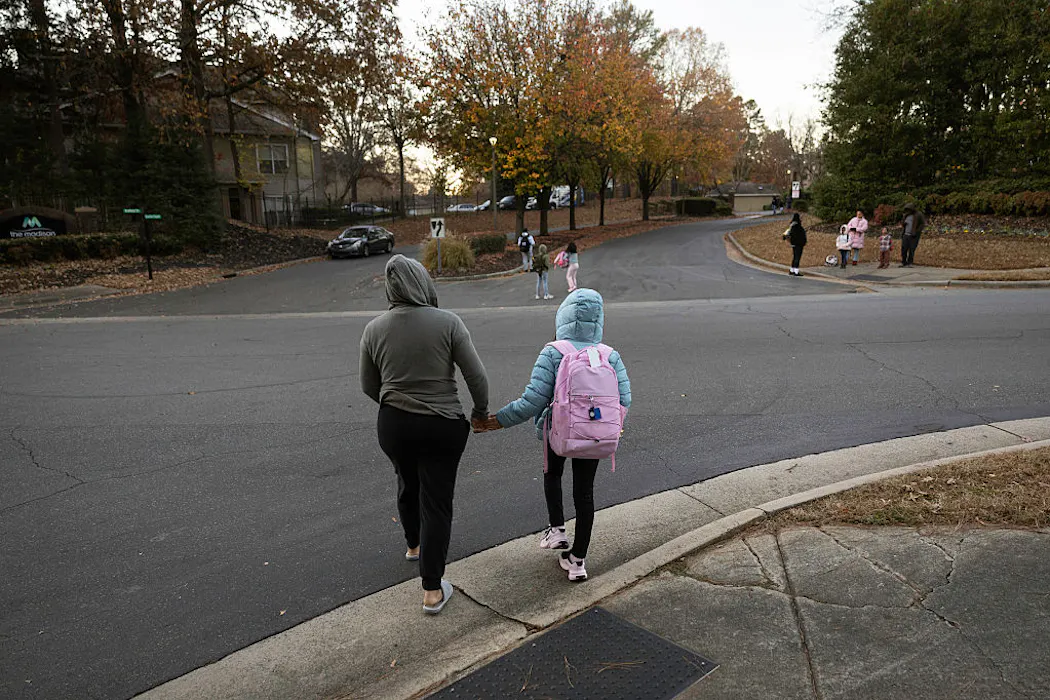
An undocumented Honduran immigrant walks her child to a school bus stop in November 2025 at an unspecified location in the U.S. John Moore/Getty Images

All public schools in the U.S. must provide an education to all students, regardless of their immigration status.

In 1982, the U.S. Supreme Court affirmed the right of immigrant students in Texas to attend school free of charge, regardless of their citizenship, in Plyler v. Doe. Texas had passed a law in 1975 that allowed public school districts to charge these students tuition, or not let them attend altogether. This law was repealed following the Supreme Court decision.

As scholars of history and education, we are particularly interested in understanding how Americans feel about this policy, which has been in place for four decades.

Some legislators in states like Ohio, Idaho and Oklahoma have unsuccessfully tried to make it harder for immigrant students to attend public school, by proposing that all public school students must share their immigration status prior to enrolling in school.

Tennessee considered a bill in 2025 and 2026 that would allow public school districts to not admit undocumented students. Though the bill passed the state Senate, it did not ultimately pass the House.

In March 2026, Republican representatives led a Congressional hearing focused on Plyer’s negative effects on U.S. schools and students, such as straining schools’ funding and available resources. The conservative think tank Heritage Foundation has called on all state legislators to propose laws that would challenge undocumented students’ right to attend public schools free of charge.

But what do most Americans actually think about undocumented students attending public schools? According to our recent survey, which is in the process of publication, most Americans broadly support public education for undocumented children.

A white sign with black writing says 'Hands off our immigrant students'
All immigrant children have the right to attend public school, though there have been some state efforts to challenge this. Tyler Russell/Connecticut Public via Getty Images

Who supports public school for all?

In mid-April 2026, with support from the Public Religion Research Institute – an organization that supports public scholarship on the beliefs of the American public – two colleagues and I worked with Ipsos to survey a nationally representative random sample of more than 1,500 Americans about their views on public education and immigration. It was a diverse cross section of people who held a range of political beliefs and affiliations.

We asked respondents whether they agreed with the statement: “I believe all children, regardless of immigration status, should have the right to public education.”

We found that there were obvious differences between survey respondents’ views, depending on their political affiliation. For instance, of the survey respondents who voted for former Vice President Kamala Harris in 2024, 95.7% of people agreed with the statement. Only 48.8% of survey respondents who voted for President Donald Trump agreed with the statement.

Similarly, 57.5% of Republicans overall agreed with the statement, while 93.9% of Democrats did.

But other than this political divide, we found strong support for universal education across all ages, ethnicity and faiths, with 75.5% of all Americans agreeing with the statement.

The survey revealed strong support for universal education, with 75.5% of all Americans agreeing with the statement. Among Hispanics and Latinos, nearly 86.9% supported the policy, along with 86.7% of African Americans, 77.7% of Asians Asian Americans and 69.9% of non-Hispanic white people.

In each income bracket, there was over 70% of support for free public education for all. Wealthier Americans – those making more than US$150,000 a year – supported this policy least, at 70.4%. More than 77% of those making under $150,000 supported it. Those making under $25,000 a year supported it by 82%.

Among age groups, American adults between 18-29 had the highest support for undocumented immigrant children attending public school, at 81.4%. Americans we surveyed over the age of 60, meanwhile, had the least support for the policy, at 71.5%.

Our survey showed that even looking at educational levels, there was little difference, with every group supporting public education for all students at 73% or more.

Across a range of faiths, people tended to support public education for all students, including undocumented immigrants. We found that 92.9% of Muslims, 82.2% of unaffiliated respondents, 81.1% of Jewish respondents, 79.5% of Catholics and 72.6% of mainline Protestants supported the idea of undocumented students attending school for free.

Evangelical Protestants were the outliers, with only 59.9% agreeing with this policy.

A shift in public opinion

While our data shows that today there’s widespread support for immigrant kids attending public school, these attitudes have shifted over time.

We can compare these numbers with polling about past state legislation, such as California’s Proposition 187, which passed in 1994.

Almost 60% of the state voted that year to bar undocumented students from public education. A federal court struck down the law in 1998 as unconstitutional.

While little other public polling exists showing how people feel about the Supreme Court’s Plyler ruling, there is data on a related question about undocumented immigrants who came to the country as children, often known as Dreamers. There seems to have been a shift since the ‘90s in public opinion toward supporting undocumented students. Much of this may have been due to the strong advocacy of Dreamers themselves.

In 2020, Pew Research found 74% of Americans think that people who were brought to the U.S. as young children without legal authorization should be allowed to legally stay in the country. Approximately 91% of Democrats said they thought Dreamers should be able to remain in the U.S., while 54% of Republicans said the same.

At 57.5%, Republicans’ support for public education for undocumented children might seem low. However, it does correlate with other recent polling from the University of Massachusetts-Amherst that shows 91% of Republicans support Trump’s overall immigration policies.

Even as political parties may play a role influencing views toward immigration, as a whole, Americans overwhelmingly support public education for all children.

The Conversation

The authors do not work for, consult, own shares in or receive funding from any company or organization that would benefit from this article, and have disclosed no relevant affiliations beyond their academic appointment.

What happens to debt when someone dies?

The fate of a person's debts after they die depends in part on what they owned. MicroStockHub/iStock via Getty Images Plus

Curious Kids is a series for children of all ages. If you have a question you’d like an expert to answer, send it to CuriousKidsUS@theconversation.com.


What happens to debt when someone dies? – Lucy, age 17, Cincinnati, Ohio


Imagine everyone has a large piggy bank that represents everything they own. Inside it are items such as cash in a bank account, a home, a car, clothing, jewelry, furniture, investments and other valuables. On the outside of the piggy bank are sticky notes labeled IOU – promises to repay borrowed money some day.

These IOUs represent the debt people owe others. Examples of consumer debt include credit card balances you haven’t paid off, outstanding car loans or home loans, unpaid medical bills and student loans.

As a finance professor who teaches and studies how money works, I can explain that most debts don’t disappear when the person who owes money dies.

Usually, executors manage estates

When someone passes away, their assets and debts become what’s known as an estate. Estates include everything that person owned, such as cash in bank accounts, any homes, boats, vehicles, clothing, jewelry, furniture, stocks, bonds, retirement accounts, intellectual property – copyrights, patents and trademarks – and other valuable things.

Then, someone is appointed to manage the estate. This person, called an executor, manages the distribution of anything left in the estate. In most cases, the deceased names an executor in their will, a document that spells out what should happen to their assets after death.

Going through probate

If no executor was named before death, or if someone was named but either cannot or will not serve, a special court that deals with estates, called a probate court, appoints an administrator to handle the estate.

If the person died without a legitimate will and has no living relatives, their property goes through a process called escheatment, where the assets pass to the government after debts are paid off.

When someone has written a will, their estate – with some exceptions – goes straight into the probate process. The court confirms the will, appoints the executor and ensures that all debts and taxes are paid off before the remaining assets are distributed to people and organizations known as beneficiaries that the person who owned the assets named in their will. They may include any combination of relatives, friends and charities.

The executor looks at everything the deceased had left and adds up its total value. Next, they identify and total all debts and use the estate’s assets to pay off its debts.

House with gavel. Real estate law and house auction concept.
When the deceased owned a house, the sale or inheritance of that property will be sorted out during probate. manusapon kasosod/Moment via Getty Images

As long as the estate’s assets are worth more than its debts, beneficiaries receive money and other items of value from the estate.

If someone dies without a will, they are considered intestate. In that case, the probate court appoints an administrator, often a close relative, such as a spouse or child. Later, the contents of the estate are distributed to the deceased’s relatives in accordance with state law, even if this differs from the deceased’s unwritten wishes.

In some cases, this process can take many years, and even decades, to wrap up.

When the piggy bank falls short

There are times, however, when estates are insolvent, meaning that their debts are worth more than their assets. That means they can’t afford to cover all of their IOUs. In such cases, some creditors – the people or companies owed money – may not be paid in full.

Importantly, relatives of a deceased person are not responsible for paying off any remaining debts with their own money.

However, the estate may end up using funds it would have otherwise inherited to pay off the deceased person’s outstanding debts.

And there are some situations in which others may still be responsible for repaying those debts, especially for bills tied to the medical treatments they received as part of their end-of-life care.

Different rules in some states

For example, a deceased person’s spouse may need to help pay debts if they are what’s known as a cosigner for the medical treatment or if they live in a community property state, such as Arizona, California and Texas, where spouses share ownership of most assets and debts acquired during the marriage. Some states have filial responsibility laws that could require adult children to help pay a deceased parent’s unpaid medical or nursing home bills, though these laws are rarely enforced.

Also, if someone agreed to take responsibility for a debt while the deceased person was alive, they may still be required to pay it. Furthermore, if that person shared a credit card with someone else, the surviving cardholder is typically responsible for any remaining balance. This law depends on the type of account held and may vary in some states.

If the deceased had a mortgaged property, their beneficiaries can keep it – as long as they continue to make the necessary payments. Families and friends in that situation can also sell homes and use some or all of the proceeds to pay off the loans.

When a property is underwater – meaning it’s worth less than the remaining home loan – the lender takes the loss on the unpaid balance. Heirs are not personally responsible for the deceased’s home loan, but the lender will first seek repayment from the estate.

Financial data shows that about 73% of Americans die with some unpaid debt. Each year in the United States, about 160,000 to 340,000 people die with more debt than assets. But this situation might change within two or three decades as younger Americans inherit an estimated US$110 trillion after the death of today’s older generations.

Although this topic is sad, it’s a good reminder that having money comes with responsibilities and that planning ahead can protect your loved ones. I also think that understanding how things work, even after death, can make what you need to do in your lifetime much clearer and less overwhelming.


Hello, curious kids! Do you have a question you’d like an expert to answer? Ask an adult to send your question to CuriousKidsUS@theconversation.com. Please tell us your name, age and the city where you live.

And since curiosity has no age limit – adults, let us know what you’re wondering, too. We won’t be able to answer every question, but we will do our best.

The Conversation

James Malm does not work for, consult, own shares in or receive funding from any company or organization that would benefit from this article, and has disclosed no relevant affiliations beyond their academic appointment.
❌
Subscriptions