Normal view

Life after death: From burned trees to bleached corals, how dead organisms live on as the building blocks of new life

People’s knee-jerk reaction to seeing death in nature is often not positive. The burn scar left by wildfire on a once-forested hillside, or a ghostly white coral reef, may evoke tragedy and despair. But in nature, most plants and animals are recycled back into new life.

The fallen branches and leaves that crunch under your boots as you step on the forest floor are providing nutrients for new growth as they decompose. Empty shells can become the foundations for new sea life to grow. Dead organic matter left over after a harvest supports soils and the production of food that feeds people worldwide.

These remnants of life can set both the pace and outcome of ecosystem recovery, enabling life to persist and thrive, or preventing it from doing so.

Ecologists, like us, refer to this as ecological memory, where remnants of the past influence how ecosystems look and behave in the present. Similar to human memories, traumatic events can have the strongest influences in nature: Fires, storms, heat waves and outbreaks of pests or disease can cause widespread death of plants and animals, leaving behind abundant and lasting physical remains.

In a new paper published in Science Advances, working with colleagues around the country, we show how death plays nuanced and powerful roles in nature’s afterlife.

In some cases, dead organisms prevent life from returning after an extreme event. In other cases, they make ecosystems more resilient by fueling regeneration of new life and hastening recovery. Understanding this afterlife and its influence on ecosystems will be increasingly valuable for helping ecosystems recover in a changing climate.

Foundation species – nature’s architects

Our study focused on a set of ecologically important organisms, known as foundation species. These are abundant and iconic organisms, such as trees, grasses, oysters and corals, that create the natural infrastructure on which entire communities of organisms exist.

Foundation species can be found everywhere, from the depths of the oceans to the summits of mountains. Because they are so abundant while alive, they can remain abundant after they die. And their influence can carry on in an afterlife that shapes the trajectories of ecosystems, either supporting recovery to the ecosystem’s original structure or transforming it into a new one.

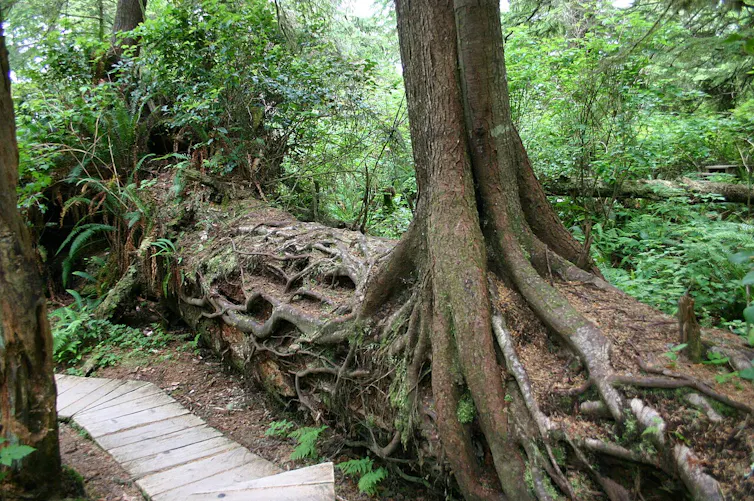
Trees of different ages grow from a fallen log.
A fallen log serves as a nursery for a new hemlock tree in British Columbia, Canada, hence the nicknames nursery log or nurse log. Seeds often struggle to establish themselves on the ground, but decaying trees provide soft, nutrient-rich environments with less competition or risk from soil fungus. Wing-Chi Poon, CC BY-SA

To investigate how the dead remains of foundation species affect the ability of their living counterparts to establish, grow and survive, we tapped into a U.S. National Science Foundation network of Long Term Ecological Research. Scientists at these sites track populations of foundation species across a diversity of ecosystems that have experienced different extreme events.

We looked at coral reefs, mangrove forests, salt marshes, kelp forests, oyster reefs, tropical rainforests, temperate rainforests, hemlock forests, tallgrass prairies and boreal forests, ranging from the tropics to just shy of the Arctic Circle.

We found that, following extreme events, the dead affect the living more commonly than we expected. The dead foundation species either significantly increased or decreased living foundation species in nine out of the 10 ecosystems we studied – the kelp forest was the only exception.

In roughly half of the cases, dead foundation species hampered the ability of their living counterparts to reestablish, grow and survive after extreme events.

Take the tropical montane rainforest of Puerto Rico. This ecosystem is periodically walloped by hurricanes that strip its canopy and blanket the forest floor with tree branches and leaves. This layer of debris chokes off sunlight needed by the seedlings below and reduces the number that emerge to replace the trees lost during the storm, ultimately slowing the forest’s recovery.

Kai Kopecky clears dead coral skeletons from a research site. Lauren Enright

The South Pacific coral reefs of Moorea present a more extreme example. Marine heat waves that cause coral bleaching can transform these reefs into something fundamentally different: ghost towns of dead skeletons overgrown by seaweeds. The nooks and crannies of the standing coral skeletons provide an opportunity for the seaweeds, which compete with coral for reef space, to proliferate and take over the reef, preventing the return of corals.

But in the other cases we studied, we found that dead organisms actually promote the regeneration of their living counterparts.

For example, the mangrove forests of the Florida Everglades actually benefit from storm-generated debris. During a hurricane, leaf litter blown or washed out of the canopy ended up in the complex network of roots below, providing a pulse of nutrients that enhanced the production of new roots and hastened mangrove recovery.

Mangroves put down roots in a coastal area.
When mangroves are torn up by storms, they can rebuild on top of one another. The recovery can take years, so frequent storms make recovery slower. Tommy Shannon/Florida Coastal Everglades LTER, CC BY-SA

In the Eastern hemlock forests of New England, an outbreak of a tree-killing pest – the woolly adelgid – left behind wide swaths of standing dead trees. But unlike the dead skeletons on a bleached reef, these dead trees often help new hemlock saplings grow by maintaining a favorable climate on the ground below.

The question now is, how can humanity use this information to fortify the resilience of ecosystems after extreme events?

How humans can help

As humans, many of us rely on therapy to help manage how traumatic memories affect our lives. We can also help ecosystems manage the remnants of dead organisms after disasters in several ways.

On land, standing dead trees are sometimes felled to create “nurse logs,” which release nutrients that nourish living trees. Dead grass litter is removed using prescribed burning to create better conditions for new grass to grow. On the coasts, dead oyster shells are deposited onto mud flats, and the rubble of coral skeletons is either stabilized or removed to create more solid substrates where new oysters and corals can settle, grow and thrive.

Workers on a barge with mounds of oyster shells push them into the water with a hose.
Workers aboard a barge laden with 680 bushels of clam and oyster shells use high-pressure hoses to blast them into the Mullica River in Port Republic, N.J. The shells are collected from restaurants in Atlantic City, dried and placed into the river, where they become the foundation for new oyster colonies as free-floating baby oysters attach to them and start to grow. AP Photo/Wayne Parry

As rising temperatures create more frequent extreme events and trigger more die-offs, dead foundation species will be useful to help guide ecosystem recoveries afterward.

Where there is life, there is death

When you’re in nature, whether hiking in a forest or snorkeling on a tropical reef, your attention is typically drawn to the life that exists in these places. But if you take a closer look, you may notice that death is all around, too.

Death is an integral part of life. The quicker we all learn to embrace its capacity to be a transformative force, and find ways to use the remnants left in its wake, the better we will be able to help nature and ourselves thrive into the future.

The Conversation

Kai Kopecky receives funding from the National Science Foundation and the LTER Network Office.

John Kominoski works for Florida International University.
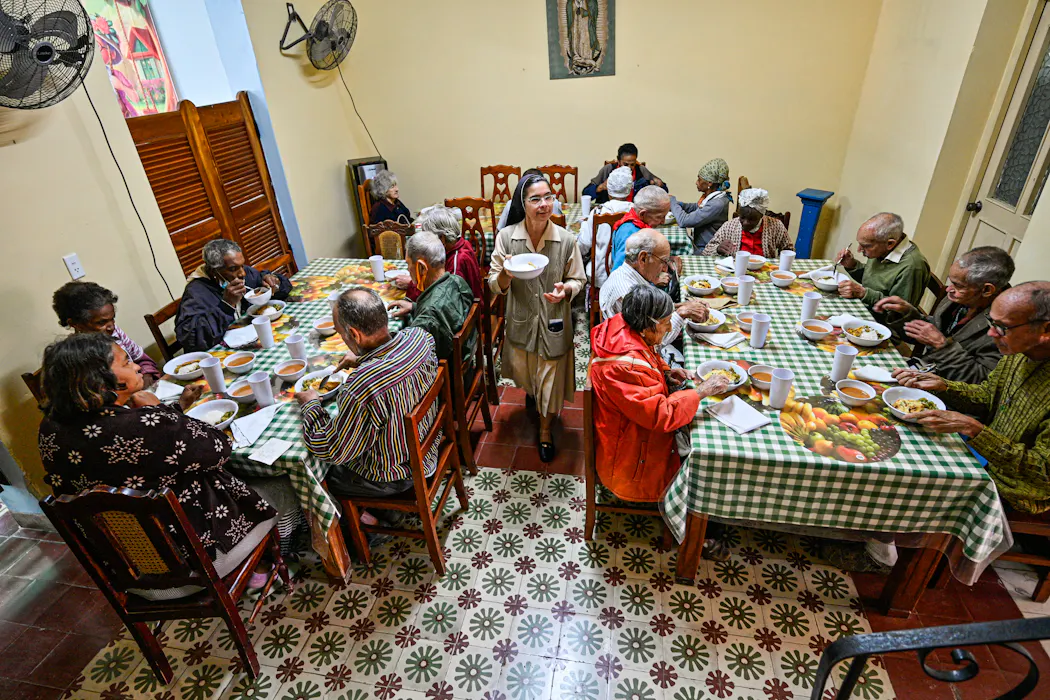
Trump administration pledges $100M in aid for Cuba, but only if Catholic or other faith-based groups distribute it

Older people eat at a dining hall run by the Catholic Church in Havana's Guanabacoa neighborhood in February 2026. Adalberto Roque/AFP via Getty Images

The United States is prepared to provide US$100 million in humanitarian assistance to Cuba, Secretary of State Marco Rubio announced on May 13, 2026.

But there’s a catch.

Neither the Cuban government nor its military would be allowed to manage its distribution. Instead, only humanitarian and faith-based partners, such as Caritas – the Catholic Church’s humanitarian aid network – and other nonprofits would deliver the aid. That is, the U.S. is willing to provide assistance that will help the Cuban people, but it does not trust the Cuban government to distribute it.

A week later, on May 20, Rubio reinforced the caveats that came with the Trump administration’s announcement during a 5-minute video address directed at the Cuban people. In his remarks, which coincided with Cuban Independence Day, he blamed Cuba’s economic problems and chronic energy shortages on its own government.

Cuban President Miguel Díaz-Canel has said Cuba would accept the U.S. offer of aid “without ingratitude,” while also criticizing the new approach and urging the U.S. to lift or ease the decades-old embargo. The timing of the offer was particularly challenging because it coincided with the U.S. indictment of Raúl Castro, a former Cuban president who helped lead the revolution that brought his brother, Fidel Castro, to power in 1959.

The Trump administration’s aid restriction may sound unusual. But as a scholar of Cuban studies and a former humanitarian aid worker, I have seen firsthand how faith-based organizations have long played a critical role in reaching Cuban families when formal systems there fall short.

There are precedents

You may wonder whether religious groups and other kinds of nonprofits are prepared to distribute $100 million in humanitarian aid inside Cuba.

But there’s evidence that this arrangement would probably work. The Catholic Church has one of the strongest national networks in Cuba outside the government, and this would not be the first time it has coordinated the distribution of humanitarian aid.

For several months after Hurricane Melissa hammered the island’s eastern provinces in 2025, Washington supported smaller humanitarian shipments to Cuba. And it sent that assistance through the church.

From 2011 to 2017 I saw church networks become lifelines for the most vulnerable, delivering aid from governments, humanitarian organizations and faith-based groups directly into communities and opening pathways beyond Havana into rural areas where need is often greatest.

A man in a long dark robe stands near a group of people who look haggard.
Friar Luis Pernas stands near a group of Cubans lining up to receive free medicine at the Church of the Holy Cross of Jerusalem in Havana in April 2026. Yamil Lage/AFP via Getty Images

Cuba’s other faiths

Not all of these faith-based groups are tied to the Catholic Church.

Protestant and evangelical churches, including Baptist and Assemblies of God communities, maintain extensive networks across Cuba.

I observed that foreign aid that arrived in Havana did not automatically reach rural provinces such as, Holguín or Santiago de Cuba. Getting it there required trucks, fuel, warehouses, local partners and logistical assets that Cuba lacked even then and has in much shorter supply now.

I worked directly with vulnerable communities in the aftermath of hurricanes and other disasters in Cuba to help deliver lifesaving aid, including food and clean water, to those most in need.

That experience makes me certain that other faith-based networks could potentially also play a critical role in delivering U.S. humanitarian aid as they have done in years past and in the spring of 2026.

Many of Cuba’s faith-based groups operate through house churches – small congregations that meet inside private homes instead of formal church buildings. They emerged because the Cuban government didn’t allow anyone to build new churches after a constitutional change in 1992 led to somewhat more freedom for worshippers. New local congregations could form, but they had to be based in houses. House churches are now deeply connected to their communities.

Together, these networks often reach rural areas and vulnerable families that more formal systems struggle to serve.

Pivot from Russia to Venezuela

After the Soviet Union collapsed in 1991, Cubans endured years of severe shortages of food, fuel, medicine and basic supplies, hobbling transportation and many basic services. Daily life changed dramatically, and families had to find new ways to survive with very little.

Until then, the Soviet Union had met Cuba’s demand for oil in exchange for shipments of Cuban sugar. The Cuban government euphemistically called that era of economic collapse a “Special Period in a Time of Peace.”

Starting in the late 1990s, Venezuela began to supply Cuba with deeply discounted oil, an arrangement that lasted until January 2026, when the U.S. ousted Venezuelan President Nicolás Maduro. The U.S. subsequently imposed an oil blockade on Cuba.

Losing access to oil has created a major crisis. Without fuel, Cuba’s government is unable to operate power plants, buses, water pumping systems, food refrigeration, hospitals, schools and agriculture at full capacity.

Many Cubans are enduring frequent, long blackouts and are unable to get to work or travel almost anywhere. They’re losing access to healthcare, and food insecurity is growing.

In short, Cuba is facing a major human-made disaster today without having been hit by a hurricane, earthquake or other kind of common disaster. Instead, it’s the result of politics and foreign policy.

People attend a church service in an informal setting.
Cuban worshippers attend a service at the Nazareth Baptist Church in the neighborhood of La Vibora, in Havana, on April 14, 2026. People who gather for these services also exercise, eat meals and receive medical care. Adalberto Roque/AFP via Getty Images

Potential appeal to Cuban Americans

Many Cuban Americans support sending U.S. humanitarian aid to Cuba if it reaches ordinary Cubans and does not strengthen the Cuban government. Bypassing the Cuban authorities by distributing assistance via faith-based groups would be appealing to Cuban Americans who have long accused Havana of using foreign assistance from foreign sources to maintain their grip on power.

Based on my own experience on the ground after disasters in Cuba, I believe that if aid is delivered through trusted and transparent channels, it could save lives and reduce suffering.

And if the aid is never delivered, I would expect that the people who need help most would once again pay the highest price.

The Conversation

Dulce Suarez previously worked on programs funded by government agencies, including USAID, while employed by a non-governmental organization that received these contracts. She does not currently receive funding or any financial benefit related to this article.

To ‘86’ occasionally means to kill but usually doesn’t: A linguistic investigation into the Instagram threat charge against James Comey

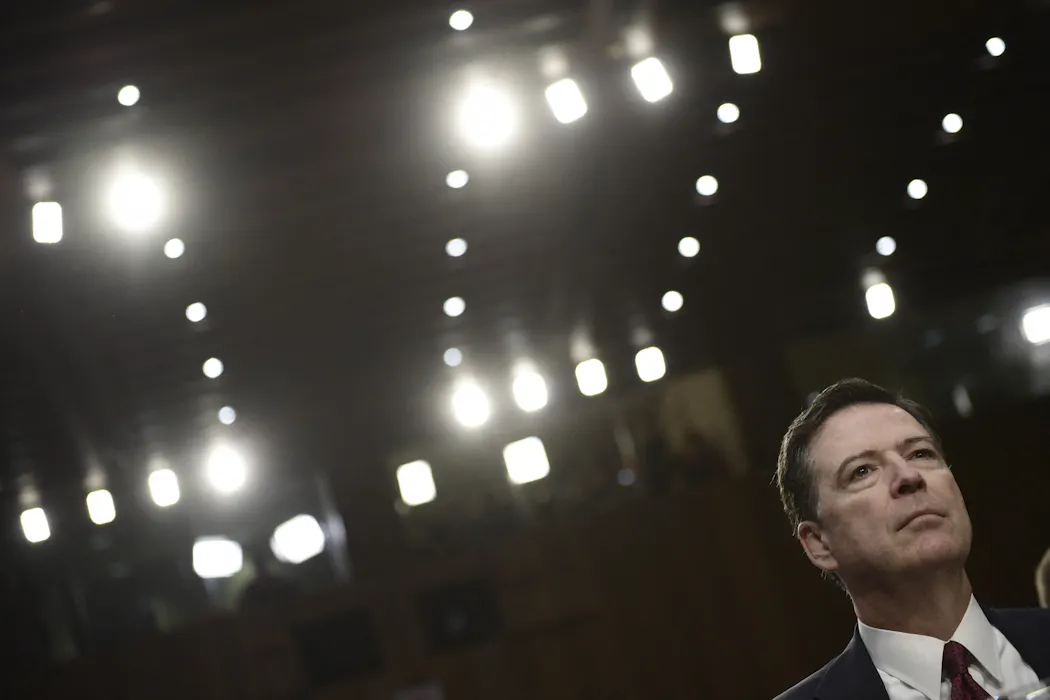
A federal grand jury indicted former FBI Director James Comey in April 2026 over a social media photo of seashells. Brendan Smialowski/AFP via Getty Images

A federal grand jury in April 2026 charged James Comey with making a threat against President Donald Trump and transmitting a crime across state lines.

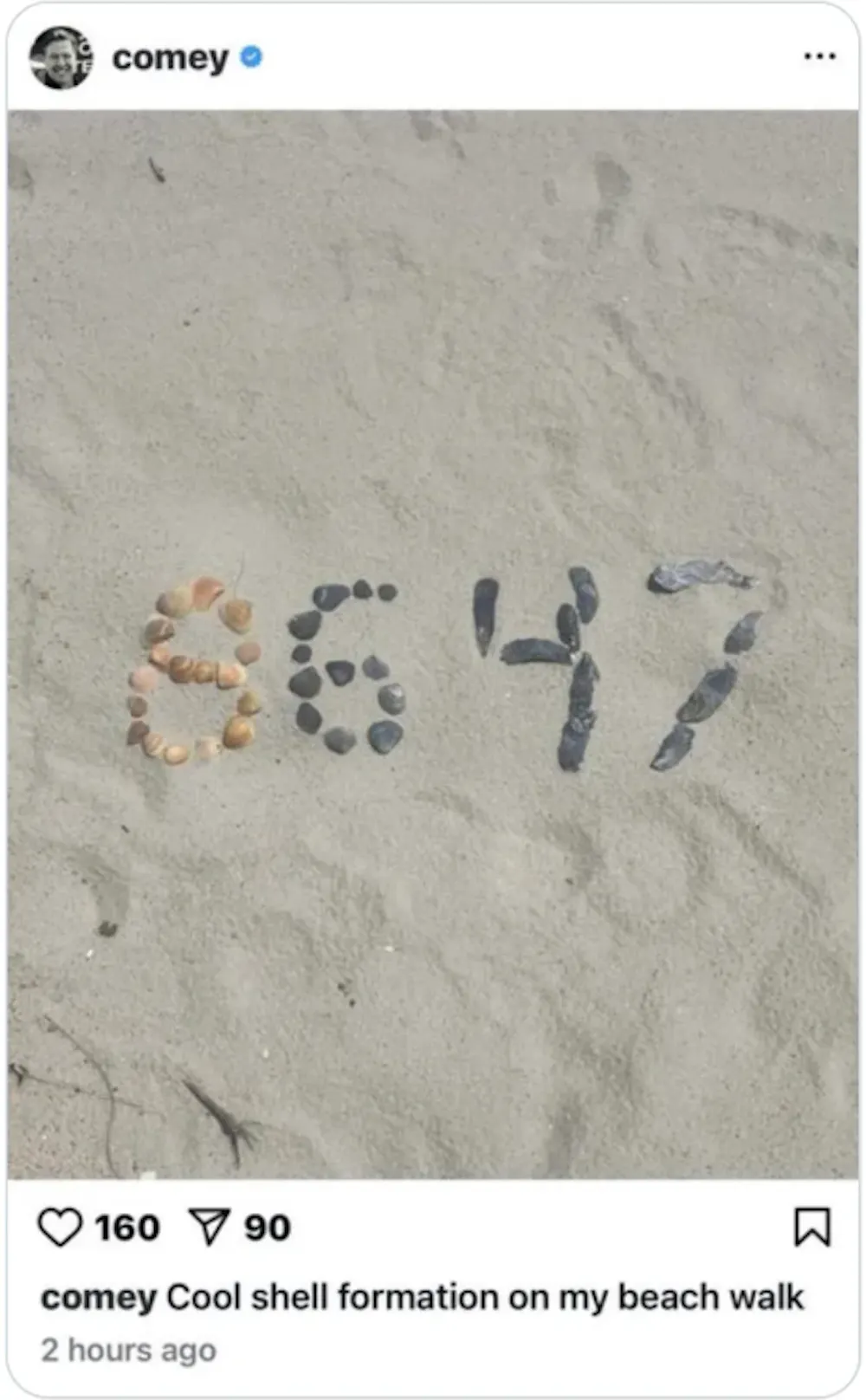
The charges came after Comey, the former FBI director, posted an image of seashells on a North Carolina beach, arranged in the form of the numerals “86” and “47.” Forty-seven was an ostensible reference to Trump, the 47th U.S. president, and 86 to a colloquial expression conveying a sense of “getting rid of” or “casting aside.”

But is “86 47” really a threat? And if so, is it a criminal one amounting to a threat to assassinate the president, as prosecutors have suggested?

In contrast to crimes such as murder or arson, which can be committed without uttering – or writing – a single word, threats are inherently crimes of language. They don’t exist without the linguistic symbols used to convey them.

Linguists like me who work in the field of language and the law understand these types of crimes to be “speech acts,” utterances that perform the action they name. What is a promise if not the words “I promise” or an apology if not the words “I’m sorry”?

The law is full of speech acts. Rulings, verdicts and arrests are all speech acts. So, too, are the crimes of language: solicitation, perjury, bribery and threats.

What is a threat?

Threats are language that states or implies the intent to intimidate or create harm. As a speech act, they need not be direct but often are.

In December 1984, the White House mail room received a letter with the message, “Ronnie, Listen Chump! Resign or You’ll Get Your Brains Blown Out,” referring to President Ronald Reagan. Below these words was a drawing of a pistol with a bullet being ejected from the barrel.

The Secret Service conducted a handwriting comparison analysis of the words, which led to the arrest of David Hoffman. He stated that “he didn’t know it was against the law to threaten the President.”

But Hoffman did commit a language crime. Although he didn’t use the words “I threaten to blow your brains out if you don’t resign,” the passive construction “you’ll get your brains blown out” accompanied by a drawing of a pistol constituted a direct threat that expressed a clear intent to intimidate and harm the president.

The scientific process of dictionaries

This brings us to the Comey case. Can a photo of 38 seashells arranged in the numerals “86” and “47,” and broadcast over Instagram, constitute a threat against Trump?

In theory, “86 47” could be an indirect threat, but the interpretation of Comey’s message really hinges on the meaning of “86” when used as a verb.

Three men stand behind a lectern as one man speaks.
Acting Attorney General Todd Blanche speaks on April 28, 2026, in Washington, D.C., as charges are brought against former FBI Director James Comey. Tasos Katopodis/Getty Images

This is where tools of forensic linguistics, which helps solve crime and resolve matters of language and the law, can help.

The first tool is lexicography, the academic study of creating dictionaries. A classic maxim of lexicography is that dictionaries are out of date before they are printed. It’s a nod to the fact that words’ meanings change and new words enter the language quickly.

Although dictionaries are imperfect, their definitions are the result of the rigorous study of word meaning and adherence to the scientific process of lexicography, the practice of writing and editing dictionaries and other reference materials.

In the Comey case, we would expect to find “86” listed as a noun. But the inclusion of the nonstandard verb form – “to 86” – would tell us that what may seem mysterious and cryptic actually has a conventionalized and well-recognized meaning.

Of the five major dictionaries of contemporary English I consulted, all had entries for “86” as a verb. The Oxford English Dictionary, for example, includes: “to eject or debar (a person) from premises; to reject or abandon; (in earliest use) to refuse to serve (a customer).”

Oxford also offers this second entry: “In restaurants and bars, an expression indicating that the supply of an item is exhausted.” This may explain why many restaurant workers across the country have strong reactions to the Comey indictment.

The American Heritage Dictionary definition includes “to refuse to serve (an unwelcome customer) at a bar or restaurant; to throw out, eject; to throw away, discard.” Merriam-Webster provides a similar definition: “to refuse to serve (a customer); to eject or ban (a customer); broadly, to eject, dismiss or remove (someone).”

Collins Dictionary offers two entries, the first in line with the others – “ to reject from, or to refuse to serve at” – and the second: “to cut off, eject, cancel, eliminate, kill, etc.”

The dictionary evidence is therefore mixed: Most definitions convey a sense of “kicking out” or “refusing service,” but Collins does include “kill” as a secondary definition.

How ordinary speakers of English use ‘86’

More evidence is needed, so I turned to the second tool: linguistic corpora. A corpus – plural: corpora – is a collection of texts chosen to represent language as it is actually produced by speakers and writers across genres and time periods. Linguistic corpora are useful because they show us usage in context, while providing enough data to conduct quantitative analysis of word meaning.

With over 1 billion words, the Corpus of Contemporary American English is the largest corpus of spoken and written American English available today. I analyzed usage of the word “86” in the corpus and found 372 attestations in full form – “eighty-six,” not “86.”

Seashells are arranged on a beach in the form of the numerals '86' and '47.'
Comey posted an image of seashells on a beach arranged in the form of the numerals ‘86’ and ‘47.’ James Comey/Instagram

The vast majority of the attestations had nothing to do with “ejecting.” But in a random sample of 100 cases of “eighty-six,” 20% were the verb form conveying the sense of “discard” or “eject.” Of those, two attestations meant “to kill,” and both came from fictional television and film. Far more common were expressions such as “Definitely 86 the coat, it sends the wrong message” and “Can we 86 the flags, please?”

When the direct object of the verb was a human subject, “86” still overwhelmingly meant “to discard” or “eject,” including this example when the subject was another sitting U.S. president: “Obama’s going to lose this election … they will blame his one term on a homophobic electorate who chose to eighty-six him because of his SSM stance,” in reference to his support for gay marriage.

In the Obama case, “86” clearly meant “vote him out.”

User-generated dictionaries are a third tool linguists use to analyze word meaning in the context of language crimes. They are less reliable than dictionaries written by professional lexicographers, but – like corpora – they give us a sense of the pulse of the language as it’s happening now.

Although they often contain factual errors, they tell us what English speakers think they know about the origins and meanings of words – a useful tool for analyzing language crimes.

I studied the entries provided by users for “86” on Urban Dictionary, where the highest-ranked definition is “to remove, end usage, or take away.” Of the 63 entries, only seven mention killing, one of those in reference to the Comey seashells. The vast majority of other entries align with the dictionary evidence: 86 means to get rid of something, or to have run out of a key ingredient.

The Comey indictment states that “a reasonable recipient who is familiar with the circumstances would interpret” Comey’s post “as a serious expression of an intent to do harm to President Trump.”

Looking across dictionaries, linguistic corpora and user-generated dictionaries, “eighty-six” could mean to kill but probably doesn’t. A general speaker of contemporary American English would interpret Comey’s post as an expression of opinion, a desire to “eject” the president from office.

The Conversation

Phillip M. Carter does not work for, consult, own shares in or receive funding from any company or organization that would benefit from this article, and has disclosed no relevant affiliations beyond their academic appointment.

Trump and Lula at the White House: a relationship built on pragmatism and a broader regional calculus

Brazilian President Lula da Silva greets US President Donald Trump upon his arrival at the White House: the trip also serves a second, equally important function for Lula, as each item on the bilateral agenda maps directly onto a domestic electoral fault line. Ricardo Stuckert/PR, CC BY

For about three hours of closed-door talks between Brazilian President Luiz Inácio Lula da Silva and US President Donald Trump at the White House on May 7, 2026, many observers in the two countries held their breath. Since there was no official joint statement or press conference, they did not know what to expect. Despite the reported “chemistry” between both presidents at the United Nations General Assembly last September, bilateral tensions were far from resolved.

The meeting between both presidents could have gone many ways: on the surface, Brazil and the US currently stand more as geopolitical rivals than allies. Over the last few months, Lula has made several criticisms to what he saw as a renewed US unilateralism. The Trump administration, in turn, seems to be responsive to the former President Jair Bolsonaro family’s demands regarding free speech or organized crime.

But Lula wanted the conversation to succeed, not so much because of diplomatic concerns, but because he faces an uphill battle ahead of the October elections. His trip to Washington was, above all, a domestic political operation. Even if the meeting lacked specific results, the positive atmosphere reported by both presidents was a victory for Lula in the context of a presidential race that is already shaping up to be one of the most consequential in Brazil’s recent history.

Flávio Bolsonaro, the eldest son of the jailed former President Jair Bolsonaro, has mounted a formidable electoral challenge. Polls now show him in a statistical tie with Lula in a hypothetical runoff, which is a remarkable position for a candidate whose political inheritance includes a father convicted of attempting a coup d'état.

The far-right senator has made several trips to the United States over recent months, including an appearance at the conservative CPAC summit, projecting himself as the candidate who can restore Brazil’s relationship with Washington after years of what he characterizes as Lula’s anti-American drift. His pitch to Brazilian voters is simple and powerful: only a Bolsonaro can work with Trump.

That narrative has found purchase in a Brazilian electorate that is increasingly attentive to geopolitical alignments. This is not the Brazil of previous electoral cycles, where foreign policy was a footnote.

Trump as a lifeline

Since Trump’s return to the White House, the Bolsonarist movement has portrayed the U.S. president as a lifeline, not only capable of keeping Jair Bolsonaro out of jail but also helping his movement’s political comeback. Flávio has reportedly pledged significant concessions to Washington on rare earth minerals, narcoterrorism designations, and trade, presenting these as proof of loyalty to an administration that the Bolsonaro family views as friendly and like-minded.

Whether or not Trump reciprocates that loyalty in any meaningful way is almost beside the point. The image of members of the Bolsonaro dynasty in Washington, welcomed by the MAGA establishment, is itself an electoral asset.

This is precisely the vulnerability that Lula traveled to Washington to neutralize. By securing a White House meeting, the Brazilian president sent a clear signal to his domestic audience: the relationship with Washington is not broken, and it does not require a Bolsonaro to fix it. The Brazilian-only press conference that followed the meeting only served to reinforce this point.

But the trip serves a second, equally important function. Each item on the bilateral agenda maps directly onto a domestic electoral fault line for Lula. On trade and tariffs, Lula returns home able to claim that he is fighting to protect Brazilian exporters and consumers from the inflationary pressures of a trade war. On organized crime – specifically the potential US designation of drug gangs PCC and Comando Vermelho as foreign terrorist organizations – the president can portray himself as a defender of Brazilian sovereignty and judicial autonomy, resisting external interference in domestic security policy. On rare earth minerals and strategic resources, Lula can reframe what is, in essence, a negotiation over economic dependency as a story of Brazil’s rising geopolitical clout.

And on democracy itself, the contrast with the Bolsonaro family could not be starker: while the father languishes under house arrest for plotting a coup, they were not able to prevent Lula from being welcomed in Washington as a legitimate (and friendly) head of state.

Political pragmatism

It would be a mistake, however, to reduce Trump’s willingness to meet Lula to a mere diplomatic courtesy. The Trump administration has shown a consistent pragmatism beneath its ideological posturing. Its management of relations with Claudia Sheinbaum’s Mexico, its intermittent engagement with Venezuela, and now its reception of Lula all suggest that the White House can work with ideological opponents when strategic interests demand it.

Brazil, the largest economy in South America and a country with substantial reserves of the critical minerals that Washington covets for its industrial and defense supply chains, is too significant to be held hostage to electoral sympathies for the Bolsonaro family. There is also a broader regional calculus: as the United States asserts primacy across Latin America through what has become known as the “Trump Corollary”, having a cooperative Brazilian government is considerably more useful than a destabilized one.

None of this means that Lula’s Washington gambit will succeed electorally. Flávio Bolsonaro has proven to be a more disciplined and adaptable candidate than his father, and the transnational networks that animate the Bolsonarist movement extend well beyond Washington. A single White House photo-op carries only so much weight.

What the trip does illustrate, however, is the degree to which Brazilian electoral politics has become inseparable from the global contest over alignment, sovereignty, and great-power patronage. In that contest, Lula has made his move. It will hardly change the minds of those who, left or right, have already made up their minds about their candidates. But it shows to the centrist voter, if anything, that a pragmatic defense of Brazilian sovereignty can be much more efficient than ideological submission to foreign interests.

The Conversation

Guilherme Casarões não presta consultoria, trabalha, possui ações ou recebe financiamento de qualquer empresa ou organização que poderia se beneficiar com a publicação deste artigo e não revelou nenhum vínculo relevante além de seu cargo acadêmico.

The sacred cloth at the center of the Hajj pilgrimage

During the Hajj pilgrimage, Muslims go around the cube-like sacred structure, the Kaaba, which is covered with a black cloth, the kiswah. MASTER/Moment via Getty Images

As Muslims gather for the annual pilgrimage of Hajj in Mecca, Saudi Arabia, they will circle around the “Kaaba,” a black cube draped in gold-embroidered cloth. A ceremonial textile – known as the “kiswah” – covers the Kaaba, around which Muslims will walk seven times in a ritual known as “tawāf.” It is the central act of the annual pilgrimage.

The Kaaba itself is a roughly cubic gray granite structure about 43 feet tall, which Muslims believe was established by the Prophet Abraham – Ibrahim in Arabic – and his son Ishmael as a place of monotheistic worship in antiquity. The Kaaba is empty inside, with no altar, idol or relic on display.

Yet, it is the geographical and spiritual center of the Muslim world. Muslims across the globe turn toward the Kaaba during their five daily prayers. The kiswah is what they actually see when they get there.

As a scholar of Islam, I study how spiritual objects carry meaning across generations. For all Muslims, the black cloth covering the Kaaba is deeply sacred as it touches Islam’s most sacred site and is believed by many to perform miracles simply through a touch.

The history of the kiswah

The earliest documented covering, recorded in ninth-century Arabic chronicles, is attributed to a Yemeni king named As'ad Abū Karib who reigned around 400 C.E. He is said to have draped the shrine in striped red wool.

For centuries afterward, successive coverings were laid one on top of another. As a result, by the eighth century, the accumulated weight threatened to collapse the structure.

Al-Mahdi, an Abbasid caliph, the dynasty which governed from Persia to Spain between the eighth and 13th centuries, performed the pilgrimage in 777 C.E. He ordered everything stripped down and replaced annually with a single cloth. This cycle has governed the practice for nearly 1300 years.

The color wasn’t black, as it is today. For most of Islamic history the kiswah was white, red, green, yellow or striped. White linen came from Coptic Christian weavers in the Nile Delta during the seventh century. The Mamluk sultans of Egypt, who ruled from 1250-1517, favored a saffron-yellow silk.

The transition to black happened only around 1224 C.E. under an Islamic ruler in Baghdad. The transformation has become so complete that most Muslims would be startled to learn it was ever otherwise.

What is the cloth made of, and where does it come from?

Today the kiswah is woven at a state factory called the King Abdulaziz Complex in Mecca, in a neighborhood called Umm al-Joud. It uses about 1,500 pounds of high-grade silk dyed black. Roughly 260 pounds of gold-plated and pure silver thread are embroidered into Quranic calligraphy along a wide belt that runs two-thirds of the way up the cube. A separate, even more ornate curtain covers the door.

History of the kiswah and the story of it manufacture.

The whole assemblage costs over US$5 million annually, paid from the Saudi treasury; the covering is replaced once a year on the first day of the Islamic calendar. Previously, it was replaced during the Hajj.

But the kiswah is not only an artifact. It is, and has always been, a political object. For roughly a thousand years, the right to manufacture and ship the cloth from Cairo to Mecca was symbolic of who claimed legitimate rule over the Muslim world.

Egyptian sultans sent it under the Mamluks; Ottoman sultans sent it from Cairo for four centuries beginning in 1517. The cloth traveled in a ceremonial caravan accompanied by a richly draped, empty palanquin called the “maḥmal” — a sort of mobile throne announcing the absent sultan’s protection of the holy cities.

In 1926, when the founder of modern Saudi Arabia conquered Mecca, his religious militia attacked the Egyptian caravan in a clash known as the Maḥmal Incident.

Saudi Arabia’s founder had just taken control of Mecca with the help of a fiercely puritanical religious militia. When Egyptian pilgrims arrived with the ceremonial caravan, accompanied by music and public celebration, the militia viewed the displays of reverence as contrary to “true Islam.” They attacked the Egyptians, killing dozens of people.

The clash marked a deeper shift in the Muslim world’s center of gravity. Religious authority and prestige, long anchored in cosmopolitan Cairo, were moving toward the Arabian heartland, where a rising Saudi order was reshaping Mecca through a far more austere version of Islam.

The Saudi state has manufactured the kiswah itself ever since.

When the old kiswah comes down each year, it is cut into pieces by the Banū Shayba, a family that has carried out this duty for generations. The fragments are then distributed as gifts to heads of state, museums and ordinary pilgrims who happen to be present at the right moment.

In Muslim belief, whoever holds a fragment is holding something that connects the earthly world with the divine.

The Conversation

Iqbal Akhtar does not work for, consult, own shares in or receive funding from any company or organization that would benefit from this article, and has disclosed no relevant affiliations beyond their academic appointment.

Quantum sensors use atoms, electrons and light as ultra-steady rulers – detecting faint motion, magnetism and gravity for navigation, medicine and science

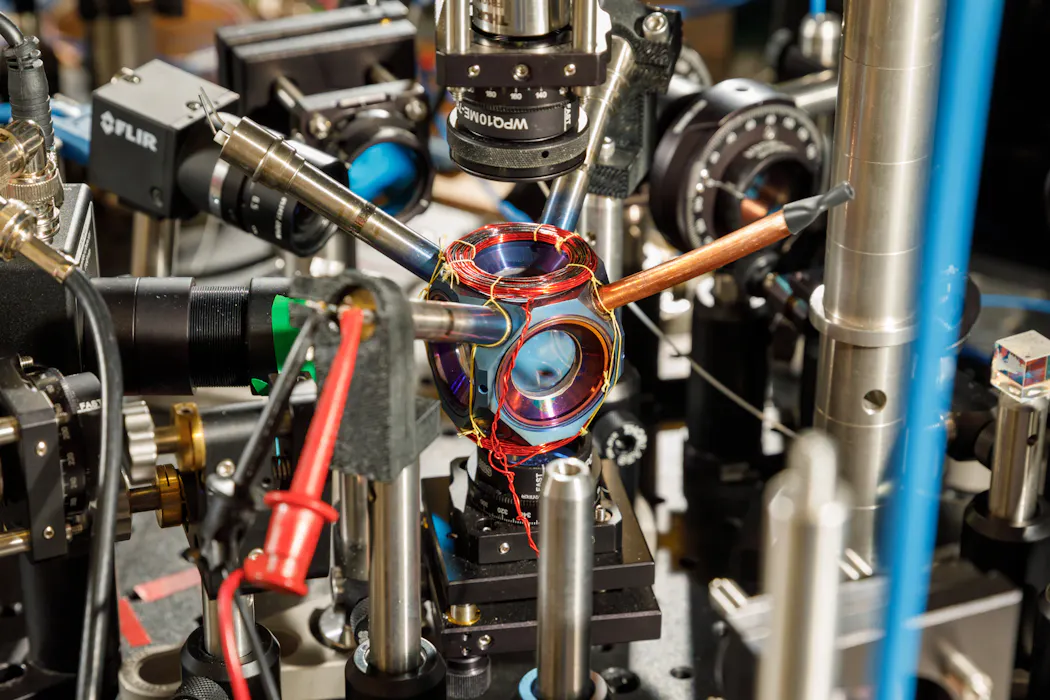
This device measures acceleration and rotation by shining lasers into small clouds of rubidium atoms. Sandia National Laboratories

Quantum computers get a lot of attention, even though they are not ready for prime time, but quantum sensors are already doing useful work. These sensors measure fields, forces and motion so small that ordinary background noise can drown them out. Some sensors are already in daily use, while others are moving from research labs into flight tests, hospitals and field instruments.

For example, a human brain produces magnetic signals in the femtotesla-to-picotesla range – billions of times weaker than a refrigerator magnet – far weaker than the magnetic noise in an ordinary room. That is why brain scanners that measure these signals need ultrasensitive detectors and strong magnetic shielding. In some hospitals, these detectors use quantum technology to help map brain activity before epilepsy surgery, without touching the brain.

Quantum sensors are showing up in other fields as well, including in navigation when GPS signals are jammed or spoofed, mapping gravity to reveal what’s underground, and boosting astronomers’ ability to measure gravitational waves. I am a photonics and quantum technologies researcher. My lab applies physics to develop a range of devices, including quantum sensors.

What is a quantum sensor?

A sensor turns a physical effect – temperature, pressure, light, acceleration or magnetic field – into a number. Most sensors do this with engineered parts: springs, coils or computer chips. But these can drift, or become less accurate, as they age or warm up.

A quantum sensor uses a tiny quantum system as the “active ingredient” that interacts with the world to measure a physical quantity. The most common choices for quantum systems are atoms, electron spins, and superconducting circuits.

An atom has a fixed set of energy levels, like rungs on a ladder. Light or microwaves can move it between those levels only at exact frequencies. A magnetic field, motion or gravity can shift those frequencies or change the phase of the atom’s wave, and the sensor turns that shift into a measurement.

A spin is a built-in property of electrons that makes them act like an infinitesimal cross between a spinning top and a bar magnet. Using spins as a sensor means measuring how a magnetic field causes the spin to “wobble.” The spin is like a spinning top and the magnetic field is like your finger gently touching the top. How much the top wobbles in response indicates how forcefully you touched the top, an analogy to measuring the strength of the magnetic field.

Another type of quantum sensor is a superconducting circuit, an electrical circuit cooled to extremely low temperatures so current flows with no resistance. A superconducting quantum interference device, or SQUID, is a superconducting loop. This electrical loop is sensitive to tiny changes in magnetic fields, which register as measurable changes in an electrical signal from the device.

Most quantum sensors follow a three-step loop: They prepare a known quantum state, let the world nudge it, then read out the change. Many devices form a wave-like interference pattern between two quantum systems, similar to the way in which two overlapping ripples create patterns on a pond. The devices measure how this pattern changes in response to changes in the environments around the devices shift.

Quantum sensor advantage

Quantum sensors are not automatically better at everything, and they still rely on classical engineering. But here are three advantages they offer:

  • They are naturally uniform. Atoms of the same kind are identical, so the sensing element is consistent from one device to the next and less prone to drift than many manufactured parts.

  • They respond to tiny nudges. A small field can shift a quantum state in a measurable way – if the device is shielded enough from interference, or noise.

  • Engineers can reshape the noise. Techniques like “squeezed” light do not remove noise, but they can move uncertainty away from the part of the measurement that matters most.

Magnetism: From brain scans to chip debugging

One mature example of a quantum sensor is the clinical brain-imaging method, called magnetoencephalography, or MEG. MEG measures the magnetic fields produced by brain activity and is used in research and clinics, including for mapping seizure activity and important brain areas before surgery. It typically uses sensors coupled to SQUIDs inside shielded rooms.

a diagram with larger blue cubes with smaller gray cubes on either side of each
Shining a laser through a tiny chamber of atoms turns the cloud of atoms into a sensor that can detect the extremely weak magnetic fields of the brain. Brookes et al Trends in Neurosciences, CC BY

Newer magnetometers may not need the same extreme cooling as SQUIDs do. The National Institute of Standards and Technology, or NIST, has developed chip‑scale atomic magnetometers that operate at room temperature. NIST and other research teams are exploring them for biomedical work because they can measure weak fields from the brain and heart without cryogenic cooling eqipment needed by SQUIDs. In one example, researchers reported fetal heart measurements using an array of optically pumped magnetometers, and they discuss these room-temperature sensors as a route toward more flexible systems than fixed cryogenic setups.

Nitrogen‑vacancy centers are another type of quantum system that can be used as a sensor. It relies on a specific “flaw” in diamond: a nitrogen atom sitting next to a gap from a missing carbon atom. That defect acts like a quantum spin that can be prepared with light, perturbed by magnetic fields, and read out by counting emitted photons.

Nitrogen‑vacancy center sensors are not designed to do whole-head brain scans. Their strength is fine spatial resolution: They can map magnetic fields over tens of nanometers, or billionths of a meter. That can help image tiny magnetic structures, study materials, and even map currents in microwave and electronic devices such as computer chips.

Motion: Navigation when satellite signals are untrusted

When satellite navigation signals are blocked or untrusted, navigation falls back on accelerometers and gyroscopes like those in your smartphone. The challenge is drift: Tiny errors build up over time. Cold‑atom sensors offer a different route. In a normal accelerometer, a small object inside the sensor lags behind when you accelerate. In an atom interferometer, a cloud of laser-cooled atoms plays that role and their matter waves interfere in a way that depends on acceleration and rotation.

These quantum navigation systems are not yet standard equipment. But agencies and companies are testing them because they could provide a backup when satellite signals are weak, blocked or spoofed. The European Space Agency has described “hyper-sensitive” quantum sensors as possible supplementary navigation tools, while noting that the challenge is making them reliable and robust outside the lab. The U.K. government has also publicly described flight trials of quantum navigation technology as an added layer of resilience.

Gravity: Maps that reveal water, minerals and voids

false color image of Earth
NASA is developing a quantum gravity sensor to improve maps like this one that shows differences in the strength of gravity at different places on Earth. NASA

Gravity sensing uses related physics. If you can measure tiny changes in gravity from place to place, you can infer hidden structure underground. NASA’s Jet Propulsion Laboratory is developing the Quantum Gravity Gradiometer Pathfinder, a space-based quantum sensor aimed at mapping subtle gravity changes linked to underground features such as aquifers and mineral deposits.

This gravity sensor is still under development. The system would use two clouds of ultra-cold rubidium atoms as test masses. Cooled near absolute zero, the atoms behave like waves. The instrument would compare the acceleration of the two atom waves. A small difference sensed at the two clouds’ locations points to a gravity anomaly caused by hidden mass.

Seeing the universe: ‘Squeezing’ light to beat quantum noise

Some of the most famous sensors in science measure incredibly small changes in distance. Gravitational-wave observatories such as the Laser Interferometric Gravitational-Wave Observatory, or LIGO, do this by splitting a laser beam to travel along a pair of 2.5-mile-long (4-kilometer-long) tracks at right angles and bounce back off mirrors at the ends. When a gravitational wave caused by a distant cosmic event like two black holes merging passes through the device, the travel times of the two beams is slightly different.

This is quantum-enhanced sensing. The observatory measures a distance change, but quantum physics sets one of its noise limits. Quantum noise can limit how well those instruments work. LIGO reports that it uses “frequency-dependent squeezing,” a method to reduce quantum noise, to help the detectors probe a larger volume of the universe and find about 60% more mergers than before LIGO.

The catch

Quantum states are delicate. Vibrations, stray fields and temperature swings can wash out an interference pattern or scramble a spin state. That is why many of the most sensitive devices still use vacuum chambers, lasers and shielding.

Quantum sensors are already working where tiny signals matter: in clocks, hospitals and observatories. The next step is to make these sensors smaller, cheaper and tough enough to work outside specialized labs.

The Conversation

Alex Krasnok does not work for, consult, own shares in or receive funding from any company or organization that would benefit from this article, and has disclosed no relevant affiliations beyond their academic appointment.

❌
Subscriptions