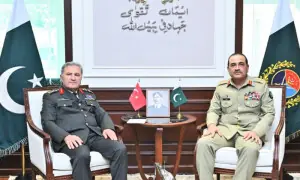
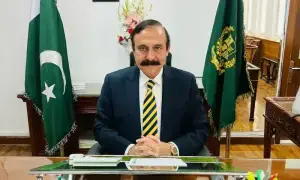
Chief of Defence Forces (CDF) and Chief of the Army Staff (COAS) Field Marshal Syed Asim Munir discussed avenues for enhanced bilateral defence cooperation during a meeting with General Metin Tokel, commander of the Turkish Land Forces, the military’s media wing said in a statement on Thursday.
The Inter-Services Public Relations (ISPR) said that General Tokel called on CDF Munir at the General Headquarters (GHQ) today.
“During the meeting, matters of mutual professional interest, regional secur
Chief of Defence Forces (CDF) and Chief of the Army Staff (COAS) Field Marshal Syed Asim Munir discussed avenues for enhanced bilateral defence cooperation during a meeting with General Metin Tokel, commander of the Turkish Land Forces, the military’s media wing said in a statement on Thursday.
The Inter-Services Public Relations (ISPR) said that General Tokel called on CDF Munir at the General Headquarters (GHQ) today.
“During the meeting, matters of mutual professional interest, regional security dynamics, and avenues for enhanced bilateral defence cooperation were discussed,” it said.
Chief of Defence Forces (CDF) and Chief of the Army Staff (COAS) Field Marshal Syed Asim Munir discussed avenues for enhanced bilateral defence cooperation during a meeting with General Metin Tokel, commander of the Turkish Land Forces, the military’s media wing said in a statement on Thursday. The Inter-Services Public Relations (ISPR) said that General Tokel called on CDF Munir at the General Headquarters (GHQ) today. “During the meeting, matters of mutual professional interest, regional security dynamics, and avenues for enhanced bilateral defence cooperation were discussed,” it said. DawnToday
CDF Munir highlighted the deep-rooted historical, cultural, and strategic ties between the two countries and appreciated the strong defence partnership between the armed forces of Pakistan and Turkiye, the ISPR added.
It stated that upon arrival at GHQ, the visiting dignitary was presented with a “smartly turned-out” guard of honour by a Pakistan Army contingent.
The statement added that the visiting dignitary also visited the Naval Headquarters (NHQ) in Islamabad and called on Chief of Naval Staff Admiral Naveed Ashraf.
“During the meeting, matters of professional interest and regional maritime security environment were discussed,” it added.
Moreover, General Tokel also called on the Chief of Air Staff Air Chief Marshal Zaheer Ahmed Baber Sidhu at Air Headquarters (AHQ).
“The meeting focused on bilateral military cooperation and matters pertaining to professional interest,” said the ISPR statement.
During his visit, General Tokel lauded the professionalism of the Pakistan Armed Forces and acknowledged its contributions towards regional peace and stability.
“He also expressed his commitment to further enhancing defence cooperation and institutional linkages between the armed forces of the two brotherly nations,” the ISPR concluded.
Earlier this week, CDF Munir also held meetings with the commander of Bahrain’s National Guard, General Shaikh Mohammad bin Isa bin Salman Al Khalifa, and the Lebanese armed forces’ Commander-in-Chief General Rodolphe Haykal.
During both interactions, he discussed the strengthening of military collaboration and prospects for enhancing bilateral military relations with the respective countries.
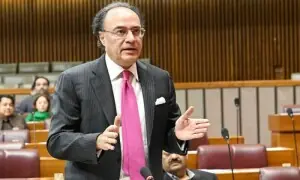
Finance Minister Muhammad Aurangzeb will present the federal budget for the next fiscal year (FY26–27) in the National Assembly on June 12, an adviser to the minister has confirmed.
Adviser to the Finance Minister Khurram Schehzad shared the revised budget schedule in a post on X.
He added that the Pakistan Economic Survey for the outgoing FY2025–26 would be launched at 2:20pm on Thursday by Aurangzeb.
Budget sessions of the National Assembly and S
Finance Minister Muhammad Aurangzeb will present the federal budget for the next fiscal year (FY26–27) in the National Assembly on June 12, an adviser to the minister has confirmed.
Adviser to the Finance Minister Khurram Schehzad shared the revised budget schedule in a post on X.
He added that the Pakistan Economic Survey for the outgoing FY2025–26 would be launched at 2:20pm on Thursday by Aurangzeb.
Budget sessions of the National Assembly and Senate have already been summoned by President Asif Ali Zardari.
The National Economic Council (NEC), the highest economic decision-making forum of the federation, met earlier on Wednesday to finalise federal and provincial development plans ahead of the budget presentation.
Prime Minister Shehbaz Sharif, who chaired the meeting, said the Centre held consultations with the provinces on all matters “with extreme seriousness, and we made decisions in the best interest of Pakistan”.
The NEC finally met after being delayed three times, as negotiations had continued over the freezing of provincial shares in the federal divisible pool under the National Finance Commission (NFC) award.
The budget presentation in the parliament had earlier been set for June 10.
The federal government, its coalition partners and provincial governments had been struggling to reach a consensus over the Centre’s demand for more than Rs1 trillion for strategic needs.
However, the ruling PML-N and its major ally, the PPP, on Monday reached a consensus on the broad framework of the federal budget.
They reached a broad agreement on cutting development and other expenditures at all tiers of the federation to cover around Rs800 billion revenue shortfall this year and jointly create similar, but higher, fiscal space next year for additional “strategic needs”.
Under the agreement, provincial shares from the federal divisible pool would stay frozen at the current fiscal year’s position. Any increase in the targeted revenue next year on top of the Federal Board of Revenue’s (FBR) collection in the current year would be retained by the Centre, informed sources said.
The sources said the additional amount being discussed for next year to be given up by the provinces was not fixed but dynamic, depending on FBR revenue collection, and could range anywhere between Rs1.3tr and Rs1.7tr.
Interestingly, Balochistan and Khyber Pakhtunkhwa were not part of the deal so far.
Under tight International Monetary Fund (IMF) oversight, the government has trimmed allocations for most sectors in the next federal development programme to create additional fiscal space for the PML-N’s trademark national highways, a new Rs87 billion share for coalition partners and a Rs70bn allocation for ruling party lawmakers’ schemes.
Yet, the government has unveiled a record national development programme of Rs4.715tr.
The overall development portfolio comprises the largest share of provincial annual development plans (ADPs) at Rs3.138tr (up 9.6pc), followed by the federal Public Sector Development Programme (PSDP) of Rs1.126tr, up 12.6pc from the current year, and Rs451bn from state-owned enterprises (SOEs), up 27pc from Rs355bn in the current fiscal year.
PM Shehbaz has said that the government was taking measures to bring the informal economy into the tax net.
The government last week unveiled the ‘Fixed Tax Asaan Scheme’ to bring small traders and shopkeepers into the tax net, with an annual turnover of up to Rs200 million.
The government is also considering relaxing the remittance cap in the upcoming budget as overseas Pakistanis in several countries face difficulties in protecting their investments and liquid assets abroad, according to sources in the financial industry.
Pakistan, along with seven other Muslim countries, on Tuesday condemned the “continued incursions by extremist Israeli settlers into Al Aqsa Mosque” in the strongest terms, calling for an immediate cessation of all such provocative practices.
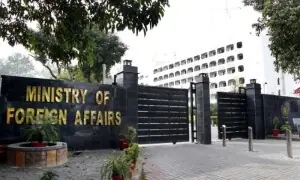
According to a joint statement released by the Foreign Office (FO), the foreign ministers of Pakistan, Egypt, Turkiye, Indonesia, Jordan, Saudi Arabia, Qatar and the United Arab Emirates condemned “in the strongest terms the continued incursions by extremis
Pakistan, along with seven other Muslim countries, on Tuesday condemned the “continued incursions by extremist Israeli settlers into Al Aqsa Mosque” in the strongest terms, calling for an immediate cessation of all such provocative practices.
According to a joint statement released by the Foreign Office (FO), the foreign ministers of Pakistan, Egypt, Turkiye, Indonesia, Jordan, Saudi Arabia, Qatar and the United Arab Emirates condemned “in the strongest terms the continued incursions by extremist Israeli settlers, into Al Aqsa Mosque under the protection of the Israeli forces, as well as the raising of the Israeli flag within its courtyards”.
“They stress that these provocative and unacceptable actions constitute a flagrant violation of international law, the relevant United Nations resolutions, and the historical and legal status quo at the holy sites in occupied East Jerusalem.
The FO added that the foreign ministers reaffirmed their “categorical rejection” of any attempts to alter the historical and legal status quo in Jerusalem and its Islamic and Christian holy sites, and stressed the preservation of this status quo, while recognising the special role of the historical Hashemite custodianship in this regard.
“The foreign ministers reiterated that the entire area of Al Aqsa Mosque, which amounts to 144 dunams, is a place of worship exclusively for Muslims, and that the Jerusalem Endowments and Al-Aqsa Mosque Affairs Department, affiliated with the Jordanian Ministry of Awqaf and Islamic Affairs, is the legal entity with exclusive jurisdiction to administer the affairs of the blessed Al Aqsa Mosque and to regulate entry thereto.”
Islamabad further stated that the foreign ministers of the aforementioned countries held Israeli authorities responsible for halting these escalatory actions and warned that “repeated Israeli violations exacerbate tensions, fuel instability and extremism, undermine international efforts to achieve peace, and constitute a clear breach of Israel’s obligations under international law”.
The Muslim and Arab countries called for an immediate cessation of all such “Israeli illegal and provocative practices” and reaffirmed the need to respect the historical and legal status quo at Al Aqsa Mosque in its entirety, the FO said.
“The foreign ministers reaffirm their unwavering solidarity with the Palestinian people and their steadfast support for the realisation of their legitimate and inalienable national rights, foremost among them their right to self-determination and the realisation of an independent and sovereign Palestinian State on the 1967 lines, with East Jerusalem as its capital,” the FO said.
They further reaffirmed their support for all efforts aimed at ending the Israeli occupation and achieving a just, lasting, and comprehensive peace based on the two-state solution in accordance with international law, the relevant UN resolutions, and the Arab Peace Initiative, the FO concluded.
Earlier in April, Pakistan condemned in “strongest terms” the storming of the Al Aqsa Mosque compound and the raising of Israel’s flag in its courtyard, terming the acts “reprehensible”.
The condemnation issued by the FO said “these reprehensible acts constitute a blatant violation of international law, as well as of the sanctity and inviolability of the holy site. Such provocative steps also risk further escalating tensions in the region”.
Prime Minister Shehbaz Sharif on Thursday approved a strategic roadmap for comprehensive reforms in Pakistan Railways, which includes improvements in services, digitisation, track upgradation and private-sector investment, the Prime Minister’s Office (PMO) said.
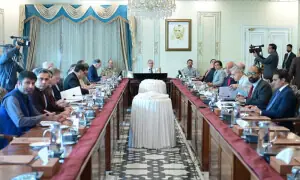
In a statement, the PMO said PM Shehbaz chaired an important meeting on reforms in Pakistan Railways in Islamabad on Thursday, adding that the prime minister approved the strategic roadmap for comprehensive reforms in the railways sector
Prime Minister Shehbaz Sharif on Thursday approved a strategic roadmap for comprehensive reforms in Pakistan Railways, which includes improvements in services, digitisation, track upgradation and private-sector investment, the Prime Minister’s Office (PMO) said.
In a statement, the PMO said PM Shehbaz chaired an important meeting on reforms in Pakistan Railways in Islamabad on Thursday, adding that the prime minister approved the strategic roadmap for comprehensive reforms in the railways sector.
The PMO stated that the meeting was given a detailed briefing on the strategic roadmap and targets for comprehensive reforms in Pakistan Railways.
“The roadmap includes targets to increase market share in both passenger and freight sectors,” the statement said, while highlighting the key points.
“Improvement in railway services, enhancement of network capacity and financial sustainability will be the key pillars of the roadmap,” it added.
Furthermore, the roadmap also includes targets related to “improving the governance system of railways, digitisation, expansion of railway lines, regional connectivity, private-sector participation through public-private partnerships and achieving financial sustainability”.
“The reforms also include the use of modern coaches, provision of facilities for passengers in trains and at stations, upgradation of ML-1, ML-2, ML-3 and other tracks, and right-sizing,” it said.
“Pakistan Railways has immense potential to become a safe and affordable mode of transportation for the public and freight services,” the statement quoted PM Shehbaz as saying.
“Freight services are the backbone of the railway system,” said the premier, directing that the freight sector be promoted on a priority basis and instructing that internationally renowned experts and consultants be hired for the implementation of the railway reforms roadmap.
“Improvement in the railway system will reduce traffic pressure on roads,” PM Shehbaz added.
During the meeting, the prime minister also emphasised that a modern and efficient railway system would help reduce carbon emissions and promote environmentally friendly transport.
“The development of Pakistan Railways will enhance regional connectivity and increase economic activity. Revenue generated through private-sector investment in railway land should be utilised for the improvement of the railway system,” he directed.
Federal ministers Ahsan Iqbal, Ahad Khan Cheema, Hanif Abbasi, Adviser on Privatisation Muhammad Ali, Minister of State for Finance Bilal Azhar Kayani and senior officials of relevant institutions attended the meeting.
In January, Abbasi said work on ML-1 railway project is expected to begin in July 2026 from the Karachi Port.
The ML-1 project aims to upgrade and modernise key infrastructure to enhance freight and passenger connectivity from Karachi to Peshawar.
In August 2025, the Senate Standing Committee on Railways had recommended expediting work on the project.
The first Hangor-class submarine has arrived at Karachi Port, marking a significant milestone in the Pakistan Navy’s modernisation programme and underscoring the deepening strategic defence cooperation between Pakistan and China, a statement issued by the Pakistan Navy said on Thursday.
The Hangor-class submarine is equipped with advanced combat systems, modern sensors, Air Independent Propulsion (AIP) technology and enhanced stealth features, which will significantly enhance the navy’s combat c
The first Hangor-class submarine has arrived at Karachi Port, marking a significant milestone in the Pakistan Navy’s modernisation programme and underscoring the deepening strategic defence cooperation between Pakistan and China, a statement issued by the Pakistan Navy said on Thursday.
The Hangor-class submarine is equipped with advanced combat systems, modern sensors, Air Independent Propulsion (AIP) technology and enhanced stealth features, which will significantly enhance the navy’s combat capability.
PNS Hangor arrives at Karachi port. — Pakistan Navy PR
On arrival, the submarine was accorded a traditional naval welcome attended by Pakistan Navy officers and personnel, as well as family members of the crew, the statement said.
“Cadets of Pakistan Naval Academy presented a ceremonial salute to the incoming submarine and its crew, accompanied by a fly-past by PN Z9EC helicopters,” said the PN.
Upon arrival at the Pakistan Navy Dockyard, a reception ceremony was held to mark the occasion. Commander Pakistan Fleet Vice Admiral Abdul Munib attended as the chief guest.
PNS Hangor arrives at Karachi port. — Pakistan Navy PR
The name Hangor holds a significant place in Pakistan’s naval history, referring to the 1971 Pakistan-India war, during which then-PNS Hangor became the first submarine since World War II to sink a warship, when it sank the Indian frigate INS Khukri.
The navy is set to induct a total of eight Hangor-Class submarines.
The navy launched the first of the new submarines in April 2024, while the second, third and fourth were launched on March 15, August 15 and December 17 in 2025, respectively.
The Foreign Office on Thursday warned that any deliberate attempt to block water essential to Pakistan’s survival and development would have “far-reaching consequences”.
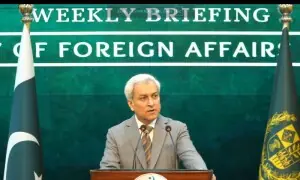
“Any such act would be treated with utmost seriousness and could possibly amount to an act of war under Article 51 of the UN Charter,” said FO spokesperson Tahir Andrabi during a weekly media briefing while responding to a question about recent remarks by Indian water minister.
A day ago, Indian Minister of Water CR Patil told I
The Foreign Office on Thursday warned that any deliberate attempt to block water essential to Pakistan’s survival and development would have “far-reaching consequences”.
“Any such act would be treated with utmost seriousness and could possibly amount to an act of war under Article 51 of the UN Charter,” said FO spokesperson Tahir Andrabi during a weekly media briefing while responding to a question about recent remarks by Indian water minister.
A day ago, Indian Minister of Water CR Patil told India’s ANI news agency that “not a single drop of water will go [to Pakistan] in the coming years”.
Patil said that India was “actively working on it” after “directives” from Prime Minister Narendra Modi.
Taking note of the remarks, Andrabi said that “any attempt to block or substantially curtail water that is vital to the livelihood, agriculture and well being of over 25o million Pakistanis would be a deeply irresponsible act”.
He added it would violate established international obligations “concerning transboundary rivers and indeed India’s own bilateral agreement with Pakistan”.
“Pakistan firmly rejects any notion that water can be treated as a political tool or instrument of coercion or a weapon,” he said, emphasising that such an action would be a threat to the regional peace and security in South Asia and beyond.
He said that the responsibility of such a threat “to international peace and security would fall squarely on India’s shoulders”.
The FO spokesperson added that Pakistan’s rights and interests regarding its water resources were non-negotiable.
He said that Pakistan would “vigorously” defend those rights, utilising all available diplomatic, political, legal, economic and other measures consistent with international law and the UN Charter.
“Any deliberate attempt to block water essential to Pakistan’s survival and development would constitute an extremely grave act with far-reaching consequences, as stated at the top leadership level by Pakistan,” Andrabi warned.
Every state had the right of self-defence, she said, adding that Pakistan would take “all necessary measures to safeguard its economy and its vital national interests and lives of 250m people”.
Andrabi called on India to “act responsibly, honour its international commitments and refrain from statements and actions that could further escalate tensions in the region”.
He stated that Pakistan remained committed to safeguarding its interests and “will closely monitor developments on the ground in India-occupied Kashmir and elsewhere from where these water resources emerge”.
Expansion of India’s nuclear arsenal ‘not surprising’
In response to a question over India expanding its nuclear arsenal, as per a recent report by the Stockholm International Peace Research Institute (SIPRI), Andrabi said the finding was not surprising to Pakistan.
“It broadly corroborates concerns that Pakistan has consistently been raising regarding India’s continued vertical proliferation,” he stated, hinting that the findings may not “fully reflect” India’s scale of nuclear arsenal.
The spokesperson noted that Pakistan also remained aware of recent developments in India’s strategic capabilities, including “cannisterisation of the missile systems, expansions of sea-based nuclear-capable submarines and pursuit of increasingly longer-range intercontinental ballistic missile systems that go beyond India’s periphery, neighbourhood or legitimate defence deals”.
Andrabi warned of “grave consequences” for international peace and security in the context of the development.
“These developments enhance operational readiness, complicate crisis stability, and carry implications that extend beyond South Asia,” he remarked.
Andrabi said while Pakistan did not seek an arms race and was “not interested in matching warheads and ammunition by number,” it also remained cognisant of the “evolving security environment”.
He said Pakistan continued to work towards the preservation of “strategic stability and deter any possible Indian aggression,” and urged the international community to “closely monitor” the situation.
“Deployment of India’s nuclear arsenal may affect strategic stability in South Asia and undermine peace and security at the regional and global level,” he cautioned.
In the given context, he said the international community, in particular the suppliers of high technology, should be cognisant of the implications of “advanced technologies and emerging capabilities being incorporated into India’s posture with grave international consequences”.
Release of Pakistani seafarers in Somalia ‘high priority’
On the issue of Pakistani sailors held captive by pirates aboard a vessel off the coast of Somalia, Andrabi said their rescue and safe repatriation remained a “high priority”; however, he also acknowledged that the situation had so far proved to be “difficult and operationally challenging”.
The seamen were taken hostage more than a month ago when pirates hijacked the MT Honour 25 off the southeastern coast of Somalia on April 21. There were 11 Pakistanis among the vessel’s crew, who remain in the pirates’ captivity.
“Sadly, despite our best efforts, we have not been able to secure their release,” Andrabi said of the 11 Pakistani seafarers, but voiced optimism that Pakistan was making “earnest efforts” to secure their release.
“We are engaged with the Somali authorities and the ship owner, both of whom are engaged with the pirates to secure early release,” he said.
He recalled that the Deputy Prime Minister and Foreign Minister Ishaq Dar had been in touch with the Somali Foreign Minister Abdisalam Abdi Ali over the issue.
In a phone call with the Somali FM, DPM Dar had conveyed his “grave concern” about the situation and stressed the need to ensure the early release and safe repatriation of the individuals, Andrabi said.
DPM Dar also urged measures to improve the living conditions of all the captives aboard the vessels.
Dar’s Somali counterpart assured him of the Somali government’s “continued and sincere” efforts to secure the release of the Pakistani individuals.
“Both leaders agreed to remain in close coordination until the matter is resolved,” Andrabi said.
Further elaborating on the steps taken by the government to secure their release, Anbrabi said that the Somali ambassador in Islamabad was called to the Ministry of Foreign Affairs (MOFA) over the issue.
He also recalled that the Pakistani embassy in Djibouti had dispatched teams to the Somali capital Mogadishu and added that authorities were holding “interministerial and inter-departmental meetings” on the issue as well.
“Another important in-person meeting will be held next week here at MOFA,” Andrabi said.
The spokesperson said that the situation was “operationally challenging”.
“They (captives) are held in a part of Somalia which is a semi-autonomous region [..] there are tribal societies and the pirates belong to a certain tribe and the ship owners belong to another tribe.”
He called on the families to exercise patience, vowing that the matter remained a high priority.
‘Curtains on Pakistan’s mediation role not drawn yet’
When asked about the recent escalation in the US-Iran war, Andrabi remarked that while it was difficult to remain optimistic in the current scenario, Pakistan remained engaged in diplomacy.
“If a mediator and facilitator loses hope, or becomes pessimistic, this does not augur well for the peace process,” Andrabi said.
Pakistan was cognisant of the challenges, he said, acknowledging that diplomatic space had “shrunk” due to the renewed aggression. However, he said that such was often the “natural progression” in conflict situations.
“Challenges of ceasefire, and cycles in an armed conflict — where you have space for peace, space for dialogue, and then you have a cycle of hostilities are expected in all international conflicts,” he said, expressing Pakistan’s readiness to “work with positivity”.
He recalled Prime Minister Shehbaz Sharif’s statement from June 8, which he said summarised Pakistan’s stance, reiterating that diplomatic efforts continued, citing DPM Dar’s phone call with his Turkish counterpart Hakan Fidan as well as coordination with other regional partners and Interior Minister Mohsin Naqvi’s recent visit to Tehran.
“Let us not draw the curtains on Pakistan’s mediation role, and let us not lose hope,” the spokesperson remarked.
On being asked if there are any exchanges of visits from Iran or Pakistan expected, the spokesperson said, “I do not have any specific information right now, but I certainly do not rule out such visits in the future”.
Temperatures crossed 40 degrees Celsius in parts of the country on Tuesday, amid a heatwave forecast to last till June 12.
On Tuesday, the highest temperature recorded in Lahore was 43°C, while the mercury reached 41°C in Islamabad. The highest temperature recorded in Karachi was 36°C.
Commuters rush to board an air-conditioned bus on a hot summer day in Rawalpindi on June 9, 2026. —AFP
Commuters stand under a bus shelter as they wait to board an
Temperatures crossed 40 degrees Celsius in parts of the country on Tuesday, amid a heatwave forecast to last till June 12.
On Tuesday, the highest temperature recorded in Lahore was 43°C, while the mercury reached 41°C in Islamabad. The highest temperature recorded in Karachi was 36°C.
Commuters rush to board an air-conditioned bus on a hot summer day in Rawalpindi on June 9, 2026. —AFP
Commuters stand under a bus shelter as they wait to board an air-conditioned bus on a hot summer day in Rawalpindi on June 9, 2026. —AFP
A worker pushes a cart along a street on a hot summer day in Lahore on June 9, 2026. —AFP
A man pushes a cart loaded with water cans on a hot summer day in Lahore on June 9, 2026. —AFP
Commuters drink cold water served along a street during a hot summer day in Karachi on June 9, 2026. —AFP
Commuters stand under a bus shelter as they wait to board an air-conditioned bus on a hot summer day in Rawalpindi on June 9, 2026. —AFP
Traffic police personnel cover their heads with cloth as they stand at a road junction amid a heatwave in Rawalpindi on June 9, 2026. —AFP
Labourers cover their heads with cloth as they push a loaded cart amid a heatwave in Rawalpindi on June 9, 2026. —AFP
Workers load ice blocks onto a vehicle on a hot summer day in Lahore on June 9, 2026. —AFP
A labourer shields his head with a cloth as he hauls a loaded cart amid a heatwave in Rawalpindi on June 9, 2026. —AFP
ISLAMABAD: Pakistan on Friday “categorically rejected” India’s remarks regarding upcoming elections in Gilgit-Baltistan (GB), calling them “baseless” and part of a “carefully choreographed attempt to conflate fact with fiction”.
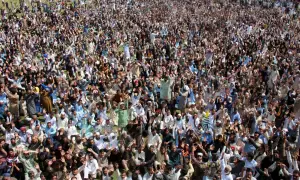
General elections in GB are scheduled for Sunday (June 7), after a four-month delay attributed to harsh winter weather. The PPP and other political parties have staged a series of rallies across the region and ramped up efforts to garner support ahead of the polls.
In a
ISLAMABAD: Pakistan on Friday “categorically rejected” India’s remarks regarding upcoming elections in Gilgit-Baltistan (GB), calling them “baseless” and part of a “carefully choreographed attempt to conflate fact with fiction”.
General elections in GB are scheduled for Sunday (June 7), after a four-month delay attributed to harsh winter weather. The PPP and other political parties have staged a series of rallies across the region and ramped up efforts to garner support ahead of the polls.
In a statement, Foreign Office (FO) Spokesperson Tahir Andarabi said India remained in “illegal occupation of the internationally recognised disputed territory of Jammu and Kashmir,” and termed New Delhi a “global leader in propagating fake narratives and tendentious propaganda”.
“We unequivocally reject this latest Indian rhetoric with the contempt it deserves,” the statement said.
New Delhi, in a statement issued by its foreign ministry earlier on Friday, objected to the upcoming elections in GB, claiming that “the entire Union Territories of Jammu and Kashmir and Ladakh, including the so-called ‘Gilgit-Baltistan’, are integral and inalienable parts of India”.
Reiterating Islamabad’s position, the FO said the Jammu and Kashmir dispute was the longest unresolved item on the UN Security Council agenda and originated from India’s “forcible and unlawful occupation” of the state in 1947.
The only just and durable settlement, it added, lay in implementing relevant UNSC resolutions guaranteeing the Kashmiri people their “inalienable right to self-determination through a free and impartial plebiscite under UN auspices”.
The statement further said that said India’s “unfounded assertions” on GB could not divert attention from “grave and systematic human rights violations” in India-occupied Kashmir.
The FO elaborated that Indian forces enjoy impunity under “draconian laws” and termed it “state terrorism” against unarmed Kashmiris.
Pakistan called on India to vacate all occupied territories, reverse “all illegal and unilateral actions” taken in occupied Kashmir since August 5, 2019, and repeal draconian laws.
Islamabad also urged New Delhi to allow access to neutral observers, international human rights and humanitarian organisations, and the international media to ascertain the situation on the ground.
“India must also enable the Kashmiri people to exercise their right to self-determination in accordance with the relevant UN Security Council resolutions,” the statement read.
Earlier this year, a minister of the caretaker setup in the region, Ghulam Abbas, rejected what he termed Indian propaganda, saying the people of GB have always been loyal to Pakistan and have consistently struggled to become a formal part of the country.
Speaking at the ‘Meet the Press’ programme at the National Press Club, it was highlighted that Gilgit-Baltistan separated from India without major violence, as the people of the region voluntarily chose to hoist the Pakistani flag.
“The Indian propaganda and the statements of Narendra Modi claiming that the people of GB are protesting against Pakistan to join India have become a laughing stock in the region,” Abbas said, adding that “this narrative is not even being accepted by the international community.”
Prime Minister Shehbaz Sharif on Saturday held a meeting with Interior Minister Mohsin Naqvi, during which they discussed the latter’s upcoming visit to Tehran, according to a statement from the Prime Minister’s Office (PMO).
The interior minister also briefed the prime minister on his recent engagements on the sidelines of the Shanghai Cooperation Organisation (SCO) conference in Bishkek, the capital of Kyrgyzstan, the PMO added.
“Consultations also took place between the prime minister and the
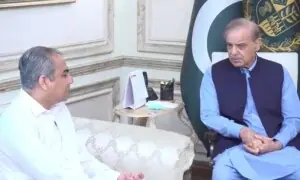
Prime Minister Shehbaz Sharif on Saturday held a meeting with Interior Minister Mohsin Naqvi, during which they discussed the latter’s upcoming visit to Tehran, according to a statement from the Prime Minister’s Office (PMO).
The interior minister also briefed the prime minister on his recent engagements on the sidelines of the Shanghai Cooperation Organisation (SCO) conference in Bishkek, the capital of Kyrgyzstan, the PMO added.
“Consultations also took place between the prime minister and the interior minister regarding his upcoming visit to Tehran. The prime minister provided guidance related to the visit,” the statement added.
A day earlier, Naqvi met his Iranian counterpart, Eskandar Momeni. The two ministers held an important meeting focusing on bilateral relations and the current regional situation.
During the talks, both ministers exchanged views on Pakistan-Iran relations and recent regional developments, according to a post by the Interior Ministry.
In the meeting today, a detailed exchange of views also took place on the country’s overall law and order situation and prevailing security conditions between the premier and the interior minister.
The interior minister informed the prime minister about the measures being taken to maintain peace and security across the country and ensure the protection of citizens, the statement said.
PM Shehbaz emphasised the need for close coordination among all relevant institutions and the adoption of a unified strategy to strengthen law and order and further enhance national security.
On May 17, Naqvi landed in Tehran on a previously unannounced two-day visit, which diplomatic sources said was linked to Pakistan’s continuing efforts to revive the stalled Iran-US peace process after President Donald Trump rejected Tehran’s latest response to American proposals.
Diplomatic sources in Islamabad said the unscheduled trip was part of Pakistan’s continuing shuttle diplomacy aimed at preventing the negotiations from collapsing entirely after momentum generated by earlier rounds of talks in Islamabad slowed sharply.
The visit, officially framed around bilateral and border security cooperation, came as the fragile ceasefire brokered earlier through Pakistani mediation continued to hold unevenly amid intermittent tensions around the Strait of Hormuz and prolonged disruption to global energy shipping.
During the visit, Naqvi met Iranian President Masoud Pezeshkian and Parliament Speaker Mohammad Bagher Ghalibaf. According to Iranian media, the minister’s one-on-one meeting with the president was held at the Presidential Palace and lasted around 90 minutes.
Iranian Interior Minister Eskandar Momeni and Foreign Minister Abbas Araghchi were also present on the occasion, the official IRNA news agency reported.
Naqvi later met Parliament Speaker Mohammad Bagher Ghalibaf, who criticised “some regional governments” for believing that the presence of the United States would bring them security.
“Recent events have shown that this presence not only fails to create security but also lays the groundwork for insecurity,” Ghalibaf was quoted as saying by IRNA.
The US-Iran conflict is currently stalemated in a shaky ceasefire struck in April, which was followed by historic direct talks between the warring parties hosted by Pakistan.
Though daily strikes throughout Iran and the Gulf have stopped since then, bursts of armed conflict have continued.
Earlier today, tensions surged again when the US military said it struck radar sites in Iran after downing drones headed toward the strait. Shortly after, air raid sirens sounded in neighboring Gulf nations Kuwait and Bahrain — both US allies. Iran’s Revolutionary Guards said they had targeted “enemy bases in the area” with missiles in response to a US “invasion” of the country’s Sirik and Qeshm islands.
The US and Iran also exchanged attacks on each other’s military targets on Monday. After the US military carried out strikes near the Strait of Hormuz, Iran responded with a missile attack on Wednesday, damaging Kuwait’s airport and resulting in casualties.
Since the conflict began, Iran has repeatedly attacked targets in the Gulf region home to US military bases.
Nevertheless, diplomacy has continued with Trump under pressure to reach an agreement that would lift the US and Iranian competing blockades around the Strait of Hormuz, which have choked international oil supplies and threatened the global economy with rising prices.
The government of Azad Jammu and Kashmir on Friday declared the Joint Awami Action Committee (JAAC) a proscribed organisation and placed it under the First Schedule of the region’s anti-terrorism act.
The notification by AJK’s Home Department said the group is “engaged in terrorism” and has acted in a manner “prejudicial to peace and security” of the state.
It further stated that JAAC is involved in “creating anarchy in the state by intimidating public, promoting hatred and creating a sense of i
The government of Azad Jammu and Kashmir on Friday declared the Joint Awami Action Committee (JAAC) a proscribed organisation and placed it under the First Schedule of the region’s anti-terrorism act.
The notification by AJK’s Home Department said the group is “engaged in terrorism” and has acted in a manner “prejudicial to peace and security” of the state.
It further stated that JAAC is involved in “creating anarchy in the state by intimidating public, promoting hatred and creating a sense of insecurity in society and public at large etc”.
“Now, therefore, in exercise of powers conferred under section 12 of Azad Jammu and Kashmir Anti-Terrorism Act, 2014, the President, Azad Jammu and Kashmir has accorded approval to list the Jammu Kashmir Joint Awami Action Committee (JK-JAAC), also known by names such as Joint Awami Action Committee (JAAC) and Awami Action Committee (AAC) etc, in the First Schedule of ATA, 2014, Proscribed Organization for the purpose of the said Act.”
Persistent avoidance of institutional dialogue and refusal to engage with a designated implementation committee have led to accusations that the group is pursuing tactics aimed at disrupting the electoral process in AJK.
The criticism intensified as JAAC continued to call for a wheel-jam strike on June 9 — the same date the AJK Election Commission has scheduled for candidates to begin filing nomination papers for the upcoming July 27 general elections.
Earlier today, the AJK government urged outsiders to avoid travelling to the region and asked current visitors to leave immediately.
The group’s latest protest call centres on a highly contentious demand to abolish the 12 seats in the region’s Legislative Assembly that are reserved for refugees from Indian-occupied Jammu and Kashmir who settled in mainland Pakistan after 1947.
JAAC alleged that these seats are frequently used by mainstream Pakistani political parties to influence the formation of governments in Muzaffarabad.
On Thursday, the AJK Legislative Assembly strongly defended the status quo, backing the refugee seats and calling for elections to proceed on schedule.
Anxious to prevent a repeat of past bloodshed, Islamabad dispatched federal paramilitary forces to reinforce the region’s thinly stretched police force.
On Thursday, AJK Inspector General of Police Captain (retired) Liaqat Ali Malik formally requested 14,000 additional personnel from the federal government to secure the territory from June 7 to June 21.
Video footage circulating on Friday showed convoys of security personnel entering Muzaffarabad, suggesting that reinforcements were already being moved into the region ahead of the planned strike.
“Our foremost responsibility is to protect public and private life and property, and the police will act in accordance with their mandate,” Malik told Dawn earlier.
Meanwhile, speculation mounted on social media that authorities might suspend internet and mobile data services, as they had during the weeklong JAAC strike in September-October last year.
The previous shutdown had severely disrupted academic activities, online businesses and freelance work, while also hampering communication by rendering internet-based calling and messaging services inaccessible across the region.
Separately, the University of AJK on Friday postponed its Spring 2026 term examinations, scheduled to commence on June 8, until further orders in view of the JAAC strike call.
Prime Minister Shehbaz Sharif on Friday stressed the importance of the country having “strong” security, as he spoke about the budget-making process.
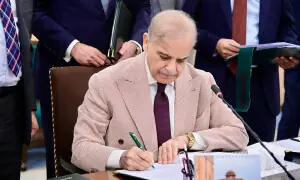
He made the remarks during a federal cabinet meeting that approved the budget, which is now expected to be tabled in the parliament. “Today, we are presenting the third budget of our government,” the premier noted.
“There were definitely a lot of challenges while preparing this budget. I believe that no nation can handle its matters, let alone make
Prime Minister Shehbaz Sharif on Friday stressed the importance of the country having “strong” security, as he spoke about the budget-making process.
He made the remarks during a federal cabinet meeting that approved the budget, which is now expected to be tabled in the parliament. “Today, we are presenting the third budget of our government,” the premier noted.
“There were definitely a lot of challenges while preparing this budget. I believe that no nation can handle its matters, let alone make progress, if its security is not strong and invincible,” the prime minister stressed.
He added, “We have to build water reservoirs and dams [as well as] work with speed on indigenous energy resources, which include solar panels, wind, and batteries.”
The prime minister mentioned that “measures for tax relief and economic progress” will be proposed in the budget.
Noting that the government had “lengthy discussions” with the International Monetary Fund (IMF) during the budget-making process, PM Shehbaz said he had a 30 to 45-minute-long phone call with its Managing Director Kristalina Georgieva, who hailed Pakistan’s economic progress.
He noted that the PML-N had “very detailed conversations” with its ally PPP, which were “successful”. He also thanked other coalition allies for their “unconditional” support.
The prime minister highlighted that the Centre remained engaged in “comprehensive interaction” with the four provinces over the past one and a half months.
“They were told how the centre needs additional funds,” he said, terming the dialogue with the provinces “very meaningful”.
The PML-N and the PPP had agreed to cut development and other expenditures at all tiers of the federation and jointly create similar, but higher, fiscal space next year for additional “strategic needs”.
As a result, the freeze on allocations for provincial development programmes will continue for a specific period beyond one year, according to Finance Minister Muhammad Aurangzeb.
During his address, PM Shehbaz appreciated PML-N President Nawaz Sharif, calling him his “leader”, and Punjab Chief Minister Maryam Nawaz for “showing a big heart for the pressing needs of the federal government”.
“They said that they stood ready to extend support to the federal government in challenges in defence and water security,” he remarked.
The prime minister then recalled his team had “several” meetings with the Sindh leadership, which also cooperated. He thanked President Asif Ali Zardari and PPP Chairman Bilawal Bhutto-Zardari for their “decision in the best interest of the country”.
PM Shehbaz also thanked Balochistan CM Sarfraz Bugti’s “big-heartedness” and KP CM Sohail Afridi’s “positive sentiments”.
“There can be no grander demonstration of national unity, solidarity, and cohesion than this,” he remarked.
The premier acknowledged that “despite our best efforts”, the government had to impose taxes in the past two budgets due to the “national and IMF requirements so that the economy […] could be stabilised and the avenues for progress could be expanded”.
The prime minister added: “Definitely, the common man had to face many difficulties due to it, and I, on my own and the cabinet’s behalf, would like to thank the 240 million people of Pakistan who tolerated the inflation with patience.”
PM Shehbaz highlighted that inflation had declined to single-digit from 38 per cent in the past two years, before increasing slightly due to the ongoing Middle East conflict. He further highlighted that the policy rate had also dipped to 11pc from 22.5pc during the period, but had to be raised due to the impacts of the US-Iran war.
“Today, our economy is stable, and we should hope that with this third budget, […] the wheel of our economy will pick up pace on the condition that we collectively work hard around the clock and stand ready to fulfil our responsibilities,” he emphasised.
At the outset of his address, PM Shehbaz said he attended the funeral prayers of “martyrs who sacrificed their lives in the line of duty”, which included two Christians.
“It was a heart-wrenching scenario that brought tears to every eye,” he said, recalling his meeting with the families of the martyred personnel.
The presentation of the federal budget for the next fiscal year (FY2026-27) has been pushed to June 10, according to Parliamentary Affairs Minister Dr Tariq Fazal Chaudhry.
His remarks come after several media outlets reported on Tuesday that the budget would not be presented on June 5, for which sessions of both houses of Parliament were summoned.
Asked about the reason for postponing the budget presentation during Samaa TV’s ‘Nadeem Malik Live’ programme on Tuesday night, Chaudhry said, “The i
The presentation of the federal budget for the next fiscal year (FY2026-27) has been pushed to June 10, according to Parliamentary Affairs Minister Dr Tariq Fazal Chaudhry.
His remarks come after several media outlets reported on Tuesday that the budget would not be presented on June 5, for which sessions of both houses of Parliament were summoned.
Asked about the reason for postponing the budget presentation during Samaa TV’s ‘Nadeem Malik Live’ programme on Tuesday night, Chaudhry said, “The initial proposal for the budget was June 5, [but] now, the budget will be released on June 10, God willing.”
Asked for a confirmation, the minister reiterated that the new date for the budget announcement was June 10 (Wednesday).
Elaborating on the reason for the delay, Chaudhry stressed that one of the two main steps in the budget process was “convincing the allies” in the ruling coalition.
However, he played down the impression of any rifts between the PML-N and the PPP, terming the latter’s chairman Bilawal Bhutto-Zardari a “very good ally of ours”.
The minister also refuted reports of the government planning to pass additional legislation that would impact the upcoming federal budget.
“There is not even one per cent truth in this. This is a rumour. No legislation is taking place before the budget,” he declared, reiterating that the budget presentation was delayed for consultations between the allies.
The National Economic Council (NEC) is set to meet today to formally approve the macroeconomic framework for FY2026-27 cleared on Monday by the Annual Plan Coordination Committee (APCC).
Under the framework, the government has set an economic growth target of four per cent — up from the 3.7pc growth rate recorded this year — and inflation at 8.2pc for FY2026-27.
The upcoming budget is expected to be formulated under the tight oversight of the International Monetary Fund (IMF), which last month discussed the “budget strategy” with authorities during its visit to Pakistan.
Subsequently, the government has trimmed allocations for most sectors in the next federal development programme to create additional fiscal space for the PML-N’s trademark national highways, a new Rs87 billion share for coalition partners and a Rs70bn allocation for ruling party lawmakers’ schemes.

 Login
Login