
 Login
Login


To ‘86’ occasionally means to kill but usually doesn’t: A linguistic investigation into the Instagram threat charge against James Comey

A federal grand jury in April 2026 charged James Comey with making a threat against President Donald Trump and transmitting a crime across state lines.
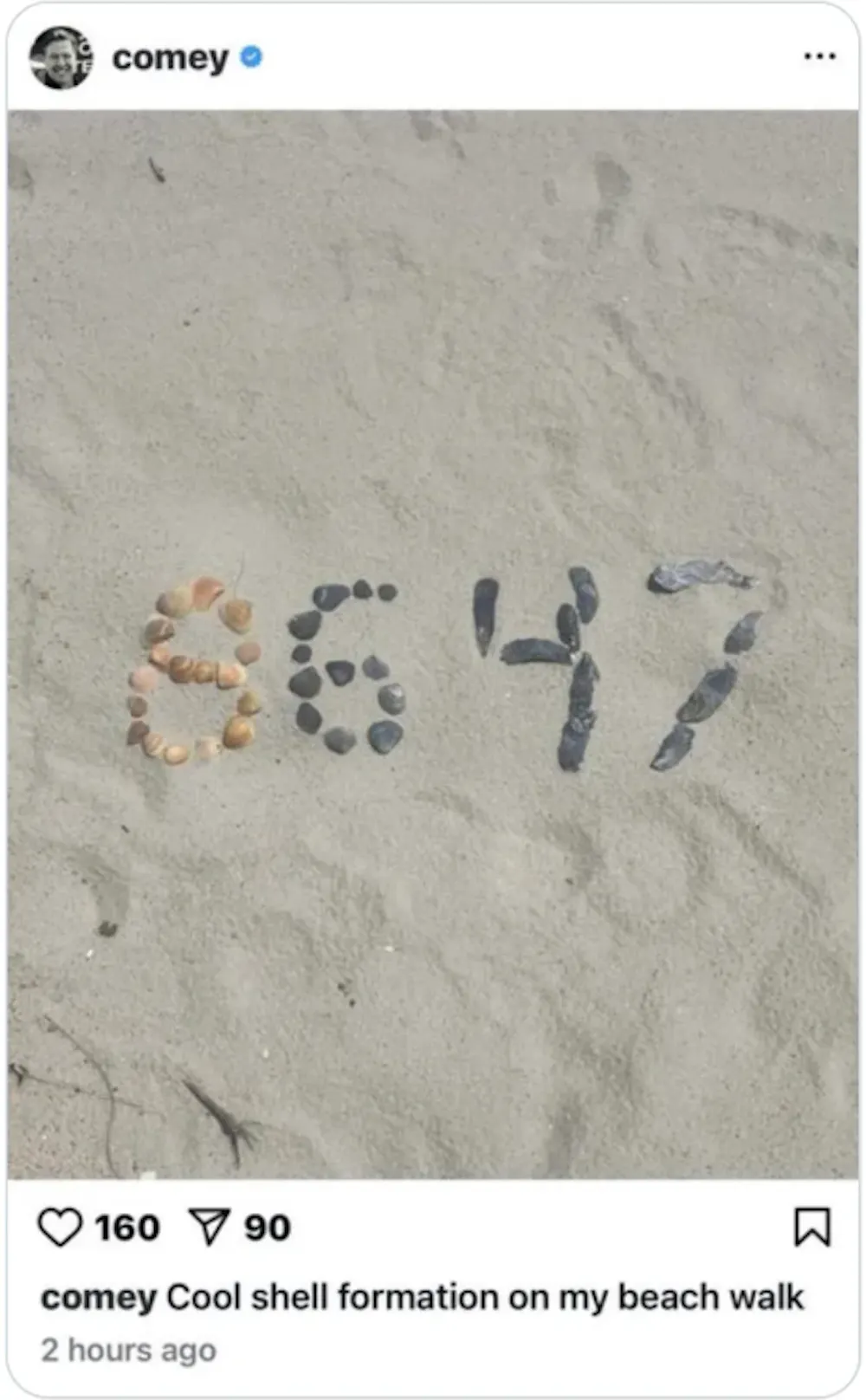
The charges came after Comey, the former FBI director, posted an image of seashells on a North Carolina beach, arranged in the form of the numerals “86” and “47.” Forty-seven was an ostensible reference to Trump, the 47th U.S. president, and 86 to a colloquial expression conveying a sense of “getting rid of” or “casting aside.”
But is “86 47” really a threat? And if so, is it a criminal one amounting to a threat to assassinate the president, as prosecutors have suggested?
In contrast to crimes such as murder or arson, which can be committed without uttering – or writing – a single word, threats are inherently crimes of language. They don’t exist without the linguistic symbols used to convey them.
Linguists like me who work in the field of language and the law understand these types of crimes to be “speech acts,” utterances that perform the action they name. What is a promise if not the words “I promise” or an apology if not the words “I’m sorry”?
The law is full of speech acts. Rulings, verdicts and arrests are all speech acts. So, too, are the crimes of language: solicitation, perjury, bribery and threats.
What is a threat?
Threats are language that states or implies the intent to intimidate or create harm. As a speech act, they need not be direct but often are.
In December 1984, the White House mail room received a letter with the message, “Ronnie, Listen Chump! Resign or You’ll Get Your Brains Blown Out,” referring to President Ronald Reagan. Below these words was a drawing of a pistol with a bullet being ejected from the barrel.
The Secret Service conducted a handwriting comparison analysis of the words, which led to the arrest of David Hoffman. He stated that “he didn’t know it was against the law to threaten the President.”
But Hoffman did commit a language crime. Although he didn’t use the words “I threaten to blow your brains out if you don’t resign,” the passive construction “you’ll get your brains blown out” accompanied by a drawing of a pistol constituted a direct threat that expressed a clear intent to intimidate and harm the president.
The scientific process of dictionaries
This brings us to the Comey case. Can a photo of 38 seashells arranged in the numerals “86” and “47,” and broadcast over Instagram, constitute a threat against Trump?
In theory, “86 47” could be an indirect threat, but the interpretation of Comey’s message really hinges on the meaning of “86” when used as a verb.

This is where tools of forensic linguistics, which helps solve crime and resolve matters of language and the law, can help.
The first tool is lexicography, the academic study of creating dictionaries. A classic maxim of lexicography is that dictionaries are out of date before they are printed. It’s a nod to the fact that words’ meanings change and new words enter the language quickly.
Although dictionaries are imperfect, their definitions are the result of the rigorous study of word meaning and adherence to the scientific process of lexicography, the practice of writing and editing dictionaries and other reference materials.
In the Comey case, we would expect to find “86” listed as a noun. But the inclusion of the nonstandard verb form – “to 86” – would tell us that what may seem mysterious and cryptic actually has a conventionalized and well-recognized meaning.
Of the five major dictionaries of contemporary English I consulted, all had entries for “86” as a verb. The Oxford English Dictionary, for example, includes: “to eject or debar (a person) from premises; to reject or abandon; (in earliest use) to refuse to serve (a customer).”
Oxford also offers this second entry: “In restaurants and bars, an expression indicating that the supply of an item is exhausted.” This may explain why many restaurant workers across the country have strong reactions to the Comey indictment.
The American Heritage Dictionary definition includes “to refuse to serve (an unwelcome customer) at a bar or restaurant; to throw out, eject; to throw away, discard.” Merriam-Webster provides a similar definition: “to refuse to serve (a customer); to eject or ban (a customer); broadly, to eject, dismiss or remove (someone).”
Collins Dictionary offers two entries, the first in line with the others – “ to reject from, or to refuse to serve at” – and the second: “to cut off, eject, cancel, eliminate, kill, etc.”
The dictionary evidence is therefore mixed: Most definitions convey a sense of “kicking out” or “refusing service,” but Collins does include “kill” as a secondary definition.
How ordinary speakers of English use ‘86’
More evidence is needed, so I turned to the second tool: linguistic corpora. A corpus – plural: corpora – is a collection of texts chosen to represent language as it is actually produced by speakers and writers across genres and time periods. Linguistic corpora are useful because they show us usage in context, while providing enough data to conduct quantitative analysis of word meaning.
With over 1 billion words, the Corpus of Contemporary American English is the largest corpus of spoken and written American English available today. I analyzed usage of the word “86” in the corpus and found 372 attestations in full form – “eighty-six,” not “86.”
The vast majority of the attestations had nothing to do with “ejecting.” But in a random sample of 100 cases of “eighty-six,” 20% were the verb form conveying the sense of “discard” or “eject.” Of those, two attestations meant “to kill,” and both came from fictional television and film. Far more common were expressions such as “Definitely 86 the coat, it sends the wrong message” and “Can we 86 the flags, please?”
When the direct object of the verb was a human subject, “86” still overwhelmingly meant “to discard” or “eject,” including this example when the subject was another sitting U.S. president: “Obama’s going to lose this election … they will blame his one term on a homophobic electorate who chose to eighty-six him because of his SSM stance,” in reference to his support for gay marriage.
In the Obama case, “86” clearly meant “vote him out.”
User-generated dictionaries are a third tool linguists use to analyze word meaning in the context of language crimes. They are less reliable than dictionaries written by professional lexicographers, but – like corpora – they give us a sense of the pulse of the language as it’s happening now.
Although they often contain factual errors, they tell us what English speakers think they know about the origins and meanings of words – a useful tool for analyzing language crimes.
I studied the entries provided by users for “86” on Urban Dictionary, where the highest-ranked definition is “to remove, end usage, or take away.” Of the 63 entries, only seven mention killing, one of those in reference to the Comey seashells. The vast majority of other entries align with the dictionary evidence: 86 means to get rid of something, or to have run out of a key ingredient.
The Comey indictment states that “a reasonable recipient who is familiar with the circumstances would interpret” Comey’s post “as a serious expression of an intent to do harm to President Trump.”
Looking across dictionaries, linguistic corpora and user-generated dictionaries, “eighty-six” could mean to kill but probably doesn’t. A general speaker of contemporary American English would interpret Comey’s post as an expression of opinion, a desire to “eject” the president from office.
Phillip M. Carter does not work for, consult, own shares in or receive funding from any company or organization that would benefit from this article, and has disclosed no relevant affiliations beyond their academic appointment.
