
Normal view

‘Devil Wears Prada 2’ shows how Christian imagery circulates in unusual ways through the fashion industry

Actress Meryl Streep attends the world premiere of 'The Devil Wears Prada 2' in New York. Angela Weiss / AFP via Getty Images

At the world premiere of “The Devil Wears Prada 2,” actress Meryl Streep leaned into her character’s devilish persona. She wore the character’s signature sunglasses along with long black gloves and a flowing red leather cape from Givenchy’s Winter 2026 collection.

Streep’s outfit, though, is a small moment in a much larger story – one in which Christianity and fashion have been intertwined for centuries, sometimes as adversaries, sometimes as collaborators.

While neither of the “Devil Wears Prada” movies revolve around Christianity, the invocation of the devil taps into an older moral rhetoric. For centuries, fashion was cast as the troublesome, if not villainous, enemy of a pure and spiritual Christianity – a symbol of putting material desires before holy ones. For example, 18th-century cleric and founder of Methodism John Wesley urged his followers to show their faith by dressing “neatly” and “plainly.”

Yet Christian imagery has come to shape the industry in profound ways. As a scholar who researches the relationship between Christianity and fashion, I have traced how Christian imagery circulates in surprising forms. The devil, for instance, occasionally appeared in fashion advertising to suggest sin, sensuality and transgression.

Christian imagery of angels and Eve

In the mid-20th century, Christianity often occupied a supporting role in the fashion industry. It showed up in articles by Christian religious leaders and color photographs of Christian art and architecture published in fashion magazines.

For example, articles on how Christianity addresses contemporary problems by Catholic Bishop Fulton Sheen and Columbia University Chaplain James A. Pike appeared in Vogue alongside ads for makeup and fashion photo shoots.

Christian imagery also appeared in fashion advertisements featuring “Sunday best” clothing and Easter dresses. Ads showed angels gifting consumers “heavenly” products that promised beauty and ease.

The devil only occasionally played a part in ads for fashion products, such as perfumes, makeup and handkerchiefs. These advertisements depicted the devil as a snake or alluded to him and his role in the Book of Genesis. The biblical passage recounts how the serpent, typically interpreted as the devil in Christian theology, tempted Eve to sin by eating the forbidden fruit. Eve then offers the fruit to Adam, and, having both sinned, they realize their nakedness, are ashamed and make clothing.

Fashion advertisements, ranging from Revlon in the 1940s to Hanes in the 1960s, celebrated Eve’s rebellious action. Revlon “double” dared women to try their “Fatal Apple” makeup so they could look like Eve, while Hanes stated, “Poor Girl! She never knew the temptation of seamless stockings by Hanes,” next to an illustration of Eve holding an apple by a serpent.

Ads played with the idea of fashion as a temptation in which female consumers should indulge. Female consumers were urged to “Be Eve” and give into the desire to purchase products.

The devil was eclipsed as ads featured garden settings and products that promised “the look of Eve.” Eve symbolized beauty and promised consumers the same results through their purchasing power.

A 1967 ad for the “Eve Petticoat” issued an invitation: “Come, pretty girl. Be Eve, if you wish.” In that same decade, Catalina’s “part of the art of Eve” campaign for their swimwear showed what this meant. Each ad featured a woman in a provocative pose wearing a Catalina bathing suit in a garden setting. By donning Catalina, the ad implies, the wearer can become Eve – attractive, stylish and sexy. By highlighting Eve’s rebellion alongside her beauty, ads framed her as a fashion heroine.

Eve’s prominent role in advertising demonstrates how the Judeo-Christian tradition permeated American culture, including the fashion industry.

An evolving fashion landscape

While Christianity appeared in industry advertisements, it also slowly began to take a more prominent role in fashion garments, as designers became more bold. Christianity inspired the design of many garments, and later, Christian figures began to appear on designer garments.

For example, in the 1960s, American designer Geoffrey Beene, known for his minimalist design aesthetic, drew inspiration from the cassocks worn by Catholic priests. So, too, did Spanish designer Cristóbal Balenciaga. In 1967, his black evening gown with cape radiated simplicity in form and draping even as it also referenced the attire of Catholic priests.

While Beene and Balenciaga received praise for their restraint and elegance, the lesser-known London-born designer Walter Holmes created controversy with his “mini-medievals” in 1968. Modeled after a monk’s robe and a nun’s habit, Holmes combined Christian inspiration with the miniskirt trend, which some people found fun, while others labeled it offensive.

Luxury fashion brand Krizia’s collection.

In the 1990s, Italian luxury fashion brand Krizia’s collection included women wearing cassock-like dresses, while Italian fashion designer Stefano Pilati’s 2010 line for Yves Saint Laurent played on the attire of Catholic nuns.

More recently, in spring 2020, French designer Virginie Viard’s designs for Chanel referenced nuns and Catholic school girl uniforms.

Yves Saint Laurent 2010/2011 fashion show.

‘Spiritual marketplace’

In the 1990s, Christianity began playing an even larger part in fashion, as the Virgin Mary and saints began to appear on garments. Prior to this, designers often avoided using religious figures; they preferred more abstract interpretations; it also helped prevent any controversy that might emerge from depicting sacred figures.

Designer Gianni Versace challenged this tacit rule in his Fall/Winter 1991 collection. It included biker jackets adorned with bejeweled crosses and, in the finale, a halter top that featured the Virgin Mary made out of a mosaic of jewels. The garment was also the centerpiece of ads for the collection and showcased the fashion potential of Christian figures.

Versace’s Marian halter reflected the larger shift away from institutional religion toward individual spirituality. Christian symbols were lifted from church contexts and recirculated through popular culture, including fashion, in new ways. Versace’s rock star rendering of the Virgin Mary offered people a new way of seeing her – one open to interpretation outside of doctrine. Like Versace, they could claim her and reimagine her on their own terms.

Sociologist Wade Clark Roof described the religious landscape as a “spiritual marketplace.” People relied less on religious authorities and more on the meaning they could create from “available images, symbols, moral codes, and doctrines.”

Religious ideas and products circulated through music and movies, crystal shops and sports stadiums, Christian bookstores and designer collections. Within this spiritual bazaar, fashion became a place where people could reimagine Christian symbols, figures and history in new ways.

Modern-day trends

In the years since, Christianity has become a regular feature in fashion collections. Most notably, Christianity regularly has a starring role in the work of Dolce & Gabbana. Their 1998 “Stromboli” collection revolved around a Christian theme, a Marian procession, and dresses, tunics and blouses featuring Marian imagery.

The design duo have returned to Christian imagery several times. For example, their 2013 “Tailored Mosaic” line, inspired by the golden mosaics in the Cathedral of Monreale in Sicily, featured garments adorned with angels, saints and Mary, as well as biblical figures.

Dolce & Gabbana ‘Tailored Mosaic’ show.

A critic called the mix of garments the designers’ “most heavenly offerings to date.” In 2018, Christian themes and symbols again permeated their collection.

It is now almost commonplace for fashion lines to reference or include Christian symbols, themes and figures. At New York Fashion Week in 2026, YesuGod, “a luxury Christian fashion house,” showcased its designs – garments adorned with the words “anno domini” and others with “the Lord is Coming.” More recently, in 2025, the vestments of Catholic priests inspired Dolce & Gabbana’s menswear collection.

The devil makes only an occasional appearance on the fashion runway and on the red carpet; historically, too, his presence has been minimal. Christian figures who embody ideals of goodness and holiness – saints, Mary and even Jesus – are the ones who rule the runway. Christianity and fashion are not so separate after all.

The Conversation

Lynn S. Neal does not work for, consult, own shares in or receive funding from any company or organization that would benefit from this article, and has disclosed no relevant affiliations beyond their academic appointment.

The sacred cloth at the center of the Hajj pilgrimage

During the Hajj pilgrimage, Muslims go around the cube-like sacred structure, the Kaaba, which is covered with a black cloth, the kiswah. MASTER/Moment via Getty Images

As Muslims gather for the annual pilgrimage of Hajj in Mecca, Saudi Arabia, they will circle around the “Kaaba,” a black cube draped in gold-embroidered cloth. A ceremonial textile – known as the “kiswah” – covers the Kaaba, around which Muslims will walk seven times in a ritual known as “tawāf.” It is the central act of the annual pilgrimage.

The Kaaba itself is a roughly cubic gray granite structure about 43 feet tall, which Muslims believe was established by the Prophet Abraham – Ibrahim in Arabic – and his son Ishmael as a place of monotheistic worship in antiquity. The Kaaba is empty inside, with no altar, idol or relic on display.

Yet, it is the geographical and spiritual center of the Muslim world. Muslims across the globe turn toward the Kaaba during their five daily prayers. The kiswah is what they actually see when they get there.

As a scholar of Islam, I study how spiritual objects carry meaning across generations. For all Muslims, the black cloth covering the Kaaba is deeply sacred as it touches Islam’s most sacred site and is believed by many to perform miracles simply through a touch.

The history of the kiswah

The earliest documented covering, recorded in ninth-century Arabic chronicles, is attributed to a Yemeni king named As'ad Abū Karib who reigned around 400 C.E. He is said to have draped the shrine in striped red wool.

For centuries afterward, successive coverings were laid one on top of another. As a result, by the eighth century, the accumulated weight threatened to collapse the structure.

Al-Mahdi, an Abbasid caliph, the dynasty which governed from Persia to Spain between the eighth and 13th centuries, performed the pilgrimage in 777 C.E. He ordered everything stripped down and replaced annually with a single cloth. This cycle has governed the practice for nearly 1300 years.

The color wasn’t black, as it is today. For most of Islamic history the kiswah was white, red, green, yellow or striped. White linen came from Coptic Christian weavers in the Nile Delta during the seventh century. The Mamluk sultans of Egypt, who ruled from 1250-1517, favored a saffron-yellow silk.

The transition to black happened only around 1224 C.E. under an Islamic ruler in Baghdad. The transformation has become so complete that most Muslims would be startled to learn it was ever otherwise.

What is the cloth made of, and where does it come from?

Today the kiswah is woven at a state factory called the King Abdulaziz Complex in Mecca, in a neighborhood called Umm al-Joud. It uses about 1,500 pounds of high-grade silk dyed black. Roughly 260 pounds of gold-plated and pure silver thread are embroidered into Quranic calligraphy along a wide belt that runs two-thirds of the way up the cube. A separate, even more ornate curtain covers the door.

History of the kiswah and the story of it manufacture.

The whole assemblage costs over US$5 million annually, paid from the Saudi treasury; the covering is replaced once a year on the first day of the Islamic calendar. Previously, it was replaced during the Hajj.

But the kiswah is not only an artifact. It is, and has always been, a political object. For roughly a thousand years, the right to manufacture and ship the cloth from Cairo to Mecca was symbolic of who claimed legitimate rule over the Muslim world.

Egyptian sultans sent it under the Mamluks; Ottoman sultans sent it from Cairo for four centuries beginning in 1517. The cloth traveled in a ceremonial caravan accompanied by a richly draped, empty palanquin called the “maḥmal” — a sort of mobile throne announcing the absent sultan’s protection of the holy cities.

In 1926, when the founder of modern Saudi Arabia conquered Mecca, his religious militia attacked the Egyptian caravan in a clash known as the Maḥmal Incident.

Saudi Arabia’s founder had just taken control of Mecca with the help of a fiercely puritanical religious militia. When Egyptian pilgrims arrived with the ceremonial caravan, accompanied by music and public celebration, the militia viewed the displays of reverence as contrary to “true Islam.” They attacked the Egyptians, killing dozens of people.

The clash marked a deeper shift in the Muslim world’s center of gravity. Religious authority and prestige, long anchored in cosmopolitan Cairo, were moving toward the Arabian heartland, where a rising Saudi order was reshaping Mecca through a far more austere version of Islam.

The Saudi state has manufactured the kiswah itself ever since.

When the old kiswah comes down each year, it is cut into pieces by the Banū Shayba, a family that has carried out this duty for generations. The fragments are then distributed as gifts to heads of state, museums and ordinary pilgrims who happen to be present at the right moment.

In Muslim belief, whoever holds a fragment is holding something that connects the earthly world with the divine.

The Conversation

Iqbal Akhtar does not work for, consult, own shares in or receive funding from any company or organization that would benefit from this article, and has disclosed no relevant affiliations beyond their academic appointment.

America’s musical founding father: ‘Liberty songs’ by a self-taught singer and tanner helped fuel the Revolution

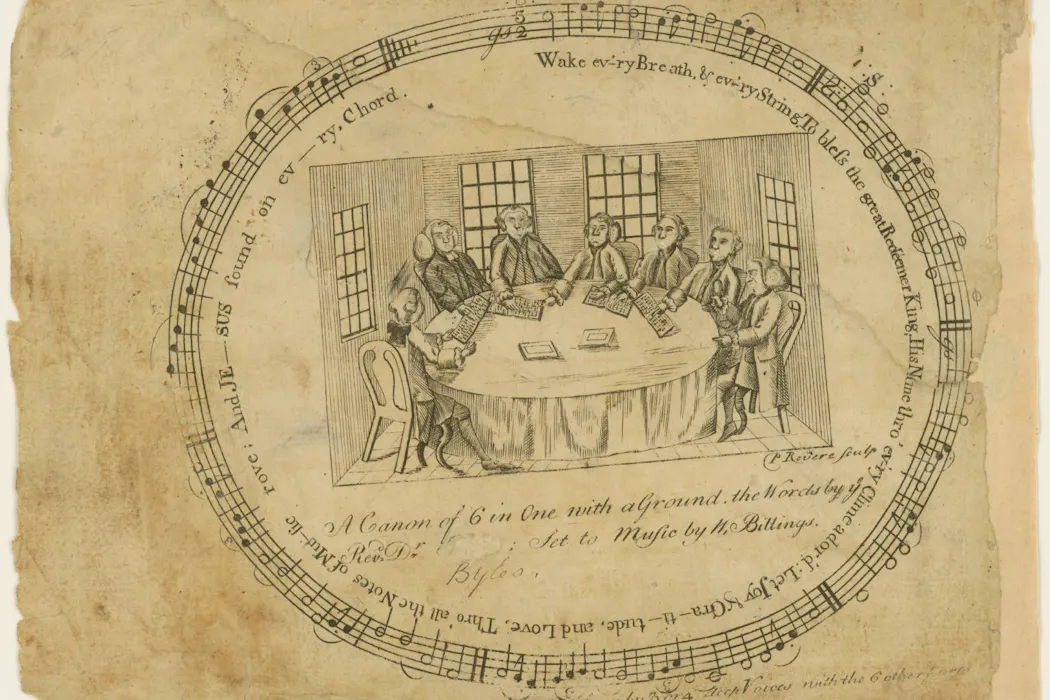
Paul Revere made the engraving used in the frontispiece of 'The New-England Psalm-Singer,' a tune book William Billings published in 1770. John Carter Brown Library via Wikimedia Commons

As July 4, 2026, approaches, Americans will be paying more attention than usual to events of 1776: the year the American Colonies declared their independence from Great Britain. Public historians, including filmmaker Ken Burns, have tried to offer a more inclusive view of the American Revolution, highlighting lesser-known patriots. But figures such as Thomas Jefferson, John Adams, George Washington and Benjamin Franklin will undoubtedly get the lion’s share of attention on the 250th anniversary.

One important character who rarely makes it into the limelight is the pioneering composer William Billings, who lived in Boston at the time of the Revolution. Billings is widely considered America’s first noteworthy composer, publishing six tune books and writing some 340 choral works – some of which are still sung today.

Apprenticed at 14 as a leather tanner, he learned music in his spare time and became a renowned teacher of singing schools, which taught basic elements of music so people could sing hymns more confidently. He also became a staunch supporter of independence, one of the Boston “Whigs” who spearheaded the American Revolution.

A black and white illustration of an enormous, leafy tree that towers over the white house next to it.
William Billings owned a tannery near the Liberty Tree in Boston, a rallying point for revolutionaries. AC8 Sn612 825h, Houghton Library, Harvard University via Wikimedia Commons

I have been studying Billings for 25 years now and always find more of interest about him – so interesting, in fact, that I wrote a historical novel about him. He was a colorful character with a voracious appetite for snuff and an unforgettable appearance. As music historian Nathaniel Gould wrote in 1853, Billings was “blind with one eye, one leg shorter than the other, one arm somewhat withered, with a mind as eccentric as his person was deformed.”

‘Liberty songs’

Billings was a friend of Samuel Adams, the revolution’s great agent provocateur, and sang regularly with him. He likely knew Paul Revere, who is credited with engraving the frontispiece to Billings’ first tune book, “The New-England Psalm-Singer,” published in 1770.

That was the year of the Boston Massacre, when British soldiers fatally shot five civilians. The event was one of several incidents that eventually triggered the conflict later known as the Revolutionary War. Billings did not serve in the military, probably because of his disabilities. His contribution to the independence movement was his music.

A tune from his first collection, “Chester,” is one of Billings’ best known, for which he also wrote words:

The Foe comes on with haughty Stride;
Our troops advance with martial noise,
Their Vet’rans flee before our Youth
And Gen’rals yield to beardless Boys.

That was not the only Billings song with a revolutionary message.

Lamentation Over Boston” adapted a Hebrew psalm about the Judeans’ exile in Babylon: “By the Rivers of Watertown we sat down & wept,” he wrote, referring to a town a few miles west, “when we remember’d thee O Boston.” Billings’ lyrics cast Britain as the oppressive Babylon: “For they that held them in Bondage/ Requir’d of them to take up Arms against their Brethren.” It may be the very first American protest song.

William Billings is far from a household name today, but he wrote several of the Revolution’s ‘liberty songs.’

In 1778 Billings published “Independence: The States, O Lord”, again writing music and words:

The States, O Lord, with Songs of Praise shall in thy Strength rejoice,
And Blest with thy Salvation raise To Heav’n their cheerful voice….
And all the Continent shall sing: Down with this earthly King, No King but God.

There’s some evidence these songs had national reach.

“The words stirred the patriotic heart, and with their striking melodies were sung at home and by the choirs, and especially in the military camps,” Louis F. Benson wrote about Billings’ music in his 1915 study “The English Hymn.” “The New England soldiers learned the words by heart, and every fifer the tunes, and carried them to whatever part of the country duty called them.”

Billings’ pieces were only a handful of the hundreds of what John Adams called “liberty songs” circulating in the Colonies. Most of them were less pious than what Billings composed. “Some of the outrageously ribald songs would have horrified polite society,” according to historian Bruce C. Daniels, author of “Puritans at Play.” “Dozens of them made metaphorical reference to England as a whore.”

HBO’s 2008 miniseries on John Adams’ life shows a group singing ‘Chester.’

Struggle after Independence

The peak of Billings’ career was during the 10 years after the Declaration of Independence. Two years before, he had met Lucy Swan while leading a singing school in Stoughton, Massachusetts. They got married the same year and went on to have a large family. In 1780, they moved into a nice house on Boston’s fashionable Newbury Street.

In the late 1770s and 1780s Billings published four tune books, including arguably his most important, “The Singing Master’s Assistant.” He also tried his hand at writing prose and even served briefly as editor of The Boston Magazine before being fired, apparently for his poor taste. He published a grisly tale about a clan of incestuous cannibals from Scotland.

At some point, he seems to have given up leather tanning. But by the 1790s Billings was reduced to working as a street cleaner and hog wrangler. He had to mortgage his house. Lucy died in 1795, leaving William to single-parent their six children – including a daughter, also named Lucy, born three years earlier.

A faded image shows a musical score arranged in concentric circles, which cherubs and open books drawn around the edges.
The frontispiece of William Billings’ final tune book, ‘The Continental Harmony,’ which was published in 1794.

American musical tastes had changed. Billings’ rough-hewn “fuguing” songs, a style with vigorous counterpoint between the different voice parts, were no longer in fashion. Formally trained singing instructors competed for students in Boston.

And Billings was unable to secure copyright for his compositions. Before the Revolution, he succeeded in having a bill to protect his first tune book passed by the Massachusetts legislature. The Tory governor refused to sign it, however, perhaps due to Billings’ associations with patriots like Samuel Adams. In any event, several of his pieces were reprinted in other collections, and he was paid nothing.

When Billings died in 1800, he was buried on Boston Common in an unmarked grave. But his music was kept alive by shape-note singers, a style of musical notation that caught on in the 1800s and helped preserve older, sacred songs. Billings’ music played at least a small part in uniting American colonists well enough to defeat the powerful British military.

The Conversation

David W. Stowe does not work for, consult, own shares in or receive funding from any company or organization that would benefit from this article, and has disclosed no relevant affiliations beyond their academic appointment.

❌
Subscriptions