
Normal view

AI-generated fantasies of US intervention reveal how desperation has narrowed Cuba’s political horizons

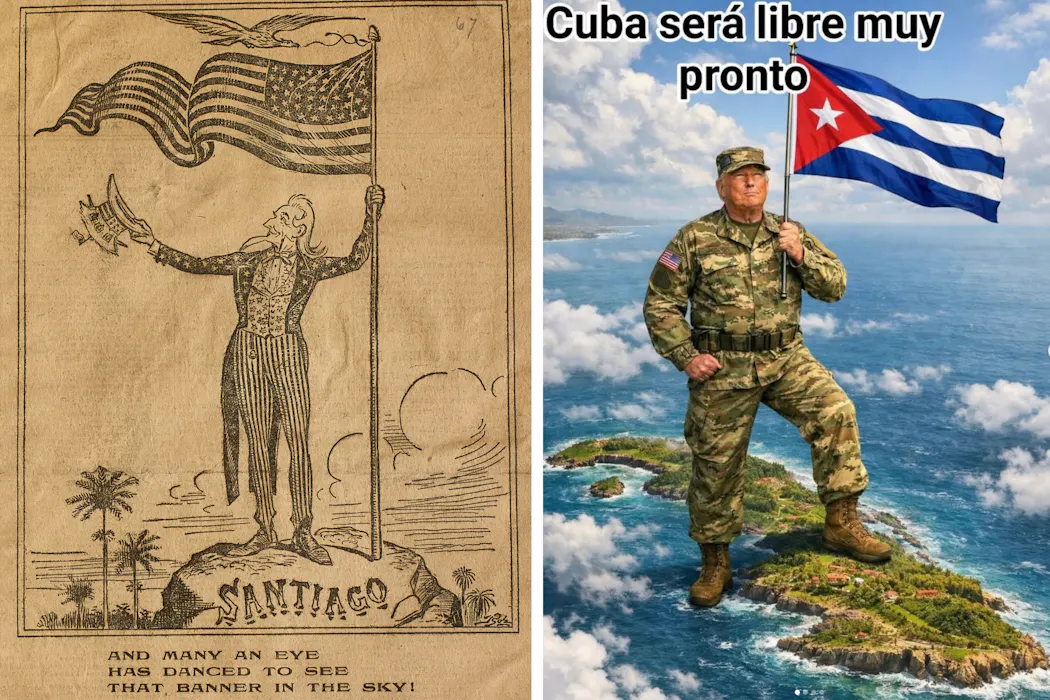
Cuba's American liberators, depicted on the left in a political cartoon from 1898 and on the right in an AI image. Cartoon: Blanche S. Crawford, Cartoon History of the Spanish American War (Scrapbook, 1898), 48. AI image: screenshot from Instagram. Images for this article sourced by Jorge Damian de la Paz.

Ever since U.S. commandos successfully removed Nicolás Maduro from power in Venezuela on Jan. 3, 2026, speculation has been growing that “Cuba could be next” on the list of the Trump administration’s targets.

“We’ll take over Cuba almost immediately,” President Donald Trump mused during a speech in Florida on May 1. “On the way back from Iran, we’ll have … the USS Abraham Lincoln come right by Cuba, stop about 100 yards offshore, and they’ll say, ‘Thank you very much, we give up.’”

It’s hard to say whether such remarks are just bluster. While the White House has been trying to coerce Cuban authorities into negotiated political and economic concessions through a de facto oil blockade since January, Trump has also reportedly grown frustrated by the Cuban government’s ability to outlast months of sustained U.S. pressure.

That has not stopped many Cubans and Cuban Americans from eagerly predicting a military operation’s success or insisting that such a U.S. action is necessary.

Their tool of choice? Not battle plans or political manifestos, but artificial intelligence. For weeks, Cuban social media feeds and WhatsApp groups have been filled with armchair fantasies of deliverance from communist rule made with tools like Midjourney, DALL-E, Runway and ChatGPT. In some clips and images, the island nation is represented as a female captive or a child being freed by an American protector. In others, magically renovated cityscapes feature statues and portraits erected in Trump’s honor, replacing revolutionary iconography.

It is easy to dismiss such animations as online trolling. But as a historian of Cuba, I noticed something troubling when my colleague Jorge Damian de la Paz sent me a selection of these digital illustrations and reels. Their visual language eerily mirrors classic U.S. political cartoons during Cuba’s final war for independence against Spain in the late 19th century. That imagery went on to justify U.S. meddling in Cuban affairs for decades.

A fraught history

In the 1890s, American illustrators at publications such as Puck, Judge and Harper’s Weekly similarly portrayed Cuba as a feminized victim: weak, vulnerable, often racialized as nonwhite and incapable of securing freedom on her own. They imagined grateful tropical citizens celebrating future American liberators for defeating their Spanish overlords and bestowing the benefits of “civilization” on Caribbean life.

Such tropes were not innocent. They helped generate the cultural consensus that legitimized U.S. intervention in the Cuban war in 1898 – known by most Americans as the Spanish-American War. They also shaped Cuba’s postwar order: four years of U.S. military occupation, an imposed amendment to Cuba’s first constitution authorizing future American military action to preserve stability, and decades of political and economic dependence on the United States.

Taking their cue from heroes of the independence struggle such as José Martí, many Cubans grew to resent this asymmetrical relationship with the North, even as they fell in love with imported American consumer products and cultural pastimes. Especially by the 1930s and 1940s, mainstream political movements on the island all sought to, at a minimum, rebalance the extent of U.S. influence over Cuban life. Their failure to do so was part of what propelled Fidel Castro’s radical nationalist revolution to power in 1959.

Reversing course

But today, formal and informal polling suggests that significant numbers of Cubans and Cuban Americans seem willing to welcome, or at least tolerate, the explicit U.S. intervention that most of their forefathers rejected.

AI-generated expressions of these views do not appear to be coming from staunchly anti-communist exiles in South Florida alone. Comments and reposts suggest they are resonating among Cubans living on the island, many of whom are desperate for “something, anything” to put an end to the worsening blackouts, shortages and societal paralysis that have made daily life feel like purgatory.

If a U.S. military operation is the only way to escape, one friend in Havana told me, “que sea rápido” – let it be over quickly.

What’s distinct about AI is that it is providing this fatalism with a visual vocabulary rooted in imperial attitudes from the 1890s. This makes sense when you consider how the technology works: Generative AI systems have been trained on enormous, often U.S.-centric archives of historical photographs and other materials. They easily reproduce the old cultural and political prejudices seen in these digital repositories.

As a result, image and video generators appear to be spitting 19th-century American discourses back at 21st-century Cuban users. The most extreme iterations of the imagery even resurrect a long-dormant idea from more than a century ago: the outright annexation of the island as a U.S. state. In so doing, AI provides narrative fuel for the Trump administration’s efforts to rewind the clock to an era when Washington condescendingly treated Latin America as its “backyard.”

Deprivation and desperation

The depth of Cuba’s predicament today helps explain why these images are going viral.

Long before the Trump administration cut off oil supplies, Cubans were enduring their worst economic, political and social crisis in three decades. Botched internal reform efforts, repression of dissent, and mass migration profoundly eroded faith in Cuba’s Communist Party leadership and institutions in recent years. This has been particularly true since the island’s tourist-heavy economy was hit hard by COVID-19 and 2021 mass protests rocked more than 50 towns and cities.

Of course, plenty of Cubans in Cuba still blame the long-standing U.S sanctions regime, and Trump’s unprecedented additions to it, for many of their problems. Not all are willing to accept change at any cost.

But Cuban officials’ defense of national sovereignty in the face of mounting U.S. threats rings increasingly hollow. Cuba hasn’t held a truly competitive election in nearly 80 years and has been ruled by a one-party state for 65. Under those circumstances, political independence does not rest on the consent of the governed. It’s also hard for a country to claim sovereignty when its economy relies so strongly on external patrons, such as Russia, China, Venezuela (until January) and even the United States. Despite the embargo, Cuban Americans send hundreds of millions of dollars in remittances, food, medicines and other goods annually.

The seduction of rescue

Yet even if fantasies of rescue are understandable, they should be deeply concerning to anyone who cares about Cuba’s future.

The danger posed by AI images is not simply that they normalize the idea of a U.S. military intervention that could cost Cuban lives. It is that they replace deeper civic imagination with spectacle and clickbait.

AI is offering visions of liberation without requiring Cubans to grapple with the far more difficult dilemmas that any real transition would entail. Those questions include how to rebuild institutions, restore trust, confront inequality, reconstruct the economy, forge reconciliation and negotiate competing political visions after decades of polarization and authoritarianism.

Prolonged desperation, coupled with authorities’ stubborn refusal to open the island’s political and economic systems, has narrowed some Cubans’ political horizons to the point where they outsource their own salvation rather than imagine it from the bottom up.

The coming weeks may determine whether digital fantasies turn into concrete policy or remain wishful thinking. But one thing is certain: AI images of U.S. military intervention in Cuba reveal that many Cubans and Cuban Americans have given up on defining change on Cuban terms. That choice could mean the difference between a Cuba that once again becomes a U.S. client state and one where Cubans reclaim ownership of their nation’s future.

The Conversation

Michael J. Bustamante does not work for, consult, own shares in or receive funding from any company or organization that would benefit from this article, and has disclosed no relevant affiliations beyond their academic appointment.
National Science Foundation cuts mean researchers like me are losing grants – but impacts extend far beyond academia

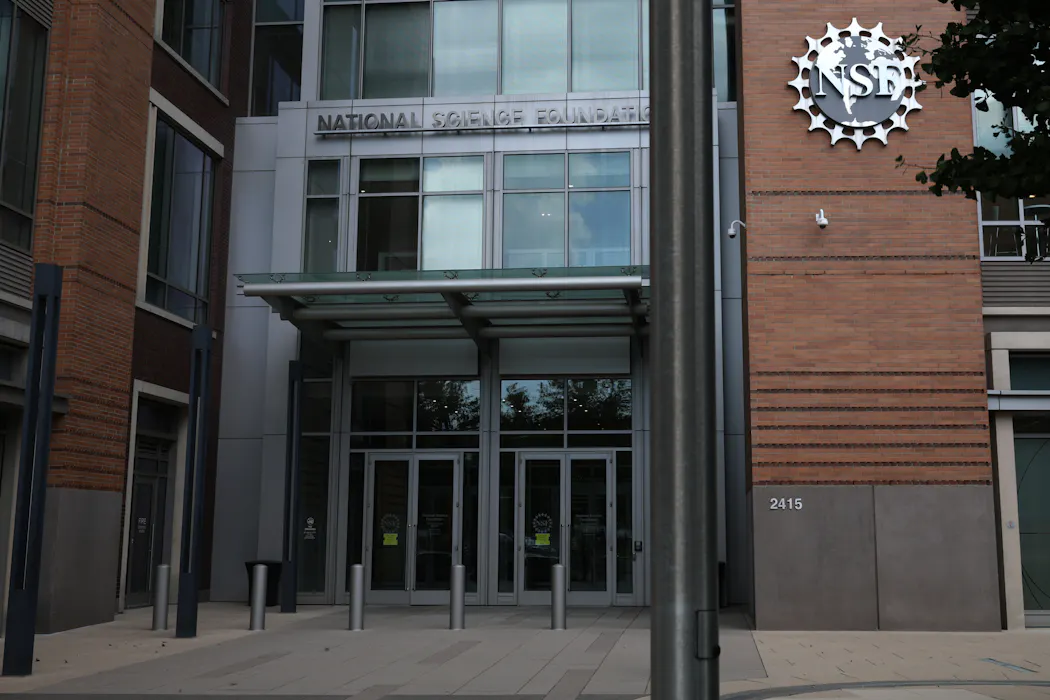
The National Science Foundation's Washington headquarters seen in July 2025. Alex Wong/Getty Images

As a university researcher focused on education, I have spent hundreds of hours designing studies to help the field and that might attract the National Science Foundation’s attention.

When I received my first National Science Foundation funding award – after many failed attempts – I joined a list of scholars whose work has led to innovations like the smartphone, high-speed fiber-optic networks and educational television shows like “Bill Nye the Science Guy.”

Congress created the National Science Foundation, or NSF, in 1950, to fund scientific and technological discoveries that benefit Americans.

In the academic world, few things signal success like receiving one of the approximately 11,000 grants the NSF gives out to researchers each year. These grants are typically worth an average of US$200,000, dispersed over several years. The foundation gives out about $8.5 billion annually in total.

The National Science Foundation’s work, though, has been upended under the current Trump administration – making it harder for researchers to secure funding that is necessary to complete our work.

Here’s what is most important to understand about what the National Science Foundation does, and why its work matters far beyond academic and scientific research circles:

Changes at NSF

Sethuraman Panchanathan, the National Science Foundation’s former director, resigned in April 2025, offering little explanation. The foundation remains without formal leadership.

Even with its fiscal year 2026 budget largely protected by Congress, the NSF has awarded grants at roughly 20% of its historical rate this fiscal year.

And in April, the Trump administration, without explanation, fired all 22 members of the National Science Board, an independent advisory group that supports the foundation’s work and also advised the president and Congress on science.

A cartoon image shows a person shining a light on molecules.
The National Science Foundation typically gives out approximately $8.5 billion annually in grants for scientific and other kinds of research. Westend61/Stock Illustrations/Getty Images

Not just an academic problem

After eight years of teaching high school science, I decided to get a Ph.D. to help improve the way science is taught. As a single father, though, I couldn’t have done it without the financial stipend my adviser gave me – thanks to his NSF funding – and some additional teaching on the side.

Eventually, I graduated, got my first job and received my first National Science Foundation funding award, which I used to support several students I worked with, similar to what had been done for me.

I’ve spent the past decade as a university researcher studying how family interactions shape the personal connections children make with science and engineering. This includes studying how children develop false stereotypes about who can become a scientist.

The Biden administration awarded me the Presidential Early Career Award for Scientists and Engineers for this work.

Today, however, my research would likely not get funded.

This is in part because the now dismantled Department of Government Efficiency directed the cancellation of more than 1,700 NSF grants worth approximately $1.4 billion in 2025.

Some observer groups suggest the numbers may be much larger, in part because the National Science Foundation stopped updating its list of cancellations in June 2025.

Many projects were flagged and terminated for using words like “women,” “bias,” “stereotype” and “race”.

Two of my NSF-funded research projects were terminated in 2025. One study examined how short social media videos can support healthy parenting in families facing extreme weather events. The second was a national study of how children from different cultures and races participate in out-of-school science learning activities.

A competitive process

The National Science Foundation accepts roughly 1 in 5 applications.

First, funding proposals have to meet or exceed the highest standards of scientific rigor. Second, a person or team’s proposed research must show great promise for benefiting society.

The NSF funds physics, engineering and other kinds of scientific research. It also funds research focused on sociology, linguistics, education and economics.

The National Science Foundation has funded projects that developed the mathematics behind how kidneys get matched to donors and research tracking how extreme weather reshapes communities.

Most of the funding the agency distributes goes to university-based researchers. Approximately 25% of all the federal funding that U.S. colleges and universities receive to conduct scientific studies comes from the National Science Foundation.

Funding discoveries that benefit all

When Congress passed the National Science Foundation Act in 1950, paving the way for the foundation itself, it also set up the National Science Board. The president appoints the board’s 24 members, who are typically highly regarded scientists and industry leaders. Members of the board serve six-year terms as part-time advisers – not government employees – to ensure independence.

While board members typically don’t decide what gets funded, they help set up rules and standards the National Science Foundation uses to select the most promising research funding applications.

Before 2025, the foundation also recruited outside experts – typically university researchers – to weigh in on the merits of nearly every funding proposal. Five to 12 of these experts, who received a small stipend, reviewed each application.

Experts then send certain applications to National Science Foundation employees. These employees then ultimately decide whether to approve an application.

This all changed in December 2025, when the foundation made this external review process optional. Some National Science Board members openly questioned these changes. Four months later, all of the board members were fired.

Some critics argue that the terminations themselves were unlawful because National Science Board members are appointed to fixed terms under federal law, and the statute does not clearly authorize the president to remove them before those terms expire.

While House Democrats have questioned the legality of firing the board members, there’s been no legal action to reinstate the board members.

A few members of the National Science Board have suggested that the terminations would give the current administration more control over what research gets funded and leave little room for independent scientific experts to weigh in.

A white older man wearing a blue blazer and a bow tie stands at a podium that says 'Save NASA Science' in front of the US Capitol building, with a group of people dressed formally standing behind him.
Bill Nye, better known as ‘The Science Guy,’ speaks during an October 2025 news conference in Washington, urging Congress to protect funding for NASA and the National Science Foundation. Saul Loeb/AFP/via Getty Images

Playing by different rules

Additional changes might be in store for the National Science Foundation.

The White House Office of Management and Budget proposed a major overhaul of the rules for all federal grants on May 29, 2026.

The new rules would give individual political appointees power to hide competitive grant opportunities from the public so only those with direct knowledge could apply. Political appointees could also cancel grants at any point for almost any reason, even if an optional review panel of 12 outside experts believe the funding is in the best interest of the American people.

These rules would apply to all federal grants, whether research-related or not. For the National Science Foundation, the new rules don’t eliminate the National Science Board’s oversight on paper, but they would make that oversight practically meaningless, even if the members are reinstated.

The proposed rules, which do not require congressional approval, are expected to be finalized by Oct. 1, 2026. Some legal experts anticipate the change will face immediate court challenges.

A loss of trust

For decades, despite knowing that most NSF proposals fail, researchers have been willing to commit countless hours to applying for research grants because it represented a gold standard in science funding.

They trusted that multiple experts would impartially assess their projects, based on their merit. But the past year’s changes have thrown that process into disarray. This shift means that many people who might have benefited from NSF-funded innovations never will experience the effect of new discoveries that could improve their lives.

The Conversation

Remy Dou received funding from the National Science Foundation.

❌
Subscriptions