
Normal view

As corporations race for the stars, we need international collaboration on space governance

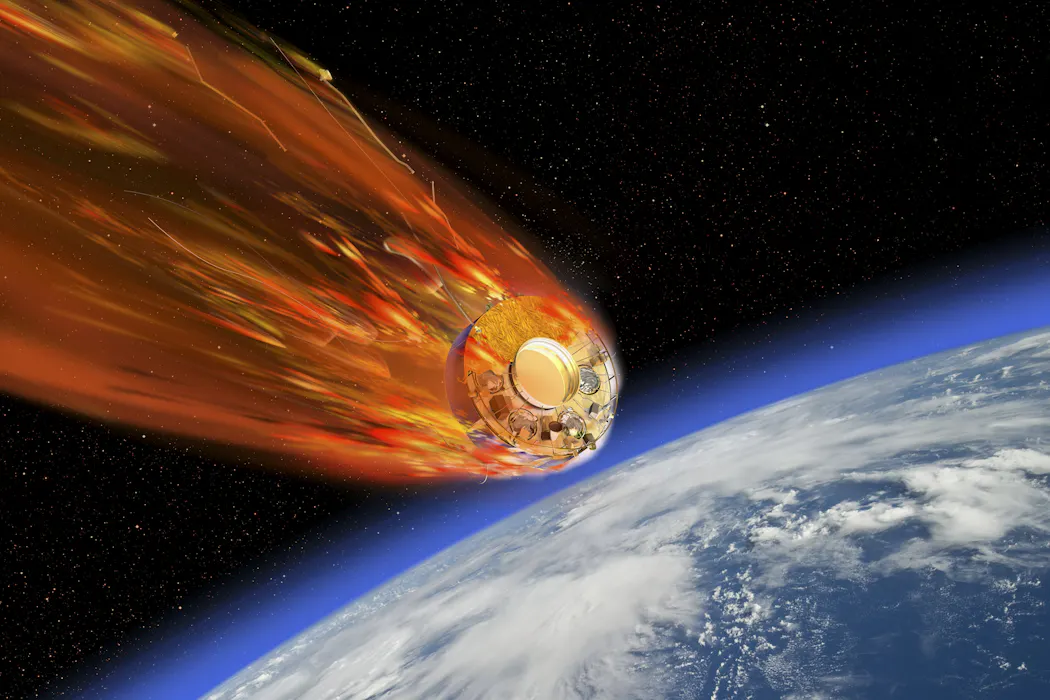
A satellite burns up as it travels through Earth's atmosphere. Several of these large satellite re-entries now occur every day. (European Space Agency/David Ducross), CC BY-SA

The science academies of G7 member countries have identified international space governance as a pressing issue for the G7 Leaders’ Summit, to be held from June 15-17 in Evian, France.

The explosive growth of large satellite constellations over the last decade offers great promise for near-universal access to broadband internet. But this growth comes with risks that are not yet fully understood.

These include contamination of the night sky, disruption of astronomy research, increasing risk of satellite collisions and hazards from large numbers of satellites falling back to Earth.


Read more: A million new SpaceX satellites will destroy the night sky — for everyone on Earth


Our understanding of the human impact on the near-Earth space environment is at a similar stage to our understanding of climate change back in the 1990s. We know that increased human activity is causing large disruptions to the space environment, but whether a tipping point is soon to be reached is not yet clear.

In this context, one of the most significant recommendations for G7 member states is to establish an intergovernmental panel on space sustainability (IPSS).

Impacts on atmospheric chemistry

Research and understanding of human impacts in space is still at a very early stage. For example, we don’t really know when some orbital altitudes will become so overpopulated with space debris that they reach operational capacity.

Scientists have also recently recognized that the increased global rocket-launch rate — with more than one rocket now being launched every day — may lead to a reversal in the recovery of the ozone layer.

Similarly, we are aware that satellites burning up as they fall back to the Earth’s atmosphere will have significant effects on the chemistry in the upper atmosphere. We know there are now several of these large satellite re-entries occurring every day, but the full effects of this are not clear.

Messy space governance

Several scientific bodies now advise on policy in different areas of space sustainability. One is the Inter-Agency Space Debris Coordination Committee, which focuses on space debris degradation of the environment.

Another is the International Astronomical Union Centre for the Protection of the Dark and Quiet Sky, which co-ordinates efforts to reduce the impact of satellites on optical and radio astronomy.

A dark night sky filled with stars and the pink and blue coloured and butterfly-shaped 'Butterfly Nebula.'
An image of NGC 6302, known as the ‘Butterfly Nebula,’ taken using the Hubble Space Telescope. The telescope is increasingly impacted by satellite constellations in low-Earth orbit. (NASA)

But no single body exists to provide comprehensive policy input to governments for policy and regulatory decisions. The situation is similar to that in climate change research, when the early Advisory Group on Greenhouse Gases (AGGG), formed in the 1980s, transitioned to the Intergovernmental Panel on Climate Change (IPCC).

We urgently need an intergovernmental panel on space sustainability (IPSS).

Ten years ago, the number of active satellites in low-Earth orbit numbered almost 2,000; today, it’s close to 20,000. In recent years, governments and corporations have announced plans for up to a million more.

Defining global thresholds

How could this IPSS be structured, to approach space governance in a similar way to how the IPCC approached the climate change problem?

A primary goal should be to define global thresholds for sustainability. Much like the 1.5 C limit in climate science, the panel should identify thresholds beyond which specific orbital altitudes have reached carrying capacity.

Like the IPCC, an IPSS should include several working groups to provide transparent and accessible summaries of scientific results for policy makers.

One should focus on the physical science of the orbital environment. This means the state of low-Earth orbit as a finite resource — including estimates of space debris and collision growth, effects of space weather and models of sustainable future launch traffic.

A satellite, breaking into fragments, with the Earth behind.
A satellite breaks up in orbit. (ESA/ID&Sense/ONiRiXEL), CC BY-SA

Another working group should centre on the environmental and societal impacts of large satellite constellations. This would assess stratospheric ozone depletion caused by rocket launch emissions, the effects of higher satellite re-entry rates, changes to atmospheric chemistry and increased casualty risks. It would also quantify their impact on ground-based astronomy.

Finally a working group on mitigation and policy could set the stage for clear international standards for post-mission satellite disposal, active debris removal and new licensing requirements that account for a constellation’s “system-wide” rather than “per-satellite” risk.

Space traffic footprints

A useful addition to the IPSS would be a Task Force on Space Traffic Footprints. Modelled after the IPCC’s Task Force on National Greenhouse Gas Inventories, this body would develop standardized methodologies for states to report their “space traffic footprint” — the burden their space objects pose to the safety and sustainability of the low-Earth orbit environment.

Similar to the IPCC’s role in vetting climate models, the IPSS needs to provide independent assessment of claims regarding satellite demisability — the way satellites are safely decommissioned and de-orbited. This should evaluate how successful de-orbiting technologies are and how well we can track satellites and estimate their location uncertainties.

By creating a co-ordinated international approach now, the IPSS will help balance the enormous promise of commercial activity in space with the environmental risks — just as the IPCC has done with Earth’s changing climate from human activities.

The Conversation

Peter Brown receives funding from the Natural Sciences and Engineering Research Council of Canada, the United Sstates National Aeronautics and Space Administration, the European Space Agency, Natural Resources Canada and Defence Research and Development Canada

The women’s rights crisis in Afghanistan is an ongoing humanitarian calamity

Where is one of worst places to be a woman? Afghanistan.

That’s what most people think when it comes to the topic of the women’s rights crisis under the ruling Taliban in Afghanistan. But this only tells part of the story.

Focusing on the word “rights” hides something more serious underneath: how people live and survive in this situation. What’s unfolding in Afghanistan is not just a women’s rights crisis, but a humanitarian disaster.

It affects how people access health care, education, food systems and basic supports and whether these system can function at all when half the population has been systematically removed from them. It forces families to deal with women’s limited access to work and services, often pushing households into deeper economic and social vulnerability.

The Taliban has steadily removed women from public spaces including work, health care and education. Recently, for example, female health-care workers were stopped at the gates of a United Nations office and banned from entering the facility by Taliban authorities.

These ongoing removals are incrementally creating a system that determines who has the right to exist, to provide assistance and to receive assistance.

What’s happening in Afghanistan is not simply gender discrimination; rather, it’s pushing an entire gender out of public systems altogether. The predicament of Afghan women is less a social problem and more a structural crisis that shapes institutions and everyday life.

Gender apartheid

This is why the situation in Afghanistan is increasingly referred to as a form of gender apartheid rather than a women’s rights crisis. The exclusion of women reveals how institutions are built and will be maintained in the future.

Gender apartheid refers to a situation in which people are banned from certain spaces or activities based on their gender identity.

This discriminatory and violent practice in Afghanistan has been widely documented and heavily reported on, but the situation continues to deteriorate daily.

Its effects are also accumulative, with each restriction reinforcing others and deepening the overall crisis. These systemic rights violations would be increasingly difficult to reverse even if political bodies and the ruling government changed tomorrow.

That’s because removing women from professional spaces leads to schools losing teachers, hospitals losing trained staff and aid networks losing access to half the population. And this loss isn’t temporary; it limits how systems can respond to the growing needs around them.

When women get barred from institutions, the problem isn’t just that these organizations suffer in their service delivery and performance. It also results in the loss of institutional memory — the skills, professional knowledge and experience that is no longer transferred to future generations.

Over time, institutions also scale down or suspend certain services due to a shortage of female workers. As services shrink, significant gaps appear in the networks of care and support leaving entire groups of people without consistent access to support.

Blocking aid and support

The Taliban refusal to allow female workers into UN and UNICEF offices is one of many examples happening today in Afghanistan that ban qualified women from entering places where they can deliver urgent care and assistance.

This effective crackdown on women’s rights is blocking aid and support in a society where it’s desperately needed.

Male workers are also limited in the ways they can assist female patients due to Taliban gender norms and restrictions, so support for women cannot be simply reassigned to them. This affects several aspects of humanitarian aid including health care, food distribution and protection systems.

It also delegates the burden of these unmet needs into households where women must provide unpaid labour and care-giving responsibilities.

Taliban rule consequently delays or prevents life-saving interventions for women and children, a violation of the human right to survive.

It’s not just UN and UNICEF offices where women workers are banned from entry: they’re being turned away at other aid organizations, hospitals, schools and various public institutions in a widespread erosion of human rights. The Taliban has put in place a network of human rights violations across the entire humanitarian system.

Humanitarian aid also depends on access to information and correct data: who is hungry, who is unsafe and who needs protection. In Afghanistan, where women are limited in who they can interact with and where female staff are largely absent from outreach, surveys and home visits, this information becomes incomplete.

Poor data leads to incomplete distribution of assistance and mismatched allocation of aid. As a result, the most vulnerable populations can remain invisible in official assessments.

This invisibility especially affects households headed by women and those living in remote or rural areas with already limited access.

Normalizing crises

The impact of Aghanistan’s gender apartheid might not be visible to many outside the country, but in the near future, humanitarian systems will break down.

Future generations of female professionals have already been eliminated by the Taliban’s ban of girls from schools.

UNICEF estimates the ban could cost Afghanistan 25,000 teachers and health-care workers. In a country where women are prohibited from receiving care from male providers, banning women from both education and health-care work creates a profound medical emergency.


Read more: The Taliban wages war on women, but their voices roar on the page. Here are 5 essential books by Afghan women writers


Over time, systems will be redesigned without women as providers even as they remain central as recipients. As gender restrictions disrupt the flow of resources, knowledge and care, the capacity to deliver services is declining every day despite high demand. Many women are also pushed into informal or hidden work that is insecure and vulnerable to exploitation and abuse.

Gender apartheid in Afghanistan will not end through recognition alone. Naming systemic terror does not stop it and, without action, repeated exposure to crisis can instead normalize it through compassion fatigue. Humanitarian organizations now face a stark choice: operate under restrictive conditions and risk legitimizing them, or withdraw and leave people without support.

The longer the situation persists, the more the exclusion of women in Afghanistan risks becoming a normalized structure rather than an emergency. The question is no longer only how to restore what’s been lost, but whether systems once dependent on women’s participation can be rebuilt at all.

The Conversation

Sepita Hatami does not work for, consult, own shares in or receive funding from any company or organisation that would benefit from this article, and has disclosed no relevant affiliations beyond their academic appointment.

❌
Subscriptions