
Normal view

  • ✇National Herald
  • The other high-risk gamble in West Asia Ashok Swain
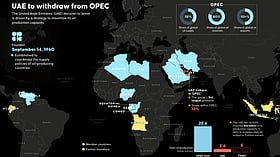
    The UAE’s decision to walk out of OPEC and OPEC+ is not just about oil. It represents a blunt geopolitical rupture. Abu Dhabi is no longer disguising its rivalry with Saudi Arabia nor walking a tightrope between regional camps. It is openly gravitating towards a new axis consisting of the US, Israel and increasingly India — and this high-risk strategy is deepening conflict lines across regions already on edge.OPEC, created in 1960, was designed to coordinate oil production and give oil-producing
     

The other high-risk gamble in West Asia

10 May 2026 at 09:58

The UAE’s decision to walk out of OPEC and OPEC+ is not just about oil. It represents a blunt geopolitical rupture. Abu Dhabi is no longer disguising its rivalry with Saudi Arabia nor walking a tightrope between regional camps. It is openly gravitating towards a new axis consisting of the US, Israel and increasingly India — and this high-risk strategy is deepening conflict lines across regions already on edge.

OPEC, created in 1960, was designed to coordinate oil production and give oil-producing countries collective control over global prices. OPEC+ came into being in 2016 to fold in 10 other countries, including big producers like Russia. For decades, Saudi Arabia dominated both structures, using them as instruments of economic and geopolitical influence. The UAE’s exit strips away part of that leverage and signals that Abu Dhabi no longer accepts Riyadh’s leadership, not just in oil but in the broader regional order.

The economic argument for leaving is straightforward. The UAE wants to produce more oil than OPEC quotas allow because the Iran war has put its economy under great strain. It wants to monetise its reserves quickly, to hedge against a future where fossil fuel demand has declined. But this is only the surface. What lies underneath is a deeper strategic break with Saudi Arabia, stretching across energy policy, military alliances and global partnerships.

The Abraham Accords of 2020 marked a significant geopolitical shift, with the UAE normalising relations with Israel and building cooperation in trade, technology and security. In contrast, Saudi Arabia declined to join the Accord, with Crown Prince Mohammed bin Salman maintaining that normalisation of ties with Israel would be contingent on the establishment of a Palestinian state and broader regional considerations.

This divergence between the UAE and Saudi Arabia is growing, and it shows in their external alignments.

Deserted OPEC headquarters in Vienna

Where Saudi Arabia is strengthening ties with Pakistan through a formal defence partnership, the UAE is moving closer to India, expanding cooperation in defence, intelligence, energy and technology, while also embedding itself deeper into a shared strategic space with Israel.

The United States has quietly encouraged this shift. Washington has long viewed OPEC as an obstacle to lower oil prices and greater Western leverage over energy markets. By leaving OPEC, the UAE weakens the cartel’s collective ability to control supply and pricing, opening space for increased Emirati production and greater market volatility that could benefit American oil producers.

Abu Dhabi’s move aligns neatly with broader US strategic interests: weakening Saudi-dominated oil coordination, reducing OPEC’s influence and committing the UAE more deeply to a US-led geopolitical and economic order.

The UAE’s growing proximity to India is also not just economic. It is political and strategic as well and carries serious implications. Abu Dhabi has chosen to align itself with a government in New Delhi whose domestic and regional policies have caused deep concern in the Muslim world. At the same time, India has been moving closer to Israel, expanding defence cooperation, intelligence sharing and technological partnerships.

The convergence of interests — seen in evolving UAE–India ties and India–Israel relations—is not accidental but part of an opportunistic geopolitical realignment that prioritises security cooperation and economic gain without bothering with notions of accountability and justice or a rules-based order.

The UAE’s relations with Pakistan have deteriorated sharply. Abu Dhabi has scaled back financial support, cooled diplomatic engagement and withdrawn from investment commitments. Pakistan was asked to pay back the entire UAE debt of $3.5 billion in April.

So, the UAE–Saudi rivalry will extend beyond West Asia, and what was once a regional competition is now entangled with India–Pakistan dynamics, creating overlapping fault lines. Instead of trying to reduce tensions, the UAE is embedding itself firmly on one side of a deeply polarised geopolitical divide.

Crown Prince Mohammed bin Salman Al Saud of Saudi Arabia

The UAE’s broader foreign policy reinforces this pattern. From Yemen to Libya, from Ethiopia and Sudan to the Horn of Africa, Abu Dhabi has pursued influence through strategic investments, military interventions and even proxy actors.

In Yemen, it backed separatist groups that clashed with Saudi-supported forces. In Sudan, it supports paramilitary actors accused of terrible atrocities. In Libya, it armed and financed a rival strongman. It has forged ties with Somaliland. All these actions have entrenched division.

The UAE frames its activism as a fight against extremism and disorder. But the reality is more troubling. It has continued to expand economic, technological and military cooperation with Israel despite its horrific genocidal project in Gaza. Trade has grown and defence and intelligence ties have deepened. The Iran war has only hardened Abu Dhabi’s conviction that its security lies with Israel and the US, not with Arab institutions.

The addition of India to this axis intensifies the problem. By aligning with Netanyahu-led Israel and Modi-led India while distancing itself from traditional partners, the UAE risks deepening divisions across West and South Asia. It also risks undermining its own credibility. A state that claims to promote tolerance cannot indefinitely ignore the implications of its alliances.

Saudi Arabia is not without fault. Its own interventions and ambitions have contributed to regional instability. But the UAE’s challenge is not a progressive alternative. It is a competing model of authoritarian power projection. The rivalry between the two is less about ideology and more about who will dominate the next phase of regional politics.

The risk is that this competition, now intertwined with India-Pakistan dynamics and reinforced by external alliances, will deepen instability across multiple regions. Yemen, Sudan and Libya are already paying the price. South Asia could become another arena for Gulf rivalries to play out.

Ashok Swain is a professor of peace and conflict research at Uppsala University, Sweden. More by the author here
  • ✇National Herald
  • Presiding over its own irrelevance Ashok Swain
    It’s India’s turn at the helm of BRICS this year and its position in the bloc — once seen as a counterweight to Western-dominated alliances and a US-led international order — couldn’t be more incongruous. As New Delhi prepares to host the 18th BRICS summit in September this year, India finds itself presiding over a divided grouping while becoming increasingly isolated within it. The BRICS grouping was already beset with contradictions but the ongoing Iran war seems to have split it wide open. On
     

Presiding over its own irrelevance

3 May 2026 at 16:10

It’s India’s turn at the helm of BRICS this year and its position in the bloc — once seen as a counterweight to Western-dominated alliances and a US-led international order — couldn’t be more incongruous. As New Delhi prepares to host the 18th BRICS summit in September this year, India finds itself presiding over a divided grouping while becoming increasingly isolated within it.

The BRICS grouping was already beset with contradictions but the ongoing Iran war seems to have split it wide open. Once projected as a platform for coordinated political assertion, for its commitment to multipolarity, it now appears incapable of even issuing a joint statement on a major geopolitical crisis involving one of its own members.

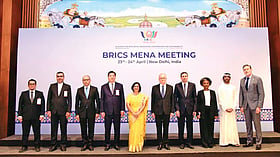
The BRICS MENA meeting, of deputy foreign ministers and special envoys of West Asia and North Africa, in New Delhi on 23–24 April, ended without consensus, forcing New Delhi to fall back on issuing a ‘chair’s summary’ rather than a collective declaration. That distinction is not procedural; it’s political — you get a chair’s summary when you lack consensus.

The divisions in the group are structural. Iran, now a BRICS member, expected solidarity from the bloc in the face of military confrontation. Yet other members, particularly the UAE, which has since withdrawn from OPEC (Organization of Petroleum Exporting Countries), resisted the use of strong language against the US and Israel. China and Russia leant towards Tehran. India equivocated with vague expressions of concern.

This paralysis has left BRICS unable to take a stand even when a member state has been attacked, when its leaders have been assassinated. Draft statements have failed and negotiations have stalled.

India’s role in this deadlock has been revealing. As chair, it was expected to provide direction but has instead chosen ambiguity. India’s reluctance to take a firm stand reveals the contradictions in the Modi government’s foreign policy.

In pursuing what its external affairs minister S. Jaishankar describes as ‘strategic autonomy’, India has developed trade, defence and strategic partnerships with the US and Israel, economic and energy ties with the Gulf, and cultural and diplomatic cooperation with Iran. With the war forcing a show of hands, India has tried to hedge to avoid alienating anyone.

But within BRICS, a grouping that increasingly defines itself through a critique of US dominance, that ambiguity comes at a cost. India’s refusal to take a position on a conflict involving BRICS bête noire US and a BRICS member is seen not as prudence but a lack of commitment. Iran has openly expressed its expectation that India, as BRICS chair, will mobilise the bloc in its favour, but New Delhi’s interests are too deeply embedded in the US–Israel alliance to hazard such a stance.

At the same time, China’s influence within the grouping continues to expand. The enlargement of BRICS, often presented as a sign of its growing global appeal, has in fact strengthened Beijing’s centrality. Many of the newer members share closer strategic alignment with China than with India. The balance within BRICS has shifted decisively. India is no longer a co-equal pillar. It has become a dispensable player in a structure increasingly shaped by China.

This shift has made India’s position more uncomfortable. Its strained bilateral relations with China, marked by unresolved border conflicts and strategic rivalry, limits the possibility of meaningful cooperation within BRICS.

India’s position is further complicated by Trump’s warnings of imposing punitive tariffs on countries pursuing alternative trade arrangements under BRICS. Wary of the Trump administration, the Modi government won’t risk taking a stand that might invite retaliation at various levels it cannot afford.

Consequently, New Delhi has been hesitant about endorsing initiatives that will be seen as a challenge to a US-dominated global economic order. Take for instance, talks of de-dollarisation.

The consequence is a narrowing of India’s strategic space within BRICS. It cannot fully align with the bloc’s more assertive agenda without risking economic and diplomatic repercussions. Yet by holding back, it undermines its standing within the group.

The internal contradictions of BRICS have never been so thoroughly exposed. For the first time, the grouping is confronting a situation where its members are divided over an ongoing military conflict involving one of their own. The inability to forge a consensus reflects deep incompatibilities.

India’s chairmanship has coincided with this rupture, and its own ambiguity has rendered it totally ineffective in managing the contradictions in the group. If anything, the crisis has exposed the limits of India’s influence.

The implications for the upcoming summit are difficult to ignore. Expectations are low. China’s President is unlikely to attend. With divisions unresolved and no shared strategic direction, the summit is unlikely to produce anything of consequence. At best, it will generate carefully worded statements that skirt contentious issues. And this, in turn, will reinforce the perception that India has no locus to lead the Global South.

This moment also raises big questions about India’s foreign policy. Its attempt to straddle competing geopolitical alignments is hard to sustain. Within BRICS, that strategy is already failing. The more India hedges, the more space China occupies. The more India avoids taking a stand on global issues, the less influence it commands.

The credibility of BRICS as the pivot of an alternative global order was already fading. Under India’s chairmanship, that decline has become unmistakable. The grouping continues to expand, add members and meet, but its capacity for meaningful collective action is eroding.

The Modi government’s failure to define a clear role for India within the bloc means that India now chairs BRICS without commanding it. It will play host without shaping the outcome in any way. The September summit in New Delhi will only lay bare its irrelevance.

Ashok Swain is a professor of peace and conflict research at Uppsala University, Sweden. More by the author here

❌
Subscriptions