Normal view

  • ✇The Independent Singapore News
  • Indian woman in Singapore warns of $5000 fine for picking up fallen mangoes Anna Maria Romero
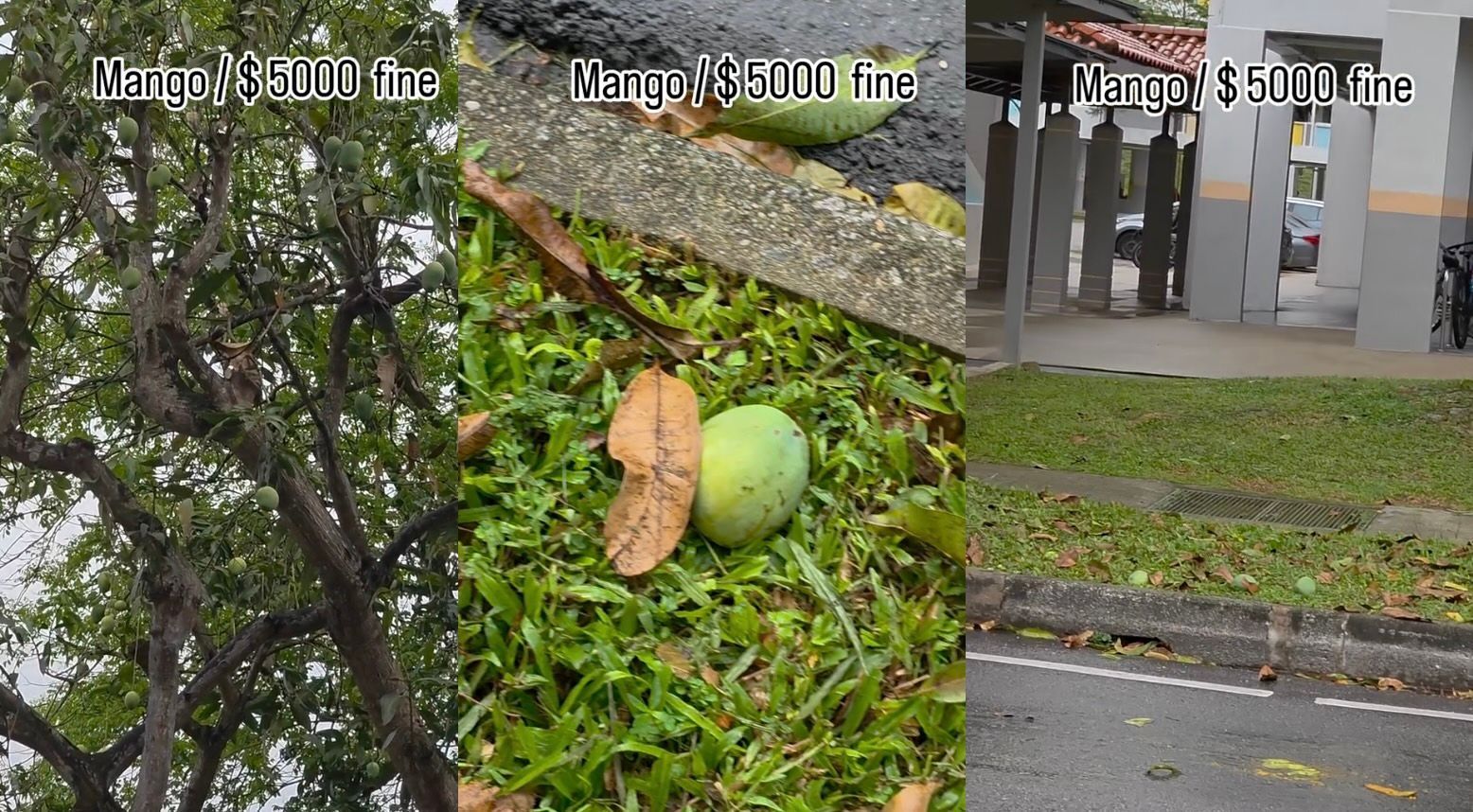
    SINGAPORE: An Indian content creator living in Singapore has received a lot of attention after her recent Instagram video, where she highlighted the fact that picking fruit that fell from public trees can come at a very high price. “Mango / $5000 fine #Singapore #Indian currency 3.74 lakhs,” wrote Priyanka Sinha (@ppriyankasinha) in the caption of her May 9 post. In it, she showed fallen mangoes on what appeared to be the grounds of an HDB block, as well as those that are still on a tree. Her po
     

Indian woman in Singapore warns of $5000 fine for picking up fallen mangoes

SINGAPORE: An Indian content creator living in Singapore has received a lot of attention after her recent Instagram video, where she highlighted the fact that picking fruit that fell from public trees can come at a very high price.

“Mango / $5000 fine #Singapore #Indian currency 3.74 lakhs,” wrote Priyanka Sinha (@ppriyankasinha) in the caption of her May 9 post.

In it, she showed fallen mangoes on what appeared to be the grounds of an HDB block, as well as those that are still on a tree.

Her post seems to have puzzled other Instagram users, who asked about the reason why people would be fined for picking the fruit. 

A couple of commenters wrote that “India is the best,” where the laws aren’t as strict as they are in Singapore. The post created quite a stir in India, where it was covered by a number of local media outlets.

Since it’s mango season in Singapore as well as other parts of Asia, including India, Ms Sinha’s warning is a timely one for those who may be unaware that under the city-state’s Parks and Trees Act, fruit growing on public land is considered government property. You can neither collect fruit that falls to the ground nor pluck fruits that are still on trees without permission from the National Parks Board (NParks). Otherwise, as she pointed out, people may face fines of up to S$5,000.

The law does not just apply to fruit, however, since even cutting the leaves of plants found on public ground is not permitted.

In January 2018, a worker from Bangladesh was seen taking leaves from a Syzygium myrtifolium tree, which is also known as the Kelat Oil or Red Lip tree. After pictures of a notice of offence that he had been issued were shared on social media, his employer appealed to NParks on his behalf, and his composition fine was reduced to a warning.

Other offenders have not been so lucky. An individual who took two Kopsia singapurensis saplings, which are critically endangered, was slapped with a S$3,000 fine.

In 2019, Lawrence Wong, who was then Minister of National Development, said in Parliament, “NParks manages most of the trees on state land. Members of the public who wish to pluck fruit from trees, or  collect fruit that has dropped from trees on state land, should approach NParks for permission.” /TISG

Read also: Singaporean man warns against Aljunied durian vendor with ‘unethical’ sales tactics

This article (Indian woman in Singapore warns of $5000 fine for picking up fallen mangoes) first appeared on The Independent Singapore News.

Hong Kong gov’t steps up measures at ecological hotspots ahead of Golden Week visitor surge

30 April 2026 at 06:23
eco-tourism

The Hong Kong government has introduced a string of measures to manage ecotourism hotspots in Sai Kung and Lantau Island, as a surge in visitors is expected during China’s upcoming Golden Week holiday.

The Agriculture, Fisheries and Conservation Department (AFCD) said in a statement on Wednesday that it would deploy drones and additional staff to patrol several hotspots – including Sharp Island and High Island Reservoir’s East Dam in Sai Kung, as well as Shui Hau on Lantau – from Friday to Tuesday.

Large crowds at Sharp Island, Sai Kung, on October 1, 2025. Photo: Greenpeace.

The announcement comes two days before Labour Day, a public holiday in Hong Kong and the start of a five-day Golden Week holiday in mainland China.

“In addition, the AFCD will conduct joint patrols with the Food and Environmental Hygiene Department (FEHD) during the holiday to remind visitors not to litter, and the FEHD will also strengthen the cleaning of public areas on the island,” it said. “The AFCD will conduct joint sea patrols with the Marine Department and the Police to maintain order.”

The government has faced criticism over its management of ecological hotspots, especially after overtourism and visitors’ environmentally degrading behaviour during last year’s Golden Week holiday.

Jim Chu, assistant director at AFCD, said on RTHK on Wednesday that authorities expected 1,000 people to descend on Sharp Island daily during the Labour Day Golden Week – far higher than the average of 600 to 800 visitors during regular weekends and public holidays.

Sharp Island, Shui Hau

The coastal areas of Sharp Island and Shui Hau on Lantau Island are currently not designated as country parks, marine parks, or marine reserves, the AFCD said in the statement.

It also said it had installed footfall counters at the pier of Sharp Island and in Shui Hau to monitor visitor numbers and would set up booths and distribute leaflets to educate tourists about environmental protection and conservation.

“The AFCD is currently promoting environmental protection awareness among visitors through various publicity and educational efforts,” it said.

AFCD drone monitoring above the Po Pin Chau viewing platform near the East Dam of High Island Reservoir in Sai Kung. Photo: GovHK.

The AFCD will also cooperate with the WWF-Hong Kong to set up public education booths.

AFCD staff will “explain or advise” visitors if they display any potential behaviour that could cause ecological damage, such as damaging, disturbing, feeding, or collecting marine life, or entering the water near corals.

Greenpeace criticised the measures this week, saying they were advisory and lacked deterrence, describing them as “a toothless tiger.”

According to the NGO, the government is promoting 22 sites with high ecological value as tourist attractions, but they are not protected by Hong Kong’s environmental ordinances because they lie outside designated country parks and marine parks.

Sai Kung campsites

The AFCD also said it would step up monitoring of campsites at Ham Tin Wan, Sai Wan, and Long Ke Wan in Sai Kung East Country Park to reduce littering and maintain cleanliness.

AFCD staff member promoting environmental protection in a countryside campsite in Hong Kong. Photo: GovHK.

“The AFCD will deploy additional staff day and night to patrol, be stationed, enforce regulations against violations, and use drones and CCTV systems to assist in monitoring the campsites,” it said.

Greenpeace said that Ham Tin Wan and Sai Wan campsites suffered from overcapacity and littering during the Lunar New Year holiday in February.

The government announced in March that it would introduce a campsite booking system by National Day.

  • ✇Exploring Nature - Sheila Newenham
  • Cloudland Canyon Waterfalls Sheila Newenham
    I’d half expected the falls to be dry. It’s hardly rained in northwest Georgia this autumn. But nature always delights as she often reminds me. The tiered unnamed falls cascade in a soft veil to join the creek and meander among the fallen leaves. The low water level made for easy scrambling across narrow streams, allowing me to fully explore this beautiful gorge in solitude. I’d parked at the north end of Sitton’s Gulch Trail in a quiet residential neighborhood instead of the busy Cloudland
     

Cloudland Canyon Waterfalls

I’d half expected the falls to be dry. It’s hardly rained in northwest Georgia this autumn. But nature always delights as she often reminds me. The tiered unnamed falls cascade in a soft veil to join the creek and meander among the fallen leaves. The low water level made for easy scrambling across narrow streams, allowing me to fully explore this beautiful gorge in solitude.

Sitton's Gulch Creek Sitton's Gulch Creek

I’d parked at the north end of Sitton’s Gulch Trail in a quiet residential neighborhood instead of the busy Cloudland Canyon State Park lot. It’s a rolling uphill hike from here to the steps above the falls and an easy hike back. It turns out that was a blessing, as I’d lingered at the falls and dusk was quickly approaching as I tried to ignore scores of puffball mushrooms and striking leaves along my way to get to the car before the last of the light, which disappears earlier in the canyon bottoms.

pear-shaped puffball mushrooms

It’s mid-November, and most of the leaves have fallen. Those still in the treetops twirl in the breeze, mimicking the gentle patter of a spring rain. I’m a half-mile from the parking lot when the full aroma of decaying leaves envelopes me and stops me in my tracks. I close my eyes and inhale deeply, savoring the nostalgia and peace of an eastern hardwood forest. My shoulders fall, and I’m instantly relaxed. It brings me back to barefoot summers full of exploration.

Cloudland Canyon Waterfalls Sitton's Gulch Creek Trail Cloudland Canyon Waterfalls

A couple of weeks ago, the falls were reportedly dry. Since then, there’s been some rain. And the snow flurries two days ago. I glimpsed a pool of water as I rounded a bend in the trail. What I’d thought was the sounds of rustling leaves was actually the gentle sound of water splashing down the boulder-strewn gulch! I’m elated!

I had an image in my head of the red maples in full color with the motion-blurred water falling behind them. It’s an image I missed on my last trip here, because I didn’t have my tripod. I had to hand-hold a long exposure, and all of the images turned out blurry.

Cloudland Canyon Waterfalls Cloudland Canyon Waterfalls

I wanted a do-over, even though I know we can never visit the same river twice. Today, most of the red leaves are on the ground, leaving the ochres and golds aloft to sing the song of the season.

The creek widens as I move up the path; small cascades roll over rocks in miniature torrents. Just before the unnamed falls, the Sitton’s Gulch Creek is only a few feet wide, carrying leaves, eddying in pools, and spilling down the canyon.

Cloudland Canyon Waterfalls
Unnamed Tiered Falls

I lingered at the base of these falls for an hour, enthralled with the way the water moves and all of the leaf mosaics plastered on the rocks.

Cloudland Canyon Waterfalls Cloudland Canyon Waterfalls Cloudland Canyon Waterfalls Cloudland Canyon Waterfalls

Climbing the wooden steps, I crossed the creek on a boardwalk at the lip of the falls. I took the short spur to Hemlock Falls. A viewing platform overlooks the ninety-foot waterfall.

Cloudland Canyon Waterfalls Cloudland Canyon Waterfalls
Dusk is coming

Social trails descend steeply to the base of the falls, an area that would be pooled with water when the creek runs full. Today, it would be a safe scamper down. But. I’m three miles from my car and one-and-a-half hours from sunset. Next time. This canyon keeps calling me.

Cloudland Canyon Waterfalls

If you’re interested in purchasing or licensing any images you see here, please email me at SNewenham at exploringnaturephotos.com, and I’ll make it happen.

Subscribe here to receive an email whenever a new blog posts.


The post Cloudland Canyon Waterfalls appeared first on Exploring Nature by Sheila Newenham.

  • ✇Exploring Nature - Sheila Newenham
  • Waterton Park and the 2017 Kenow Fire Sheila Newenham
    When I set out for Waterton National Park in Alberta, Canada, I imagined fall forests resplendent in golds, accented by oranges and reds. The smell of leaves composting into the earth and the peace of the earth quieting into winter. What I found was a blackened landscape, still deeply scarred by the 2017 Kenow Fire eight years ago. Crandall Lake Vista When the foliage is gone, the structure lies bare. Undulations ripple along the mountainsides; seeps and drainages stand out.  The rhythms o
     

Waterton Park and the 2017 Kenow Fire

When I set out for Waterton National Park in Alberta, Canada, I imagined fall forests resplendent in golds, accented by oranges and reds. The smell of leaves composting into the earth and the peace of the earth quieting into winter. What I found was a blackened landscape, still deeply scarred by the 2017 Kenow Fire eight years ago.

Crandall Lake, Waterton Kenow fire
Crandall Lake Vista

When the foliage is gone, the structure lies bare. Undulations ripple along the mountainsides; seeps and drainages stand out. 

Waterton Kenow 2017 Fire Waterton Kenow 2017 Fire Waterton Kenow 2017 Fire

The rhythms of the forest are speaking in structure, not color. This gift in this landscape of open vistas is long sightlines – a dream for wildlife spotting.

Waterton Kenow 2017 Fire Waterton Kenow 2017 Fire

The Kenow Fire ignited with a lightning strike and burned slowly until September 11, 2017, when it blew up in critically dry conditions, surging from 30,000 to 104,000 acres overnight, overtaking Waterton National Park. The Kenow Wildfire was a fire of exceptional severity exceeding every fire since the Park’s records began in 1700. In the end, half of the vegetated land and 80% of the hiking trails in the Park were burnt. 

In almost all of this burn area, most or all of the organic matter was seared away by the fire. The topsoil burned away to a depth of three feet.

Waterton Park Bellevue Prairie Trail Waterton Kenow 2017 Fire

Dense conifer forests are being replaced by young aspens and shrubs such as Saskatoon berry, thimbleberry, and huckleberry. It’s a bear’s delight! The conifers will come back, too. They grow relatively slowly.

Black Bear
Licking the berries off the branches like lollipops.

Fire is necessary, natural, “normal” for these forests. Our human misunderstanding and resulting meddling have given rise to an increase in these large, catastrophic (by human standards) fires. This was a dramatic fire. The recovery is being documented and studied, providing insights into the land’s history and the resilience of nature.Waterton Kenow 2017 FireIt’s often not what I expected, but it’s always an adventure.

If you’re interested in purchasing or licensing any images you see here, please email me at SNewenham at exploringnaturephotos.com, and I’ll make it happen.

Subscribe here to receive an email whenever a new blog posts.


The post Waterton Park and the 2017 Kenow Fire appeared first on Exploring Nature by Sheila Newenham.

❌
Subscriptions