
Normal view

From beef ribs to a ‘heavenly’ walk: Xi-Trump summit symbolism underscored American power and Chinese tradition

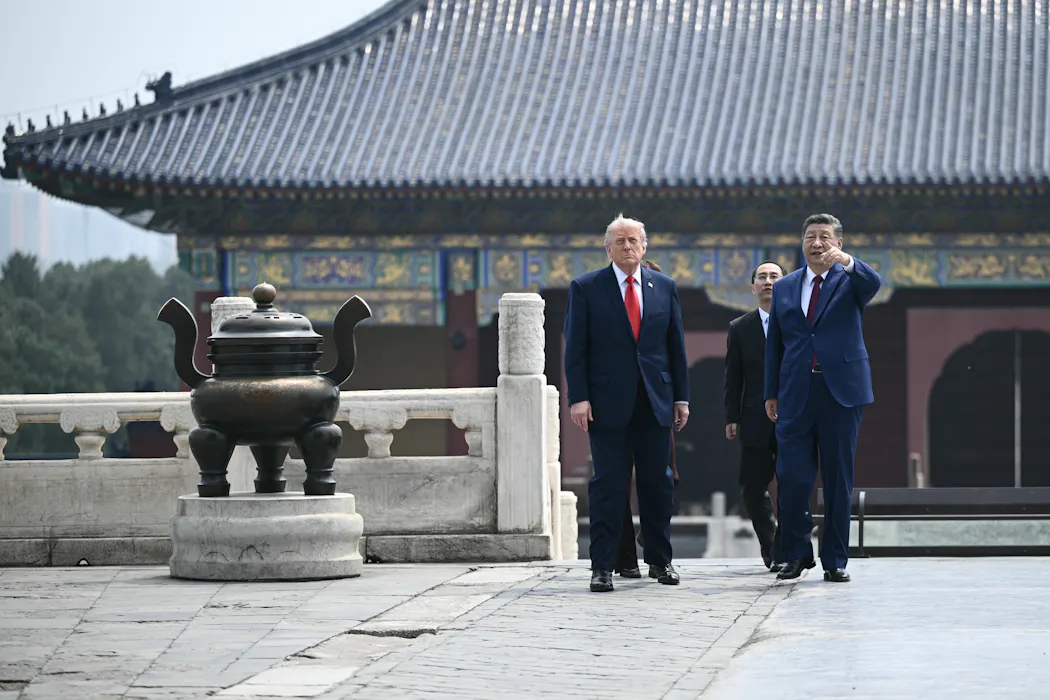
China's President Xi Jinping and U.S. President Donald Trump visit the Temple of Heaven in Beijing on May 14, 2026. Brendan Smialowski/Getty Images

Diplomacy often masquerades as theater. And nearly nine years after his first state visit to China, Donald Trump returned to Beijing with an extended cast of characters.

Alongside the U.S. president on his May 2026 visit was a senior delegation of politicians including his secretary of defense, and a phalanx of business leaders and technology executives. It was a traveling display of American political and corporate power.

Not that the hosting Chinese were short of symbolic gestures themselves. Trump’s first China visit in 2017 had already shown how far Beijing was willing to go to turn diplomacy into theater. On that occasion, Chinese President Xi Jinping and his wife Peng Liyuan personally accompanied Donald and Melania Trump through the Forbidden City, Beijing’s former imperial palace, drinking tea inside the palace walls and taking in a Peking opera at the Belvedere of Pleasant Sounds, a Qing imperial theater built for court entertainment.

So what was being conveyed this time around? As a cultural historian of modern China, I took a peek beyond the official statements and trade headlines of the Xi-Trump summit and into the images, gestures and cultural symbolism on display.

Two men in suits look away from the cabinet.
China’s President Xi Jinping and U.S. President Donald Trump at the Temple of Heaven in Beijing on May 14, 2026. Brendan Smialowski/ AFP via Getty Images

The weight of heaven

The formal choreography began at Beijing’s Great Hall of the People, where the two leaders exchanged views on the Iran conflict, the war in Ukraine and the Korean Peninsula, among other items.

But the more interesting story of the visit, to me, was told outside the meeting room.

After their two-hour bilateral meeting, Trump and Xi paid a cultural visit to the Temple of Heaven in Southern Beijing. Built in the early 15th century, the temple is China’s most complete surviving imperial religious complex. For nearly five centuries, emperors of the Ming and Qing dynasties came here to worship Heaven and pray for good harvests.

Its most recognizable structure, the Hall of Prayer for Good Harvests, rises in three tiers of blue-glazed tiles above a marble platform, its circular form and crimson columns translating cosmology into architecture. UNESCO inscribed the site as a World Heritage Site in 1998, recognizing it as “a masterpiece of architecture and landscape design.”

When Trump and Xi posed for photographs, they were standing in a place long associated with cosmic order and the welfare of the people. To bring a foreign leader there is to invite a particular reading of the relationship: not simply as a bargain between states, but as a relationship that Beijing hopes to associate with order, abundance and peace.

There was also a more practical layer to this symbolism. The Temple of Heaven links political authority to agricultural abundance. Emperors came here to pray not for abstract harmony but for grain. That made it a pointed setting for a visit in which American agricultural exports — soybeans, grains and beef among them — were expected to matter.

For Trump, any Chinese commitment to buy more U.S. farm goods would have clear domestic political value. For Xi, the setting allowed a hard bargaining issue — farm purchases — to be translated into an older symbolic language of harvest that spoke to both domestic and international audiences.

Before Trump, Kissinger

Trump was not the first American statesman to be brought to the Temple of Heaven.

In July 1971, Henry Kissinger, then national security adviser to President Richard Nixon, arrived in Beijing on his famous secret mission — the back-channel visit that helped re-open the door between two countries that had little direct contact for more than two decades. Between tense negotiations with Chinese premier Zhou Enlai, Kissinger made time to visit the temple.

There, standing amid the old cypress groves, he was said to have been deeply moved by the timeless atmosphere of the hall and its surroundings.

A man uses chopsticks to transfer food to another man's dish
Henry Kissinger accepts food from Chinese Premier Zhou Enlai during a state banquet in the Great Hall of the People in Beijing in 1973. Bettman/Getty Images

The motif of old trees and deep time returned on May 15, when Xi gave Trump a rare walk through Zhongnanhai, the walled compound that now houses the core of China’s party-state leadership. Reuters reported that a hot mic captured Xi drawing Trump’s attention to the age of the trees around them — some centuries old, some said to be more than a thousand years old. When Trump asked whether Xi had taken other presidents on similar walks, Xi replied that he had only rarely.

Together, the Kissinger anecdote and the Zhongnanhai walk reveal a recurring logic in Chinese-American diplomacy: America’s fast-moving economy is invited to look at China’s sense of tradition. Xi has used this tactic with other leaders, too. When French President Emmanuel Macron visited China in 2023, he attended a guqin performance invoking the classical idea of the zhiyin — the rare listener who truly understands one’s music.

Basketball and roast duck

Trump’s visit was not staged only through imperial grandeur, however. It also moved into a more familiar register: food, sports and popular culture.

The state dinner on May 14 was another study in careful hospitality. Chefs designed the menu to honor both Chinese culinary prestige and Americans’ — and Trump’s — known preferences: Peking roast duck, crispy beef ribs, pan-fried pork bun, tiramisu and fruit and ice cream.

The table setting for U.S. President Donald Trump at a state banquet with China’s President Xi Jinping at the Great Hall of the People in Beijing on May 14, 2026. Brendan Smialowski/AFP via Getty Images

Trump thanked Xi for a “magnificent welcome like none other,” then replied in a language more recognizably his own. He spoke not only of power politics but of people-to-people ties: Chinese workers who helped build America’s railroads, Chinese enthusiasm for basketball and blue jeans and the sheer presence of Chinese restaurants across the U.S.

The examples were characteristically Trumpian — simple, vivid and easy to grasp. But they pointed to something important. U.S.–China relations have never been made only by presidents, diplomats and official communiques. They have also been shaped by athletes, musicians, restaurant owners, students and tourists.

The basketball reference was especially resonant. Sports have long offered a softer language for U.S.–China relations. In April 2026, just weeks before Trump’s visit, China and the U.S. marked the 55th anniversary of ping-pong diplomacy — the famous 1971 exchange in which a “little ball” helped move the “big ball” of world politics.

Basketball now plays a similar role. For many Chinese fans, the NBA is a deeply familiar world of players, teams and memories that represents the spirit of America: Michael Jordan, Kobe Bryant, LeBron James and Yao Ming. That reservoir of affection has survived even periods of political tension. Trump, in invoking it, was drawing on something real.

A second act in the US?

The main lesson of all this symbolism is that, in U.S.–China relations, atmosphere has never been secondary.

Diplomatic theater cannot settle disputes over technology or Taiwan, or determine the future of the global order. But it can shape the mood in which rivalries are managed, and the stories that leaders tell their public about what the relationship means.

And on that front, the summit worked on several levels. To the Chinese audience, it presented their leaders as confident and capable of managing a tense relationship with the U.S. on China’s own cultural terms.

Two men in suits wave and clap hands in front of children.
U.S. President Donald Trump and Chinese President Xi Jinping attend a welcome ceremony at the Great Hall of the People on May 14, 2026, in Beijing, China. Alex Wong/Getty Images

For Trump and the American delegation, it offered a lesson in Chinese traditions and culture that promotes deeper understanding across political divides. And for both societies, the references for food, sports and popular culture created a more neutral ground on which connection could still be imagined.

From the 1970s opening to Trump’s 2017 visit to the Forbidden City, and from the Temple of Heaven photo-op to the walk among old trees at Zhongnanhai in 2026, cultural staging remains central to how China presents itself to America — and how America is invited to imagine China. It was announced on May 15 that Xi will pay a state visit to the U.S. in September at the invitation of Trump. If that happens, the theater of diplomacy will move to American soil, and the question will be how Washington chooses to stage China in return.

The Conversation

Xianda Huang does not work for, consult, own shares in or receive funding from any company or organization that would benefit from this article, and has disclosed no relevant affiliations beyond their academic appointment.

From beef ribs to a ‘heavenly’ walk: Xi-Trump summit symbolism underscored American power and Chinese tradition

China's President Xi Jinping and U.S. President Donald Trump visit the Temple of Heaven in Beijing on May 14, 2026. Brendan Smialowski/Getty Images

Diplomacy often masquerades as theater. And nearly nine years after his first state visit to China, Donald Trump returned to Beijing with an extended cast of characters.

Alongside the U.S. president on his May 2026 visit was a senior delegation of politicians including his secretary of defense, and a phalanx of business leaders and technology executives. It was a traveling display of American political and corporate power.

Not that the hosting Chinese were short of symbolic gestures themselves. Trump’s first China visit in 2017 had already shown how far Beijing was willing to go to turn diplomacy into theater. On that occasion, Chinese President Xi Jinping and his wife Peng Liyuan personally accompanied Donald and Melania Trump through the Forbidden City, Beijing’s former imperial palace, drinking tea inside the palace walls and taking in a Peking opera at the Belvedere of Pleasant Sounds, a Qing imperial theater built for court entertainment.

So what was being conveyed this time around? As a cultural historian of modern China, I took a peek beyond the official statements and trade headlines of the Xi-Trump summit and into the images, gestures and cultural symbolism on display.

Two men in suits look away from the cabinet.
China’s President Xi Jinping and U.S. President Donald Trump at the Temple of Heaven in Beijing on May 14, 2026. Brendan Smialowski/ AFP via Getty Images

The weight of heaven

The formal choreography began at Beijing’s Great Hall of the People, where the two leaders exchanged views on the Iran conflict, the war in Ukraine and the Korean Peninsula, among other items.

But the more interesting story of the visit, to me, was told outside the meeting room.

After their two-hour bilateral meeting, Trump and Xi paid a cultural visit to the Temple of Heaven in Southern Beijing. Built in the early 15th century, the temple is China’s most complete surviving imperial religious complex. For nearly five centuries, emperors of the Ming and Qing dynasties came here to worship Heaven and pray for good harvests.

Its most recognizable structure, the Hall of Prayer for Good Harvests, rises in three tiers of blue-glazed tiles above a marble platform, its circular form and crimson columns translating cosmology into architecture. UNESCO inscribed the site as a World Heritage Site in 1998, recognizing it as “a masterpiece of architecture and landscape design.”

When Trump and Xi posed for photographs, they were standing in a place long associated with cosmic order and the welfare of the people. To bring a foreign leader there is to invite a particular reading of the relationship: not simply as a bargain between states, but as a relationship that Beijing hopes to associate with order, abundance and peace.

There was also a more practical layer to this symbolism. The Temple of Heaven links political authority to agricultural abundance. Emperors came here to pray not for abstract harmony but for grain. That made it a pointed setting for a visit in which American agricultural exports — soybeans, grains and beef among them — were expected to matter.

For Trump, any Chinese commitment to buy more U.S. farm goods would have clear domestic political value. For Xi, the setting allowed a hard bargaining issue — farm purchases — to be translated into an older symbolic language of harvest that spoke to both domestic and international audiences.

Before Trump, Kissinger

Trump was not the first American statesman to be brought to the Temple of Heaven.

In July 1971, Henry Kissinger, then national security adviser to President Richard Nixon, arrived in Beijing on his famous secret mission — the back-channel visit that helped re-open the door between two countries that had little direct contact for more than two decades. Between tense negotiations with Chinese premier Zhou Enlai, Kissinger made time to visit the temple.

There, standing amid the old cypress groves, he was said to have been deeply moved by the timeless atmosphere of the hall and its surroundings.

A man uses chopsticks to transfer food to another man's dish
Henry Kissinger accepts food from Chinese Premier Zhou Enlai during a state banquet in the Great Hall of the People in Beijing in 1973. Bettman/Getty Images

The motif of old trees and deep time returned on May 15, when Xi gave Trump a rare walk through Zhongnanhai, the walled compound that now houses the core of China’s party-state leadership. Reuters reported that a hot mic captured Xi drawing Trump’s attention to the age of the trees around them — some centuries old, some said to be more than a thousand years old. When Trump asked whether Xi had taken other presidents on similar walks, Xi replied that he had only rarely.

Together, the Kissinger anecdote and the Zhongnanhai walk reveal a recurring logic in Chinese-American diplomacy: America’s fast-moving economy is invited to look at China’s sense of tradition. Xi has used this tactic with other leaders, too. When French President Emmanuel Macron visited China in 2023, he attended a guqin performance invoking the classical idea of the zhiyin — the rare listener who truly understands one’s music.

Basketball and roast duck

Trump’s visit was not staged only through imperial grandeur, however. It also moved into a more familiar register: food, sports and popular culture.

The state dinner on May 14 was another study in careful hospitality. Chefs designed the menu to honor both Chinese culinary prestige and Americans’ — and Trump’s — known preferences: Peking roast duck, crispy beef ribs, pan-fried pork bun, tiramisu and fruit and ice cream.

The table setting for U.S. President Donald Trump at a state banquet with China’s President Xi Jinping at the Great Hall of the People in Beijing on May 14, 2026. Brendan Smialowski/AFP via Getty Images

Trump thanked Xi for a “magnificent welcome like none other,” then replied in a language more recognizably his own. He spoke not only of power politics but of people-to-people ties: Chinese workers who helped build America’s railroads, Chinese enthusiasm for basketball and blue jeans and the sheer presence of Chinese restaurants across the U.S.

The examples were characteristically Trumpian — simple, vivid and easy to grasp. But they pointed to something important. U.S.–China relations have never been made only by presidents, diplomats and official communiques. They have also been shaped by athletes, musicians, restaurant owners, students and tourists.

The basketball reference was especially resonant. Sports have long offered a softer language for U.S.–China relations. In April 2026, just weeks before Trump’s visit, China and the U.S. marked the 55th anniversary of ping-pong diplomacy — the famous 1971 exchange in which a “little ball” helped move the “big ball” of world politics.

Basketball now plays a similar role. For many Chinese fans, the NBA is a deeply familiar world of players, teams and memories that represents the spirit of America: Michael Jordan, Kobe Bryant, LeBron James and Yao Ming. That reservoir of affection has survived even periods of political tension. Trump, in invoking it, was drawing on something real.

A second act in the US?

The main lesson of all this symbolism is that, in U.S.–China relations, atmosphere has never been secondary.

Diplomatic theater cannot settle disputes over technology or Taiwan, or determine the future of the global order. But it can shape the mood in which rivalries are managed, and the stories that leaders tell their public about what the relationship means.

And on that front, the summit worked on several levels. To the Chinese audience, it presented their leaders as confident and capable of managing a tense relationship with the U.S. on China’s own cultural terms.

Two men in suits wave and clap hands in front of children.
U.S. President Donald Trump and Chinese President Xi Jinping attend a welcome ceremony at the Great Hall of the People on May 14, 2026, in Beijing, China. Alex Wong/Getty Images

For Trump and the American delegation, it offered a lesson in Chinese traditions and culture that promotes deeper understanding across political divides. And for both societies, the references for food, sports and popular culture created a more neutral ground on which connection could still be imagined.

From the 1970s opening to Trump’s 2017 visit to the Forbidden City, and from the Temple of Heaven photo-op to the walk among old trees at Zhongnanhai in 2026, cultural staging remains central to how China presents itself to America — and how America is invited to imagine China. It was announced on May 15 that Xi will pay a state visit to the U.S. in September at the invitation of Trump. If that happens, the theater of diplomacy will move to American soil, and the question will be how Washington chooses to stage China in return.

The Conversation

Xianda Huang does not work for, consult, own shares in or receive funding from any company or organization that would benefit from this article, and has disclosed no relevant affiliations beyond their academic appointment.

From beef ribs to a ‘heavenly’ walk: Xi-Trump summit symbolism underscored American power and Chinese tradition

China's President Xi Jinping and U.S. President Donald Trump visit the Temple of Heaven in Beijing on May 14, 2026. Brendan Smialowski/Getty Images

Diplomacy often masquerades as theater. And nearly nine years after his first state visit to China, Donald Trump returned to Beijing with an extended cast of characters.

Alongside the U.S. president on his May 2026 visit was a senior delegation of politicians including his secretary of defense, and a phalanx of business leaders and technology executives. It was a traveling display of American political and corporate power.

Not that the hosting Chinese were short of symbolic gestures themselves. Trump’s first China visit in 2017 had already shown how far Beijing was willing to go to turn diplomacy into theater. On that occasion, Chinese President Xi Jinping and his wife Peng Liyuan personally accompanied Donald and Melania Trump through the Forbidden City, Beijing’s former imperial palace, drinking tea inside the palace walls and taking in a Peking opera at the Belvedere of Pleasant Sounds, a Qing imperial theater built for court entertainment.

So what was being conveyed this time around? As a cultural historian of modern China, I took a peek beyond the official statements and trade headlines of the Xi-Trump summit and into the images, gestures and cultural symbolism on display.

Two men in suits look away from the cabinet.
China’s President Xi Jinping and U.S. President Donald Trump at the Temple of Heaven in Beijing on May 14, 2026. Brendan Smialowski/ AFP via Getty Images

The weight of heaven

The formal choreography began at Beijing’s Great Hall of the People, where the two leaders exchanged views on the Iran conflict, the war in Ukraine and the Korean Peninsula, among other items.

But the more interesting story of the visit, to me, was told outside the meeting room.

After their two-hour bilateral meeting, Trump and Xi paid a cultural visit to the Temple of Heaven in Southern Beijing. Built in the early 15th century, the temple is China’s most complete surviving imperial religious complex. For nearly five centuries, emperors of the Ming and Qing dynasties came here to worship Heaven and pray for good harvests.

Its most recognizable structure, the Hall of Prayer for Good Harvests, rises in three tiers of blue-glazed tiles above a marble platform, its circular form and crimson columns translating cosmology into architecture. UNESCO inscribed the site as a World Heritage Site in 1998, recognizing it as “a masterpiece of architecture and landscape design.”

When Trump and Xi posed for photographs, they were standing in a place long associated with cosmic order and the welfare of the people. To bring a foreign leader there is to invite a particular reading of the relationship: not simply as a bargain between states, but as a relationship that Beijing hopes to associate with order, abundance and peace.

There was also a more practical layer to this symbolism. The Temple of Heaven links political authority to agricultural abundance. Emperors came here to pray not for abstract harmony but for grain. That made it a pointed setting for a visit in which American agricultural exports — soybeans, grains and beef among them — were expected to matter.

For Trump, any Chinese commitment to buy more U.S. farm goods would have clear domestic political value. For Xi, the setting allowed a hard bargaining issue — farm purchases — to be translated into an older symbolic language of harvest that spoke to both domestic and international audiences.

Before Trump, Kissinger

Trump was not the first American statesman to be brought to the Temple of Heaven.

In July 1971, Henry Kissinger, then national security adviser to President Richard Nixon, arrived in Beijing on his famous secret mission — the back-channel visit that helped re-open the door between two countries that had little direct contact for more than two decades. Between tense negotiations with Chinese premier Zhou Enlai, Kissinger made time to visit the temple.

There, standing amid the old cypress groves, he was said to have been deeply moved by the timeless atmosphere of the hall and its surroundings.

A man uses chopsticks to transfer food to another man's dish
Henry Kissinger accepts food from Chinese Premier Zhou Enlai during a state banquet in the Great Hall of the People in Beijing in 1973. Bettman/Getty Images

The motif of old trees and deep time returned on May 15, when Xi gave Trump a rare walk through Zhongnanhai, the walled compound that now houses the core of China’s party-state leadership. Reuters reported that a hot mic captured Xi drawing Trump’s attention to the age of the trees around them — some centuries old, some said to be more than a thousand years old. When Trump asked whether Xi had taken other presidents on similar walks, Xi replied that he had only rarely.

Together, the Kissinger anecdote and the Zhongnanhai walk reveal a recurring logic in Chinese-American diplomacy: America’s fast-moving economy is invited to look at China’s sense of tradition. Xi has used this tactic with other leaders, too. When French President Emmanuel Macron visited China in 2023, he attended a guqin performance invoking the classical idea of the zhiyin — the rare listener who truly understands one’s music.

Basketball and roast duck

Trump’s visit was not staged only through imperial grandeur, however. It also moved into a more familiar register: food, sports and popular culture.

The state dinner on May 14 was another study in careful hospitality. Chefs designed the menu to honor both Chinese culinary prestige and Americans’ — and Trump’s — known preferences: Peking roast duck, crispy beef ribs, pan-fried pork bun, tiramisu and fruit and ice cream.

The table setting for U.S. President Donald Trump at a state banquet with China’s President Xi Jinping at the Great Hall of the People in Beijing on May 14, 2026. Brendan Smialowski/AFP via Getty Images

Trump thanked Xi for a “magnificent welcome like none other,” then replied in a language more recognizably his own. He spoke not only of power politics but of people-to-people ties: Chinese workers who helped build America’s railroads, Chinese enthusiasm for basketball and blue jeans and the sheer presence of Chinese restaurants across the U.S.

The examples were characteristically Trumpian — simple, vivid and easy to grasp. But they pointed to something important. U.S.–China relations have never been made only by presidents, diplomats and official communiques. They have also been shaped by athletes, musicians, restaurant owners, students and tourists.

The basketball reference was especially resonant. Sports have long offered a softer language for U.S.–China relations. In April 2026, just weeks before Trump’s visit, China and the U.S. marked the 55th anniversary of ping-pong diplomacy — the famous 1971 exchange in which a “little ball” helped move the “big ball” of world politics.

Basketball now plays a similar role. For many Chinese fans, the NBA is a deeply familiar world of players, teams and memories that represents the spirit of America: Michael Jordan, Kobe Bryant, LeBron James and Yao Ming. That reservoir of affection has survived even periods of political tension. Trump, in invoking it, was drawing on something real.

A second act in the US?

The main lesson of all this symbolism is that, in U.S.–China relations, atmosphere has never been secondary.

Diplomatic theater cannot settle disputes over technology or Taiwan, or determine the future of the global order. But it can shape the mood in which rivalries are managed, and the stories that leaders tell their public about what the relationship means.

And on that front, the summit worked on several levels. To the Chinese audience, it presented their leaders as confident and capable of managing a tense relationship with the U.S. on China’s own cultural terms.

Two men in suits wave and clap hands in front of children.
U.S. President Donald Trump and Chinese President Xi Jinping attend a welcome ceremony at the Great Hall of the People on May 14, 2026, in Beijing, China. Alex Wong/Getty Images

For Trump and the American delegation, it offered a lesson in Chinese traditions and culture that promotes deeper understanding across political divides. And for both societies, the references for food, sports and popular culture created a more neutral ground on which connection could still be imagined.

From the 1970s opening to Trump’s 2017 visit to the Forbidden City, and from the Temple of Heaven photo-op to the walk among old trees at Zhongnanhai in 2026, cultural staging remains central to how China presents itself to America — and how America is invited to imagine China. It was announced on May 15 that Xi will pay a state visit to the U.S. in September at the invitation of Trump. If that happens, the theater of diplomacy will move to American soil, and the question will be how Washington chooses to stage China in return.

The Conversation

Xianda Huang does not work for, consult, own shares in or receive funding from any company or organization that would benefit from this article, and has disclosed no relevant affiliations beyond their academic appointment.

Button-pushing explorers: How to grasp that AI agents can do amazing things while knowing nothing

The simple process of taking an action, assessing what happens and adjusting can lead to smart-seeming behavior. Westend61 via Getty Images

The nonprofit ARC Prize Foundation on May 1, 2026, released the results of a new benchmark: a test of an AI system’s ability to solve a game. The results were striking – humans scored 100%, while the most advanced AI systems scored under 1%.

At first glance, this may be surprising to users of AI who are impressed by its polished essays, codebases and multistep projects generated in seconds. How can these brilliant AI systems struggle with these simple Tetris-shape puzzles?

That confusion points to a risk: AI is becoming integrated into everyday life faster than people can make sense of it.

We are cognitive psychologists who study how to teach difficult concepts. To recognize the limits and risks of today’s AI agent systems, it’s important for people to grasp that the systems can both accomplish superhuman feats and make mistakes few humans would. To that end, we propose a new way to think about AIs: as button-pushing explorers.

Mental models for AI

We teach college students, a group rapidly incorporating AI tools into their daily routines. That gives us regular opportunities to ask what they think is going on with AI. The answers vary widely. One student said that someone at OpenAI or Anthropic is reading and approving every response the system generates. Another, more succinctly, said, “It’s magic.”

These responses illustrate two tempting ways of making sense of AI. At one extreme, AI is treated as an inscrutable black box – a powerful but ultimately mysterious force. At another, people explain it using the same assumptions they use to understand other humans: that its outputs reflect reasoning or judgment.

The worry is that these misinterpretations don’t go away as users gain more experience interacting with AI, and they might get reinforced. When AI performs well, its output can feel like evidence of understanding or confirmation that it really is something like magic. That apparent success makes it harder to question what the system is actually doing. Biases can seem logical or inevitable; harmful behavior can look like a deliberate choice or even fate, as if it could not have gone any other way.

Cognitive scientist Anil Seth explains why AIs don’t have – and won’t have – consciousness.

Saying that AI models are shaped by patterns in data, training processes and system design is true, but that’s too abstract to tell people when to trust the systems’ outputs or when they might fail. To help people avoid misplaced trust in AI, AI literacy efforts will need to include some mechanistic understanding of what produces their behavior – explanations that are perhaps not perfectly accurate but useful. Statistician George Box once wrote, “All models are wrong, but some are useful.”

Researchers have come up with several mental models for large language models. One is “stochastic parrot,” which shows that the models use statistical methods – stochastic refers to probabilities – to mimic responses with no understanding of meaning. Another is “bag of words,” which emphasizes that the models are collections of words – for example, all English words found on the internet – with a mechanism for giving you the best set of words based on your prompt.

These ways of thinking about large language models were never meant to be complete accounts of the systems. But the metaphors serve an important cognitive purpose: They push back against the idea that fluent language is necessarily caused by humanlike understanding.

But as the AI systems people use are increasingly powerful agents capable of stringing together actions on their own, it’s important for people to have a different kind of mental model: one that explains how they act. One place to find such a model is in earlier research on AI systems that learned to play Atari 2600 games. These systems didn’t understand the games the way humans do, but they still managed to rack up a lot of points.

The simple loop: Act, observe, adjust

Imagine a neural network, a relatively simple kind of AI model, placed into a video game it has never seen before. It does not “understand” the game like a human would. It has no idea whether it’s shooting space invaders or navigating an ancient pyramid. It doesn’t know the goals or rules.

Instead, it learns to play through a simple loop: Take an action – move left, jump, shoot – observe what changes, and then adjust. If an action leads to a good outcome, such as gaining points, it adjusts to become more likely to take similar actions in similar situations. If it leads to a bad outcome, such as losing a life, it adjusts in the opposite direction.

Even this simple mechanism can produce surprisingly capable behavior. Over time, by repeating this loop, the neural networks learned to play a wide range of Atari games – but not all games.

There is one game that famously stumped these early neural networks: Montezuma’s Revenge. To make progress, a player must carry out a long sequence of actions – climbing ladders, avoiding obstacles, retrieving keys – before receiving any reward at all. Unlike simpler games, most actions offer very little immediate feedback. The game required something like goal-directed, long-term planning.

Early neural networks would try a few actions, receive no reward and fail to make further progress through Montezuma’s underground pyramid. From the system’s perspective, all actions looked equally useless. But researchers made a breakthrough by changing the feedback signal. Instead of rewarding only success, they also rewarded the system for doing something new. The rewards were for visiting parts of the game it had not seen before or trying actions it had not previously taken. This tweak encouraged exploration.

In 2016, Google DeepMind rewarded its AI model for exploration – try something, see what happens, adjust – while playing the Atari 2600 game Montezuma’s Revenge, which dramatically improved the AI’s performance on the game that’s notoriously difficult for AIs.

With that change, performance improved dramatically. The neural network began navigating obstacles, taking multiple steps toward goals and adapting when things went wrong. From the outside, this kind of behavior can look like planning or problem-solving. But what looks like planning was not caused by sophisticated planning abilities. The underlying mechanism is still the same simple loop: act, observe, adjust.

This kind of system isn’t a stochastic parrot or a bag of words. It’s closer to a button-pushing explorer: something that doesn’t understand the world in a human sense but moves forward by pushing buttons, seeing what happens and adjusting what it does next.

From video games to modern AI agents

Today’s AI systems can do far more than play games like Montezuma’s Revenge. They can coordinate tools, write and run code, and carry out multistep projects. The range of possible actions is much larger, and the environments in which they operate are increasingly complex.

But these agents are still fundamentally button-pushing explorers. The behavior can be sophisticated, but the process that produces it is not. Humans can often infer how a new environment works after just a few observations. Systems that rely on these feedback loops cannot. They need to try many actions and see what happens before they can make progress.

This helps explain both the strengths of these AI systems and some of their most concerning failures. What these agents learn depends on what is being rewarded. And in real-world systems, those reward signals are often imperfect.

AI systems that conduct negotiations aim to maximize their client’s interests, sometimes with deceptive tactics. Rental pricing software used by landlords ends up price fixing. Marketing tools generate persuasive but misleading reviews.

These systems aren’t trying to be evil or greedy. They are adjusting to the signals they are given. From the button-pushing explorer perspective, these failures are downright predictable.

Effective AI literacy means holding two ideas at once: These systems can do surprisingly complex things, and they are not doing them the way humans do. If AI is seen as humanlike or magical, its outputs feel authoritative. But if it is understood, even imperfectly, as a button-pushing explorer shaped by feedback, people are likely to ask better questions: Why is it doing this? What shaped this behavior? What might it be missing?

That’s the difference between being impressed by AI and being able to reason about it.

The Conversation

Ji Y. Son receives research funding from the Gates Foundation and Valhalla Foundation.

Alice Xu does not work for, consult, own shares in or receive funding from any company or organization that would benefit from this article, and has disclosed no relevant affiliations beyond their academic appointment.

What makes a good teacher? Ask a Republican and a Democrat, and they are likely to agree

Support for students is one value that both Democrats and Republicans alike value in a teacher. Brittany Murray/MediaNews Group/Long Beach Press-Telegram via Getty Images

If you follow the headlines, it can seem like K-12 schools in the United States are a political battlefield.

Some conservative parents and advocacy groups are lobbying to remove certain books from classrooms and libraries, most often those that highlight LGBTQ+ issues or race and racism.

Some civil liberties groups, librarians and progressive parents, meanwhile, are pushing back against book bans, saying they are a form of unnecessary censorship.

Parents and school boards also are clashing over a range of other issues, ranging from how transgender and nonbinary students are treated and which bathrooms they can use, to whether teachers should use artificial intelligence in the classroom.

Beyond this evidence of political polarization, though, there’s another, less divisive reality. Ask people to name their best teacher, and regardless of their political affiliation, they will likely offer a similar answer. Most people will say that they learned a lot from a teacher who knew them, cared about them and made learning relevant to their lives.

Over five years, from 2020 through 2025, we asked more than 2,000 Americans, including Democrats, Republicans and independents, what makes a very good teacher. We expected deep partisan divides. Instead, we found something rare: genuine, cross-partisan agreement.

How we ran the study

We began in 2020 with a nationally representative survey of 334 adults, asking them to recall a teacher they learned a lot from. We then asked the survey participants to look at 10 statements that might describe a good teacher and rank them from most to least important.

Five of the statements we offered focused on relationships – like caring about students, making educational lessons relevant and giving students individualized support. The other five focused on whether teachers covered a lot of material, rewarded top performers with grades or prizes, and whether they applied rules consistently to all students.

Respondents generally focused on highlighting the same seven out of 10 statements, giving us a vision of how they perceived a very good teacher. People prioritized the same factors – how much the teachers cared about their students and whether they supported them – regardless of their age, race, gender or political affiliation. Republicans and Democrats were indistinguishable in their descriptions of effective teaching.

People did not prioritize whether teachers covered a lot of material, made students compete or ran a strict and disciplined classroom.

In 2022, we conducted a similar survey of 179 teachers in Arizona and California. The results echoed our 2020 survey participants’ view: Teachers also defined very good teachers as ones who emphasized relationships, made lessons relevant and knew the subject matter.

Given the prominence of politically charged education debates, we were a bit surprised by our results. We began to wonder: Do people privately agree on what it means to be a good teacher, but change their opinion if their image of good teaching is associated with an ideological orientation they disagree with?

A woman with blonde hair hugs a girl wearing a backpack, and they both smile as a man wearing a tie looks at them and also smiles.
A student gets a hug from a teacher at a Garden Grove, Calif., elementary school on the first day of class in September 2024. Paul Bersebach/MediaNews Group/Orange County Register via Getty Images

Adding a partisan label

To explore this question in late 2024 and early 2025, we ran a third experiment with a nationally representative sample of 1,562 adults from a range of political backgrounds.

We gave all participants the same description of a very good teacher, identified in our previous experiments. We then randomly noted if these descriptions of a good teacher were endorsed by Democrats, Republicans or people with no political affiliation.

When the participants read the teacher descriptions without any political labels attached, about 85% of Democrats, Republicans and independents agreed with the description of a very good teacher.

When we added a note saying that a political party the survey participant did not identify endorsed a particular description of a good teacher, they became less likely to support the statement.

The effect was sharpest among Republicans: Support fell from 85% to 64% when the description was tied to Democrats. Democrats’ agreement slipped less, from 86% to 76%, when the description was tied to Republicans.

Even with these caveats, nearly two-thirds of Republicans and Democrats still agreed on what it means to be a good teacher.

Political scientists call this affective polarization: How we react to an idea depends not just on the idea, but on who we think supports it.

At the national level, education is often framed as an intractable partisan conflict.

Yet at the individual level, many Americans continue to express confidence in their own local schools. Our findings suggest that part of this gap may be driven by how issues are framed rather than by fundamentally incompatible beliefs.

A man wears a tie and gives a thumbs up as a group of children seated at desks raise their hands.
Regardless of political affiliation, people are less likely to prioritize whether teachers cover a lot of material or ran a strict and disciplined classroom. Paul Bersebach/MediaNews Group/Orange County Register via Getty Images

This matters more than you might think

Federal and state education policy over the past four decades, including laws like No Child Left Behind, which mandated routine federal testing in reading and math, emphasize testing and competition. These priorities don’t always match what Americans across the political spectrum say they value most.

Americans continue to differ on many important education questions, including what children should learn in school, the role of school boards and other issues.

But these disagreements coexist with a shared beliefs about what good teaching looks like in practice.

Recognizing this gap could open new possibilities for education reform. When debates focus exclusively on disagreements, they can obscure areas of agreement that might otherwise serve as starting points for collaboration.

We encourage readers to go ahead and run a similar, small experiment: Ask people about their best teacher, then listen to what they say. The answer, it turns out, is likely more unifying than you expect.

The Conversation

For this specific project, Gustavo E. Fischman received funding from the Institute of Social Science Research at ASU. He also received funds for other projects from the National Science Foundation, the Spencer Foundation, the Open Society Foundation, the IDRC, and the Fulbright Commission.

Eric Haas and Margarita Pivovarova do not work for, consult, own shares in or receive funding from any company or organization that would benefit from this article, and have disclosed no relevant affiliations beyond their academic appointment.

Button-pushing explorers: How to grasp that AI agents can do amazing things while knowing nothing

The simple process of taking an action, assessing what happens and adjusting can lead to smart-seeming behavior. Westend61 via Getty Images

The nonprofit ARC Prize Foundation on May 1, 2026, released the results of a new benchmark: a test of an AI system’s ability to solve a game. The results were striking – humans scored 100%, while the most advanced AI systems scored under 1%.

At first glance, this may be surprising to users of AI who are impressed by its polished essays, codebases and multistep projects generated in seconds. How can these brilliant AI systems struggle with these simple Tetris-shape puzzles?

That confusion points to a risk: AI is becoming integrated into everyday life faster than people can make sense of it.

We are cognitive psychologists who study how to teach difficult concepts. To recognize the limits and risks of today’s AI agent systems, it’s important for people to grasp that the systems can both accomplish superhuman feats and make mistakes few humans would. To that end, we propose a new way to think about AIs: as button-pushing explorers.

Mental models for AI

We teach college students, a group rapidly incorporating AI tools into their daily routines. That gives us regular opportunities to ask what they think is going on with AI. The answers vary widely. One student said that someone at OpenAI or Anthropic is reading and approving every response the system generates. Another, more succinctly, said, “It’s magic.”

These responses illustrate two tempting ways of making sense of AI. At one extreme, AI is treated as an inscrutable black box – a powerful but ultimately mysterious force. At another, people explain it using the same assumptions they use to understand other humans: that its outputs reflect reasoning or judgment.

The worry is that these misinterpretations don’t go away as users gain more experience interacting with AI, and they might get reinforced. When AI performs well, its output can feel like evidence of understanding or confirmation that it really is something like magic. That apparent success makes it harder to question what the system is actually doing. Biases can seem logical or inevitable; harmful behavior can look like a deliberate choice or even fate, as if it could not have gone any other way.

Cognitive scientist Anil Seth explains why AIs don’t have – and won’t have – consciousness.

Saying that AI models are shaped by patterns in data, training processes and system design is true, but that’s too abstract to tell people when to trust the systems’ outputs or when they might fail. To help people avoid misplaced trust in AI, AI literacy efforts will need to include some mechanistic understanding of what produces their behavior – explanations that are perhaps not perfectly accurate but useful. Statistician George Box once wrote, “All models are wrong, but some are useful.”

Researchers have come up with several mental models for large language models. One is “stochastic parrot,” which shows that the models use statistical methods – stochastic refers to probabilities – to mimic responses with no understanding of meaning. Another is “bag of words,” which emphasizes that the models are collections of words – for example, all English words found on the internet – with a mechanism for giving you the best set of words based on your prompt.

These ways of thinking about large language models were never meant to be complete accounts of the systems. But the metaphors serve an important cognitive purpose: They push back against the idea that fluent language is necessarily caused by humanlike understanding.

But as the AI systems people use are increasingly powerful agents capable of stringing together actions on their own, it’s important for people to have a different kind of mental model: one that explains how they act. One place to find such a model is in earlier research on AI systems that learned to play Atari 2600 games. These systems didn’t understand the games the way humans do, but they still managed to rack up a lot of points.

The simple loop: Act, observe, adjust

Imagine a neural network, a relatively simple kind of AI model, placed into a video game it has never seen before. It does not “understand” the game like a human would. It has no idea whether it’s shooting space invaders or navigating an ancient pyramid. It doesn’t know the goals or rules.

Instead, it learns to play through a simple loop: Take an action – move left, jump, shoot – observe what changes, and then adjust. If an action leads to a good outcome, such as gaining points, it adjusts to become more likely to take similar actions in similar situations. If it leads to a bad outcome, such as losing a life, it adjusts in the opposite direction.

Even this simple mechanism can produce surprisingly capable behavior. Over time, by repeating this loop, the neural networks learned to play a wide range of Atari games – but not all games.

There is one game that famously stumped these early neural networks: Montezuma’s Revenge. To make progress, a player must carry out a long sequence of actions – climbing ladders, avoiding obstacles, retrieving keys – before receiving any reward at all. Unlike simpler games, most actions offer very little immediate feedback. The game required something like goal-directed, long-term planning.

Early neural networks would try a few actions, receive no reward and fail to make further progress through Montezuma’s underground pyramid. From the system’s perspective, all actions looked equally useless. But researchers made a breakthrough by changing the feedback signal. Instead of rewarding only success, they also rewarded the system for doing something new. The rewards were for visiting parts of the game it had not seen before or trying actions it had not previously taken. This tweak encouraged exploration.

In 2016, Google DeepMind rewarded its AI model for exploration – try something, see what happens, adjust – while playing the Atari 2600 game Montezuma’s Revenge, which dramatically improved the AI’s performance on the game that’s notoriously difficult for AIs.

With that change, performance improved dramatically. The neural network began navigating obstacles, taking multiple steps toward goals and adapting when things went wrong. From the outside, this kind of behavior can look like planning or problem-solving. But what looks like planning was not caused by sophisticated planning abilities. The underlying mechanism is still the same simple loop: act, observe, adjust.

This kind of system isn’t a stochastic parrot or a bag of words. It’s closer to a button-pushing explorer: something that doesn’t understand the world in a human sense but moves forward by pushing buttons, seeing what happens and adjusting what it does next.

From video games to modern AI agents

Today’s AI systems can do far more than play games like Montezuma’s Revenge. They can coordinate tools, write and run code, and carry out multistep projects. The range of possible actions is much larger, and the environments in which they operate are increasingly complex.

But these agents are still fundamentally button-pushing explorers. The behavior can be sophisticated, but the process that produces it is not. Humans can often infer how a new environment works after just a few observations. Systems that rely on these feedback loops cannot. They need to try many actions and see what happens before they can make progress.

This helps explain both the strengths of these AI systems and some of their most concerning failures. What these agents learn depends on what is being rewarded. And in real-world systems, those reward signals are often imperfect.

AI systems that conduct negotiations aim to maximize their client’s interests, sometimes with deceptive tactics. Rental pricing software used by landlords ends up price fixing. Marketing tools generate persuasive but misleading reviews.

These systems aren’t trying to be evil or greedy. They are adjusting to the signals they are given. From the button-pushing explorer perspective, these failures are downright predictable.

Effective AI literacy means holding two ideas at once: These systems can do surprisingly complex things, and they are not doing them the way humans do. If AI is seen as humanlike or magical, its outputs feel authoritative. But if it is understood, even imperfectly, as a button-pushing explorer shaped by feedback, people are likely to ask better questions: Why is it doing this? What shaped this behavior? What might it be missing?

That’s the difference between being impressed by AI and being able to reason about it.

The Conversation

Ji Y. Son receives research funding from the Gates Foundation and Valhalla Foundation.

Alice Xu does not work for, consult, own shares in or receive funding from any company or organization that would benefit from this article, and has disclosed no relevant affiliations beyond their academic appointment.

What makes a good teacher? Ask a Republican and a Democrat, and they are likely to agree

Support for students is one value that both Democrats and Republicans alike value in a teacher. Brittany Murray/MediaNews Group/Long Beach Press-Telegram via Getty Images

If you follow the headlines, it can seem like K-12 schools in the United States are a political battlefield.

Some conservative parents and advocacy groups are lobbying to remove certain books from classrooms and libraries, most often those that highlight LGBTQ+ issues or race and racism.

Some civil liberties groups, librarians and progressive parents, meanwhile, are pushing back against book bans, saying they are a form of unnecessary censorship.

Parents and school boards also are clashing over a range of other issues, ranging from how transgender and nonbinary students are treated and which bathrooms they can use, to whether teachers should use artificial intelligence in the classroom.

Beyond this evidence of political polarization, though, there’s another, less divisive reality. Ask people to name their best teacher, and regardless of their political affiliation, they will likely offer a similar answer. Most people will say that they learned a lot from a teacher who knew them, cared about them and made learning relevant to their lives.

Over five years, from 2020 through 2025, we asked more than 2,000 Americans, including Democrats, Republicans and independents, what makes a very good teacher. We expected deep partisan divides. Instead, we found something rare: genuine, cross-partisan agreement.

How we ran the study

We began in 2020 with a nationally representative survey of 334 adults, asking them to recall a teacher they learned a lot from. We then asked the survey participants to look at 10 statements that might describe a good teacher and rank them from most to least important.

Five of the statements we offered focused on relationships – like caring about students, making educational lessons relevant and giving students individualized support. The other five focused on whether teachers covered a lot of material, rewarded top performers with grades or prizes, and whether they applied rules consistently to all students.

Respondents generally focused on highlighting the same seven out of 10 statements, giving us a vision of how they perceived a very good teacher. People prioritized the same factors – how much the teachers cared about their students and whether they supported them – regardless of their age, race, gender or political affiliation. Republicans and Democrats were indistinguishable in their descriptions of effective teaching.

People did not prioritize whether teachers covered a lot of material, made students compete or ran a strict and disciplined classroom.

In 2022, we conducted a similar survey of 179 teachers in Arizona and California. The results echoed our 2020 survey participants’ view: Teachers also defined very good teachers as ones who emphasized relationships, made lessons relevant and knew the subject matter.

Given the prominence of politically charged education debates, we were a bit surprised by our results. We began to wonder: Do people privately agree on what it means to be a good teacher, but change their opinion if their image of good teaching is associated with an ideological orientation they disagree with?

A woman with blonde hair hugs a girl wearing a backpack, and they both smile as a man wearing a tie looks at them and also smiles.
A student gets a hug from a teacher at a Garden Grove, Calif., elementary school on the first day of class in September 2024. Paul Bersebach/MediaNews Group/Orange County Register via Getty Images

Adding a partisan label

To explore this question in late 2024 and early 2025, we ran a third experiment with a nationally representative sample of 1,562 adults from a range of political backgrounds.

We gave all participants the same description of a very good teacher, identified in our previous experiments. We then randomly noted if these descriptions of a good teacher were endorsed by Democrats, Republicans or people with no political affiliation.

When the participants read the teacher descriptions without any political labels attached, about 85% of Democrats, Republicans and independents agreed with the description of a very good teacher.

When we added a note saying that a political party the survey participant did not identify endorsed a particular description of a good teacher, they became less likely to support the statement.

The effect was sharpest among Republicans: Support fell from 85% to 64% when the description was tied to Democrats. Democrats’ agreement slipped less, from 86% to 76%, when the description was tied to Republicans.

Even with these caveats, nearly two-thirds of Republicans and Democrats still agreed on what it means to be a good teacher.

Political scientists call this affective polarization: How we react to an idea depends not just on the idea, but on who we think supports it.

At the national level, education is often framed as an intractable partisan conflict.

Yet at the individual level, many Americans continue to express confidence in their own local schools. Our findings suggest that part of this gap may be driven by how issues are framed rather than by fundamentally incompatible beliefs.

A man wears a tie and gives a thumbs up as a group of children seated at desks raise their hands.
Regardless of political affiliation, people are less likely to prioritize whether teachers cover a lot of material or ran a strict and disciplined classroom. Paul Bersebach/MediaNews Group/Orange County Register via Getty Images

This matters more than you might think

Federal and state education policy over the past four decades, including laws like No Child Left Behind, which mandated routine federal testing in reading and math, emphasize testing and competition. These priorities don’t always match what Americans across the political spectrum say they value most.

Americans continue to differ on many important education questions, including what children should learn in school, the role of school boards and other issues.

But these disagreements coexist with a shared beliefs about what good teaching looks like in practice.

Recognizing this gap could open new possibilities for education reform. When debates focus exclusively on disagreements, they can obscure areas of agreement that might otherwise serve as starting points for collaboration.

We encourage readers to go ahead and run a similar, small experiment: Ask people about their best teacher, then listen to what they say. The answer, it turns out, is likely more unifying than you expect.

The Conversation

For this specific project, Gustavo E. Fischman received funding from the Institute of Social Science Research at ASU. He also received funds for other projects from the National Science Foundation, the Spencer Foundation, the Open Society Foundation, the IDRC, and the Fulbright Commission.

Eric Haas and Margarita Pivovarova do not work for, consult, own shares in or receive funding from any company or organization that would benefit from this article, and have disclosed no relevant affiliations beyond their academic appointment.

Clinical trials that are actually marketing ploys targeting doctors – how seeding trials put profit over patients

Marketing trials aren't conducted for scientific knowledge or the benefit of patients. Ekin Kizilkaya/iStock via Getty Images Plus

Some clinical trials aren’t designed to answer scientific questions. They’re designed to market drugs. In our recently published research, my team and I analyzed over 34,000 industry-funded trials and found that hundreds of studies across seven medical fields were likely designed to promote a drug to physicians rather than to generate scientific data. For some fields, nearly 1% of clinical trials were for marketing purposes.

Known as seeding trials, these studies prioritize marketing over science while disguising their commercial purpose as legitimate research. Pharmaceutical companies use them to familiarize physicians with new products under the guise of data collection. Participants sign consent forms, believing they are contributing to medical knowledge.

In reality, patients are absorbing risks that serve corporate interests rather than resolving genuine uncertainty about the therapeutic potential of a drug.

The term seeding trial first entered the medical literature in 1994, when then-commissioner of the Food and Drug Administration David Kessler and his colleagues described such studies as attempts to entice doctors to prescribe new drugs through trials that appear to serve little scientific purpose.

Three decades later, the problem of seeding trials persists.

How seeding trials work

While the structure of a seeding trial looks similar to legitimate clinical trials on the surface, the objectives are different.

In a typical clinical trial, researchers recruit patients across clinics and hospitals to test whether a treatment is safe and effective.

In contrast, the pharmaceutical company behind a seeding trial enrolls large numbers of physicians at many sites, each seeing only a few patients. The goal is exposure: getting doctors to prescribe the drug, not generating robust data. Doctors may be selected based on their prescribing volume rather than their research credentials.

In a legitimate trial, the number of study sites reflects the number of patients needed to answer a scientific question. In a seeding trial, the number of sites reflects the number of doctors the company wants to reach.

Doctor in white coat, stethoscope and tie gesturing to pill bottle, talking to patient
Seeding trials recruit doctors based on their prescribing volume. Cameravit/iStock via Getty Images Plus

Seeding trials often target drugs already on the market and operate as Phase 4, or postmarketing, studies. These types of studies are typically conducted after a drug has been approved to monitor its long-term safety or effectiveness. This trial stage receives less regulatory scrutiny than trials for initial drug approval, and the aims of the study may have limited relevance to actual patient care. For example, a seeding trial might measure whether patients prefer the taste of a new formulation or how quickly a drug dissolves in the stomach, rather than whether it actually improves health outcomes.

Legitimate trials also have independent oversight, with committees of scientists and ethicists who monitor the study’s progress and can halt it if patients are being harmed.

In a seeding trial, this oversight is often minimal. The sponsor of the study – typically the pharmaceutical company funding the research – maintains heavy control over the trial’s design and conduct.

Cases that exposed seeding trials

Seeding trials had attracted little public attention until litigation in the 1990s forced open the internal files of two major pharmaceutical companies, revealing that studies presented as science had been designed as marketing campaigns.

The most notorious example is Merck’s ADVANTAGE trial for the painkiller Vioxx (rofecoxib), which was first approved in 1999. The company presented the study, which ran from 1999 to 2001, as scientific research, but internal documents revealed that its primary purpose was to encourage physicians to prescribe Vioxx to their patients.

Meanwhile, Merck was accused of downplaying the significant cardiovascular risks associated with the drug. The consequences were severe: Approximately 30,000 lawsuits and nearly $5 billion in compensation followed Vioxx’s withdrawal from the market.

Close-up of bottle of Vioxx, with round pills arranged around it
Merck downplayed Vioxx’s risk of heart attack and stroke. AP Photo/Daniel Hulshizer

Parke-Davis’ STEPS trial for the painkiller Neurontin (gabapentin) – first approved in 1993 for epilepsy – followed a similar pattern of disguising marketing as research. Internal documents showed that the trial, which ran from 1996 to 1998, aimed to disseminate marketing messages through the medical literature and encourage clinicians to prescribe the drug off-label for conditions it was not approved for, such as neuropathic pain and bipolar disorder.

Unlike Vioxx, gabapentin was never withdrawn. The trial’s commercial legacy outlasted its scientific one.

These cases came to light only because litigation forced the release of internal company documents. Without that exposure, they would have remained indistinguishable from ordinary research.

How common are seeding trials?

My team and I study how pharmaceutical firms innovate and respond to regulations. To estimate the prevalence of seeding trials, we analyzed nearly 34,400 industry-funded Phase 3 and Phase 4 studies that posted results on ClinicalTrials.gov between 1998 and 2024. The trials covered seven therapeutic areas where researchers had previously documented seeding trials, including major depressive disorder, epilepsy, Type 2 diabetes and rheumatoid arthritis.

We screened these trials for criteria that prior research has identified as hallmarks of a seeded trial, such as low patient-to-site ratios and limited independent oversight.

Ultimately, we identified 204 trials – 0.59% – that had characteristics consistent with marketing-driven study design. The prevalence of these probable seeding trials in different disciplines ranged from 0.15% in osteoarthritis to 0.98% in rheumatoid arthritis.

These figures might understate the true scope of marketing-driven research. The criteria we used capture only the most identifiable cases of studies driven by marketing purposes. Definitively identifying seeding trials requires access to internal sponsor documents revealing the intent of the study, and those documents surface only through litigation or whistleblowers.

Many trials occupy an ambiguous middle ground, generating useful data while simultaneously serving promotional objectives. Without systematic surveillance, the full extent of marketing-driven studies remains unknown.

Close-up of person holding an orange pill bottle
Pharmaceutical companies have a vested interest in getting their drug products to doctors and patients. Catherine McQueen/Moment via Getty Images

The criteria to identify seeding trials also require careful interpretation. A low patient-to-site ratio, for instance, can reflect the practical difficulties of enrolling patients in studies of drugs already on the market, such as trials testing new drug combinations or new uses for an existing treatment. These markers are best understood as signals of possible marketing intent warranting closer scrutiny, not proof of marketing intent.

Whether the prevalence of seeding trials has shifted with the expansion of transparency requirements over the past decade cannot be determined from existing registry data.

What can be done

Seeding trials may be uncommon, but they are not accidental. They reflect structural incentives in a system where the companies that fund research also stand to gain from its results. Strengthening transparency in clinical trial registration, funding disclosure and oversight would help ensure that clinical research serves patients first.

Along with other researchers, we’ve proposed reforms that cluster around two areas. The first is standardized reporting that discloses trial funding, investigator payments, enrollment criteria and the rationale for site selection. The second is independent oversight, such as committees funded through pooled industry levies, which are fees collected from pharmaceutical companies to finance independent monitoring. Random audits with publicly available results are one form of such oversight.

Some infrastructure for tracking financial relationships between industry and physicians is already in place. In the U.S., the Open Payments database allows public tracking of industry payments to physicians. But regulatory variability across countries creates openings for companies to conduct marketing-driven trials in jurisdictions with weaker oversight, particularly in low- and middle-income countries.

Clinicians can protect themselves and their patients by screening for a set of red flags before agreeing to participate in or cite a trial in their research. These include unusually low patient-to-site ratios, selecting investigators based on prescribing volume, sponsor-dominated oversight and study endpoints of limited clinical relevance. Consent forms are among the few documents patients see before enrolling, and clearer disclosure of the commercial and scientific purpose of a study is among the reforms we have called for.

For patients, clinicians and regulators alike, the question to ask of any trial is the same: Whom does it really serve?

The Conversation

Sukhun Kang does not work for, consult, own shares in or receive funding from any company or organization that would benefit from this article, and has disclosed no relevant affiliations beyond their academic appointment.

❌
Subscriptions