China has been unrivaled in the lithium market since it adopted a national policy of promoting the energy transition to reduce its dependence on imported fuels and guarantee its energy security. The so-called “white gold” is essential for the lucrative electric vehicle industry, dominated by the Asian giant, as it is used in battery manufacturing. Between 2021 and 2023, demand for lithium increased by 250%, according to data from the International Energy Agency. More than half of the world’s lit
China has been unrivaled in the lithium market since it adopted a national policy of promoting the energy transition to reduce its dependence on imported fuels and guarantee its energy security. The so-called “white gold” is essential for the lucrative electric vehicle industry, dominated by the Asian giant, as it is used in battery manufacturing. Between 2021 and 2023, demand for lithium increased by 250%, according to data from the International Energy Agency. More than half of the world’s lithium reserves are concentrated in the so-called “lithium triangle,” between Argentina, Bolivia, and Chile, which explains why China has set its sights on Latin America, with at least 28 projects linked to the lithium supply chain in five countries, including Mexico and Brazil.
Thirty years ago, the blockbuster movie Twister featured a group of academics putting themselves at risk by chasing tornadoes in the name of science. Although the Hollywood story entailed a surfeit of sensationalism, special effects, and unrealistic stereotypes, the movie got a few things right. Specifically, the scientists were trying to study tornadoes using a large number of spatially distributed, home-built, low-cost (and potentially sacrificial) sensors.
Today, we commonly refer to the
Thirty years ago, the blockbuster movie Twister featured a group of academics putting themselves at risk by chasing tornadoes in the name of science. Although the Hollywood story entailed a surfeit of sensationalism, special effects, and unrealistic stereotypes, the movie got a few things right. Specifically, the scientists were trying to study tornadoes using a large number of spatially distributed, home-built, low-cost (and potentially sacrificial) sensors.
Today, we commonly refer to the coordinated use of tens to hundreds of similar sensors that are spread out as “large-N” sensing. Such sensor distributions have led to important advances in seismology and infrasound science, where they have improved our understanding of seismic ground motion and helped shed light on volcanic eruption dynamics [e.g., Rosenblatt et al., 2022; Anderson et al., 2023].
The benefits of large-N networks and arrays include robust spatial sampling and signal extraction from noise. They are also advantageous for detecting small signals, sensing natural hazards in remote environments, and offering critical redundancies for sensors at risk from lava or debris flows, wildfire, weather, or even malicious mammals.
Since 2013, our research group in the Department of Geosciences at Boise State University (BSU) has worked to study infrasound from geophysical phenomena by capitalizing on the benefits of low-cost, large-N sensing technology [e.g., Slad and Merchant, 2021]. More than a decade on, this effort has yielded scientific successes from a variety of environments, and it is continuing to evolve.
Large-N Sensing for Infrasound
Many violent natural processes, including landslides, volcanic eruptions, earthquakes, avalanches, and meteors, produce infrasound.
Many violent natural processes, including landslides, volcanic eruptions, earthquakes, avalanches, and meteors, produce infrasound, defined as low-frequency sound below the threshold of human hearing (less than 20 Hertz). Such events may create audible sound as well, but the subaudible band is often much more energetic in terms of sound intensity, and it has long wavelengths that can propagate long distances with little attenuation. These characteristics make infrasound especially valuable for remote sensing of natural phenomena.
Our group at BSU grew more interested in developing our own inexpensive infrasound sensing solutions after costing out technology for commercial data logging systems, the compact electronic devices that record and store sensor data. These systems can be far more expensive than infrasound transducers—the sensors that actually detect sound—themselves.
The cost element became particularly relevant after we lost instrumentation deployed at the summit of Chile’s Villarrica volcano when it erupted a 2-kilometer-tall lava fountain on 3 March 2015 [Johnson et al., 2018]. In an instant, our hardware, including seismic and infrasonic sensors and their commercial multichannel data loggers, was entombed beneath falling lava. This financial loss incentivized our work to develop low-cost loggers that would match the technical specifications and fidelity of commercial systems.
The result was the customized Gem infrasound logger, which we created using the widely available and very economical Arduino open-source electronic prototyping platform and its low–power consumption microcontroller. The Gem is an all-in-one infrasound sensor and data logger with a high dynamic range (millipascals to 100 pascals), a 100-hertz sample rate appropriate for infrasound, and a built-in GPS for precise timing and synchronization [Anderson et al., 2018].
Although we initially conceived of the Gem as an alternative to commercial loggers to be deployed as single stations or in small arrays, we quickly realized its potential for use in high-density distributed sensing arrays that enabled new detection capabilities. In particular, its small package size (it has about the dimensions and weight of a paperback novel) and its ease of deployment—simply insert alkaline batteries, place it on the ground, and turn it on—have opened opportunities for rapid, large-N deployments in difficult-to-access environments.
Early Successes for the Gem
Volcán Villarrica, near Pucon, Chile, is seen in 2025 (left). The volcano regularly releases gas from a small lava lake recessed deep within the summit crater (right). Credit: Jeffrey B. Johnson
The Gem’s inaugural field mission came in January 2020 during a return to Villarrica, where activity had returned to normal following its 2015 paroxysmal eruption [Rosenblatt et al., 2022]. Typical activity in the volcano’s normal state includes open-vent degassing from a small lava lake recessed deep within the summit crater, which produces its famously powerful volcano infrasound [e.g., Johnson et al., 2012].
To capture Villarrica’s infrasound in detail, a four-person team from BSU climbed the 3,000-meter-tall glaciated volcano and quickly installed 16 sensors around the crater rim, as well as another 16 sensors along an 8-kilometer linear transect from the summit down the northern slope (Figure 1). This unique sensor distribution permitted us to capture the infrasound wavefield and how it interacts with topography in unprecedented detail.
Fig. 1. (a) Oblique and (b) plan views of Villarica’s summit region were created from structure-from-motion surveys in 2020. Red triangles and circles indicate locations of Gem sensing packages. (c) Also in 2020, Jake Anderson adjusts a cable suspended across the volcano’s crater that held a Gem sensor (circled). (d) In 2025, Jerry Mock unloads Gem systems at Villarica’s summit during another data collection campaign there. Click image for larger version. Credit: Jeffrey B. Johnson
Deploying such an array configuration using much heavier, larger, and power-intensive conventional instruments would have taken far more time and resources, as well as a bigger group. With the Gems, however, the installation was feasible for our small team, each member of which could easily carry eight instruments and the batteries needed to power them.
To monitor volcanoes with infrasound, it is necessary to understand the influence of atmospheric effects.
Once in place, these sensors collected continuous data during the 2-week study that were used to quantify the diffraction of sound coming out of the volcanic crater [Rosenblatt et al., 2022] and to measure the sound’s attenuation as it propagated away. Such studies are important for investigating time-varying atmospheric parameters such as changing temperatures and winds, which can affect infrasound transmission, diminishing its amplitude or even—in extreme cases—completely silencing it in an acoustic shadow zone [Johnson et al., 2012]. To monitor volcanoes with infrasound, it is necessary to understand the influence of atmospheric effects.
Months later, another opportunity arose to demonstrate the Gems’ capability for large-N infrasound sensing. During the early days of the COVID-19 pandemic, on 31 March 2020, a magnitude 6.5 earthquake occurred near Stanley, Idaho. The earthquake, the largest in the state since 1983, kicked off an energetic aftershock sequence, with more than 700 magnitude 3 or greater earthquakes occurring in 6 months. Most of these events produced significant local infrasound radiation, or “airquakes,” caused by ground-atmosphere coupling [e.g., Johnson et al., 2020].
Pandemic-related precautions inhibited a large team from venturing as a group into the field. However, a lone BSU researcher (coauthor Jacob Anderson), trudging through forest terrain and deep snow on skis, was able to deploy and activate 22 Gems in less than 4 hours in early April, thanks in part to the sensors’ compact size and ease of deployment.
This array captured hundreds of local infrasonic aftershocks within about 25 kilometers of their epicenters. It also recorded a far larger event 700 kilometers away, the 15 May magnitude 6.5 Monte Cristo earthquake in Nevada. The array detected the epicentral infrasound from the distant earthquake source, as well as infrasound from numerous secondary sources, including mountain ranges throughout the western United States that reradiated the ground motion as infrasound (Figure 2) [Anderson et al., 2023].
Fig. 2. This map shows source region(s) of infrasound associated with the May 2020 Monte Cristo earthquake in Nevada that was detected by an array of Gem infrasound sensors deployed at the PARK site near Stanley, Idaho. Click image for larger version. Credit: Adapted from Anderson et al. [2023], CC BY 4.0
Detecting all these distinct signals was possible because of the enhanced array processing capabilities provided by the large number of sensors. Anderson et al. [2023] showed that when the data were processed from 3-sensor subsets of the 20+-sensor array—instead of from the whole array—it was possible to detect only the most intense earthquake infrasound arrivals. In other words, the larger array had much greater fidelity and sensing capabilities than smaller distributions of sensors.
During its 2-month deployment, the Stanley array also detected sounds from other distant nonearthquake sources, including waterfalls 195 kilometers away and thunder more than 900 kilometers away [Scamfer and Anderson, 2023]. Such enhanced detections, facilitated by large-N sensing, demonstrate an improved capacity to monitor a range of Earth phenomena continuously over a wide range of distances.
Putting Sensors in Harm’s Way
Since those proof-of-concept deployments, Gems have been used to monitor snow avalanches, lahars, river flow discharge, stratospheric sounds (while mounted aboard a solar balloon), and numerous volcanoes during field experiments [e.g., Tatum et al., 2023; Bosa et al., 2024; Rosenblatt et al., 2022; Brissaud et al., 2021]. Given their ease of use, small size, and low replacement cost, they’ve also been tested in hazardous environments where the risk to more expensive hardware could be considered unreasonable.
The motivation to put sensors in harm’s way is to gain insight into geophysical phenomena by recording subtle signals close to the source that may not be detectable from farther away.
The motivation to put sensors in harm’s way is to gain insight into geophysical phenomena by recording subtle signals close to the source that may not be detectable from farther away. For example, at Villarrica, Rosenblatt et al. [2022] suspended a Gem on a cable 100 meters above a lava lake to collect infrasound data from a unique, bird’s-eye perspective over the crater (Figure 1c). (Stringing the cable across the crater proved far more challenging than deploying the sensor itself, which slid down the cable until finding its resting place at the bottom of the cable’s arc.)
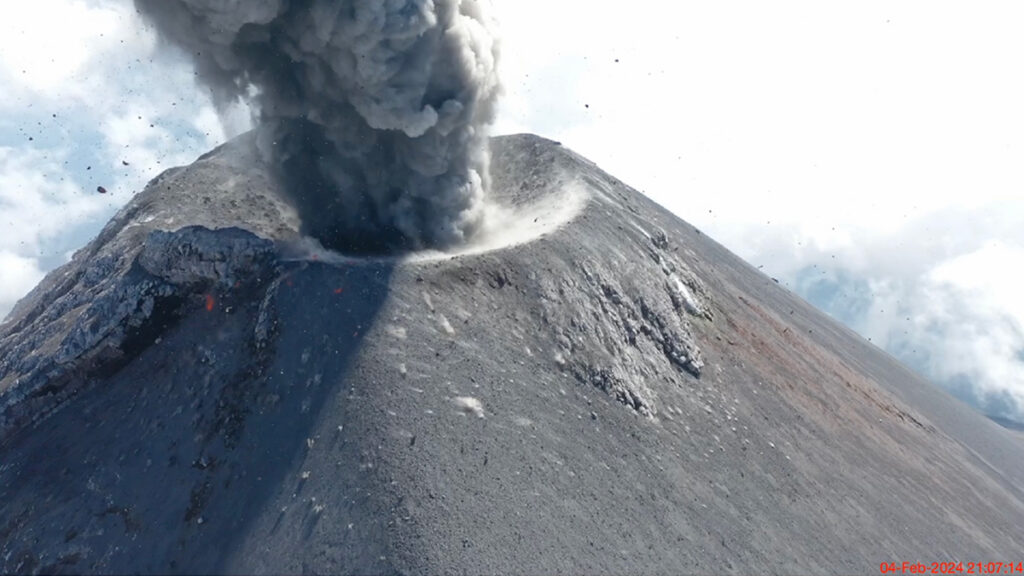
In another case, we landed a pair of Gems on the ground near a frequently exploding crater at Fuego volcano in Guatemala using a drone (see video below). We later retrieved one of the sensors from high on the volcano’s flanks. Another was lost because high winds initially posed too great a risk to fly the drone back for it. Then the following day after the wind subsided, we could not locate the stranded Gem, which was probably a casualty of a nighttime explosion.
Drone footage and infrasound recordings were collected during an explosion of Fuego volcano on 4 February 2024. Pa = pascals. Credit: video: Jerry C. Mock; animation and infrasound: Jeffrey B. Johnson
Our group at BSU also has nascent interest in using Gems to study fire in natural environments. Wildfires produce infrasound from a spatially extensive source region corresponding to actively burning areas. Because of the source complexity and the fact that fire infrasound is low amplitude and tremor-like [Johnson et al., 2025], enhancing signal-to-noise ratios in recorded infrasound is critical. This enhancement is enabled by using large-N monitoring networks, making infrasound wildfire surveillance a promising area of investigation.
Low-cost, rapid infrasound deployments could one day be used as an effective operational tool.
Toward this objective, our group installed 76 sensors ahead of a prescribed burn in Reynolds Creek, Idaho, in October 2023 to begin developing infrasound as a tool for monitoring and mapping wildfire. We have also deployed Gems for infrasound studies of naturally occurring wildfires, such as the Emigrant wildfire in Oregon in August and September 2025 (Figure 3). During that active wildfire response, a team safely and quickly installed tens of sensors within a matter of hours in an area facing dynamic hazards from the rapidly expanding fire, which eventually covered 33,000 acres (about 13,354 hectares). Luckily, no instruments were lost, and the data have shown the potential to track a wildfire as it advances.
Preliminary results suggest that low-cost, rapid infrasound deployments could one day be used as an effective operational tool. For example, in firefighting responses, infrasound might complement intermittent aerial observations, from aircraft or drones, because it provides a continuous record of fire activity. Infrasound surveillance might also be able to “hear” combustion sources within a burn area that is obscured to optical sensing because of clouds or nightfall.
Fig. 3. (a) The spread and severity of the 2025 Emigrant Fire in Oregon, as calculated from prefire (21 August) and postfire (18 October) Sentinel-2 satellite images, are shown. Inset maps show the distribution of 37 Gem sensors rapidly deployed in three arrays. (b) Smoke from the fire rises from the landscape on 31 August during deployment of the sensors. (c) Following the fire, one sensor that had been melted by the fire was recovered with its data card still intact (red circle). dNBR = differenced normalized burn ratio. Click image for larger version. Credit: (a) and (b): Madeline A. Hunt; (c): Jacob F. Anderson
The Evolution of Low-Cost Sensors
Five years ago, the single-sensor Gem was a cutting-edge infrasound logging solution. While it remains a powerful and economical tool for large-N arrays and for sensing in hostile environments, it is evolving.
Boise State University researchers (left to right) Madeline Hunt, Owen Walsh, Jerry Mock, and Jacob Anderson prepare to deploy Gem sensors in Idaho’s Sawtooth Mountains in January 2024. Credit: Jeffrey B. Johnson
We have now developed the Gem into an even more versatile version called the Aspen, which can log four independent sensors at a sample rate of 200 hertz, double that of the Gem. The Aspen retains the small size, low weight, low power consumption, and low cost of the Gem, but with the capability to record higher-resolution 24-bit, time-synchronized data from a triaxial seismic sensor and an infrasound transducer.
Recording synchronous seismoinfrasonic data on the same logging platform offers the advantage of sensing both ground shaking and infrasonic oscillations. The ability to measure waves propagating in the ground and in the air simultaneously could facilitate work in the growing field of environmental seismology, which focuses on geophysical sources at Earth’s surface like debris flows and volcanoes.
Although we have focused on seismoacoustic geophysical measurements in our work, the concept of gathering data with low-cost instrumentation in harm’s way or from coordinated arrays of numerous sensors holds promise across Earth and environmental sciences. Such approaches could be used, for example, with tiltmeters (which measure slope changes), gravity meters, or near-infrared thermometers (e.g., optical pyrometers), all of which would offer additional data streams complementing seismoacoustic observations in geophysical studies of volcanoes.
With the diversity of emerging uses, it’s clear that large-N sensing—infeasible or cost prohibitive in many cases until recently—could transform how we measure many facets of Earth, helping to reveal the inner workings of volatile volcanoes, twisting tornadoes, and more.
Acknowledgments
More information about low-cost infrasound sensing solutions can be found at https://sites.google.com/boisestate.edu/infravolc/home. Development of the Gem infrasound logging platform was supported by a grant from the National Science Foundation (EAR-2122188).
References
Anderson, J. F., et al. (2018), The Gem infrasound logger and custom‐built instrumentation, Seismol. Res. Lett., 89(1), 153–164, https://doi.org/10.1785/0220170067.
Anderson, J. F., et al. (2023), Remotely imaging seismic ground shaking via large-N infrasound beamforming, Commun. Earth Environ., 4(1), 399, https://doi.org/10.1038/s43247-023-01058-z.
Bosa, A. R., et al. (2024), Dynamics of rain-triggered lahars and destructive power inferred from seismo-acoustic arrays and time-lapse camera correlation at Volcán de Fuego, Guatemala, Nat. Hazards, 121, 3,431–3,472, https://doi.org/10.1007/s11069-024-06926-1.
Brissaud, Q., et al. (2021), The first detection of an earthquake from a balloon using its acoustic signature, Geophys. Res. Lett., 48, e2021GL093013, https://doi.org/10.1029/2021GL093013.
Johnson, J. B., et al. (2012), Probing local wind and temperature structure using infrasound from Volcan Villarrica (Chile), J. Geophys. Res., 117, D17107, https://doi.org/10.1029/2012JD017694.
Johnson, J. B., et al. (2018), Forecasting the eruption of an open-vent volcano using resonant infrasound tones, Geophys. Res. Lett., 45, 2,213–2,220, https://doi.org/10.1002/2017GL076506.
Johnson, J. B., et al. (2020), Mapping the sources of proximal earthquake infrasound, Geophys. Res. Lett., 47, e2020GL091421 , https://doi.org/10.1029/2020GL091421.
Rosenblatt, B. B., et al. (2022), Controls on the frequency content of near-source infrasound at open-vent volcanoes: A case study from Volcán Villarrica, Chile, Bull. Volcanol., 84(12), 103, https://doi.org/10.1007/s00445-022-01607-y.
Scamfer, L. T., and J. F. Anderson (2023), Exploring background noise with a large‐N infrasound array: Waterfalls, thunderstorms, and earthquakes, Geophys. Res. Lett., 50, e2023GL104635, https://doi.org/10.1029/2023GL104635.
Slad, G., and B. Merchant (2021), Evaluation of Low Cost Infrasound Sensor Packages, Sandia Rep. SAND2021-13632, Sandia Natl. Lab., Albuquerque, N.M., https://doi.org/10.2172/1829264.
Tatum, T., J. F. Anderson, and T. J. Ronan (2023), Whitewater sound dependence on discharge and wave configuration at an adjustable wave feature, Water Resour. Res., 59, e2023WR034554, https://doi.org/10.1029/2023WR034554.
Author Information
Jeffrey B. Johnson (jeffreybjohnson@boisestate.edu), Jacob F. Anderson, Madeline A. Hunt, Owen A. Walsh, and Jerry C. Mock, Department of Geosciences, Boise State University, Idaho
Citation: Johnson, J. B., J. F. Anderson, M. A. Hunt, O. A. Walsh, and J. C. Mock (2026), Sensing the sounds from Earth’s hazardous environments, Eos, 107, https://doi.org/10.1029/2026EO260142. Published on 8 May 2026.
Brazilian President Luiz Inácio Lula da Silva has canceled a planned trip to Chile to attend José Antonio Kast’s inauguration on Wednesday and will instead be represented at the ceremony by Foreign Minister Mauro Vieira. Brazilian officials said the change was due to “scheduling reasons.”
Brazilian President Luiz Inácio Lula da Silva has canceled a planned trip to Chile to attend José Antonio Kast’s inauguration on Wednesday and will instead be represented at the ceremony by Foreign Minister Mauro Vieira. Brazilian officials said the change was due to “scheduling reasons.”
Venezuelan opposition leader and Nobel Peace Prize winner María Corina Machado greeted Thursday 17,000 Venezuelans in the streets of Santiago, Chile.
“Santiago is overflowing with us, my Venezuelans!,” she told the crowd as they shouted “Maria Presidente,” spilling out from downtown Parque Almagro in a sea of Venezuelan flags.
Earlier, hundreds of well wishers had gathered in Plaza de Armas to welcome Machado as she was awarded the keys to the city by the Santiago mayor. There, she h
Venezuelan opposition leader and Nobel Peace Prize winner María Corina Machado greeted Thursday 17,000 Venezuelans in the streets of Santiago, Chile.
“Santiago is overflowing with us, my Venezuelans!,” she told the crowd as they shouted “Maria Presidente,” spilling out from downtown Parque Almagro in a sea of Venezuelan flags.
Earlier, hundreds of well wishers had gathered in Plaza de Armas to welcome Machado as she was awarded the keys to the city by the Santiago mayor. There, she hugged and took selfies with well-wishers. Later, in the march, she embraced members of the crowd, inviting two children to join her on the stage and wave to the thousands lining the streets.
The march, which the police had planned to be attended by 4,000, was the largest public demonstration attended by Machado since she left Venezuela in December. After leaving the event, Machado said it was “indescribable” on social media.
“Today our clear path is to move forward so that all those who have been forced to leave their country can travel back to reunite with their families with their heads held high,” Machado said.
Chile is home to the fourth largest Venezuelan diaspora in Latin America with almost 700,000 Venezuelan nationals living there, 42% of the foreign-born Chilean population. Of the illegal migrants living in Chile, 75% are Venezuelan, according to figures from the Liberty and Development think tank.
Exploiting these figures was central to new President José Antonio Kast’s successful presidential campaign. He promised to expel thousands of illegal migrants living in Chile. In his inaugural address Wednesday, he said he had already ordered the military to build a physical barrier along the border with Bolivia, a regular crossing for migrants arriving on foot.
In his first day in office, Kast launched the Shield Frontier Plan, a strategy for erecting walls five meters in height equipped with motion sensors, facial recognition and infrared cameras. The plan also includes funding for surveillance drones along Chile’s northern borders.
As violent and petty crime has risen in recent years, the Centre for Public Studies says seven in ten Chileans “strongly agree” that illegal immigration is driving insecurity.
Kast, his followers and other members of his party have, in their discourse against migration, publicly targeted the Venezuelan diaspora. In January, Kast singled out Venezuelans on Canal 5 Noticias, saying illegal Venezuelans’ “days were numbered” as he promised an unprecedented ramp up of deportation orders. After his election victory, he repeatedly called on Venezuelans to remove themselves from Chile before he took power.
Machado, who was in Chile for Kast’s inauguration, said in a statement that the Venezuelans living in Chile were “decent people.”
“What we are doing here today is asking all Chileans — and all Latin Americans — to help us ensure that every Venezuelan can return with dignity and freedom to the country they adore,” she added.
Striking a similar tone to Kast, U.S. President Donald Trump has vilified Venezuelan’s living in the U.S., tying them to the international criminal organization, one the U.S. labels terrorist, the Tren de Aragua. Since taking office, Trump has said Venezuelans linked to the gang were “invading” the U.S.
Machado, who gifted her Nobel Peace Prize medal to Trump in January following the U.S. capture of Nicolás Maduro, said in a video address Thursday that Trump remained a “fundamental ally” to Venezuela.
Trump had earlier questioned Machado’s suitability to lead, citing (misleading) low approval ratings. Trump has also praised Venezuela’s interim president and Maduro’s former vice president, who is widely disliked by Venezuelans.
As tension between the Venezuelan diaspora and the new hardline government bubble in Chile, Machado tread a fine line, telling reporters that she had not yet discussed with Kast how Chile can support Venezuelan’s who have fled the country.
Featured Image: Thousands gather in the streets of Santiago, Chile with Venezuelan opposition leader Maria Corina Machado
Medellín, Colombia – José Antonio Kast was sworn in today as the new president of Chile, inaugurating the country’s first far-right government since the fall of Augusto Pinochet’s military dictatorship in 1990.
Kast beat Jeanette Jara from the Communist Party last December, winning 58% in second-round polls following a campaign focused on law and order and tackling illegal immigration through mass deportations.
He succeeds left-wing president Gabriel Boric, forming part of a broader right-
Medellín, Colombia – José Antonio Kast was sworn in today as the new president of Chile, inaugurating the country’s first far-right government since the fall of Augusto Pinochet’s military dictatorship in 1990.
Kast beat Jeanette Jara from the Communist Party last December, winning 58% in second-round polls following a campaign focused on law and order and tackling illegal immigration through mass deportations.
He succeeds left-wing president Gabriel Boric, forming part of a broader right-wing wave across the Americas.
Chile’s new president resembles U.S President Donald Trump in his approach to certain policy matters, such as his promises to curb illegal immigration, increase mass deportations and even build border walls.
Kast is a controversial figure: his father was a member of the Nazi party, and he was raised deeply conservative.
While studying law at the Universidad Católica, he was mentored by Jaime Guzmán, who was a trusted advisor of Pinochet.
Kast is now the first president to defend the legacy of Pinochet, and he has suggested that the dictator would have supported his candidacy. He has also appointed two ex-Pinochet lawyers, Fernando Barros and Fernando Rabat, to his cabinet as Minister of Defence and Minister of Justice and Human Rights, respectively. This move has drawn criticism from human rights groups.
Kast previously failed in a 2022 bid for the presidency, losing to Boric. Boric, however, was a deeply unpopular president, with polling from July 2025 highlighting a 66% disapproval rating.
Kast recently withdrew from transition talks with his predecessor, claiming that he had not been informed about the construction of an underwater sea cable connecting Chile and China. The spat raised concerns regarding democratic transfer of power.
Kast is part of a growing right-wing coalition across the Americas, supported by Trump, who has announced a return of the Monroe Doctrine, which maintains Washington’s dominance across the Western Hemisphere.
Before assuming office, Kast attended Trump’s “Shield of the Americas” summit on Saturday alongside other Latin American leaders, signalling his eagerness to cooperate with Washington in its invigorated counter-narcotics strategy.
His swearing-in ceremony, held in the coastal city of Valparaíso, was attended by many prominent political figures from the Americas, including conservative leaders like Ecuador’s Daniel Noboa and Argentina’s Javier Milei.
The left-wing president of Brazil, Lula Inácio da Silva, canceled at the last minute after finding out that his potential rival in the next elections, Flávio Bolsonaro – the son of jailed former president Jair Bolsonaro – would be attending.
Venezuelan opposition figure, María Corina Machado, also attended the inauguration, posting on X that she was excited to meet with Venezuelans in Chile during her visit.
Kast has singled out Venezuelan immigrants, having centered his campaign on fighting irregular migration through mass deportation with his “Border Shield” plan; it references “hundreds of thousands of illegals, bringing with them crime, narcotrafficking, human trafficking and gun smuggling, and labor exploitation”. Migrants represent almost 10% of the population in Chile, the largest group being Venezuelans – 17% of which entered irregularly, according to El País. Despite this, figures shared by the Minister of Defense, Adriano Delpiano, indicate that the number of irregular entries to Chile decreased by 54% between 2021 and 2025.
Despite Kast’s promises to restore public order amid rising crime, Chile remains one of the safest countries in Latin America.
Featured image description: José Antonio Kast in European Parliament

 Login
Login