
Normal view

  • ✇Popular Science
  • It’s a barracuda! It’s a shrimp! It’s a robot helping coral reefs. Mack DeGeurin
    Coral reefs may soon have new swimming visitors observing their life-rich aquatic metropolises. But  that visitor isn’t a fish—or even a human. It’s an autonomous, multi-sensor survey robot. Developed by the Woods Hole Oceanographic Institution (WHOI) Reef Solutions Initiative, this new underwater surveyor uses a combination of hydrophones, high-resolution cameras, and an onboard computer to find signs of marine life hotspots. It then moves in closer for a better look, creating data-rich maps th
     

It’s a barracuda! It’s a shrimp! It’s a robot helping coral reefs.

15 May 2026 at 17:39

Coral reefs may soon have new swimming visitors observing their life-rich aquatic metropolises. But  that visitor isn’t a fish—or even a human. It’s an autonomous, multi-sensor survey robot. Developed by the Woods Hole Oceanographic Institution (WHOI) Reef Solutions Initiative, this new underwater surveyor uses a combination of hydrophones, high-resolution cameras, and an onboard computer to find signs of marine life hotspots. It then moves in closer for a better look, creating data-rich maps that would likely take many human divers multiple trips to produce.

The system, appropriately called the Curious Underwater Robot for Ecosystem Exploration (CUREE), does all this all by itself. Well, that’s the goal, at least. In actual testing around Joel’s Shoal in the U.S. Virgin Islands, the curious robot was able to home in on the distant crackle of shrimp, and even tailed a barracuda for more than 984 feet. That last barracuda tracking bit required some human intervention to get it back on course, but the majority of the barracuda tracking occurred totally autonomously. The findings were published this week in the journal Science Robotics

Keeping tabs on coral reef’s inhabitants 

Coral reefs are like a busy neighborhood or bustling bar in the ocean. Though they account for less than 0.1 percent of physical ocean space, roughly a quarter of all marine species spend some part of their lives there. But overfishing, human development, and warming ocean temperatures are putting those bustling ecosystems at risk. Because of this threat, it’s more important than ever for marine biologists to have an accurate and timely sense of what those environments look like.

Getting a clear sense of what species are where in a reef isn’t simple, though. At any given time, most of a reef is barren, with marine life typically clumping into hotspots distributed throughout the reef. Currently, researchers primarily track those hotspots with  trained human divers, though that approach isn’t perfect. Our pesky lungs and limited oxygen tanks mean human divers run  on a short clock. It’s also costly for research teams to properly train and equip a human diver, which limits the amount of time and frequency with which they can take a plunge.

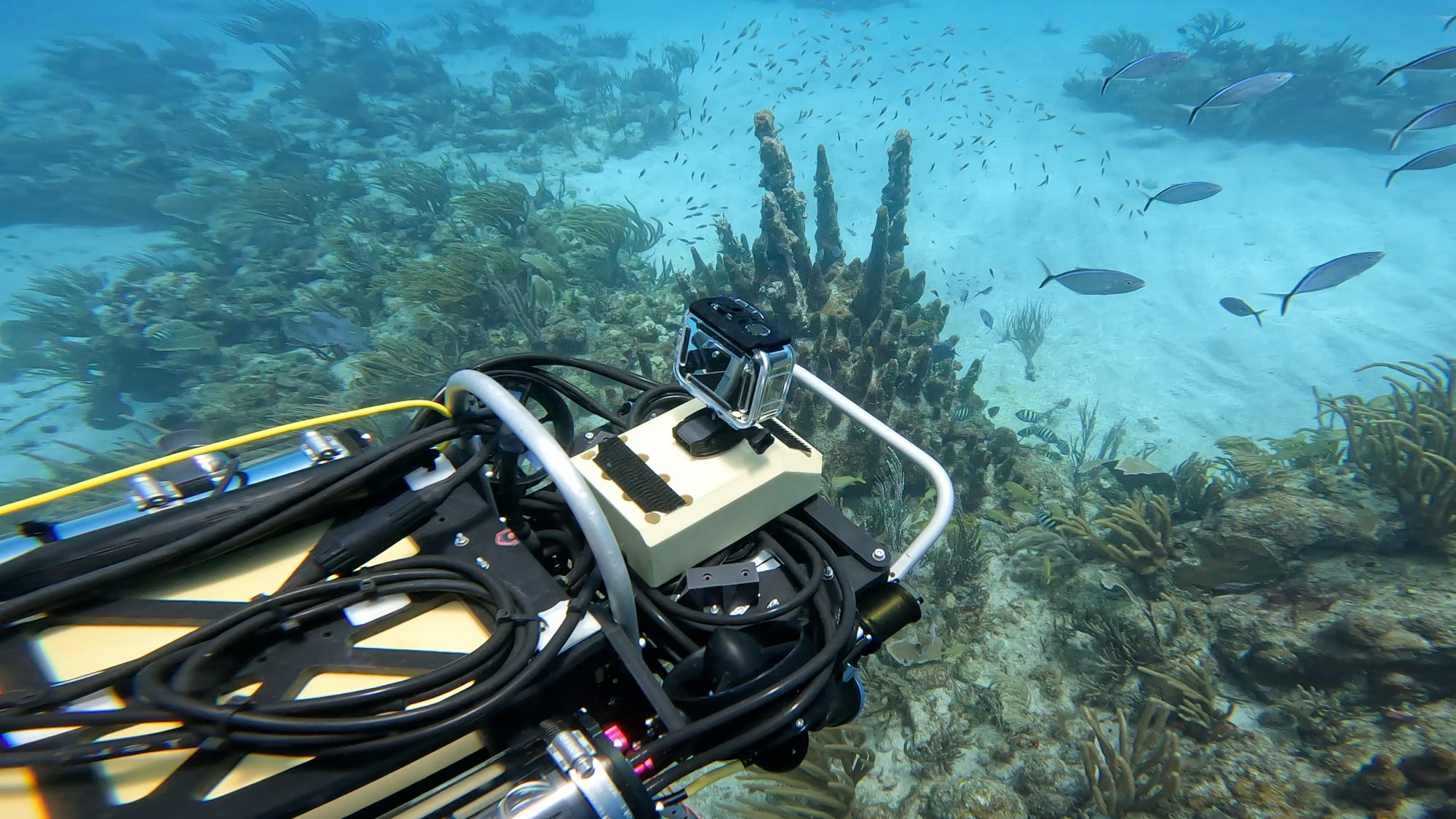
an autonomous underwater robot exploring a coral reef
CUREE (Curious Underwater Robot for Ecosystem Exploration), an autonomous underwater vehicle navigates using information from its cameras and outstretched hydrophones to gather audio and visual information about a coral reef environment. Image: Photo by Austin Greene, © Woods Hole Oceanographic Institution.

An underwater robot could potentially solve both those problems, but it would need the right tools for the job. That’s where CUREE comes in. Engineers outfitted the robot with a variety of sensors that can detect both visual and auditory signals. The system can analyze far-off audio signals in real time to hear distant noises as subtle as fish calling out to each other. It can then triangulate that data using an onboard computer system that moves toward areas it suspects have a high chance of containing marine life. If it spots life once there, it can then use its cameras to provide more precise data about the species and their behavior.

“In some sense, they’re almost a perfect compliment for each other,” WHOI roboticist Seth McCammon said of the multiple sensor method in a statement. “Passive acoustics gives you a broad sense of the environment, while vision is short range, but is this really information-rich data stream.” 

Curious robot stalks a barracuda 

The team put CUREE to the test near Joel’s Shoal, a coral reef located on the coast of St. John in the U.S. Virgin Islands. In one test,  the robot could accurately find and count the number of fish in a region. It was able to detect signs of fish from up to 82 feet away and then use those clues to identify life hotspots.

a diver gives a robot a thumbs up
Woods Hole Oceanographic Institution (WHOI) scientist and WARP Lab lead Yogesh Girdhar tests the CUREE (Curious Underwater Robot for Ecosystem Exploration) autonomous underwater vehicle in the U.S. Virgin Islands in November 2021. Members of the WARP Lab designed CUREE to navigate and sense complex coral reef environments autonomously to identify biodiversity hotspots. Image: Photo by Dan Mele © Woods Hole Oceanographic Institution.

However, the  most interesting result was CUREE’s successful barracuda tracking. Once locked on to its target, CUREE followed the apex predator for a total of nine minutes and 55 seconds, as the fish weaved its way around, looking for lunch. The tracking video in the study shows the barracuda traveling first to a hotspot and then backtracking to another spot where it had previously startled a large reef snapper. And while a human diver had to initiate the robot’s lock on the barracuda,and had to re-lock on the target several times, CUREE did most of the work on its own. The team says eight minutes and 59 seconds of the tracking was done with full autonomy.

Though this isn’t the first underwater robot, its use of multiple sensor types makes it unique because it’s eventually a jack of all trades. Researchers can, in theory at least, drop the robot in a broad area of water and let it get to work surveying. 

The post It’s a barracuda! It’s a shrimp! It’s a robot helping coral reefs. appeared first on Popular Science.
  • ✇Popular Science
  • Game teaches kids programming basics without screens Mack DeGeurin
    Parents around the world are responding to growing research showing that excessive screen time, especially for young children, may have negative cognitive effects. But what happens when a well-meaning parent wants to introduce their child to subjects intrinsically linked to screens, like computer programming? A new learning series from Japanese public broadcaster NHK called Texico aims to help solve that dilemma by using paper, plastic toys, and everyday objects to break down the core concepts a
     

Game teaches kids programming basics without screens

11 May 2026 at 12:03

Parents around the world are responding to growing research showing that excessive screen time, especially for young children, may have negative cognitive effects. But what happens when a well-meaning parent wants to introduce their child to subjects intrinsically linked to screens, like computer programming? A new learning series from Japanese public broadcaster NHK called Texico aims to help solve that dilemma by using paper, plastic toys, and everyday objects to break down the core concepts and strategies essential to programming.

Each episode in the series runs about 11 minutes and focuses on key concepts including analysis, combination, abstraction, and simulation. The goal, NHK says, is to help children “learn the principles of programming without even touching a computer.”

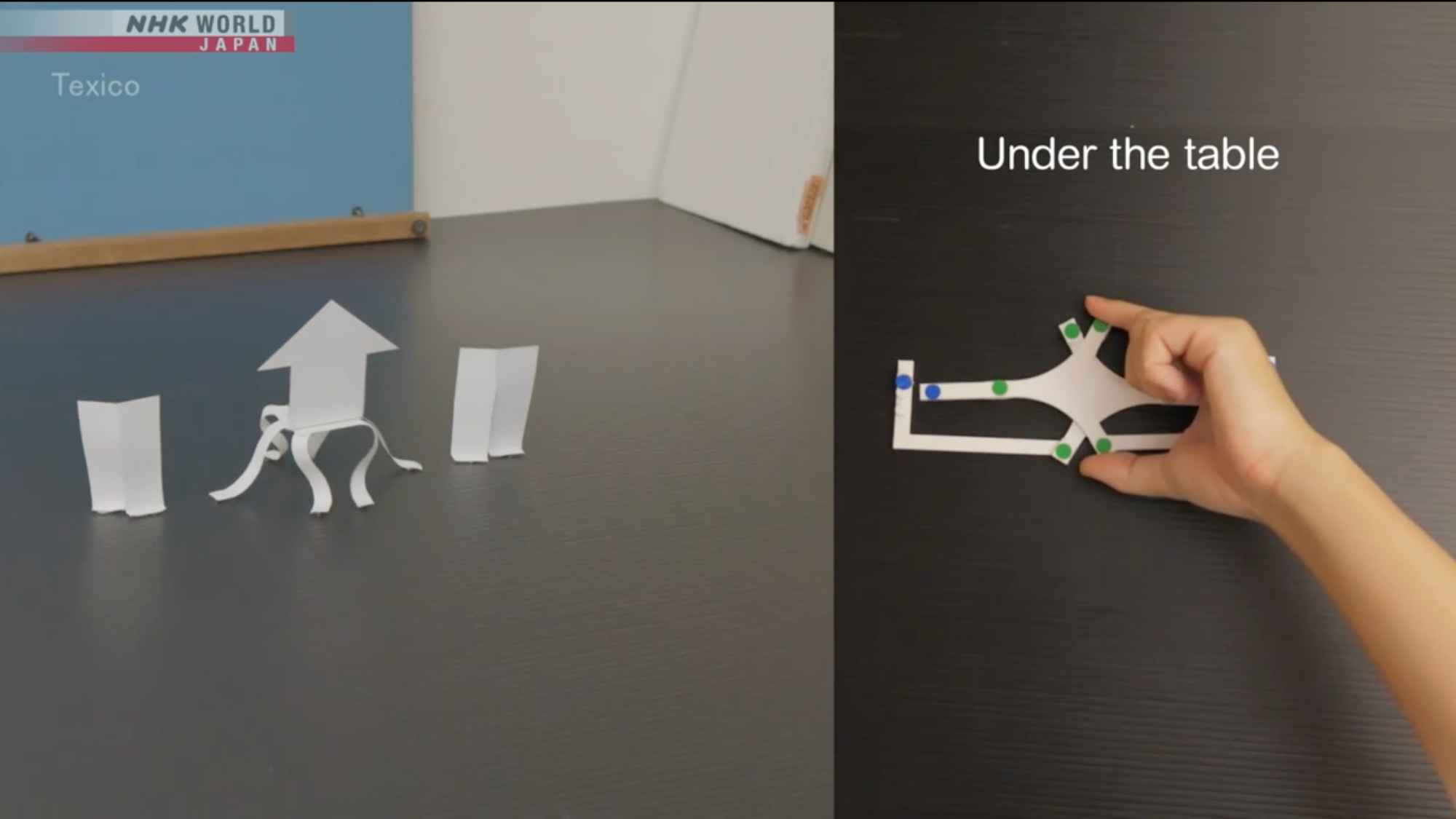
playing cards on a green table
Each 11 minute episode breaks down some of the essential strategies needed for programming. Image: Texico.

‘If you think hard enough, you can see the underlying logic,’

In one episode, a toy train on a plastic track approaches a lowered rail crossing. Viewers are asked to visualize what will happen when the train makes contact with the barrier. In this case, both the train and the lowered rail continue moving forward.

The next segment complicates the scenario: the track now forms a circle, with the train, rail, and a wooden triangle block all positioned at different points. When the rail moves, so does the block. Viewers are asked to recall what happened in the previous example and apply that logic to the new configuration, essentially practicing the kind of mental simulation that underlies real programming work.

Another episode teaches foundational logic by asking viewers to tear a sheet of paper into nine pieces. A teacher then selects one piece and instructs the viewer to write a number from one to nine and place it face down. The viewer then writes the remaining numbers on the other pieces, also face down, so the teacher can’t see it. The teacher then somehow correctly guesses which piece holds which number. 

But the trick isn’t magic. Instead, it has everything to do with the geometry of tearing paper. It’s revealed that the first piece the teacher selected was the center of the sheet. When paper is torn into nine equal pieces, the center piece is the only one without any straight edges. So when the teacher went to identify it, they simply looked for the piece that didn’t look like the others. 

It’s a simple but elegant demonstration of the kind of pattern recognition that programmers rely on constantly.

“If you think hard enough, you can see the underlying logic,” a voice in the video says, followed by the slightly creepy musical mantra “Texico, Texico, Texico.” 

blue train tracks arranged in a circle on a brown table
The train track can mimic what is going on inside the brain when doing real programming. Image: Texico.

The pull away from screens 

Offline approaches to teaching computer concepts provide a way for newcomers of all ages interested in coding to get their feet wet without having to deal with distracting screens. For many, that’s a welcome reprieve. A recent YouGov poll found that more than half (57 percent) of adults in the United States spend at least five hours per day looking at screens. All that time starting into the digital glow has been shown to interfere with sleep and, in some cases, even contribute to anxiety and other mental health issues

Screenless learning could also prove popular as parents and school districts push back against what many now see as an overreliance on screens. More  than 35 states have enacted policies limiting smartphone use in classrooms. Districts in California and Oregon have recently gone further, adopting rules that restrict student use of laptops and tablets and prioritize pen and paper. Should that trend spread, it would mark a stark departure from the past two decades, during which “EdTech” was enthusiastically embraced and widely deployed in classrooms across the country.

“We are prioritizing developmentally appropriate learning during the most critical period for language, social, and cognitive development,” Jeanne Grazioli, a superintendent in a Southern Oregon schools district said after they moved to reduce screen time.

And while the debate over screens is far from settled, there is growing evidence that introducing concepts through analog methods pays dividends later on. In his recent book The Digital Delusion, neuroscientist and educator Dr. Jared Cooney Horvath points to research suggesting that students who learn to write by hand retain an advantage over those who move straight to typing, despite the fact handwriting has become increasingly less common in daily adult life. 

”Many people believe that thinking happens entirely in the brain, as if we’re just gray matter hitching a rise inside a body,” Horvath writes. “But this misses something essential: we don’t merely have bodies—we are bodies. Learning doesn’t arise from the brain alone, it emerges from the rhythms, movements, and sensations of our entire physical selves.” 

“Put simply, handwriting builds a foundation that typing cannot,” he adds. 

Something similar may be at work when children learn programming basics through analog tools. And even if future research doesn’t bear that out conclusively, Texico offers something valuable on its own terms: a set of refreshing, screen-free puzzles that challenge young learners  (and at least one adult tech writer) to flex their critical thinking skills. 

The post Game teaches kids programming basics without screens appeared first on Popular Science.

  • ✇Popular Science
  • Robot probes 16th century Italian shipwreck 1.5 miles below the Mediterranean Mack DeGeurin
    An intrepid sub-sea robot recently dove nearly 1.5 miles below the Mediterranean Sea off the coast of southern France. The remotely operated vehicle (ROV) went down to examine  the wreckage of a merchant ship that dates back to the 16th century. There, it found hundreds of ornately decorated ceramics, jars, and jugs strewn across the sand.  From the boat, a French navy sailor remotely controlling the robot plucked these treasures up ever so gently with the robot’s  pincers. Despite centuries of
     

Robot probes 16th century Italian shipwreck 1.5 miles below the Mediterranean

8 May 2026 at 17:21

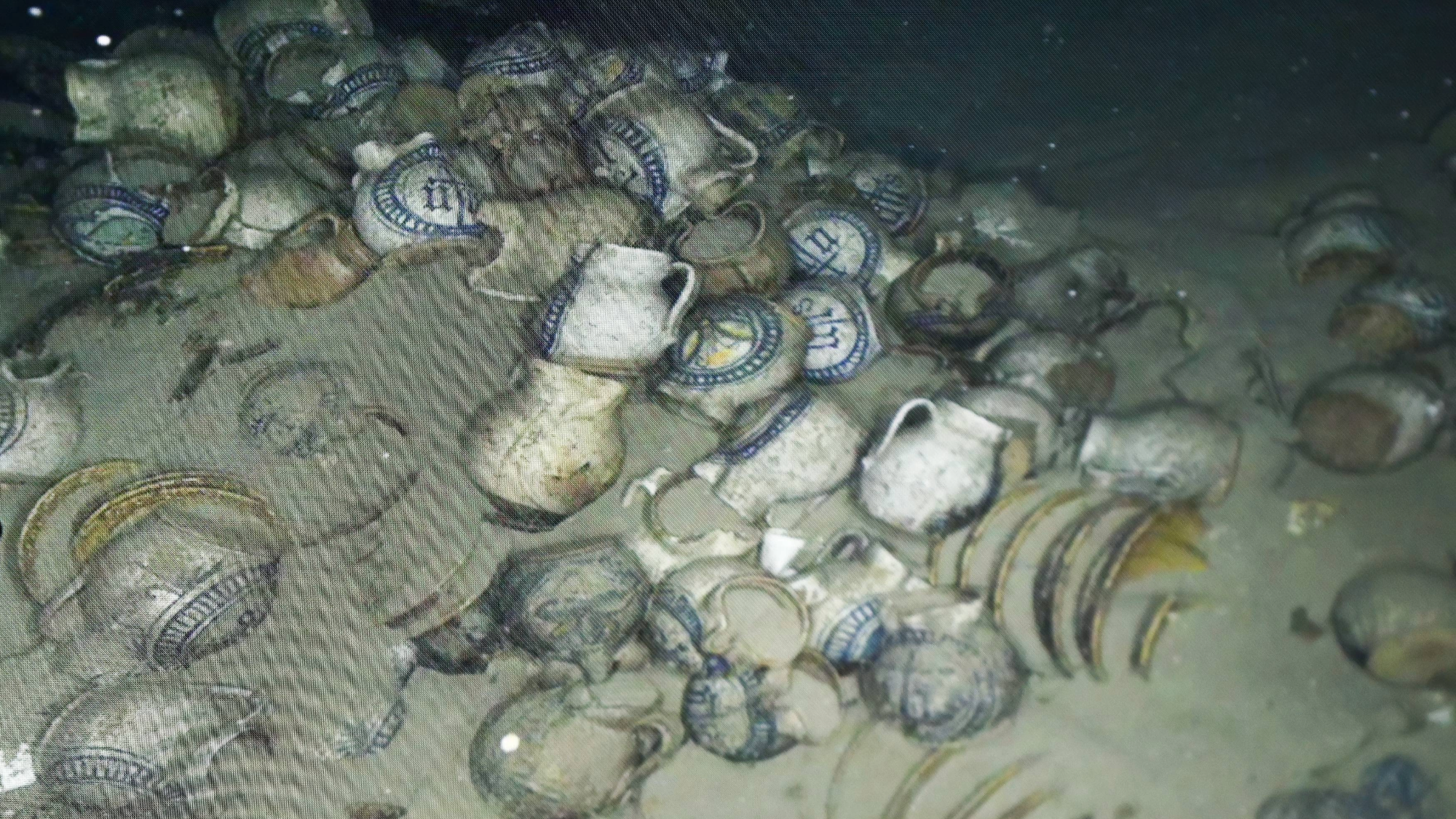
An intrepid sub-sea robot recently dove nearly 1.5 miles below the Mediterranean Sea off the coast of southern France. The remotely operated vehicle (ROV) went down to examine  the wreckage of a merchant ship that dates back to the 16th century. There, it found hundreds of ornately decorated ceramics, jars, and jugs strewn across the sand.  From the boat, a French navy sailor remotely controlling the robot plucked these treasures up ever so gently with the robot’s  pincers. Despite centuries of ocean burial, the artifacts still maintained the bold blue and yellow geometric designs they had when the ship mysteriously capsized. But the ship’s discovery was mostly due to luck, and its current exploration is only made possible by modern advances in robotics.

Archaeologists are officially calling the site Camarat 4. It sits roughly 30 miles off the coast of Ramatuelle, but French authorities are keeping the exact location secret to prevent unauthorized visitors from nosing around. Camarat 4 was initially discovered during a routine French navy survey of the region last year, and the wreckage is now considered the deepest shipwreck in French territorial waters. The record for the deepest shipwreck ever found belongs to the USS Samuel B. Roberts. The navy vessel lies about four miles deep off the coast of the Philippines, according to the Guinness Book of World Records.

But reaching 1.5 miles isn’t a day at the beach either. To get down there and explore the mysterious vessel, archaeologists worked alongside the navy and reportedly used the largest robot in their arsenal.The robot is capable of diving down to 8,202 feet and was equipped with several cameras and a pair of pincers capable of grabbing objects. When the robot was deployed, it reportedly took a full hour just to reach the sea floor.

When it did, the cameras revealed the shipwreck in greater detail than ever before. They  captured 66,974 images, snapping pictures at a rapid clip of eight photos per second. Those images clearly showed the ship’s six cannons, an anchor, and 12 cauldrons. Strewn across the seabed nearby were a small building’s worth of ceramics, one of which had the first three Greek letters of Jesus Christ’s name inscribed on it.

Archaeologists say that  the cannons and the cargo reinforce the idea that this was a merchant ship. Though researchers have traced its origins to somewhere in northern Italy, it remains entirely unclear where its final destination was or what caused it to meet its watery grave.

All of the photos taken by the robot will help create a 3D model of the wreckage, which could aid further research. The robot was also able to grab and recover three pitchers and a plate from the site, though it’s unclear how many others may have been broken in the process. Using a modern robot’s giant pincers to grab nearly 500-year-old, decaying artisan works isn’t exactly a foolproof recovery method.

Exploring the sunken Italian ship isn’t just a matter of mere curiosity. Archaeologists involved in the excavation say that detailed historical records about Mediterranean merchant ships from this period are scarce. Knowing more about why this ship was there and where it was going could shed greater light on trade routes of the time.

Related Shipwreck Stories

Robots bring long lost ocean sites within reach 

Ironically, the sunken Italian ship’s sheer inaccessibility is also what makes it such a valuable site to explore. Its depth and remoteness mean it has been completely untouched by looters or previous explorers. Even so, modern humanity has  managed to leave its mark on the ancient vessel in the form of garbage. Beer cans, plastic containers, and old fishing nets were all spotted near the cannons and ceramics.

“After the awe of the discovery comes the sadness of finding such things,” DRASSM director Arnaud Schaumasse said in an interview with Le Monde.

Trash aside, the Camarat 4 expedition highlights the promise of future deep-sea exploration made possible by increasingly capable robotics, some of which are being designed to operate autonomously. By diving deeper than ever before, archaeologists will have the tools to explore mysteries that would otherwise have been left to rot in the ocean’s unforgiving darkness.

The post Robot probes 16th century Italian shipwreck 1.5 miles below the Mediterranean appeared first on Popular Science.

  • ✇Popular Science
  • The world’s largest explosion lab is ready for big booms. And yes, it’s in Texas. Mack DeGeurin
    Everything is bigger in Texas, and that includes its controlled detonations. Texas A&M University recently revealed what they say is the world’s largest controlled explosion lab, where researchers can fill a nearly 500-foot metal tube with gas and ignite it in the name of science. They are calling it The Detonation Research Test Facility (DRTF). By precisely measuring what it takes to turn a simple flame into a massive, deadly detonation, researchers hope to make discoveries that could bette
     

The world’s largest explosion lab is ready for big booms. And yes, it’s in Texas.

6 May 2026 at 18:50

Everything is bigger in Texas, and that includes its controlled detonations. Texas A&M University recently revealed what they say is the world’s largest controlled explosion lab, where researchers can fill a nearly 500-foot metal tube with gas and ignite it in the name of science. They are calling it The Detonation Research Test Facility (DRTF). By precisely measuring what it takes to turn a simple flame into a massive, deadly detonation, researchers hope to make discoveries that could better prepare engineers to prevent gas leaks, and potentially inform ways to build explosion-resistant infrastructure. And all of that will require lots and lots of yeehaw inducing bangs.

Located in Southeast Central Texas, the detonation tunnel is about six feet in diameter and stretches nearly the length of two football fields. Its metal exterior consists of three-quarter-inch steel walls and is covered in earth to muffle the sound—or try to, at least. Inside, the tube holds various sensors that can measure the explosion as it intensifies. By containing all the power within the facility, researchers can study explosions strong enough to level entire buildings. The shockwaves that form in the tunnel can apparently reach speeds of Mach 5—or roughly 3,800 miles per hour.

“The facility enables us to observe, measure and understand one of nature’s most extreme forces in ways that haven’t been scaled before, or even been possible until now,” Texas A&M Engineering professor Dr. Elaine Oran said in a statement

Measuring a detonation, from flame to boom 

The idea for the massive detonation tunnel began as an inquiry from the coal mining industry. Industry leaders sought to scientifically determine whether natural gas trapped in a coal mine could explode and detonate. The short answer is yes. It quickly became clear, however, that a facility capable of measuring that would prove useful for a number of other explosion-related questions as well.

To measure an explosion, researchers start by sending an electrical current through a long wire leading into the chamber. Eventually, the current leads to a spark, which creates a flame, not unlike a gunslinger  in a Western striking a match and watching a flame trickle its way to a stick of dynamite. 

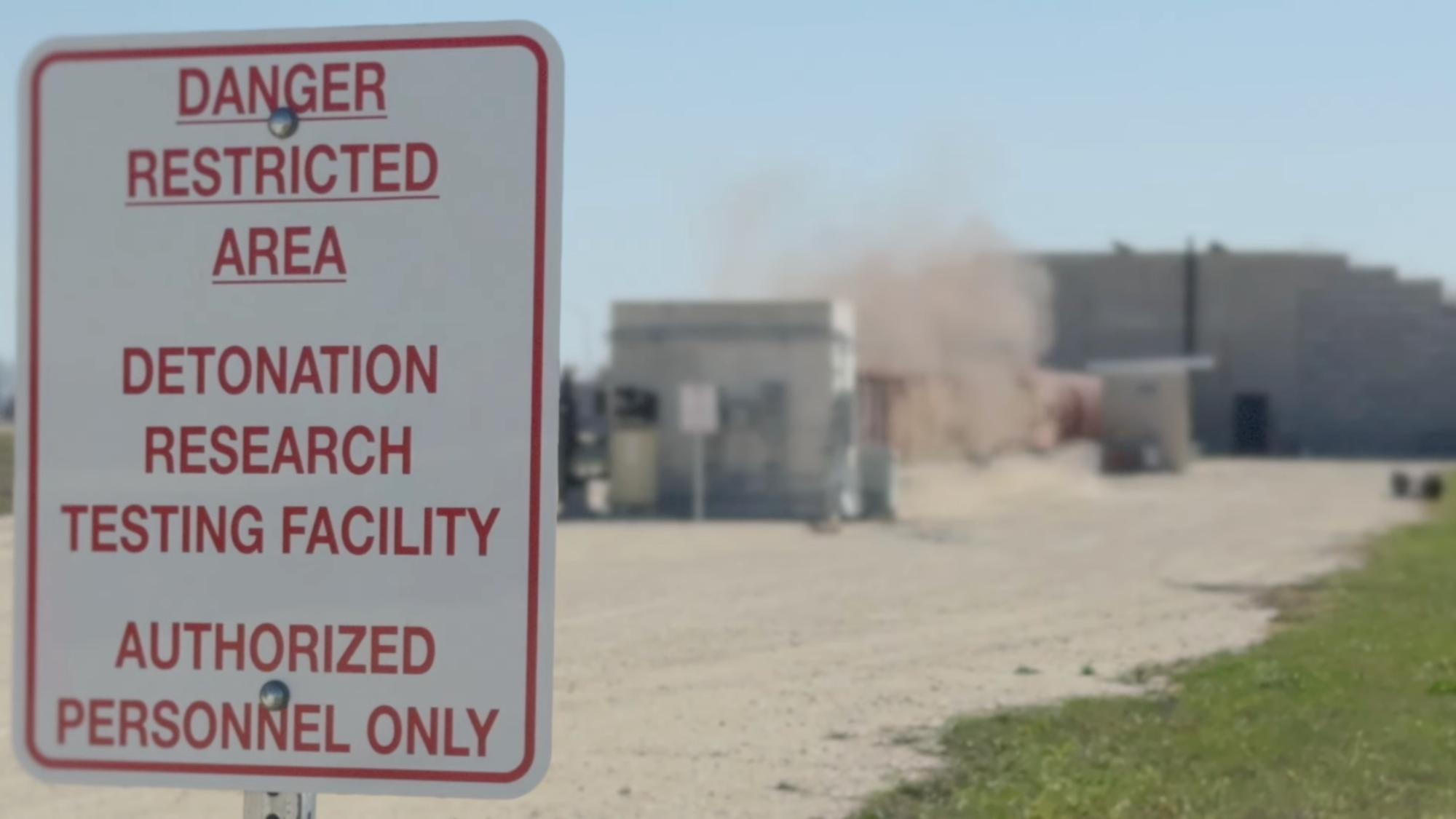
a long brown tube connected to a building
Texas A&M University’s Detonation Research Test Facility is a nearly 500-foot detonation tube more than 6 feet in diameter, built with three-quarter-inch-thick steel walls and paired with a 90-meter earth-covered muffler. Image: Texas A&M University College of Engineering.

When the flame enters the chamber, it begins a violent journey. The chamber is lined with what researchers refer to as an “obstacle course” of metal beams that generate turbulence. As the flame travels, more surface area is created, which in turn causes it to burn faster and stronger.

Eventually, all of that power creates a shockwave in front of the flame. Once the shockwave is strong enough, it pushes forward and creates a second, much larger explosion. That second, earth-shaking boom is the detonation.

Video footage of the process occurring in real time is dramatic, to say the least. Everything is quiet except for a voice in the control room counting down three, two, one. That’s followed by what sounds like a muffled gunshot as the flame enters the tube’s first segment. Visually, the tunnel’s thick metal exterior quivers and soil shakes off it as each succeeding segment ignites. That all leads up to the detonation, which is a significantly larger  boom that shakes the entire facility and sends earth soaring into the air. Seconds later, amid smoky air, the soil can be heard raining back down, like an artillery scene from a war film.

And even though the facility is designed to withstand massive explosion level forces safety, it still leads some to check their heart rates. 

“There’s a lot of nervousness, [and] jitters,” Texas A&M Aerospace engineering student Zachary Wideman said in a video. “Because something on this scale with this type of energy, you can’t help but be nervous.”  

Though the facility’s controlled explosions will likely prove most useful for industrial safety initially, engineers involved believe its scientific findings could have broader appeal. The shockwaves it creates could prove important for future testing of hypersonic plane and space shuttle propulsion. On the more conceptual side, scientists interested in the history of the cosmos could use the tube’s controlled explosions to help build models of supernovas, which undergo a similar physical process, albeit on a much, much larger scale.

The post The world’s largest explosion lab is ready for big booms. And yes, it’s in Texas. appeared first on Popular Science.
❌
Subscriptions