
Normal view

San Diego mosque attack: racist interpretations of European history are inspiring extremists

The Islamic Center of San Diego on May18, a few hours after the shooting. Leonard LMT/Wikimedia Commons, CC BY

On Monday, May 18, two assailants, a 17 and an 18 year old, attacked the Islamic Center of San Diego, the site of both a mosque and school, killing three adults. The assailants were wearing Nazi SS insignia, and had the words “race war” written on their weapons.

The attack underscores European history’s centrality to the global far right’s discourse and ideology. It was the latest deadly manifestation of the weaponisation of European history to justify violence in America in the present.

But this is not just a US problem. Europe’s history was also explicitly referenced in the manifesto of the 2019 Christchurch shooter in New Zealand. The Christchurch attack was itself inspired by Anders Breivek’s 2011 attack in Norway, which was primarily motivated by a violent white nationalist worldview.

These attackers all drew inspiration from Adolf Hitler and the SS to justify both antisemitic and Islamophobic violence. But within the white nationalist imaginary, European history begins much earlier. It extends to visions of a pure white race in the Greek and Roman eras, and to idolisation of historical figures such as Charles Martel, the Frankish leader who defeated a Muslim army in Tours in 732.


Leer más: The enduring legacy of medieval Christian depictions of Islam in today’s political discourse


It also leans heavily on the imagery of the European Crusades to retake the Holy Land, which began in the 12th century. The Knights Templar – the Crusade-era order of Christian warrior monks – has captured far-right popular imagination in Europe and the US, especially among the alt-right.

Political actors across the spectrum invoke the past to grant legitimacy in the present and suggest inevitability in the future. But for far-right leaders, European history is especially easy to weaponise. It provides a ready-made set of memes, metaphors, images and tropes that legitimise hate speech – and hate crimes – in the name of protecting Christian Europeans from the perceived threat of Jewish and Muslim invaders.

Warning signs

In 1992, I set foot in the Islamic Center of San Diego for the first time. As an undergraduate student at UC San Diego, I was there to announce that our Muslim Student Association was fundraising for the very first Bosnian Muslim refugees who were arriving in our county. We had to have this meeting because most of the congregation at the mosque had no idea there were even Muslims in the former Yugoslavia.

Track forward to May 2026, two assailants used a camera to record their massacre in the Center and broadcast it on Discord, with the words “race war” etched onto their pistols. The practice of writing on firearms is not an isolated incident in the history of Islamophobic attacks, nor is recording them on video.

In March 2019, an Australian-born man attacked two mosques in Christchurch, New Zealand. He killed 51 people and filmed his attack, broadcasting it on Facebook. The video is still in circulation on the internet today.

The Christchurch attacker used five guns inscribed with the names of various European historical figures and battles against Muslims, as well as the racial slur “kebab remover”, a sinister euphemism for ethnic cleansing that is linked to the 1991-1995 Bosnian civil war.

The phrase is an homage to Bosnian Serb leader Radovan Karadžić, the very warlord whose crimes against humanity led so many Bosniak refugees to flee the country – and many of those who reached the US settled in San Diego. It was Karadžić who conflated “kebabs” with the Bosniak Muslims, and “remove kebab” is still an Islamophobic meme among the European far right, where the continent’s ubiquitous kebab shops are often equated with Muslim immigration.


Leer más: How Islamophobic rhetoric leaves an impact on the mental health of Muslim Americans


The New Zealand attacker also etched battles from the Crusades on his weapons, and his online manifesto named Anders Breivik as his hero. Breivik detonated a bomb in central Oslo in 2011, killing 8 people before massacring 69 more. Breivik was obsessed with the medieval Crusades, dressing up as a Knight Templar in his own manifesto.

The New Zealand neo-Crusader attack inspired two attacks in the US the following month. In April 2019, three members of a Kansas militia calling itself the Crusaders were arrested before they could carry out a plot to bomb an apartment complex housing Somali Muslim families and a mosque.

In the same month, a 19-year-old student walked into a synagogue in northern San Diego County and opened fire on the congregation that was commemorating the last day of Passover, killing a 60 year old woman and injuring three others. This same attacker had previously tried to burn down a local mosque, inspired by the Christchurch shooting.

This assailant was a nursing student at Cal State University San Marcos where I teach, and was studying in a building just across from my history department. He told students he admired Hitler, and his colleagues reported it to our administration, which failed to act on the warnings of his weaponisation of history.


Leer más: San Diego mosque shooting reflects how online rhetoric, media depictions and political discourse contribute to increased Islamophobia


Weaponised history legitimises violence

Following in the footsteps of the New Zealand shooter and the Cal State San Marcos shooter, both of the San Diego mosque shooters engaged in their deadly assault to motivate future copycat attacks.

Their manifestos reportedly envision their shooting as inspiring a “crusade”. They even called themselves the “Sons” of the New Zealand attacker.

On April 24 2026, I returned to the Islamic Center, not as a student, but as a history professor giving a community lecture. And as a historian, I was uniquely qualified to warn them that, based on my study of the history of past Islamophobia in our area and globally, there was an increased risk of violent attacks, including on the Center itself. Tragically, my fear became manifest just a few weeks later.

In that lecture, I lamented that while Crusader history is ubiquitous, neither on my campus nor in the entire San Diego area is there a single class or program devoted to the history of both Muslim Americans and Arab Americans. This is a class I have been pushing and fighting for since 2012, when I permanently moved to the area.

We can combat the radicalisation that stems from a racist, fantasised version of European history. We can do this by not just teaching classes on Europe’s military conquests and crusades, but also the rich, lengthy history of ordinary Muslims and Arabs coming to both the US and Europe, trying to make a better future for both their children and their newly adopted countries.


A weekly e-mail in English featuring expertise from scholars and researchers. It provides an introduction to the diversity of research coming out of the continent and considers some of the key issues facing European countries. Get the newsletter!


The Conversation

Ibrahim Al-Marashi no recibe salario, ni ejerce labores de consultoría, ni posee acciones, ni recibe financiación de ninguna compañía u organización que pueda obtener beneficio de este artículo, y ha declarado carecer de vínculos relevantes más allá del cargo académico citado.

San Diego mosque attack: racist interpretations of European history are inspiring extremists

The Islamic Center of San Diego on May18, a few hours after the shooting. Leonard LMT/Wikimedia Commons, CC BY

On Monday, May 18, two assailants, a 17 and an 18 year old, attacked the Islamic Center of San Diego, the site of both a mosque and school, killing three adults. The assailants were wearing Nazi SS insignia, and had the words “race war” written on their weapons.

The attack underscores European history’s centrality to the global far right’s discourse and ideology. It was the latest deadly manifestation of the weaponisation of European history to justify violence in America in the present.

But this is not just a US problem. Europe’s history was also explicitly referenced in the manifesto of the 2019 Christchurch shooter in New Zealand. The Christchurch attack was itself inspired by Anders Breivek’s 2011 attack in Norway, which was primarily motivated by a violent white nationalist worldview.

These attackers all drew inspiration from Adolf Hitler and the SS to justify both antisemitic and Islamophobic violence. But within the white nationalist imaginary, European history begins much earlier. It extends to visions of a pure white race in the Greek and Roman eras, and to idolisation of historical figures such as Charles Martel, the Frankish leader who defeated a Muslim army in Tours in 732.


Leer más: The enduring legacy of medieval Christian depictions of Islam in today’s political discourse


It also leans heavily on the imagery of the European Crusades to retake the Holy Land, which began in the 12th century. The Knights Templar – the Crusade-era order of Christian warrior monks – has captured far-right popular imagination in Europe and the US, especially among the alt-right.

Political actors across the spectrum invoke the past to grant legitimacy in the present and suggest inevitability in the future. But for far-right leaders, European history is especially easy to weaponise. It provides a ready-made set of memes, metaphors, images and tropes that legitimise hate speech – and hate crimes – in the name of protecting Christian Europeans from the perceived threat of Jewish and Muslim invaders.

Warning signs

In 1992, I set foot in the Islamic Center of San Diego for the first time. As an undergraduate student at UC San Diego, I was there to announce that our Muslim Student Association was fundraising for the very first Bosnian Muslim refugees who were arriving in our county. We had to have this meeting because most of the congregation at the mosque had no idea there were even Muslims in the former Yugoslavia.

Track forward to May 2026, two assailants used a camera to record their massacre in the Center and broadcast it on Discord, with the words “race war” etched onto their pistols. The practice of writing on firearms is not an isolated incident in the history of Islamophobic attacks, nor is recording them on video.

In March 2019, an Australian-born man attacked two mosques in Christchurch, New Zealand. He killed 51 people and filmed his attack, broadcasting it on Facebook. The video is still in circulation on the internet today.

The Christchurch attacker used five guns inscribed with the names of various European historical figures and battles against Muslims, as well as the racial slur “kebab remover”, a sinister euphemism for ethnic cleansing that is linked to the 1991-1995 Bosnian civil war.

The phrase is an homage to Bosnian Serb leader Radovan Karadžić, the very warlord whose crimes against humanity led so many Bosniak refugees to flee the country – and many of those who reached the US settled in San Diego. It was Karadžić who conflated “kebabs” with the Bosniak Muslims, and “remove kebab” is still an Islamophobic meme among the European far right, where the continent’s ubiquitous kebab shops are often equated with Muslim immigration.


Leer más: How Islamophobic rhetoric leaves an impact on the mental health of Muslim Americans


The New Zealand attacker also etched battles from the Crusades on his weapons, and his online manifesto named Anders Breivik as his hero. Breivik detonated a bomb in central Oslo in 2011, killing 8 people before massacring 69 more. Breivik was obsessed with the medieval Crusades, dressing up as a Knight Templar in his own manifesto.

The New Zealand neo-Crusader attack inspired two attacks in the US the following month. In April 2019, three members of a Kansas militia calling itself the Crusaders were arrested before they could carry out a plot to bomb an apartment complex housing Somali Muslim families and a mosque.

In the same month, a 19-year-old student walked into a synagogue in northern San Diego County and opened fire on the congregation that was commemorating the last day of Passover, killing a 60 year old woman and injuring three others. This same attacker had previously tried to burn down a local mosque, inspired by the Christchurch shooting.

This assailant was a nursing student at Cal State University San Marcos where I teach, and was studying in a building just across from my history department. He told students he admired Hitler, and his colleagues reported it to our administration, which failed to act on the warnings of his weaponisation of history.


Leer más: San Diego mosque shooting reflects how online rhetoric, media depictions and political discourse contribute to increased Islamophobia


Weaponised history legitimises violence

Following in the footsteps of the New Zealand shooter and the Cal State San Marcos shooter, both of the San Diego mosque shooters engaged in their deadly assault to motivate future copycat attacks.

Their manifestos reportedly envision their shooting as inspiring a “crusade”. They even called themselves the “Sons” of the New Zealand attacker.

On April 24 2026, I returned to the Islamic Center, not as a student, but as a history professor giving a community lecture. And as a historian, I was uniquely qualified to warn them that, based on my study of the history of past Islamophobia in our area and globally, there was an increased risk of violent attacks, including on the Center itself. Tragically, my fear became manifest just a few weeks later.

In that lecture, I lamented that while Crusader history is ubiquitous, neither on my campus nor in the entire San Diego area is there a single class or program devoted to the history of both Muslim Americans and Arab Americans. This is a class I have been pushing and fighting for since 2012, when I permanently moved to the area.

We can combat the radicalisation that stems from a racist, fantasised version of European history. We can do this by not just teaching classes on Europe’s military conquests and crusades, but also the rich, lengthy history of ordinary Muslims and Arabs coming to both the US and Europe, trying to make a better future for both their children and their newly adopted countries.


A weekly e-mail in English featuring expertise from scholars and researchers. It provides an introduction to the diversity of research coming out of the continent and considers some of the key issues facing European countries. Get the newsletter!


The Conversation

Ibrahim Al-Marashi no recibe salario, ni ejerce labores de consultoría, ni posee acciones, ni recibe financiación de ninguna compañía u organización que pueda obtener beneficio de este artículo, y ha declarado carecer de vínculos relevantes más allá del cargo académico citado.

San Diego mosque attack: racist interpretations of European history are inspiring extremists

The Islamic Center of San Diego on May18, a few hours after the shooting. Leonard LMT/Wikimedia Commons, CC BY

On Monday, May 18, two assailants, a 17 and an 18 year old, attacked the Islamic Center of San Diego, the site of both a mosque and school, killing three adults. The assailants were wearing Nazi SS insignia, and had the words “race war” written on their weapons.

The attack underscores European history’s centrality to the global far right’s discourse and ideology. It was the latest deadly manifestation of the weaponisation of European history to justify violence in America in the present.

But this is not just a US problem. Europe’s history was also explicitly referenced in the manifesto of the 2019 Christchurch shooter in New Zealand. The Christchurch attack was itself inspired by Anders Breivek’s 2011 attack in Norway, which was primarily motivated by a violent white nationalist worldview.

These attackers all drew inspiration from Adolf Hitler and the SS to justify both antisemitic and Islamophobic violence. But within the white nationalist imaginary, European history begins much earlier. It extends to visions of a pure white race in the Greek and Roman eras, and to idolisation of historical figures such as Charles Martel, the Frankish leader who defeated a Muslim army in Tours in 732.


Leer más: The enduring legacy of medieval Christian depictions of Islam in today’s political discourse


It also leans heavily on the imagery of the European Crusades to retake the Holy Land, which began in the 12th century. The Knights Templar – the Crusade-era order of Christian warrior monks – has captured far-right popular imagination in Europe and the US, especially among the alt-right.

Political actors across the spectrum invoke the past to grant legitimacy in the present and suggest inevitability in the future. But for far-right leaders, European history is especially easy to weaponise. It provides a ready-made set of memes, metaphors, images and tropes that legitimise hate speech – and hate crimes – in the name of protecting Christian Europeans from the perceived threat of Jewish and Muslim invaders.

Warning signs

In 1992, I set foot in the Islamic Center of San Diego for the first time. As an undergraduate student at UC San Diego, I was there to announce that our Muslim Student Association was fundraising for the very first Bosnian Muslim refugees who were arriving in our county. We had to have this meeting because most of the congregation at the mosque had no idea there were even Muslims in the former Yugoslavia.

Track forward to May 2026, two assailants used a camera to record their massacre in the Center and broadcast it on Discord, with the words “race war” etched onto their pistols. The practice of writing on firearms is not an isolated incident in the history of Islamophobic attacks, nor is recording them on video.

In March 2019, an Australian-born man attacked two mosques in Christchurch, New Zealand. He killed 51 people and filmed his attack, broadcasting it on Facebook. The video is still in circulation on the internet today.

The Christchurch attacker used five guns inscribed with the names of various European historical figures and battles against Muslims, as well as the racial slur “kebab remover”, a sinister euphemism for ethnic cleansing that is linked to the 1991-1995 Bosnian civil war.

The phrase is an homage to Bosnian Serb leader Radovan Karadžić, the very warlord whose crimes against humanity led so many Bosniak refugees to flee the country – and many of those who reached the US settled in San Diego. It was Karadžić who conflated “kebabs” with the Bosniak Muslims, and “remove kebab” is still an Islamophobic meme among the European far right, where the continent’s ubiquitous kebab shops are often equated with Muslim immigration.


Leer más: How Islamophobic rhetoric leaves an impact on the mental health of Muslim Americans


The New Zealand attacker also etched battles from the Crusades on his weapons, and his online manifesto named Anders Breivik as his hero. Breivik detonated a bomb in central Oslo in 2011, killing 8 people before massacring 69 more. Breivik was obsessed with the medieval Crusades, dressing up as a Knight Templar in his own manifesto.

The New Zealand neo-Crusader attack inspired two attacks in the US the following month. In April 2019, three members of a Kansas militia calling itself the Crusaders were arrested before they could carry out a plot to bomb an apartment complex housing Somali Muslim families and a mosque.

In the same month, a 19-year-old student walked into a synagogue in northern San Diego County and opened fire on the congregation that was commemorating the last day of Passover, killing a 60 year old woman and injuring three others. This same attacker had previously tried to burn down a local mosque, inspired by the Christchurch shooting.

This assailant was a nursing student at Cal State University San Marcos where I teach, and was studying in a building just across from my history department. He told students he admired Hitler, and his colleagues reported it to our administration, which failed to act on the warnings of his weaponisation of history.


Leer más: San Diego mosque shooting reflects how online rhetoric, media depictions and political discourse contribute to increased Islamophobia


Weaponised history legitimises violence

Following in the footsteps of the New Zealand shooter and the Cal State San Marcos shooter, both of the San Diego mosque shooters engaged in their deadly assault to motivate future copycat attacks.

Their manifestos reportedly envision their shooting as inspiring a “crusade”. They even called themselves the “Sons” of the New Zealand attacker.

On April 24 2026, I returned to the Islamic Center, not as a student, but as a history professor giving a community lecture. And as a historian, I was uniquely qualified to warn them that, based on my study of the history of past Islamophobia in our area and globally, there was an increased risk of violent attacks, including on the Center itself. Tragically, my fear became manifest just a few weeks later.

In that lecture, I lamented that while Crusader history is ubiquitous, neither on my campus nor in the entire San Diego area is there a single class or program devoted to the history of both Muslim Americans and Arab Americans. This is a class I have been pushing and fighting for since 2012, when I permanently moved to the area.

We can combat the radicalisation that stems from a racist, fantasised version of European history. We can do this by not just teaching classes on Europe’s military conquests and crusades, but also the rich, lengthy history of ordinary Muslims and Arabs coming to both the US and Europe, trying to make a better future for both their children and their newly adopted countries.


A weekly e-mail in English featuring expertise from scholars and researchers. It provides an introduction to the diversity of research coming out of the continent and considers some of the key issues facing European countries. Get the newsletter!


The Conversation

Ibrahim Al-Marashi no recibe salario, ni ejerce labores de consultoría, ni posee acciones, ni recibe financiación de ninguna compañía u organización que pueda obtener beneficio de este artículo, y ha declarado carecer de vínculos relevantes más allá del cargo académico citado.

A draft African charter on ‘family values’ is on the cards: why it’s flawed and dangerous

A series of conferences held in Entebbe, Uganda, between 2023 and 2025 have resulted in a draft African Charter on Family, Sovereignty and Values. The meetings were organised by the Inter-parliamentary Network on African Sovereignty and Values, which organises continental conferences for African legislators and faith-based advocates. Supported by international conservative groups like Family Watch International and heavily promoted by Ugandan president Yoweri Museveni, the aim of the drafters of the charter is to convince African governments to sign on to it.

The draft charter is situated within the current global movement to the right, which prioritises nationalism, tougher immigration policies and an erosion of social values like gender equity. Framed as an effort to “protect” the family, it urges governments to adopt a series of regressive measures.

These include:

  • opposing comprehensive sexuality education

  • rejecting the sexual and reproductive health and rights agenda, especially abortion (under any circumstance)

  • establishing African “sovereignty” over health, food, education and economic development

  • preserving African cultural values, traditions and the role of elders.

Several legal responses have been set out by African rights institutions, such as Afya Na Haki. These show the clash of many of the draft charter’s proposals with continental legal provisions.

We are researchers with extensive experience in sexual and reproductive health and rights. Here, we address the inaccuracies contained in the charter. We are particularly concerned about the implications if it is adopted.

Decades of scientific evidence produced on the African continent and elsewhere suggest that the measures, if adopted, will cause significant harm.

Reproductive health and rights

The draft charter declares, among other things, that African countries shouldn’t ratify any agreements that reference sexual and reproductive health and rights. It also calls for eliminating comprehensive sexuality education and any form of abortion service provision.

At a very basic level, disregarding sexual and reproductive health undermines obstetric and gynaecological care, childbirth and fertility treatments. It also affects the prevention and treatment of HIV and sexually transmitted infections. It harms access to contraceptive services and family planning, as well as reproductive cancer care. No African country would sensibly contemplate this.

Additionally, the draft falsely claims that the sexual and reproductive health rights “agenda” promotes abortion on demand. Yet, the UN’s definition of “reproductive health” encompasses comprehensive abortion care within countries’ legal frameworks.

The draft charter encourages states to define all related terms to clearly exclude any rights to abortion. No exceptions are specified. This would include cases where the pregnant person’s life is at risk, as well as pregnancies resulting from rape or incest.

This stance contradicts understandings of abortion within African countries. A 2025 survey conducted across 38 African countries found that nearly two-thirds (63%) of citizens say abortion is justified if the woman’s health or life is at risk. Nearly half (48%) justified abortion in the case of rape or incest.

The draft also flies in the face of recent changes in African law. Globally, Africa, compared with other regions, has had the largest number of countries liberalising abortion laws since 1994.

Implementing the draft charter would additionally lead to a significant increase in maternal mortality from unsafe abortions. It’s important to note that the proportion of unwanted and unsupportable pregnancies that end in abortion is consistently similar across countries with liberal or restrictive abortion laws. This means that restrictive laws don’t reduce abortion rates. They merely drive abortion underground, rendering it unsafe.

Already, sub-Saharan Africa accounts for 29% of the global unsafe abortions and 62% of abortion-related deaths. Further restrictions on comprehensive abortion care (including post-abortion care) would drive up maternal morbidity and mortality.

Comprehensive sexuality education

The draft charter argues for abstinence-focused sexuality education. It falsely claims that comprehensive education would sexualise African children, undermine their innocence and violate parental rights.

Comprehensive sexuality education is a curriculum-based, scientifically accurate process of teaching and learning about the cognitive, emotional, physical and social aspects of sexuality. It encourages abstinence but also provides teaching, in an age-appropriate manner, on contraception and ways to avoid sexual risks. These risks include infections and unplanned pregnancies.

Research conducted over three decades indicates that comprehensive sexuality education provides more positive outcomes than abstinence-based sexuality education. These outcomes include reducing early and unintended pregnancies and sexually transmitted diseases (including HIV). It also helps delay early initiation of sexual activity and reduces intimate partner violence.

In claiming that comprehensive sexuality education undermines children’s innocence, the draft charter conflates “innocence” with ignorance. Children have a natural curiosity regarding sexual issues once they reach puberty. They will seek out information where they can (including social media). One of the ways of protecting them from sex-related harms is to empower them with age-appropriate knowledge about sexual issues. And the skills to avoid sexual risks.

Comprehensive sexuality education also recognises that parents often struggle with talking to their children about sexual matters. It therefore offers an important source of trustworthy information for children and adolescents. Further, while the family is of pre-eminent importance in society, it can also be the site of child abuse, child neglect and intimate partner violence.

Definition of family

Finally, the draft charter defines the family as based on marriage between a man and a woman. This definition of family as nuclear and heterosexual is not an originally African one.

In precolonial Africa, the practice of polygyny/polyandry was prevalent. This presented a clear contrast to the nuclear, monogamous model. In reality, family structures are highly diverse in Africa. They include many multigenerational, single-parent, re-constituted and same-sex parent families.

The draft charter dresses up its provisions in the language of ubuntu. This is a relational, inclusive and dynamic ethical philosophy. In doing so, it distorts the essence of ubuntu by converting this philosophy into a rigid, exclusionary and state-focused ideology.

What next

The draft charter threatens to undermine the rule of law and the shared legal principles that underpin the international treaty system. It claims to defend African sovereignty.

But true sovereignty means honouring the treaties governments have freely adopted. These include the Maputo Protocol, which guarantees women extensive rights, including reproductive health choices and protection from violence. The African Children’s Charter similarly enshrines children’s rights to protection, development and well-being.

The draft charter is not defence of African values. It’s a legal coup against them. It should be dismissed outright by all African governments.

The Conversation

Catriona Macleod receives funding from the National Research Foundation of South Africa.

Godfrey Kangaude and Nicola Jearey-Graham do not work for, consult, own shares in or receive funding from any company or organisation that would benefit from this article, and have disclosed no relevant affiliations beyond their academic appointment.

The US Constitution and laws do not protect oil companies from being sued over the harm they cause to the climate

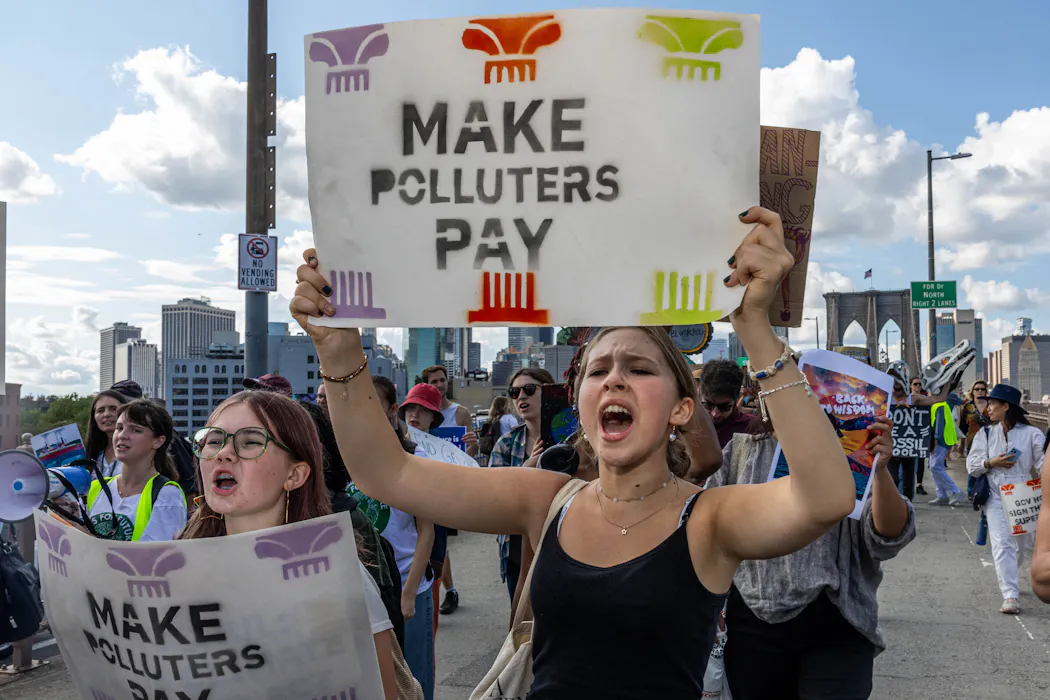
Across the U.S., people are calling for companies to pay for the damage they have done to the environment. Alex Kent/AFP via Getty Images

In recent years, at least two dozen local and state governments have sued petroleum companies to recover the billions in costs they have incurred responding to and rebuilding after flooding, storms and wildfires – all of which have been worsened by changes to the climate resulting from burning fossil fuels.

Most of these lawsuits, often filed in state courts, make a simple claim: Fossil fuel companies knew for decades that their products were harmful but concealed that fact to protect their profits. The lawsuits ask judges to order companies that have profited from the extraction and sale of fossil fuels to pay for the costs their products have imposed on the taxpaying public.

Recently, the U.S. Supreme Court agreed to hear one of these cases, Suncor Energy v. Boulder County, in the term beginning in October 2026. In their appeal to the Supreme Court, the oil companies are asking the nation’s highest court to block state courts from even considering holding the companies liable for climate-related damages.

The effort to block liability is part of a decades-long strategy by the conservative legal movement to limit victims’ ability to seek reimbursement for damage caused by corporate irresponsibility. In fact, this type of orchestrated campaign to abuse corporate power goes back well over a century in U.S. environmental legal history.

As professors with decades of experience analyzing environmental law, we believe this effort misreads the U.S. Constitution, misunderstands judicial precedent and misrepresents the role of courts in a federal system.

An aerial view of a neighborhood with muddy water filling streets and yards.
In a lawsuit, Boulder County, Colo., claims petroleum companies’ actions contributed to the climate change that exacerbated heavy rains and flooding. The lawsuit also alleges that the companies knew their products were dangerous to the environment, and sold them anyway. Matt Jonas/Digital First Media/Boulder Daily Camera via Getty Images

Foreign relations and national security justifications

One type of argument companies are using to try to limit their liability involves the federal government’s authority to conduct foreign affairs and protect national security. Federal courts have long applied a “customary policy of deference to the President” in matters of foreign affairs because the Constitution gives the president powers to enter treaties, appoint ambassadors, and the like.

Some prominent conservative legal scholars have tried to extend this concept by claiming that allowing lawsuits seeking compensation for climate-related damages to proceed would penalize multinational corporations doing business in the United States. They say such cases would interfere with the federal government’s ability to conduct the nation’s foreign affairs.

The Office of the Solicitor General – the government’s top litigation attorney – is making that argument to the Supreme Court in the Suncor case. It claims that by lodging authority over the nation’s foreign affairs in the federal government, the Constitution limits local governments’ ability to sue multinational corporations. Some legal academics support this claim by relying on a 2015 Supreme Court decision that states the nation must “speak with one voice” on foreign affairs.

But that case concerned the president’s narrow power to formally recognize foreign governments, which differs from corporate liability in state court for harms occurring in the U.S. As scholars at the Transnational Litigation Blog have noted, elimination of state law based on the federal government’s power to determine the nation’s foreign affairs is a “controversial and mostly moribund” doctrine. Applying it to suits in which defendants caused harm within the state is a stretch.

More troubling, the argument could prevent any lawsuit against energy, asbestos, pharmaceutical, or other multinational corporations. Unsurprisingly, both the Colorado and Hawaii Supreme Courts have rejected this reasoning. The Colorado court stated that Boulder’s suit involves areas of traditional state responsibility. It denied that Boulder was “seeking to implement foreign policy” or that its claims “intrude(d) on any power over foreign policy … reserved to the federal government.”

The Trump administration and its energy company allies have also tried to invoke national security as a a reason to dismiss these suits. The administration and the companies claim that forcing oil companies to defend these suits would reduce production of needed energy supplies. But that claim is completely unsubstantiated.

A fire truck drives by a burned-out home.
Wildfires like the one in Fourmile Canyon, Colo., in 2010, have been made more likely and worse by greenhouse gas emissions, which increase air temperatures and dry out vegetation. AP Photo/Jae C. Hong

Clean Air Act preemption

The oil companies also argue that the federal Clean Air Act preempts local claims in state courts like those made by Boulder County.

Many local claims are based on longstanding doctrines that allow court-ordered remedies for infringements like “nuisance,” which involve interfering with the public’s interest in health, safety, and welfare or enjoyment of private property.

In 2011, the Supreme Court found that the Clean Air Act blocks federal claims that air pollution is a nuisance. But it left open whether the act would also prevent similar state law cases. Numerous other Supreme Court decisions have declared that courts should presume that federal laws do not block claims in areas of traditional state authority. Since the nation’s founding, state courts have had jurisdiction over cases, like Suncor, that deal with liability for damage caused by a defendant’s wrongdoing.

In fact, the Clean Air Act includes a provision that explicitly preserves rights and remedies created and administered by state courts. Rather than seeking to regulate pollution, lawsuits like Suncor claim that the oil industry knew for decades that its product was dangerous but concealed that fact to protect its profits. The Clean Air Act does not regulate corporate fraud or deception, and no federal statute has ever preempted state law deception claims.

Even if the Supreme Court were to find that liability for fraudulent marketing is functionally equivalent to regulating emissions, that should not block state-level lawsuits. In 1984, the Supreme Court found that even the Atomic Energy Act – which comprehensively regulates management of nuclear materials and facilities, a matter of recognized federal concern – did not prevent state lawsuits to recover damages caused by a company with a federal license to operate a nuclear plant. The court stated it was “inconceivable that Congress intended to leave victims” without a remedy.

The same logic applies in these climate-damage cases. The Clean Air Act provides no compensation to communities that bear wildfire, flood, and infrastructure costs due to climate change. Preventing local governments from suing would leave local governments and the constituents they represent with no way to seek compensation for harms they have suffered. As the Supreme Court said in 2005, “If Congress had wanted to deprive injured parties of a long available form of compensation, it surely would have expressed that intent more clearly.” It did not do so in the Clean Air Act.

More generally, federal environmental laws protect wide-ranging public interests by regulating future behavior. State court damage claims seek to compensate specific victims for past harms. In building the modern environmental regulatory framework, Congress undeniably assumed that longstanding state laws that impose civil liability for irresponsible behavior would continue to be available to compensate those harmed by such actions.

People stand on a road that has been eroded by water, which still runs nearby.
Climate-related natural disasters have caused billions of dollars in damage in the U.S. alone. Marc Piscotty/Getty Images

A back-up plan

The energy industry and its political allies are already planning for the possibility that the Supreme Court will reject their pleas for immunity. U.S. Rep. Harriet Hageman, a Wyoming Republican, and Sen. Ted Cruz, a Republican from Texas, have introduced legislation that would block any lawsuits in state or federal courts based on state laws requiring energy businesses to pay for climate-related damage.

The bills are in the early stages in Congress. However, they are also based on the flawed idea that the federal government’s power over national security and foreign affairs bars the rights of local communities and individuals to seek redress for harms they have experienced.

Conservative legal scholars and practitioners have long sought to shield irresponsible corporations from answering for the harms they cause.

We believe people and communities who have suffered harm from companies deserve their day in court. Claiming that the Constitution requires local taxpayers to endure these harms without a chance to prove their case is not a defense of national security. It is a defense of corporate impunity.

The Conversation

The authors do not work for, consult, own shares in or receive funding from any company or organization that would benefit from this article, and have disclosed no relevant affiliations beyond their academic appointment.

The US Constitution and laws do not protect oil companies from being sued over the harm they cause to the climate

Across the U.S., people are calling for companies to pay for the damage they have done to the environment. Alex Kent/AFP via Getty Images

In recent years, at least two dozen local and state governments have sued petroleum companies to recover the billions in costs they have incurred responding to and rebuilding after flooding, storms and wildfires – all of which have been worsened by changes to the climate resulting from burning fossil fuels.

Most of these lawsuits, often filed in state courts, make a simple claim: Fossil fuel companies knew for decades that their products were harmful but concealed that fact to protect their profits. The lawsuits ask judges to order companies that have profited from the extraction and sale of fossil fuels to pay for the costs their products have imposed on the taxpaying public.

Recently, the U.S. Supreme Court agreed to hear one of these cases, Suncor Energy v. Boulder County, in the term beginning in October 2026. In their appeal to the Supreme Court, the oil companies are asking the nation’s highest court to block state courts from even considering holding the companies liable for climate-related damages.

The effort to block liability is part of a decades-long strategy by the conservative legal movement to limit victims’ ability to seek reimbursement for damage caused by corporate irresponsibility. In fact, this type of orchestrated campaign to abuse corporate power goes back well over a century in U.S. environmental legal history.

As professors with decades of experience analyzing environmental law, we believe this effort misreads the U.S. Constitution, misunderstands judicial precedent and misrepresents the role of courts in a federal system.

An aerial view of a neighborhood with muddy water filling streets and yards.
In a lawsuit, Boulder County, Colo., claims petroleum companies’ actions contributed to the climate change that exacerbated heavy rains and flooding. The lawsuit also alleges that the companies knew their products were dangerous to the environment, and sold them anyway. Matt Jonas/Digital First Media/Boulder Daily Camera via Getty Images

Foreign relations and national security justifications

One type of argument companies are using to try to limit their liability involves the federal government’s authority to conduct foreign affairs and protect national security. Federal courts have long applied a “customary policy of deference to the President” in matters of foreign affairs because the Constitution gives the president powers to enter treaties, appoint ambassadors, and the like.

Some prominent conservative legal scholars have tried to extend this concept by claiming that allowing lawsuits seeking compensation for climate-related damages to proceed would penalize multinational corporations doing business in the United States. They say such cases would interfere with the federal government’s ability to conduct the nation’s foreign affairs.

The Office of the Solicitor General – the government’s top litigation attorney – is making that argument to the Supreme Court in the Suncor case. It claims that by lodging authority over the nation’s foreign affairs in the federal government, the Constitution limits local governments’ ability to sue multinational corporations. Some legal academics support this claim by relying on a 2015 Supreme Court decision that states the nation must “speak with one voice” on foreign affairs.

But that case concerned the president’s narrow power to formally recognize foreign governments, which differs from corporate liability in state court for harms occurring in the U.S. As scholars at the Transnational Litigation Blog have noted, elimination of state law based on the federal government’s power to determine the nation’s foreign affairs is a “controversial and mostly moribund” doctrine. Applying it to suits in which defendants caused harm within the state is a stretch.

More troubling, the argument could prevent any lawsuit against energy, asbestos, pharmaceutical, or other multinational corporations. Unsurprisingly, both the Colorado and Hawaii Supreme Courts have rejected this reasoning. The Colorado court stated that Boulder’s suit involves areas of traditional state responsibility. It denied that Boulder was “seeking to implement foreign policy” or that its claims “intrude(d) on any power over foreign policy … reserved to the federal government.”

The Trump administration and its energy company allies have also tried to invoke national security as a a reason to dismiss these suits. The administration and the companies claim that forcing oil companies to defend these suits would reduce production of needed energy supplies. But that claim is completely unsubstantiated.

A fire truck drives by a burned-out home.
Wildfires like the one in Fourmile Canyon, Colo., in 2010, have been made more likely and worse by greenhouse gas emissions, which increase air temperatures and dry out vegetation. AP Photo/Jae C. Hong

Clean Air Act preemption

The oil companies also argue that the federal Clean Air Act preempts local claims in state courts like those made by Boulder County.

Many local claims are based on longstanding doctrines that allow court-ordered remedies for infringements like “nuisance,” which involve interfering with the public’s interest in health, safety, and welfare or enjoyment of private property.

In 2011, the Supreme Court found that the Clean Air Act blocks federal claims that air pollution is a nuisance. But it left open whether the act would also prevent similar state law cases. Numerous other Supreme Court decisions have declared that courts should presume that federal laws do not block claims in areas of traditional state authority. Since the nation’s founding, state courts have had jurisdiction over cases, like Suncor, that deal with liability for damage caused by a defendant’s wrongdoing.

In fact, the Clean Air Act includes a provision that explicitly preserves rights and remedies created and administered by state courts. Rather than seeking to regulate pollution, lawsuits like Suncor claim that the oil industry knew for decades that its product was dangerous but concealed that fact to protect its profits. The Clean Air Act does not regulate corporate fraud or deception, and no federal statute has ever preempted state law deception claims.

Even if the Supreme Court were to find that liability for fraudulent marketing is functionally equivalent to regulating emissions, that should not block state-level lawsuits. In 1984, the Supreme Court found that even the Atomic Energy Act – which comprehensively regulates management of nuclear materials and facilities, a matter of recognized federal concern – did not prevent state lawsuits to recover damages caused by a company with a federal license to operate a nuclear plant. The court stated it was “inconceivable that Congress intended to leave victims” without a remedy.

The same logic applies in these climate-damage cases. The Clean Air Act provides no compensation to communities that bear wildfire, flood, and infrastructure costs due to climate change. Preventing local governments from suing would leave local governments and the constituents they represent with no way to seek compensation for harms they have suffered. As the Supreme Court said in 2005, “If Congress had wanted to deprive injured parties of a long available form of compensation, it surely would have expressed that intent more clearly.” It did not do so in the Clean Air Act.

More generally, federal environmental laws protect wide-ranging public interests by regulating future behavior. State court damage claims seek to compensate specific victims for past harms. In building the modern environmental regulatory framework, Congress undeniably assumed that longstanding state laws that impose civil liability for irresponsible behavior would continue to be available to compensate those harmed by such actions.

People stand on a road that has been eroded by water, which still runs nearby.
Climate-related natural disasters have caused billions of dollars in damage in the U.S. alone. Marc Piscotty/Getty Images

A back-up plan

The energy industry and its political allies are already planning for the possibility that the Supreme Court will reject their pleas for immunity. U.S. Rep. Harriet Hageman, a Wyoming Republican, and Sen. Ted Cruz, a Republican from Texas, have introduced legislation that would block any lawsuits in state or federal courts based on state laws requiring energy businesses to pay for climate-related damage.

The bills are in the early stages in Congress. However, they are also based on the flawed idea that the federal government’s power over national security and foreign affairs bars the rights of local communities and individuals to seek redress for harms they have experienced.

Conservative legal scholars and practitioners have long sought to shield irresponsible corporations from answering for the harms they cause.

We believe people and communities who have suffered harm from companies deserve their day in court. Claiming that the Constitution requires local taxpayers to endure these harms without a chance to prove their case is not a defense of national security. It is a defense of corporate impunity.

The Conversation

The authors do not work for, consult, own shares in or receive funding from any company or organization that would benefit from this article, and have disclosed no relevant affiliations beyond their academic appointment.

Tiny fossils found in 1.7 billion-year-old mud yield clues to the evolution of complex life

Drill cores of sedimentary rock which contains microscopic fossils. Maxwell Lechte

Stored in an open-air warehouse in tropical Darwin, Australia, are dozens of trays containing cylindrical cores of rock. They are from drill holes bored hundreds of metres below the surface by mineral exploration companies decades ago.

Some of these cores at the Northern Territory Geological Survey are mudstone – a type of sedimentary rock formed from hardened seafloor mud. The companies that drilled these cores were largely unaware that within these mudstones were fossils of microscopic organisms buried on the seafloor of an ancient inland sea that covered much of northern Australia over 1.5 billion years ago.

As our new study, published today in Nature, shows, these fossils are crucial for addressing a longstanding puzzle about the major evolutionary leap that led to all complex life on Earth: the origin of eukaryotes.

Large brown rocks rising from a grassy plain.
Layers of 1.7 billion-year-old sedimentary rocks, Kakadu National Park, Northern Territory. Maxwell Lechte

Small but complex

All life on Earth can be placed into one of two types which are fundamentally different at the cellular level.

Prokaryotes (bacteria and archaea) have simple cellular organisation and are mostly single celled. Eukaryotes – including all animals, plants, algae and fungi – are very different. They have much more complicated cells featuring a nucleus and other specialised structures such as organelles which perform specific jobs.

The eukaryotic revolution transformed the planet. It led to the rise of animals and, eventually, to us. Based on observations from the genes of living organisms, it is now widely agreed that the last common ancestor of all living eukaryotes resulted from the symbiotic union of (at least) two prokaryotic microbes: an archaeon and a bacterium.

The first evidence for eukaryotic life comes in the form of these fossils of single-celled organisms. They show a level of cellular complexity not seen among prokaryotes, but common in eukaryotes.

Eukaryote fossils can be found around the world in rocks dating back at least 1.5 billion years. The fossils of the Northern Territory, the oldest of which date back to 1.75 billion years ago, are the oldest currently known eukaryote fossils globally.

But the ancient world in which early eukaryotes evolved remains shrouded in mystery. And so many fundamental aspects regarding their nature are unknown.

Oxygen – friend or foe?

Many types of bacteria can live and grow in places without oxygen. But nearly all eukaryotes alive today use oxygen for their survival. That’s because aerobic respiration – breaking down food using oxygen – provides the vast amounts of energy that complex life demands.

But the idea that oxygen has always been beneficial for all eukaryotes has come under fire in recent years. This follows the surprising discoveries of enigmatic eukaryotes that can thrive in conditions without oxygen.

There is also mounting evidence from the geological record that when eukaryotes were first evolving, oxygen was likely much scarcer. This means oxygen-free marine habitats would have been the norm. Collectively, these observations have called into question the assumption eukaryotes have depended on oxygen since their inception.

Genetic studies of living microbes belonging to groups considered closest to the ancestors of the first eukaryote can offer key insights into eukaryote ancestry. But only the fossil record can tell us about long-extinct lineages. And only geology can offer a window into the kind of world these organisms lived in.

A microscopic image of five fossils.
Fossils of single-celled eukaryotic organisms with complex surface features such as extensions and plates. Leigh Anne Riedman

More than 12,000 fossils

For our new study, we crushed up samples of the mudstone cores stored in Darwin, then dissolved them. We identified more than 12,000 fossils by analysing the organic residue left behind by this dissolution under a microscope.

We also studied the mudstones the fossils were preserved in to better understand what the environment was like when the sediments were deposited. This offered insight about the habitats in which these eukaryotes lived. And by analysing the chemistry of these mudstones, we could determine whether oxygen was present in the ancient seawater.

Our results show that eukaryote fossils were found in environments ranging from coastal mudflats to the open sea. But they were present only in samples deposited in oxygenated settings. Samples from oxygen-free environments contained only simple, prokaryotic forms.

This suggests that even the oldest known eukaryotes that lived on Earth 1.7 to 1.4 billion years ago were dependent on oxygen. These data lend support to a long-held hypothesis that oxygen played a key role in driving the evolution of early eukaryotes.

Resolving the drivers and context of the major evolutionary leap represented by early eukaryotes is one of the major outstanding questions in the life sciences. Ongoing studies of these enigmatic, ancient microfossils will no doubt tell us more about our own origins – and our place in the cosmos.

The Conversation

Maxwell Lechte received funding from the Moore–Simons Project on the Origin of the Eukaryotic Cell.

Leigh Anne Riedman receives funding from the NASA Exobiology program, and has received funding from the Moore–Simons Project on the Origin of the Eukaryotic Cell, the Palaeontological Association and the American Philosophical Society.

❌
Subscriptions