Reading view

Don’t throw that home away!

A home being demolished.

Ours is a throw-away culture. That even applies to houses. When homes or buildings are demolished to make way for a road, condo development or another house or building, the materials and contents are usually sent to the landfill. As with other characteristics of our consumer-driven societies, it’s wrong.

Many components — wood, concrete, bricks, metal, plastic, vinyl — can be reused, repurposed or recycled. It’s not a new idea, but it hasn’t taken off the way it should. In many jurisdictions, people have been able to apply for salvage rights, allowing them to take useful items from a home or structure slated for demolition. And “deconstruction” companies have been around for a while, but they’re the exception rather than the rule.

In some cases, entire houses are moved to another location and fixed up rather than being demolished. Vancouver circular construction think tank Light House estimates about 20 per cent of demolished homes here could have been moved and another 60 per cent could have been deconstructed, with materials reused or recycled.

Some municipalities are finally seeing the value in keeping materials out of landfills, implementing bylaw and regulation changes to encourage salvaging and recycling. It’s about time!

Vancouver has some rules around recycling materials from house demolitions, depending on the age and character of the home, and offers a “Construction and Demolition Waste Toolkit.”

As a Tyee article reports, population growth in Vancouver meant tearing down 7,100 single-family homes from 2012 to 2023 and about 2,700 every year in the larger Metro Vancouver region to make way for multiplex housing such as highrise towers. About one-third of Metro Vancouver’s landfill is from construction and demolition.

The problem isn’t just the waste of good materials. A 2025 Australian study notes that disposing of construction and demolition waste in landfills “has been widely recognized as a source of leachate, containing toxic contaminants, which pose significant environmental risks.”

And the building and construction sector accounts for about 37 per cent of global greenhouse gas emissions, with close to one-third of that from the energy used to produce materials for a building.

According to the CBC, “Replacing one building with another generates an entire building’s worth of emissions, which means that, from a climate perspective, it’s better to extend the lifetime of those materials and reuse them than discard them.”

The Tyee article highlights a Vancouver company, Vema Deconstruction, that claims to have saved from 135,000 to 225,000 kilograms of construction materials since its founding in 2022. It’s not just buildings that can be recycled. The Patullo Bridge that connected New Westminster and Surrey across the Fraser River was recently replaced, and steel, asphalt and concrete from the old bridge will be recycled.

Diverting construction materials has many benefits. As the City of Vancouver notes, “Recycling and reusing building materials has cost-saving incentives, saves trees, conserves landfill space, reduces greenhouse gas emissions, and supports affordable housing.”

Reclaiming wood is especially beneficial. It means no trees have to be cut down, leaving them to sequester climate-altering carbon dioxide, and for the numerous other benefits trees, especially old-growth, provide. The retained or reused wood continues to store carbon dioxide and other greenhouse gases — when wood decomposes, it emits methane, a potent greenhouse gas. And it can cost less than cutting, transporting and processing timber.

Of course, deconstructing a home takes longer and usually costs more than demolishing and carting it to the landfill. That’s why government incentives and regulations are often necessary, as well as more avenues to sell reclaimed materials.

As with just about everything in our consumer-based societies, though, the economic system itself creates the problem. The bottom line rarely underlines the most environmentally sustainable path. Using more products, doing things quickly and discarding and replacing products and materials all generate more profit than conserving, reducing, reusing and recycling.

We need to aim for a circular rather than a linear economy. This means considering the entire life cycle of the goods we produce — designing products to create zero or minimal waste and pollution, keeping products in use through better design, repair, reuse and recycling and safely returning materials to the natural environment while using renewable energy.

Homes and buildings are a good place to start. Deconstruction should be mandatory.

David Suzuki is a scientist, broadcaster, author and co-founder of the David Suzuki Foundation. Written with David Suzuki Foundation Senior Writer and Editor Ian Hanington.

The post Don’t throw that home away! appeared first on rabble.ca.
  •  

Danielle Smith expected to try to force Albertans to endure a separation referendum

Danielle Smith, Alberta’s premier, touting her “referendum imitative” last month.

Thanks to her sneaky separatist manoeuvring, Alberta Premier Danielle Smith seems to have wedged herself between the proverbial rock and metaphorical hard place. 

If she doesn’t do what the Alberta separatists in her United Conservative Party (UCP) demand and call a referendum using the wording on their Citizen Initiative petition – “Do you agree that the Province of Alberta should cease to be a part of Canada to become an independent state?” – they may very well depose her in an internal party coup. 

If she does that, though, she will run up against the courts – which have ruled that question to be unconstitutional and quashed approval of the petition because First Nations were not consulted.  She may also soon face an energized pro-Canadian electorate that is finally starting to pay enough attention to send her packing if it gets the chance.

If she tries to find a “compromise” between those irreconcilable positions, one side, the other, or both could turn on her. 

Nevertheless, it looks as if starting today Premier Smith will try to wiggle out of the trap she has built and wedged herself into by pretending to be a loyal Canadian while doing everything she can to facilitate the schemes of the separatist crowd. 

The Legislature’s Select Special Citizen Initiative Proposal Review Committee has asked Thomas Lukaszuk, proponent of the Forever Canadian petition campaign, to come to its meeting this afternoon at 3 o’clock.

“It is possible the Committee will consider a motion during the May 20 meeting to invite you to present to the Committee,” said Chair Brandon Lunty, the UCP MLA for Leduc-Beaumont, in a letter to Lukaszuk, a former Progressive Conservative deputy premier of Alberta.

The letter continues: “In the event that the Committee chooses, during the meeting, to invite you to present, I would ask that, should you be available to attend, you please be prepared to make a presentation on the citizen initiative proposal of up to five minutes, after which committee members will have the opportunity to ask questions regarding the proposal and your presentation.”

Needless to say, this is both gormless and rude. Lukaszuk obviously picked up on the letter’s tone when he posted it to social media, commenting, “Looks like the UCP led committee dealing with the #ForeverCanadian petition has found whole FIVE MINUTES to discuss the future of Alberta and Canada.”

Nevertheless, he will be there. He told me last night: “I think Canada is worth five minutes. I will definitely go and make sure that this is the longest five minutes that those UCP MLAs have ever experienced!”

The obvious conclusion from this is that Lunty’s boss and her advisors have already decided to put separation on the ballot in October, and they’ll make it official this week, but they’d like to find a way to blame Lukaszuk for what is bound to be an unpopular decision. 

Up to now, the committee has been slow-walking the Forever Canadian petition – which was intended to require the members of Legislative Assembly to vote yes or no on the question, “Do you agree that Alberta should remain within Canada?” – observed Mount Royal University political science professor Duane Bratt said on social media last night.

“It does not matter what @LukaszukAB or Forever Canada may have wanted,” Bratt said, responding to a post that suggested the UCP was trying to make Lukaszuk the scapegoat for the referendum they desperately want. “It is the determination of the MLA Committee that matters. And I am almost 100% that they will recommend a referendum and along party lines.”

Whether the UCP has decided to use Lukaszuk’s wording for their separatist referendum, as some have speculated, remains to be seen. But if they do, Lukaszuk observed, the premier will have to be the proponent, because he won’t. 

And if they use his question, he added, “that will cause them more problems than they can imagine.” 

“My question was designed to be asked in a legislature and to block their question,” he said. “My question does not meet the Clarity Act requirements and it cannot possibly start a constitutional process for separation.”

Which leaves us where, exactly? 

In the short term, if the UCP tries to use the Forever Canadian question, the hard-core separatists in the party bureaucracy will be furious – at the premier. If the government tries to move ahead with the Stay Free Alberta question, the vote will quickly bump up against the courts. What’s more, we can expect a large cohort of Alberta voters who have not really been paying attention up to now to be infuriated by this UCP threat against their country and the rights it guarantees them.

Still, one way or another, Smith might succeed in wiggling off the hook. History shows you can never count her out. 

Years ago, one of Smith’s smartest and closest political allies, who must remain nameless to protect the periodically helpful, told me that the former Wildrose Party leader often operated her mouth without engaging her brain. 

But whenever this got her in trouble, as it frequently did, she reckoned she could always talk her way out of the hot water she’d gotten herself into. “And she usually could,” they ruefully remembered. 

The post Danielle Smith expected to try to force Albertans to endure a separation referendum appeared first on rabble.ca.
  •  

Prominent Alberta separatist advocates internal UCP coup to oust Danielle Smith

Jeffrey Rath, in cowboy hat, on the steps of the Alberta Legislature on October 25 during a separatist rally in Edmonton.

Over the weekend prominent Alberta separatist Jeffrey Rath took to the internet appearing to advocate an internal United Conservative Party (UCP) coup to remove Premier Danielle Smith. 

Her sin, in Rath’s obvious estimation, is that she’s been working too closely with Liberal Prime Minister Mark Carney and playing both sides of Independence Avenue in her efforts to keep the party’s fraying coalition of outright separatists and traditional Canadian Conservatives in one piece. 

His solution: The separatist cadres who now clearly control the UCP, but not quite yet either the government caucus or the provincial government, should dump her and replace her with a more ideologically acceptable leader and declare the party to be a separatist entity in the manner of the Parti Québécois.

Arguably, this could either be a sign of Smith’s increasing strength thanks to her latest deal with Carney, or of the separatists’ increasing strength as the holders of most of the internal power positions in the UCP party bureaucracy. Or, perhaps, a bit of both. 

Smith’s strategy, as is well understood, has been to assert that only she can successfully keep the open separatists now embedded in the party, caucus and cabinet from scaring away electors accustomed to voting Conservative without thinking too deeply about what the party nowadays represents.

Likewise, as the vessel of Preston Manning’s strategy of blackmailing the federal government into doing Alberta’s bidding by threatening to become the 51st State, she is the only politician likely to be able to get away with perpetrating this political protection racket. 

Talk of an internal party coup, though, should be taken seriously because Rath, who is legal counsel and for all practical purposes the self-appointed spokesperson for the Stay Free Alberta petition/Alberta Prosperity Project (SFA), is extremely influential within Alberta’s separatist faction. It is not clear if he has ambitions of his own in the new Alberta he hopes to create, but it is easy to assume that he must. 

So when Rath was so blunt about what he thinks should happen next in a series of social media posts, we should pay attention. He speaks for many in the UCP. 

“Premier Smith had no mandate from her membership to sign the Carbon Tax MOU with Mark Carney,” Rath posted at one point. “Danielle Smith no longer enjoys the confidence of the members of the UCP.”

If that’s not a call for a coup, I don’t know what is. 

“Enough is enough,” he said in another post. “We are a super majority of the party. Time to take it back from the Kenneyites.” (The “Kenneyites,” remember, basically purged the “Red Tories” from the UCP after former premier Jason Kenney engineered the double reverse hostile takeover of the Progressive Conservative Party and the Wildrose Party in the summer of 2017. This is an irony, since those Red Tories, had they still been around in any numbers, could have saved Kenney’s bacon in the fall of 2022.)

Here’s another, delivered Trump-style, in all caps: “DANIELLE SMITH HAS LOST HER MANDATE TO LEAD THE UCP!”

Rath’s message to the cadres in the UCP’s riding constituency associations: “MAKE SURE TO ATTEND YOUR LOCAL CA BOARD AGM AND ELECT A SLATE OF PRO-INDEPENDENCE BOARD MEMBERS. CONTACT YOUR LOCAL APP OR STAY FREE REGIONAL LEADERS FOR GUIDANCE.”

“We need to work to replace every non independence board in the province,” he said in part in another post

All these messages were posted on X, the social media platform previously known as Twitter, a place a lot of moderate Albertans nowadays sensibly eschew, if only to keep their blood pressure down. Someone has to look in there, however, and I’m willing to take the risk so that the rest of you don’t have to.

If this was more than just an anticipatory outburst of exuberance in memory of the late grandmother of Europe’s titled classes it suggests Danielle Smith’s “United Conservative” coalition could actually be starting to fracture.

It’s worth noting that the separatists on social media are also infuriated by the possibility that when the pipe gets laid, it may not follow the route most of them prefer, that is, the one most likely to annoy the most British Columbians and First Nations along the way to Prince Rupert. (The British Columbia city of that name and the terminus of the Alberta separatists’ imagined Danzig Corridor to the sea, that is, not the first governor of the late Hudson’s Bay Co., just to be clear.)

Meanwhile, speaking of Independence Avenue, a metaphor lest you tried to look it up on Google Maps, Edmonton City Councillor Michael Janz announced he had applied on behalf of many of his constituents to rename the road in front of the Alberta Legislature “Forever Canadian Avenue.”

Janz – councillor for Ward papastew, located just across the North Saskatchewan River from the Legislature – said the renaming of two blocks of 99th Ave. between 107th St. and 109th Street “will celebrate the largest non-partisan citizen movement in Alberta’s history.”

“The Forever Canadian petition collected signatures from Albertans who want Alberta to proudly remain a Canadian province,” Janz explained in a statement. “This effort was prompted as a response to Premier Danielle Smith encouraging conversations about Alberta separation. The petition gathered 456,000 signatures and motivated more than 10,000 Albertans to volunteer in support of this work.”

Janz, who is a tireless progressive activist not unprepared to be a gadfly if that’s what it takes to accomplish something, was accompanied to an outdoor news conference yesterday by Forever Canadian petition proponent Thomas Lukaszuk, a former Progressive Conservative deputy premier of Alberta. 

Janz will make application to the Edmonton Naming Committee, an independent body of volunteers appointed by the city. He pointed out that there is a precedent, when another city councillor successfully applied in 2018 to have a city road renamed Canadian Forces Trail. 

If Janz succeeds with this one, it will drive the UCP and the SFA nuts. 

The post Prominent Alberta separatist advocates internal UCP coup to oust Danielle Smith appeared first on rabble.ca.

  •  

Bernie’s backstory life in a city with a socialist mayor

Few Americans or outside observers of the Excited States are neutral about Bernie Sanders, the long- serving independent Senator from Vermont. For many, he is the best President America never had, after two failed attempts to win the Democratic Party presidential nomination in 2016 and 2020. For others he is the heroic standard bearer and one of the key spokespeople for a resurgent progressive tendency in US politics and a leader in the struggles to oppose Donald Trump and his wannabe stormtroopers.

Sanders has critics both on the Right, where he is viewed as a dangerous radical, and on the Left, where he is sometimes attacked for being too willing to compromise with the forces of capital. Other critics caricature him as a crabby old man in a cardigan, out of touch with realities of the 21st century. Love him or hate him, Sanders is a true American giant.

Poet Dan Chiasson’s new book, Bernie for Burlington, about the years that Sanders served as the 37th Mayor of Burlington (1981-1989) is a welcome addition to a growing body of Sanders literature. Well written and accessible, it is not only a portrait of the Burlington years, which brought Sanders to national attention; it is also a sharply observed and well written love letter to the unique and cranky virtues of Vermont, and of Burlington, where Chiasson grew up during the Sanders years. This is a book that will please Sanders’ many fans around the world and will serve as a rich resource for scholars and political junkies who write about Bernie in the future.

Chiasson is the author of six other books: The Afterlife of Objects (University of Chicago Press, 2002), Natural History (Alfred A. Knopf, 2005), One Kind of Everything: Poem and Person in Contemporary America (University of Chicago Press, 2007), Where’s the Moon, There’s the Moon (Alfred A. Knopf, 2010), Bicentennial (Alfred A. Knopf, 2014), The Math Campers (Alfred A. Knopf, 2020). He writes frequently for The New Yorker and The New York Review of Books. He is a professor of poetry at Wellesley College and has been called “the country’s most visible poet-critic.”  

So, who is Bernie Sanders, and what can an account of his time as mayor of Burlington tell us about him and about America in our time? Chiasson sets out to answer these questions, and does it from the perspective of someone who came of age in the years Bernie was mayor of Burlington.

Two anecdotes from early in the book give a sense of the distinctive poet and city native’s narrative method. In one, the nine-year-old Chiasson sees two figures approaching the front door of his family home. When the visitors, canvassing for votes,  knock on the door, and his grandmother calls out “It’s Sanders,” Chiasson’s grandfather booms “DON’T OPEN THE DOOOR!”

In the second glimpse, drawn from a 1988 community access TV show Bernie produced while mayor, called, unimaginatively, “Bernie Speaks: The Mayor’s Show,”  the bemused mayor/host is shown interviewing skate punks about their outlandish hair styles, piercings and heavily zippered leather jackets. Chiasson grew up with the featured interviewees, and was just outside the frame when the video was shot, he tells us. This sets the tone for the entire narrative. The author knows almost everyone he writes about in Burlington, and remains present, if just off camera, throughout his  Bernie and Burlington story. This, plus the poet’s eye for humanizing detail and felicitous sentence making ensure that  the book is not only useful but also a distinct pleasure for the reader.

With the pleasures of the text come lots of information. We learn about Bernie’s impoverished childhood and the soul-wounding impacts of poverty on his parents. We learn about his college years, first in New York and then in Chicago, and his first forays into social justice activism as he campaigned with other University of Chicago students to force the school to integrate residential buildings it owned. We see the young Bernie’s fascination with the theories of rogue psychoanalyst Wilhelm Reich and his sexual function enhancing orgone boxes. We learn of Bernie’s growing interest in Vermont, an interest that began with visits to a Vermont tourism office in downtown Manhattan with his older brother Larry. We see him marry for the first time and scrape together money to buy a derelict farm property in Vermont, where he eventually settled and pursued his political interests.

Sanders became a “perennial candidate,” at first as part of Liberty Union, an anti-war party, but mainly as an independent. We see him forge his national identity as mayor of Burlington, where he drew support reliably from low income neighborhoods and less reliably from the liberals, academics and back to the land hippies who were changing the demographic face of Vermont in those days. In a 1972 campaign diary, Sanders wrote “Of all the groups a candidate talks before, I prefer ostensibly to talk to low income people. They “know” a lot more than most people because their lives are constantly on the line and they can’t escape behind 10,000 a year incomes- as can the good liberals.” 

As mayor, Sanders fought hard to protect Burlington’s poorest neighborhoods from “urban renewal” and to make developers and the University of Vermont, located within Burlington’s city limits but immune to civic taxes and regulations, more accountable to the city.

Throughout his long march to Burlington and then to DC, Sanders was fierce in his criticism of the oligarchs who even then dominated American politics and public discourse. He had a particular focus on the Rockefellers, seeing the liberal wing of the Republican party, led by Nelson Rockefeller as part of the American problem, not a solution. He was scathing in his critiques of Democrats as well, and during his political career, often received support from conservatives who shared his skepticism about liberalism.

Bernie improved the lives of low income Burlington residents and fulfilled many of his campaign promises. He went on to an important role in the emergence of a new anti-MAGA progressive movement in this century, and continues actively in that role. Chiasson’s book is a literary success and a treasure trove of information that will help any reader come to their own conclusions  about what the Bernie story means.

Highly recommended.

The post Bernie’s backstory life in a city with a socialist mayor appeared first on rabble.ca.

  •  

Mark Carney and Danielle Smith have more objectives in common than they don’t

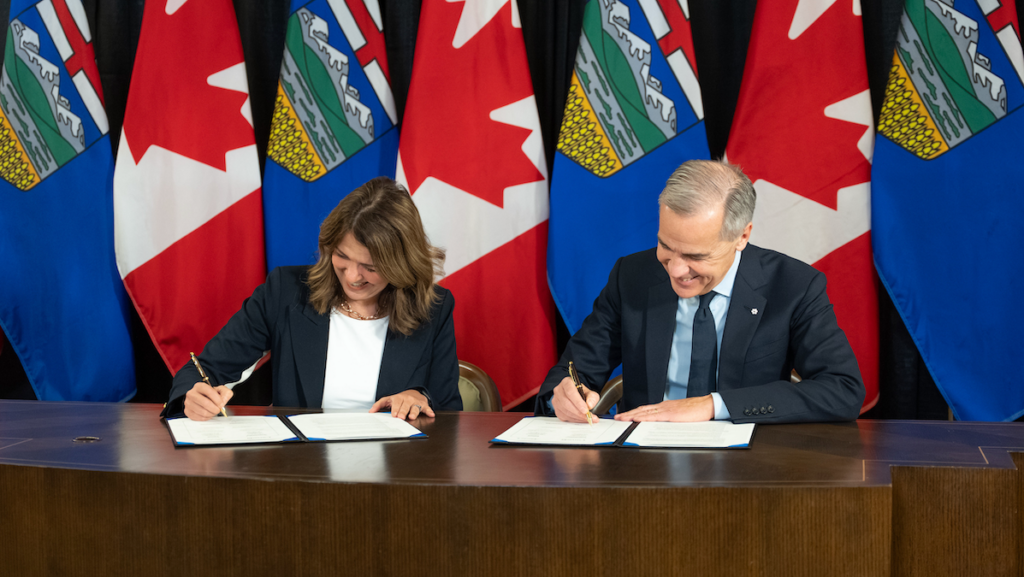
Alberta Premier Danielle Smith and Prime Minister Mark Carney signed the memorandum of understanding last fall that set the stage for Friday’s carbon pricing, carbon capture and bitumen pipeline deal.

There’s no need to make the explanation of the carbon pricing, carbon capture and bitumen pipeline deal announced Friday in Calgary by the federal and Alberta governments too complicated. It’s actually pretty simple. 

After all, notwithstanding their political differences, Prime Minister Mark Carney and Premier Danielle Smith have more objectives in common right now than they don’t, so it couldn’t have been that hard for them to reach an agreement. 

Carney has served many years as an expert in and senior representative of international finance capital, of which the oil industry remains a key component in Canada. While neither an expert nor a deep thinker, Smith has been a lobbyist for the oil industry and an effective public proponent of its preferred policies throughout her career as a journalist and politician. 

Of course they weren’t going to have all that much trouble finding ways to grant the Canadian oilpatch its wish for a pipeline to the West Coast, preferably completely paid for by taxpayers, plus slow-walked carbon taxes and big subsidies for the carbon-capture boondoggle to build social license for the pipeline. 

They may have their differences, but they are flying in formation when it comes to the oil industry. 

They have immediate parallel political needs as well. Smith must thread the needle between appearing to be an Alberta separatist and appearing to be a patriotic Canadian unifier to hold her fraying but still united voting coalition together – and, not incidentally, to hang onto her job as premier since separatists now clearly dominate her party. 

Friday’s deal lets her do that – for the moment, anyway. And the moment is all Smith ever thinks about. To give her her due, it seems to work. 

Carney needs to keep his coalition together as well. Instead of MAGA separatists on the right who would really rather be part of the United States so they could own machineguns and call people hateful names, he needs to appease moderate green voters in British Columbia and Quebec and somehow hold the country together. 

Since the contradictions of using bitumen as the glue to keep their political coalitions together will become more obvious over time, they’re in a hurry to get the deal done and some pipe laid so the doubters on both sides of the political spectrum can be told there is no alternative. For this reason, we should take seriously their promise that work on the pipeline, whatever route it takes, will start next year.

The simplicity of this political equation seems to have confused the Canadian political and business commentariat, grown used to sustained attacks on Ottawa by conservative Alberta governments. Commentators’ theories and explanations, as a result, were all over the map Friday and yesterday  – sometimes with unintentionally hilarious results.

According to Carson Jerema in The National Post, it’s all a dirty trick by Carney to “ensnare Danielle Smith in pipeline blackmail.” Ottawa’s gift of “free rein to polluters” (as Environmental Defence put it in a news release) “will give anti-energy B.C. Premier David Eby an effective veto,” according to the Post

Meanwhile, over at the environmentally inclined National Observer, Max Fawcett agreed … sort of. Carney isn’t taking a wrecking ball to Canada’s climate policies, he’s saving the country by defusing Smith’s constant carping about Canada, Fawcett asserted. “He understands the value of appearing to say yes to certain forms of economic development while creating or accelerating the conditions that will make it a non-starter.”

Postmedia’s Rick Bell – who often acts as a sort of de facto minister of propaganda for Smith’s United Conservative Party (UCP) – was enthusiastic, with mild reservations. “Carney is the prime minister and Smith says there was no choice but to meet him in the middle,” he wrote, leaving his usual breathless hyperbole to his colleague Don Braid. “She figures this deal did just that and it is a win for Alberta and a far cry from those days of ‘anger, frustration and despair’ under Trudeau.”

Well, the last time Smith said something like that, about the memorandum of understanding with Ottawa that set the stage for Friday’s deal, she was jeered at her own party convention

And then there was Braid – Postmedia’s other high-profile Alberta political columnist – who went right over the top with a panegyric to Smith that wouldn’t have seemed out of place in the pages of Pravda or the People’s Daily in the 1950s. 

“She has won every single battle with Ottawa over the past year,” said Braid, sending his hosannas heavenward. “In scope and importance, her victories against Ottawa outweigh former PC premier Peter Lougheed’s limited victory in the oil pricing crisis after 1980. … Smith may have set up this province for decades of economic gains.”

Well, if Carney is sneakily giving by a veto, British Columbia’s premier doesn’t seem to happy about it. And if Smith is saving Confederation, you have to wonder why she’s pushing ahead with her separatist referendum agenda. It seems to me that coastal British Columbians are as unhappy with this state of affairs as are Alberta separatists. And if anyone’s thinking about the constitutional requirement for consultation with First Nations, no one seems to be talking about it. 

You have to wonder if, despite Smith’s best efforts to keep the UCP united, something’s going to give as the separatists that now control the party push for it to officially declare itself to be a separatist party. Can political entropy in Alberta be far behind? 

And how comfortable will some members of Carney’s narrow majority in Parliament be in a government that appears to have completely tossed the environmental policies of the Trudeau era, unlamented though they may be here in Alberta. Steven Guilbeault, the former federal environment minister? B.C. MPs Will Greaves and Stephanie McLean? 

Is it possible that the biggest winner in this deal of the century could turn out to be … Avi Lewis?

The post Mark Carney and Danielle Smith have more objectives in common than they don’t appeared first on rabble.ca.

  •  

The war on sleep training babies will harm mothers

A sleeping baby.
A sleeping baby.

I am not a pediatrician, but I am a parent. In my capacity as someone’s mother, I have experienced the sleepless nights of the infant years. This makes me a keen observer of all things related to getting children of all ages to sleep.

If you’re a chronically online person like me, you’ll likely have heard a myth that the family-friendly nation of Denmark has banned “cry-it-out” sleep training (here’s what actually happened there). If you’re on parenting message boards, you’ve certainly seen tired moms debate whether sleep training a child by letting them cry alone until they go off to Dreamland is a family’s salvation or the worst form of child abuse. Whether to let a baby fuss unsoothed at bedtime – and for how long – is one of the most vicious parenting debates of the 21st century. While I am not an expert on the science of babies’ sleep, I do know it’s mothers’ who will suffer if we end sleep training.

For those who aren’t familiar with the players in this discourse, allow me to provide some context. A parent innocently researching approaches to children’s sleep will likely come across articles like this one in Psychology Today. Here, psychology professor Dr. Darcia F. Narvaez opines: “If you are going to have a baby, you need to figure out a way to be with the child during the first three years of life.” The La Leche League also wants to scare you into abandoning Sleep Training: “How the adult brain reacts to stress is wired by early development.” These are terrifying words for a new mom to read at two in the morning!

The pro-sleep training side has its own experts. Common arguments for those who advocate more aggressive sleep training are that it is good for parents (because more sleep) and good for babies (because learning to fall asleep without constantly being held or soothed can establish better sleep habits). Perhaps the most famous (or infamous, depending on whom you ask) proponent of letting the baby cry is Richard Ferber. 

Dr. Ferber is a successful pediatrician who published Solving Your Child’s Sleep Problems in 1985. The idea of “Ferberizing one’s baby” was soon everywhere. It even became a plot point in comedies like Meet The Fockers and the hit sitcom Modern Family. But sleep training isn’t just a joke! Today, it’s become something of a cottage industry. There are even so-called sleep training experts who charge sleep-deprived parents hundreds of dollars an hour to help them resist the heartbreaking sounds of a crying baby long enough for a baby to fall back to sleep.    

I am not a scientist, nor do I have the hubris to claim I know which side of the sleep training debate has the more reliable science on its side. However, I am a feminist with extensive knowledge of the history of parenthood – especially motherhood. And regardless of what’s best for babies, history teaches me that guilting families into abandoning the cry-it-out method will be harmful for mothers.

Modern Canada is a place where new mothers receive far less support than they need. A large percentage of women in this country are ineligible for parental leave benefits, and even if you can access them, the increasing cost of living means you may still be struggling to provide for your little one.

Another salient fact in this discussion is that Canada does not provide enough support for people suffering from postpartum mental health issues, which can be exacerbated by sleep deprivation. Research shows mothers are likely to be the ones getting up with infants in the middle of the night. So, when we tell families it’s neglectful to let a baby cry themselves to sleep, that essentially sentences mothers to years of no sleep.

We know sleep deprivation has a host of nasty effects. Everything from a person’s mood to their balance is impacted when they go without rest. In a world without sufficient support for moms, the case against sleep training expects mothers to act as martyrs.

Now, it is possible to imagine a world where we could move past sleep training, if that is indeed what is best for babies. If governments provided free access to well-paid night nurses to tend to babies in the middle of the night a couple of times a week, mom could occasionally catch up on their rest. If men in partnerships with women actually got up in the middle of the night with their children, that would also protect mothers’ physical and mental health. But in a Canada where many people can’t even find a daycare with space for their toddler, a society that truly supports mothers still feels lightyears away.

The truth is simple: until our world supports mothers, eliminating sleep training will simply become yet another way our society torments moms.

The post The war on sleep training babies will harm mothers appeared first on rabble.ca.

  •  

Doug Ford has opened the door to privatizing our water, history show how that can put public health at risk

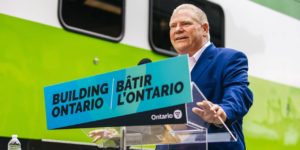
A photo of Ontario Premier Doug Ford.

Although he reinvented himself as a kingpin in the nursing home business, former Ontario premier Mike Harris used to be best known for the water contamination fiasco that killed seven people and sickened thousands more in Walkerton, ON.

That tragedy led to a dramatic decline in support for his government and was considered a key reason Harris resigned as premier in 2002.

Not surprisingly, the premiers who’ve followed Harris have steered clear of anything that smacks of weakening government surveillance of Ontario’s water systems.

Until now, that is.

Shaking off the Walkerton bogeyman, current Ontario Premier Doug Ford is embarking on a plan that will effectively privatize aspects of the province’s water systems, with potential risks to our drinking water.

Ford is well aware of the political danger of being associated with any weakening of public management of water. This explains why he’s going out of his way to deny the label “privatization” applies to the changes in new legislation, which the government insists will keep our water “publicly owned.”

But, as law professor Joel Bakan and economist Jim Stanford noted in a piece in the Star yesterday, the new legislation creates a regime for water and wastewater services in Ontario that is effectively privatized — despite the Ford government’s attempt to deny what it’s doing amounts to privatization.

The Ford government’s keenness to put in place this new water regime — while disguising the fact that it involves privatization — raises the question: whose interests is the government serving in doing this?

Clearly, there’s no public pressure for our water systems to be redesigned to include profit-making. That’s because there would be no benefit for the public.

However, there is one group that would benefit significantly — private investors.

Indeed, private investors — particularly large global institutional investment firms that represent (among others) pension funds, insurance companies and very wealthy families — have trillions of dollars in capital and are keen to invest it in low-risk projects where they can earn returns as high as seven to nine per cent a year. And public infrastructure, including Ontario’s water system, fits that bill.

Under Ford’s legislation, water and sewage systems can be removed from the control of local governments — the plan is to start with Peel Region — and transferred to specially-created, profit-making corporations.

“Key decisions — including finances, contracts and water rates — would be made by corporate boards,” observes Meera Karunananthan, a geography professor at Carleton University.

She also says that the public would continue to be responsible for the debt from constructing the water infrastructure, while the profits would go to investors. “Simply put, the public bears the burden while shareholders capture the reward.”

The public is also potentially endangered. A 2002 public inquiry found that among the factors contributing to the Walkerton tragedy was the Harris government’s failed provincial oversight after it privatized water testing.

Harris was an unusually gung-ho privatizer, and his legacy of privatization — with all the associated risks — lives on in areas beyond water management.

He also encouraged privatization in Ontario’s long-term-care homes and then went on to benefit handsomely from the privatized nursing home industry he helped create. Shortly after retiring as premier, he became a significant shareholder and chairman of Chartwell Retirement Residences, a major private chain operating publicly-funded nursing homes.

Chartwell was among the for-profit nursing homes that were found to have higher death rates during the COVID pandemic than not-for-profit homes, according to a 2020 investigation by a team of Toronto Star reporters as well as a CBC probe. Harris retired as Chartwell chairman two years later, in 2022.

While public services and infrastructure offer lucrative opportunities for moneyed investors, there’s a reason not to hand over aspects of these vital provincial responsibilities to private interests which are, above all, focused on making profits.

Ontarians died needlessly in nursing homes and in Walkerton. Doug Ford should take note.

This article was originally published in the Toronto Star.

The post Doug Ford has opened the door to privatizing our water, history show how that can put public health at risk appeared first on rabble.ca.

  •  

Governments are on a privatization rampage

Prime Minister Mark Carney and Ontario Premier Doug Ford are pursuing similar pro-business policies at the expense of public services.

Prime Minister Mark Carney wants to privatize our airports, our seaports and build a lot more private gas and nuclear power plants. Ontario Premier Doug Ford is privatizing our water, our healthcare and building a lot more private gas and nuclear power plants. Carney said Canada was “not for sale,”  and Ford says “that’s how we “protect Ontario.” 

Both Carney and Ford are using the Trump crisis as was so brilliantly described in Naomi Klein’s book Shock Doctrine. Crisis capitalism is being used to privatize our public assets and services.

When privatizing our public assets and services, we always hear the same song.

We have to “modernize, reform, increase competitiveness, innovation and increased efficiencies through alternative models of ownership.” Then we are told the same false claim: This will lead to “lower costs” which will be passed on to you. The same claim of lower rates came from Ontario Premier Mike Harris’ hydro legislation. Rates have now more than quadrupled.

 Hwy 407 is now the most expensive toll way in the world. In a deal far worse than the privatization of HWY 407, the privatization of the Bruce nuclear plant in a long-term lease in the year 2000, the profits were privatized but the $34 billion debt and the risks and cleanup remained public. 

The privatization of long-term care homes where many died from neglect during the COVID-19 pandemic and the higher and higher rates of Hydro privatization has left the people of Ontario with no appetite for any more privatization of public assets. 

The privatization of Connaught Labs by former Prime Minister Brian Mulroney also hurt us badly during the pandemic. The record of privatization around the world is dismal. The prime example of privatization failures is in the UK where the privatization of water, electricity and rail has left that country a basket case. The record of privatization is clear, when you introduce the profit motive, private corporations benefit and we all will pay a lot more. The risk is not just higher rates,the loss of sovereignty and control is the biggest risk. There doesn’t seem to be any difference between the Conservative and Liberal parties; both are on a public asset privatization rampage.

The post Governments are on a privatization rampage appeared first on rabble.ca.

  •  
❌