Reading view

Why early medieval Ireland had laws for bees
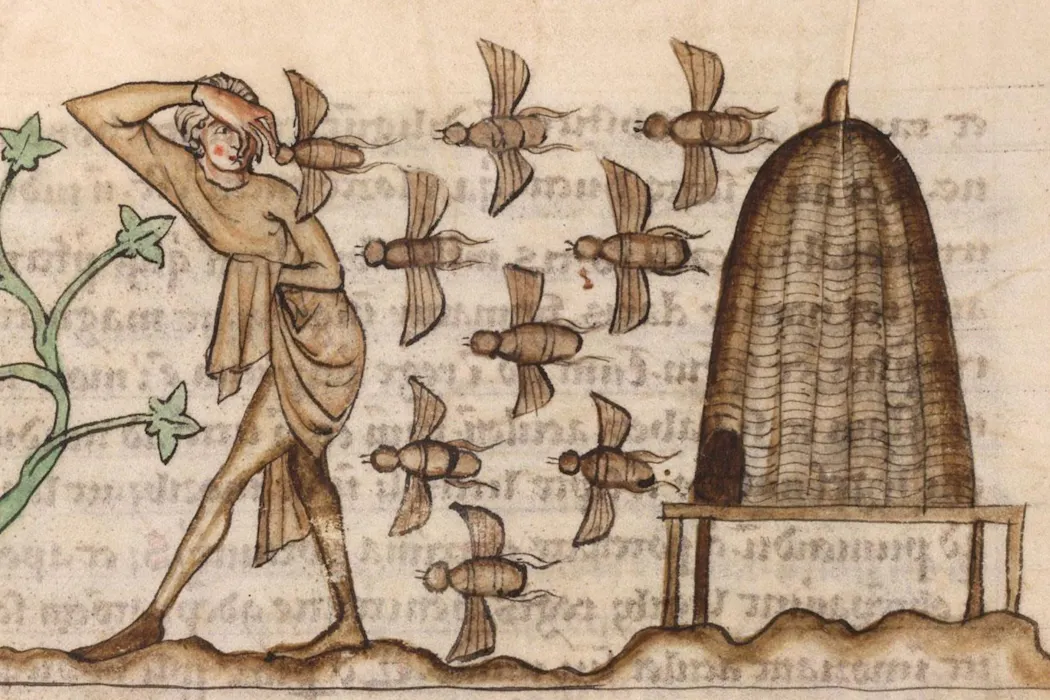
Bees attacking a threat, as depicted in a medieval manuscript. Douai Cuincy Library Network, CC BY-SA

Who owns a swarm of bees? And what happens when they stray onto a neighbour’s land?

In early medieval Ireland, such questions were addressed by a remarkable set of laws known as the Bechbretha, which set out the rights and responsibilities associated with beekeeping. Also known as bee-judgments, these laws formed part of the wider medieval Irish legal system, Brehon law (known in Old Irish as fénechas or customary law).

Brehon law espoused restorative rather than criminal justice and was chiefly concerned with the type of compensation to be paid for crimes committed. Most of these laws were written down in the 7th and 8th centuries, but they probably preserve much older traditions that had previously been passed down orally.

Early medieval Irish society was hierarchical. In legal cases, the amount of compensation owed or received depended entirely on a person’s social rank, with payments varying according to their status.

The Bechbretha provided a legal guide for lawyers dealing with cases involving bee trespass (where a neighbour’s bees came onto another’s land and supposedly stole nectar from flowers and plants), injuries or death caused by bees, beehive theft and the compensation owed in each situation.

Medieval illustration of a man running from bees
Legal cases could be brought against beekeepers whose bees stung passersby. National Museum of Antiquities, CC BY-SA

In medieval Ireland, bees were given legal status because they were classified as domestic livestock. Like cattle, horses, pigs, poultry and sheep, they were legally protected because of their considerable value. Beekeeping produced a wide range of goods, including honey for food and sweetening, as well as mead and beer, beeswax for candles, sealants and writing tablets, and other products used in medicine, polishing, lubrication, skincare and waterproofing.

The Bechbretha also had another purpose – maintaining good relations within local communities. According to the Bechbretha and another legal text, the 8th-century Bretha Comhaithchesa, Judgements on Neighbourhood, a mutual agreement among the farming community ensured compensation would be paid if and when animal trespass, theft or injury occurred. A certain level of trust between neighbours was required for this process to work.

That said, it is one thing to show where a neighbour’s large domestic animal has trespassed or caused damage. It is something else to prove that neighbouring bees had rampaged through your flowers, stealing nectar before buzzing away with their ill-gotten gains.

One suggestion the Bechbretha makes is to dust flour over bees, follow them to source and identify the culprits. Because honeybees tend to return repeatedly to the same nectar sources, tracking and marking them with white flour – which scatters onto the ground as they fly, leaving a visible flight path – can be effective. The laws also state that the owner of stray bees has three years to collect their honey, but by the fourth year must surrender the first swarm from that hive to the wronged party.
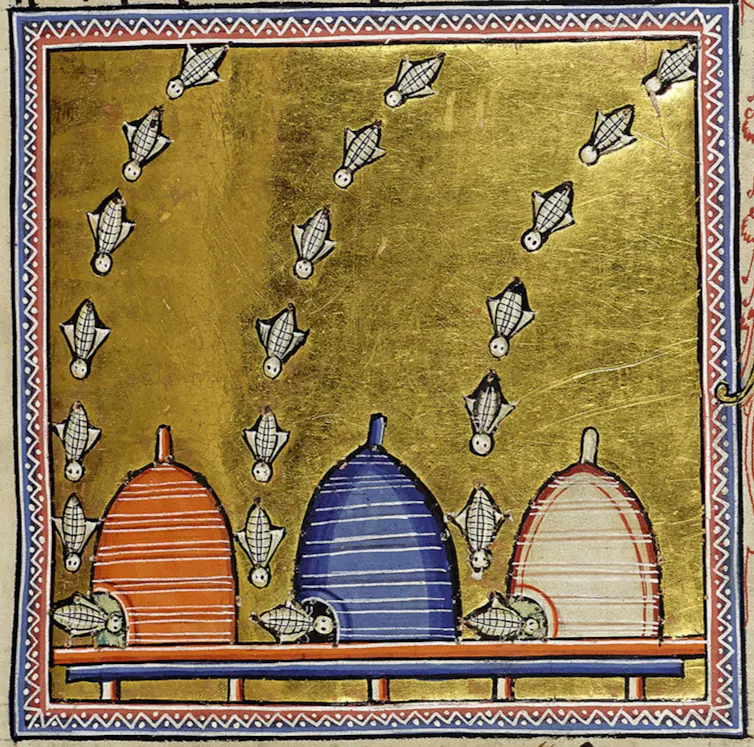
Gold-adorned illustration of bees flying into their hives
The illustration for bees in the Aberdeen Bestiary manuscript, written and illuminated in England around 1200. Aberdeen University Library Online Collections, CC BY-SA

The Bechbretha also dealt with questions about ownership of swarms which settled and built new hives on either private or common land. The beekeeper who found the new hive was entitled to a third of the honey for three years but after that time elapsed, the landowner on which the swarm settled became its owner. Where a swarm was discovered in woodland, the finder was entitled to (almost) everything. The local church and patriarch of the finder’s kin-group were both entitled to a share.

Where hives were stolen or illegally moved and where perpetrators got stung or died from being stung, beekeepers were not held responsible. Where bees stung people without provocation, compensation was due, though if the victim killed the bee(s), their death was deemed recompense enough. Generally, for valid situations where someone was stung, killed or maimed, hives were given over in payment.

Theft of beehives carried hefty penalties, dependent on their location. The closer a hive was to a homestead, particularly a high-status one, the larger the compensation. This was usually in the form of cattle, the main currency used in pre-coinage Ireland. Theft of hives from monasteries also carried imposing fines.
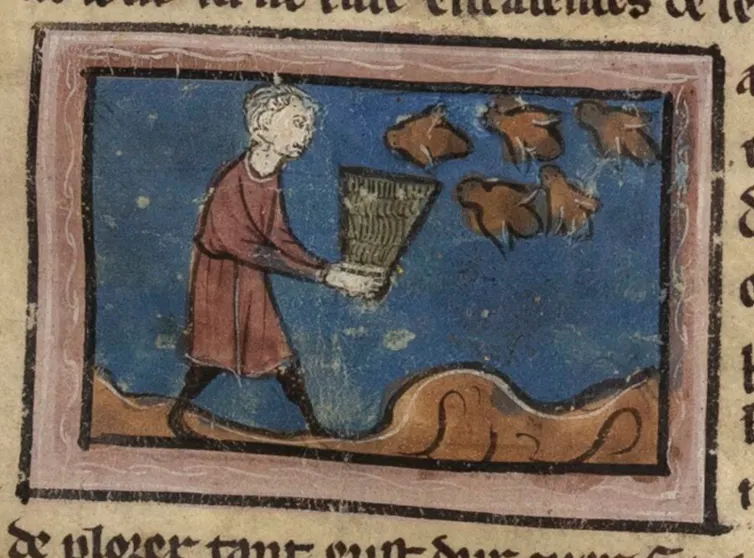
Illustration of a man trying to catch very large bees in a basket
A man tries to catch bees in a basket. Illustration from a medieval French manuscript. National Library of France, CC BY-SA

That there were a set of early medieval Irish laws solely for bees reveals the high regard with which these little creatures were held. Restitution through beehives and bee produce helped the proliferation of beekeeping throughout the community. In pre-industrial, early medieval Ireland, where society’s survival depended so much upon the climate, bees were a pivotal part of the agricultural system, as they are today.

At the close of the tenth century, writers of Irish historical records documented two instances of bech-dibadbee mortality – which resulted in mass famine and death among the human population. The fact that these disasters were recorded is significant in that it suggests an awareness about what happens if the bees disappear.

Today, bee colonies around the world face multiple threats – from habitat loss, climate change, toxic chemicals and deadly invasive parasites. The Bechbretha shows that if the will is there and communities are involved and feel invested, protecting our bees is possible.

The Conversation

Chris Doyle does not work for, consult, own shares in or receive funding from any company or organisation that would benefit from this article, and has disclosed no relevant affiliations beyond their academic appointment.
  •  

From ‘French leave’ to ‘Irish goodbyes’: why you may be right to exit a party without saying goodbye

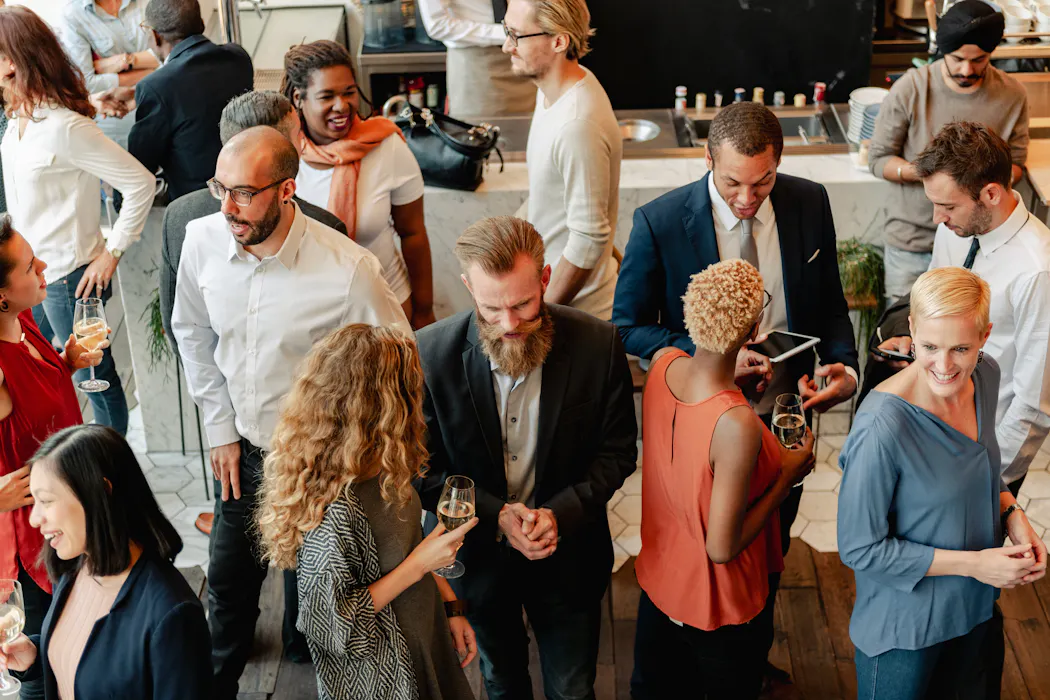
Rawpixel.com

Whether you call it an Irish goodbye, French leave or filer à l'anglaise (leave in the English style), as the French prefer, the act of quietly slipping out of a party without fanfare is a familiar social impulse. The Brazilians called it sair à francesa (French style) and the Germans a Polnischer Abgang (Polish departure). Whatever name it goes by, the concept is the same: one moment you’re there, the next you’ve vanished into the night without a drawn-out round of explanations, hugs and promises to catch up soon.

The pattern is telling: every culture has a term for it, and every culture blames someone else. That collective deflection suggests we already know, on some level, that slipping out unannounced is a social transgression.

But for those of us with anxiety, that silent exit isn’t rudeness. While etiquette traditionalists will probably insist that leaving without saying goodbye is a social no-no, some psychologists argue that it’s a coping strategy. Here’s why sneaking out without saying goodbye might be the healthiest decision you make all evening.

When you break it down – and let’s be honest, those of us who are anxious, introverted, neurodivergent or dealing with chronic illness have all broken this down into agonising detailed steps – saying goodbye is a loaded cultural ritual. It’s a performance that demands a high degree of social skill, accuracy and nuance.

Goodbyes are high-demand situations and, sadly, by the end of a social occasion, many of us are already depleted and don’t have the energy to handle all the steps involved.

For many of us, socialising can mean feeling overwhelmed, constantly monitoring how we come across, trying to fit into other people’s expectations, comparing ourselves to others and worrying about rejection. It can be exhausting to feel like you’re constantly trying to act like your best version of normal.

When socialising means constantly adapting yourself to other people’s expectations, the healthy choice becomes using your last bit of energy to recharge and take care of yourself. Don’t leave the party completely drained with nothing left to recover with.

Sometimes we want to leave quietly because leaving loudly feels like shouting out: “I matter! Look at me, I’m leaving!” The fact is, many of us sit with the belief that we don’t really matter that much, so we don’t say goodbye because we don’t feel we are worth the performance.

Sometimes a silent exit is about self-respect, minding your energy reserves, even if you really enjoyed the evening. At other times, though, it’s an act of self-erasure. You leave without saying goodbye because you think no one will care, that you don’t matter enough to make a fuss when leaving.

Leaving quietly can become a way to protect yourself from the discomfort of saying goodbye. But the quiet exit cuts both ways. Ask yourself whether leaving without a word made your life bigger – you conserved enough energy to recover and you’re glad to go back next time – or whether it shrank it, adding another reason to avoid socialising altogether.

If you are going to pick apart your goodbye and negatively assess it, the next goodbye will feel even harder. Be careful to reality-test your post-event ruminations. It’s usually not as bad as you think, especially if you are assessing your performance through the distorting lens of anxiety.

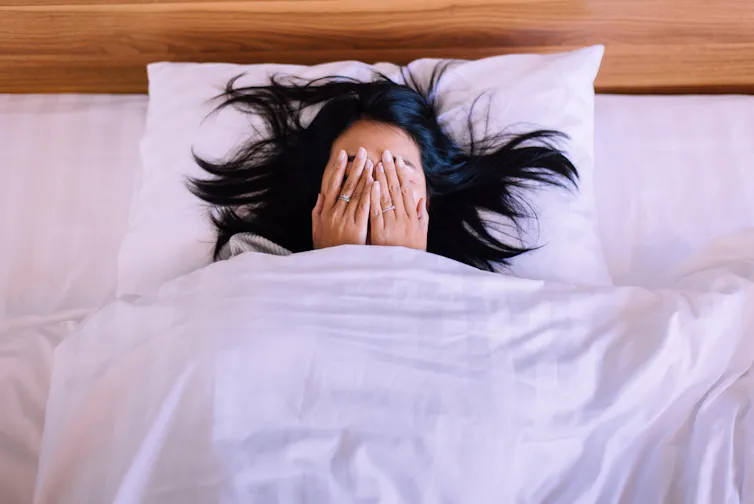
A woman lying in bed, hands over her face, suggesting remembering something bad.
It’s probably not as bad as you remember it. GBALLGIGGSPHOTO/Shutterstock.com

The healthiest choice of all

There is always a tension between wanting to belong and wanting to be yourself. If saying goodbye starts to feel so pressured and so performed that you lose any sense of being authentic, then the connection is starting to cost more than it’s worth.

If you feel like you need to be a chameleon to survive the complexities of socialising, the healthiest choice is to find a way to be who you really are. Find a way to tell your friends and family that leaving quietly is something you need because of how your nervous system and psychology are made, and not a reflection of the relationship. Research shows that being your truest self and having the best social connections go hand in hand.

And if you are neurodivergent, being open about what you need can feel like a risk, but it can also be a way to find acceptance, support and understanding when you let people know what you need and like.

If you’re anxious, it’s worth letting your host know in advance that you might need to slip away quietly. Otherwise, there’s a risk that people will read it the wrong way, as coldness or indifference, say.

Get ahead of it by letting people know you’ll leave without saying goodbye, and that you’re grateful to have been invited. Anxious people aren’t bad at relationships. Relationships just work better when everyone understands the other person’s needs.

Less is more

There’s a growing idea that being choosy about your social life isn’t antisocial – some psychologists call it “selective sociality”. Picking your moments carefully means you have more to give when it counts. The goal isn’t to retreat, but to invest in deeper relationships and in real presence, rather than the hollow churn of online contact – unless it supports meaningful connection.

In a world where being seen to do the right thing has begun to outweigh doing the right thing, selective sociality offers a way forward. Knowing our limits and being open about them, when possible, doesn’t weaken connection – it helps create relationships that feel real and sustainable.

If sneaking out without a fuss makes it more likely you will go to the next party, then it’s a choice for more social connection and therefore your health.

Correction: Our colleagues in Australia inform us that “ninja bombing” is not a common Australian term for exiting a party without saying goodbye. This line has now been removed from the first paragraph.

The Conversation

Trudy Meehan does not work for, consult, own shares in or receive funding from any company or organisation that would benefit from this article, and has disclosed no relevant affiliations beyond their academic appointment.

  •  

This year’s Venice Biennale marks a major shift in European cultural politics

I was texting a museum director friend in Asia recently. We were discussing whether a trip to this year’s “artworld Olympics”, the Venice Biennale, justified the carbon release.

I felt ambivalent. The main exhibition is curated by Koyo Kouoh, whose 2016 edition of Ireland’s Biennale, EVA International, on the 1916 Easter Rising centennial I had admired. Kouoh died of cancer earlier this year. Her posthumously realised Venice Biennale, titled In Minor Keys, seemed a final opportunity to appreciate the subtle, intelligent work of Africa’s leading curator.

Against the lure of Kouoh’s exhibition, though, was a queasy realisation that the Biennale seemed to be ideologically backsliding. Russia and Israel, both accused of war crimes, were controversially participating.

Alongside the huge guest-curated show of contemporary art, the Biennale invites countries to present exhibitions they curate themselves in national pavilions in the Giardini di Biennale and citywide venues. Following Putin’s full-scale invasion of Ukraine in 2022, Russia was excluded, its pavilion remaining shuttered throughout the 59th and 60th editions. But last year Giorgia Meloni’s government appointed rightwing ideologue Pietro Buttafuoco as Biennale director.

Buttafuoco revoked Russia’s exclusion. He also facilitated the relocation of Israel’s exhibition from its usual Giardini pavilion to a high security cul-de-sac in the Biennale’s second official venue, the massive Arsenale.

“This biennale seems cursed,” texted my friend. Despite feeling hypocritical about the environmental burden, I booked a flight to Venice.

Angry protests and violent reprisals

In the weeks leading up to the exhibition, my friend’s suggestion looked increasingly on point. A complicated choreography of war, state violence and activism began to play out. They culminated during the Bienniale preview in angry protests and violent reprisals.

The Art Not Genocide Alliance (ANGA) gathered 236 curators, artists and art workers to campaign for Israel’s exclusion and improved conditions for cultural workers.

When Kouoh’s international jury refused to consider Israel and Russia for the Biennale’s prestigious Golden Lion awards, artist Belu-Simion Fainaru, who was representing Israel, threatened them with legal action, according to the Italian news agency Adnkronos and arts publication Hyperallergic. The jury resigned. Their subsequent silence has not been explained.

Relieved of the professional all-female expert jury that Kuouh appointed, Buttafuoco instated a Eurovision-style audience prize. At the time of writing, over 70 artists have withdrawn from the awards in protest.

Like an artwork, a curse is a performative utterance at the nexus of ritual symbolism and magic. People like to believe that art, unlike curses, is a force for good. But as I argue in my book The Deployment of Art, there is a long history of state co-option of art and artists in the service of malign agendas of state violence. To me, The 61st Biennale seems one such example.

In a statement on the Biennale website, Buttafuoco amplifies the spiritual dimensions of Kouoh’s vision. “It is an exhibition permeated with spirit, with a sacredness that puts the person, the human being, back at the heart of things … looking to the sky once more.”

Much art in the main exhibition is hard to square with such whimsy. Pio Abad’s precise critical drawings of everyday objects of imperial plunder, like houseplants and chocolate, alongside stolen Benin bronzes. Walid Raad’s series of found photographs of beds slept in by Palestine Liberation Organization leader Yasser Arafat. Joana Hadjithomas and Khalil Joreige’s extraordinary sculptural excavation of the lost ancient city of Orthosia, hidden beneath a buried refugee camp in southern Lebanon.

But other works better serve Buttafuoco’s vague, obfuscating narratives of “sacredness” and “spirituality”.

In the Arsenale, an uprooted olive tree that recalls images of the desecration of Palestinian olive groves rotates on a plinth to the perverse accompaniment of tinkly ballerina music. This work by Theo Eshetu is titled Garden of the Broken Hearted, but the accompanying label doesn’t explain why the tree was uprooted, or from where, only that it “stands as a poetic reflection of impermanence”.

Alfredo Jaar’s “shrine” to base materials, a thrumming scarlet cathedral titled The End of the World meanwhile, so overwhelms the senses that I felt faint. I later saw a young woman collapsed outside it, attended by paramedics. Numerous other works draw on ritual traditions and spiritual practices from “the powerhouse of Africa” (Buttofuocco’s term).

Police presence was pervasive throughout the previews. Armed, helmeted officers held a line around Pussy Riot’s demonstration at the Russian pavilion, where protesters released blue, yellow and pink smoke canisters chanting “bloody Russian art” and “curated by Putin, corpses included”.

On the final preview day, as many pavilions closed early in strike protest, police stomped through the Giardini in heavily armed groups ten or 20 strong. At 4.30pm a peaceful crowd of ANGA protesters, many with young children in pushchairs or carried on shoulders, marched from the Giardini to the Arsenale where riot police used batons to beat them back. Surveillance helicopters hovered over the city until long after midnight.

Visions of hell

When future art historians study the 61st Biennale, they may notice a poster slogan from the ANGA protest: “Palestine is the Future of the World.” Meanwhile, visitors would do well to venture beyond the Giardini and Arsenale to an unofficial collateral exhibition organised by the Museo Moderno Buenos Aires.

Taking its title from John Milton’s description of hell, Darkness Visible: The Long Shadow of the Dictatorship brings together a trans-generational group of artists. Their work has been shaped by a regime of state terror (1976-83) that implemented a systemic policy of kidnappings, torture, murder and the forced disappearance of thousands.

Darkness Visible positions art as a vehicle for understanding history, protecting memory and human rights, and engaging in activism against state violence. One photograph by Marcelo Brodsky documents a demonstration by the Madres de Plaza de Mayo demanding information about their forcibly disappeared children. Brodsky’s mother (whose son was disappeared) appears in the image holding a banner that draws connections between second world war concentration camps in Warsaw and ESMA, a clandestine torture and extermination centre used by the Argentinian junta during the dictatorship.

As I contemplated this image, the exhibition’s curator Victoria Noorthoorn explained: “We wanted to present this show in Venice now because our Argentinian artists have much to say about fear, violence, pain and trauma that remain as scars from Argentina’s repressive regime. Their work reminds us of the need to protect core values: human and civic rights, democracy, freedom of expression and artistic creation.”

The protests I witnessed in Venice were marked by real anger, solidarity but also moments of tenderness and joy. A hopeful sign of how art and artists might imaginatively reinvent future biennales, undo the cursed present and lead us away from the darkness closing in.

The Conversation

Clare Carolin does not work for, consult, own shares in or receive funding from any company or organisation that would benefit from this article, and has disclosed no relevant affiliations beyond their academic appointment.

  •  

Trump-Xi summit: US president says he will discuss arms sales to Taiwan – breaking decades of US policy

Donald Trump and Xi Jinping are likely to discuss many issues as they meet this week in Beijing. But alongside trade, technology and the war in Iran, one topic of conversation will stand out – the future of Taiwan.

Taiwan has long been a sensitive issue in Sino-American relations. Beijing regards the island as a breakaway province which must be reunited with the mainland. The United States has long opposed such a step. Yet in recent months, Trump has fuelled speculation that he may be ready to change key aspects of US policy on the issue, potentially granting Beijing long-sought concessions.

Trump’s apparent readiness to make these moves means that Taiwan is one of the issues on which we might see the most significant policy developments at the summit. And that could happen simply through the famously voluble president uttering just a few simple words.

The president’s policy towards Taiwan has been inconsistent and seemingly more malleable than that of previous administrations. Advocates for Taiwan point out that his administration recently approved the largest ever US arms sale to the island. But at the same time, he has sowed doubts about the strength of his support for Taiwan’s independence.

US policy towards Taiwan has traditionally been based on two principles. The first is “strategic ambiguity”, which means that the US declines to explicitly state whether it would actively use its military to defend Taiwan from attack by China. This policy is supposed to deter China while also discouraging Taiwan from formally declaring its independence from Beijing.

The second principle is the “one China policy”. According to this policy, the US recognises Beijing as the legitimate government of China, while opposing any violent solution to its dispute with Taiwan. It also retains robust informal links to the Taiwanese government in Taipei.

Observers are concerned that Trump may water down these principles during his summit with Xi. For instance, he might state that the US not only “does not support” Taiwanese independence but actively “opposes” it. Or he might double down on previous comments he has made indicating that whether or not Xi invades Taiwan is “up to him”.

Trump has also explicitly stated that he will discuss future US arms sales to Taiwan with Xi during this week’s summit. This violates one of the so-called Six Assurances that the US has upheld towards Taiwan since the 1980s, and which were endorsed by the US Congress in 2016.

Even securing a discussion of arms sales would be a victory for Xi, who would welcome an opportunity to chip away at the Six Assurances. Presumably he would then try to weaken the US commitment to the other five, which include a US commitment not to change its position on Taiwan’s sovereignty.

More concretely, if Xi succeeds in making US arms sales to Taiwan a legitimate topic of negotiation in Sino-American relations, then he could head them off in the future by offering the US concessions in other areas. For instance, if Trump or a future president asks Beijing for its help settling a conflict like that in Iran, Beijing might demand an end to US arms sales to Taiwan as the price.

High stakes

Given Trump’s reputation as a formidable China hawk, his attitude towards Taiwan may seem surprising. But it’s actually part of a longstanding pattern.

In relations with China, Trump has arguably always prioritised economic issues, while appearing less concerned about the security of America’s regional allies. He has also raised doubts about whether Taiwan is even defensible. In his first term, he reportedly told aides that: “Taiwan is like two feet from China. We are 8,000 miles away. If they invade, there isn’t a fucking thing we can do about it”.

Trump is also both highly transactional and less focused on abstract principles of foreign policy than most previous presidents. He views America’s support of allies such as Taiwan as a gift that it gives them, one that is often not worth the cost. If he can achieve a concrete victory for himself today by trading away support for Taiwan tomorrow, he may well be willing to do so.

All of these developments matter because they make a violent conflict between China and Taiwan, potentially ultimately involving the US, more likely. If Trump makes concessions to Xi, it will be the latest signal that US support for Taiwan is wavering. That made be read in Beijing as permission to violently change the status quo. Even though such an act might belatedly then be met with force from Washington in response, it is made more likely by Trump’s stance today.

Even worse for Trump, the summit comes at a time when American power and the wisdom of its long-term strategy are being visibly called into question in the Middle East. The US is bogged down in an intractable conflict and has severely damaged its deterrent capacity in the Indo-Pacific by burning through advanced munitions at a high rate. Trump’s personal unpopularity is also rising at home amid the war and its economic fallout.

This weakened position makes it even more likely that Trump will want to strike a deal with Xi to help end the war in Iran or ease trade tensions to help the economy at home. Taiwan may be the price of that – and, ultimately, peace.

The Conversation

Andrew Gawthorpe is affiliated with the Foreign Policy Centre in London.

  •  

What Iran’s absence from the Venice Biennale reveals about art and politics

Just days before the opening of the 2026 Venice Biennale, organisers announced that Iran would no longer participate.

A short statement posted to the Venice Biennale website on May 4 said: “With regard to the National Participations in the 61st International Art Exhibition…it has been announced that the Islamic Republic of Iran will not participate.” No explanation was given. I believe that silence is itself revealing.

Iran’s withdrawal is less a sudden decision than the result of converging geopolitical and economic pressures that are reshaping both the global art world and Iran’s place within it.

At the most immediate level, the withdrawal reflects the material realities of crisis. With internet access restricted, international flights suspended and communication networks severely disrupted, even the basic logistics of participation – coordinating, shipping and installing artworks – probably became nearly impossible for Iran.

These conditions have been compounded by intensifying economic pressures, including the sharp devaluation of the Iranian rial, which has made international cultural engagement increasingly difficult to sustain.

An explanation of the Venice Biennale.

Such constraints point to a fundamental condition of contemporary art: global exhibitions rely on infrastructures of mobility and communication that are easily destabilised by conflict and sanctions.

The timing is also significant. The decision comes amid renewed military tensions and escalating political rhetoric surrounding Iran’s position in the global order. In such moments, when political discourse edges toward existential threat, the stakes of cultural visibility are heightened. At the same time, sustaining cultural presence becomes more difficult.


Read more: Middle East conflict looks increasingly like a war nobody can win


More revealing still was the lack of any announced artist, curatorial framework or exhibition concept for Iran’s pavilion, even days before the Biennale’s opening.

Iran’s presence at the Venice Biennale has historically been organised through state institutions, with oversight exercised by the ministry of culture and Islamic guidance since the Iranian revolution (1978-79). As with many national pavilions, this model positions art as a form of cultural diplomacy. But in Iran’s case, it has often produced a disconnect between official representation and contemporary artistic practice.

This gap is significant. The Venice Biennale, often described as the “Olympics of the art world”, remains structured around national pavilions, with each country responsible for presenting its cultural identity on a global stage. Yet, as critics have long argued, it has never been a neutral platform, but a space where art and geopolitics intersect.

More broadly, biennials are deeply embedded in political and institutional contexts, rather than existing outside them. Within this framework, they are often understood as sites of cultural soft power, where nations project influence through artistic production.

National representation in crisis

Iran’s withdrawal must also be understood in relation to the wider turmoil surrounding the 2026 biennale itself. This year’s edition has been marked by extraordinary controversy, including disputes over the involvement of Russia and Israel, calls for boycotts and the resignation of the entire international jury just days before the opening.

These events expose the fragility of the biennale’s longstanding claim to neutrality. Rather than existing outside politics, it has become a site where geopolitical tensions are actively staged and contested.

To exhibit at the biennale is never neutral: it means entering a highly visible arena shaped by competing narratives of legitimacy and power. For the Islamic Republic, this raises a deeper tension. The biennale’s national pavilion model requires countries to present a coherent cultural identity through contemporary art. Yet Iran’s artistic landscape is anything but singular. It is shaped by internal contradictions between state and independent practices, censorship and experimentation and local production and diasporic circulation.

The entire jury resigned just days before the opening.

These tensions are difficult to reconcile within a state-managed exhibition framework. The very premise of the pavilion – art as national representation – sits uneasily with a system in which artistic expression is subject to ideological and institutional control.

At the same time, the Biennale embodies forms of global circulation, cultural competition and visibility tied to international art markets that do not always align with the cultural and political ethos of the Islamic Republic. Representation therefore involves negotiating how a nation appears, to whom, and on whose terms.

The current moment makes this tension even more acute. As political rhetoric escalates and the possibility of large-scale destruction is invoked in global discourse, cultural visibility becomes more urgent. Art offers one of the few spaces through which narratives beyond conflict and diplomacy can emerge. Yet for Iranian artists, cultural presence is becoming more fragmented, shaped by diasporic networks, constrained by national borders and limited by economic and infrastructural pressures.

Iranian artists, particularly those working through independent and diasporic networks, have for decades operated beyond the frameworks of state representation, with their work circulating internationally through alternative artistic circuits. Iran’s missing pavilion, then, does not signal the disappearance of Iranian art. Rather, it reveals the precarious conditions through which that art circulates.

Iran’s absence from the Venice Biennale also highlights the limits of the national pavilion model. The system has frequently been criticised for reducing complex artistic practices to simplified national identities, even as contemporary art now operates through transnational networks that exceed the boundaries of the nation-state.

In Venice this year, the missing pavilion reflects an art world shaped as much by political crisis as by artistic production. Iranian art is not absent from the global stage. Yet the conditions under which it circulates and remains visible have become increasingly fragile.

The Conversation

Katayoun Shahandeh works for SOAS University of London.

  •  

How to talk to children when terrorist attacks and violence dominate the news

When a man stabbed Jewish people in Golders Green, London, in what police declared a terrorist incident, the story spread fast – through news alerts, social media and the whispered conversations of anxious adults. When this happens, children notice.

Whether they catch a fragment of a TV bulletin, overhear a parent on the phone, or simply sense that something has shifted in the atmosphere at home, the news has a way of reaching them before they are ready. The question isn’t really whether to talk to children about violence and fear; it’s how.

First, it’s important to know that children have the resilience and capacity to process difficult topics, but bear in mind that this needs to happen in a supportive environment.

Start with safety. Ensure your child feels relaxed and secure. Safety comes from routines, keeping daily rhythms and practising rituals that remind everyone you are together and safe – for example, a nighttime story or song, a special time on the couch after dinner.

Your capacity to deal with issues like violence and fear is the most important factor in contributing to your child feeling safe during these conversations. If you feel overwhelmed or anxious, wait until you feel calmer and more grounded, or have someone to support you with the conversation.

Some families – particularly those who face racism or other forms of discrimination – will already be familiar with these conversations. But if this is new to you, the main thing to do is to be honest and clear. Be direct and specific. Avoid metaphors and euphemisms and vague ideas like “bad people”.

Adjust your language to the child’s age, but don’t overthink it. Simply pause often, ask questions, and watch their face for confusion.

Children don’t stay afraid for long. They move in and out of difficult feelings quickly, which is why short, repeated conversations work better than one big, serious talk.

Come back to them to check understanding and listen for misunderstandings. Ask them if they have any questions. And don’t be surprised if the child looks particularly bored or disinterested. Children prefer delight and joy and play rather than serious adult conversations. It doesn’t mean they are not listening or appreciating the explanation, it just means their priorities are elsewhere – and that’s a good thing.

A mother talks to her concerned daughter.
It’s important to make them feel safe. LightField Studios/Shutterstock.com

Keeping children grounded amid fear

Limit media exposure and try to avoid talking about scary events around them – they are always listening and there’s huge room for misunderstanding when they hear rather than take part in conversations.

Research shows that if children are exposed to media and talk about fearful events, that it’s important what they hear is mediated through a supportive adult who can explain the content appropriately. They can pick up on the signs of fear and anxiety from adults, particularly in times of uncertainty, even if they can’t fully understand the words in the conversation.

Follow your child’s lead. Your job is to open the door. They decide whether to walk through it and when to leave. Don’t mistake silence for shutdown. Children often process fear through movement, play, singing, dancing, making and even breaking things.

It’s OK to say “I don’t know” to questions you can’t answer. And it’s OK to say: “I know the answer, but it’s too much information for you at your age, I’ll tell you a little bit now and explain more when I think you are old enough.”

Most important of all, for you and your child, look at your circle of safety. Remind your child they are safe here and now with you, that there is a community that you live in and link with who are there to support you and keep you safe. Focus on hope and efficacy and on what can we do right now for the future we want.

The Conversation

Trudy Meehan does not work for, consult, own shares in or receive funding from any company or organisation that would benefit from this article, and has disclosed no relevant affiliations beyond their academic appointment.

  •  
❌