When we talk about intellectually gifted children, the debate tends to focus on one of two questions: how we detect this characteristic, and why it doesn’t always translate into higher marks at school. While these are important questions, they overlook another equally important one: what can schools do once they know a student has to learn in a different way to other others?
Even when gifted students are identified, educators tend to offer an uninspiring response. They set more work, or more of the same kind of exercises, as if learning were a simple question of doing more. This is a very common mistake. Instead of increasing students’ burdens, we should be adjusting the level of the challenge itself.
Enriched learning
Educators’ responses to gifted children are typically found at two extremes: inaction or overload. But properly adapted education doesn’t mean giving a child ten exercises where others do five. This only serves to make education repetitive and unstimulating.
If a student has already covered some of the planned content, teachers can reorganise their learning pathway and avoid unnecessary repetition. This frees up time in the school day that, instead of being filled with more of the same kinds of tasks, should be used for enrichment activities and a broader curriculum.
In practice, this means activities such as open problems, research projects, exploring links between disciplines, working on tasks with multiple solutions, critically analysing information, and creating their own outputs.
Javier Tourón, an internationally recognised Spanish expert in this field, points out that enrichment can take various forms: flexible groupings within the classroom, temporary breaks for specific activities, resource rooms, or complementary programmes. But these should always be based on pupils’ actual needs, not as a one-size-fits-all measure.
Don’t overburden, adapt
The question is not whether these pupils need special activities, but rather which curricular and methodological decisions enable them to learn in a meaningful way. This forces us to consider a number of issues:
Objectives: not all students need to progress through the curriculum at the same pace. In a language class where, for example, the class is working on the structure of a narrative text, a gifted student could be given a more challenging objective. This could be experimenting with different narrators, playing with the story’s timeline, or analysing how the meaning of a text changes depending on the point of view.
Tasks: limited, repetitive tasks may be useful at times, but they cannot be the only way of teaching. Gifted students need real intellectual challenges. For example, instead of ten identical calculations, they could be asked to design a problem themselves.
Assessment: it is useful to know what a student already knows. Initial assessments and tests can avoid students repeating what they have already learnt, and free up time for more complex projects.
In maths, for instance, the final result may only be one part of the assessment. Teachers could also assess how the student reaches the answer, their ability to explain their method, and their comparison of different methods.
Organising learning: effective curriculum adaptation does not always mean taking pupils out of the classroom or creating a completely separate programme. It can often be achieved within the main classroom, provided the school has the flexibility to group pupils, diversify, enrich and personalise the learning experience.
For example, in language or social studies, while the class is exploring a common topic, gifted students may take on a different role, such as identifying links with other topics, coming up with higher-level questions, comparing sources, or preparing a short presentation for the group.
These measures are often seen as a privilege, but that is not what they are. They are a way of meeting a student’s specific educational needs.
Inclusion is not just about helping those with difficulties. It also means recognising that diversity takes many different forms and that a school cannot give the same response to all those who learn differently. Ignoring the needs of gifted pupils also leads to exclusion and, in the long term, can cause boredom, disengagement and demotivation.
A universal design
The Universal Design for Learning (UDL) framework is particularly relevant for gifted pupils because it is based on a central tenet of inclusive education: that not all students learn in the same way, nor do they all need the same conditions to participate, progress and fulfil their potential. This would be akin to assuming that every person wears the same size of clothes.
UDL enables teachers to diversify forms of engagement, meaning the ways that students connect with the learning process. This can mean, for instance, offering different project options based on a student’s interests, or challenges of varying complexity.
UDL also covers means of representation (for example, presenting the same content through text, visual diagrams, videos or oral explanations), and of action and expression (for example, giving student the option of demonstrating what they have learnt through an oral presentation, a written text, an infographic, a model or a research project).
As some authors argue, inclusive education is not a question of adapting students to a one-size-fits-all approach to teaching, but of transforming educational design to reduce barriers and expand learning opportunities for all.
This approach benefits not only those with the most obvious difficulties, but also those who need greater intellectual stimulation, flexibility, and opportunities for personal development in order to fully realise their potential.
The whole classroom benefits
The good news is that transforming teaching in this way doesn’t just benefit certain pupils. When a school adapts, stops overburdening students, and presents them with more open-ended challenges, it improves the whole class’s educational experience.
Why, then, do we continue to uphold such a homogeneous approach to teaching in the classroom when we know that diversity is the norm? Giftedness forces us to confront this uncomfortable question.
Catering for the needs of gifted children means improving the way we design the classroom experience. But this is no easy task. It calls for greater investment in training across the entire educational sector, and an open-minded approach that embraces diversity as an inherent part of being human.
Jessica Cabezas Alarcón no recibe salario, ni ejerce labores de consultoría, ni posee acciones, ni recibe financiación de ninguna compañía u organización que pueda obtener beneficio de este artículo, y ha declarado carecer de vínculos relevantes más allá del cargo académico citado.
Who owns a swarm of bees? And what happens when they stray onto a neighbour’s land?
In early medieval Ireland, such questions were addressed by a remarkable set of laws known as the Bechbretha, which set out the rights and responsibilities associated with beekeeping. Also known as bee-judgments, these laws formed part of the wider medieval Irish legal system, Brehon law (known in Old Irish as fénechas or customary law).
Brehon law espoused restorative rather than criminal justice and was chiefly concerned with the type of compensation to be paid for crimes committed. Most of these laws were written down in the 7th and 8th centuries, but they probably preserve much older traditions that had previously been passed down orally.
Early medieval Irish society was hierarchical. In legal cases, the amount of compensation owed or received depended entirely on a person’s social rank, with payments varying according to their status.
The Bechbretha provided a legal guide for lawyers dealing with cases involving bee trespass (where a neighbour’s bees came onto another’s land and supposedly stole nectar from flowers and plants), injuries or death caused by bees, beehive theft and the compensation owed in each situation.
In medieval Ireland, bees were given legal status because they were classified as domestic livestock. Like cattle, horses, pigs, poultry and sheep, they were legally protected because of their considerable value. Beekeeping produced a wide range of goods, including honey for food and sweetening, as well as mead and beer, beeswax for candles, sealants and writing tablets, and other products used in medicine, polishing, lubrication, skincare and waterproofing.
The Bechbretha also had another purpose – maintaining good relations within local communities. According to the Bechbretha and another legal text, the 8th-century Bretha Comhaithchesa, Judgements on Neighbourhood, a mutual agreement among the farming community ensured compensation would be paid if and when animal trespass, theft or injury occurred. A certain level of trust between neighbours was required for this process to work.
That said, it is one thing to show where a neighbour’s large domestic animal has trespassed or caused damage. It is something else to prove that neighbouring bees had rampaged through your flowers, stealing nectar before buzzing away with their ill-gotten gains.
One suggestion the Bechbretha makes is to dust flour over bees, follow them to source and identify the culprits. Because honeybees tend to return repeatedly to the same nectar sources, tracking and marking them with white flour – which scatters onto the ground as they fly, leaving a visible flight path – can be effective. The laws also state that the owner of stray bees has three years to collect their honey, but by the fourth year must surrender the first swarm from that hive to the wronged party.
The Bechbretha also dealt with questions about ownership of swarms which settled and built new hives on either private or common land. The beekeeper who found the new hive was entitled to a third of the honey for three years but after that time elapsed, the landowner on which the swarm settled became its owner. Where a swarm was discovered in woodland, the finder was entitled to (almost) everything. The local church and patriarch of the finder’s kin-group were both entitled to a share.
Where hives were stolen or illegally moved and where perpetrators got stung or died from being stung, beekeepers were not held responsible. Where bees stung people without provocation, compensation was due, though if the victim killed the bee(s), their death was deemed recompense enough. Generally, for valid situations where someone was stung, killed or maimed, hives were given over in payment.
Theft of beehives carried hefty penalties, dependent on their location. The closer a hive was to a homestead, particularly a high-status one, the larger the compensation. This was usually in the form of cattle, the main currency used in pre-coinage Ireland. Theft of hives from monasteries also carried imposing fines.
That there were a set of early medieval Irish laws solely for bees reveals the high regard with which these little creatures were held. Restitution through beehives and bee produce helped the proliferation of beekeeping throughout the community. In pre-industrial, early medieval Ireland, where society’s survival depended so much upon the climate, bees were a pivotal part of the agricultural system, as they are today.
At the close of the tenth century, writers of Irish historical records documented two instances of bech-dibad – bee mortality – which resulted in mass famine and death among the human population. The fact that these disasters were recorded is significant in that it suggests an awareness about what happens if the bees disappear.
Today, bee colonies around the world face multiple threats – from habitat loss, climate change, toxic chemicals and deadly invasive parasites. The Bechbretha shows that if the will is there and communities are involved and feel invested, protecting our bees is possible.
Chris Doyle does not work for, consult, own shares in or receive funding from any company or organisation that would benefit from this article, and has disclosed no relevant affiliations beyond their academic appointment.
Manual lymphatic drainage is sometimes used for lipoedema, but evidence for its usefulness remains limited.DuxX/Shutterstock
For many women with lipodoema, the diagnosis comes after years of being told the same thing: eat less, more more. The problem is that the fat accumulating around their hips and legs isn’t responding to diet or exercise, because it was never caused by them in the first place.
Lipoedema is a long-term condition that affects the way fat is stored in the body. It mainly affects women and usually develops or worsens at times of hormonal change, such as puberty, pregnancy or menopause. The link with these life stages is one reason researchers think hormones may play a role, although the exact cause is still not fully understood.
It usually appears as a symmetrical build-up of fatty tissue around the hips, buttocks and legs. In some people, it also affects the arms. The upper body may remain much smaller, which can make the body look noticeably out of proportion. A common feature is that the hands and feet are usually unaffected, so there may be a clear difference between the affected limbs and the unaffected hands or feet.
Lipoedema primarily involves abnormal fat distribution. This is why the name can be confusing: although “oedema” usually refers to fluid swelling, lipoedema is not caused by fluid build-up. Some people may develop swelling or lymphatic problems alongside lipoedema, particularly in very advanced cases, but these are not the defining feature.
Misunderstanding lipoedema can delay diagnosis and leave people feeling blamed for symptoms that are not simply a result of lifestyle. Many people with lipoedema describe pain, tenderness, heaviness in the affected areas and a tendency to bruise easily. In more severe cases, the size and weight of the affected limbs can make walking, exercising and everyday movement more difficult.
Lipoedema can also overlap with obesity. Someone can have lipoedema and obesity at the same time, which can make diagnosis and treatment more complicated. Obesity may increase strain on the body, worsen mobility and overload the lymphatic system. Where lipoedema is advanced, especially if body weight is also very high, this can contribute to secondary lymphoedema.
Because lipoedema is not a fluid condition, treatments designed for lymphoedema may not have the same effect. Manual lymphatic drainage is a specialist massage technique intended to encourage fluid to move through the lymphatic system, but evidence for its usefulness in lipoedema itself remains limited.
Lipoedema is usually diagnosed through a person’s medical history and a physical examination. There is no single blood test or scan that can confirm it. A healthcare professional will look for typical signs, such as symmetrical fat distribution, tenderness, easy bruising and the sparing of the hands and feet.
They may also use a simple clinical check called Stemmer’s sign. This involves trying to pinch and lift the skin at the base of a toe or finger. If the skin cannot be lifted easily, this can suggest lymphoedema. In lipoedema, Stemmer’s sign is negative, meaning the skin can still be pinched.
One common claim is that lipoedema fat never responds to diet or exercise. The reality is more nuanced. Healthy eating, physical activity and weight management can still improve health, pain, mobility and quality of life, particularly for people who also have obesity. The aim should be to support strength, movement, comfort and long-term health, without encouraging crash dieting or blaming the patient.
Compression garments also help some people by reducing heaviness, discomfort and swelling. These are close-fitting medical garments that apply controlled pressure to the affected area. Good skin care is important too. This includes keeping the skin clean and moisturised, drying carefully between skin folds and treating cuts promptly, especially if swelling or reduced mobility makes the skin more vulnerable to irritation or infection.
Lipoedema can affect a person’s emotional wellbeing and quality of life. This does not mean it directly causes mental health disorders. But living with chronic pain, changes in body shape, reduced mobility and repeated medical dismissal can take a toll.
People may feel self-conscious, frustrated or isolated, especially if they have spent years being told their symptoms are simply a matter of weight. Some research suggests that many patients diagnosed with lipoedema report significant psychological distress before lipoedema-related symptoms begin. Psychological and social support is therefore an important part of care.
There is no cure for lipoedema, but symptoms can be managed. The best approach is usually holistic, meaning it looks at the whole person rather than treating one symptom in isolation. This may include movement, compression, pain management, weight support where appropriate, skin care and emotional support.
For people with severe obesity, bariatric surgery, an umbrella term for procedures that modify the digestive system to help people lose weight, may also improve symptoms and daily functioning.
Because knowledge about lipoedema varies, it is important to seek advice from healthcare professionals who understand the condition. Organisations such as The International Lipoedema Association provide further information and support.
Good care should recognise both the physical symptoms and the emotional impact, without reducing lipoedema to either a cosmetic concern or a simple weight issue. Better recognition can help people get support earlier, manage symptoms more effectively and move away from years of confusion, blame and delayed care.
Håkan Brorson does not work for, consult, own shares in or receive funding from any company or organisation that would benefit from this article, and has disclosed no relevant affiliations beyond their academic appointment.
Whether you call it an Irish goodbye, French leave or filer à l'anglaise (leave in the English style), as the French prefer, the act of quietly slipping out of a party without fanfare is a familiar social impulse. The Brazilians called it sair à francesa (French style) and the Germans a Polnischer Abgang (Polish departure). Whatever name it goes by, the concept is the same: one moment you’re there, the next you’ve vanished into the night without a drawn-out round of explanations, hugs and promises to catch up soon.
The pattern is telling: every culture has a term for it, and every culture blames someone else. That collective deflection suggests we already know, on some level, that slipping out unannounced is a social transgression.
But for those of us with anxiety, that silent exit isn’t rudeness. While etiquette traditionalists will probably insist that leaving without saying goodbye is a social no-no, some psychologists argue that it’s a coping strategy. Here’s why sneaking out without saying goodbye might be the healthiest decision you make all evening.
When you break it down – and let’s be honest, those of us who are anxious, introverted, neurodivergent or dealing with chronic illness have all broken this down into agonising detailed steps – saying goodbye is a loaded cultural ritual. It’s a performance that demands a high degree of social skill, accuracy and nuance.
Goodbyes are high-demand situations and, sadly, by the end of a social occasion, many of us are already depleted and don’t have the energy to handle all the steps involved.
When socialising means constantly adapting yourself to other people’s expectations, the healthy choice becomes using your last bit of energy to recharge and take care of yourself. Don’t leave the party completely drained with nothing left to recover with.
Sometimes we want to leave quietly because leaving loudly feels like shouting out: “I matter! Look at me, I’m leaving!” The fact is, many of us sit with the belief that we don’t really matter that much, so we don’t say goodbye because we don’t feel we are worth the performance.
Sometimes a silent exit is about self-respect, minding your energy reserves, even if you really enjoyed the evening. At other times, though, it’s an act of self-erasure. You leave without saying goodbye because you think no one will care, that you don’t matter enough to make a fuss when leaving.
Leaving quietly can become a way to protect yourself from the discomfort of saying goodbye. But the quiet exit cuts both ways. Ask yourself whether leaving without a word made your life bigger – you conserved enough energy to recover and you’re glad to go back next time – or whether it shrank it, adding another reason to avoid socialising altogether.
If you are going to pick apart your goodbye and negatively assess it, the next goodbye will feel even harder. Be careful to reality-test your post-event ruminations. It’s usually not as bad as you think, especially if you are assessing your performance through the distorting lens of anxiety.
There is always a tension between wanting to belong and wanting to be yourself. If saying goodbye starts to feel so pressured and so performed that you lose any sense of being authentic, then the connection is starting to cost more than it’s worth.
If you feel like you need to be a chameleon to survive the complexities of socialising, the healthiest choice is to find a way to be who you really are. Find a way to tell your friends and family that leaving quietly is something you need because of how your nervous system and psychology are made, and not a reflection of the relationship. Research shows that being your truest self and having the best social connections go hand in hand.
And if you are neurodivergent, being open about what you need can feel like a risk, but it can also be a way to find acceptance, support and understanding when you let people know what you need and like.
If you’re anxious, it’s worth letting your host know in advance that you might need to slip away quietly. Otherwise, there’s a risk that people will read it the wrong way, as coldness or indifference, say.
Get ahead of it by letting people know you’ll leave without saying goodbye, and that you’re grateful to have been invited. Anxious people aren’t bad at relationships. Relationships just work better when everyone understands the other person’s needs.
Less is more
There’s a growing idea that being choosy about your social life isn’t antisocial – some psychologists call it “selective sociality”. Picking your moments carefully means you have more to give when it counts. The goal isn’t to retreat, but to invest in deeper relationships and in real presence, rather than the hollow churn of online contact – unless it supports meaningful connection.
In a world where being seen to do the right thing has begun to outweigh doing the right thing, selective sociality offers a way forward. Knowing our limits and being open about them, when possible, doesn’t weaken connection – it helps create relationships that feel real and sustainable.
If sneaking out without a fuss makes it more likely you will go to the next party, then it’s a choice for more social connection and therefore your health.
Correction: Our colleagues in Australia inform us that “ninja bombing” is not a common Australian term for exiting a party without saying goodbye. This line has now been removed from the first paragraph.
Trudy Meehan does not work for, consult, own shares in or receive funding from any company or organisation that would benefit from this article, and has disclosed no relevant affiliations beyond their academic appointment.
Archaeologists have found something unexpected inside a 1,600-year-old Roman-era Egyptian mummy: a fragment of Homer’s Iliad. It wasn’t placed beside the body, but inside the mummy’s abdomen. But the real surprise isn’t just where the fragment was found. It’s how it got there. To understand, we must go back – to the Iliad itself, and to what it became in the Roman world.
In The Iliad, a poem shaped in the 8th century BC and attributed to Homer, the Trojan war does not end in triumph or renewal. It ends in devastation. The poem closes at the edge of collapse, with Troy reduced to a landscape of heroic ruin. And yet, this is not where the story ends.
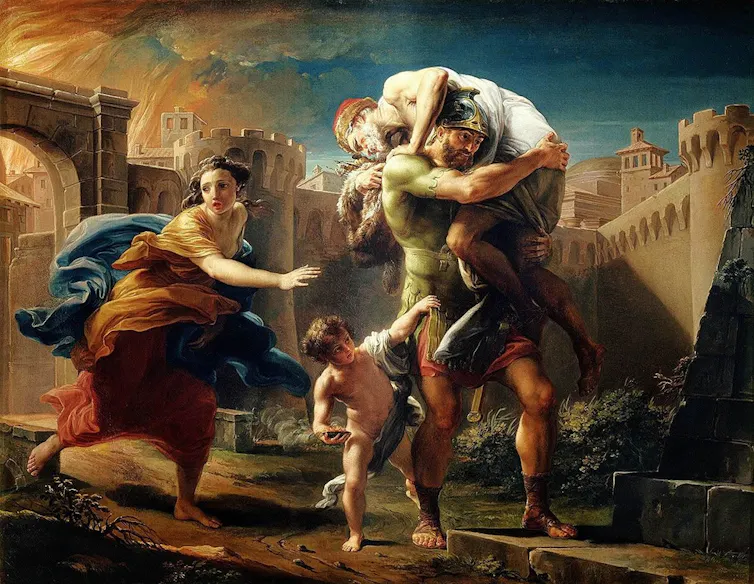
According to later Roman tradition, one Trojan escaped. Aeneas – son of Anchises and the goddess Aphrodite – fled the burning city carrying his father on his shoulders and the household gods in his hands. He moved west, across the Mediterranean, towards Italy, where he became the ancestor of Rome.
This continuation did not come from the Iliad itself. It was shaped centuries later, most famously in Virgil’s Aeneid. But it changed the meaning of the Trojan war entirely. The past, in other words, was actively reorganised – through stories that could be reworked, extended and connected across time and space.
Painting by Pompeo Batoni (1753), depicting Aeneas fleeing the burning city of Troy with his father Anchises and the household gods, as the fall of Troy is recast as the beginning of a journey toward the foundation of Rome.Galleria Sabauda
Turning defeat into origin
For Roman audiences, the Trojan war was more than a distant Greek legend. It became a way of thinking about origins, identity and power.
Claiming descent from Troy was more than a matter of tracing a lineage. It required constant cultural work – through storytelling, education and shared knowledge. The Iliad provided the raw material: characters, events and genealogies that could be reshaped and redeployed across generations.
Across the Roman Empire, educated elites learned Homer as part of their schooling. They quoted him in speeches, analysed him in classrooms and used him to signal cultural authority. To know the Iliad was to speak a language that others across the empire understood.
A senator in Rome, a teacher in Asia Minor or a student in Egypt could all draw on the same stories. The poem created a shared frame of reference – one that allowed very different people to situate themselves within a common past.
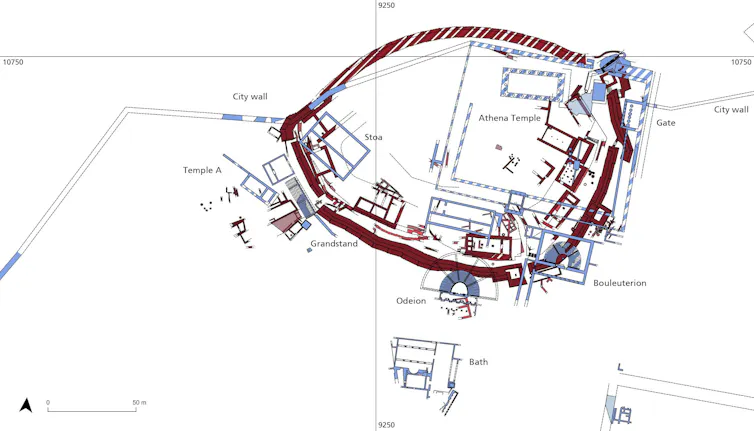
Plan of the late bronze age citadel of Troy (c. 1300–1109BC) shown in red, with Roman-period structures in blue, integrated into the ancient fortification in such a way that the surviving walls functioned as a theatrical backdrop of ‘authentic antiquity’, transforming archaeological depth into a deliberately scenographic experience.University of Tübingen, CC BY-SA
In the Roman imperial period, the site of ancient Troy – located in modern-day Turkey – became a destination. Emperors invested in its development, tying it directly to Rome’s claimed Trojan origins. Under Emperor Augustus, Troy was folded into the political language of empire. And under Emperor Hadrian, it became part of a wider culture of travel, memory and heritage.
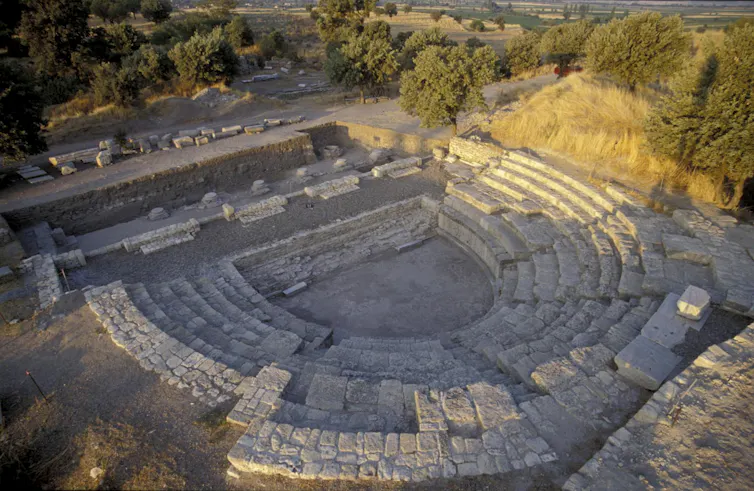
A visitor to Troy in the 2nd century AD would have arrived at a curated landscape. There were baths, places to stay and spaces for performance. A small theatre – the Odeion – was built directly into the ancient citadel, so that the remains of the bronze age city, understood as the setting of the legendary battles around Troy, formed a dramatic backdrop.
Visitors could walk through what was presented as the setting of Homeric epic, experiencing the Trojan war as something anchored in the ground beneath their feet.
From Troy to Egypt
Across the Roman Empire, the Iliad circulated as a living text: copied, taught and read. Egypt, one of Rome’s most important provinces, was no exception. Yet here, Homer circulated within a cultural landscape that differed in important ways from the Greek literary world in which the poem had first taken shape.
For Roman observers, Egypt often appeared as a place where antiquity was materially preserved as well as remembered – through temples, monuments and practices that emphasised continuity with the past. At the same time, it was a deeply hybrid society, where Egyptian, Greek and Roman traditions interacted in complex ways.
Homer was among the most widely copied authors in Roman Egypt – read and taught as a marker of education and cultural belonging and deeply embedded in everyday literary culture.
The Odeion of Troy, a small covered theatre inserted into the fabric of the ancient citadel and constructed in the early 2nd century AD, exemplifies the Roman reconfiguration of the site’s urban and cultural landscape.University of Tübingen, CC BY-SA
The Homeric version of the Trojan War was particularly prominent among the Greek-speaking elite, especially in urban centres such as Oxyrhynchus, where the mummy was found. Other versions of the story – which placed greater emphasis on Paris and Helen’s stay in Egypt, as reported by Herodotus based on accounts from Egyptian priests – were probably more widespread among the broader Egyptian population.
The initial media coverage of the discovery of the fragment inside the Egyptian mummy suggested the text was deliberately chosen to accompany the deceased. As a personally meaningful object, perhaps reflecting their education or cultural identity.
The most telling explanation, however, may be the most straightforward. Discarded or damaged papyri could be reused as inexpensive material. The fragment may therefore have functioned as stuffing – bundled together and inserted into the body cavity without particular regard for its literary content.
The very fact that a scrap of the Iliad could end up as disposable filling, however, speaks to how deeply Homer had penetrated everyday life in Roman Egypt.
A text in motion
To make sense of the past in the Roman world meant moving between story and monument, between genealogy and deep time. Each perspective made the others more intelligible.
The Iliad helped create a world in which different pasts could be connected, compared and reshaped. By linking stories, places and traditions across the Mediterranean, the Roman world turned the past into a flexible resource – one that could generate identity, authority and belonging in shifting contexts.
This is why the Iliad mattered: it circulated across many different settings. It shaped elite education, but it was also part of everyday reading culture. At Troy, it helped transform the city into a place of cultural memory. The text itself also had a long material afterlife, surviving not only as an authoritative story, but through manuscripts and writing materials that were copied, passed on – or even reused for entirely different purposes.
Its most enduring insight is therefore this: the past is not something simply preserved, but something continuously made and remade – through the stories, practices and materials that carry it across time.
This article features references to books that have been included for editorial reasons, and may contain links to bookshop.org. If you click on one of the links and go on to buy something, The Conversation UK may earn a commission.
The authors do not work for, consult, own shares in or receive funding from any company or organisation that would benefit from this article, and have disclosed no relevant affiliations beyond their academic appointment.
Lighting accounts for almost 8% of the world’s energy usage. It makes up around 10-20% of domestic energy bills, with an even higher proportion in commercial premises like offices.
LED lightbulbs marked a huge leap forward in energy efficiency. They can reduce energy consumption by 50-80% in comparison with older technology, but their impact goes beyond energy savings, as by emitting less heat than older bulbs, they also reduce the need to cool interiors.
Type of light also plays a role in our bodies, affecting sleep, attention and metabolism. But its impact mainly depends on intensity. Bluer light – typically emitted by screens and “cold” LED bulbs – can alter the brains’ production of melatonin, which impacts sleep and circadian rhythms. Warmer and properly adjusted LEDs, on the other hand, can minimise this effect. They are also more energy efficient than other systems.
Better lighting doesn’t mean more light
A typical mistake in interiors is total, uniform lighting. We flip the switch and illuminate an entire space without considering how each each area of it will actually be used. But lighting needs are far from uniform. For instance, European regulations state that a hallway needs around 100-200 lux, while a workstation needs around 500.
Dividing up spaces can reduce lighting energy consumption by anywhere from 20% to 40% without affecting visual comfort. And further savings – as much as 20-60% – can be achieved through smart lighting systems that use sensors to automatically adjust lighting depending on where people are within a space.
Excessive lighting is another common problem. Many lighting systems exceed recommended levels without producing noticeable benefits, causing unnecessary energy use.
In short, what we need is to use less energy, and adapt spaces to how people actually use them.
A building’s most efficient lighting resource is natural light. Outside it can exceed 10,000 lux, while inside it is rarely more than 500 lux. Even so, it is common to leave artificial lights switched on all day, which both increases energy costs and reduces our exposure to natural light.
Colour temperature also affects the way we feel. Cold light makes us more alert, while warm light is better for rest and relaxation. Dynamic lighting systems allow us to adapt lighting over the course of the day, improving comfort and only using as much energy as necessary.
Sustainability and health certifications
In recent years, energy-efficient lighting has ceased to be an isolated objective, and now forms part of global certification systems that analyse buildings as a whole. The two most important certifications are LEED and WELL.
In lighting, LEED does not just look at energy consumption. It also considers use of natural light, ways of reducing power consumption from lighting, automatic controls and sensors, and the quality of lighting in interior spaces.
Studies show that LEED-certified buildings can significantly reduce global energy consumption, with lighting and heating making a direct impact.
In practice, LEED pushes us towards more energy-efficient buildings, where lighting systems are an integral part of the design as opposed to an isolated, separate element.
WELL: lighting and health
While LEED certification is based on efficiency, the WELL Building Standard looks at human health. In its lighting section, WELL looks at exposure to natural light (including duration), control of excessive light, spectral qualities of artificial light, alterations to circadian rhythms and night-time light exposure, and flexibility of lighting at different times of day.
The WELL Standard illustrates how the paradigm is shifting when it comes to lighting. No longer just a technical parameter, it is now seen as a direct determiner of physical and mental wellbeing. A 2022 study found that following WELL criteria can reduce fatigue, and improve quality of sleep and cognitive performance.
WELL introduces the vital concept that improvements to lighting should not just aim to save money, but also protect our health.
A space’s design is also decisive in energy consumption. For instance, lighter coloured surfaces reflect up to 80% of light, while darker colours increase the need for artificial light.
Research has shown that certain passive design choices can reduce energy use for lighting by 30-50%, all without any technological changes. These include a building orientation that makes the most of natural light, using materials that reflect light, control of excessive light or glare, and indirect lighting.
Carefully designing a space can save as much energy as renovating its entire lighting system.
The lighting of the future
Reducing energy consumption does not depend on one technological fix, but on a broader, integrated strategy that ranges from the layout of a space down to the type of lightbulbs used.
There is not one official statistic that encompasses the potential savings of all of these measures combined, as this figure also depends on the type of building, climate and use. But we do have estimates. For instance, modernising lighting in an office building can reduce lighting energy consumption by 60-90%, depending on how well it is optimised.
But lighting is not just a question of energy use. It is also a key component of health, productivity and wellbeing. The buildings of the future will therefore not just be more efficient, but also healthier, and certified under criteria that cover energy, use, health and design.
A weekly e-mail in English featuring expertise from scholars and researchers. It provides an introduction to the diversity of research coming out of the continent and considers some of the key issues facing European countries. Get the newsletter!
Roberto Alonso González-Lezcano no recibe salario, ni ejerce labores de consultoría, ni posee acciones, ni recibe financiación de ninguna compañía u organización que pueda obtener beneficio de este artículo, y ha declarado carecer de vínculos relevantes más allá del cargo académico citado.
As part-night lighting (i.e., turning off streetlights in the middle of the night) becomes more widespread among local authorities, three studies focusing, respectively, on robins, toads and bats show that, often, turning off the lights for a few hours is not enough to restore natural night. In terms of biodiversity, the challenge is not just about switching off the lights, but knowing when and where to do so.
In recent years, switching off street lighting in the middle of the night has turned out to be a no-brainer for several challenges: reducing energy bills, demonstrating a commitment to energy efficiency, and limiting light pollution and its effects on ecosystems.
From a biodiversity perspective, the best solution would be to have no lighting at all.
But this option clashes with other legitimate uses of night-time spaces: our own! This leaves one question: is switching off the lights for a few hours in the middle of the night really enough to reduce the impact of light on biodiversity? Not necessarily: its effects on organisms depend on the context – location, large-scale light landscape, weather conditions – and the species concerned.
A widespread measure whose biological effects remain poorly understood
Not all species actually use night-time in the same way. The early evening, the middle of the night and the hours leading up to dawn are often associated with different behaviours: foraging, movement, returning to roost, falling asleep and waking up, communication… In this context, part-night lighting may limit certain effects of light pollution on biodiversity… or miss the mark entirely if it doesn’t coincide with species’ peak activity times.
Another important point: switching off lights locally does not necessarily mean returning to total darkness. In towns and cities, nearby lighting – streetlights on adjacent streets, shop signs, shop windows or private lighting – as well as light scattered by clouds often maintain residual brightness. And this effect is not limited to urban zones: in rural areas too, the light halo from towns and cities can remain visible for several dozen kilometres (approx. 15 miles). For the species most sensitive to light, the difference between periods when lights are on and off may, therefore, be minimal, even when public lighting is switched off locally. A local council’s switch-off schedule is therefore not sufficient, on its own, to describe the actual lighting conditions to which animals are exposed.
The European robin, commonly found in cities: switching off the lights in the middle of the night isn’t enough
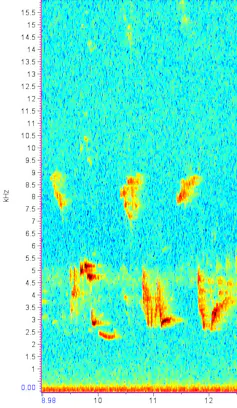
This is what we observe in the European robin. For this diurnal bird, part-night lighting is not sufficient, in an urban context, for restoring activity patterns comparable to those observed in unlit areas. Even when streetlights are switched off between 11:00 pm and 6:00 am, the birds tend to sing earlier in the morning and later in the evening than in truly dark areas.
Spectogram of the European robin’s song.Fourni par l'auteur
To test this effect in the Nantes metropolitan area (Loire-Atlantique department) in France, we compared three types of site: unlit sites, sites lit up all night, and sites where street lighting is switched off for part of the night.
We used a simple indicator: the European robin’s song. By recording the soundscape over several days, we can reconstruct the species’ singing patterns across the entire day-night cycle and see how they vary according to light conditions.
The result is clear: sites where lighting is cut off in the middle of the night often look more like sites lit all night than unlit ones. The gap appears mainly at key moments for this species, at dawn and dusk – respectively around 40 minutes before sunrise and 20 minutes after sunset – which correspond to its peak vocal activity.
The familiar bird song of robins, as well as those of the Eurasian wren, chaffinches and blackcaps.
Laurent Godet, Fourni par l'auteur737 ko(download)
In our study, the peak in the “dawn chorus” occurs on average before sunrise, by a matter of tens of minutes. However, it is precisely at this time, in an urban landscape that is already well lit, that part-night lighting is barely distinguishable from continuous lighting.
This is no doubt due to the central roles dawn and dusk play in diurnal species: these transitions serve as reference points for synchronising daily rhythms. Many lighting systems still leave lights on in the early evening and switch them back on before dawn. In other words, lights are switched off in the middle of the night, but are kept on at the two times that matter most for synchronising activity.
For a robin, this shift can have very real consequences: singing earlier also means defending its territory earlier, interacting differently with other birds, and bringing forward essential activities such as foraging or attracting a mate.
The data alone does not allow us to conclude that there is a direct effect on reproduction or survival. However, it does show that part-night lighting does not automatically bring the situation back to normal, particularly in urban areas where darkness is often incomplete even when a street or neighbourhood is in the dark.
A bat from Réunion: switching lights off slightly earlier could make all the difference
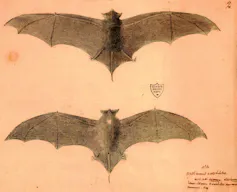
A free-tailed bat native to the island of Réunion (Mormopterus acetabulosus).Paul Jossigny, CC BY
For the free-tail bat, a nocturnal bat endemic to Réunion, bringing forward the switch-off times by two hours is enough to mitigate the effect of the lighting at the start of the night. However, this effect persists at the end of the night, when lighting in the morning is switched on early.
We studied this species, Mormopterus francoismoutoui, in a setting that allowed us to go beyond a simple comparison between lit and unlit sites. For one month, at certain sites, the part-night lighting scheme was altered: the streetlights were switched off two hours earlier than usual. This allowed us to compare the situation before and after this change at the same sites, alongside unlit control sites. Bat activity was monitored acoustically, using recording devices to capture their echolocation calls. This is not a direct count of individuals, but an indicator of their activity.
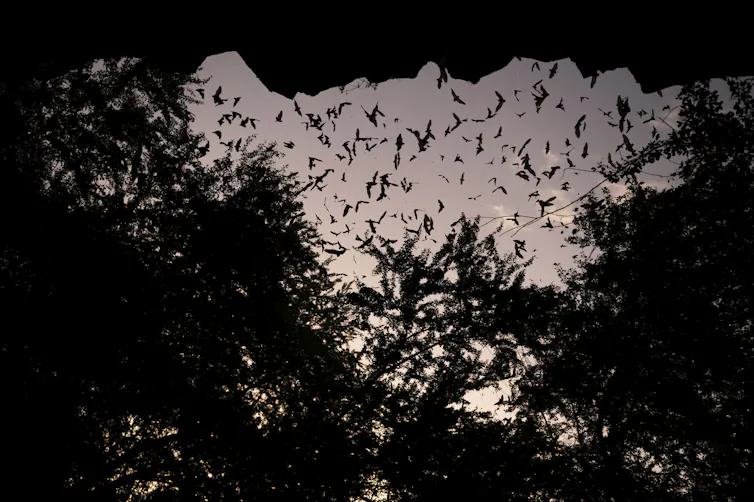
Free-tailed bats in Réunion flying out of a roost.Samuel Challéat, CNRS Nocturnal Environment Observatory, UMR Géode, Fourni par l'auteur
The results show that as long as the streetlights remain on, bats are detected more frequently near the lit areas, particularly at the beginning and end of the night, i.e. during their peak activity periods. When the evening switch-off is brought forward, this effect disappears at the start of the night: the light no longer “structures” their activity as it did before. However, a difference tends to persist before dawn, which is consistent with the morning switch-on remaining unchanged. Bats therefore still seem to be attracted to lit areas during their peak of activity before dawn, particularly when the weather was favourable.
This result highlights an important point: the effectiveness of part-night lighting depends on how much it overlaps with the activity rhythms of the species present. Turning off the lights in the middle of the night may have little effect if a species concentrates its movements and foraging at the beginning or end of the night. Conversely, a seemingly modest adjustment – in this case, switching off the lights two hours earlier in the evening – may be enough to mitigate the effect of lighting for part of the night.
However, we must exercise caution when interpreting these findings. A higher presence near streetlights does not necessarily mean that light is beneficial. It may reflect an opportunity, for example, if insects are attracted to the light but it may also indicate more ambiguous effects: altered movement patterns, a concentration of individuals in certain areas, increased competition, or greater exposure to predators. In other words, these results primarily show a redistribution of activity over time and space, without allowing us to conclude that artificial lighting is, in itself, beneficial or harmful.
For toads, partial switch-off remains only a partial solution
For the spiny toad (Bufo spinosus), a primarily nocturnal amphibian, part-night lighting mitigates certain effects of artificial light to some extent, without recreating the conditions of a truly dark night.
The spiny toad is a common species in southern and western France, frequently found near inhabited areas, including urban and suburban settings. For its very close relative, the common toad (Bufo bufo), artificial light at night is already known to affect behaviour, physiology and even gene expression in cells: over 1,000 genes malfunction when the animals are exposed to low-intensity light at night! However, in these animals, activity is often most pronounced at the start of the night, suggesting that part-night lighting can, at best, only mitigate the effects.
What is meant by ‘gene expression’?
Gene expression refers to the way in which an organism “activates” or “deactivates” certain genes, depending on the time of day, the environment or the state it is in. Not all genes are active all the time. Depending on whether it is day or night, or whether an animal is resting, active or under stress, certain genes are activated more than others. This enables the production of the molecules necessary for the organism to function. To say that artificial light can alter gene expression therefore means that it does not merely change the visible behaviour of animals: it can also profoundly affect their biological functioning.
We tested this hypothesis experimentally on individuals from one of the areas least affected by light pollution in western France – in Mayenne and Orne. Three groups were formed: one group was kept in natural darkness, one group was exposed to low light levels throughout the night (0.5 lux) and one group was subjected to a part-night lighting scheme between 11:00 pm and 5:00 am, but with the same light intensity of 0.5 lux for the rest of the night. After at least nine days of exposure, we monitored the males’ activity via video during the night.
The distance travelled varied little between the different groups, no doubt partly due to the experimental setup. However, one finding stands out clearly: the longer the toads are exposed to light, the more time they spend in their shelter. The individuals subjected to part-night lighting occupy an intermediate position between those placed in darkness and those exposed to light all night. This is also the only group to show a resumption of activity after the lights were switched back on at 5:00 am.
For a toad, this can have very real consequences: spending more time in hiding potentially means having less time to forage for food, find a mate or move to another site. The surge in activity observed when the lights were switched on again could represent extra energy spent or a source of stress. Part-night lighting therefore reduces certain behavioural effects, but for these animals it does not seem to be equivalent to a completely unlit night.
We still do not know whether this attenuation also results in a reduction in the physiological or genetic effects of artificial light. We also need to gain a better understanding of the impact of a sudden change in light intensity, both when the lights are switched off and when they are switched back on.
A common finding: the importance of key moments during the night
It would be an oversimplification to conclude that part-night lighting is pointless. However, our findings serve as a reminder that it is primarily designed with human night-time activities in mind – when public spaces are less busy and traffic is lighter – rather than with the times when light has the greatest influence on biodiversity.
In our three studies, it is precisely the early and late hours of the night that appear to be decisive. For robins, maintaining light at dusk and dawn is sufficient for sustaining shifts in activity, even when the lights are switched off in the middle of the night. For free-tail bats, bringing forward the evening switch-off reduces the effect of light at the start of the night but not at the end of the night if the morning switch-on remains unchanged. Where toads are concerned, switching the lights back on at the end of the night revives activity at a time when it would normally be decreasing. In all three cases, the conclusion is the same: to be effective, part-night lighting must coincide with the periods when species are most sensitive to light and produce a genuinely perceptible reduction in brightness.
Finally, describing part-night lighting simply as “turning lights off” can be misleading. This method of managing street lighting also involves abrupt, artificial transitions: switching on, switching off, and switching on again, which can disrupt organisms. Turning off the lights in the middle of the night is, therefore, not just about less light: it is also another way of artificially dividing up the night.
What are the implications for local action?
These findings do not, of course, provide a one-size-fits-all solution. However, they suggest three key measures if we are to ensure that part-night lighting also benefits biodiversity.
Firstly, adjust lighting schedules around dusk and dawn, which are often crucial for species’ rhythms and activity. Secondly, reduce light spill from areas that remain lit – adjacent streets, shop signs, private lighting – so that switching off the lights results in a real reduction in brightness. Finally, adapt the lighting strategy to suit different locations – city centres, residential areas, the outskirts of nature areas – rather than applying the same rule everywhere.
Such planning decisions are best informed by both environmental expertise and residents’ experience, so as to identify sensitive locations and times, make decisions transparently, and then adjust the choices in light of feedback and observations.
A weekly e-mail in English featuring expertise from scholars and researchers. It provides an introduction to the diversity of research coming out of the continent and considers some of the key issues facing European countries. Get the newsletter!
Samuel Challéat is coordinator of the CNRS Nocturnal Environment Observatory, director of CNRS GDR 2202 LUMEN (Light & Nocturnal Environment), and deputy director of UMR 5602 GÉODE (Geography of the Environment, CNRS, Toulouse 2 University). He has received funding from La Réunion National Park as part of the FENOIR programme, and from the CNRS Mission for Transversal and Interdisciplinary Initiatives (MITI) as part of the OUTRENOIR programme.
Jean Secondi est membre du GDR2202 LUMEN (Lumière & environnement nocturne) du CNRS
Kévin Barré est membre de l'Observatoire de l'environnement nocturne du CNRS et du GDR2202 LUMEN (Lumière & environnement nocturne) du CNRS. Il a reçu des financements du Parc national de La Réunion et de la Mission pour les initiatives transverses et interdisciplinaires (MITI) du CNRS
Laurent Godet is a member of UMR 6554 LETG, the CNRS Nocturnal Environment Observatory, and the CNRS GDR2202 LUMEN (Light & Nocturnal Environment). He has received funding from the Réunion National Park, the CNRS Mission for Transversal and Interdisciplinary Initiatives (MITI) and the Fondation de France as part of the LARN project.
Léa Mariton is a member of the CNRS Nocturnal Environment Observatory and of the CNRS GDR 2202 LUMEN (Light & Nocturnal Environment). She has received funding from La Réunion National Park and from the CNRS Mission for Transversal and Interdisciplinary Initiatives (MITI).
Thierry Lengagne est membre du GDR2202 LUMEN (Lumière & environnement nocturne) du CNRS.
In a global context marked by chaos and turbulence, technological advancements, health crises, marketplace alterations, shifting demographics and organizational foolishness, the demand for more adaptive and reflective forms of leadership has become a necessity. Given this context, wisdom can provide a meaningful understanding of “good” leadership to navigate such turbulence and seize the opportunities that come along with it. As such, wisdom constitutes a cornerstone of effective leadership and serves as a key driver of organizational excellence.
How do leaders ‘wise up’?
To put wisdom to good use in leadership, in one of our research pieces, we developed a valid “wise leadership scale”, designed to assess the extent to which leaders and managers demonstrate wisdom within organizations by gathering data in France and Morocco. In a recent research output, we validated the new wise leadership scale using data collected from Canada, China and Morocco. How do we define wise leadership?
Wise leadership is oriented toward enabling others to contribute meaningfully to the flourishing of individuals, organizations, and the wider community.
We conceptualised wise leaders as individuals who enact normatively positive behaviours through four mechanisms:
Intellectual shrewdness
This involves the ability to recognise, comprehend, and make sound decisions in both predictable and unpredictable situations. It entails quickly detecting subtle cues and underlying dynamics, anticipating potential difficulties, and generating actionable insights, even in ambiguous and uncertain contexts.
Wise leaders grasp what needs to be done and are acutely aware of the repercussions of their decisions and actions. To establish facts and provide deductive explanations without rushing to judgement, they rely on reasoned and circumspect observation. Wise leaders also possess the intellectual abilities required to realise their envisioned future by selecting the appropriate course of action at the right moment, while carefully considering the prevailing circumstances.
A lack of intellectual shrewdness along with sound judgement and foresight among high-ranking executives and engineers resulted in Volkswagen’s Dieselgate scandal in 2015.
The latter was about setting up unauthorised software to evade nitrogen oxide emission regulations. The individuals concerned were intelligent leaders with remarkable engineering and financial abilities. Nonetheless, they exhibited poor judgement and unwise behaviour as they did not adequately assess the potential repercussions or anticipate the harmful consequences for both the company and themselves of tampering with emission tests. The scandal resulted in a colossal loss of over €33 billion in penalties and settlements for Volkswagen.
Spurring action
This refers to the capacity to inspire and mobilise others around a compelling vision. Wise leaders help subordinates perceive a positive future vision as both meaningful and attainable.
Spurring action involves directing followers toward actions that yield desired outcomes that followers themselves recognise and appreciate as wise. To this end, wise leaders display specific traits and behaviours that enable them to align individual and organizational goals. Wise leaders additionally, actively develop the potential of their followers, elevating them to new levels of performance and growth. On top of this, wise leaders are also able to bring people with varying interests together, even by resorting to power if necessary. Lastly, by fostering a sense of purpose, nurturing trust, building strong human connections, and creating opportunities for organizational members to work collaboratively, wise leaders entice subordinates to achieve positive work outcomes.
Given the patients’ powerless position to alter the course of the legal process, Yamada opted to be a part of the solution to global health problems, rather than a party to a lawsuit that prevented such treatments from reaching those in desperate need.
In one-on-one meetings with each GSK board member, Yamada emphasised GSK’s moral obligation to relieve human suffering and associated it with the company’s long-term performance. All 39 corporations withdrew their legal action against South Africa in April 2001. GSK’s business strategy in developing countries, stakeholder relations, and reputation were all positively impacted by this decision.
Moral conduct
This refers to how far morals, values, and principles guide wise leaders’ day-to-day interactions with stakeholders in a consistent, truthful, and ethical manner. Wise leaders avoid excess and greed, uphold high ethical standards and prioritise virtuous outcomes. In practice, wise leaders balance their own interests with those of others, carefully evaluate the moral implications of their decisions and actions, and consistently adhere to their ethical principles. To achieve this, wise leaders rely on a strong moral compass that provides clear behavioural guidelines, ensures consistency between words and deeds, and reinforces their moral commitment. As a result, they serve as role models for their followers; their organizations function harmoniously, grounded in a noble purpose aimed at delivering benefits to the greatest number of people.
As an example, Mario Rovirosa, CEO of Ferrer – Spain’s first B corp pharmaceutical company, stresses that the brand’s slogan “Ferrer for good” says it all: it is the company’s purpose to “do good” in society and on the planet, and asserts that Ferrer harnesses its pharmaceutical activity to obtain the required resources to do good.
Rovirosa spearheaded Ferrer to become the first Spanish pharmaceutical laboratory to obtain the B Corp certification that is awarded by B Lab to firms that meet high standards of social and environmental performance, accountability, and transparency.
Ferrer takes into account the effects corporate decisions have on their employees, customers, suppliers, community, and the physical environment. Recently, the company conferred more than half of its profits to social and environmental initiatives.
Cultivating humility
Cultivating humility involves a balanced sense of self-worth that lies between the vices of deficiency and excess. Wise leaders deeply value their expertise and knowledge yet continually subject them to critical scrutiny. They are committed to lifelong learning as they strongly believe that true wisdom also stems from the vast realms of knowledge that remain unexplored. Wise leaders remain open to learning from all sources, including subordinates, and readily acknowledge that they do not know everything.
Moreover, the humility of wise leaders is evident in their willingness to openly admit mistakes and draw valuable lessons from them. Finally, wise leaders willingly adopt the perspectives of others, rather than exclusively rely on self-focused stances. In so doing, they truly guard against intellectual arrogance and ignorance.
When Anne Mulcahy took the reins of Xerox in 2001, it was recommended that she announce the company’s bankruptcy. Xerox was losing 300 million dollars each year. However, she chose not to take the “easy path”. When confronted with daunting obstacles, Mulcahy favoured dialogue over speeches and exhorted staff to share critical viewpoints and even discordant stances, and hence succeeded in accommodating diverse perspectives and expectations.
Anne Mulcahy’s tenure as CEO at Xerox is a shining example of operational efficiency and cultivating humility, which is part of wise leadership.
Mulcahy did what the vast majority of leaders would not do: she approached junior subordinates to mentor her in product development, engineering, and finance. Mulcahy ended up saving Xerox and improving its profitability by slashing both its capital expenditures and total debt in half, and cutting its general and administrative expenses by one third.
The proposed wise leadership model broadens the scope of existing approaches, such as authentic, ethical and transformational leadership, by incorporating the core components of judgement, action, morality, and humility.
This new wise leadership scale can serve as a practical tool to assess the degree of wise leadership demonstrated by current employees and to identify individuals with (un) wise tendencies during leadership recruitment and selection processes.
It also offers a valuable mechanism to design and deliver targeted leadership training and development programmes aimed at fostering wisdom in leaders, which may lead, in turn, to generating positive organizational outcomes.
The European Academy of Management (EURAM) is a learned society founded in 2001. With over 2,000 members from 60 countries in Europe and beyond, EURAM aims at advancing the academic discipline of management in Europe.
A weekly e-mail in English featuring expertise from scholars and researchers. It provides an introduction to the diversity of research coming out of the continent and considers some of the key issues facing European countries. Get the newsletter!
Les auteurs ne travaillent pas, ne conseillent pas, ne possèdent pas de parts, ne reçoivent pas de fonds d'une organisation qui pourrait tirer profit de cet article, et n'ont déclaré aucune autre affiliation que leur organisme de recherche.

 Login
Login