
 Login
Login
Italian prosciutto in place of Yunnan ham: how Chinese migrants navigate food in Australia
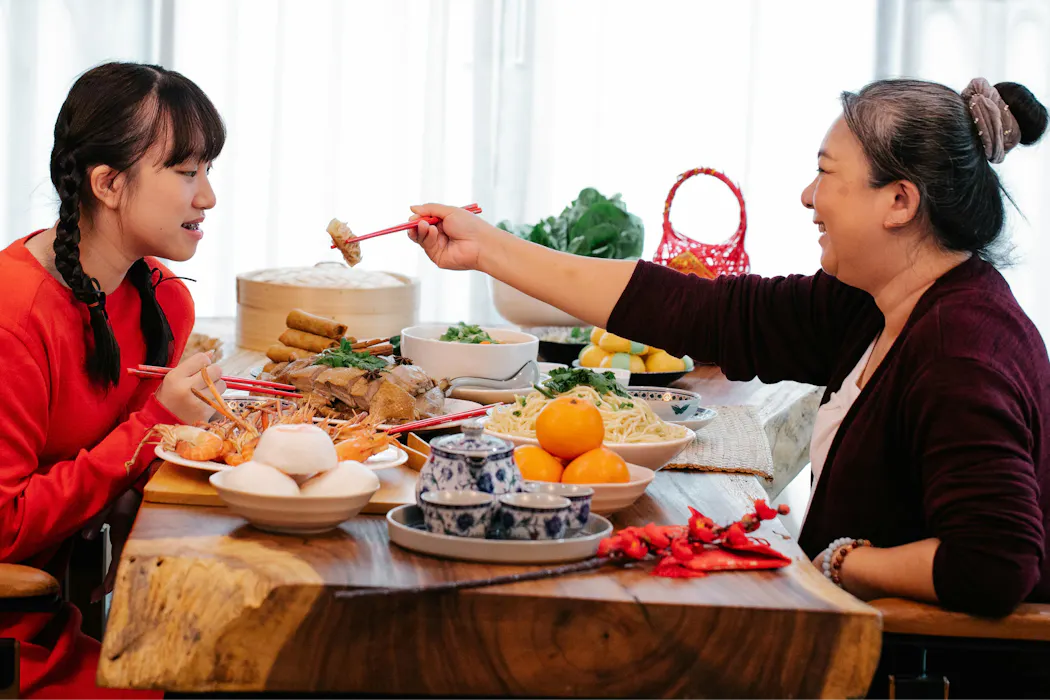
Chinese food heritage is diverse and vast, and embodies the distinct geographical and historical traces of various cultural identities.
As migrants in Australia, Chinese food features prominently in our everyday lives. Jing grew up eating regional cuisine from northern China; Wilfred grew up eating Cantonese food; Catherine grew up in Singapore enjoying home cooked Chinese food with a Eurasian twist.
The ways in which we understand, approach, enjoy and cook Chinese food are different, and we set out to find the role of food in the lives of other migrants of Chinese ancestry.
Tracing food heritage
We talked to Chinese-Australians between the ages of 18 to 40 to learn about how their food heritages have guided them to navigate and adapt to Australian lives.
They spoke to us about incorporating non-traditional Chinese ingredients, new ways of cooking and sourcing cooking equipment.
In their Australian kitchens, they experimented with the recipes they learnt from their families and those they interpret as “Chinese” cuisine.
They were concerned about authenticity, health and taste to varying degrees in the Chinese dishes they cooked, and spoke about how food heritage helped intergenerational families connect.
Fei* is ethnically Chinese and was born in Indonesia. She has lived in Australia for the past 12 years. She told us:
Whenever I go back to Indonesia, my auntie would cook for us, so I would ask a lot of old recipes […] I love their response because they will always say, when you were a child, you liked to eat this food. They will give you some feedback, but they’ll say, there’s a new way of cooking this.
Fei’s cooking was co-developed with family members, even when they are living in different countries. The art of cooking becomes a way for her family connect, despite distance.
Sally* migrated to Australia about nine years ago from Yunan Province. She shared a poignant story of the health of the older members of her family:
Even my grandmother [who] had Alzheimer’s and she barely remember who am I, but when she had – before I hang up the phone call, she’s like, remember to eat vegetable.
For Sally’s grandmother, even in old age, food was an expression of care.
Food facilitates new understandings of intergenerational family members – even those who have passed away.

Lynn* is an undergraduate student who migrated to Australia as a baby. She describes herself as “ethnically Chinese, but culturally Singaporean”, and told us how she got to know her grandfather through her father’s cooking:
I actually have never tried my grandpa’s chilli crab. I didn’t know that he actually made chilli crab until I think it was like two years [after] he’d passed when my dad made this recipe. […] I’m not sure how similar it was to the original, but it was pretty good.
Lynn’s father’s cooking his father’s chilli crab recipe as a way of honouring him and keeping his memory alive.
New habits
Food heritage is the phrase for the traditional cuisines which define our cultural identities and includes ingredient sourcing, food preparation and food consumption.
Food heritage is not static. It changes as migrants adapt to life in Australia.
Australia’s rich multicultural food cultures create transcultural food experiences for our Chinese-Australians.
Sally spoke to us about her and her mother melding Italian and Chinese ingredients:
If I cook dishes that require Yunnan’s ham, I use Italian prosciutto ham to replace it. It tastes really similar to Yunnan’s ham. My mum does that as well. She likes to get Italian Deli ham, smoked cured bacon, and then she’ll think it tastes like the actual thing from Yunnan.

Rong* came to Australia about 10 years ago from Shandong Province. She told us how she cooks for her daughter who loves noodles:
I need to bring something healthier to her table, and then I was like, okay, I’m not going to use the noodles, the Chinese noodles. I’m going to use pasta noodles, which is low GI, healthier. So, I just tried to figure different kind of ways of the noodles, not only Chinese noodles, but also Italian noodles, Vietnamese noodles, like pho. So all those kinds of things, and she loved them.
Rong also told us that she had to change the way she cooks because her apartment has an induction stove rather than a gas stove.
Although gas and induction stove tops are both common in China, certain dishes such as stir-fry are perceived to taste better in a hot wok on a gas stove.
“Soggy food”, according to many of our participants, is the result of induction stoves and flat pans rather than woks. Rong even told us that now, when she returns to China, she does not know how to cook in a Chinese kitchen with a gas stove.
Adapting to Australia
Food culture, is central to migrant adaptation, acculturation and wellbeing.
By better understanding the evolving nature of food heritage practices in Australia, we can better understand how migrants navigate Australia creatively while these transcultural connections provide an anchor for settlement and belonging.
*Names have been changed.

Catherine Gomes is a member of The Australian Sociological Association.
Jing Qi is affiliated with the RMIT Chinese-Australian Studies Forum, and the Chinese Community Council of Australia Victoria Chapter.
Wilfred Yang Wang is affiliated with Centre for Holistic Health, a not-for-profit organisation that supports the social and mental wellbeing of the Chinese communities in Melbourne, Australia.
