
Reading view

Bangarra’s Sheltering is a powerful showcase of First Nations dance and creativity
Jeff Tan

Frances Rings’ artistic directorship of Bangarra Dance Theatre’s shines through the company’s new triple-bill production, Sheltering.

Rings demonstrates a commitment to uplifting company members and First Nations creatives, with a coherent curatorial vision that shows care for diverse audiences.

This triple-bill is a beautiful sampler of what this important company has to offer to the cultural, political and creative facets of our nation.

A nurturing home for First Nations creatives

Sheltering comprises three individual choreographic works: Keeping Grounded, Brown Boys, and Sheoak.

Sheoak is a 2015 work by Rings herself, commissioned by then Artistic Director Stephen Page.

Keeping Grounded (2023) is choreographed by Indjalandji-Dhidhanu and Alyawarre woman Glory Tuohy-Daniell, with a cast of eight company dancers.

Keeping Grounded is performed by eight company dancers. Daniel Boud

The most recent work is a short dance film called Brown Boys (2024). It was directed by Cass Mortimer Eipper and Daniel Mateo, a Bangarra company member and Gomeroi and Mari Ma’ufanga, Tongatapu (Tonga) man.

Both Brown Boys and Keeping Grounded were first presented in Bangarra’s emerging artist showcase, Dance Clan, and supported from there onto the mainstage program. Creators Tuohy-Daniell and Mateo trained at NAISDA, Australia’s National Indigenous Dance College, and joined Bangarra through its Russell Page Graduate Program, which provides training and mentorship for new company dancers.

Keeping Grounded

Keeping Grounded opens onto an enormous and heavy rope net designed by Dyarubbin woman, Shana O’Brien. Under it, figures twitch and roll like a catch of fish.
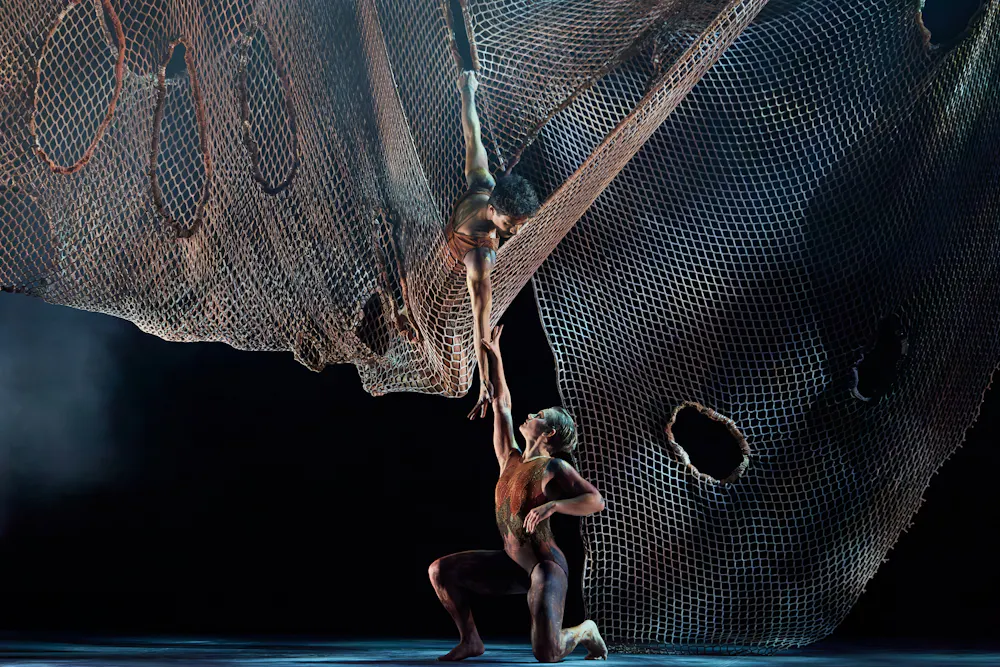
The set features a large heavy rope net designed by Dyarubbin woman Shana O’Brien. Daniel Boud

Karen Norris’ textured lighting supports the impression of a coastal setting, and “sets the scene” across the work as it shifts from an evocation of Country to a more technologically-mediated aesthetic.

In an interview with Glory Tuohy-Daniell, the choreographer describes how the work invites viewers “to consider how small, almost forgotten actions keep us grounded […] a step barefoot, a moment of stillness, a return”.

Tuohy-Daniell’s movement vocabulary is striking for its literal groundedness, reflecting the central theme highlighted in the work’s title.

The first sections see the dancers bound to the floor with a variation on the typical angular, rolling, swooping and sharply delineated shapes of Bangarra’s Indigenous contemporary style – here purposefully fractured.

Set to a score by Brendon Boney, the movement in this section is broken into one movement per beat, a staccato rhythm that suggests a disconnect from the flow of nature. This “pixellated” quality makes familiar forms new in an exciting way.

Brown Boys

Six-minute dance film Brown Boys is a meditation on the experience of young First Nations men. Daniel Mateo, the writer, choreographer and performer, has a cultural background spanning northern New South Wales and Tonga.

The program notes describe Brown Boys as a total work of art involving poetry, choreography, cinematography, sound and dramaturgy.

Adding to this is the central role of sculpture. Set and costume designer Elizabeth Gadsby has worked with traditional forms to establish a culturally informed aesthetic. This includes a fale (pronouned “fah-lay”), which is a traditional Tongan shelter made of grass matting. This structure frames Mateo’s body inside the film frame.

A fale is a kind of traditional Tongan shelter. Cass Eipper

Ochres, minerals and soils are other material elements featured in the design and choreography. The striking final image shows Mateo literally grounded by a soil mound that takes the silhouette of a 19th century crinoline skirt.

Mateo’s text and performance are extraordinary. His direct and settled gaze to camera, gentle unfolding movements, and spoken word poem, give visibility, dignity and complexity to the figure of the young Indigenous man. That he has “always been beautiful” could not be more persuasively portrayed.

Sheoak

Rings’ mastery of group choreography was recently showcased in her commissioned work for the Australian Ballet, Flora. Having delivered another major work for Vivid 2025, this was likely the right time to revive one of her classics.

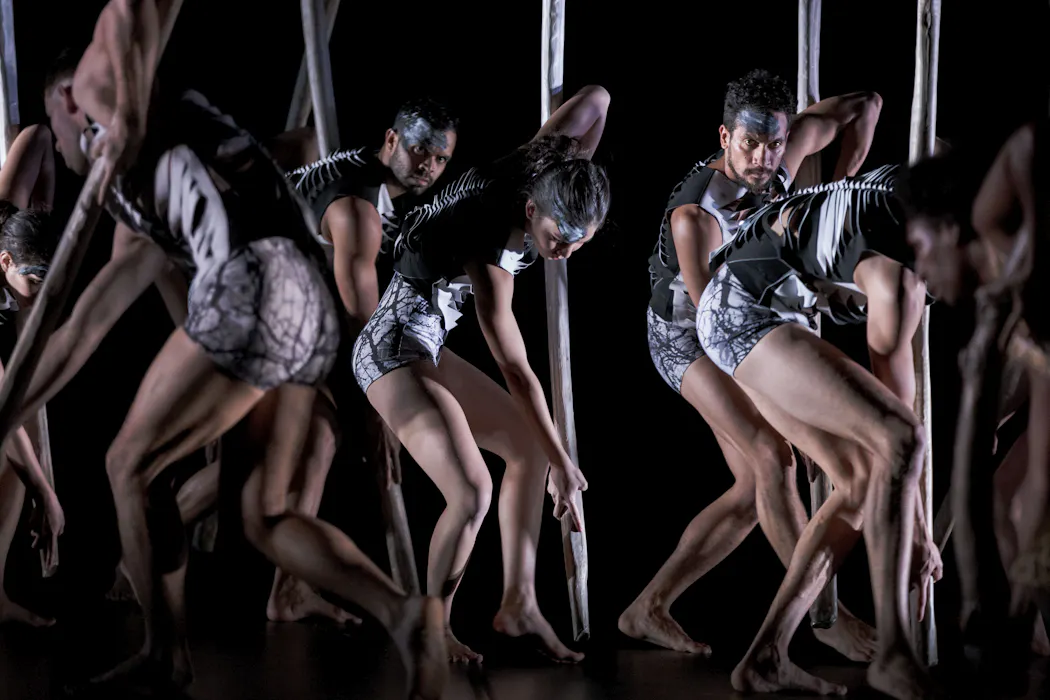
The opening image of Sheoak showcases both Rings’ choreographic skill and Jennifer Irwin’s amazing legacy as a costume designer. The dancers wear shirts with black on white streaks – skeletal puzzle pieces that join together to form larger human sculptures.

Sheoak gives palpable form to the exhaustion and frustration experienced by First Nations peoples. Daniel Boud

The theme of this work is cultural strength, resilience and adaptability, with the sheoak tree as the central metaphor. Dancer Chantelle Lee Lockhart is captivating in the role of this “Grandmother tree”, as it’s known to the Dharawal people.

The choreography weaves around Jacob Nash’s set design, featuring seven two-metre-long branches. The passing of branches signals the struggle to pass on cultural responsibility and knowledge from generation to generation.

The company of technically virtuosic dancers seems right at home in each of the three diverse works of Sheltering. The program particularly underscores Tuohy-Daniell’s potential as a new leading light in Australian choreography

Sheltering as a whole is dedicated to the late David “Dubboo” Page, brother of former Artistic Director Stephen Page. David’s work as composer, singer and musician was central to establishing the Bangarra aesthetic. His music also features in Rings’ Sheoak.

Sheltering is on now at the Sydney Opera House until June 13. The production will show at the Arts Centre Melbourne from June 18 to 27, and at the Queensland Performing Arts Centre from July 9 to 18.

The Conversation

I am writing as an Australian of Irish and Danish political exile, convict, and settler descent working within the Western tradition of contemporary art and dance. I acknowledge the much deeper cultural traditions that bind music, dance, painting, sculpture, and site in the art of Indigenous peoples.
  •  

What the hit new show Off Campus gets right in its portrayal of sexual violence

Prime Video

In a media landscape where sexual violence is largely normalised, the hit new show Off Campus is a refreshing pivot.

Created for Amazon Prime by showrunners Louisa Levy and Gina Fattore, the series explores the devastating impacts of sexual violence on young women. But it does so with sensitivity, and without gratuitous depictions of said violence.

Normalising sexual assault onscreen

Off Campus, a romantic college drama based on author Elle Kennedy’s novel series of the same name, is enjoying plenty of popularity right now. This is mainly due to its ridiculously attractive leading men and women, coupled with steamy (consensual) sex scenes and cheesy romance.

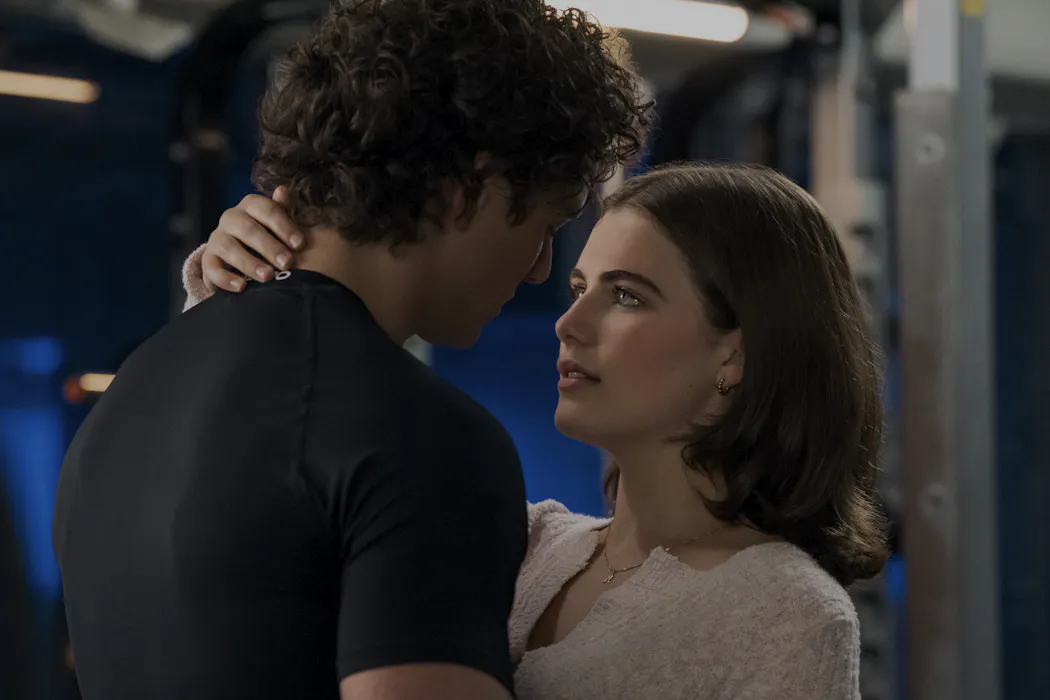
Season one follows college junior Hannah Wells and her fake dating scheme-turned-romance with star hockey-player Garrett Graham.

In a main subplot, we learn Hannah was drugged and raped by a classmate, Aaron Delaney, at a party. She was 15 when it happened.

But Hannah’s experience of assault chronologically takes place before the first episode. The incident is only hinted at subtly, through flashbacks.

Instead, the focus is on her life in the aftermath of sexual assault. This is the kind of representation post-#MeToo activists have been advocating for. Here, the reality of violence against women is addressed, but not viscerally depicted.

Contemporary series and films have a plethora of narrative plots predicated on graphic depictions of violence against women. Yet little has been done to address this.

As gender studies experts Stephanie Patrick and Mythili Rajiva explain, onscreen rape depictions continue to “rehearse gendered scripts, positioning women as sexual objects onscreen for the pleasure of audiences and/or male protagonists”.

These portrayals are now a pervasive part of screen culture, spanning genres and audiences.

Game of Thrones (2011-19), for instance, had multiple violent depictions of rape of prominent female characters, including Daenerys Targaryen, Cersei Lannister and Sansa Stark.

Similarly, Teen drama 13 Reasons Why (2017-20) also depicted both the rape of the central character Hannah Baker and the gang rape of minor character Tyler Down.

Both shows, though wildly different, demonstrate a heinous interest in showing the violation of bodies for entertainment.

What do we audiences get out of watching this, other than gnawing discomfort? And why do such shows remain highly watched, despite the controversy they attract?

Do we need to see sexual violence?

One might argue depictions of sexual assault and violence may make viewers more invested in the issue, and therefore more empathetic towards the experience of survivors.

Feminist film scholar Debra Ferreday says “like fans, feminists are intimately invested in practices of remediation and in the creation of transformative works” – and are therefore more likely to respond to these depictions with an activist mindset.

But, it’s not that simple.

There is also the potential to re-traumatise viewers who have experienced sexual assault, something showrunners are starting to take into account. And this has partly driven the rise of intimacy coordination in the industry. In the words of screen and media scholar Inge Sørensen:

the ways in which nudity, sex and intimacy are […] directed and acted on and off set are no longer only an ethical issue for […] cast and crew members on discrete productions. It is an industry concern with potentially significant financial and reputational consequences for any production.

There is also the potential for graphic depictions of sexual assault to desensitise viewers and normalise predatory and/or violent behaviour, particularly with reference to young men.

We can sen the effects of this in regards to shows such as Game of Thrones, wherein a number of online users argued the fantasy setting provided justification for the violent rape scenes. They saw no issue with them.

The Off Campus approach

Enter Off Campus. Alongside the main plot of Hannah and Garret’s budding attraction, we get glimpses into Hannah’s post-traumatic stress.

She confides in Garrett about her inability to orgasm, is hesitant to drink at parties, and feels guilty the only result of her legal trial against her abuser was the alienation of her family in their hometown in Indiana.

Hannah eventually confides in her family and friends, who rally around her. Prime Video

These moments come to a crux in episode seven, when Aaron plays against Garrett in a hockey game, and Hannah is too traumatised to attend. She isolates herself, struggles with overwhelming anxiety and avoids Garrett’s calls.

This scene mirrors the experience of many victim/survivors, who fear they will not be believed, or their assault won’t be taken seriously. Hannah’s beliefs reflect pervasive rape myths and stereotypes that shroud victim/survivors in doubt and shame.

Off Campus successfully touches on these problematic ideologies, before challenging a legacy of storylines that have helped endorse rape myths and minimise the effects of sexual violence.

Hannah eventually reaches out to her family and friends, who rally around her. Her mum, for instance, tells her she has “nothing to be sorry for”.

Hannah’s performance in the college’s pop showcase symbolises a final reclamation of self. Prime Video

Almost a decade on from #MeToo

The series’ overall sensitive approach suggests at least some showrunners are becoming less interested in violent depictions of sexual assault onscreen.

As we near the ten-year anniversary of the #MeToo movement, violence against women remains high, with an estimated one in five women having experienced sexual violence since the age of 15.

Off Campus marks a pivot away from harmful representation on a macro level, while initiating important conversations around the impact of sexual violence on an individual level. This visibility can steer victim/survivors towards seeking support, and encourage greater empathy and awareness among the broader audience.

The National Sexual Assault, Family and Domestic Violence Counselling Line – 1800 RESPECT (1800 737 732) – is available 24 hours a day, seven days a week for any Australian who has experienced, or is at risk of, family and domestic violence and/or sexual assault.

The Conversation

Bridget Mac Eochagain does not work for, consult, own shares in or receive funding from any company or organisation that would benefit from this article, and has disclosed no relevant affiliations beyond their academic appointment.

  •  
❌