Reading view

Gaokao jitters meet youth unemployment fears as 12.9 million students chase university dreams across China
Malay Mail

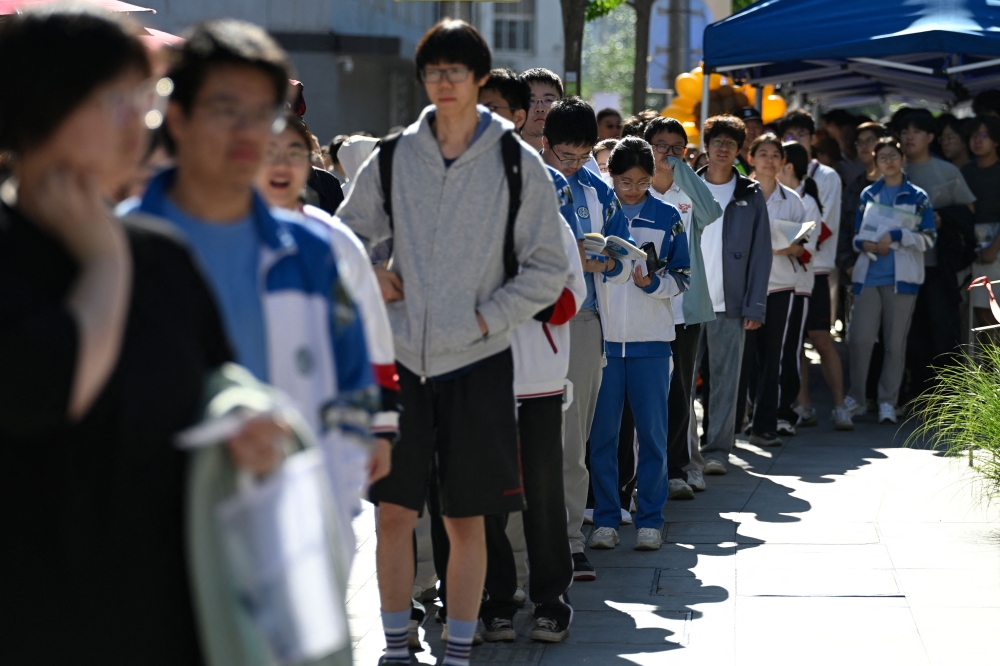
BEIJING, June 7 — Hundreds of young Chinese students clutching pens and their IDs shuffled into a testing centre in blue-skied Beijing on Sunday, swarmed by parents, joining millions sitting for the national high-stakes university entrance exam.

Around 12.9 million students nationwide registered for this year’s “gaokao”, according to the Ministry of Education, which for most is the sole determining factor in admission to a Chinese university.

The multi-day exam, which began Sunday, drills test-takers on subjects including Chinese, mathematics, English, science and the humanities—with the tallied scores to be released later this month.

“It’s my first time, so I’m a bit anxious,” said student Zhang Xinnan moments before entering the exam hall.

The spectacled Beijinger admitted he was nervous for the essay portion of the Chinese test.

But, wearing his school uniform, the 18-year-old told AFP that despite the jitters he thought he would do well, having spent the last year drilling practice questions.

“The things we needed to master have been mastered,” said Zhang, who hopes to work with new energy vehicles.

“Just go in with self-confidence; you’ll be solid.”

Some mothers and fathers clustered outside the exam halls dressed in red, a symbol of good fortune in Chinese culture.

A teacher hoisted a huge sunflower made from dozens of balloons — the plant’s name in Mandarin is a homophone for a Chinese idiom about success.

Dozens of police and security guards milled about as parents stood beside the line of students waiting to enter the exam hall, hoping to film their children walking inside.

Education authorities are on high alert each year and have sought to crack down on cheating, this year explicitly warning students not to bring smart glasses or smart watches into test sites that are surveilled by video.
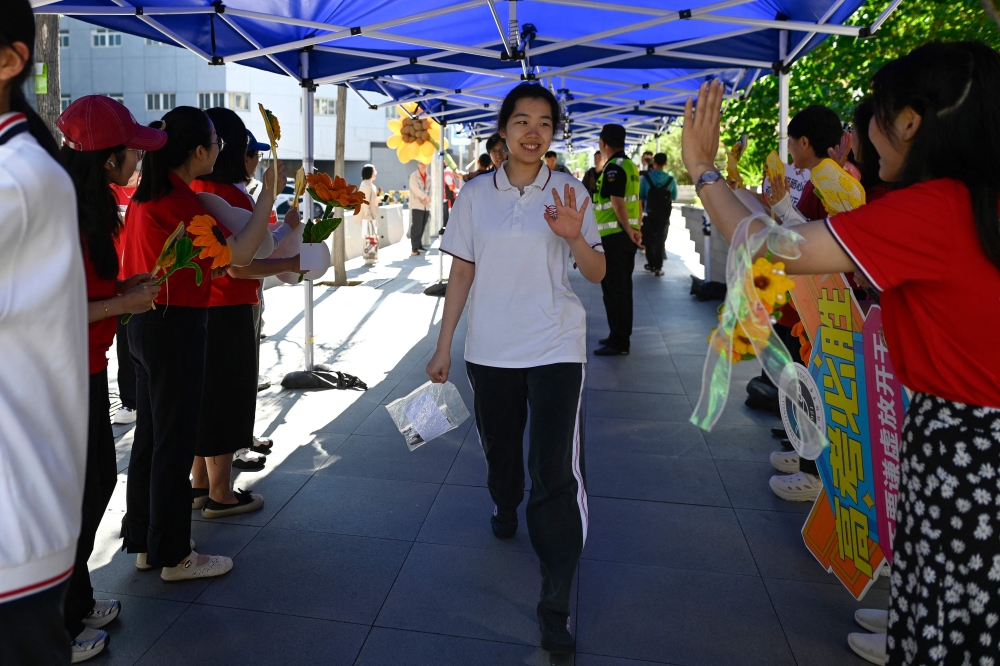
Parents outside the exam halls dressed in red, a symbol of good fortune in Chinese culture. — AFP pic

Shifting attitudes

High-level education has expanded rapidly in China in recent decades as an economic boom pushed up living standards — as well as parental expectations for their children’s careers.

Yet the job market that fresh graduates enter is no longer as rosy as it once was, with high youth unemployment a significant concern.

Roughly one in six Chinese between the ages of 16 and 24, excluding students, are jobless, according to official data.

Attitudes toward the test are changing, with students and parents more and more unwilling to trade physical and mental health for high test scores.

“I’m pretty free range,” said mother Deng Ju, standing across from the exam hall holding a stack of practice books for her daughter, revising last minute with her friend nearby.

“Just perform normally; that’s enough,” said Deng, 53. “I care more about physical health; the test is just a formality.”

For Deng, whose daughter isn’t aiming for a “name school” such as the elite Tsinghua or Peking University in the capital, doing away with the gaokao would be ideal.

“No more gaokao. Let’s not gaokao anymore,” she told AFP. “But that’s impossible,” she said, smiling.

Topics of change and adapting to challenges featured on this year’s gaokao exams, which often touch upon ideology and societal issues.

A question in Beijing asked test-takers to write a slogan for an artificial intelligence event targeted toward retirees, according to state newspaper People’s Daily.

“The school plans to organise volunteers to carry out the “Artificial Intelligence (AI) and Happy Old Age” themed activity at nursing homes. Please write a slogan for the event to attract seniors to participate,” the question read.

In Shanghai, students were asked to write 800 words about technology’s reshaping of the world and human imagination.

For many Beijing students, the gaokao was still a step toward achieving their dream.

“I hope I can go to my ideal university,” said student Zhang.

His friends also cared about the exam, he said.

“But if we can calm down, we should be able to get to a stable mentality,” said Zhang.

“Mentality is the most important when it comes to the gaokao.” — AFP

  •  

China holds 'special operation' near Taiwan after Japan-Philippines sea border talks

Malay Mail

BEIJING, June 7 — China held a “law enforcement operation” in waters east of Taiwan following recent talks between Japan and the Philippines to draw a boundary there, state media reported yesterday.

Tokyo and Manila said last month they would start formal talks “to delimit the maritime boundary” of an economic zone and continental shelf between them, angering Beijing.

China, which asserts Taiwan is part of its territory, called the talks “illegal” and has claimed exclusive control over the waters concerned.

Yesterday, Beijing’s transport ministry organised maritime police from coastal provinces Fujian and Guangdong to “conduct a special maritime traffic law enforcement operation in waters east of Taiwan Island”, state news agency Xinhua said.

The report did not give details on the operation, including how long it lasted or whether it was still ongoing, and it did not say whether maritime police dispatched ships to the area.

The operation was “a necessary action taken against Japan and the Philippines’ unilateral announcement they would start ‘negotiations on delimiting a maritime boundary’” near Taiwan, Xinhua added.

Taiwan said Wednesday it should be consulted on the Japan-Philippines talks.

Manila and Tokyo’s shared grievances over Chinese maritime territorial claims have seen them draw increasingly close in recent years.

Japan and China are in territorial and economic disputes in the East China Sea, where coast guard ships from both sides routinely stage tense standoffs.

Beijing has meanwhile deployed navy and coast guard vessels in the South China Sea, in a bid to bar the Philippines from strategically important reefs and islands, leading to a string of confrontations. — AFP


  •  

French luxury department store shuts doors in Beijing after 13 years

Galeries Lafayette Beijing featured image

Major French luxury department store Galeries Lafayette closed its first China flagship branch on Wednesday, over a decade after opening, pointing to sluggish domestic consumption and shifting spending habits.

A sign is seen on the Galeries Lafayette department store in Beijing on May 26, 2026, a day before it closes. Photo: Greg Baker/AFP.

A steady stream of shoppers browsed for last-minute deals as employees packed away unsold merchandise and mannequins on the penultimate day of Galeries Lafayette operations in Beijing, which has been open for 13 years, AFP journalists saw.

The six-floor emporium three kilometres (1.8 miles) west of the Forbidden City was being emptied of handbags, clothing, shoes and children’s toys before it locked up indefinitely.

“Don’t be sad, this is not goodbye forever,” the store said in a social media post this month announcing its Beijing closure.

“Beijing, until we meet again!”

When the French chain opened its doors in mainland China in 2013, it was at the beginning of a huge growth period for the Chinese luxury market.

China’s burgeoning middle class became a significant part of the global luxury consumer base as brands that were once only aspirational were now within reach in the world’s second largest economy.

But since the Covid-19 pandemic and property market woes dampened domestic consumption in China, the luxury sector has struggled to adapt.

“In response to… shifting market dynamics, Galeries Lafayette will refresh its business formats moving forward,” the chain said in a press release announcing the closure of its 48,000-square metre Beijing location this month.

“Consumer expectations regarding the traditional department store model have evolved significantly. Modern shoppers are increasingly prioritising greater convenience, elevated service, more meaningful experiences, and a greater sense of wellbeing,” it said.

Its Beijing branch was too large, while the Covid pandemic, a slump in domestic consumption spurred by a property crisis and a slowdown in the luxury sector added to its plight, the chain told AFP separately.

The chain is still operating its two other locations in mainland China — in Shanghai, which opened in 2018, and in southern China’s Shenzhen, which opened in 2023.

Finance worker Qian Linlin, whose office is steps away from the Beijing flagship store, said she was surprised to learn the mall she visited occasionally during lunch breaks would shut down.

“I noticed there weren’t many customers, but I never imagined that one day it would suddenly close down and then leave,” the 40-year-old said a day before its curtain call.

“After it opened, at the time, it was also a landmark building, and us young people would all come over to shop,” she said.

“We can only look back on memories.”

  •  

Capital cuisine: Three Beijing restaurants bringing China’s regional cuisines to Beijing’s fine dining tables

Malay Mail

BEIJING, June 11 — Beijing does not immediately strike one as a culinary destination. 

The buildings are towers of glass and steel, the roads wide enough to lose yourself in, and the scale of the city is designed for movement. 

It is a capital in the most literal sense — built for business, not pleasure.

Almost everyone I met on this trip had come from somewhere else. Our guide was from Nanjing. A chef from Henan. A waiter from Fujian. 

It is a city that has always drawn people in from the vast interior of the country, and they bring their food with them: their ingredients, their techniques, their memories of home.

In a handful of restaurants across the capital, a more deliberate version of that same story unfolds. 

Three chefs in three restaurants across Beijing make a serious, meticulous argument for regional Chinese cuisine — not just Beijing’s own, but Cantonese, Sichuanese, and a reimagined version of the capital’s culinary tradition itself. 

The restaurants have Michelin stars and are among Asia’s 50 Best. The cooking is precise, refined, and deeply personal. 

Taken together, they amount to something that feels brand new, yet rooted in the same traditions.

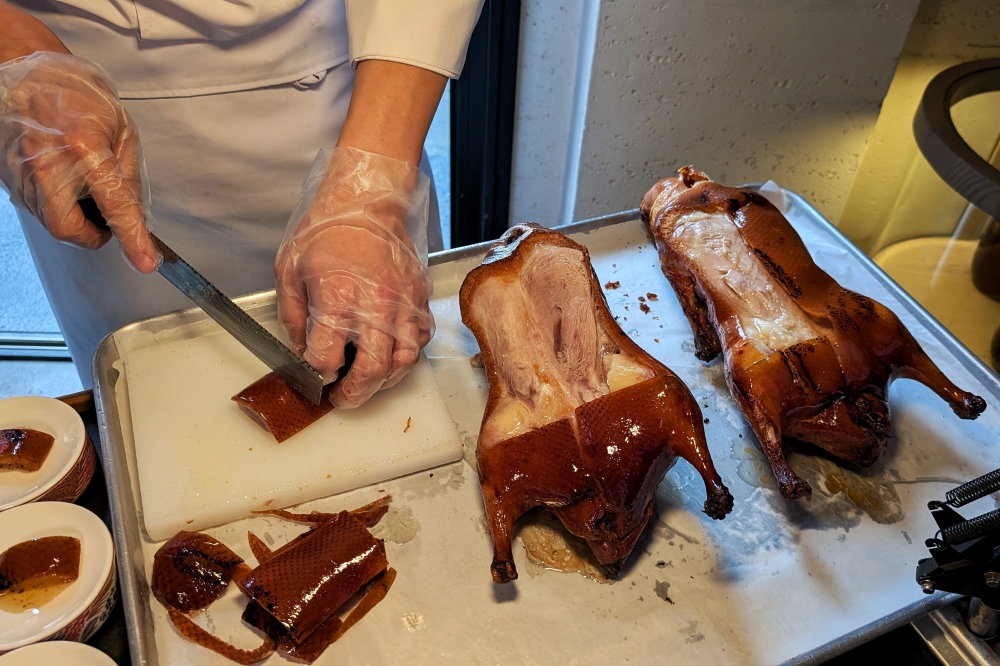
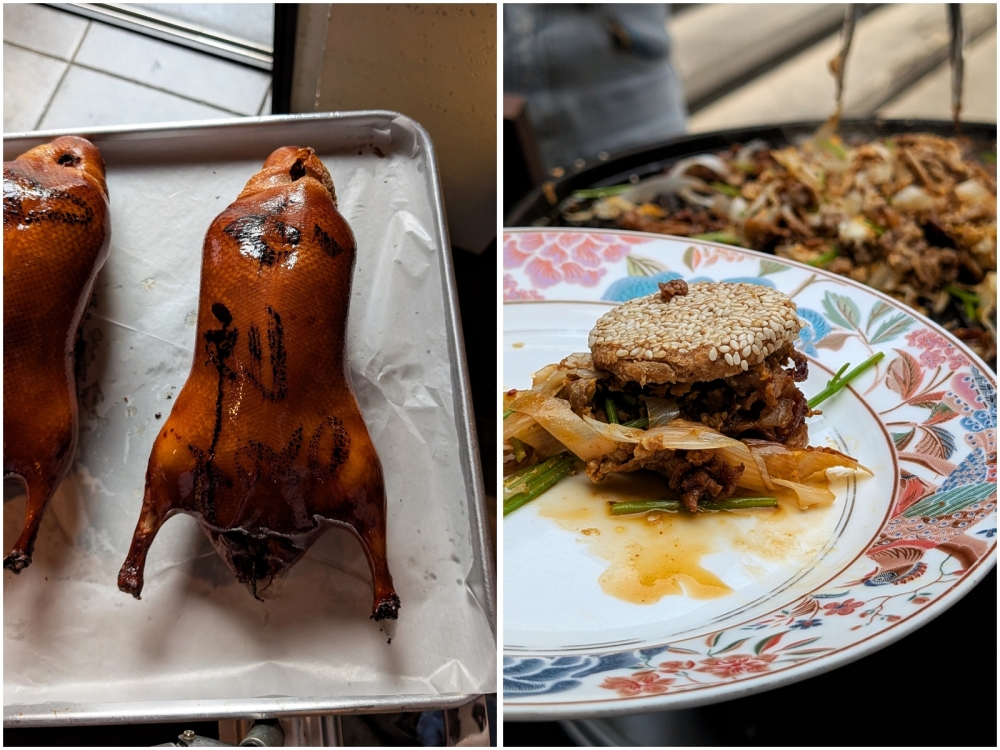
Historically, ducks were marked with sugar syrup in case of a swap during roasting. Today, Mansion Cuisine by Jingyan encourages guests to write messages on their ducks before roasting (left). Traditional Peking-style grilled lamb, served with a sesame biscuit (right). — Picture by Ethan Lau

Mansion Cuisine by Jingyan

Chef Duan Yu calls his cooking “New Beijing Cuisine”, which is the centrepiece at the Michelin-starred Mansion Cuisine by Jingyan, the crown jewel of his Jingyu Catering Group of restaurants. 

Housed in a remodelled siheyuan courtyard near the Lama Temple, the restaurant utilises a modern approach to traditional imperial Beijing cuisine.

Among the dishes that stood out: sea cucumber dressed in a dark, glossy sauce derived from Tianfuhao pork knuckle, 天福号酱肘子, a condiment tracing its history over 280 years to a Shandong shopkeeper who set up in Beijing during the Qing dynasty. 

The sea cucumber itself is firm and springy, nothing like the soft, slippery texture that is more prevalent here.

The Peking duck came three ways: first, a thin slice with cliff honey and black truffle, then carved into the traditional 108 slices to preserve the lacquered skin and served with erbajiang, 二八酱, a classic Beijing peanut and sesame paste condiment, and finally, the rest of the duck wok-fried with salt and pepper, and with chillies and scallions.

Peking-style hotpot, also known as shuanyangrou, or instant-boiled mutton, is a pillar of traditional Beijing cuisine. 

Lamb from Inner Mongolia is used at Jingyan, with thin slices interwoven with strips of cartilage for a snappy, almost crunchy resistance, cooked quickly in a clear broth with goji berries, and served with two sauces: the first a traditional sesame paste, the second with sand onion, also from Inner Mongolia. 

The same cut of lamb is later grilled with onions and coriander and served between sesame biscuits.

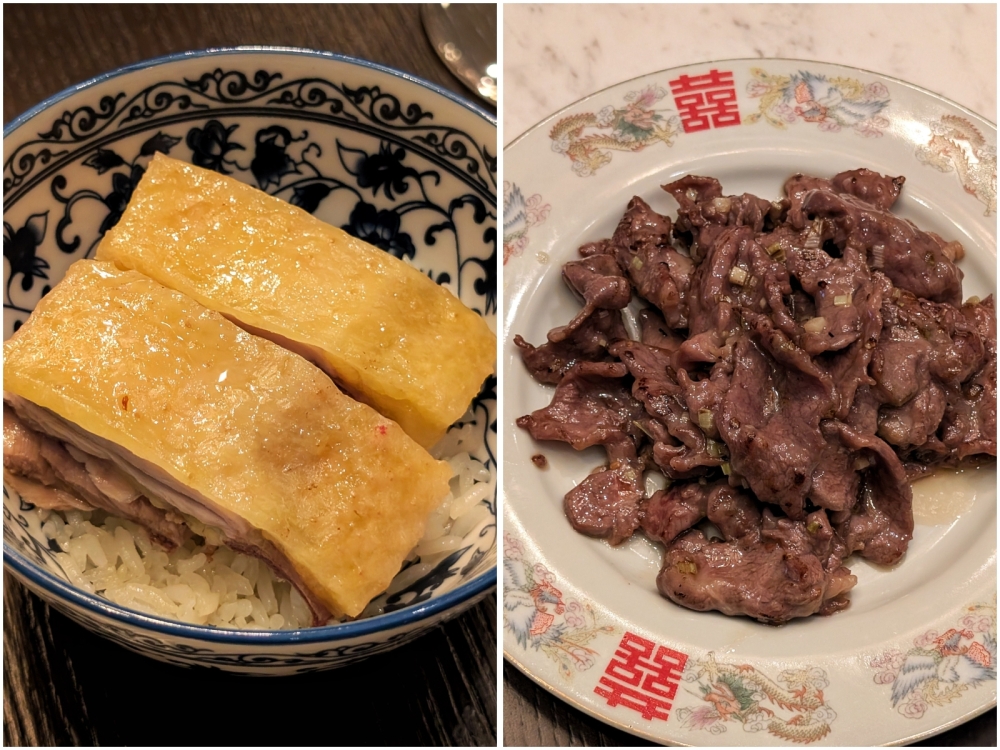
Anpu-style poached chicken at The House of Dynasties looks very similar to the white cut chicken we are used to here in Malaysia, but bears a few key differences (left). Instead of soy sauce, oyster brine is used to season the wok-fried beef slices (right). — Picture by Ethan Lau

The House of Dynasties

For most Malaysians — especially those based in Kuala Lumpur — Cantonese food is no mystery. 

So of the three restaurants, this was the one I expected to feel most at home in. 

And I did, for the most part. But there were moments where the food diverged from anything I knew, and those turned out to be the most interesting moments of the meal.

Chef Justin Tan is from Zhanjiang, a small coastal city in Guangdong whose culinary identity is distinct even within Cantonese cooking. 

He made history when T’ang Court at The Langham Shanghai became the first restaurant in mainland China to receive three Michelin stars, in the inaugural 2016 Michelin Guide Shanghai. 

Now at Rosewood Beijing’s The House of Dynasties, a restaurant inspired by Dream of the Red Chamber, a classic of Chinese literature, his hometown keeps surfacing on the plate.

The Anpu-style poached chicken rice was the clearest illustration of the distance between what I knew and what I was eating. 

The flavour was extraordinarily pure — clean, unadulterated chicken, without the familiar presence of scallion and ginger. 

The chicken itself was denser and firmer, none of the slippery, supple texture we are used to here, though the skin had a lovely smooth quality to it. 

The Zhanjiang-style fried lobster arrived buried under fermented black beans and garlic, the meat startlingly firm, deeply savoury and impossible to stop eating.

But the dish that left the biggest impression was the simplest: wok-fried beef. 

Chef Tan explained that instead of soy sauce, he uses oyster brine — made in-house, one step before it’s reduced all the way down to oyster sauce — for its pure, savoury, briny flavour, showcasing Zhanjiang’s famous oysters.

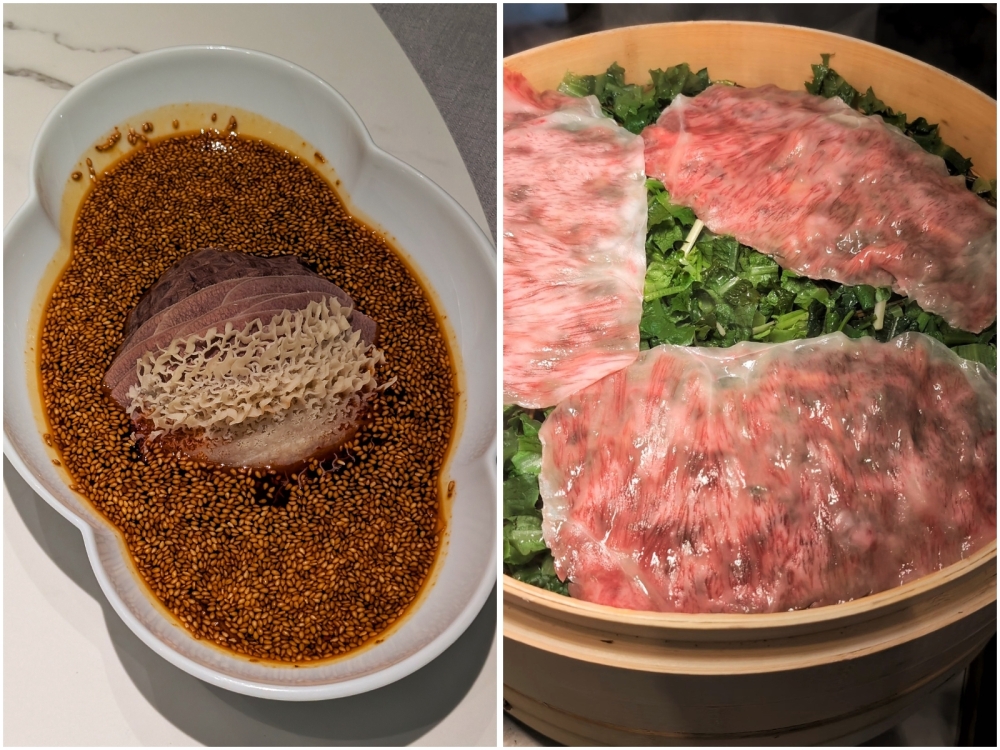
The husband-and-wife-offal pieces are tingly, spicy and texturally stimulating (left). Steamed Wagyu beef from Shandong with celtuce and Chinese celery, a remarkably refreshing summer Sichuan dish (right). — Picture by Ethan Lau

Chef 1996

This was the restaurant I was most looking forward to. I had seen Fuchsia Dunlop — the writer who is arguably the most authoritative voice on Sichuan cuisine in the English language — visit and share her experience on Instagram, and that was enough. 

Here in Malaysia, Sichuan food is having a moment, but it arrives mostly through its loudest exports: the mala hotpot, the numbing heat, the communal spectacle of it. 

What I encountered at Chef 1996 was something else entirely.

Chef Dee Liang’s restaurant is private rooms only, situated in an industrial part of Chaoyang. 

Like with Chef Duan and his restaurant group, Chef 1996 is the showpiece of the Meizhou Dongpo empire, which has over 100 locations in both China and the United States. 

The restaurant’s name is a reference to the year Chef Dee and her husband opened the first location. 

It opened in 2023 and by 2026 had entered Asia’s 50 Best Restaurants at No. 52 — the first Sichuan restaurant ever to do so.

The fuqi feipian — husband and wife offal pieces, beef tongue and tripe in spicy numbing oil — was the dish I had been fixating on since seeing it on Dunlop’s Instagram, and it delivered. 

The numbing heat was less a wall of sensation than a tingle, like little needles dancing across the tongue, the spice precise and almost delicate.

But the dish that genuinely surprised me was the steamed Shandong Wagyu beef with celtuce and Chinese celery, served with an erjingtiao pepper sauce. 

Incredibly fresh and summery, light in a way I had not associated with Sichuan cooking at all — a complete dismantling of my narrow perception of what the cuisine could be. 

The familiar heat returned with the braised topmouth culter, a freshwater fish served with rice jelly, pickled chillies and pickled ginger, layering soft, pillowy textures with sharp, tangy spice.

Mansion Cuisine by Jingyan

22 Jianchang Hutong, 

Dongcheng, Beijing.

Open daily, 11.30am-2pm, 5.30-10pm

Tel: +86 10 8663 2999

http://www.jingyu2020.com/h-col-118.html

Instagram: @jingyan_beijing

The House of Dynasties

4F, Rosewood Hotel, 

Jing Guang Centre, Hujialou, 

1 Chaoyangmenwai Street, 

Chaoyang, Beijing.

Open daily, 11.30am-2.30pm, 5.30-10pm

Tel: +86 10 6536 0066

https://www.rosewoodhotels.com/en/beijing/dining/the-house-of-dynasties

Chef 1996

4A Jiangtaiwa, 

Xinghuo East Road, 

Chaoyang, Beijing.

Open daily 11am-2pm, 4.30-11pm

Tel: +86 135 2150 9321

https://chef1996.com/

Instagram: @chef1996restaurant

* Follow us on Instagram @eatdrinkmm for more food gems.

* Follow Ethan Lau on Instagram @eatenlau for more musings on food and occasionally self-deprecating humour.

  •  
❌