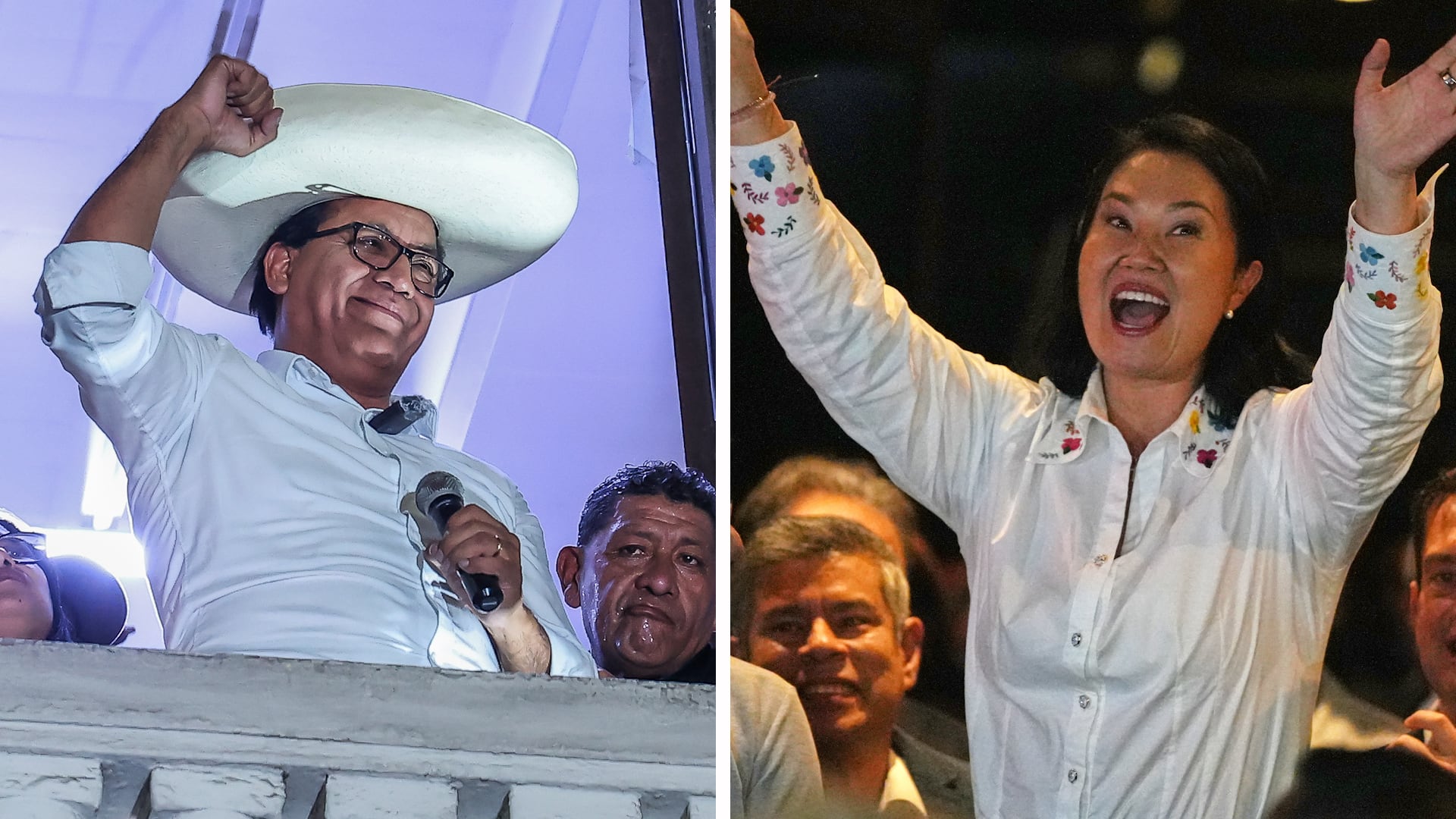
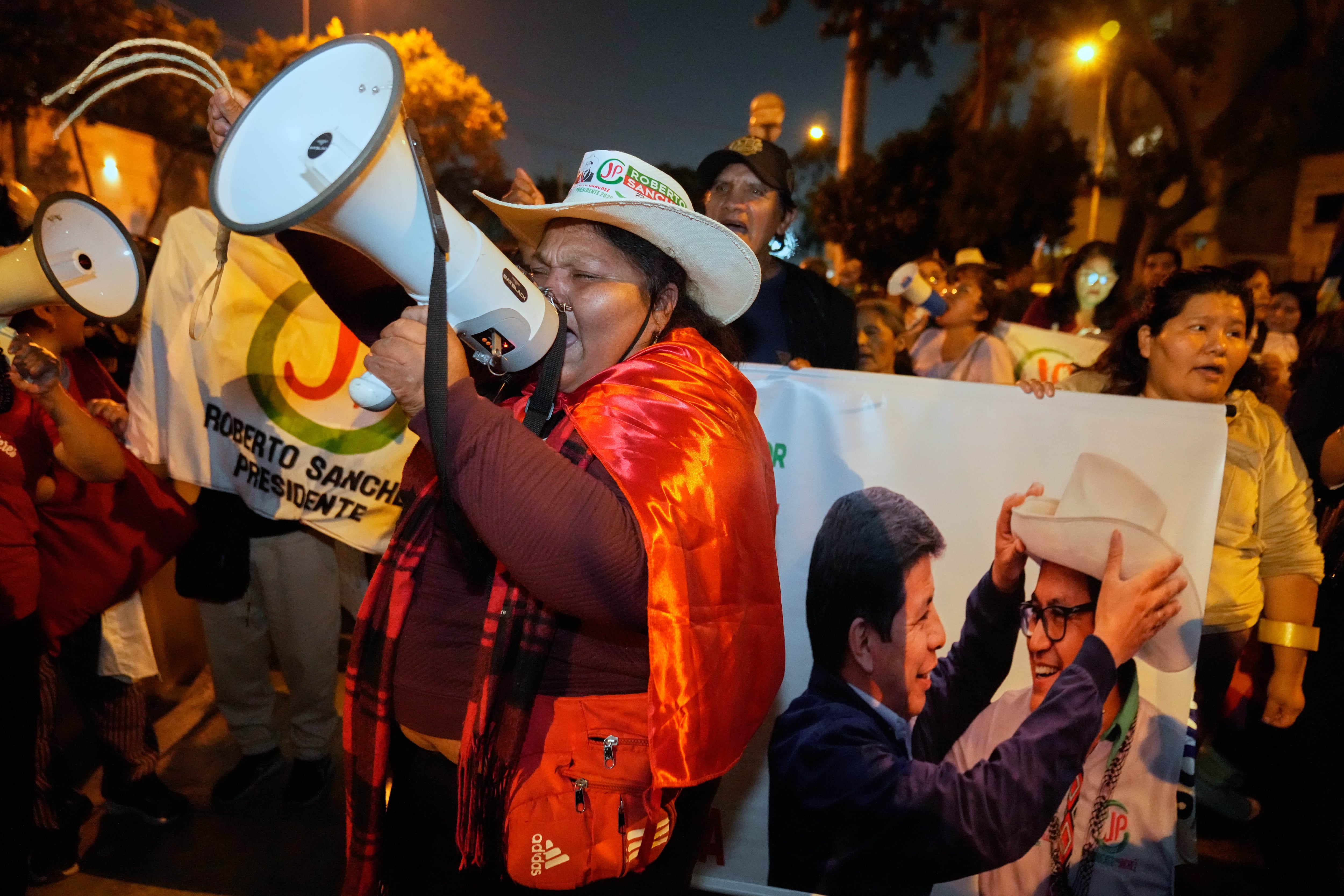
Peru’s recent history of presidential elections advises caution when the margin is measured in tenths of a percentage point. If anyone knows this better than anyone else, it is Keiko Fujimori, who lost by a hair to Ollanta Humala in 2011, to Pedro Pablo Kuczynski in 2016 and to Pedro Castillo in 2021. That is why, although an exit poll currently gives a slight edge to the leftist Roberto Sánchez —50.3% to 49.7%— the presidential runoff remains open in a race to choose the country’s ninth leader in 10 years.
Keiko Fujimori, the daughter of 1990s leader Alberto, is vying with a congressman to become country’s ninth president in a decade
Peruvians go to the polls on Sunday in an election runoff that pits a perennial rightwing candidate, Keiko Fujimori, against a leftist congressman, Roberto Sánchez. Amid rising crime, chronic political instability, corruption scandals and voter apathy, they are vying to become Peru’s ninth president in a decade.
Fujimori, who is the daughter of the late president Alberto Fujimori, won 17% of the vote in the first round in April. Sánchez, a former trade and tourism minister, took 12 % of the vote, edging out Rafael López Aliaga, an ultra-conservative former Lima mayor. The stage is set for a polarised left-right replay of the country’s last election in 2021.
The economy of Peru’s Sacred Valley has long been entwined with the seasons. Rural communities typically grow crops and raise livestock to sustain themselves and to barter with others, a process that necessitates an attunement with nature, its cycles, and how these patterns influence self-sufficiency.
This is particularly true for the Quechua communities, Indigenous peoples who have long worked for subsistence rather than state currencies. In recent years, health clinics, schools, markets, and transportation requiring residents to use cash have slowly eroded this way of life. Today, many Quechua men leave their communities to work in tourism, which offers an income and the opportunity to learn Spanish. Conversely, women often remain at home to care for children and farms, making them dependent on support from their partners and family members.
In 2009, the nonprofit Awamaki formed to aid communities around Ollantaytambo, Cusco, as they navigated this change. U.S.-based Kennedy Leavens and Miguel Galdo, of Peru, had worked together previously at a similar organization supporting 10 women weavers from Patacancha. When that project shuddered, the two decided to found Awamaki to maintain their support.
The nonprofit grew quickly, and today, it assists nine cooperatives, comprising 174 artisans and community members who work across craft and tourism. With collaboration at its core, Awamaki prides itself on sustainability and focuses on broadening its partners’ access to a diverse array of markets and economic opportunities.
In addition to financial changes, the climate crisis is rapidly transforming the ways of the Sacred Valley, which faces disproportionate impacts as glaciers melt and the water supply dwindles. “The shift towards having personal income, for our artisan partners, is not about replacing traditional livelihoods, but about widening the economic ground beneath them so they can move their families towards prosperity and build resiliency to the effects of climate change, all without leaving the community or traditional ways of life,” the nonprofit tells us.
Partnering with Awamaki allows cooperative members to focus on traditional spinning, dyeing, and weaving traditions, while the nonprofit offers structural support in selling their goods and coordinating tourism. Carving through the terrain north of Cusco, the Andean highlands were once home to the Incans and still hold traces of the ancient empire, like the historic city of Machu Picchu, which continues to attract around one million people from around the globe each year. For many years, the organization says, visitors would arrive in villages without prior notice, and the women would halt their work to meet tourists and hopefully, sell a piece.
And of course, this way of making is demanding, as women not only weave, but also raise alpacas, shear their wool, and spin and dye the soft fibers into yarn. “Before weaving, I have to wash my hands carefully so the wool doesn’t get damaged. It requires attention and care,” Ricardina, an Awamaki member from the Cusci Qoyllur cooperative, tells us. “Sometimes I can weave more, sometimes less. It depends on time, on my children, on everything else I have to do.”
Today, Awamaki helps to coordinate tourism and provide compensation for visits. This includes programs like Murmur Ring’s immersion, which will bring a group of creatives to the region this June. “Our role is to create opportunities that can be compatible with cultural continuity, if that is what communities themselves want,” they say, adding:
For women, without personal income, everyday decisions can feel distant. Paying for school supplies, buying medicine, covering transportation costs, buying food to supplement the limited traditional crops that grow at high altitude–all of these depend on uncertain flows of money and shifting household dynamics. As climate patterns grow more erratic, with harsher frosts, longer dry spells, and thinning pasture, even the agricultural base families rely on has become less predictable, deepening that sense of financial fragility.
This regular support has simultaneously buoyed many women to greater financial independence and helped retain their way of life. “When new artisans join a cooperative, they are typically mentored by other women in their own community. Cultural knowledge remains community-held and community-led,” the nonprofit shares.
“In my family, we make decisions together—about how to earn and how to move forward,” Daniela, a weaver from the Puskariy Tika cooperative, says. “Through this work, we are able to keep going and improve our lives little by little.”
Nadia, of the Rumia cooperative, echoes this sentiment. “Being part of Awamaki changed things for us. Now we have a steady income, and that allows us to keep weaving,” she says. “In our community, it’s not always easy. Some people say, ‘Why do you weave?’ But they don’t understand this work… We also teach our children to care for the environment, to grow things, to respect the land. That’s part of our work, too.”
To learn more about the women and support their work, visit Awamaki’s website.
Lima, Peru — Peru’s general election, held Sunday, April 12, has been thrown into uncertainty following a series of logistical failures, contested tally sheets, and newly reported irregularities that have raised doubts about the integrity of the process—even as authorities insist there is no evidence of fraud.
With partial results still being processed several days later, no clear contender has emerged to face Keiko Fujimori in the runoff, despite her leading the vote with around 17%. The tight race for second place—separated by a razor-thin margin—between right-wing candidate Rafael López Aliaga and leftist Roberto Sánchez could ultimately be decided by thousands of challenged votes.
Delays, missing materials, and ballots found in the trash
Election day was marked by widespread delays in the delivery of voting materials, especially in Lima, forcing authorities to extend voting into Monday in several districts.
Officials are now facing scrutiny over more troubling incidents. In one of the most widely reported cases, sealed boxes containing 1,200 ballots—distributed across four tamper-evident containers—were found discarded in the trash in the Lima district of Surco.
The National Office of Electoral Processes (ONPE) attributed the incident to negligence during the transport of ballot boxes and tally sheets to its central headquarters. It maintained, however, that the chain of custody was not compromised, noting that a coordinator, a police officer, and an electoral observer from the National Jury of Elections were present in the vehicle.
However, Roberto Burneo, president of the National Jury of Elections (JNE), told a congressional oversight committee on Friday that the ONPE’s statement was “false.”
“It is important to clarify that, regarding those boxes, contrary to what ONPE indicated, there was no observer accompanying them nor a police officer. They were transported in unregistered private vehicles, and the JNE was not present,” he said.
Burneo added that evidence has already been submitted to prosecutors.
“Serious irregularities,” but no fraud, observers say
Despite the growing list of incidents, international observers from the Organization of American States and electoral experts have drawn a distinction between administrative failures and deliberate manipulation.
“There have been serious irregularities that must be investigated and sanctioned, but this is not a fraudulent situation,” former Justice Minister Aldo Vásquez told CNN. “At least up to now, there is no evidence supporting that claim.”
Observers from international organizations echoed that assessment, noting that while “egregious irregularities” were documented, they do not amount to systemic fraud.
Still, the scale and variety of problems—from late poll openings to missing materials—have eroded public confidence.
Thousands of disputed votes could decide the runoff
At the center of the uncertainty are more than 5,000 tally sheets marked as “disputed”—representing just over one million votes—due to inconsistencies such as missing signatures, illegible figures, or arithmetic errors.
These votes are now under review by electoral authorities and, in such a close race, could determine who advances to the runoff.
“Of course they can change the outcome,” said electoral lawyer Silvia Guevara. “The difference between candidates is so small that these votes could tip the balance.”
“This is a situation that won’t be resolved tomorrow or in two or three days. Citizens will need to be patient,” she added to Canal N.
Institutional crisis and ongoing investigations
The fallout has triggered multiple investigations. The Public Ministry and the Comptroller General have launched inquiries, while the National Board of Justice—the body responsible for overseeing judicial appointments—has opened a preliminary investigation against Piero Corvetto Salinas, head of the ONPE.
According to Vásquez, the process could lead to disciplinary sanctions or even suspension, noting that “it is highly likely that a formal proceeding will be opened.”
Meanwhile, electoral authorities have confirmed that at least 85 requests to annul the election have been filed, further complicating the timeline.
With the runoff scheduled for June, the coming days will be decisive not only in determining who advances, but also in whether Peru’s electoral institutions can restore public trust after one of the most controversial elections in recent years.
Peruvians who went to the polls this past Sunday to vote in the presidential runoff will not know who their president is until July. One month is how long the National Jury of Elections estimates it will take to review the 1,555 tallies that have been challenged, a spokesman confirmed on Tuesday. Two days after voting, uncertainty over a result that will be decided by about 25,000 votes between the leftist candidate Roberto Sánchez and the right-wing Keiko Fujimori is turning into weariness and allegations of fraud on the streets and social media.
Bogotá, Colombia – Peru’s presidential election has been upturned by news that the country’s public prosecutor is seeking a jail term for Roberto Sánchez, one of two candidates set to compete in next month’s run-off.
The public prosecutor announced on Tuesday it is seeking a five year and four month jail term for alleged irregularities in campaign donations to the Together for Peru (Juntos por el Perú) party between 2020 and 2021.
The announcement has fuelled existing concerns about the integrity of the elections and the state of Peru’s democracy, which has faced a spate of crises in recent years.
If successfully prosecuted, Sánchez would be unable to stand in the election set for June 7.
The candidate denies the accusations, saying, “I proved that I never made personal use of the party’s financial resources, and that is why the alleged fraud as a serious crime was dismissed by the Judiciary through a court ruling.”
The timing of the release of the documents, leaked to the press on May 12 and formally unsealed the next day, has raised suspicions in some quarters of attempted electoral manipulation. The documents show that the prosecutor’s resolution was issued on January 15 but was only made public this week, as Sánchez closes in on advancing to run-off elections following a lengthy vote count.
Jo-Marie Burt, from the Washington Office on Latin America (WOLA), says the charges may signal that an elite coalition in congress is seeking to subvert the election process to avoid the chance of Sánchez coming to power.
“One cannot help but see this as a politically motivated move designed to remove him as a viable candidate,” she told Latin America Reports.
Sánchez, a leftist former trade minister, is set to face off with Keiko Fujimori, the right-wing politician who has dominated the political scene in Peru for a decade but has been defeated in each of the last three presidential run-offs.
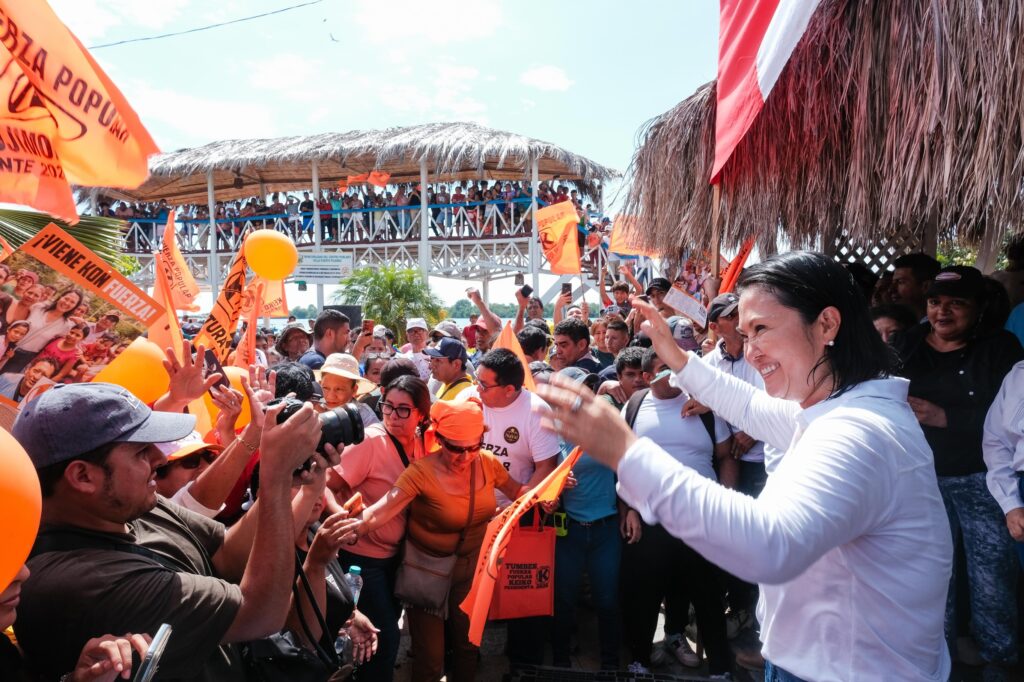
Keiko Fujimori greets supporters. Image credit: Keiko Fujimori via Facebook.
WOLA’s Burt sees the hand of Keiko Fujimori behind this intervention: “The [prosecutor’s office] is now run by people who are closely allied with Keiko Fujimori and her allies. Hence the concern that this action against Sánchez is politically motivated.”
The public prosecutor’s decision to seek a jail term for Sánchez is just the latest in a series of moves which have fuelled concerns about the integrity of Peru’s judiciary.
While the prosecutor’s office is technically independent from the executive and legislative branches, it has been clouded by accusations of politicization since the accession of Attorney General Tomás Gálvez, considered an ally of Fujimori.
In November last year the UN Special Rapporteur on the independence of judiciary and lawyers, Margaret Satterthwaite, raised concerns about the ousting of Attorney General Delia Espinoza, who had been actively pursuing investigations into links between organized crime and legislators.
“Judicial independence is not optional. It is the foundation of democracy,” she said, after congress voted to bar Espinoza from office for ten years.
Espinoza’s replacement by Gálvez – who has been under investigation for links to organized crime in the Cuellos Blancos del Puerto influence peddling scandal – deepened fears for the integrity of the judiciary in Peru. In January this year, he announced that three major corruption investigation units, including the one investigating the Cuellos Blancos case, were being closed down.
Peru’s National Human Rights Coordinator claimed at the time this “constitutes an institutional breakdown that seriously weakens the fight against impunity by jeopardizing ongoing investigations.”
Featured image description: Roberto Sánchez at a campaign rally.
Featured image credit: Roberto Sánchez via Facebook.
Bogotá, Colombia – Peru’s presidential election has been upturned by news that the country’s public prosecutor is seeking a jail term for Roberto Sánchez, one of two candidates set to compete in next month’s run-off.
The public prosecutor announced on Tuesday it is seeking a five year and four month jail term for alleged irregularities in campaign donations to the Together for Peru (Juntos por el Perú) party between 2020 and 2021.
The announcement has fuelled existing concerns about the integrity of the elections and the state of Peru’s democracy, which has faced a spate of crises in recent years.
If successfully prosecuted, Sánchez would be unable to stand in the election set for June 7.
The candidate denies the accusations, saying, “I proved that I never made personal use of the party’s financial resources, and that is why the alleged fraud as a serious crime was dismissed by the Judiciary through a court ruling.”
The timing of the release of the documents, leaked to the press on May 12 and formally unsealed the next day, has raised suspicions in some quarters of attempted electoral manipulation. The documents show that the prosecutor’s resolution was issued on January 15 but was only made public this week, as Sánchez closes in on advancing to run-off elections following a lengthy vote count.
Jo-Marie Burt, from the Washington Office on Latin America (WOLA), says the charges may signal that an elite coalition in congress is seeking to subvert the election process to avoid the chance of Sánchez coming to power.
“One cannot help but see this as a politically motivated move designed to remove him as a viable candidate,” she told Latin America Reports.
Sánchez, a leftist former trade minister, is set to face off with Keiko Fujimori, the right-wing politician who has dominated the political scene in Peru for a decade but has been defeated in each of the last three presidential run-offs.
Keiko Fujimori greets supporters. Image credit: Keiko Fujimori via Facebook.
WOLA’s Burt sees the hand of Keiko Fujimori behind this intervention: “The [prosecutor’s office] is now run by people who are closely allied with Keiko Fujimori and her allies. Hence the concern that this action against Sánchez is politically motivated.”
The public prosecutor’s decision to seek a jail term for Sánchez is just the latest in a series of moves which have fuelled concerns about the integrity of Peru’s judiciary.
While the prosecutor’s office is technically independent from the executive and legislative branches, it has been clouded by accusations of politicization since the accession of Attorney General Tomás Gálvez, considered an ally of Fujimori.
In November last year the UN Special Rapporteur on the independence of judiciary and lawyers, Margaret Satterthwaite, raised concerns about the ousting of Attorney General Delia Espinoza, who had been actively pursuing investigations into links between organized crime and legislators.
“Judicial independence is not optional. It is the foundation of democracy,” she said, after congress voted to bar Espinoza from office for ten years.
Espinoza’s replacement by Gálvez – who has been under investigation for links to organized crime in the Cuellos Blancos del Puerto influence peddling scandal – deepened fears for the integrity of the judiciary in Peru. In January this year, he announced that three major corruption investigation units, including the one investigating the Cuellos Blancos case, were being closed down.
Peru’s National Human Rights Coordinator claimed at the time this “constitutes an institutional breakdown that seriously weakens the fight against impunity by jeopardizing ongoing investigations.”
Featured image description: Roberto Sánchez at a campaign rally.
Featured image credit: Roberto Sánchez via Facebook.
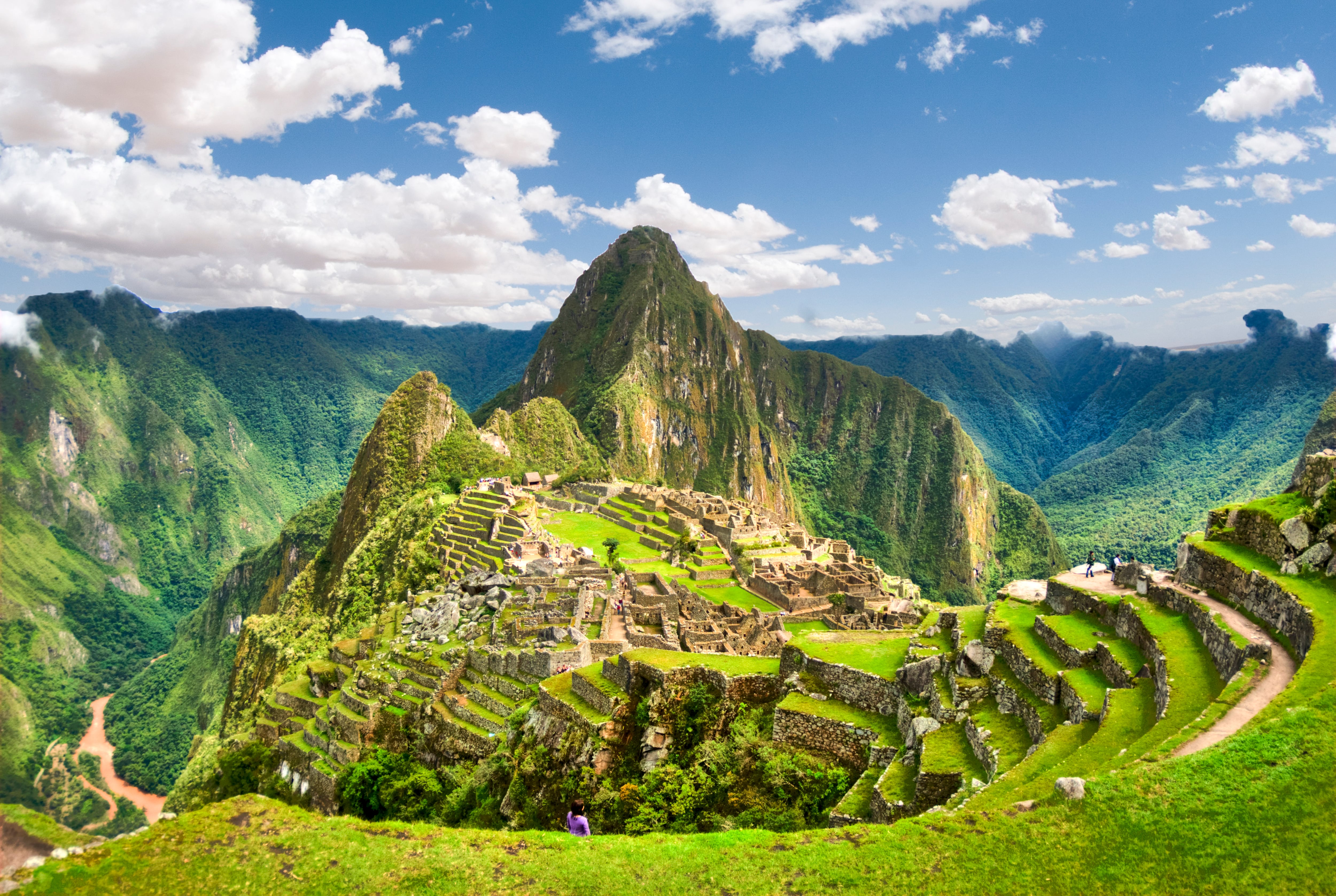
An open letter from Zurich, addressed to Keiko Fujimori and Roberto Sánchez — the two presidential contenders — has shaken up the runoff election in Peru. New7Wonders, the Switzerland‑based organization that in 2007 created the contest to determine the New Seven Wonders of the World, has reminded Peru that Machu Picchu faces a concrete threat: losing the international recognition that turned the Inca citadel into a magnet for millions of travelers and one of those places one must see at least once in their lives.

 Login
Login