
 Login
Login
Hong Kong’s ‘shoebox’ flat reform leaves low-income residents in limbo

By Catherine Lai
Hong Kong resident Lisa Lau put on a costume drama as she settled on the bed that occupies much of her tiny apartment, trying to take her mind off a looming eviction.

Subdivided flats like Lau’s three-square-metre (32-square-feet) home — made by splitting up an apartment into smaller units — are being phased out after a law to regulate them came into effect in March.
Chinese President Xi Jinping has ordered the wealthy finance hub to resolve housing woes that are the result of decades of pervasive inequality, an acute housing shortage and eye-watering rents.
The Hong Kong government has given owners who register under the new system until 2030 to renovate their subdivided flats, but some landlords have already issued eviction notices to their tenants.
“I’ll stay here day by day,” Lau, a 48-year-old welfare recipient who had received an eviction notice months ago, told AFP.
“I don’t know (where to go),” said Lau, who lives on the equivalent of about US$930 a month, of which US$330 go for rent.
“I’m scratching my head.”

The new rules ban flats smaller than eight square metres (86 square feet) and mandate safety and hygiene standards, such as having at least one openable window, a sink and a toilet in an enclosed space.
Authorities estimate that more than 220,000 people in the city of 7.5 million live in so-called “shoebox” flats, around one-third of which need major renovation.
Lau’s cubicle is one of nine in a single unit, separated by thin wooden dividers, in a 60-year-old building in one of Hong Kong’s poorest neighbourhoods, Sham Shui Po.
With no kitchen, she makes soup or noodles in a rice cooker placed on the bed.
She uses a shared toilet and shower, and has taped a foam board across the bottom of her doorway to keep out rats and cockroaches.
Unaffordable housing
Despite the cramped conditions, Lau is reluctant to leave a familiar area where she has built a social network, and hopes her application for transitional housing nearby would be approved.
“As long as the landlord doesn’t come (to evict residents), we are so at peace, we are so comfortable,” she said.
The Housing Bureau said over 100 households had already moved out of Lau’s building, and that it was helping the 40 that are left to find suitable accommodation.
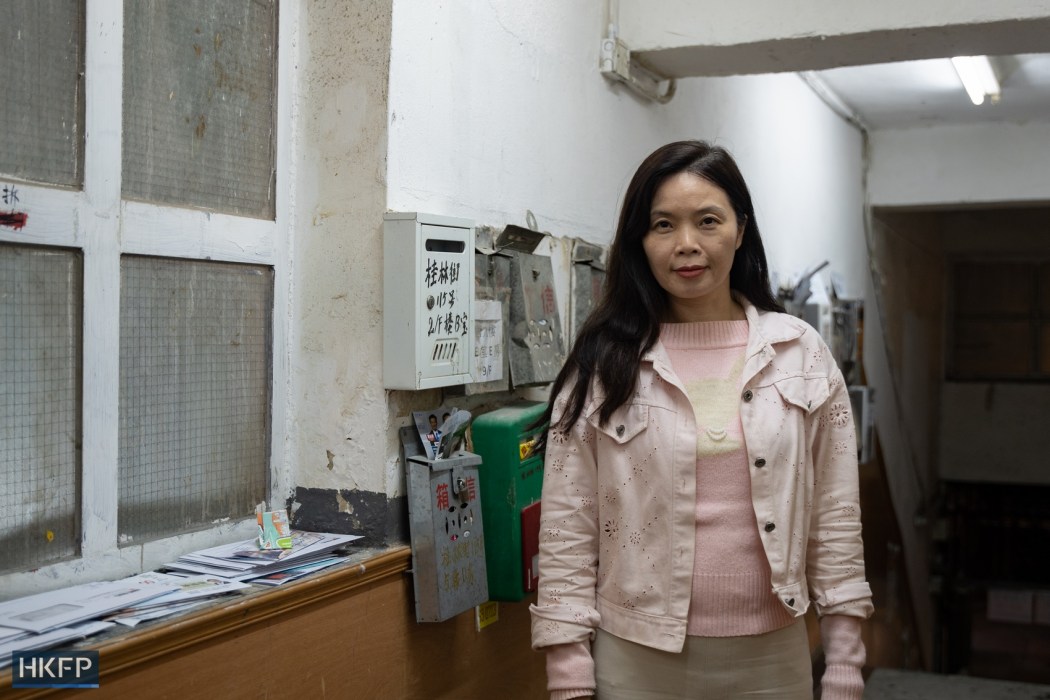
The Society for Community Organisation, an NGO that works with underprivileged groups, said the reform could help alleviate some of the worst living environments in Hong Kong.
But more government housing is needed, especially in the central areas, said Sze Lai-shan, the group’s deputy director.
“Don’t expect these people who live in very small flats to move into the new basic housing units. They won’t be able to afford it,” she said.
“A lot of the poorest people will be very dependent on the government to resettle them.”
The charity knows of around 300 households threatened with forcible eviction from subdivided flats, with more expected to follow, according to Sze — far more than the 35 notices the government said it had received.
Some residents have moved into public or transitional housing, while others have moved into other substandard flats as a temporary measure, Sze added.
‘Coffin homes’
Liu Xiaoli, who faces eviction from her subdivided flat, works two part-time jobs as a cook and cleaner to make ends meet after her divorce, and supports her daughter and granddaughter in mainland China.

“If the rent here or in other places goes up, I really can’t afford it,” the 63 year-old told AFP, adding that she was unable to find alternate accommodation nearby.
“I couldn’t find any (apartments) that meet the government’s requirements,” she said.
“Right now, I’m just delaying as much as I can.”
In response to AFP’s inquiry, the government said it had “significantly increased public housing supply” with an aim to produce around 196,000 units in the next five years, and sped up the process for residents on the waiting list for public housing.
These measures would contribute to “reduced demand” for subdivided units, keeping rents at bay, a Housing Bureau spokesperson said in a statement.
The new rules do not apply to notorious “coffin homes”, cubicles stacked on top of each other like bunk beds in shabby dormitories.
Wan Hon-cheung, 64, has been living in a plywood box about the size of a single bed for the last 10 years, and hopes the government will improve conditions for residents like him as well.
He often gets bitten by bedbugs and walks with a cane, making climbing up and down from his bed difficult.
“For us lower classes… this is reality, there’s nothing to complain about.”
