
 Login
Login
São Paulo stock exchange reverses losses and closes higher on US-Iran negotiation signals
 The São Paulo stock exchange reversed its losses in the final minutes of trading and closed Tuesday with a slight gain of 0.05%, lifted by President Donald Trump's statement that he is in "heated negotiations" with Iran just hours before his ultimatum for the reopening of the Strait of Hormuz expired.
 According to a report by Agência Brasil, industry specialists and oil-sector groups say what they describe as abusive fuel price increases in Brazil are not explained by international volatility alone. The report cites cases of gasoline being sold for R$9 a liter at some stations in São Paulo and links part of the distortion to the loss of state control over the distribution chain after the privatization of BR Distribuidora.
 Jorge Messias, Brazilian President Luiz Inácio Lula da Silva's nominee to fill the open seat at the Federal Supreme Court (STF), defended on Wednesday before the Senate the need to limit the power of judges, in a bid to expand support for his candidacy in what is shaping up to be a closely contested vote. The Solicitor General of the Union appeared before the Constitution and Justice Committee, where he made explicit overtures toward the Bolsonarist right-wing opposition, particularly critical of the country's top court's recent rulings.
 Agostina Páez, a 29-year-old Argentine lawyer and influencer from the province of Santiago del Estero, has been held in Rio de Janeiro since January 14, when she was filmed making racist gestures toward employees of a bar in the Ipanema neighborhood. The video quickly went viral and led to three criminal complaints for racial slur, a crime that carries a penalty of two to five years in prison per offense under Brazilian law.
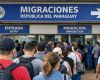 Hundreds of Brazilians camped overnight on beach chairs, plastic benches and tarps outside an immigration center in Ciudad del Este, on the border with Brazil, to secure a spot in a Paraguayan government drive to fast-track residency applications. Some organized an improvised barbecue on a barrel while they waited. Others had traveled more than 1,500 kilometers by bus. All shared a common thread: the desire to leave Brazil for reasons they describe as political, economic and ideological, according to a report by BBC News Brasil.
 A federal judge in Rio de Janeiro issued a preliminary injunction suspending the 12% crude oil export tax for five international companies operating in Brazil: Shell, TotalEnergies, Equinor, Repsol Sinopec and Petrogal. The ruling represents an initial court victory for the oil companies in their dispute with President Luiz Inácio Lula da Silva's government over a levy they consider unconstitutional.
 The presidents of Brazil, Luiz Inácio Lula da Silva, and Paraguay, Santiago Peña, agreed on Sunday in Campo Grande to intensify negotiations over Annex C of the Itaipú treaty, the instrument that governs the financial terms and energy sales of the binational hydroelectric dam, one of the largest in the world.
 Chilean executive Germán Naranjo Maldini has been held since Friday 15 May at the Guarulhos prison on the outskirts of São Paulo, charged with racial slur after directing racist and homophobic insults at a flight attendant of the airline Latam during a flight between São Paulo and Frankfurt on 10 May. The Chilean fishing company Landes, where he served as commercial manager, formally and preventively removed the executive from his position following the circulation over the weekend of a video showing the verbal attacks.
 Brazilian President Luiz Inácio Lula da Silva on Tuesday unveiled in Brasília a public security plan worth around USD 2.25 billion aimed at weakening the finances of organized crime, regaining control of prisons, curbing arms trafficking, and improving homicide investigations, five months ahead of October's presidential election. The package is designed to give the government a distinct identity on one of the issues where public opinion sees the ruling party at its weakest against the right wing's punitive narrative.
 Brazilian President Luiz Inácio Lula da Silva on Tuesday rejected the US government's argument that Brazil engages in “unreasonable” practices in the bilateral relationship, arguing that it is Washington that runs a trade surplus with his country. If anyone should impose tariffs, he said, it would be Brazil.º
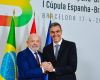 Brazilian President Luiz Inácio Lula da Silva and Spanish Prime Minister Pedro Sánchez on Friday cemented a political alliance in Barcelona between the European and Latin American left against the advance of the far right on both continents. At the first bilateral Spain-Brazil summit, held at the Pedralbes Palace with military honors and the participation of roughly ten ministers from each side, both leaders displayed total alignment and signed a series of cooperation agreements.