 Login
Login
P51 Comes In For Landing!
KohensDigicams07 posted a photo:

This was towards the end of the airshow when the classic P51 Mustang returned to the ground! This was shot on the Kodak EasyShare CD33:)


KohensDigicams07 posted a photo:
This was towards the end of the airshow when the classic P51 Mustang returned to the ground! This was shot on the Kodak EasyShare CD33:)

As Japanese retail analyst BCN+R described earlier this year, DJI had a massive market share in the video camera market in 2025. The Chinese tech company's dominance has only strengthened so far in 2026.
I’ve only ever been charged by two species. The bear took only a few quick steps before stopping.


The snowshoe hare, on the other hand, well, I was reminded of the killer bunny scene in Monty Python’s The Holy Grail.


In 2014, on a trail in Rocky Mountain National Park, a showshoe hare charged toward me. I wondered with confusion how this was going to play out when he stopped, regarded me for a moment, and then ran off into the woods just over a yard away from me.


I had a similar experience this summer while hiking the Sherman Peak Loop Trail in eastern Washington. As the trail snaked up the mountain, I rounded a curve to see a snowshoe hare sitting on the trail. I stopped. The hare didn’t move. Suddenly, he bolted in my direction. I wasn’t sure what his intention was when he slowed and came right at me. Initially, I thought he was going to blow past me. I was simply between him and a preferred hiding spot, a warren or a family. I stomped my foot as he stopped next to me, and he startled, disappearing into the brush. I’m not quite sure whether he touched my pant leg or not. It all happened so fast!


What is it with the snowshoe hare?!? I’m reminded of an exotic animal veterinarian who remarked, “If rabbits had canine teeth, they would rule the world.”
Starting up the connector trail, I thought, “This must be the bobcat’s favorite trail,” because of the frequency of feline scat along the route. Joining the loop on the east side, the habitat is dark and wet with a few mosquitoes. Small rivulets trickle across my path.


The forest opens up to a rock slide dotted with dense stands of willows, where I talk aloud as I hike so as not to surprise wildlife – snowshoe hare or otherwise.


Elk sign becomes prevalent along the way, and the mountainside is covered with huckleberry bushes. Two people on muleback, going downhill, pass me. Mules are perfect for this rugged terrain. As I continued to climb, rounding along the south side, wildflowers began to flank the trail. Although it’s called the Sherman Peak Loop, I expected it to loop around the peak. But with all of this elevation gain, I’m beginning to wonder if the peak isn’t part of the loop!

The route levelled out at 1150 feet from where I started, 6400 feet above sea level, in an area of meadows, with lupine and pine trees. There’s mountain lion scat on the trail. I stop to look for any other signs of this beauty. I find that I’m more at ease where the trail traverses treed slopes thick with windfall. It seems like animals are less likely to hang out there, but these broad, park-like flat areas are easy-going for all of the animals that call this mountain home. It makes me a little uneasy.


From this side of the mountain, there are views southward for days. I can almost see my house from here!

Passing the Kettle Crest trail junction, I round onto the west side. I leave the forest and stop in awe at the expansive fields of wildflowers – lupine, buckwheat, paintbrush.


The ground squirrels are chastising me, chattering from their lookouts downslope. I keep stopping to marvel at the beauty.


The carpets of flowers get more dramatic with each step. I can’t afford to linger as much as I’d like because I got a late start today.


Leaving the meadows, I enter a dense stand of young trees crowding the trail. Again, I’m talking to myself, nature, no one, and everyone. My bear spray is at hand, but it’s best that I don’t need it. I’m curving around to the north side on a gentle descent, again seeing the bobcat-sized feline scat that was so common at the outset. There’s another snowshoe hare just off the path. It’s not until this moment, when I see the scat and the hare together, that it clicks.


Snowshoe hares are lynx’s favorite prey. This could be lynx scat!!

When I get back to civilization, I learn that I was hiking in the Colville National Forest Lynx Recovery Zone! My first lynx (scat) encounter!!
This loop has been a wonderful trip through a diversity of habitats. Over three hours and five-and-a-half miles, every step was a delight.


If you’re interested in purchasing or licensing any images you see here, please email me at SNewenham at exploringnaturephotos.com, and I’ll make it happen.
Subscribe here to receive an email whenever a new blog posts.
The post Sherman Peak Loop Trail appeared first on Exploring Nature by Sheila Newenham.
Rabbits and hares are often overlooked, even though they are a crucial part of our ecosystems serving as a key food source for many species and even an indicator of climate change.
“Poor rabbits. It’s the exact reason I started rehabbing them, because I felt sorry for them,” says Tallulah, founder of My Wildlife Rescue, the only authorized wildlife custodian in Ontario that specializes in rehabilitating neonatal and juvenile wild rabbits and hares. “Other animals have the ability to defend themselves.”
Tallulah, who opened her rescue in 2018, suggests there are two reasons that rabbits and hares are underrated animals: people see rabbits as common and often assume wild native rabbits and domestic rabbits are similar, so they lose interest in learning about wild ones. “Basically, they are just seen as common, and you can just get [a domestic] one in the store,” she says.
And unlike bears, lynx and wolves, “They aren’t charismatic megafauna…Humans like to learn about predators, I don’t know why, but it seems like something we can relate to,” Tallulah hypothesizes, “They are also very hard to study because they are small, quiet and active at dusk and dawn.”
Although largely understudied in Ontario, Tallulah argues that native rabbits and hares are sensitive indicators of climate change. Droughts, for example, can drastically reduce rabbit litters mid-summer, as extreme heat stresses mothers, limits food, and increases mortality among kits. “Last year, we had loads of babies in the spring, then nothing in the middle of the summer, and it picked up again in the fall,” says Tallulah, reflecting how a summer drought directly affects rabbit populations.
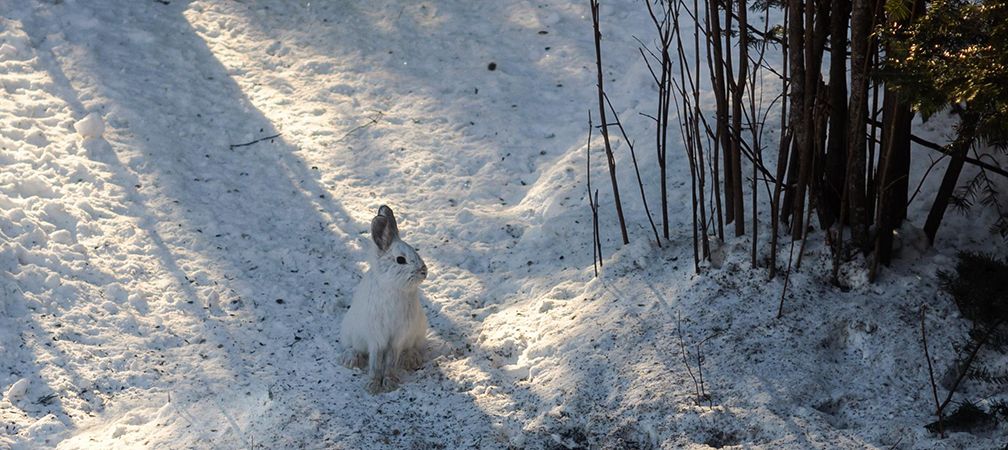
Snowshoe hares face another challenge: their fur changes colour based on day length, not snow cover. With winters arriving later and ending earlier, the white hares stand out against snowless ground, making them more vulnerable to predators. Changes in populations and survival rates of these animals reflect the broader impacts of shifting weather patterns.
Because wild rabbits and hares are often not seen as having economic value, rescues that care for them tend to receive limited public or government support and fewer donations. This is unfortunate, as species like the snowshoe hares form a crucial part of the food web. “They basically feed everybody. For example, the Canada lynx lives and dies by the cycle of the snowshoe hare. If there are very few hares, there will be very few lynx because that’s usually what they eat.”
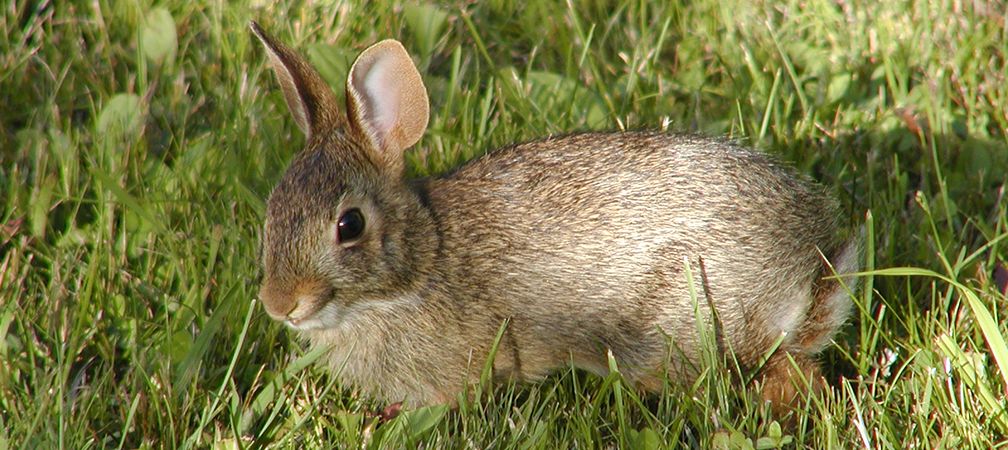
At her Ottawa-based rescue, Tallulah cares for two of Ontario’s most common young rabbits (kits) and hares (leverets): Eastern cottontails and snowshoe hares. In total, Ontario is home to five species, including the white-tailed jackrabbit, Arctic hare in the far north, and the non-native European hare, which was introduced over a century ago but is rarely seen today. Chances are that the Eastern cottontail and snowshoe hare are the two you’ll most likely spot in the wild.
If you come across a young rabbit or hare, these key differences can help you identify them:
Rabbits are born blind, hairless, and completely helpless. They grow fur and open their eyes around seven to eight days old. Eastern cottontail rabbits build small nests, shallow indentations in the grass lined with fur and vegetation.
Hares are born with fur, with their eyes open, and are ready to move. Snowshoe hares do not burrow; instead, their leverets are born in the open. Within a day, the young start exploring and hiding, though they remain near the birthplace because the mother returns twice daily to feed them, similar to Eastern cottontails. Additionally, mature hares fur changes colour with seasons, helping them blend into their environment.
“Everybody can do something [to help rabbits and hares this spring],” says Tallulah. Here’s what she recommends:
