KUALA LUMPUR, June 3 – Live Nation Malaysia’s managing director Paramananthan Rajagopal is urging fans once again to source their concert tickets from authorised and official ticketing platforms.
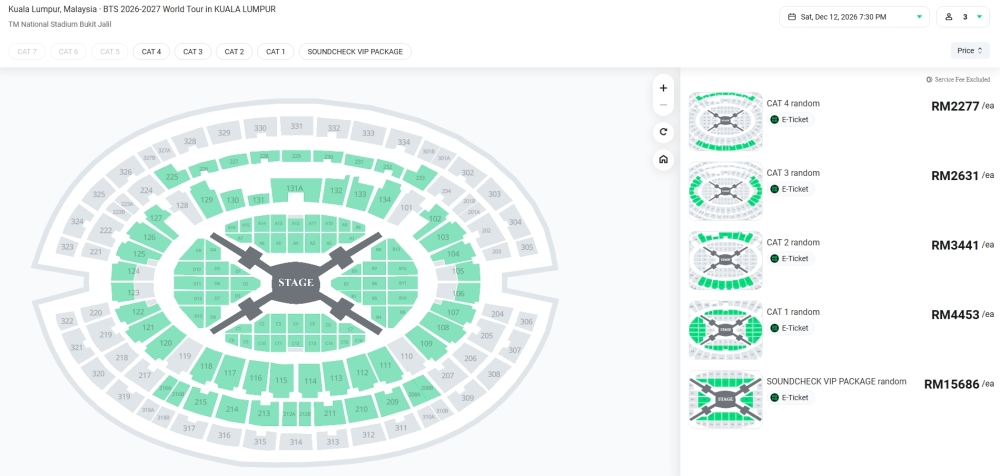
This comes after several secondary ticketing or reseller websites such as Viagogo or Veritickets were already seen selling tickets for the upcoming K-pop group concerts BTS World Tour ‘Arirang’ in Kuala Lumpur even before the presales started.
In a brief conversation, Paramananthan told Malay Mail that fans should stop sourcing tickets from such sites as it could lead to ticketing scams and they should be aware of the websites they are visiting.
“When the buying stops, so does the scamming.
“Fans also need to be aware of the authenticity of these platforms,” he said.
When asked whether Live Nation Malaysia will take legal action against these sites, Paramananthan said that there are no legal action they could take against these types of resellers as Malaysia does not have any law that explicitly bans ticketing scalping.
Previously, local BTS fans took to social media platforms such as X and Threads to vent their frustrations after several secondary ticketing websites were seen selling the highly anticipated BTS in KL tickets even before its official release dates.
Aside from that, local BTS fans also called out several influencers who were allegedly trying to sell BTS in KL tickets ahead of the release date too via social media.
A screenshot from a secondary ticketing website Veritickets selling tickets for the upcoming BTS in KL concerts at inflated prices and before the official presales even began. — Screenshot via veritickets.com
A check by Malay Mail showed that a reseller site, Veritickets, was selling several ticket categories, including the VIP package, for the upcoming BTS in KL concerts at inflated prices of RM2,000 to RM15,000.
The original ticketing prices for the concerts ranged between RM338 to RM1,288.
Although Malaysia does not yet have an anti-scalping law, it was previously reported that one is currently being formulated by the Ministry of Domestic Trade and Cost of Living (KPDN) and the Communications Ministry.
However, this was reported back in 2023 and little to no updates have been provided by either ministry so far despite Malaysia expecting to host several global concert tours this year.
I’m not nearly as worried about mice and rats as I am of the looney in charge of Health and Human Services.Hantaviruses are spread in rodent droppings, which is why they’re a greater threat out West where desert climates suit rodent life and their droppings don’t return to the earth quickly. And how better could […]
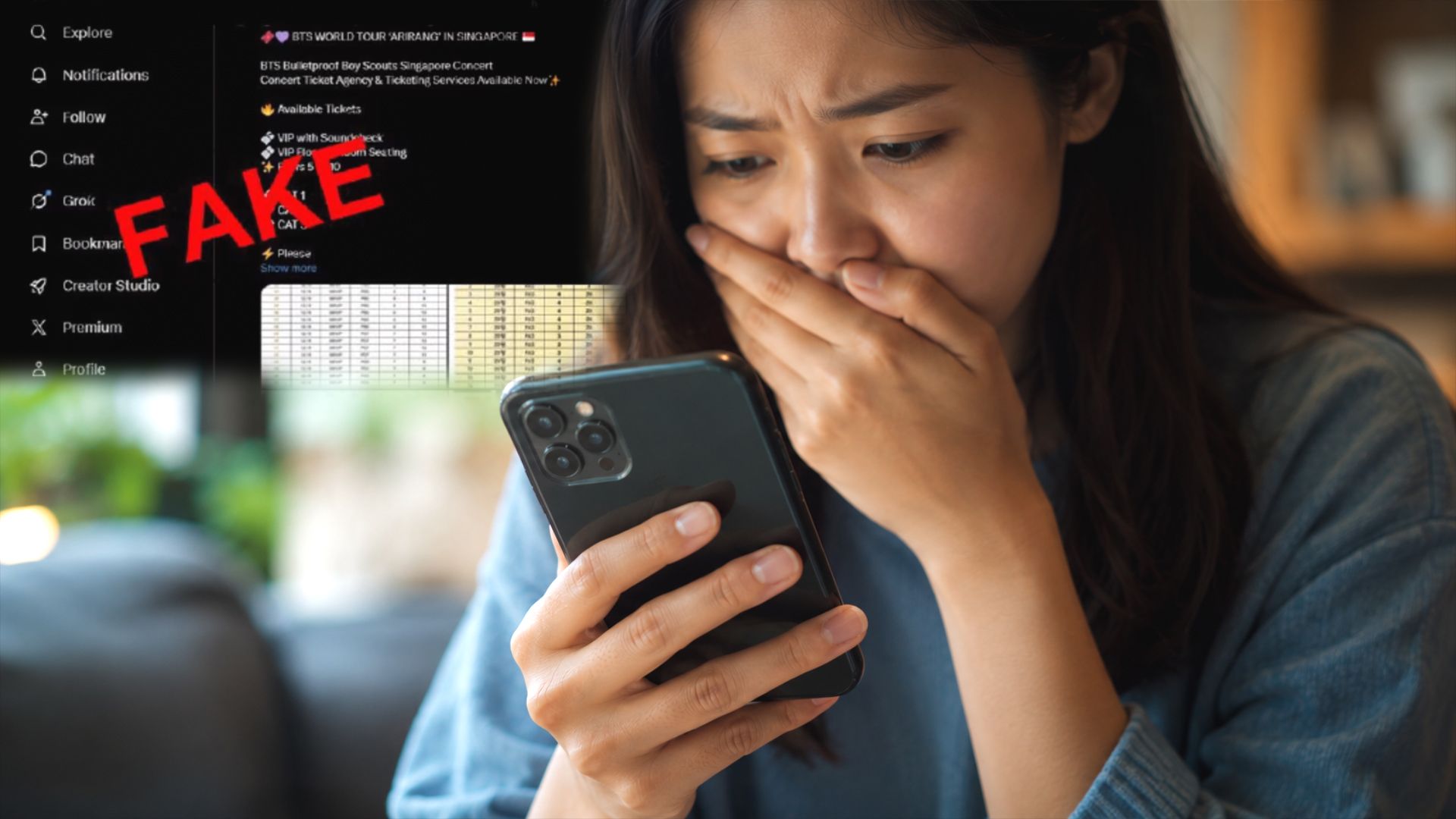
SINGAPORE: Singaporeans hoping to secure seats for BTS’s upcoming concerts have already lost at least S$11,000 to scammers, according to the Singapore Police Force (SPF), cited by Channel NewsAsia (CNA) in a June 6 report.
The police said at least 14 reports linked to fake BTS World Tour “Arirang” ticket sales were lodged between June 1 and June 6. The warning comes as demand for tickets remains sky-high following the start of presales this week. Many of the scams began on the social media platform X (Twitter), although fake listings were also spotted on Instagram and Carousell. Victims were typically drawn in by posts offering concert tickets.
Once contact was made, they were asked to transfer money through PayNow or a PayNow QR code. After receiving payment, scammers demanded more money in the usual case, claiming there were extra processing or administrative charges. The scam only became apparent when the promised tickets never arrived.
Concert ticket demand creates supply opening for scammers
The timing is hardly surprising. BTS, at present, is one of the biggest names in global entertainment, and demand for their concert tickets has been intense. During the first presale session, queue numbers reportedly stretched into the tens of thousands.
A demand of that nature creates the perfect supply conditions for scammers. Fans worried about missing out can be tempted by offers that appear genuine, especially when official tickets seem impossible to secure.
The losses reported so far average nearly S$800 per case, showing how fast small transactions can add up when excitement overrides caution.
Police remind fans that tickets cannot be transferred or legally resold
SPF stressed that concertgoers should only purchase tickets through authorised sellers such as Ticketmaster. The police pointed out that tickets sold through the platform are non-transferable and cannot legally be resold. Anyone attempting to enter the venue with a resale ticket risks being turned away without a refund.
Authorities also warned fans to be sceptical of claims that tickets can be transferred into a Ticketmaster account after purchase. They added that Ticketmaster doesn’t send tickets by email.
The warning addresses one of the most common tactics used by fraudsters, who craft convincing stories to persuade buyers that a ticket transfer is possible.
Social media platforms are working with authorities to prevent scam activities
SPF said it is working with X (Twitter) to remove fraudulent accounts advertising BTS tickets. It has also contacted Carousell to take down suspicious listings.
The police noted that some major platforms already restrict ticket sales. Under Meta’s commerce policies, Facebook Marketplace doesn’t permit listings for event tickets, while TikTok Shop does not support such transactions.
As scams continue to adapt to popular events, authorities are encouraging the public to use the ScamShield app, enable two-factor authentication and set banking transaction limits.
Concert tickets may be hard to get, but losing money to a scam is far worse. A simple rule remains the safest one: If a ticket offer appears outside official channels, walk away and wait for a legitimate opportunity instead.
Crypto swaps are fast and permissionless, which is exactly why scammers love them. Before you hit “swap,” decide where you’ll execute: a DEX router you trust (Uniswap, 1inch) or a centralized venue where you can sanity-check tickers, fees, and withdrawals (Binance, Kraken, Coinbase).
A simple way to cut risk is by reducing unknown interfaces and “too-good-to-be-true” rate widgets. If you’re comparing venues, using a low-fee crypto exchange can help you avoid hidden costs scammers often mask with wide spreads or fake fee breakdowns, especially if you stick to well-known brands and consistent workflows. For instance, some users prefer services like Changelly for straightforward swaps, while others keep it simple with a single CEX account (like Kraken) they’ve already secured with 2FA. Either way, look for transparent maker/taker pricing, clearly listed withdrawal fees, and a site/app you’ve bookmarked.
In 2026, swap scams are more polished than ever, preying on urgency: gas spikes, sudden pumps, and “fix your transaction” prompts. This guide breaks down the most common swap scams and the habits that keep your funds safe.
Understanding Crypto Swap Scams
Scammers exploit the seamless UX of DEXs through fake interfaces and sponsored ads that mimic legitimate platforms. These phishing sites use subtle URL misspellings (“unlswap.org” instead of “uniswap.org”) and trick users into granting unlimited token access via hidden approvals or EIP-2612 permit signatures. One wrong click grants attackers full wallet access.
Telegram bot-in-the-middle attacks swap output tokens with worthless lookalikes, while fake bridges demand deposits to random addresses rather than minting on destination chains. Cross-chain “gasless” approvals grant permanent spending rights. Young professionals face targeted attacks through LinkedIn, Discord, and Twitter DMs promising exclusive deals.
Protection is straightforward: verify URLs manually, double-check token addresses, scrutinise approval requests, and use revoke.cash regularly. Make verification your default habit.
Targeted Platforms and Attack Vectors
The biggest platforms face the most attacks. Uniswap, PancakeSwap, 1inch, Matcha, ParaSwap, and Jupiter see constant impersonation. MetaMask, Trust Wallet, Phantom, and Coinbase Wallet are spoofed relentlessly through Google ads that rank above legitimate results.
ScamSniffer and Chainalysis identify MetaMask plus Uniswap or 1inch as the top phishing combination. Drainer kits like Inferno and Angel have stolen hundreds of millions since 2023. Networks with lower fees (Base, Arbitrum, Polygon, BNB Chain) attract high retail volumes and therefore more scammers. Always verify the URL and contract address; never assume familiarity equals safety.
Approval and Permit Signature Scams
Approval scams trick users into granting unlimited spending rights to malicious contracts. That routine “approve max" on a fake Uniswap site lets attackers drain your entire token balance. Gasless permits (EIP-2612, Permit2) are worse, as one signed message with no gas cost grants instant drain capability. Phishing sites clone legitimate interfaces but swap the spender address to attacker contracts.
Always check wallet prompts: verify spender address, token, allowance amount, and deadline. If it's infinite or unfamiliar, decline. Use simulation features in MetaMask and SafePal. Set custom spending caps, never infinite. Audit approvals regularly via revoke.cash. Hardware wallets force review of every signature, making blind signing nearly impossible.
Fake Tokens, Honeypots, and Rug Pulls
Permissionless DEXs allow anyone to create tokens. Scammers clone logos and tickers of legitimate projects, hiding malicious functions like unlimited minting or 99% trading taxes in unverified contracts. Honeypots allow buys but block sells through anti-sell logic or cooldowns. Liquidity rug pulls occur when creators withdraw pool liquidity after building hype, either instantly (hard rug) or gradually through fee manipulation (soft rug).
Protect yourself: verify contract code on Etherscan, check LP lock duration, confirm ownership is renounced, and review holder distribution. Tools like Honeypot.is and Token Sniffer catch many scams but not all. If slippage looks abnormal or transaction taxes are excessive, walk away. FOMO is the scammer's best friend; patience and due diligence separate winners from victims.
MEV Sandwich Attacks
MEV searchers exploit your slippage by sandwiching trades. When your transaction hits the mempool, they frontrun (buy to push price up), you execute at the inflated price, then they backrun (sell into your buy). Wide slippage settings give searchers free profit. Low-liquidity pools and large orders amplify vulnerability.
Defence: use tight slippage (0.1–0.5% on major pairs), split large orders, route via private RPCs (Flashbots Protect, MEV-Blocker), or use intent-based protocols like CoW Swap. Limit orders remove urgency. Always simulate trades to check price impact; suspiciously high impact may indicate wash trading.
Cross-Chain Bridge Scams
Fake bridge sites (impersonating LI.FI, Wormhole, Stargate) demand deposits to random wallets rather than minting wrapped tokens properly. Router swap traps push unlimited approvals disguised as bridge interactions. Compromised socials create urgency with fake airdrop announcements. Malicious RPC endpoints can flip chain IDs or destination addresses mid-transaction.
Ask yourself: why rush? Why unlimited approval? Type bridge URLs manually, set custom spending caps, verify destination chain ID, and test with small amounts first. Use revoke.cash regularly to audit old permissions.
Phishing and Address Spoofing
Phishing links lead to fake interfaces that drain Permit2 approvals or reroute swaps. Chainalysis tracks billions in losses from these attacks. Address poisoning plants lookalike addresses ("0x1234...ABCE" versus "0x1234...ABCD") in your transaction history; when you paste it later, funds vanish. ENS/Unicode spoofing uses homoglyphs and zero-width characters to mimic trusted domains (“.еth” using Cyrillic instead of “.eth”).
Never click links; instead, type URLs manually. Verify full EIP-55 checksummed addresses on hardware wallet screens. Use transaction simulation (Rabby, Safe, MetaMask). Maintain an address allowlist and copy from it, never from transaction history. Urgency signals scams, as legitimate opportunities don't require split-second decisions.
Defensive Tools and Workflow
Layer your defences. Route via MEV-Blocker RPC or CoW Swap for private execution. Set slippage 0.1–0.5% for liquid pairs with 5-to 10-minute deadlines. Only swap verified tokens from Uniswap/CoinGecko lists, check Etherscan for contract age, holders, and locked liquidity. Run simulations with Pocket Universe or Tenderly before executing.
Never approve infinite amounts; set exact spending caps. Audit approvals regularly via Revoke.cash. Separate wallets by risk: hot wallet for experiments, and hardware vault for main holdings. Install WalletGuard or Scam Sniffer extensions. Enable MetaMask/Blockaid security alerts.
Pre-swap checklist:
Verify token contract from official site, check on Etherscan.
Compare quotes across aggregators, check price impact.
Set tight slippage and MEV protection.
Approve exact amounts only.
Check gas and mempool congestion.
For bridges: confirm chain ID, use official interfaces, test small amounts first.
Execute a tiny canary swap before making a full trade.
ROI of Security
Protecting principal beats chasing marginal gains. Would you risk 100% loss to save £5 in gas? Using trusted aggregators costs 0.2–0.5% more but preserves capital. A £2,000 approval scam drains everything, while revoking costs £10 and prevents total loss. That's 200x ROI. Setting 0.5% slippage on £5,000 trades saves £25 versus 1% slippage.
Verifying contract addresses takes 30 seconds. Hardware wallet prompts add 3 seconds but eliminate unlimited approval risks. Missing a 20% gain hurts, but avoiding one rug pull offsets years of fees. One catastrophic loss erases months of profits.
Scepticism pays dividends. Impulsiveness pays scammers. The traders who survive aren't the fastest or most aggressive, they're the most disciplined. Build verification into your routine until it becomes automatic. Protect your capital first, and everything else follows.
About the Author
Post by:
Joshua Merrick
Joshua Merrick is a cryptocurrency strategist and blockchain professional specializing in digital asset infrastructure and exchange technologies. He is a senior team member at Changelly, where he contributes to the platform’s growth, strategic partnerships, and product development initiatives.
Focused on expanding access to seamless crypto-to-crypto exchanges, Merrick plays a key role in advancing Changelly’s mission to simplify digital asset transactions for users worldwide. With a strong emphasis on security, innovation, and user experience, he continues to support the evolution of cryptocurrency as a practical and widely adopted financial technology.:
SINGAPORE: A Singaporean car driver who staged traffic accidents to squeeze cash from unsuspecting motorists has been sentenced to 32 weeks in jail, ending a scheme that lasted more than four years.
Danial Ali Liaqat Ali, 28, was linked to at least 73 traffic incidents between September 2019 and January 2024. Most of the crashes were deliberately engineered, so he could demand on-the-spot cash settlements from other drivers.
On June 5, a Singapore court sentenced him to 32 weeks’ imprisonment and fined him S$6,000. He will also be barred from driving for 48 months after completing his jail term, The Star Online reported.
Road scam that uses motorists’ confusion to extract cash
The case stands out in the incidents involved and exposed a form of road scam that uses confusion, pressure, and motorists who prefer to avoid lengthy disputes.
Court documents showed that Danial actively sought opportunities to cause near-collisions or minor crashes. He would drive dangerously close to other vehicles, fail to brake in time or accelerate into situations likely to result in contact between vehicles.
After the incident, he would approach the other driver and claim compensation was needed for damage. He typically demanded private cash settlements ranging from S$180 to S$1,500. The total amount he collected wasn’t disclosed in court.
One incident took place on July 19, 2023, near the junction of Cantonment Road and Keppel Road. Court records showed Danial manoeuvred his vehicle in a way that created the appearance of a collision. Although no impact occurred, he later stopped the other motorist and claimed damage had been caused to his car. The driver paid him S$180.
The following day, he used a similar tactic on another motorist along Sims Avenue and extracted S$300.
In another case on Nov 5, 2023, along Geylang Road, Danial positioned his vehicle during a lane change and came into contact with another car’s side mirror. He then blamed the other motorist and obtained S$300.
Beyond the staged incidents, prosecutors said he failed to report 29 traffic accidents to the authorities between March 2023 and January 2024.
Fraud extended beyond the road
His troublemaker activities didn’t end just on the roads. Deputy Public Prosecutor Hidayat Amir told the court that while working as an assistant outlet manager at bakery-cafe chain Cedele, Danial created a membership account using his own details. He then entered his personal contact number into customer transactions to collect loyalty points.
Within days in October 2025, he accumulated enough points to redeem a S$100 voucher. He was also accused of pocketing S$100 cash from a customer later that month.
Road accidents should be handled through proper reporting channels, not private roadside settlements
During sentencing, prosecutors argued that Danial’s actions created serious risks for motorists and passengers. By deliberately engineering collisions and near-collisions, he exposed multiple road users to potential harm.
The case shows that even minor traffic incidents should be handled through proper reporting channels rather than private roadside settlements. A fast cash payment may seem like the easiest solution in the moment, but official reporting remains the best protection for everyone involved.
SINGAPORE: Singapore police are warning the public about a growing investment scam that begins with something that sounds harmless: a free investing lesson.
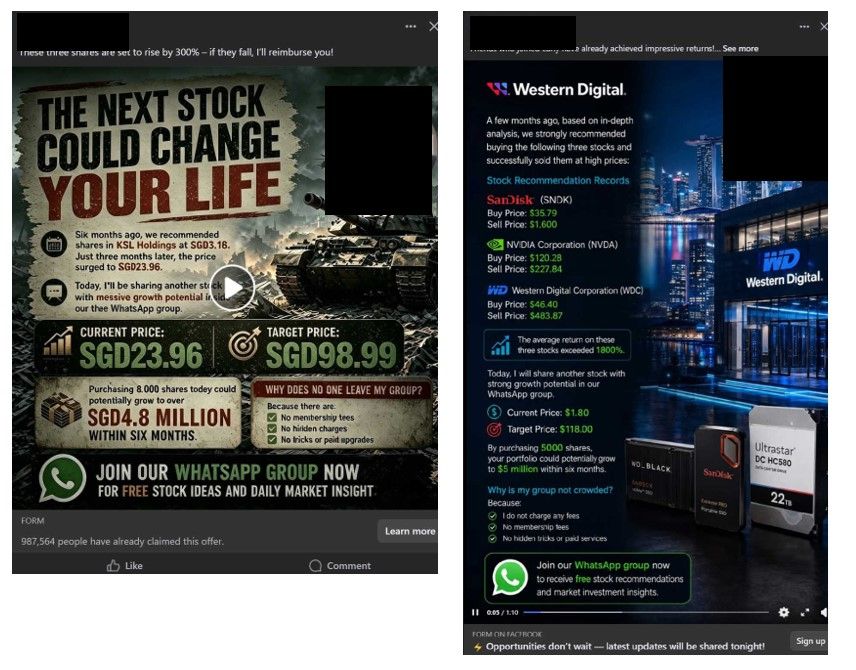
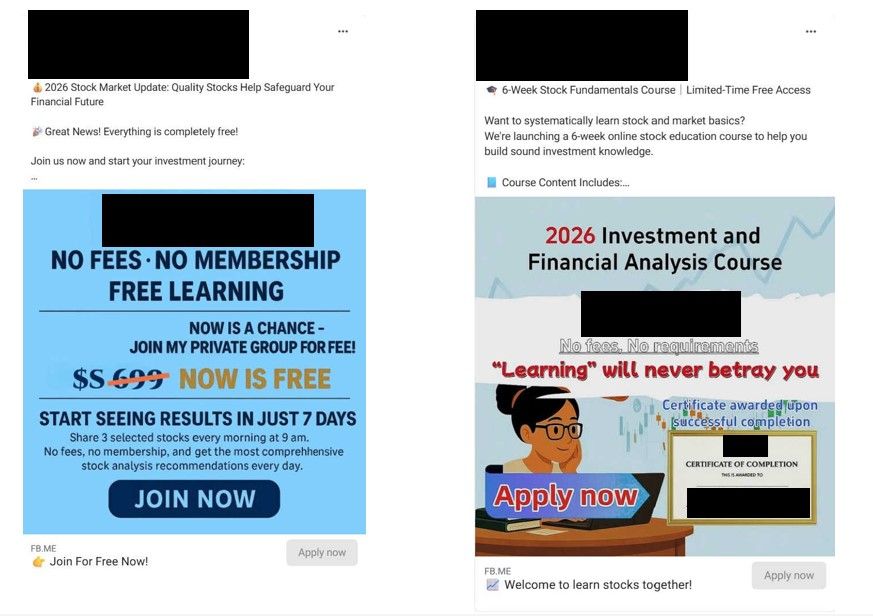
Since May 2026, at least 48 cases have been reported, with total losses reaching at least S$3.6 million, according to the Singapore Police Force (SPF). Victims were drawn in through fake social media advertisements promising free investment education before being added to WhatsApp chat groups.
Singapore Police Force (SPF)
Annex A – Examples of Online “Advertisements”
Singapore Police Force (SPF)
Annex A – Examples of Online “Advertisements”
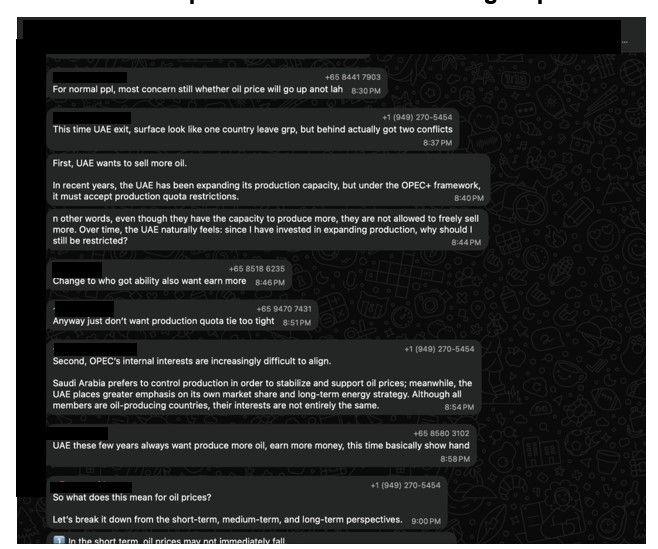
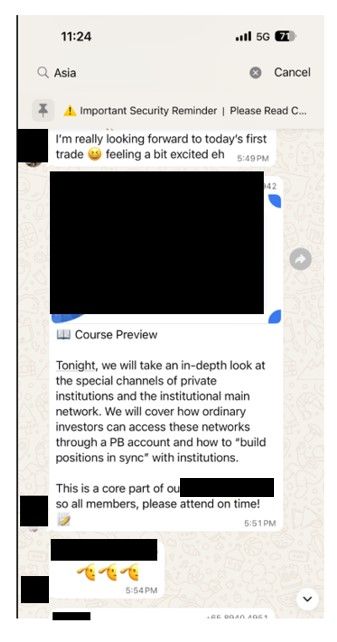
Inside these groups, scammers posed as investment mentors and shared tips, advice and bonus offers.
Singapore Police Force (SPF)
Annex B – Examples of “Investment” Chat Groups
Singapore Police Force (SPF)
Annex B – Examples of “Investment” Chat Groups
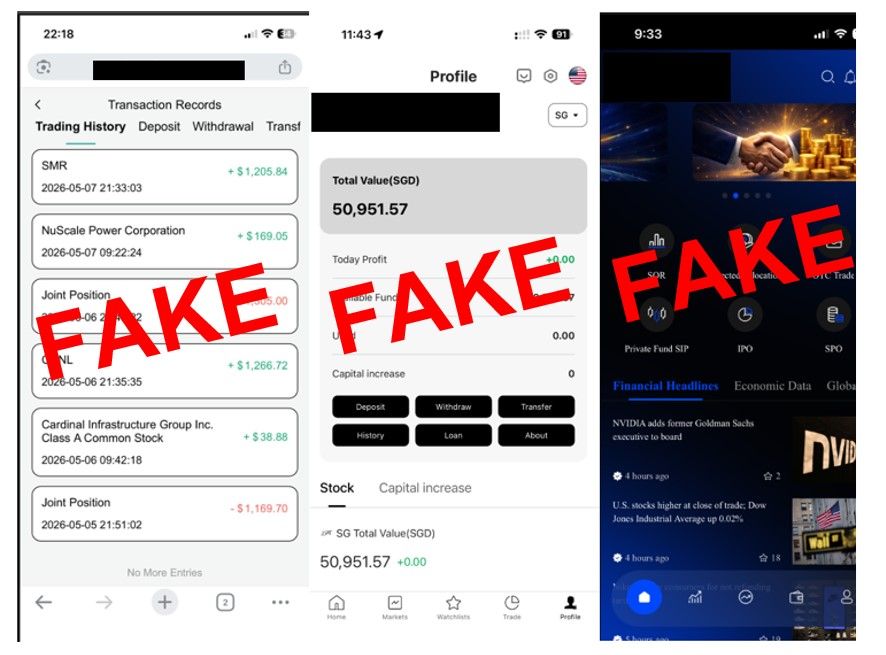
Fake group members also posted screenshots showing supposed trading gains, creating the impression that others were making money. The plan was to convince victims that the opportunity was genuine.
From free lessons to real losses
According to SPF, victims were eventually directed to create accounts on fraudulent investment websites or download fake investment apps. They were then instructed to transfer money into bank accounts controlled by scammers.
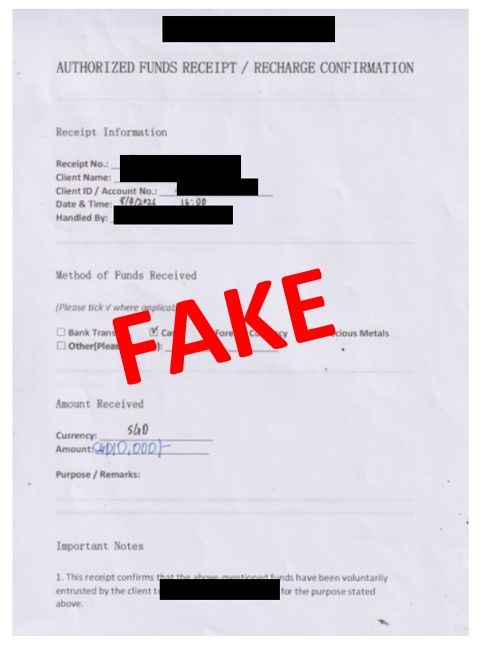
Some victims were even persuaded to hand over cash or gold to people claiming to represent investment firms. In return, they received invoices designed to make the transactions look legitimate.
Singapore Police Force (SPF)
Annex C – Example of an “Invoice” Received by the Victims
To maintain the illusion, scammers sometimes provided small early returns. Those payouts encouraged victims to invest larger amounts.
The scam usually became apparent only when victims tried to withdraw their supposed profits. By then, the money was gone, and the scammers could no longer be contacted.
Screenshots, testimonials and financial “success stories” keep the scam working
Investment scams are hardly new, but this version combines several familiar tactics into one package. The promise of free financial education lowers people’s guard.
Group chats create social proof, making victims feel they are joining a community rather than dealing with strangers. Screenshots, testimonials and apparent success stories help reinforce that sense of credibility.
Singapore Police Force (SPF)
Annex D – Examples of “Investment” Websites and Applications
For many people, investing has become a bigger topic amid rising interest in wealth-building and retirement planning. Scammers know this and are increasingly tailoring their approaches to look like genuine learning opportunities rather than direct sales pitches, making the scams harder to spot at first glance.
Police advise on how to prevent these investment scams
SPF advised members of the public not to transfer money or hand over valuables to unknown individuals whose identities have not been verified.
The police also encouraged people to activate WhatsApp security settings that prevent unknown users from adding them to chat groups.
Before committing money to any investment, the public should verify the company and its representatives through official channels, including resources provided by the Monetary Authority of Singapore. Checking app reviews and confirming that an investment platform is legitimate can also help reduce risk.
Scams continue to change shape, but the warning signs for the most part remain the same. A promise of easy gains, pressure to act fast and strangers asking for money are still reasons to pause and take a second look; a moment of caution may be worth far more than any promised return.
For more information on scams, members of the public can visit www.scamshield.gov.sg or call the ScamShield Helpline at 1799. Fighting scams is a community effort. Together, we can ACT Against Scams to safeguard our community!
ADD – security features (e.g., activate the privacy function on your device to disallow unknown users from adding you to chat groups). For more information on WhatsApp’s security features, visit https://www.whatsapp.com/security.
CHECK – scam signs against official sources (e.g., the ScamShield app or the ScamShield website at www.scamshield.gov.sg). Verify the authenticity of the investment company by:
Asking questions to understand the investment opportunities. If the company is unable to answer or avoid answering any questions, be wary.
Checking on the company, its owners, directors, and management members to assess if the investment opportunities are genuine;
Confirming the company’s and representatives’ credentials through the Financial Institutions Directory, Register of Representatives, and Investor Alert List on the Monetary Authority of Singapore (MAS)’s website (www.mas.gov.sg);
Checking that the downloaded applications are legitimate and available on the official application stores, and
Checking for user reviews and ratings of applications before downloading them, even if they are believed to be legitimate and are available on official application stores.
TELL – authorities, family, and friends if or when you encounter scams. Report any fraudulent transactions to your bank immediately.

 Login
Login