MAY 17 — China’s view of the United States today is far more complex than many in Washington assume.
On one level, Beijing continues to admire the astonishing ability of the United States to reinvent itself technologically. No other country in modern history has demonstrated such a relentless capacity to attract capital, talent, innovation and global imagination into one concentrated ecosystem. From Nvidia to OpenAI, America still possesses a magnetic technological dynamism that few powers can replicate. Chinese strategists understand this very well.
They know that the current AI revolution is not merely about software or semiconductors. It is about the reorganization of power itself: military power, financial power, informational power, and civilizational influence. Artificial intelligence is increasingly becoming the operating system of modern geopolitics.
This is why China does not underestimate the United States. Indeed, many Chinese analysts openly acknowledge that the American ability to scale innovation at breathtaking speed remains unparalleled. The sheer rise of Nvidia to a valuation exceeding US$5.4 trillion, the concentration of AI investment in seven technology giants commanding nearly one-third of the entire S&P 500, and the willingness of Wall Street to pour unprecedented capital into speculative technological futures all demonstrate an ecosystem that still leads the world in financial and technological integration.
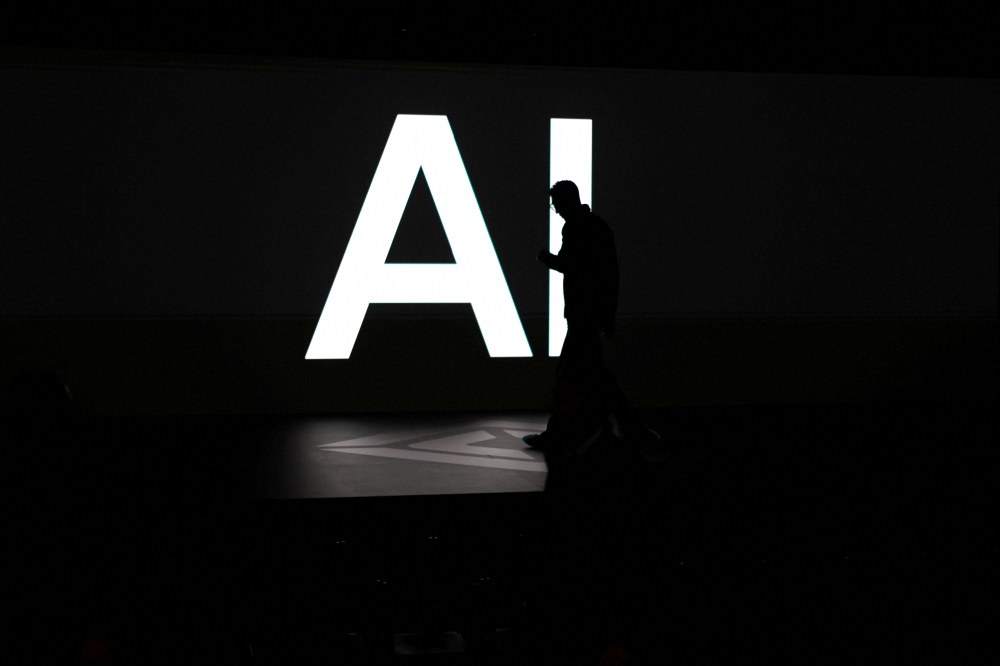
A screen reads “AI” in reference to artificial intelligence in Palo Alto, California, United States on December 11, 2025. — Reuters pic
Yet admiration does not translate into blind acceptance.
Beijing also believes that the United States is increasingly trapped by its own excesses. To Chinese policymakers, the current AI frenzy resembles the internal logic of previous American speculative cycles: the dotcom boom, the subprime mortgage expansion, periods of excessive financialization where capital detaches itself from underlying economic fundamentals. Chinese government economists have made the observation explicitly, characterizing US equity concentration as a systemic fragility rather than a sign of strength.
The concern in Beijing is not whether AI will transform the world. China fully believes it will. The concern is whether the current scale of valuation and capital concentration can be sustained without eventually triggering a severe correction. A system in which the Magnificent Seven account for nearly one-third of the S&P 500 is not a sign of healthy capitalism. It is a sign of dangerous concentration and systemic vulnerability. If those valuations correct sharply, the consequences for semiconductor supply chains, allied economies, and AI development timelines globally would be severe.
China therefore appears increasingly content to watch the American AI boom continue without directly obstructing it. There is a strategic patience in this posture. Chinese leaders likely calculate that excessive exuberance in American markets may eventually generate internal contradictions severe enough to weaken the United States from within. The larger the speculative bubble, the greater the eventual adjustment when profits fail to match expectations or when capital begins searching for safer assets.
In this sense, Beijing may believe time is on its side.
Unlike the United States, China’s governing structure remains far more state-directed and less exposed to sudden speculative swings in equity markets. Beijing certainly faces major economic challenges, including property sector instability, local government debt and subdued domestic consumption. Yet Chinese leaders may still view these as manageable long-term structural problems rather than the kind of sudden shock risks associated with speculative financial bubbles. A government that controls the terms of its own credit expansion faces a different kind of crisis than one whose asset valuations are set by markets it can no longer steer.
More importantly, China increasingly views the United States as strategically overextended. From Beijing’s standpoint, Washington is no longer merely competing economically with China. It is simultaneously trying to dominate multiple theatres of geopolitical confrontation, from Eastern Europe, the Indo-Pacific, to now West Asia.
The conflict involving Iran, Israel and the United States reinforces this perception acutely. Chinese observers increasingly interpret Washington’s unconditional arms supply to Israel, its repeated veto diplomacy at the United Nations Security Council, and its willingness to absorb the diplomatic costs of escalation with Iran as evidence that American strategic judgement is becoming clouded by ideological rigidity and geopolitical hubris. That the United States has sidelined Nato altogether in the Strait of Hormuz, managing the confrontation unilaterally, only deepens Beijing’s reading that alliance cohesion is fracturing under American overcommitment.
In Beijing’s eyes, the United States is no longer acting as a stabilising hegemon attempting to preserve order. It increasingly appears as a superpower convinced of its own indispensability, even as the global system becomes more fragmented and resistant to unilateral dominance.
China therefore sees contradiction everywhere in current American behaviour. Washington urges fiscal restraint yet fuels massive AI speculation. It warns about systemic risk while concentrating enormous market power into a handful of technology firms. It speaks about stability while escalating confrontation simultaneously across multiple geopolitical fronts. And critically, these two dynamics are mutually reinforcing in Beijing’s calculus: geopolitical overcommitment raises the fiscal stakes of any financial correction, while speculative excess narrows the room for strategic manoeuvrer. Each vulnerability amplifies the other.
To Chinese strategists, this resembles imperial overconfidence. Historically, major powers have often mistaken temporary technological superiority for permanent geopolitical supremacy. Britain once believed naval dominance guaranteed eternal primacy, and its financial system the indispensable infrastructure of global order, right up until it did not. The Soviet Union believed military parity ensured ideological victory. The United States itself previously believed the post-Cold War unipolar moment would endure indefinitely. China studies these historical cycles carefully.
This does not mean Beijing wishes for an American collapse. Far from it. Such an outcome would devastate the global economy, including China itself. Chinese prosperity remains deeply intertwined with access to American markets, technology flows and global financial stability.
Rather, China appears increasingly comfortable allowing the United States to test the outer limits of speculative capitalism and geopolitical overreach simultaneously, while performing engagement where it serves Beijing’s interests. The fanfare surrounding the meeting between President Donald Trump and President Xi Jinping is a case in point: even as the two sides signal a managed relationship, Beijing’s longer-term calculation remains unchanged. If the AI boom succeeds sustainably, China will continue adapting and competing. But if the bubble eventually bursts under the weight of inflated expectations, excessive leverage, geopolitical instability and inflationary pressures, Beijing likely believes the United States will emerge weakened by its own hubris rather than by any direct external containment strategy.
In other words, China may no longer see the need to defeat America directly.
It may simply believe America is exhausting itself.
* Phar Kim Beng is a professor of Asean Studies and director of the Institute of Internationalization and Asean Studies, International Islamic University of Malaysia. Yu-wai Vic Li is a lecturer in East Asian studies at University of Sheffield
** This is the personal opinion of the writer or publication and does not necessarily represent the views of Malay Mail.

 Login
Login