
 Login
Login
ADP Report: Only 15% Singapore workers feel safe from job cuts despite rising AI adoption; also ranked as among world’s least confident about job security

SINGAPORE: Singapore workers are showing up to work, putting in extra hours, and even adopting artificial intelligence (AI), yet many still don’t feel secure about their future.
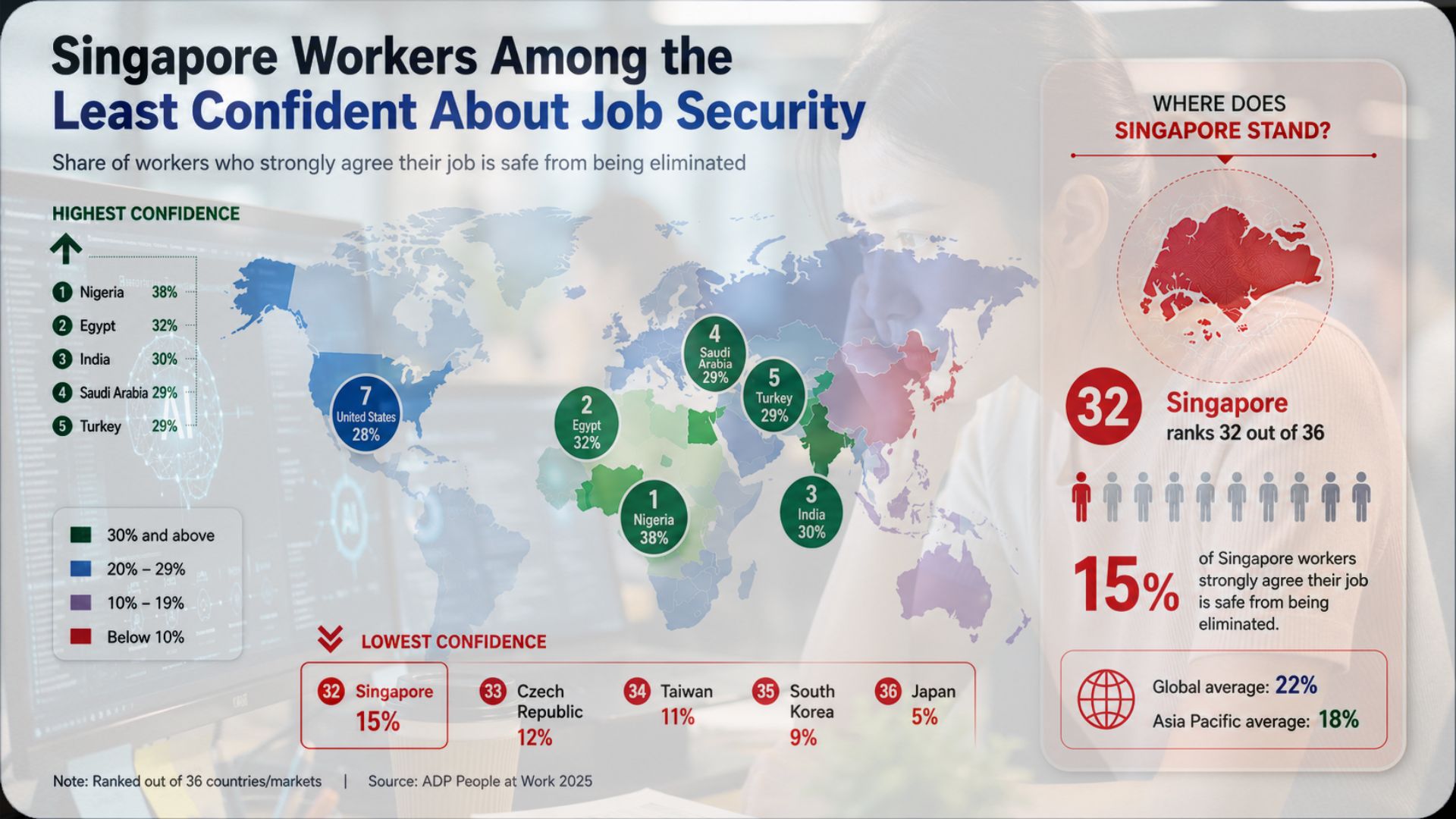
A new People at Work report by ADP Research, cited by Vulcan Post (May 21), shows that only 15% of workers in Singapore strongly believe their jobs are safe from elimination. This placed Singapore among the lowest-ranked markets globally for job security confidence.
Out of 36 markets surveyed, only four scored lower than Singapore. Across the Asia-Pacific (APAC) region, the average was slightly higher, at 18%, while the global average was 22%. Unemployment remains relatively low worldwide, yet confidence doesn’t appear to be following.
Workers are now worried about relevance, not just employment
According to Jessica Zhang, Senior Vice President for Asia-Pacific at ADP, workers are thinking beyond whether they have a pay cheque today. Her point was that many employees are now asking a different question: Will my job still matter a few years from now?
Concerns now go beyond being centred on layoffs or economic downturns as workers watch automation, AI adoption, changing business needs and how fast and easily skills can become outdated.
Zhang said employers need to do more than reassure staff. Companies should explain how jobs are changing, what that means in practical terms and continue investing in training so employees can stay useful and adaptable while supporting business performance.
Working more doesn’t always mean feeling safer
The report also found that many workers in Singapore are putting in unpaid hours. About 45% said they worked over five unpaid hours each week. Among them, 35% reported clocking between six and 15 unpaid hours weekly, while another 10% said they exceeded 16 hours.
The figure for six to 15 unpaid hours was above the Asia-Pacific (APAC) average. There is an uncomfortable contrast in these numbers. Longer hours are usually seen as a sign of commitment or ambition, yet they don’t appear to translate into greater job security.
Though it doesn’t mean hard work has no value, it still suggests workers increasingly see staying employed and staying relevant as two separate challenges.
AI is arriving, but engagement isn’t rising with it just yet
Singapore also recorded fairly high levels of generative AI use. Around 23% of workers said they used AI almost every day, while only 8% said they had never tried it. Yet employee engagement remained muted.
Fully engaged workers made up just 12% of Singapore’s workforce in both 2024 and 2025, below the regional average of 15%, a combination is worth paying attention to, as more tools don’t automatically create more confidence. Technology may improve speed and output, but workers still want clarity about where they fit in.
The deeper concern may be certainty in employment
ADP Research surveyed more than 39,000 adult workers across 36 markets between July and August 2025, including over 13,000 respondents from APAC.
For Singapore, the findings point to something further than job cuts. Many workers still have jobs, but what appears to be fading is confidence that today’s job will still look familiar tomorrow.
The practical answer is neither panic nor endless overtime. Workers can keep building skills. Employers can communicate earlier. Because when people understand where work is heading, uncertainty tends to shrink.
This article (ADP Report: Only 15% Singapore workers feel safe from job cuts despite rising AI adoption; also ranked as among world’s least confident about job security) first appeared on The Independent Singapore News.
