
Reading view

Trump-Xi summit: Cautious progress on trade, ties and some ‘win-wins’

President Donald Trump departed China on May 15, 2026, after a two-day summit with Chinese leader Xi Jinping that was scrutinized from every angle for clues on where the relationship is heading.

Trump hailed the trip as “incredible,” while Xi remarked that it marked a “new bilateral relationship.” Other observers were a little less enthusiastic, noting that no major breakthroughs were evident at the highly anticipated meeting of the world’s two most powerful political leaders.

The Conversation turned to Yan Bennett, an expert in U.S.-China relations and author of “American Policy Discourses on China,” to provide her three big takeaways from the summit.
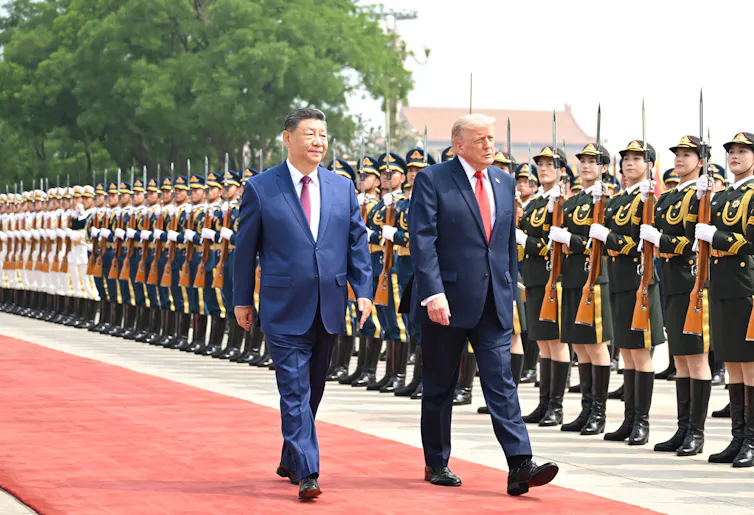
Two men in suits walk past a line of military dressed people.
Xi and Trump: Marching to the same tune? Li Xiang/Xinhua via Getty Images

Taiwan: Tough(ish) talk but status quo in place

No one really expected there to be movement on Taiwan – which mainland China lays claims over – although it is clear that Beijing would like the United States to make a firmer stance against the island moving toward a declaration of independence, or for the U.S. to expressly demand reunification.

So what we got was Beijing reiterating that Taiwan remained a priority and a core interest. Xi did this on the first day of the summit, noting that the Taiwan “question” remained “the most important issue in China-U.S. relations,” and that any mishandling of it could lead to “clashes and even conflicts.”

But this was aimed at two things. First, Xi has a domestic audience he needs to address, and Taiwan has long been important to Chinese rhetoric. The Chinese Communist Party has around 100 million members, many of whom would have expected Xi to talk tough on Taiwan – and it was those people he was largely talking to.

But he was also signaling to the U.S. that it shouldn’t support Taiwanese independence. And that won’t ruffle any feathers in Washington. Indeed, the 2025 National Security Strategy stressed that the U.S. opposed unilateral action on Taiwan from “either party” – a signal to Beijing that it opposed Taiwan declaring independence.

A group of people in army fatigues walk past a large missile launcher.
Taiwanese soldiers walk past a Sky Sword II Land-based Air Defense Missile in Taichung on Jan. 27, 2026. I-Hwa Cheng / AFP via Getty Images

Trump did mention arms deals to Taiwan. But the U.S.’s declaratory policy since the Reagan administration is that it doesn’t allow Beijing to enter discussions about what weapons Washington sells to Taiwan. And that hasn’t changed at all, nor has the U.S.’s treaty commitment to Taiwan since 1979 that requires the U.S. to provide Taiwan with defensive weapons to maintain a sufficient self-defense capability.

Rhetoric aside, everyone is happy with the status quo on Taiwan – it is in no one’s interest for it to change.

But talk of Taiwan has been muddied a little by Xi’s determination to modernize the People’s Liberation Army. The Chinese president has laid out a series of benchmarks including that the PLA should be capable of invading Taiwan by 2027. This has been misinterpreted in the U.S. under the so-called “Davidson window” – a concept that has it that China is intent on invading by that time.

In reality, China is nowhere near able to do so. It doesn’t have a “blue water navy” able to operate without port assistance, and the island is incredibly difficult to invade – it only has two places where you can land, and only at certain times of the year. It is also very mountainous. Taiwan is also slowly building its defenses – and learning a lot from Ukraine’s war with Russia – with the intention of becoming “indigestable” to China.

Xi’s modernization timeline also states that the PLA should be a “world class military” – taken to be a peer to the U.S. – by 2049. But the fact that it spends more on internal security than it does on defense indicates where the CCP’s true interests lay – in domestic security rather than external capabilities.

Trade: Tamped down expectations

The big picture is that the U.S. and China have been trying to restabilize what was until fairly recently a very good relationship in terms of economic ties.

Both sides have clear priorities to that extent. China wants to regain the American market it had in the 1990s and early 2000s – and certainly reverse the trend since 2018’s trade war.

Trump since his first administration has made it clear that he sees Chinese control over supply chains and the trade imbalance as a national security issue. Washington also wants to address unfair trade practices, such as the requirement that American companies hand over blueprints, trade secrets, customer lists, marketing plans and more to operate.

So what was achieved in the summit? On the surface, very little. There was some movement on sales of U.S. beef to China. And Trump announced that Beijing would buy 200 aircraft from Boeing – lower than the 500 that had been earlier touted in media reports. And several Chinese companies agreed to buy Nvidia microchips – a continuation of a process that began in late 2025.

That doesn’t seem much, and it was telling that Trump himself wasn’t being very “Trumpian” on what could be achieved during the summit. He wasn’t promising the moon.

But importantly, Xi and Trump agreed to establish a Board of Trade and Board of Investment – intended to create a pathway forward to more trade in the months to come.

A group of people wearing suits stand in a hall.
Tim Cook andJensen Huang, CEOs of Apple and Nvidia walk through the Great Hall of the People in Beijing. Johannes Neudecker/picture alliance via Getty Images

A lot of focus will be on technology. China is about 18 months behind the U.S. in microchip development. Some have questioned whether U.S. companies should be selling chips to China, amid fears that China could steal the intellectual property and be able to use higher-technology chips for defense reasons. The U.S. position is it can’t allow Huawei – China’s telecom giant – to take over the whole Chinese market, so it will only allow the sale of what it considers appropriate-level Nvidia chips.

Military matters: Washington wants to talk

During the Cold War, the Soviet Union and the U.S. always kept the military lines of communications open to avert a catastrophic incident. This hasn’t been the case with Beijing and Washington. We saw that in 2001 when a U.S. aircraft collided with a Chinese jet; and again over the “Chinese spy balloon incident” in 2023.

Washington is seeking to open up a line of communication on military matters, and that is probably why U.S. Secretary of Defense Pete Hegseth was there in Beijing. Indeed, it is highly unusual for a defense secretary to be at such a summit.

A man chuckles surrounded by other people
US Secretary of Defense Pete Hegseth attends a state banquet at the Great Hall of the People in Beijing on May 14, 2026. Brendan Smialowski/ AFP via Getty Images

Not that Trump believes he needs China’s help on military matters. He made that clear when asked about possible Beijing assistance prior to the summit.

In fact, little news came out of the summit on Iran. China has criticized the U.S. over the war, but has also quietly been telling Tehran to stop bombing Gulf countries.

Despite some commentary suggesting that Beijing benefits from the U.S. being bogged down in the Middle East, what Xi will want is a resolution before the economic fallout bites in China.

China’s stockpile of Iranian oil will only last a few more weeks and then oil price rises will hit China like a brick.

The Conversation

Yan Bennett has a contract position at the U.S. Department of State’s Foreign Service Institute, working to educate U.S. diplomats on transnational matters. Her views are her own and do not represent that of the U.S government.

  •  

A deep-ocean climate plan wins rare EPA approval, but is sinking plants in the sea the answer?

Innovators who are working on ways to pull carbon dioxide out of the atmosphere to fight climate change are having a tough time lately.

Their biggest supporter, Microsoft, recently began telling partners that it is pausing its carbon removal purchases. To get a sense of how big of a deal this is, look at the numbers: The tech company alone has purchased approximately 80% of the contracted cumulative volume of carbon removals to date. Its retrenchment is viewed as potentially a major blow to the sector.

However, there may be a bright spot for this industry, and it comes from an unexpected source: The U.S. Environmental Protection Agency quietly decided in March to grant a research permit under the Marine Protection, Research, and Sanctuaries Act to a Houston-based carbon removal startup.

The company, Carboniferous, aims to assess the potential to durably lock up greenhouse gases by harvesting plants that took in carbon dioxide on land and sinking them to the bottom of the ocean.

This approach is often called “ocean biomass sinking,” or marine anoxic carbon storage.

Ocean biomass sinking is one of several carbon removal approaches involving the ocean known as “marine carbon dioxide removal.” Other marine approaches include adding alkaline materials that react with seawater to increase the uptake of carbon dioxide, seeding oceans with iron to stimulate the growth of phytoplankton that can take up carbon dioxide, and farming seaweed to also take up carbon dioxide and sink it.

A crane on a ship hoists large bales.
In the Mediterranean Sea, the Israeli company Rewind has a pilot project that buries biomass bundles beneath seafloor sediments, where the lack of oxygen slows decomposition. Used with permissions from Rewind

The Intergovernmental Panel on Climate Change, which compiles research on climate change from scientists around the world, calls carbon dioxide removal “unavoidable” if the world hopes to keep rising temperatures in check and achieving the targets of the Paris climate agreement.

But is sinking biomass in the ocean the answer?

I am the co-founding director of the Institute for Responsible Carbon Removal at American University, and I have reviewed several of these projects. I see both pros and cons to ocean carbon removal techniques.

How ocean biomass sinking works

Carboniferous plans to carry out its field experiment in the Orca Basin off the coast of Louisiana. The basin is anoxic, meaning devoid of oxygen, and has a higher concentration of salt that most seawater. The EPA permit lets the company sink 20 burlap sacks containing sugarcane residue and monitoring equipment to the bottom of the sea there to study what happens.

Globally, land vegetation, including trees and crops, sequesters approximately 60 billion tons of carbon per year. However, a large portion of this carbon is quickly released back into the atmosphere – often within months to years – when the vegetation dies and decomposes, or is burned.

Ocean biomass sinking aims to lock up that carbon on the ocean floor in low-oxygen areas, where decomposition is much slower. Anaerobic processes, such as fermentation, may leave the biomass largely intact for centuries or millennia. Colder water environments can also slow the rate of biomass decay.

An illustration of carbon storage.
Plant residue can be sunk into oxic and anoxic regions of the seafloor, with different results. Both become dissolved inorganic carbon (DIC), methane (CH4) and dissolved organic matter (DOM). This carbon eventually reaches the ocean surface and atmosphere, but the process can take hundreds of years from anoxic environments, which lack oxygen (O2). M. R. Raven, et al., 2024, CC BY

The concerns

Two questions that arise are whether this approach would be effective at the scale needed and what risks it might pose to ocean ecosystems.

Recent studies have estimated that ocean biomass storage projects could durably store somewhere between 0.1 and 1 gigatons of carbon dioxide annually. That sounds like a lot, but humanity may need to remove 7 to 9 gigatons of carbon dioxide each year from the atmosphere by the middle of the century and up to 20 gigatons per year by 2100 to meet global climate goals and avoid dangerously high temperatures.

A bigger concern is that substantially increasing organic matter in deep ocean environments might stimulate the growth of anaerobic bacteria, which can produce methane, a potent greenhouse gas that could offset much of the benefits of this approach.

Proponents of ocean biomass storage counter that the absence of vertical mixing among the water layers in ocean ecosystems would prevent any additional methane releases from ultimately escaping to the atmosphere. Further research is clearly required to know the risks.

Ocean biomass storage might also pose environmental and economic risks. As biomass descends in the water column, it has the potential to release particulates or organic matter, which could alter the activities of microbes as well as the food supply and oxygen in the ocean mesopelagic zone. The zone is a busy region of high productivity and home to a million undescribed species. The result could harm commercial fisheries and other species.

It’s also unclear how seafloor communities, such as bacteria, other microbes and fungi, might respond to the introduction of massive amounts of biomass.

And the introduction of large amounts of additional biomass in deep-ocean regions might attract species that feed on dead plant material, or their predators, which could alter species interactions in ecosystems that scientists know very little about. Those effects could be further exacerbated by decaying biomass reducing oxygen in seafloor environments and potentially increasing the release of hydrogen sulfide, methane, nitrous oxide and nitrogen and phosphorus compounds.

Sinking seaweed in the ocean to store carbon.

Other ways to store carbon in the oceans

Carboniferous is not the only company focused on ocean biomass storage. Israel-based Rewind is currently experimenting with burying waste plant matter from farms and cities in an anoxic Black Sea region off the coast of Romania, as well as beneath seabed sediments in the Mediterranean Sea off the coast of Haifa in Israel. The company believes that it could sink 1 million tons of biomass residue annually by 2030.

Another Israeli company, BlueGreen Water Technologies, takes a very different approach. Instead of collecting biomass from terrestrial sources, it uses a solution of hydrogen peroxide to kill, and ultimately sink, toxic harmful algal blooms made up of cyanobacteria, also known as blue-green algae. This approach may also eliminate blooms that can devastate aquatic environments by creating low-oxygen dead zones. And because algae sequester substantial amounts of carbon, the company claims that this approach could also remove billions of tons of carbon from the atmosphere in ocean and freshwater ecosystems.

The world’s oceans are by far Earth’s largest carbon sink, storing roughly 50 times more carbon than the atmosphere and 20 times more than terrestrial forests and soils combined. This provides a compelling case to explore marine carbon removal options.

However, as is the case with all marine-based approaches, ocean biomass storage raises an array of questions that need to be resolved before the world can consider deploying it on a large scale. Carboniferous’ research program is one piece of this puzzle.

The Conversation

Wil Burns does not work for, consult, own shares in or receive funding from any company or organization that would benefit from this article, and has disclosed no relevant affiliations beyond their academic appointment.

  •  
❌