Reading view

Texas Tech’s new limits on how faculty teach gender identity and sexual orientation challenge more than free speech

Banning students from writing theses and dissertations on sexual orientation and gender identity could be seen as curtailing students' freedom of speech rights. Malte Mueller/fStop/Getty Images

Texas Tech University, a public university in Lubbock, announced in April 2026 that its five schools would phase out all academic credentials centered on sexual orientation or gender identity. The new policy, detailed in a six-page memo on April 9, also requires instructors to use “alternate materials” when courses address these topics.

Texas Tech, led by former Texas Republican state legislator Brandon Creighton, is not the first university to try to restrict instruction on gender, sexual orientation and other topics in recent years.

In 2023, for example, Florida passed legislation that banned students at public universities from majoring in critical race theory, gender studies, queer theory and intersectionality.

Texas Tech, however, goes further with this new memo. It also bars graduate students from writing “degree-culminating” theses or dissertations on sexual orientation or gender identity, something no other major public university system appears to have done.

As a scholar who studies the intersection of law, science and public policy, I doubt the policy would survive a possible constitutional challenge in court, given First Amendment freedom of speech protections. Even if courts ultimately strike the policy down, though, it may still leave a lasting mark, by signaling that some universities are willing to prioritize politics over independent academic inquiry.

A series of brown buildings are seen grouped closely together from above.
Texas Tech University’s main campus is in Lubbock, Texas. David Kozlowski/Moment Mobile via Getty Images

Texas Tech’s policy shift

Texas Tech’s policy, which will begin taking effect in June 2026, requires faculty to teach in compliance with a 2025 Texas law that declares there are “only two human sexes.”

The law echoes the language of an executive order the Trump administration issued in January 2025 that said “It is the policy of the United States to recognize two sexes, male and female.”

Despite that air of certainty, there is substantial scientific literature that shows people’s biological variation does not fit a strict binary model.

Texas Tech faculty will soon be largely prohibited from teaching about gender fluidity or gender as a spectrum. There are narrow exceptions to this rule, such as discussions about intersex traits, so long as instructors do not “advocate for or validate sociological frameworks.”

Although current faculty may continue researching “topics of their choosing,” new faculty will be hired “in alignment” with the memo.

Students, meanwhile, can continue to conduct “general independent student research,” and write standard term papers, for example, on one of these subjects. But students cannot write graduate theses or dissertations on sexual orientation and gender identity.

By legal standards, these new policies are not neutral, curricular decisions. This is because the state of Texas favors one viewpoint – that there are only two biological sexes – that this public university system now reflects.

For nearly 60 years, the U.S. Supreme Court has repeatedly rejected the idea of viewpoint discrimination at universities. This discrimination occurs when the government or another authority allows speech favoring one opinion, while restricting speech expressing an opposing opinion.

The Fifth Circuit Court of Appeals, which oversees the region where Texas Tech is located, has also long recognized that “classroom discussion is protected activity.”

In a statement to the Associated Press in April, Creighton said that the school is “focused on ensuring our academic programs are rigorous, relevant, and produce degrees of value.”

He added that this focus “is matched by our unwavering support for the First Amendment and the open exchange of ideas that define a public university. Texas Tech will continue to be a national leader on both fronts.”

Part of a broader story

The Texas Tech policy is the latest example of a broader political effort to reshape what public universities may teach and research.

Several other public universities have also recently limited programs or coursework involving gender and identity studies.

In 2022, Florida’s “Stop WOKE” Act, restricted instruction perceived as endorsing certain race-related concepts in classrooms and workplace training sessions. Some faculty members left Florida public universities, citing concerns about censorship and political interference in higher education.

In 2022, federal judge Mark Walker called that Florida law “positively dystopian” and barred its enforcement, holding that the state cannot grant academic freedom only to viewpoints it favors. The restrictions remain blocked, pending appeal.

Texas A&M English professor Melissa McCoul sued that university after she was fired in September 2025, following a classroom discussion she led about gender identity.

Texas A&M later eliminated its women’s and gender studies degree program in January 2026.

The University of Texas at Austin consolidated four ethnic studies departments and the Women’s, Gender, and Sexuality Studies Department into a single Department of Social and Cultural Analysis in February 2026. The university is also reviewing which majors, minors and courses within that new department students may pursue and enroll in.

These changes reflect a broader political climate in which some politicians and university leaders increasingly frame gender identity and other academic subjects as ideological positions, rather than scholarly areas of research. That trend has intensified alongside the Trump administration’s executive orders, actions and rhetoric surrounding gender identity and diversity, equity and inclusion initiatives.

Limiting academic research

Texas Tech was established in 1923 to prepare students for technical and agricultural professions, and “elevate the ideals, enrich the lives, and increase the capacity of the people for democratic self-government.”

That mission reflects the American Association of University Professors’ 1940 Statement of Principles on Academic Freedom and Tenure. The statement describes universities as dedicated to “the common good” through the “free search for truth.”

Universities are therefore expected to pursue scholarly inquiry according to disciplinary standards and academic expertise, not partisan priorities. That commitment is reflected in the thesis and dissertation process, through which faculty evaluate students’ ability to conduct independent research and contribute to disciplinary knowledge.

Although disfavored on some Texas and Florida campuses, topics such as HIV disparities in LGBTQ+ populations continue to be studied elsewhere as public-health subjects. The same is true for suicide risk and family rejection among LGBTQ+ adolescents and services for transgender youth.

With such lines of inquiry curtailed, some Texas Tech students now question whether the university can still provide an “honest education.” Some Texas Tech faculty members are openly discussing looking for other jobs.

A blue pencil is positioned over a white, empty speech bubble.
Restrictions on academic freedom are prompting some Texas university faculty to consider jobs out of state. nadia_bormotova/iStock via Getty Images Plus

Restricting academic independence

A September 2025 survey by the American Association of University Professors documented the toll of political interference on university faculty across the country, including in Texas.

One-quarter of the 1,100 Texas professors and researchers surveyed said they are seeking jobs outside the state. More than 60% said they would not encourage graduate students or colleagues to work at a university in Texas.

When the state decides which questions may and may not be researched, it is doing more than shaping curriculum. It is regulating the boundaries of knowledge itself by determining what future scholars may study and what universities are permitted to discover.

That – more than any single line in a memo – is what I believe should concern anyone who cares about the integrity of higher education. And it is precisely the danger longstanding First Amendment protections for academic freedom were designed to prevent.

The Conversation

Henry F. Fradella does not work for, consult, own shares in or receive funding from any company or organization that would benefit from this article, and has disclosed no relevant affiliations beyond their academic appointment.
  •  

Self-censorship, more stress, tougher recruiting – we asked US researchers how the Trump administration’s science policies have affected them

93% of surveyed researchers have negative opinions of federal science policies since January 2025. Cavan Images via Getty Images

The American academic research engine has long been the envy of the world. Generally well-funded, labs in the United States have been able to attract the best minds who generate breakthroughs and train the next generation workforce that powers the U.S. economy. But since the start of the second Trump administration in January 2025, new federal policies have destabilized the American scientific enterprise.

The disruption generated by the Trump administration’s funding, DEI and visa policies has been well reported by the media. On an individual level, though, what do academic researchers think of all these changes and how have they been directly affected?

We are researchers affiliated with Arizona State University’s scientist opinion panel survey, known as SciOPS, a 5-year research program designed to monitor, understand and improve how scientists communicate with the public. We wanted to know more about the reality inside today’s universities as researchers grapple with Trump administration policies.

Along with our colleagues, we fielded a survey of randomly sampled members of the academic science community participating in the SciOPS panel. We obtained responses from 280 scientists from several fields, including biology, chemistry, civil and environmental engineering, computer and information science engineering, geography and public health from 131 universities.

Our results show dramatic, mostly negative, effects of federal policy changes on researchers, the research system and American competitiveness.

How research in US universities has changed

Any research enterprise thrives because of its ability to fund cutting-edge science and thus attract highly motivated, well-trained people. Since the second Trump administration took office in January 2025, just over half of the scientists in our survey report that their overall funding has declined.

Declines in federal funding have had knock-on effects. Around one-quarter of scientists reported that state and local and university internal funding have also declined. Another 9% reported that internal funding has increased, presumably as universities have provided emergency funds to researchers to support critical studies.

According to the scientists who responded to our survey, Trump administration policies have also affected the scientific workforce pipeline, hampering their ability to recruit internationally and domestically.

We hypothesize that these hiring issues can be related to visa and immigration policies, which make it difficult for international graduate students and postdocs to work in the U.S. or attend international conferences. Just over half of scientists in our survey reported that international students or postdocs have expressed concerns to them about deportation.

Concerns about longer-term career impacts are also to blame for trouble recruiting the next generation of researchers. Over 80% of surveyed scientists reported that graduate students or postdocs on their research team have increased concerns about future job prospects.

These impacts have taken a toll on scientists’ professional work environment and overall outlook. Over two-thirds reported more work-related stress and almost half reported increased workloads since January 2025. About half reported decreased work motivation.

How are scientists and engineers reacting?

We found scientists’ responses to be a mixture of resilience, acquiescence and considering an exit.

While many scientists said they were less motivated at work, most reported no change in their efforts to obtain federal research funding. Small proportions did report successfully increasing their efforts to obtain funding from non-federal sources.

Our survey also asked scientists whether they had taken any self-censoring actions since January 2025 due to concern over potential negative consequences for their work or career. Over half reported having reviewed or adjusted key words in research proposals, and almost half said they’d reframed research topics. Forty-three percent had also cautioned students or collaborators to be careful what they say publicly and more than a third had abandoned plans on one or more research topics.

Although scientists are adopting strategies to cope with the new challenges, nearly two-thirds of the scientists in our sample appear to be considering one or more other career options.

Scientists look to the long term

Scientists and engineers in our sample have strong opinions about the impacts of current U.S. science policy. A large majority (87%) believe the administration’s actions have influenced research priorities more than previous administrations. Most scientists in our survey had a negative opinion of the Trump administration’s overall changes to science policy.

Scientists in our sample believed that administration policies have had a negative effect on the future scientific workforce and the ability of scientists and engineers in the U.S. to produce breakthroughs and discoveries and contribute to national welfare.

Large majorities believe these policies have harmed public perceptions of the integrity of U.S. scientists (85%) and hurt public trust in science (84%).

Academic scientists’ reactions to the Trump administration’s changes to science policy are perhaps not surprising given the perceived level of threat these actions represent to the research community. What is less certain is whether the dramatic changes we are currently witnessing – cuts to grant funding, politicization of research, downsizing of federal agencies, restrictive immigration policies, attacks on the autonomy of higher education and more – are temporary or if they represent the initial phase of a transition to a new research environment with less federal support for American science.

The Conversation

The authors do not work for, consult, own shares in or receive funding from any company or organization that would benefit from this article, and have disclosed no relevant affiliations beyond their academic appointment.

  •  

Will future missions to the Moon be sustainable? It may depend on whom you ask

Earth draws closer to passing behind the Moon in this image captured by the Artemis II crew during their lunar flyby. NASA

There’s a new space race to the Moon, and this time the ambitions are not just to visit but to stay. NASA’s Artemis program aims to establish a long-term human presence on the lunar surface in the 2030s. China, India, Japan and a number of private companies all have lunar mission programs of their own.

As of now, the human footprint on the Moon is small. That could change with the planned increase of lunar missions.

National space agencies are focused on science and exploration, while private companies aim to develop a lunar economy – potentially with mining operations. In the coming years, these groups will test technology and build some initial infrastructure on the Moon. From 2030 onward, Moon bases could become a reality.

But what are the long-term consequences of lunar missions for the Moon itself? The Artemis program’s goals are sustainable exploration and setting up a sustainable presence on the Moon. However, sustainability is a broad concept with a variety of definitions and uses when it comes to space exploration. As a sustainability scholar, a space systems engineer and a planetary scientist, we’ve been trying to pin down what sustainability means in a lunar context.

The delicate lunar environment

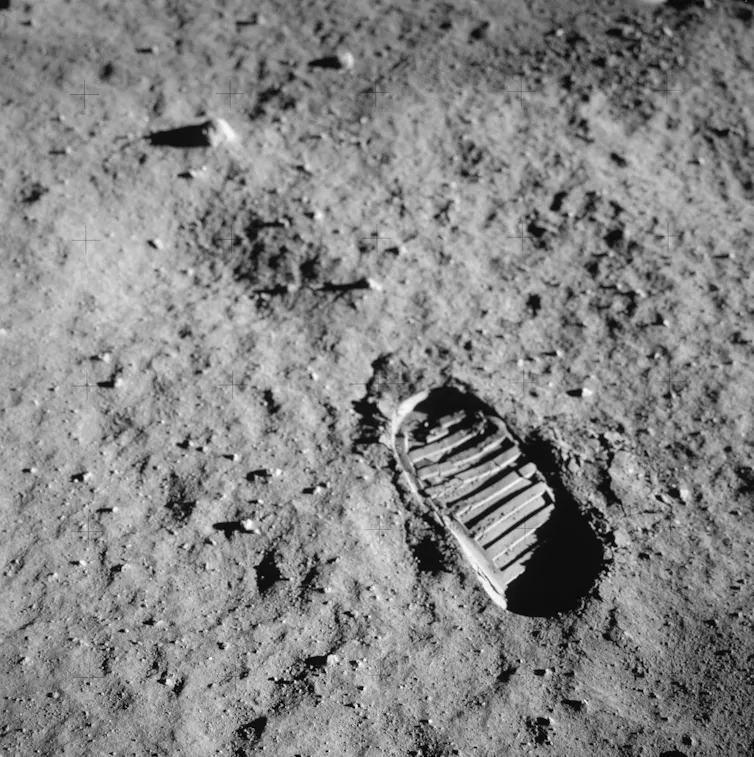
Unlike Earth, the Moon has no biodiversity, climate as we typically think of it, or oceans. But it does have its own active environment. While the Moon may seem unchanging and indestructible, it is surprisingly sensitive to human activity. Without the wind, water or other natural forces that reshape the Earth, things that happen on the Moon tend to leave a mark – sometimes for thousands, or even millions, of years.

When a rocket lands on the Moon, its engines blast the surface with exhaust gases and send fine dust particles flying at enormous speeds. A single landing by a large modern spacecraft, such as SpaceX’s Starship, could disturb an area of the lunar surface two to five times larger than the Apollo missions did in the 1960s and 1970s.

Some of those ejected dust particles can travel tens of miles across the surface, and the finest grains can reach the Moon’s orbit, potentially threatening other spacecraft. Images from satellites in lunar orbit show that changes to the uppermost layer of the surface from a single landing can remain visible for decades.

Landings can also release water vapor, carbon dioxide and other gases into the lunar exosphere – an extremely thin layer of atoms hovering above the surface – and create a temporary atmosphere.

And all these effects can come from just one mission. Future missions will focus on the polar regions, which have ideal spots for collecting solar energy atop peaks, as well as water in the form of ice in craters. Scientists don’t yet understand what the cumulative effects of the dozens of missions planned over the coming decade on the lunar environment – its surface, its thin atmosphere and its scientifically precious polar regions – will be, and whether they’re reversible.

A close-up view of an astronaut's bootprint in the lunar soil.
Without weather, footprints from human missions to the Moon last much longer than on Earth. NASA

The concept of sustainability

On Earth, the concept of sustainability balances protecting the environment, maintaining economic well-being and caring for society – current as well as future generations.

But what does sustainability mean on the Moon? To find out, we sent out a survey asking people with a demonstrated interest in space and lunar exploration to define sustainability in this new context. We received 277 complete responses from academics, space industry professionals, space agency staff and engaged members of the public.

We found that people mean very different things when they talk about lunar sustainability – and those differences often track closely with who they are and where they work.

People working in the space industry tended to think about sustainability in financial and operational terms: keeping missions affordable, making infrastructure reusable, and developing the Moon’s resources to support a self-sustaining economy.

Academics, on the other hand, related lunar sustainability to environmental and ethical concerns more frequently. A significant portion of all respondents – roughly 1 in 5 – were opposed to large-scale human activity on the Moon altogether. Their responses echoed a “leave no trace” philosophy: Don’t disturb natural conditions, don’t commercialize what belongs to all of humanity, and don’t plant flags in places that shouldn’t be owned.

The majority of respondents fell somewhere in between, calling for a careful balance of scientific, commercial and environmental interests.

The Apollo 15 lander sitting on the surface of the Moon, with a panoramic view of the dusty, rocky lunar landscape.
Human activity, from robotic landers to crewed missions – such as Apollo 15, shown here – has the potential to reshape the surface of the Moon. NASA

A continuing conversation

This diversity of perspectives on what sustainability means on the Moon is not a surprise. Even for the Earth, people do not have a universally agreed-upon perspective.

However, the shared cultural significance of the Moon calls for conversations between many groups of people, from space agencies to communities living near rocket launch sites, and from space industry professionals to amateur lunar enthusiasts.

The Moon has always been Earth’s closest celestial companion in our planet’s journey through space. As it becomes a destination for space agencies and some companies, the decisions made now will shape what the lunar surface looks like, and what the Moon means to people, for generations to come.

Some of those decisions may be irreversible. Researchers are only beginning to explore the cumulative effects of human activity on the lunar environment. And policymakers are even further behind in developing the governance frameworks needed to make collective decisions about it.

The conversation about what sustainability means for lunar missions is becoming increasingly relevant as plans for lunar bases move forward.

The Conversation

Marco A. Janssen received funding from NASA.

Afreen Siddiqi received funding from NASA.

Parvathy Prem receives funding from NASA.

  •  

For Iran’s diaspora, a tough World Cup call: To support the national team or protest – or both?

When Iran’s national soccer team walks onto American soil this summer for the 2026 FIFA World Cup, it will do so against the backdrop of an Iranian government crackdown against protesters in January, an ongoing war launched by the U.S. and Israel in February, and a four-month digital blackout affecting some 92 million people. It has left many Iranian fans feeling conflicted about who exactly they’ll be cheering for.

Even before a ball has been kicked, the tension has been clear among not only supporters but team members, too. Iranian players were issued visas to the United States at the 11th hour, and the team only arrived at their training base in Tijuana, Mexico, days before the tournament kicks off.

That came after a request to move their camp from Arizona, citing concerns over unfair treatment on U.S. soil, a move that required the formal endorsement of FIFA before it could proceed. Even with the team finally getting settled, however, multiple Iranian soccer fans have been denied visas to the U.S. Iran’s soccer association has also said its ticket allocation had been denied, leaving fans who had made the trek disappointed.

With a host nation actively at war with a competing one for the first time in World Cup history, the pitch will be a stage not just for soccer but for grief, resistance and competing nationalism. The Iranian diaspora, buffeted by the one-two punch of internal crackdowns and external interventions, now faces a deeply unsettling question: How do you express pride in one’s national team without tacitly supporting the government that it represents?

Diasporic identity crises

Along with many Iranians, mainly expatriates in the U.S., I plan to attend Iran’s opening game against New Zealand on June 15 in Los Angeles. The location is important – Los Angeles is a city that is home to the largest Iranian diaspora, so much so that it is often referred to as “Tehrangeles” within the community.

It is also a community among whom feelings toward the Islamic Republic run deep, with many of them having left Iran during or following the Iranian Revolution of 1979. Many in the community have remained loyal to the deposed Pahlavi regime and the crown prince, Reza, and going so far as celebrating the joint U.S.-Israeli led war on Iran.

It is in this community that the Iranian national team – colloquially known as Team Melli to reflect the Farsi word for national – will face battle not only against New Zealand, but also the conflicted emotions of its ethnic brethren.

With the memory of the January protests still raw, calls have been circulating among some Iranian Americans to formally protest and boycott the occasion. Proposals range from purchasing tickets, only to leave seats conspicuously empty, to booing the national anthem and withholding any celebration of Iranian goals.

Supporters have also been urged within Iranian American communities to resist FIFA’s attempts to prohibit non-Islamic Republic flags inside stadiums, with some Iranian expats suggesting on social media of spray-painting over the symbols on the current flag, carrying plain green, white and red alternatives into the ground, or wearing clothing bearing political slogans. Others have proposed exposing politically motivated tattoos or using stuffed animals to caricature Iranian leaders.

In return, Mehdi Taj, the president of the Iranian Football Association, issued a statement demanding respect, stating: “We need a guarantee there, for our trip, that they have no right to insult the symbols of our system, especially the Islamic Revolutionary Guard Corps.”

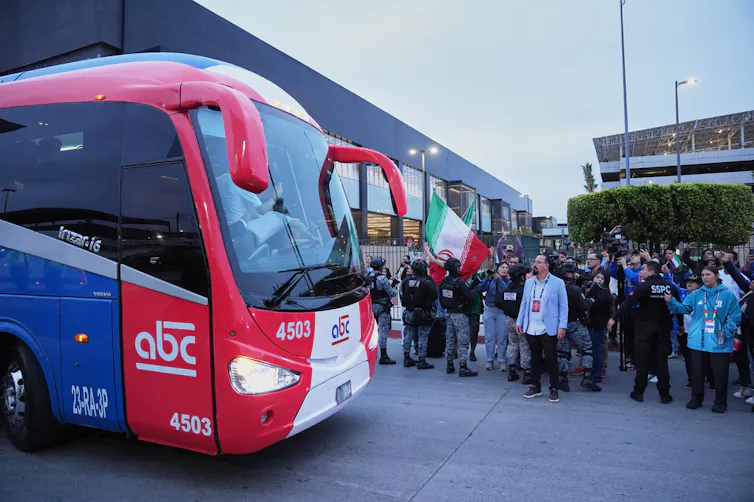
A bus passes by a crowd of people.
An Iranian national team bus arrives in Tijuana, Mexico, on June 7, 2026. AP Photo/Gregory Bull

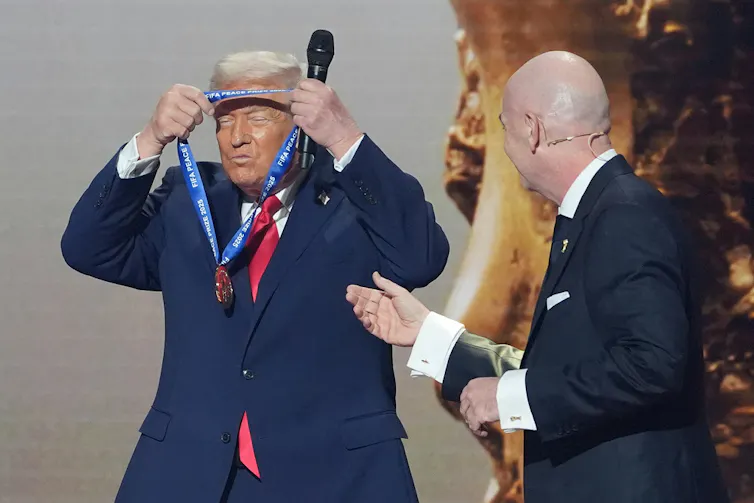
There is a broader question that Iran’s World Cup appearance forces into view, and it sits uncomfortably alongside FIFA’s own record. While the governing body of world soccer awarded President Donald Trump its inaugural Peace Prize ahead of the tournament, it is now looking the other way as the U.S. remains at war and denies visas to would-be participants and spectators. The collision of sport and statecraft is nothing new, from the 1936 Berlin Olympics to the Soviet boycott of Los Angeles in 1984. But it has rarely been managed with such apparent indifference to its own contradictions.

When sport becomes a theater for competing political claims, it is the integrity of the game itself that is diminished. One is entitled to ask whether the notion of sport existing purely on its own terms — especially on the global stage — has ever been anything more than a convenient fiction.

Collision of politics and sport

Yet here lies the puzzle. Soccer occupies a place in Iranian life that borders on the sacred. One need only look to the fierce devotion surrounding Tehran’s great rival teams Persepolis and Esteghlal, a contest that ranks among the most intense club rivalries in world soccer, or to the scenes of street celebration that have swept Iran whenever the national team has won games at previous World Cups.

The memory of defeating the U.S. at the 1998 World Cup in France and the rematch in 2022 speaks to how deeply the game is woven into the fabric of Iranian culture. Supporting Team Melli has long been a source of collective pride, a point of unity that transcends politics and generation, regardless of religion, political views and social class. This creates the dilemma for the fans watching in Los Angeles and Seattle for Iran’s three group games.

A man in a suit puts a medal around his neck.
President Donald Trump puts on the inaugural FIFA Peace Prize presented to him by FIFA President Gianni Infantino. AP Photo/Evan Vucci

In Arizona, where I teach global politics at Arizona State University, several members of the Iranian diaspora articulated this dilemma to me, capturing the tension at the heart of current events. One person invoked the sporting rivalries of the Cold War as a reminder of soccer’s capacity to transcend conflict, yet acknowledged that the wounds of the January protests remained too raw for many in the diaspora to set aside. Another was more straightforwardly hopeful, expressing a wish to see Iran progress in the tournament and a belief that success on the pitch might, however tentatively, cut across political divisions.

Yet for those who have watched the events of recent years with grief and fury, cheering on a team that represents the Islamic Republic feels, to some, like an act of complicity. For its part, the Iranian government – as well as some Iranian critics – would argue that the national team stands apart from politics entirely. From this vantage point, soccer is a matter of national identity and cultural heritage that belongs to all Iranians regardless of their views on those in power. It is, moreover, a moment of proud participation, according to one Iranian official, and that to deny the players their support is to punish athletes for the decisions of politicians.

The protests that shook Iran, and the complex political landscape that followed, have left the diaspora navigating questions that go far beyond soccer.

The Islamic Republic, whatever one’s view of its conduct, remains the sovereign government of a nation with a rich and fiercely proud culture, and the players on the pitch represent that culture as much as they represent the state.

That they do so on the soil of a country with which Iran is actively at war renders this perhaps the most politically charged sporting occasion in living memory – one in which every goal, every flag and every empty seat carries a meaning that extends well beyond the 90 minutes. In that sense, the World Cup has not created a division so much as it has given an existing one a global stage.

The Conversation

Shirvin Zeinalzadeh does not work for, consult, own shares in or receive funding from any company or organization that would benefit from this article, and has disclosed no relevant affiliations beyond their academic appointment.

  •  

What makes a good teacher? Ask a Republican and a Democrat, and they are likely to agree

Support for students is one value that both Democrats and Republicans alike value in a teacher. Brittany Murray/MediaNews Group/Long Beach Press-Telegram via Getty Images

If you follow the headlines, it can seem like K-12 schools in the United States are a political battlefield.

Some conservative parents and advocacy groups are lobbying to remove certain books from classrooms and libraries, most often those that highlight LGBTQ+ issues or race and racism.

Some civil liberties groups, librarians and progressive parents, meanwhile, are pushing back against book bans, saying they are a form of unnecessary censorship.

Parents and school boards also are clashing over a range of other issues, ranging from how transgender and nonbinary students are treated and which bathrooms they can use, to whether teachers should use artificial intelligence in the classroom.

Beyond this evidence of political polarization, though, there’s another, less divisive reality. Ask people to name their best teacher, and regardless of their political affiliation, they will likely offer a similar answer. Most people will say that they learned a lot from a teacher who knew them, cared about them and made learning relevant to their lives.

Over five years, from 2020 through 2025, we asked more than 2,000 Americans, including Democrats, Republicans and independents, what makes a very good teacher. We expected deep partisan divides. Instead, we found something rare: genuine, cross-partisan agreement.

How we ran the study

We began in 2020 with a nationally representative survey of 334 adults, asking them to recall a teacher they learned a lot from. We then asked the survey participants to look at 10 statements that might describe a good teacher and rank them from most to least important.

Five of the statements we offered focused on relationships – like caring about students, making educational lessons relevant and giving students individualized support. The other five focused on whether teachers covered a lot of material, rewarded top performers with grades or prizes, and whether they applied rules consistently to all students.

Respondents generally focused on highlighting the same seven out of 10 statements, giving us a vision of how they perceived a very good teacher. People prioritized the same factors – how much the teachers cared about their students and whether they supported them – regardless of their age, race, gender or political affiliation. Republicans and Democrats were indistinguishable in their descriptions of effective teaching.

People did not prioritize whether teachers covered a lot of material, made students compete or ran a strict and disciplined classroom.

In 2022, we conducted a similar survey of 179 teachers in Arizona and California. The results echoed our 2020 survey participants’ view: Teachers also defined very good teachers as ones who emphasized relationships, made lessons relevant and knew the subject matter.

Given the prominence of politically charged education debates, we were a bit surprised by our results. We began to wonder: Do people privately agree on what it means to be a good teacher, but change their opinion if their image of good teaching is associated with an ideological orientation they disagree with?

A woman with blonde hair hugs a girl wearing a backpack, and they both smile as a man wearing a tie looks at them and also smiles.
A student gets a hug from a teacher at a Garden Grove, Calif., elementary school on the first day of class in September 2024. Paul Bersebach/MediaNews Group/Orange County Register via Getty Images

Adding a partisan label

To explore this question in late 2024 and early 2025, we ran a third experiment with a nationally representative sample of 1,562 adults from a range of political backgrounds.

We gave all participants the same description of a very good teacher, identified in our previous experiments. We then randomly noted if these descriptions of a good teacher were endorsed by Democrats, Republicans or people with no political affiliation.

When the participants read the teacher descriptions without any political labels attached, about 85% of Democrats, Republicans and independents agreed with the description of a very good teacher.

When we added a note saying that a political party the survey participant did not identify endorsed a particular description of a good teacher, they became less likely to support the statement.

The effect was sharpest among Republicans: Support fell from 85% to 64% when the description was tied to Democrats. Democrats’ agreement slipped less, from 86% to 76%, when the description was tied to Republicans.

Even with these caveats, nearly two-thirds of Republicans and Democrats still agreed on what it means to be a good teacher.

Political scientists call this affective polarization: How we react to an idea depends not just on the idea, but on who we think supports it.

At the national level, education is often framed as an intractable partisan conflict.

Yet at the individual level, many Americans continue to express confidence in their own local schools. Our findings suggest that part of this gap may be driven by how issues are framed rather than by fundamentally incompatible beliefs.

A man wears a tie and gives a thumbs up as a group of children seated at desks raise their hands.
Regardless of political affiliation, people are less likely to prioritize whether teachers cover a lot of material or ran a strict and disciplined classroom. Paul Bersebach/MediaNews Group/Orange County Register via Getty Images

This matters more than you might think

Federal and state education policy over the past four decades, including laws like No Child Left Behind, which mandated routine federal testing in reading and math, emphasize testing and competition. These priorities don’t always match what Americans across the political spectrum say they value most.

Americans continue to differ on many important education questions, including what children should learn in school, the role of school boards and other issues.

But these disagreements coexist with a shared beliefs about what good teaching looks like in practice.

Recognizing this gap could open new possibilities for education reform. When debates focus exclusively on disagreements, they can obscure areas of agreement that might otherwise serve as starting points for collaboration.

We encourage readers to go ahead and run a similar, small experiment: Ask people about their best teacher, then listen to what they say. The answer, it turns out, is likely more unifying than you expect.

The Conversation

For this specific project, Gustavo E. Fischman received funding from the Institute of Social Science Research at ASU. He also received funds for other projects from the National Science Foundation, the Spencer Foundation, the Open Society Foundation, the IDRC, and the Fulbright Commission.

Eric Haas and Margarita Pivovarova do not work for, consult, own shares in or receive funding from any company or organization that would benefit from this article, and have disclosed no relevant affiliations beyond their academic appointment.
  •  
❌