
Reading view

Why did ‘Tyrannosaurus rex’ have such short arms?

Teeth? Big. Arms? Not so much. William_Potter/iStock via Getty Images Plus

Curious Kids is a series for children of all ages. If you have a question you’d like an expert to answer, send it to CuriousKidsUS@theconversation.com.


What did the T. rex use its little arms for? – Aurora, age 11, Pemberton Township, New Jersey


One of the most famous dinosaurs to ever roam across Earth, Tyrannosaurus rex, has filled people’s minds with wonder since the first skeleton was discovered in the early 1900s.

Scientists believe T. rex, or King of the Tyrant Lizards, as its name translates, was a fearsome predator. An adult T. rex was massive in size – approximately 40 feet (12 meters) long and 20 feet (6 meters) tall, weighing as much as an African elephant. Each of its enormous sharp teeth could be near a foot (0.3 meters) in length from the root to the tip.

I’m a paleontologist, and I use fossils to study how animals lived and evolved over long periods of time. One of the coolest things about being a paleontologist is that there are always new questions to ask and new things to learn – even about a super-well-known dino like T.rex, which went extinct just over 65 million years ago.

One T. rex mystery has to do with this giant predator’s relatively tiny arms. Why would it have arms so short that it couldn’t even reach its own mouth? How did it use them?

How ‘short’ is short?

First, let’s define what we mean by “short.”

The biggest T. rex could measure 45 feet (14 meters) from the snout to the tip of the tail, but their arms were only about 3 feet (1 meter) long. On average, a T. rex’s arms were just about 30% of the length of its legs.

In comparison, humans have, on average, arms around 66% of the length of their legs. If people had the same arm proportions as a T.rex, a 6-foot (1.8 meters) tall person would have arms only 10 or 12 inches (25 to 30 centimeters) long!

T. rex isn’t the only dinosaur with such short arms. The evolutionary trend toward shorter arms in theropods – the larger group of meat-eating, two-legged dinosaurs that T. rex belongs to – happened multiple times. Similar to how wings separately evolved in different animals – like birds and bats – traits can emerge many times in evolutionary history.

You can see the shortening of T. rex arms as a pattern in its family tree, as earlier relatives had proportionally longer arms.

Lots of schoolchildren gathered around a T. rex skeleton on display in a museum
Fossil skeletons of Tyrannosaurus rex make clear that the dinosaur itself was very big, even if its arms were proportionally small. John Zich/AFP via Getty Images

How did they use their mini-arms?

Short arms don’t seem to have been a problem for these mighty dinosaurs. T. rex was a successful carnivorous species that existed for over a million years. They only went extinct when an asteroid hit the Earth, causing a global mass extinction.

Scientists have suggested a few ideas to possibly explain how T. rex used their arms. Maybe they were used as some kind of social display that could impress other T. rex – kind of like the bright feathers of a peacock that can attract potential mates.

But male and female T. rex skeletons don’t show the major differences that paleontologists would take as clues that they relied on social displays to attract mates. And while animal behavior can sometimes be preserved, such as in bite marks or fossilized footprints, it’s rare to have enough fossil data to draw clear conclusions.

Maybe T. rex used their arms as weapons to attack or hold down prey. But these options seem unlikely since T. rex’s huge jaws would have made contact with an enemy or prey before the short arms would have been able to reach it.

Some scientists have recently hypothesized that T. rex‘s short arms were an adaptation to competition with other carnivores. If multiple predators were feeding on a carcass, one could get hurt by accidental bites or even intentional warning bites for getting too close. Shorter arms would be less likely to get chomped. Similar things occur today with territorial carnivores, like Komodo dragons.
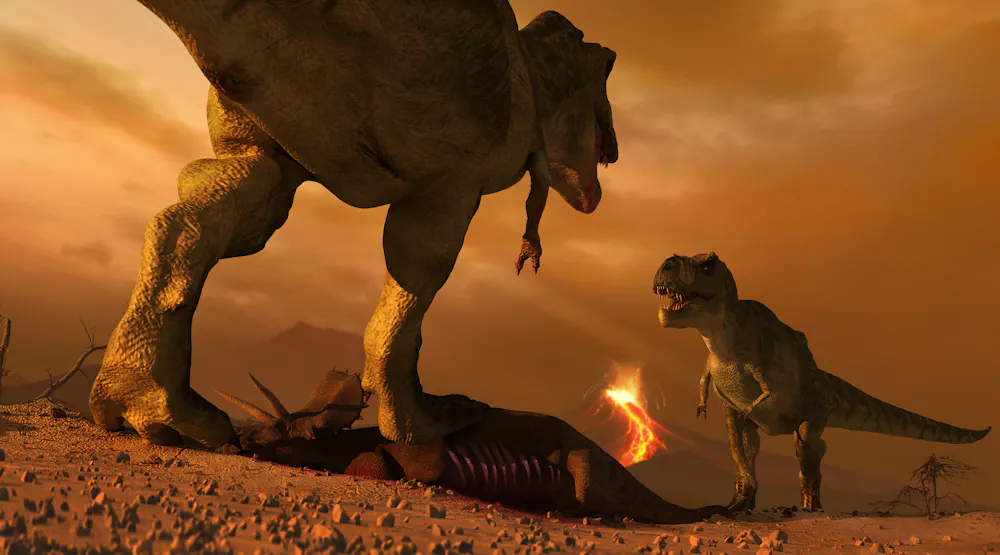
Two Tyrannosaurus dinosaurs face off over a downed prey carcass
Scientists have suggested that in a feeding frenzy, shorter arms would potentially be easier to keep out of the way of chomps from other T. rex. Mark Garlick/Science Photo Library via Getty Images

Maybe the arms didn’t have a purpose

Another possibility is that the arms served little or no purpose at all, so over time, they became vestigial. That’s the scientific term for body parts that don’t have clear purposes anymore, but are still passed down through evolution.

One example is a whale’s hindlimbs. Whales evolved from mammals that lived on land that had large legs to move around. The bones are still present in today’s whales, but have gotten much smaller over millions of years and have no function.

Some scientists have suggested a different idea: T. rex’s arms may have evolved to be smaller as another body part grew larger. The fossil record reveals that arms got shorter as theropod skulls got larger across many different dinosaur groups, including T. rex. Larger skulls likely would have made it easier to hunt and eat larger prey.

Researchers can use mathematical equations to accurately predict theropod arm length if they know the animal’s skull size and length of its upper leg bone, the femur. It turns out that larger skulls are strongly linked to shorter arms in theropods.

The reason for the change in arms, however, isn’t as clear. Some scientists have argued that the smaller arms could have helped with balance as the head got larger, but others aren’t so sure. In evolution, there isn’t always a reason why a change occurs – sometimes, changes just happen. In this case, we don’t yet know if there was a benefit for the arms to get smaller as heads got larger.

Artist's rendition of a T. rex in a misty forest.
However they got that way, small arms don’t seem to have been an issue for these big predators. Orla/iStock via Getty Images Plus

So for now, we don’t really know how T. rex used its arms or why they evolved to be so small, proportionally. As scientists find new data, we will continue to test hypotheses to better understand why this tiny-arm trend occurred so many times in theropod evolution. That’s what makes science so exciting – a future fossil discovery could be the missing puzzle piece that helps us answer these questions.

Sarah Sheffield describes – and her students act out – some of scientists’ hypotheses about T. rex arms.

Hello, curious kids! Do you have a question you’d like an expert to answer? Ask an adult to send your question to CuriousKidsUS@theconversation.com. Please tell us your name, age and the city where you live.

And since curiosity has no age limit – adults, let us know what you’re wondering, too. We won’t be able to answer every question, but we will do our best.

The Conversation

Sarah Sheffield does not work for, consult, own shares in or receive funding from any company or organization that would benefit from this article, and has disclosed no relevant affiliations beyond their academic appointment.
  •  

Bison restoration efforts and grazing rights hinge on one question: Are bison wildlife?

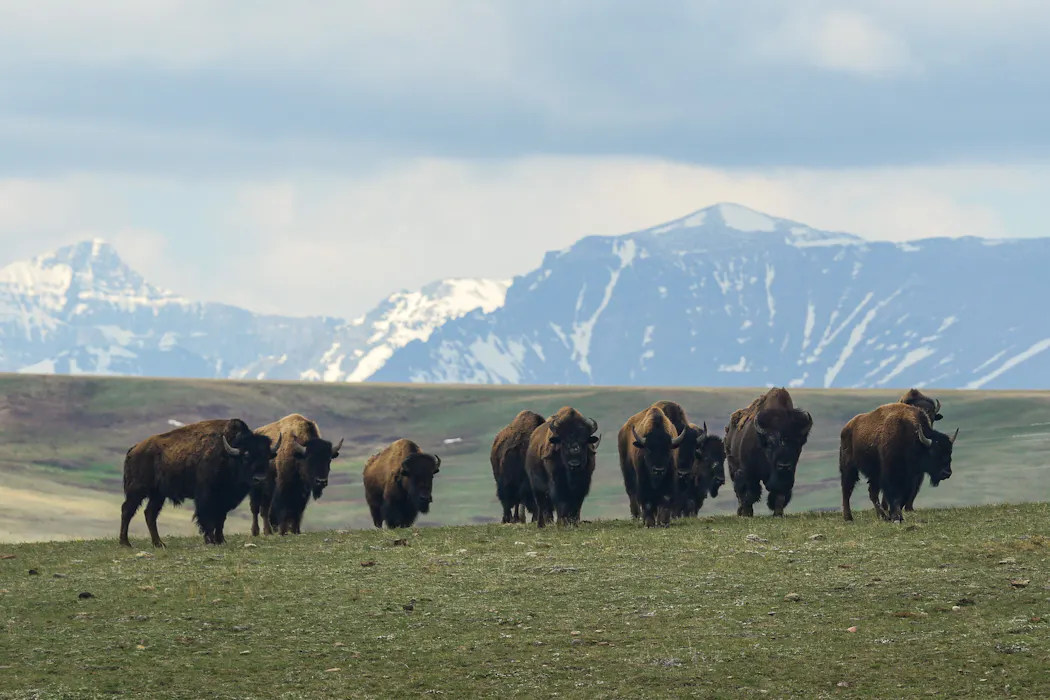
Part of a bison herd maintained by the Blackfeet Nation on a private reserve in Montana. Madison Stevens, CC BY-NC-ND

Bison are political animals. A federal decision to revoke grazing leases for bison on public lands on the rolling plains of eastern Montana is the latest manifestation of long-standing contention. The largest land animal in North America, bison are considered a “keystone” species, meaning they have high ecological and cultural importance.

The May 2026 decision represents a significant setback for a decades-long effort by American Prairie, a private conservation organization, to restore wild bison to the Great Plains. Those in favor of the decision are describing the move as a boon for rural farmers and ranchers because it would reduce competition for grazing lands.

The legal question at the heart of the federal decision is a seemingly simple one: Are bison wildlife or are they domestic livestock? Approximately 400,000 bison roam the North American landscape today, of which nearly 90% are considered livestock.

The U.S. Bureau of Land Management argues that American Prairie’s herd of around 940 animals is intended as wildlife conservation, so it does not qualify as livestock production and is therefore ineligible to hold federal permits to graze on public lands.

American Prairie plans to appeal the decision, countering that it follows all pertinent regulations for livestock management – including containment and annual testing for diseases. Despite the organization’s vision of recreating an “American Serengeti,” these bison are privately owned and managed as livestock: wild in rhetoric only.

Buffalo walk through brown grass with hills in the background.
Bison walk through part of the American Prairie land in Montana. AP Photo/Matt Brown

As political ecologists who study the human dimensions of conservation, we are interested in how environmental decisions – such as how people legally define and manage animals – reflect power dynamics and how people understand the value of wildlife.

Our own research focuses on how tribal nations are navigating complex legacies of colonial settlement to restore bison as keystone relatives in a shared ecosystem. Collaborating closely with advisers from across the four nations of the Blackfoot Confederacy, including the Blackfeet Nation in Montana, we have learned that this perspective on bison, also known as buffalo – and “iinnii” to our Blackfoot partners – complicates, and enriches, this distinction between wildlife and livestock.

A human and ecological tragedy

Less than 200 years ago, an estimated 30 million bison roamed the North American grasslands, vital to plains ecosystems and Indigenous ways of life.

By the late 1880s that number dropped to less than 1,000. Bison were brought to near-extinction by a combination of commercial hunting, disease, drought and deliberate persecution as part of a broader effort to assimilate tribal nations into reservation life.

The legacies of this destruction reverberate through Plains Indigenous communities today. But increasingly, so does a sense of hope for recovery and repair.

Buffalo stand in an area of shrubs sprinkled with snow.
The bison in Yellowstone National Park are considered wildlife, managed by the National Park Service within park boundaries. Madison Stevens, CC BY-NC-ND

Bringing the bison back

Bison restoration efforts have been underway for over a century. Since the beginning, a motley crew of advocates have each seen something different in returning bison: a business opportunity, an ecological keystone or, since 2016, the United States’ national mammal. For the Blackfoot Nations and other tribes, the buffalo is a returning relative and a symbol of resurgence.

This symbolic ambiguity has brought together a broad coalition of “bison cheerleaders,” as one of the people we interviewed put it.

This diverse base of support may also help explain the mixed system of legal classification that now governs this controversial species. On federal lands, bison are wildlife. Most states, however, consider them livestock. In a few states, including Montana and Colorado, bison are dual-listed as both wildlife and livestock, which bison advocates say allows for more flexible management.

Meanwhile, many Native American tribes, including the Blackfeet Nation, formally recognize bison as wildlife. Yet they also challenge the distinction altogether, arguing that categorizing the animals as livestock or wildlife fails to reflect Indigenous worldviews that consider buffalo as both food and kin.

A grassy landscape view shows mountain peaks in the distance.
Chief Mountain (Ninnaastako), a culturally significant place for Blackfoot people, was selected as the site of a 2023 reintroduction of free-roaming bison. Madison Stevens, CC BY-NC-ND

A question of management

In a practical sense, the distinction between wildlife and livestock matters because how bison are listed determines how they are managed and under whose jurisdiction they fall.

Imagine a bison in Yellowstone National Park. Managed as a wild animal by the National Park Service, she roams freely – watched by curious tourists – as she forages, breeds and protects her calf from large predators, such as wolves and grizzly bears. Come one harsh winter, she migrates north across the park boundary into the state of Montana.

Because Yellowstone bison carry a disease called brucellosis that can infect cattle, when she leaves the park she becomes a “species in need of disease management,” subject to state and federal disease-management rules. She is allowed to roam only within a limited tolerance zone to avoid infecting cattle.

Also, outside the park she may be hunted, both by sovereign tribal nations exercising their treaty rights and by state-licensed hunters.

Less than 50 miles away, another bison lives an ostensibly similar life, also moving with the seasons and calving among the sagebrush, vigilant for predators. Yet according to the state of Montana, this bison is a privately owned, domestic animal.

A wide view of a grassy, hilly area with various barns and other buildings visible.
The Flying D Ranch in Montana, founded by media mogul Ted Turner, is working to restore bison to the Great Plains as a business venture. Madison Stevens, CC BY-NC-ND

She counts among the more than 45,000 bison that are owned by one specific “bison cheerleader”: media mogul and private conservation advocate Ted Turner, who died May 6, 2026. Turner’s flagship Flying D Ranch, a 113,600-acre property near Big Sky, Montana, is home to around 6,000 bisonnearly as many as live in Yellowstone National Park, the largest wild herd on the continent.

Bison managers and ecologists explain that animals managed as livestock are selectively bred and handled. Yet “wildness” isn’t always cut and dry. While managed for meat production, the bison at the Flying D Ranch are still a big herd occupying a large land base with wild predators. This makes them, in some senses, wilder than most herds managed for conservation by the U.S. Department of Interior, which average only 300 animals.

Like American Prairie’s bison, their management also reflects a vision of restoring wildness to the landscape through private land conservation.

Shifting definitions

When we began interviewing people about buffalo restoration in 2022, momentum for restoring free-roaming bison was at an all-time high, elevated as a key priority by Interior Secretary Deb Haaland. In that year, the U.S. Bureau of Land Management granted American Prairie the now-contested grazing leases, following extensive environmental review.

In a profound culmination of decades of grassroots advocacy, in 2023 the Blackfeet Nation released a herd of 48 buffalo near Chief Mountain, the first to roam freely on Blackfoot territory in over 150 years. In 2024, Yellowstone National Park adopted a new bison management plan to manage a larger, more migratory population.

Several bison walk across a snow-covered grassland.
Bison in the Fort Peck Tribes’ herd in what is now Montana are descended from bison in Yellowstone National Park. Madison Stevens, CC BY-NC-ND

Yet these developments were not without detractors. In places like Montana, bison have been received by some as a symbol not of hope but of government overreach and the power of elites over rural futures in a changing West.

One way people are seeking to change the discussion is by changing the definitions, underscoring once more why they matter. In 2021, the Montana State Legislature gave county commissioners authority to veto wildlife reintroductions in their county and redefined wild bison as only those bison that have not been handled or descended from handled animals.

In passing these laws, state lawmakers effectively “defined wild bison out of existence,” as a former Montana Fish, Wildlife and Parks official told us.

Ironically, those changes were intended to make it impossible for private entities to reintroduce bison as wildlife. Yet now the federal government is saying the animals are too wild to be classified as a productive use of the landscape.

This contradiction makes more sense when seemingly technical debates over listing are understood as conflicts over competing visions for the landscape: Are public lands – and even large private holdings – places to produce food or preserve pristine wilderness? Or something else? One Blackfeet community leader we interviewed reminded us that for Indigenous people, these lands remain both home and livelihood.

The effects of the BLM decision to revoke grazing leases could ripple well beyond American Prairie. An organization representing more than 50 tribes has filed a complaint against the decision, arguing that it threatens not only buffalo restoration but growing tribal-federal co-stewardship efforts.

An unlikely coalition brought the buffalo back from the brink. In a moment of growing uncertainty over the future of conservation on public lands, our research tells us that the long-term success of bison restoration will require finding common ground – and compromise – across diverse visions for the North American landscape.

The Conversation

Madison Stevens received funding from the National Science Foundation (#2404531; #2117652) and Montana State University to conduct this research.

Elizabeth (Libby) Lunstrum receives funding from the National Science Foundation (grant #2117652) and Boise State University.

  •  
❌