Reading view

Why sophrosyne, an ancient Greek virtue, matters more than ever in the age of AI

Sophrosyne is a constellation of characteristics that includes moderation, reflectiveness and self-knowledge. PM Images/DigitalVision via Getty Images

Texting while driving. Bullying people on social media. Buying into the latest conspiracy theory. Passing off AI-generated work as your own.

That may seem like a random list of 21st-century vices. But I’d argue they’re all examples of the loss of one particular virtue: sophrosyne.

An ancient Greek concept, sophrosyne – pronounced “suh-fros-uh-nee” – is what we might call “sound-mindedness” today. It’s a constellation of characteristics, including moderation, reflectiveness and self-knowledge. They’re found in the kind of person who can respect and trust herself, and be respected and trusted by others.

As a philosopher and philosophical counselor, I research the connection between virtue and happiness. In particular, I’ve noticed a connection between sophrosyne and eudaimonia, the Greek philosophical concept for happiness, or living well.

Harmony of the soul

For the Greeks, sophrosyne represented excellence of character, moderation and self-control. It was connected to phronesis, or practical wisdom, and stood in marked contrast with hubris: excessive pride, dangerous overconfidence and lack of self-insight. Heraclitus, a philosopher who lived around 500 B.C.E., taught that sophrosyne was the most important virtue of all.

Plato, who taught a century later, discussed sophrosyne as the ability to know oneself – and to know when you don’t know something. In “Republic,” he likened sophrosyne to a harmony or friendship between the three parts of the soul: reason, spirit and bodily desires.

A faded fresco shows two bearded men in robes gesturing as they speak with each other.
At the center of ‘The School of Athens,’ by Raphael, stand Plato and his student, Aristotle. Wikimedia Commons

Plato’s student Aristotle argued that sophrosyne allows people to strike a balance between self-indulgence and self-denial – like someone who tries to get the right amount of physical exercise, neither too much nor too little. Aristotle taught that it was a virtue developed through practice, just like training for a sport or learning to play a musical instrument.

Sound-mindedness, in short, is not inborn but must be learned.

Discipline and discernment

I believe sophrosyne is still essential for the good life, the life of eudaimonia – happiness and human flourishing. It’s not a transitory feeling, but a sense of being your best self. This involves a kind of satisfaction that is not possible without self-knowledge and self-control.

What’s more, it requires the ability to discriminate between the good and the bad, the true and the false – capacities that are not inborn, but learned through steady practice. Without sophrosyne, it may not be possible to discern what is good for yourself or others. And even if you could, without sophrosyne you might lack the will to follow through.

If anything, these qualities might be even more important with the rise of artificial intelligence and social media. In my counseling practice, I’ve worked with people like “Brian,” an idealist who wanted truth and justice to win out over evil and oppression.

The problem was that he didn’t know how to vet his sources. As the COVID-19 pandemic raged, Brian fell down a conspiracy theory rabbit hole. He was certain that the condensation left in airplanes’ wake were “chemtrails,” a government brainwashing plot, and fumed against the “New World Order.” Thinking he knew it all, he was no longer open to reasoned dialogue.

A man, seen from behind, looks at his phone in a dark room.
Sound-mindedness helps us keep perspective in the sea of information online. Artur Debat/Moment Mobile via Getty Images

But if Brian is an example of the loss of sophrosyne, another person I worked with, “Lee,” shows how we can develop it. Lee spent quite a bit of time on social media, but she began to wonder how it was affecting her. She slowed down, took more breaks and started paying more attention to what her mind was doing and to how she was feeling.

As Lee became more self-aware, she realized she was wasting her time. She no longer connected to the reasons she had used social media in the first place. “Consuming social media was making me uneasy. It was like pigging out on junk food,” she told me. “Now I read more books, prepare food and walk during the time I had been spending on social media.”

Ripple effect

For the Greeks, sophrosyne was an ideal second to none. In the 1960s, though, Plato scholars Edith Hamilton and Huntington Cairns lamented that it was no longer “among our ideals.” That seems all the more true today – and the wider consequences are easy to see.

First, there’s the increase in incivility, in all its 21st-century forms – from road rage to cyberbullying. After the isolation of the pandemic, there’s even a new term for general social incivility: “social jet lag.”

The decline of sophrosyne can also lead to screen addiction, diminished attention span and ability to focus – factors that can, in turn, undermine civility. Civility takes sustained awareness of oneself and others.

The consequences go beyond our friends, families and co-workers to democracy itself. If sound-mindedness suffers, excessive pride and overconfidence hurt our ability to engage in reasoned dialogue and to respect other people’s differences.

Timeless virtue

There are a number of factors, I’d argue, that have led to the loss of sophrosyne, including a decrease in funding for education, more teaching to the test and greater economic inequality, which leaves less time and energy for things like personal development.

Another is the decline of mentoring relationships, which the ancient Greeks considered central to intellectual and moral development. A true mentoring relationship involves both instruction and leading by example. It’s about character, not success defined by wealth and status. Today, it appears that mentors have largely been replaced by celebrities and hero culture, with the rich and famous held up as examples worthy of emulation.

I believe the first step toward recovering sophrosyne is to recognize its importance in the good life. The second is to acknowledge its decline. The third is to understand the factors that have led to this decline.

Temperance, moderation, self-control, discernment – qualities such as these add up to a timeless excellence of character that cannot be faked. Becoming such a person requires guidance, practice and consistency.

The Conversation

Ross Channing Reed does not work for, consult, own shares in or receive funding from any company or organization that would benefit from this article, and has disclosed no relevant affiliations beyond their academic appointment.

  •  

Your bank’s AI just blocked your payment – what can you do?

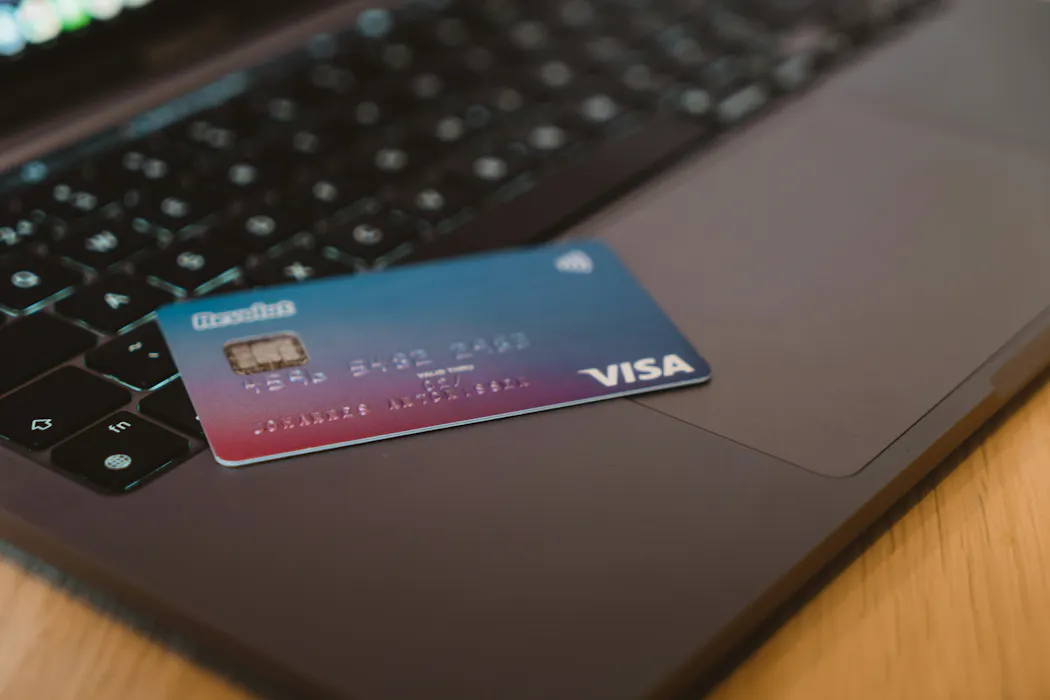
AI can detect financial fraud more efficiently than previous technology did, but it also flags legitimate transactions that it shouldn't. CardMapr.nl on Unsplash, CC BY

Imagine you’re at the supermarket checkout. Your cart is full. The line behind you is long. You tap your card. Declined.

You try again. Declined.

You haven’t overspent. You haven’t done anything suspicious. But somewhere inside your bank’s computer systems, a machine made a decision about you in less time than it takes to blink – and it made a mistake.

What just happened? And why does it keep happening to people who haven’t done anything wrong?

This isn’t a rare glitch, but something that happens to millions of people every day. And most of us have no idea why it happens or what we can do about it. The answer lies inside a fraud detection system powered by AI.

As a data science teaching professor and former financial-services data scientist, I understand how this system works and can explain why it sometimes fails the very customers it’s meant to protect. Just as important, I can help you find out what you need to know and what you can do if you or your loved ones are unfairly flagged.

A decision in milliseconds

When you tap your card, a signal travels to your bank’s fraud detection system in the time it takes to blink. The transaction processing at your checkout is fully automated, operating within AI systems that handle millions of payments simultaneously, and computes a risk score based on dozens of features extracted from that single moment. Those features might include the transaction amount relative to your recent spending average; the type of merchant; your geographic location; the time of day; the device used for online purchases; and how this purchase compares to your historical patterns.

Once those factors are plugged in, an algorithm scores your purchase in real time. A model trained on millions of past transactions then assigns each combination of features a probability on how likely it is that this transaction would be fraudulent. If that probability crosses a threshold, the transaction is blocked or flagged for review. The whole process takes less than 200 milliseconds.

‘99% accurate’ still fails millions of people

What sets this technology apart is speed. Financial institutions process millions of transactions every day, which is far greater than any human team can effectively monitor. Banks also have fraud analysts, but their work happens at a different layer entirely – reviewing patterns, investigating cases, and handling disputes that the automated system escalates to them.

To their credit, these new systems are usually accurate at catching fraud. Banks lose far less money due to card fraud today than they did before machine learning – one of the foundational technologies that power today’s AI systems – became standard.

Still, the word “accurate” conceals a problem. Consider the numbers. The Federal Trade Commission reported that Americans lost more than $12.5 billion to fraud in 2024 – a 25% increase from the year before. As banks process more transactions than ever, fraudsters are keeping pace, too.

And here is the part that is especially worth noting: According to Stripe, one of the world’s largest payment processors, “false declines” (legitimate transactions wrongly rejected) are a structural problem across the entire industry, and industry research consistently suggests they cost the financial system more than actual fraud does.

These errors aren’t random. They cluster around people and situations that the algorithm wasn’t properly trained to expect. Buying gas in a city you’ve never visited or making a large rent payment for the first time aren’t inherently suspicious. But to a machine trained on past patterns, they can look that way.

There’s something even more troubling. These algorithms learn from historical data, which is almost always imbalanced. Because fraudulent transactions are rare on a per-transaction basis, the model has seen relatively few examples of what fraud looks like across every type of customer.

What does this mean? Research has found that customers in lower-income areas and communities of color face higher rates of erroneous declines. When a model hasn’t seen enough transactions from a particular group of people or in a given situation, it has less data to build an accurate baseline for them. So when something slightly unusual happens, it flags it. Not out of intent, but out of unfamiliarity.

The model isn’t necessarily explicitly discriminating against anyone. But its outputs can still produce what researchers call disparate impact – unequal harm, distributed unequally.

As researchers at MIT explain in their book “Fairness and Machine Learning,” this is a known limitation. A model trained on incomplete representation will perform less reliably for the groups it saw least. The fix isn’t to blame the algorithm, but to train it on better, more representative data, and to test its error rates across different customer groups before deployment.

An upset young woman talks on the phone to dispute something she sees on her computer screen.
When machine learning declines a payment, you’re faced with a black box that isn’t designed for human interpretation. Vitaly Gariev on Unsplash, CC BY

Why you don’t have the right to an explanation

What makes these cases worse is the lack of any information.

When a loan officer denies your mortgage application, the law requires a written explanation. But when an algorithm declines your debit card, you get “flagged by our system” message. If you’re lucky enough to connect with a human representative, they can’t tell you much more.

This gap isn’t an accident. Most high-performing fraud models are black boxes. Their internal logic isn’t designed for human interpretation. A bank may genuinely be unable to articulate plainly why your transaction was stopped. That’s not because it’s hiding something, but because the model itself doesn’t produce a reason. It produces a number.

In response, some financial institutions are moving toward tools that make their algorithms more transparent. Known in the industry as “explainable AI,” these systems are designed to surface the most influential factors behind a given decision – flagging, for instance, that a transaction was blocked because of an unusual location combined with an atypically large amount. It’s a meaningful step toward accountability.

However, these adoptions are uneven, and the explanations that do exist are rarely surfaced to customers.

Meanwhile, those pressures haven’t yet translated into a consistent, enforceable right to a meaningful explanation when your card gets declined. Challenging a decision made by AI can be enormously difficult, and most of us don’t even know we have the right to try.

For most people, the path of least resistance is simply to move on, switch to another card, take their business elsewhere or say nothing. Research suggests a quarter of consumers who experience a false decline never return to that merchant at all.

Some people go further and close the account entirely. That instinct is understandable. However, it carries a hidden cost. A declined transaction won’t appear on your credit report, but closing the card can. Shutting down an account reduces your available credit and can shorten your credit history, which can directly affect your credit score.

What you can actually do right now?

You have more power here than the banks would like you to think.

Call your bank immediately: A fraud flag is probabilistic, not final. A bank representative can override a declined transaction in real time. The model made a guess, but a human can correct it. Do not wait.

Set alerts if you’re planning to make unusual purchases: Most banks allow you to notify them of upcoming travel, large purchases, or changes in your spending pattern. This doesn’t override the model, but it gives it new information to work with, which can prevent the flag from triggering in the first place.

Know your rights: Under the Fair Credit Billing Act, you can dispute erroneous transaction blocks and request an explanation. If you believe you’ve been systematically and unfairly blocked, the Consumer Financial Protection Bureau accepts consumer complaints.

Ask your bank what appeal processes are available: Increasingly, banks are building more customer-facing appeal services. Visa reported 106 million disputes globally in 2025, a 35% rise since 2019, and has called dispute management a “strategic priority.” Improper declines are expensive for payment companies and financial institutions, too, through customer service costs, lost revenue and eroded trust.

The bigger picture

The algorithm that blocked your payment isn’t all-knowing or neutral. It’s a machine making a statistical guess about you, based on data that was probably never perfectly fair to begin with.

As AI spreads further into our daily lives, the question of who controls these decisions, and whether we can challenge them, becomes ever more urgent. The technology will keep expanding into new realms. The rules, and our own financial fluency, need to keep up.

The Conversation

Pragati Awasthi does not work for, consult, own shares in or receive funding from any company or organization that would benefit from this article, and has disclosed no relevant affiliations beyond their academic appointment.

  •  

‘Debate me!’ doesn’t work. Here are better ways to disagree – and maybe change minds

In a deeply divided America, what passes for 'debate' seems designed to fuel polarization, not to exchange ideas and really change minds. Brendan Smialowski/AFP via Getty Images

Spend time on social media and you will see debates with titles like “I destroy MAGA mom on vaccines” or “Conservative philosopher owns feminist student.” These popular videos focus on clip-worthy gotcha questions, one-line zingers and screaming matches edited for virality.

These “debates” would be unrecognizable to the Founding Fathers, who enshrined debate as a primary tool of legislative deliberation. Even the passionate exchanges of Abraham Lincoln and Stephen Douglas, whose 1858 “great debates” about slavery drew crowds of thousands, are tame compared with today’s vitriolic exchanges. While Lincoln and Douglas exchanged insults, played to the crowd and took a few logical leaps, they could still communicate respectfully.

Then, as now, Americans were deeply divided. But today’s wars of words seem designed to fuel intense polarization, not to change minds.

Debate is broken as a tool to inform, explore ideas and persuade an audience. It’s time to find another way.

That’s a difficult conclusion for me. As a communications professor, I believe presenting an argument, listening thoughtfully to the response and responding with a rebuttal is excellent critical thinking and public speaking practice. However, when I assign a shortened Lincoln-Douglas structure, many students ask when they get to “really” debate – meaning the ruthless online back and forth.

Research says that persuasion is possible in other ways. But the process requires understanding, perspective-taking and collaboration. People must choose communication, not competition.

A black and white illustration of around a dozen men in suits, including a standing Abraham Lincoln, on a platform amid a crowd outdoors.
The Lincoln-Douglas debates inspired a format still used today – but in such a polarized society, traditional debate rarely changes minds. Cool10191/Wikimedia Commons

Us vs. them

How did even presidential debates become so combative, so filled with personal insults, that moderators have to mute microphones to stop constant interruptions?

Political scientist Lilliana Mason says a major factor is that political affiliation has become central to Americans’ personal identity. Her 2018 book, “Uncivil Agreement,” argues that in the wake of the Civil Rights Movement, political parties started aligning less with specific policies and more with social identities, such as race, class, religion and sexual orientation.

As the parties became less diverse, both demographically and ideologically, political affiliation became an umbrella-like mega-identity that stacks different aspects of personal identities together and has created two large teams: conservative and liberal. In some ways, the two parties form different cultures, though no group is a monolith. There are surface differences, such as where liberals and conservatives tend to live, and deeper ones about values and beliefs. Ultimately, mega-identity creates a sense that the “other side” is a threat.

These identities contribute to a person’s sense of self and shape how they see others too. The more someone aligns with a political party’s constituent identities, the more partisan they become, and the stronger the influence of mega-identity.

When political affiliation becomes tied to self-concept, it links to a person’s deepest values: their sense of right and wrong. That’s why conversations about controversial issues frequently elicit defensiveness. Hearing conflicting ideas feels like you are being attacked, as though you need to defend yourself and your community or lose face.

Want to talk?

With tensions this high, avoiding politics in conversation is tempting – but often hard to avoid. And sidestepping tough topics could do just as much harm as tackling them, since deep conversations are important for the health of our relationships.

So, what can be done to sway someone on controversial issues? One successful method with research behind it is called deep canvassing. The technique was originally built for door-knockers advocating for ballot initiatives but can be adapted to other kinds of fraught conversations.

First, decide which topics you can really be civil about. If something feels so personal that any contrary opinion makes you throw up internal walls, it may not be the right topic for bridge building.

Next, cordially invite the other person into a conversation, building rapport without putting them on the spot. Something like, “I saw your post on Facebook about immigration and I wanted to talk with you about it. Are you up for that?” or “I’m curious about why you think that way. Care to talk about it?” The tone should be friendly and casual.

A middle-aged woman in a purple shirt stands in a garden speaking with a tall, younger man in a white collared shirt.
Try to go into the conversation with real curiosity about someone’s opinions. Koldunova_Anna/iStock via Getty Images Plus

If they accept, gauge where they are on the topic. Canvassers start by asking a person on a 1-10 scale where they stand on an issue and why. This allows the person to articulate their position and gives them time to process how they feel and why.

Often, the initial statements and opinions they’ll share are inflammatory ones they’ve heard elsewhere, including politicians’ talking points and media sound bites. It can be tempting to start building a counterargument or to interrupt.

Don’t. Stay open and let them talk. Remember, these issues might touch on their sense of identity and can easily trigger defensiveness, so saying, “Well, actually …” could shut down the conversation.

Sharing stories

As the conversation deepens, the goal is to move past talking points into storytelling. Journalist Mónica Guzmán, in her 2022 book “I Never Thought of It That Way,” suggests questions like, “What shaped your views on this?” or “Do you know someone who…” or “What experiences have you had that make you think this way?”

Listen for connection points, such as shared values, emotions and experiences. In a conversation about voting rights, fairness could be a shared value, no matter where you stand on a given policy. Talking about gun control? Safety could be a starting point. Canvassers link that underlying value to a story or experience of theirs that shows the other side of the issue.

For example:

“I hear what you’re saying about wanting everyone to have an ID to vote. I can see we agree on wanting elections to be fair. However, I remember when REAL ID came out, I had to go to one county to get a copy of my first marriage license, another to get a copy of my divorce decree, and then dig out my new marriage license and all the other required documents. If I couldn’t take time off, or if I didn’t have reliable transportation, I might have just given up.”

Exchanging stories can go around defensive walls and open people up to conversation, making us more open-minded and curious about each other – a moment of humanization.

“I worry that this proposal could make it hard for everyone to have a voice, and that feels unfair to me. I’m curious, do you think there might be a better way to prevent fraud and make sure the process is accessible?”

Notice the lack of sources and statistics? Not focusing on data can drive a traditional debater crazy. But someone’s political stance can actually change how they interpret raw data, a process called motivated numeracy. Statistics that contradict a strongly held belief are often discarded as “fake news.”

The conversation usually ends with the canvasser asking the other person whether their rating on the issue has moved at all. If it took 21 hours for Lincoln and Douglas to talk through their issues, it is unrealistic to assume one short conversation will make a dramatic difference. But civil experiences with someone who holds a different opinion can stick with the person long after the conversation ends.

I think debate, with its competitive point scoring, no longer serves us, but techniques drawn from deep canvassing can build bridges. Perhaps with patience and practice, conversations like these can build empathy, promote compromise and begin to disassemble the walls dividing us.

The Conversation

Lisa Pavia-Higel is a trained Braver Angels volunteer facilitator, though she is not currently active in the organization. Last fall, she helped co-facilitate a People's Supper event as a volunteer. She has also undergone one training session in deep canvassing from PROMO, a St. Louis-based LGBTQIA organization, and occasionally gives her time to the organization.

  •  

Philadelphia’s 2026 sports calendar is packed – but fans are being priced out

A 16-ounce beer at Lincoln Financial Field in Philadelphia costs over $11. Robbie Jay Barratt/AMA via Getty Images

Sports have been part of America’s big birthday celebrations in Philadelphia dating back to the Centennial Exposition of 1876, which featured an international regatta and helped establish Philadelphia as a global center for rowing.

During the bicentennial festivities in 1976, the NHL, NBA and MLB all held their all-star games in Philadelphia, along with the NCAA Men’s Final Four. The city also hosted an exhibition between the Philadelphia Flyers and the Soviet Red Army hockey team, as well as the annual Army-Navy game.

For the semiquincentennial events in 2026, which have been branded America 250, Philadelphia is an epicenter of sports again.

This kicked off with the PGA Championship in May. Soon, the FIFA World Cup, MLB All-Star Game, golf’s U.S. Amateur Championship and the Philadelphia Cycling Classic, which comes back after a 10-year hiatus, will also descend upon the city.

As a researcher who studies and teaches about sports and the economics of fandom, I see the events coming to Philadelphia for America 250 as an opportunity to reflect on the growing financial inaccessibility of sports.

If excitement over these events feels reserved, it might be because so many Philadelphians have been priced out of them.

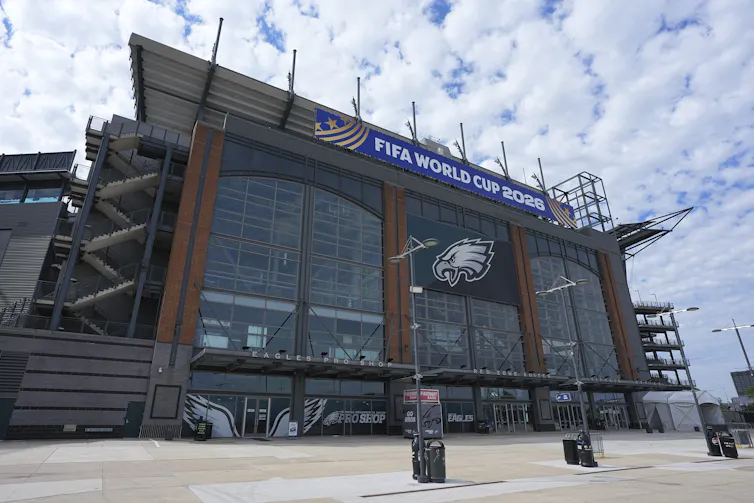
Exterior of large sports stadium
Lincoln Financial Field, home of the Philadelphia Eagles, will host six World Cup 2026 matches. Mitchell Leff via Getty Images

Live sports events are more unaffordable

Early signs of Philadelphia sports fans opting out of the growing unaffordability of sporting events came during the PGA Championship.

The tournament took place at the Aronimink Golf Club in Newtown Square, about 15 miles (24 kilometers) outside of Philadelphia. Prices to attend ranged from about US$79 for an early-week practice round to $299 for the third and fourth rounds. An all-inclusive ticket cost $1,433.

The tournament sold out nearly a year ago, but as the event approached, tickets on the resale market were being sold below face value. This shows both the impact on fan’s direct access to tickets and potential cooling of the resale market and fans.

With the first 2026 World Cup match approaching, thousands of tickets to U.S. matches remain unsold. These include group stage – or early tournament – matches featuring the U.S. team. A select number of $60 tickets were made available to national soccer federations for supporters, but the lowest price for tickets available to the general public for a group stage match in Philadelphia is $380.

While Philadelphia, unlike other U.S. cities, has not further inflated fans’ expenses by price gouging on public transportation and hotels, the costs are still too high for many if not most sports fans to afford.

Ticket prices, combined with a political climate not conducive to attracting international fans, has led to slower than expected sales for U.S. matches. According to the American Hotel and Lodging Association, FIFA has canceled up to 70% of the hotel reservations it had made in Philadelphia and other U.S. host cities.

A $6 All-Star Game ticket in 1976

Back in 1976, ticket prices for the all-star games and the Flyers’ exhibition topped out at $15. That’s the equivalent of about $88 today when adjusted for inflation.

Some tickets, like for the 1976 MLB All-Star Game, sold for as low as $6, or the equivalent of $35 today.

Face-value ticket prices for the 2026 MLB All-Star Game, however, range from $220 to $700 and are currently available only to full-season ticket holders. That’s just to attend the game. Fans who also want to attend the Home Run Derby or other events will have to pay more.

Adjusted for inflation, the cheapest MLB All-Star Game ticket today costs more than three times the highest-priced ticket cost 50 years ago.

Why tickets prices have soared

There are a number of reasons ticket prices for live events, including sports, have skyrocketed. The monopolistic practices of venue operator Live Nation, and its subsidiary Ticketmaster have contributed to this increase. In addition to service fees, Live Nation uses dynamic pricing, which raises ticket prices based on demand throughout the sale period.

The resale market is another contributing factor. Brokers and individual resellers use multiple accounts and artificial intelligence to snatch up tickets before fans can, and then resell them at a higher cost to make a profit.

Sports teams also continue to test the market and push ticket prices higher.

And finally, the size and composition of stadiums has changed dramatically in the past half-century in a way that leaves fewer affordable tickets for fans.

For example, Veterans Stadium, which opened in 1971 and served as the home for both the Philadelphia Eagles football team and the Philadelphia Phillies baseball team for over 30 years, offered more affordable tickets than the current Philadelphia stadiums. The Eagles moved into Lincoln Financial Field in 2003, and although it has a capacity slightly larger than the Vet, it has fewer seats when the luxury boxes are taken into account. In 2004 the Phillies moved into Citizens Bank Park, which featured nearly 20,000 fewer seats and an expanded club section.

Parking, hot dogs and beers add up

Beyond ticket prices, the entire fan experience also costs significantly more today.

In 1976, it cost $2 to park at Veterans Stadium. That equates to about $12 today. Standard parking for a Phillies game is now $30, and $50 for an Eagles game.

For the World Cup, parking passes are listed at between $115 and $155 for the group stage and $165 for the knockout stage. On the resale market, some parking passes are listed at over $600 for a single game.

Stadium concessions have also dramatically risen. A beer cost fans $1 in 1976 – the equivalent of $6 in today’s prices. Today a stadium beer in Philadelphia costs between $11.25 and $18. A hot dog back then cost about 75 cents, compared to $7-$10 today, with an expanding menu of food options costing $20 or more.

With tickets, parking and food, a family of four can expect to spend over $2,000 to attend an Eagles game.

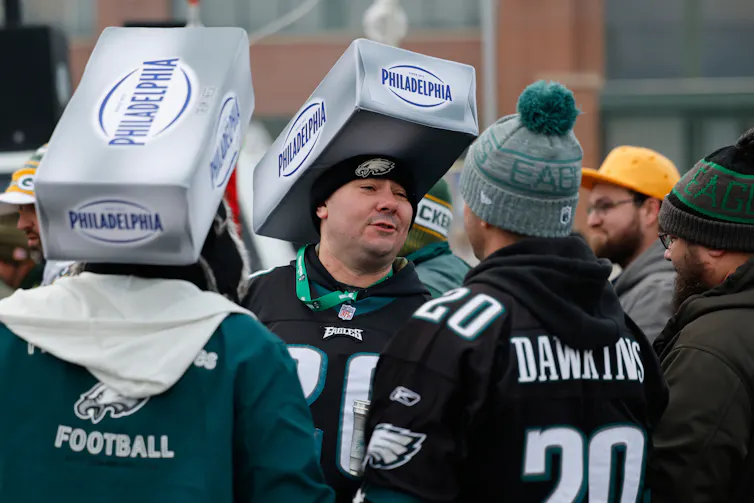
Men in football jerseys wear cardboard boxes for Philadelphia cream cheese on their heads
Philadelphia Eagles fans tailgate before a game against the Green Bay Packers in Green Bay, Wis., on Nov. 10, 2025. AP Photo/Mike Roemer

Stadium upgrades lead to fewer cheap seats

Modern stadiums and arenas typically have a 25-year lifespan before they undergo a major renovation or teams decide to build a new stadium. All three venues at the Sports Complex in South Philadelphia are either undergoing or considering a major renovation or new construction.

The Sixers, Flyers and the new WNBA franchise are preparing to begin construction on a new stadium as a part of a larger $2.5 billion redevelopment plan at the complex. Citizens Bank Park is undergoing a $600 million renovation, while the Eagles are considering whether they will renovate Lincoln Financial Field or build a new stadium that could conceivably host the Super Bowl and more major events. It’s likely these renovations will usher in even more luxury boxes and another jump in ticket prices for Philadelphia sports fans.

Read more of our stories about Philadelphia and Pennsylvania, or sign up for our Philadelphia newsletter on Substack.

The Conversation

Jared Bahir Browsh does not work for, consult, own shares in or receive funding from any company or organization that would benefit from this article, and has disclosed no relevant affiliations beyond their academic appointment.
  •  

TMZ descends on Washington in a test of whether tabloid tactics can serve the public interest

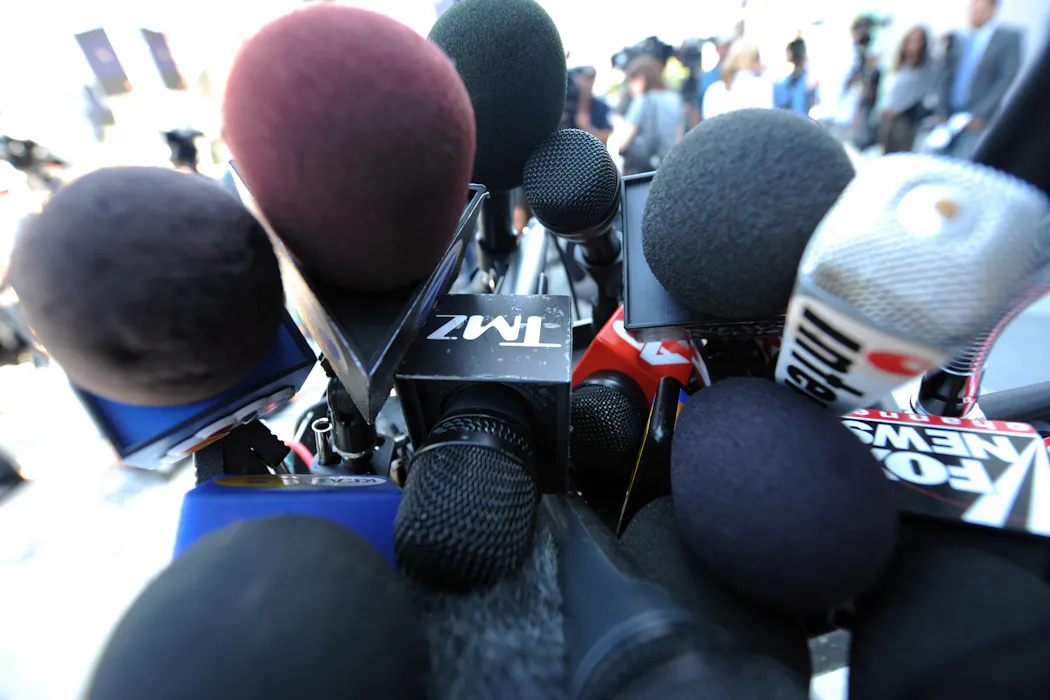
Will the Hollywood gossip outlet be able to hold those in power to account? Gabriel Bouys/AFP via Getty Images

Headlines on sex, drugs, sports and divorce always attract eyeballs. In fact, the entire tabloid industry has been built on the public’s hunger for scandal and schadenfreude.

TMZ is no exception. Through the years, it has become the go-to source for celebrity gossip, salacious affairs and public meltdowns.

So what to make of TMZ’s decision to recently launch a Washington bureau – TMZ DC – to cover the Beltway’s feuds, scandals and power struggles?

While some congressional staffers have been apprehensive about this new venture, I’m excited to see how it plays out. I’ve studied and written about how aspects of TMZ’s business model and audience engagement tactics can be replicated by local media to serve the public good.

Now that the outlet is setting its sights on the nation’s political actors, there will be an opportunity to see whether its controversial methods translate into holding those in power to account.

You are now entering the ‘thirty mile zone’

Celebrity journalism had been around since the creation of 18th-century scandal sheets, which published gossip about European aristocrats, royals and political elites. In the 19th century, the penny press emerged in the U.S. – cheap newspapers that competed for the public’s attention by running articles detailing crimes, scandals and lurid accounts of city life. Newspaper publishers William Randolph Hearst and Joseph Pulitzer supercharged this approach through what became known as “yellow journalism,” a sensational, emotionally charged style of reporting that flourished in the late 1800s.

TMZ repackaged this model for the digital age.

After a three-year stint as host of the syndicated TV show “Celebrity Justice,” Harvey Levin founded TMZ in 2005 with backing from Warner Bros. The name is a nod to Hollywood’s “thirty mile zone” – the roughly 30-mile radius around Hollywood that the entertainment industry uses to determine whether film and TV productions are considered “local” shoots or “on location.”

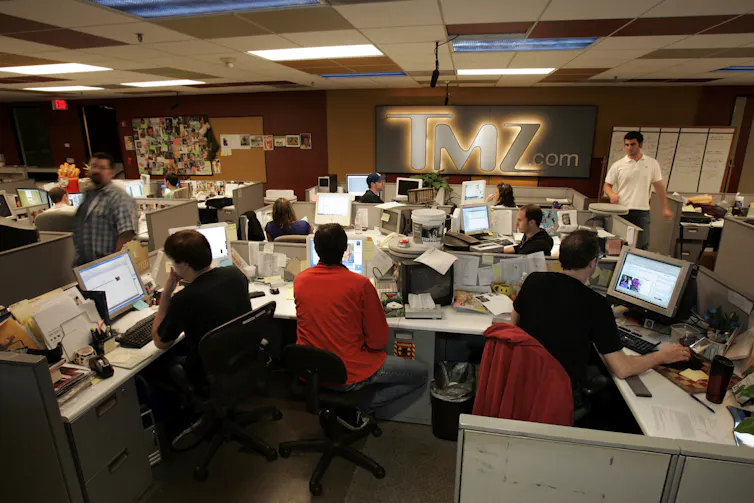
A crowded newsroom with cubicles and desktop computers.
TMZ’s former newsroom in Glendale, Calif., pictured in 2007. Ann Johansson/Corbis via Getty Images

From the start, TMZ has come under fire for its aggressive reporting tactics and its prioritization of speed over sensitivities.

Many of its posts hypersexualize women. Its articles often lack bylines, which allows it to promote its brand over the work of its reporters. The outlet has also allegedly cultivated a network of paid informants, which violates journalistic ethical norms. And it treats any and all celebrities as fodder for clicks, no matter how humiliating or intrusive the story.

TMZ has covered celebrity deaths in ways that most mainstream media outlets wouldn’t consider. It posted Michael Jackson’s autopsy report in an accessible PDF file. It published an article about Kobe Bryant’s death in 2020 before authorities had widely confirmed the news. And after One Direction member Liam Payne fell to his death in 2024, TMZ published a cropped photo of the corpse with identifying features. The ensuing outrage compelled the outlet to remove the images.

TMZ takes its talents to DC

TMZ’s content and approach were shaped by the web’s demand for speed, visuals and clicks.

However, while yellow journalism often resulted in articles that were exaggerated or misleading, TMZ usually takes pains to be rigorous and accurate in its reporting. The outlet’s journalists have become experts at records-based reporting, which involves scouring publicly available information or filing public records requests to build stories via court filings, property and tax records, police reports, financial disclosures, corporate filings or government databases.

TMZ’s attention to the dockets in Los Angeles-area courthouses has long given the outlet an edge in being the first to report on divorces – from those of Angelina Jolie and Brad Pitt and Britney Spears and Sam Asghari to, more recently, Nicole Kidman and Keith Urban’s split.

But more importantly, this type of document-based, investigative reporting is just the sort of approach that I think is needed to produce more public interest journalism. The focus simply needs to move from face-lifts and custody battles to lobbyists and insider trading.

Media scholar Patrick Ferrucci and I have explored how TMZ engages and holds its audience through a mix of original multimedia content, document-based reporting, sports-themed coverage and sensational headlines.

Yes, the outlet primarily focused on celebrities. But we wondered why traditional news organizations weren’t taking a page from TMZ’s book and covering elected officials like the paparazzi covered celebrities.

A reality show worth covering

This isn’t TMZ’s first attempt at covering national politics.

In 2007, there was a proposal for a Washington branch. However, its parent company, Time Warner, nixed the venture, deeming it too risky to mess with the bureaucrats that regulate its empire.

But with spectacle, personality clashes and corruption increasingly defining American politics – not to mention a former reality TV show host serving as president – it was only a matter of time before TMZ would have a second go at it. Plus, as TMZ DC Co-Managing Editor Charlie Cotton told Politico, the public deserves to know as much about public officials as they know about “The Real Housewives.”

TMZ already had a history of covering politics and bad actors. During the 2008 financial crisis, the outlet was able to channel its mean-girl energy into populist rage: After Congress approved US$700 billion to bail out banks, the outlet circulated images of bank employees partying with their bonus money.

In March 2026, before launching its Washington bureau, TMZ did something similar: It asked its audience to find photographs of members of Congress on vacation during a partial government shutdown that was forcing TSA employees to work without pay.

The call-out soon bore fruit. The outlet posted images of Sen. Lindsey Graham at Disney World that went viral, subjecting the South Carolina Republican to a news cycle’s worth of ridicule.

TMZ’s descent on Washington has also coincided with the rise of news influencers: social media users with hundreds of thousands – sometimes millions – of followers who post regularly about news and politics. They include V Spehar, Aaron Parnas and Heather Cox Richardson.

Quick to post and churn out content, their segments often go viral. In a nod to their digital clout, the Trump White House has even held influencer briefings.

TMZ’s reporters share similarities with these influencers. They don’t necessarily have a traditional journalism background, nor do they strictly adhere to journalistic values. Ethics can be cast aside for clout or virality. Both understand the power of bite-sized content, with TMZ pioneering the short-form blog post to break news, and influencers using their own authentic voice to gain audience trust.

Now, TMZ is pulling from the best practices of these influencers: Its staff will increasingly post short videos of themselves on social media breaking down stories. Talking directly to the camera via vertical video feels more like personal interaction instead of a stagnated and removed broadcast. This can be a key driver of audience engagement and trust.

Though it hasn’t been a paragon of ethics, TMZ has largely earned the trust of the public and – perhaps begrudgingly – of legacy media.

Time will tell if TMZ DC can become a watchdog in today’s fractured media environment. But with today’s political ecosystem now driven as much by virality as policy, I think TMZ is well positioned to go hard after the hypocrisy, backroom deals and scandals of the nation’s elected officials.

The Conversation

Angelica Kalika does not work for, consult, own shares in or receive funding from any company or organization that would benefit from this article, and has disclosed no relevant affiliations beyond their academic appointment.

  •  
❌