
 Login
Login
Frankly, I Don’t Give a Dam (Part 4)


Walter Lantz, Terrytoons, Famous, and Warner Brothers all contribute entries today to the saga of the beaver’s development in the animated cartoon, today sticking to theatrical short subjects. Let’s “cut” right to the chase, sink our teeth into the subject, and see what the audiences of the ‘40’s, ‘50’s, and early ‘60’s “saw”.
 Scrappy Birthday (Lantz/UA, Andy Panda, 2/11/49 – Dick Lundy, dir.) – The final of only two theatrical appearances for Buck Beaver, and also the swan song for Andy Panda as a star as well. A pity, as by this time, Andy had never looked so good. His flexibility of movement and character posing were at this point in his career sterling and flawless, and, when given the right plot material, such as here and in “The Playful Pelican”, Andy could be said to have finally achieved the ability to rival Mickey Mouse. Indeed, the concept of rivaling such icon seems to be prime in the minds of the studio in this production, as it also introduces to the screen a spirited girlfriend for Andy, Miranda Panda, who can easily be paralleled as the Minnie to Mickey or the Daisy to Donald. Given the right push by the creators, this duo might have gone places. But, alas, it was not in the cards. The United Artists’ distribution deal was about to run out, Lantz would lose the services of Dick Lundy, and himself wind up without contractual commitments save for commercial films for almost a year and a half. When the studio regrouped in 1951, no one seemed to feel comfortable about picking up the reins for the Panda’s productions. Paul J. Smith was handed a storyboard for “The Dog Who Cried Wolf” in 1953, boarded as a comeback script for Andy and his dog Dizzy. But Smith, while retaining Dizzy, crossed Andy out of the production, replacing his part with that of a generic farmer, and releasing the film as a one-shot instead of as part of any regular series. Andy would thus have only three more chances to appear on the screen for Lantz, as a bit player. He shared the screen with a redesigned Oswald Rabbit in an odd pairing for an early 1950’s theatrical automotive commercial (voice I believe provided by Dick Beals). He and Miranda Panda (in her only other screen appearance) walk into a barn dance (actually, about three Andys and three Mirandas, in a repeated cycle of animation) in “The Woody Woodpecker Polka”. And he makes a brief speaking appearance (voiced in Daws Butler’s Augie Doggie/Elroy Jetson voice) in the special television all-star episode, “Spook-a-Nanny” for the Woody Woodpecker show. He has since appeared on TV as one of several passengers in Woody’s car in a new opening credits sequence for a syndicated package of the Lantz cartoons in the late ‘90’s or early 2000’s, and in 2018 made some sporadic appearances in new Woody episodes, though his personality has become so un-Andy-like and his animation so poor that they really don’t count.
 It’s Miranda’s birthday. Andy arrives at her door, graciously presenting her with candy and flowers. But this is what he does for her on every birthday, and Miranda is bored with it. Why can’t he get her something different – something that all girls (at least of that era) want – a fur coat? Andy nearly keels over at the thought, proclaiming that he can’t afford a fur coat. Well, as far as Miranda is concerned, this means “You can’t afford a girlfriend, either.” She leaves Andy at the doorstep, stuffing the floral bouquet in his mouth, and smashing the candy box over his head. Enter the enterprising Buck Beaver, who can’t help just having overhead the squabble, and as usual has an instant solution – if the price is right. He jumps to the self-serving conclusion that Miranda will adore a fox fur – and just happens to have a run-down foxhound (Dizzy) for sale, at not one, not two, but a cost of five dollars. Andy becomes a dog owner without ever being able to utter a peep in protest.
If you’re going to hunt fox, you might as well look the part. Andy thus joins the local fox hunting club, and appears in red coat and hat and with hunting horn. Dizzy caddies his rifles in a golf bag, as Andy tries to sound a blast on the horn to commence the hunt. The horn seems to be plugged up with something, and it takes several blows before Andy is able to dislodge what’s inside – the fox himself, curled up for a siesta. The fox ducks into the trunk of a hollow and leafless tree. Andy inserts the end of his horn into the hole at the trunk base and attempts to blow the fox out with one prolonged blow. The force of his lung power propels out of the tree’s limbs a full covering of leafy green foliage, and this year’s entire crop of apples – all of which fall upon Andy. When Andy pops his head out of the apple pile, one fruit remains upon his head – causing the fox to perform a William Tell shot upon it with bow and arrow.
 The fox eventually resorts to subterfuge, entering another tree trunk as a fox, but emerging with the appearance of – a skunk! Andy investigates the tree hole, and finds inside a paintbrush, and a can of Special Skunk Paint manufactured by the Stinko Paint Company. Andy thus continues the chase, and after some gags in which the fox uses Dizzy as a living vacuum cleaner, the fox disappears into another stump, a sign outside declaring it to be the home of J. Primrose Skunk. When what appears to be the same “skunk” emerges again, Andy presumes it to be the still-painted fox, and charges after the creature, engaging in a battle with him in a whirlwind of action. Unseen by Andy, now emerging from the doorway of the stump comes the fox, with all paint removed, and wearing a clothespin on his nose! Back at the whirlwind, and without viewing the violence it takes to create it, Andy calls for a fur box from Dizzy, and packages up a ready-made fur coat, complete with black and white stripes. He presents the box to Miranda, surprising her completely. Without looking, she has Andy slip the garment on her – then wrinkles her nose several times at the odd smell. A scream of realization has her dart back into the house, tossing away the fur, and tossing every available object in her kitchen at Andy to give him the clear message that his presence isn’t wanted. The last object to his Andy is a frying pan – then J. Primrose Skunk appears, wearing a barrel and suspenders to cover his person. Primrose recovers his fur, zippers himself into it, then concludes the cartoon by smacking Andy another blow on the head with the frying pan, leaving a head-lump from Andy’s brow bulging from the metal bottom of the skillet.
 Woodman, Spare That Tree (Terrytoons/Fox, 12/28/50 – Eddie Donnelly, dir.) – A fairly weak outing with little in the way of plot material, that seems to exist only for the sole purpose of meeting annual production commitments. It is the kind of early-Silly Symphony knock-off that might have passed muster at some studios in the 1930’s – but in 1950? Spring is dawning, taking the form of a whirlwind sprite descending from the heavens, to thaw out the forest trees from the ice and snow, melt the river, and wake up the various creatures of the forest with their new offspring. One of the first families to be awakened is the beavers, where the tail of one adult serves as the blanket for three baby beavers. The sprite thaws out the river around their den, allowing all to dive in for a swim. All others in the forest are awakened, and a pageant and concert in honor of the season begins, including a mama and papa tree and a small new baby tree swaying to the music. Enter a burly lumberjack, looking for an easy mark for his axe. He singles out the baby tree, and prepares for a backswing to land the first chop. The animals, and even the elements, come to the rescue, in another of those “give him the works” scenarios. Daddy beaver is among the first to run interference to keep the axe blow from landing, spanking on the lumberjack’s rear end with his tail. A bird lands upon the axe handle, and pecks away at the wood, until the axe head falls off. Lack of a basic tool won’t stop the woodsman, who plants a lit stick of dynamite at the base of the little tree’s roots, despite the drill-shaped stinging formation of a swarm of mosquitoes. A centipede divides in sections, each segment separately ringing a string of bluebells as an alarm call to the Spring sprite. Hearing the ringing, the sprite zooms into the sky, getting behind a small cloud and giving it a strong push into another cloud, creating a rainfall and lightning storm. The rain puts out the dynamite fuse in the nick of time, while the lightning blasts reduce the lumberjack to his red flannel underwear, and chase him out of the forest. In a shot obviously intended to mimic the finale scenes of Disney’s “Flowers and Trees”, a ring of flowers dance around the little tree, for the fade out.
 Beaver Trouble (Terrytoons/Fox, 9/2/51 – Connie Rasinski, dir.) – The opening art card and design for the dog in this picture make the film look like it will star Dimwit. But in fact, the dog must be his distant relation, as he does not talk – only howl and bark. Two beavers are busy constructing a den, with no particular standout gag in their opening action. Much as the beavers in Andy Panda’s “Nutty Pine Cabin”, they spot a log cabin under construction, and decide its wood is just what they need for their project. The site, however, is being guarded by a watchdog, whose doghouse is itself a miniature of the larger cabin in progress. The two beavers take hold of a large log, and begin casually skipping back toward their den with it, each supporting one end of the log as they skip side by side. The dog catches sight of them, but, not wanting to be a total bully, tries to scare them rather than chomp them, following at close range behind the beavers and barking angrily. When they fail to take the hint, the dog chomps upon the open-stretch of log between their shoulders, attempting to yank the wood away. Instead, the dog’s false teeth remain embedded in the wood, and are pulled out of the dog’s jaws as the beavers continue skipping forward without missing a beat. Now the dog makes himself even more visible, jumping ahead of the beavers, and running back and forth in front of them while barking. The beavers still ignore his woofs, and back him up with the log until the dog reaches the riverbank. Then SPLASH, as the dog falls in the river, while the beavers merrily toss the log over his head and onto their den in the center of the river.
 Somehow, the dog will get the beavers’ attention – or perhaps die trying. Scrambling back to the construction site ahead of the beavers, the dog seats himself on the top log of a pyramid-shaped pile of cut logs, positioned as guardian of the woodpile and holding a small uncarved stick as a weapon to threaten intruders. The beavers still could care less about his presence, and reach directly into the center of the lumber pile, pulling out the central log upon which the pile is supported. The whole pile falls apart, and the remaining logs roll down a hill, taking the dog with them, who crashes with the lumber into an uncut tree. By the time the dog turns around, he views his doghouse – with its structure two-thirds dismantled, as one of the beavers walks off with a piece of its lumber. He stops the beaver’s progress by stepping on its tail. The second beaver comes to his friend’s rescue, calling the dog a bully and advising him to pick on someone his own size, then whacks the dog’s foot with his tail. The tricky twosome dash inside a hollow tree, but the dog lights and inserts a stick of dynamite in after them. From a hole in the tree above, one beaver spots the dog’s booby-trap, and turns the tables by sawing off the top half of the tree from within, with his teeth. The upper section of tree falls, knocking the dog inside the hollow lower half. As the dog gets jammed within the trunk, the beavers pop out the top of the lower tree half and escape, followed by the dog’s head emerging, with the lit stick of dynamite atop it. BOOM!! The hollow stump is blasted free of its roots, but remains an imprisonment for the dog’s arms, causing him to stumble about while wearing the trunk, in a mock-Charlie Chaplin walk. In a rare instance of political incorrectness, the two beavers join forces, entwining their tails to create the makeshift rotor blade of a helicopter, then spin them together to lift the dog out of the stump, and drop him down the chimney of the log cabin. The dog falls through a soot-filled fireplace, and upsets a dog dish with bone in the living room before it. When the dust clears, the bone is tied in the dog’s hair, and the dog appears in blackface as a canine African warrior.
 The beavers return to the doghouse, pulling out its structural support corner-logs one by one. The dog rushes in to replace each post with the bracing of his own paws – but when post number four is removed, the dog is literally left without a leg to stand on, and the roof collapses upon him. At this point, this film (which has already been a bit pokey in its timing) more or less runs out of plot ideas. The dog throws a lasso around the beavers, then marches them to a place to do them in with a shotgun. But, as often happens to many an animated character (such as Donald Duck in “Donald’s Penguin”, or Fox in “A-Hunting We Won’t Go”), one look at those sympathetic eyes and fuzzy faces, and the dog doesn’t have the nerve to pull the trigger. Dropping the gun and shedding a few tears, the dog slowly trods back to the site of his doghouse – now nothing more than a pile of loose roof logs – and settles down to shiver as the first winter snow begins to fall. The beavers realize that the dog has no home, so do the charitable thing – invite the dog to their own cozy den to spend the winter. To make him one of the family, the beavers tie a tennis racquet to the dog’s tail, and insert a pair of wood chips to protrude from the dog’s upper lip, providing him with the dentures and tail of a beaver. They all end the film hopping off together into the distance toward the comfortable den, for the fade out.
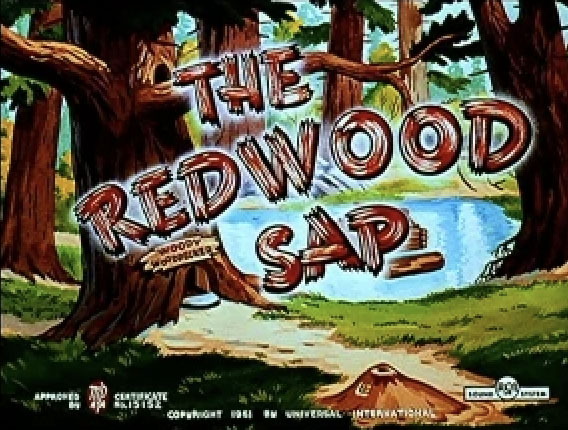 The Redwood Sap (Lantz/Universal, Woody Woodpecker, 10/1/51 – Walter Lantz, dir.) – Woody lives in an apartment in the hollow trunk of a tree, amidst a bustling community of ants, squirrels, and beavers. While all the other critters work busily in preparation for the oncoming winter season, Woody reclines in bed, enjoying some reading material suitably appropriate to his character – a volume entitled, “Work, and How to Avoid It”, by Hans Doolittle. The only thing that will interrupt Woody from his R&R is the chiming of his patented meal wristwatch, so frequently seen through his early 1950’s episode, ringing an alarm bell when its hands (shaped like a knife and fork) point to pictures of breakfast, lunch, dinner, and tea. Where does Woody get his meals? From his neighbors, of course. Zipping out his front door, he raids the contents of Dagwood-style sandwiches from the beavers, swallowing all the sliced goodies in one gulp. As the ants carry a full cob of corn, Woody sprinkles salt on the kernels, then pops them all of the cob into his own mouth by heating them with a blow torch. As the squirrel struggles to roll a towering stack of walnuts into a hole in the tree above Woody’s apartment, Woody appears on the branch above him, devouring each nut as it reaches the level of the hole. In fact, he keeps on chewing when the squirrel’s head also reaches branch level, and almost swallows the angry squirrel’s head. Woody then sails back into his apartment, floating into a reclining position on the bed with stomach bloated from his heavy meal. Woody looks up at a sampler-style sign on the wall, bearing his motto: “Why worry about tomorrow? It will be gone the day after.”
 This routine continues until the first light sprinkling of snow begins to hit the woods. The beavers disappear underwater into their den, where they sit in a parlor full of food watching TV. The ants clamber into their underground burrow, enjoying card games amidst tunnels lined with walls of corn kernels. The squirrel admires his storeroom, lined with alternating columns of walnuts and tin cans, with signs reading, “soup to nuts to soup to nuts to soup to…” All other birds in the woods pack their bags for fall migration, and one takes the time to knock on Woody’s door to suggest that he join them. But Woody is as usual too lazy to fly, envisioning only the negative sides of any suggested destination (hurricanes in Florida, and smog in sunny Hollywood). Settling down to sleep again, Woody awakens next morning, when the snow has grown to a depth of three or four feet everywhere. As his watch chimes, Woody prepares to zoom out the door – only to be buried in an avalanche of snow from the doorway. He clambers out of the ice, which has formed into the shape of an igloo inside his door, and seeks another way out through a window. Another column of ice slides in through the opening, extends over Woody’s head, then clunks him. The mercury in a wall thermometer drops to bottom, turns blue, and icicles form around the bottom of the glass barrel of the instrument, while a miniature snowstorm occurs within the glass. Woody looks down at himself, and discovers his torso is encased in an ice block – which he quickly pecks away with his beak. He opens his empty cupboard, and meets his old pal Starvation squarely in the face.
Woody’s had enough of his indoor confinement, and bores his way through the snow in his doorway, popping up outside. But where are his food sources? All holed up in their snuggly dens. All Woody can do is swallow his pride (if he ever had any), and show up at their doorsteps to beg for food. But his “pals” have been mooched from many times too often, and are out for revenge. The ants present Woody with a corn cob – cob only, devoid of corn, smacked over his head. The squirrel provides Woody with nuts – of the metal variety that fit a screw. The beavers are the most merciless, presenting Woody with a yummy-looking cake, complete with candle. However, its insides consist of ice cubes from the refrigerator, with a layer of frosting consisting of snow scooped up from outside the beaver den. Woody swallows the “cake” whole – then turns blue all over, as a cutaway view inside his stomach reveals it is so cold, even the fire on the candle goes out. Woody spends the entire winter frozen inside an ice block outside his home.
 When spring thaw comes, the local animals emerge from their homes and exchange greetings, and the migrating birds return. The bird seen earlier is the first to notice Woody, whose ice block has not yet melted. The animals put their heads together to finally rescue the trapped nuisance, by tilting the block over so that Woody’s rear is facing one side, then attacking the ice with the heat of Woody’s own blow torch. The bird revives, and zooms out of the ice through a hole he bursts through from the side opposite the torch, pausing to look at his now-sizzled tail feathers. Before Woody can even think about any lesson to be learned, his alarm watch goes off again. Reflexively, Woody returns to all the mooching activities he had utilized in the previous year, filling himself with the last stored food from each of his neighbors – and it is obvious as the cartoon ends that Woody, as usual, hasn’t learned anything, and will go on being – Woody.
• “The Redwood Sap” is viewable on Archive.org.
 Dick Lundy moved on to greener pastures – and possibly greener dollar bills – at MGM, producing in the Barney Bear series Busybody Bear (12/20/52). Good neighbor week has been declared in the morning papers, and Barney is determined to get into the spirit of helping his neighbor, who just happens to be Buck Beaver (no, not the Lantz character Lundy had left behind), just erecting signs announcing a beaver dam under construction. Another sign warns of falling trees, with the added note, “Watch your konk, neighbor”. Barney pays no heed of it as he approaches the site, and gets beaned by three different trees of varying sizes as they are felled by Buck. As Buck goes for the next one, Barney pushes him aside, pulling out his own axe to show the beaver just how it’s done. The beaver tries to yank the axe handle away, but Barney insistently gets in his chop – felling the tree upon himself before he can finish yelling “Timber”.
The beaver is next seen flinging mud upon logs with his tail to secure them into the dam. Barney tries doing the same thing with a shovel, them gets clever, inserting the shovel handle under the belt of his trousers, to operate it like a giant beaver tail. The beaver begins to get frustrated with Barney’s intrusions, and bends the shovel handle to whack Barney in the rear and up a sandy bank, where the entire front side of Barney becomes smoothly sandblasted. Next, the beaver begins cutting a log into segments with his teeth, but can’t make progress upon a stubborn outgrowth in the middle. Barney borrows an idea from Chuck Jones’s “The Eager Beaver”, placing Buck atop a block of ice until his teeth chatter, then uses him as a power saw to cut the tree, leaving Buck’s buck teeth loosely swaying from his upper lip.
 Buck moves on to using a two-handled saw on another section of a log, though he is operating it single-handedly from one side. Barney climbs atop the log and grabs the other handle. He makes cutting progress, but bashes Buck repeatedly into a tree stump on Buck’s end of the saw. Buck retaliates, by sliding the whole log until one end overhangs the drop-off of a cliff. As Barney saws through, he and his end of the log fall into the canyon. Barney wisely lets the log end fall away, and removes his trousers, allowing them to billow out in the wind and float him down as a parachute, suspended from the suspender straps. Buck isn’t going to let him have a graceful landing, and pushes the other end of the log over the cliff. Barney lands lightly on one toe – then is crushed into a pancake by the falling log.
 Buck finally gets the final log in place atop the project, then changes his signage from “under construction” to “completed”. However, as he turns around, he finds to his dismay the sight of Barney, adding a new log to the pile. Buck pushes the log away, and clears off the mud base with his tail, then finally speaks up to Barney. He tells the bear in no uncertain terms to mind his own business, and that the project is completed and just right the way it is. “I only want a little one”, he protests. Barney stubbornly insists that what he really needs is a great big one, which the bear intends to supply. To keep the complaining beaver from interfering, Barney ties him to a tree stump, then sets about his own appointed task. Scaling a hilly slope on one side of the valley, Barney chops two thirds of the way through the trunk of every tree. At the top of the hill, he yells, “Timber”, and pushes at the topmost trunk. Like a line of dominoes, one tree’s fall fells another, and another, until all the trees on the hillside are keeling over. Barney zooms back to the dam, and flings layer upon layer of mud with his shovel atop each log as it lands on the dam. Within seconds, he has constructed a dam rising nearly to the top of the valley walls. He releases the beaver, pats him on the head, and returns to his own cabin. Within moments, the beaver’s feet are being immersed in water – as the new dam is holding back all the water in the river, flooding the entire valley. Barney receives a knock on his front door. When he opens it, the beaver enters, emerging out of a wall of water, which blasts into Barney’s home in delayed reaction, thrusting the bear out the chimney top and into the flooded valley. Underwater in the bedroom, the beaver takes occupancy of Barney’s bed, pulling the covers over himself to rest up from the exhausting day, while Barney looks in from the submerged bedroom window, drumming his fingers on the windowsill in frustration, for the iris out.
You will note in the course of the cartoon that Scott Bradley was not one to miss appropriate opportunity for re-use of his own musical compositions. The main theme from Barney’s The Bear and the Beavers score receives healthy repetition here, underscoring many of the beaver’s activities.
 By the Old Mill Scream (Famous/Paramount, Casper, 7/3/53 – Seymour Kneitel, dir.) – A by-the numbers Casper script. Casper flops out at a ghost town amateur night performance in an abandoned Opry House, the spooks not appreciating his vocal rendition of his own theme song. Casper goes out into the world to make friends again. His travels take him to a beaver dam, where the smallest beaver, Little Shorttail, makes a similar flop trying to help with dam construction. Reason why? His tail is only a fraction of the size of those of the others, and only big enough to carry a tiny wad of mud for packing the logs together – in fact, just enough mud to accidentally flip into the foreman’s eyes. While the beaver cries by himself off in a corner, Casper shows up to offer any assistance in the construction. The other beavers depart in totem-pole formation. Casper finds Shorttail, the only one not afraid of him, and learns of his problem. He attempts to build confidence in Shorttail, telling him his tail is probably strong enough to carry a log – but invisibly lifting the log himself as Shorttail walks along. The dam springs a small leak, the water running right through the palms of Casper’s ghostly hands. Shorttail again can’t carry enough mud to plug the hole, leaving Casper to do it himself, piling the mud onto the beaver’s tail just as he returns to the dam, so as to allow Shorttail to claim the credit for the repair. As Shorttail goes for more wood, we get a late cameo appearance by Wolfie, who is hunting beavers with the aid of a plumber’s helper tied to a rope. He corners Shorttail in a hollow tree, and uses his plunger’s suction to pull Shorttail out of the tree’s hole. Casper shows up, scaring Wolfie out of his clothing, his outfit running away faster than himself. Shorttail shows up again at the dam along with Casper, the beaver clan now accepting Casper as their hero. Now Shorttail can carry and fling all the mud he wants for the dam – because Casper has installed a large frying pan tied to his own tail, as a prosthetic substitute.
 Unnatural History (Warner, 11/14/59 – Abe Levitow, dir.) is one of a few late returns to the Tex Avery spot gag cartoon style of the 1940’s, featuring random gag sequences involving various species of wild and domesticated animals or insects. Some of its most memorable highlights include the act of Cal the Chameleon, who can instantly match any color background inserted behind him – but draws the line at plaid, bawling in a tantrum, “I can’t do it!”. And a talking dog act, which strikes out at the booking agency when everything he says sounds like a dog bark, including his naming of “Ruth” as the greatest baseball player. As he and his owner are thrown out, the dog confides to his owner, “Maybe I shoulda said, Di Maggio”?” One of its last gags includes a beaver, repeating Chuck Jones’ gag from “The Eager Beaver” of actually “damming” a river, when the center of his dam construction falls apart from the water flow. He of course angrily shouts audible but unintelligible swear words at the water.
• “Unnatural History” is in a good print at DailyMotion.
 Beavers again get a mention – but no appearance onscreen, in Bugs Bunny’s Wet Hare (Warner, 1/20/62 – Robert McKimson, dir.). Bugs is taking his morning shower under a river waterfall, doing his best vocal impression of Al Jolson singing “April Showers”. Suddenly, the flow of water runs dry. Bugs knows he paid his water bill – then remembers what happens every year. Those pesky beavers upstream must be building a dam again. Bugs is about to investigate, then goes through a series of over-dramatic speculations, as to what might happen if it’s not the beavers, and the water has just dried up. He envisions his carrots shriveling, himself dying of thirst, and begins to gasp for water. Then just as suddenly, he changes mood entirely to his usual casual cool, remarking, “Nah, it’s gotta be them pesky beavers”.
Both of Bugs’s theories are wrong. At the top of the waterfall stands Blaque Jacque Shellaque (McKmson’s answer to Yosemite Sam, in a return appearance following his debut in “Bonanza Bunny”), who has just completed constructing a dam out of stray stones. He chuckles to himself that he fees just like a “pesky little beaver”. Bugs arrives at the top, learning from Jacque of his intention to keep the river water for himself, based on riparian rights consisting of a loaded pistol for anyone who defies him. Bugs claims to have no protest, but speculates as to how secure the dam is. What if one stone here or there were to fall out of place. He gets Jacque to remove a central stone, as a demonstration of “What could happen?” POW!! The whole thing falls apart, the water sweeping Jacque away.
 Bugs returns to his bathing, but the water dries up again (a shot we will see several times too often in this film, instead of varying things up by reanimating the angle or the flow of water differently each time the event recurs). Shellaque has built a stronger dam. A shark fin appears in the water, which Jacque thinks to be a trick, as there are no sharks in a trout stream. Apparently, however, Bugs has farmed this one in specially, leaving Jacque atop the dam, trying to bat off the shark and calling for help. Bugs comes charging to the rescue, floating on a log, but deliberately slams it right through the dam stones. “This is being saved?” shouts Jacque, once again falling into the water.
Another shower, another dam. Much larger, with neat squared-off stone wedges. Jacque wonders if the rabbit will try to blow up the dam. A small raft carrying a single stick of dynamite floats up to the dam wall. Jacque scoops it up in a net, then attempts to run with it off the dam. It blows up in his face, leaving him staggering, while a much larger raft holding crates full of dynamite floats in. BLAM!!
 Jacque is through fooling around. He climbs down into the valley, and blasts with a shotgun at the location behind the waterfall from which he hears singing, until the voice is silenced. Of course, Bugs is really off to one side of the river, tending his carrot patch, and the voice heard was nothing but a gramophone and record he placed behind the falls. Back at the top of the waterfall, Jacque has now constructed his masterpiece – a dam of solid metal and rivets (hopefully rust-proof). But instead of attacking the dam, Bugs changes tactics – rendering Jacque’s dam useless, by building another dam of rocks further upstream. “Sacre bleu”, utters Jacque at the insane determination of this rabbit. With a cannon, Jacque approaches Bugs’s dam, and blasts it away. But yet another dam stands behind it. Another cannon shot – and another dam upstream is revealed. Bugs continues to lure Jacque further and further upstream, blasting away dam after dam, until Jacque comes face to face with the towering edifice of the all-concrete Grand Cooler Dam. Reflexively, he loads his cannon, and blasts once again. The cannon ball merely bounces off the concrete structure, ricocheting back to catch Jacque in the belly, and knocks him into the waiting entrance doors of a police paddy wagon, which rolls him away to make the arrest for an assault upon public property. From the top of the dam, Bugs mutters that Jacque is not fooling him. “He’ll be back – like, in about 20 years.” Though a late entry in the series that could have had better animation and tighter timing in places, this one did have some clever ideas, and remains reasonably memorable.
• “Wet Hare” is on Facebook or on Toontales.
NEXT WEEK: Some feature work, and some television outings, next time.

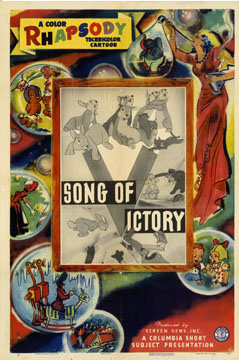 Song of Victory (Screen Gems/Columbia, Color Rhapsody, 9/4/42 – Frank Tashlin, supervision/Bob Wickersham, dir.), presents another instance of beavers being thrown in with other forest creatures for a “give them the works” finale. A typical wartime scenario has the peaceful forest taken over by the terrible trio of Hitler, Mussolini, and Hirohito look-alikes, cast in the respective species of a vulture, gorilla, and hyena. (Only the hyena seems an original concept, the other species having been used by other studios.) An intertitle announces that any similarities between these three and certain dictators, “either living or dead (we hope) is purely intentional.” Beavers appear briefly in an opening panorama shot, as usual constructing a dam. The forest axis move in from the dark recesses of the woods, survey the situation, then set-up a public speaking engagement for the vulture atop a high rock, with the gorilla and hyena slapping around various animals to herd them into the public square, the gorilla parting branches of foliage above the vulture to allow a beam of sunlight to shine down upon him as if a divine sign that he is the animals’ salvation, and the gorilla and hyena again slapping around anyone who does not applaud and heil. Soon, the animals find themselves paying tribute to the new regime, marching in long lines to provide food offerings to the trio’s fast-growing personal stockpile. A chipmunk relinquishes a bag of nuts, but notices one nut fall to the ground. Kicking the nut quickly behind his back with one toe, he reaches backwards, and grabs the nut, stuffing it in his cheek to avoid detection. But his act of treason is spotted by the vulture, who tries to squeeze the nut out of his mouth, but instead causes the chipmunk to swallow it. Infuriated, the vulture leads his pack in a shadow-show of violence to make an example of the traitor, seen as silhouettes on the wall as the chipmunk is slapped, pounded and stomped upon, then thrown out into the snow unconscious, while the trio laughs savagely. The animals pick up the prone figure of the chipmunk, and exchange looks as if to register the unanimous message, “We have had enough.”
  While most Axis spoofs treat the subject in broad humor and satiric ridicule, this cartoon does have the distinction of treating its material, despite a few moments of comic silliness, with more somber, serious overtones – not to the level of heaviness of Disney’s “Education For Death”, but at least approaching some of the darker moments of the later Halas and Bachelor’s “Animal Farm”. It emphasizes deep blues and blacks in its color selection and background work, artistically setting the appropriate mood for tyranny and revenge. (It would be nice to see the full impact of the visuals in a properly-restored print; however, due to its dated period storyline, it was bypassed for inclusion in Columbia’s “Totally Tooned In” television package, and to my knowledge has also not yet shown up on MeTV.) In its climactic finale, the film also finds inventive and psychological means of incorporating again and again visual “V” formations and the opening note pattern of Beethoven’s 5th Symphony into animal calls and sound effects, setting up a mysterious and foreboding mood for the cowering dictators as if the world is closing in upon them in their solitary fortress – a mood of perhaps more disabling impact upon them than what could be accomplished by the animals’ mere actions alone. The reveling of the trio within their hollow-tree headquarters, as they feast on their ill-gotten gains, is rudely interrupted by pecking upon the front door, following the four-note pattern of Beethoven. When the vulture opens the door to look around, he finds no one, but rears back at a huge V pecked into the wood of the front door. From the trunks of the evening-darkened trees and crests of nearby snow-covered hills and knolls rises an increasing upswell of calls in the repeated pattern of the “dot dot dot dash” of the Beethoven composition, including deep hoots of an owl, chirps from an isolated songbird, croaks of frogs in a pond, and slaps of beavers’ tails sounding upon a large hollow log aimed as if a megaphone projecting toward the fortress. The vulture’s mind begins to play tricks upon him, as he steps backwards, then realizes his own talons seem to be creating a trail of V’s facing him in the snow. He retreats back into the tree and shuts out the interior light, allowing himself and his cronies to gaze out a window into the mysterious night, as a formation of fireflies approaches the window, lighting up the trio’s entire view with a luminous V, and causing them to cringe backwards in apprehension. Crickets chirp the four note strain again, while a V formation of rabbits’ heads pops out of a snowbank, their ears also giving the appearance of another series of V’s.
 The animals now break from the psychological games, and get seriously busy, taking up strategic positions, while sending forward an advance guard of skunks, who infiltrate the tree fortress through small holes in the trunk above the dictators. Screams are heard from within, and the animal axis emerges from the fortress as if driven out by a gas bomb. Another V appears in silhouette upon the snow before them, formed by the shadows of a flock of geese flying overhead. The dictators turn about face, only to come up against a V of glowing pairs of eyeballs perched in the limbs of a tree – a flock of owls, who attack, swiping their claws at the villains’ faces. The dictators attempt to flee across the river, using the beaver dam as a bridge. But the beavers are a step ahead of them, swimming in the river to float away the center section of the dam, dumping the nefarious trio into the drink. Artillery is broken out, as bees are launched from a beehive pressed into a hollow log as an improvised machine gun, and porcupine quills are fired from such critter’s back. The geese bombard with eggs, while smaller birds in similar V formation swoop to peck at the vulture’s head. The beavers act again, now chopping down trees along the path of the villains’ retreat, narrowly missing direct hits upon their craniums. The trio finally reach the edge of a cliff and a suicide drop-off into a canyon. Their return from the edge is blocked off by the animals, who, although on the surface appearing to be their usual, fuzzy selves, are now enough of a intimidation to the trio to send yellow streaks up their backs. Who should advance upon them out of the crowd but the now-recovered chipmunk, who strikes a steadfast pose, and squeaks loudly with tongue protruding at them in defiance. The psyched-out triumvirate is so spooked by this time, that this harmless act sends them rearing back in panic, stepping right off the cliff. We see them fall, but never see on camera their fate. All we are greeted with is the peace of a new morning dawning before the animals eyes, as the sky lights up in sunbeams formed between gaps in the dissipating clouds – the beams, of course, taking the shape of a heavenly “V”.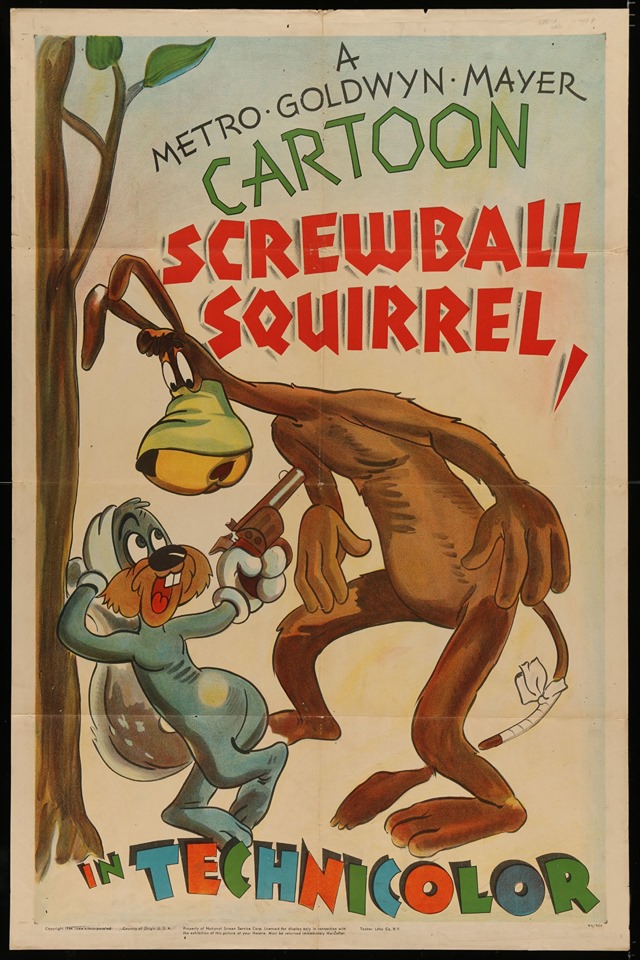
 Thus, his use of realistic and ornate forest animation in the opening shots of this film is convincing and clearly evokes the old styles – but appears purely for the purpose of satire, allowing his new character to have shock value and hit the audience right between the eyes. Certainly the recent efforts of William Hanna and Joseph Barbera had blazed the way before Tex for a parting with the old and an improvement of personality and timing, but Tom and Jerry were still developing their comedy chops when Avery blew into the lot, and Avery’s new style had definite influence upon the cat and mouse’s direction from the time of Avery’s arrival. What is surprising is that by the time of Screwy’s debut, the MGM executives were willing to let go public the sentiment of dissent with the old regime expressed by the squirrel in this cartoon – an unusual degree of self-awareness and letting the audience in on a not-so-private joke that what had been considered by management to be top-of-the-line entertainment in the late 1930’s was no longer viable for the hep, up to date audiences of the wartime 40’s looking for laughs of the quick and belly-variety for instant gratification and escapism. Perhaps this concept would not have worked out had Hugh Harman and Rudolf Ising still at this time maintained a role of control over studio productions, as it might have been viewed as a personal affront to their tastes. But their last productions had screened the previous season, leaving the field wide open for Avery’s commentary, as long as the likes of Fred Quimby and/or other executives followed their normal policy of looking the other way, so long as the cartoons made money. Thus, Avery got away with declaring an absolute schism between the new MGM and almost a decade of past filmmaking, allowing Screwy to be the standard-bearer in declaring the new direction in which the animation units would now be headed.
  While Screwy is remarking to the audience in his first-ever breaking of the fourth wall, the gray squirrel is rambling in vivid description about the cast of his cartoon, naming names of all the other equally-adorable but devoid of personality characters who will be his co-stars. Names include Freddy Frog, Wallace Woodchuck, Buster Badger, Horace Hedgehog, Scott Skunk (any intentional relation to Scott Bradley?), Dorothy Duck, and a surprise reference to Barney Bear (who, being a real character of the studio, seems a bit shocking for inclusion. However, Barney had just lost his principal director, Rudolf Ising, and perhaps Avery was unaware that his series was soon to be revived, under the new direction of George Gordon, so thought it fair to pronounce him as washed-up too). Two additional names are included in the gray squirrel’s cast, but their first names are almost obliterated by the speaking of Screwy over the top of them – perhaps a “Benny” Beaver, and a Monkey of inaudible first name. Screwy settles this abominable situation by leading the little blabbing ball of furry boredom behind a tree, then launching an unseen attack upon him, with all the flashing stars, resounding thumps, and sound effects of crashing glassware characteristic of a cartoon fight emitting from each side of the tree trunk. Only Screwy emerges back into camera view, dusting off his gloved hands while the soft sounds are heard of a lone bugler playing taps for the one he left behind the tree. “You wouldn’t have liked the story anyway”, says Screwy matter-of-factly to the theater audience. Over 80 years after its initial presentation, the candor of this sequence and its message to the industry is still jaw-dropping and truly ground-breaking, sure to have the same impact on any new viewer as it must have had upon the theater audience those many years ago.
  Old Sequoia (Disney/RKO, Donald Duck, 12/21/45 – Jack King, dir.) – Chip and Dale were not yet a part of the Donald Duck universe, though they had already appeared in the Pluto short, “Private Pluto”. Thinking along similar lines, Jack King’s unit decided to create a pair of mischievous beavers as one-shot foils for Donald – even using some leftover sped-up voice tracks from the chipmunks’ previous appearance as part of the beavers’ dialogue. To set up their meeting, Donald is cast as a forest ranger, stationed in a high tower looking out over the forest. The beavers are forest residents, with no sign of a dam or den under construction, but simply seeming to have a personal hobby of cutting down every tree they encounter – just for kicks. They are currently laying waste to a row of trees extending back as far as the camera can see – and at the forward end of their line of progress stands the monarch of the forest, a giant redwood named Old Sequoia – so old, a brass plaque affixed to the trunk can’t even state the tree’s age, leaving it as a question mark. A chief ranger (voiced by Billy (Black Pete) Bletcher) telephones Donald’s station, first reprimanding him for not answering the phone immediately when called (he had been asleep, his chair resting against a loose railing that almost pitched him into a mile-high fall into a canyon), then informing him that too many trees have been lost in his district. “If Old Sequoia goes,…YOU GO!!!” Donald scopes out the forest action through an extra-long telescope, and spots the beavers just one tree away from beginning their dirty work upon Old Sequoia. Grabbing a double-barreled shotgun, Donald soon arrives in a zip to the scene. He steps on one of the beaver’s tails, stopping his forward progress. The beaver flips him off of his tail, into the trunk of the present tree he has been gnawing at. “Timber!”, he shouts. Donald knocks the first tree down, collapsing upon its trunk. His shotgun goes flying, discharging a shot as it hits a rock, which blasts backwards to fell another tree – right on Donald’s head. Donald’s face turns the usual beet red, and a like-colored head lump emerges through the opposite side of the tree trunk atop him.
 Donald returns to the woods, to find the tree seemingly in one piece, with no further sign of the intruders. He begins pacing a patrol in front of the tree with his shotgun, only to have his marching interrupted by somewhat distant sounds resembling those of a buzzsaw in a cavern. Listening closely to one of the roots of the tree, Donald discovers the sounds to be coming from within, and guesses who is causing it. “Looks like an inside job”, he squawks. From knotholes everywhere in the trunk, streams of sawdust begin to emerge. Donald, like the beaver in Disney’s 1931 Silly Symphony, begins to play the role of the boy at the dike, hopelessly trying to plug each of the points of sawdust exit. He even tries to scoop sawdust back into the tree, but one of the beavers inside flips it out again with his tail, covering Donald in wood dust, making him resemble a child’s yellow rubber duckie. Donald zips out of frame and returns with a unique piece of heavy-duty construction equipment, vacuuming up sawdust into a giant tube, then spraying it back into the tree through one of the knotholes. Though the dust should match the tree’s original volume, it somehow distributes unevenly, causing two large chunks of the trunk to explode off the tree. Inside, the beavers are revealed, having hollowed out everything of the tree’s middle save a stick in the center, its diameter no wider than a pencil, on which the weight of the entire tree balances. Donald rushes in to add himself as an extra brace, attempting to keep the tree standing. The beavers make Donald’s life more difficult by simultaneously thumping their tails on the ground to create a shock wave. The central stick begins to bend to near snapping point, and the beavers, sensing victory, curl the tail of one beaver into a megaphone shape, allowing the other beaver to holler through it, “TIMBER!” This is actually the last we see of the beavers in the film – though Donald’s troubles are not over. As the tree tips more and more precariously, Donald takes a chance, zips out of the spot he is standing, and returns with about a dozen or more sticks, which he jams into the gap between the upper and lower tree portions in a circular perimeter, attempting to evenly distribute bracing for the tree. He then carries back the two exploded sections of the tree bark, replacing them into position on both sides (although the section with the plaque is at first inserted upside down).
  “You’re okay now, Old Sequoia”, says Donald, patting the tree. Yeah, sure. That meager bracing isn’t going to hold all that weight for long, and the two sections of bark become compressed and bulge, ready to pop again. Donald tries to hold them back, when the ranger station phone rings again. The sound waves from the ringing seem the only thing holding the bark walls of the tree in place as they reverberate off the wood, and Donald again risks following orders to answer the call. When he arrives at the station, the ranger asks “How’s Old Sequoia coming?” Now, no phone ringing is providing support for the bark, and Donald stares from his station platform at the upper branches of the giant tree falling straight toward the station. “She’s coming fine”, reports Donald, referring to the tree’s traveling progress. As the trunk of the arbor passes the station in a near miss, a protruding branch reaches out as if a giant hand, making sure that the station also comes along, and yanking the structure right off of its support poles. The tree, and the station house, wind up at the bottom of the river. The phone rings again, and a water-soaked voice howls from the receiver, “YOU’RE FIRED!!!!!!” Donald breaks into his usual squawks of temper, though sounding a bit blubbery underwater, as the bubbles from his breath escape through the closing iris out.
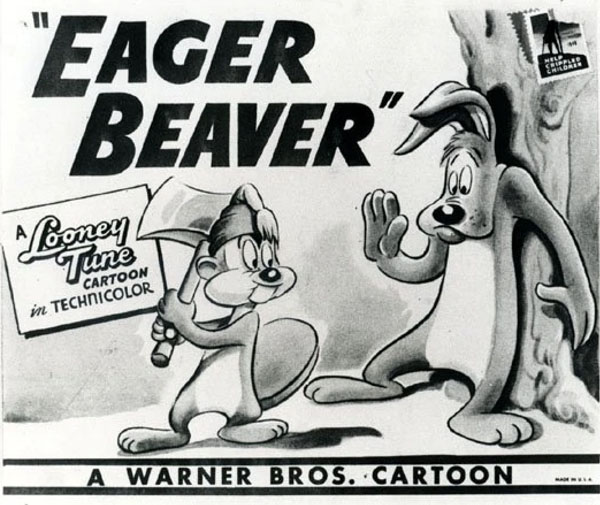
 Among this clan lives Eager Beaver, a young newbie anxious to get in on the wood-cutting action, but overlooked by his peers as meddlesome and too puny. Eager still attempts to join the activity. He aims his axe at a first tree, but is blocked from swinging by a prototype Charlie Dog, who at first seems determined to “save that tree”, but really only wants to rescue a bone he has buried under it. Now the path is clear for an axe swing, but Eager is beaten to it by several swings of other beavers’ axes, barely escaping the scene with his own head still on his shoulders. It is the same story wherever he goes – excepting for one “trunk” he successfully chops, only to find it is really a telephone pole, with an irritated lineman seated on top. One of the larger beavers, to get him out of the way of the real work, directs his attention to a humongous tree on a mountain peak, which none of the other beavers seem to be paying attention to, and shouts “WHY DON’T YOU CHOP THAT TREE DOWN??” This is with good reason, for the tree seems unchoppable. Eager’s small axe gets nowhere, not even making a dent. He goes for some heavy ammunition, raiding a dynamite shack and setting off the explosives around the tree trunk. All the blast does is expose an ultra-long root system embedded in the mountain peak – but the tree doesn’t budge an inch.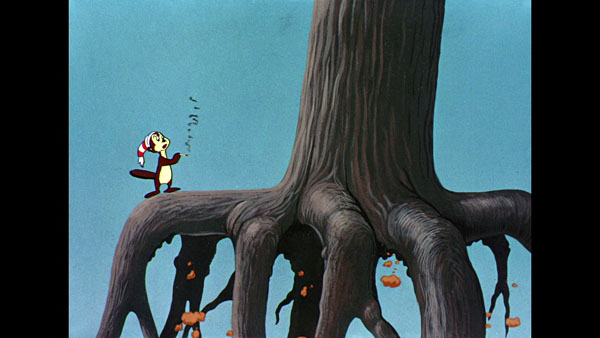
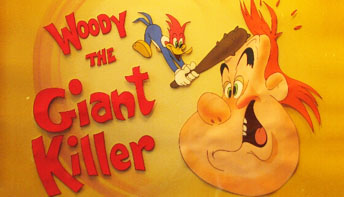


 The Little Cut Up (Famous/Paramount, Noveltoon, 1/21/49 – I. Sparber, dir.). We open on a tree in the forest, populated by a variety of creatures, including a wise owl, three squirrels who take turns whacking each other on the head to crack nuts to eat, a mama bluebird and her three fledglings, and a Mr. and Mrs. Bunny, the latter of whom is knitting little things – quite a few of them – for an expectant family. Nearby, a community of beavers busies themselves on a nearly-completed dam. Along comes a little boy dressed in clothes suggesting colonial times, and wearing a small white-powdered wig. He is carrying a hatchet, and sings an original number probably penned by Winston Sharples, “Chop Chop Chop”, describing the fun he has chopping down trees at random. Of course, the animal community tree turns out to be in the line of fire, and with a few well-places blows, the child fells it, causing it to land squarely on the beaver dam. (Damn!) The beavers are launched into the air from the impact, and cluster together, attempting to use their combined spinning tails as the blades of a helicopter, but getting their appendages tangled up, landing them back on land with a crash, and resulting in them appearing in bandages and on crutches. The other animals aren’t in much better physical shape, and everyone’s homes and property are a wreck. Wise owl emerges from the stream covered in mud, and shames the boy for the destruction he’s caused. Learning that everyone’s homeless, the child decides to make amends by taking them to his home and building them all new domiciles. At a sumptuous plantation, the boy builds wise owl a colonial-style treetop structure, complete with a rocking chair on the veranda. Mrs. Bluebird gets an equally ornate birdhouse on a pole, with a small fountain alongside for her brood to use as a birdbath. The squirrel’s home has made life easier by the addition of a nut bowl and nutcracker. A larger house serves as a hutch for the rabbits – and they can use the space, as they now have a stroller built for over a dozen babies, with a descending bar over the top that lowers a row of milk bottles when it’s feeding time. As for the beavers, the child puts his hatchet to more constructive use, chopping a sturdy cherry tree to give the beavers a strong lumber supply for their new dam. A colonial gentleman armed with a musket – the boy’s father – hears the tree fall, rushes to the scene, and places blame on the beavers for felling the best cherry tree in Virginia. The boy stands in front of the raised musket barrel to block the shot, and states – – well, you should know the rest, as the boy is of course, the young George Washington.


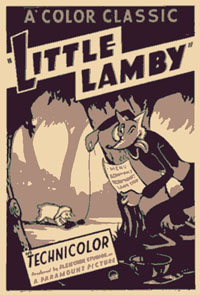


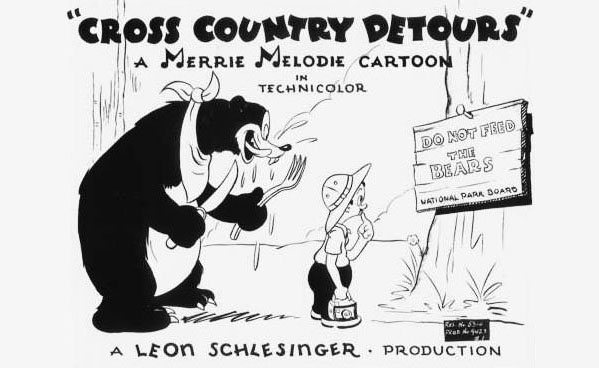


 That night, Barney returns to what will be the scene of – the crime, armed with boxes galore. Displayed as still illustrations within the book pages, Barney “borrows” some wood. The next page displays him loaded – for bear, so to speak, adding the words, “Quite a bit.” The next page shows the beavers’ warehouse, empty, with the additional words, “In fact, all of it.” The theft of the century. However, Barney is as inept in covering his traces as he is as a woodsman. An elderly beaver with a walking cane, who acts as night watchman for the community, passes the warehouse on his rounds – and does a delayed double-take upon discovering the place laid “bear”. He races to a square in the center of the village, and rings a triangle to sound a community alarm, rousing all the other beavers from their dens, in a scene likely inspired by the “Giant on the beach” alarm sounded by Gabby in Fleischer’s “Gulliver’s Travels.” It’s not hard to find the path of the culprit, as the watchman points the community’s eyes to a long trail of huge bear pawprints left in the fallen snow. The trail ends obviously at the doorstep of Barney’s cabin. Inside Barney now basks in the heat of a monster blaze in the fireplace, stoked by a lumber pile at his sides reaching all the way to the ceiling. What’s more, embers and plumes of smoke pour out the chimney top, almost as visible as a rocket’s exhaust, making it elementary to determine from outside where the community woodpile is currently located.

 Nutty Pine Cabin (Lantz/Universal, Andy Panda, 6/1/42 – Alex Lovy, dir.) – Another fun romp, that I remember fondly from early screenings on the Kelloggs’ Woody show as a child. Rustic woodland cabins must have been a part of the American dream in 1942, because Andy Panda has the same home-building fever as Barney Bear. Andy’s chosen material, however, is plywood instead of logs. Though his carpentry supplies include a tape measure, he could use some practice in measuring board length, as the first act of the cartoon displays his battle to hammer in place one board in the cabin’s side wall that is too long. It either pops out at the top, bends upwards at the bottom, or springs outward as a bulge in the middle. When Andy finally manages to hold it in place, its top edge raises the roof just slightly, allowing all the other wall boards to fall out of place, then the roof to collapse upon him for lack of structural support.


 Correct me if I’m wrong. It’s rather surprising that I seem to have come up empty in locating any verified appearances of a beaver in any known surviving silent cartoon. You would think Paul Terry’s Aesop’s Fables would be loaded with them somewhere – but they don’t seem to even turn up in natural settings where you’d expect all varieties of animals to be represented, such as “If Noah Lived Today” or “Amateur Night On the Ark”. Maybe the primitive pencils at the Terry studio couldn’t hit on a model design for the creature they felt comfortable with. Similarly, Max Fleischer missed his chance to include the species in his first Talkartoon, Noah’s Lark. It thus appears that Disney (as he often did in those days) got the jump on everybody, including the characters in one of his earliest Silly Symphonies, Autumn (Columbia, 2/13/30 – Ub Iwerks, dir.) (noticeably overlooked by the Cartoon Brew coverage, as were nearly all of this week’s films).
  The beavers dance atop a dam under construction in the foreground, tamping down lumber into its structure with their tails, while several other small groups of beavers are seen in the stream, constructing beaver dens with entrances below water. Two beavers dance together in synchronized rhythm along the bank, then chew down a small tree, which topples onto the head of one of them. In the later climax of the film, as the first cold blasts of winter wind are felt, one beaver calls an alarm to the others, and one-by-one, several beavers dive into the water and are seen as bulges and vibrations within the structure of a beaver den, having entered it from below. A stranger appears – a misguided duck, who doesn’t have the good sense to fly south, and instead also dives under the water, attempting to join the beavers in their comfy abode. He is quickly and rudely ejected, swimming away with complaining quacks. The skunk looks for shelter, but gets hit with a back of porcupine quills from inside one tree already occupied – so moves into another one, sending all of its furry occupants scattering for another tree next door. The crows get the final shot, taking up residence inside the hollow clothing of the scarecrow. One small crow is left out, and kicks the pantleg of the trousers, hoping for access. In an ending which nearly duplicates that of “The Skeleton Dance”, the bony foot of one of the crows reaches out from the drop-seat of the trousers, yanks the little crow inside, then re-buttons the drop-seat.
 Minus Iwerks (who by this time had moved on to another animation studio), Disney’s beavers make a comeback in The Busy Beavers (Columbia, Silly Symphony, 6/22/31 – Burt Gillett, dir.). Obviously, with the beavers taking center stage, there’s a lot more room for action and gags in this one. It’s rather comical also to note that in both of these early cartoons, the sound engineers seem to have no idea what a beaver should sound like (their natural sounds are more like grunts), so decide to use what sounds like a squeaky toy to emit puppy-dog like high-pitched barks. This does have the advantage of permitting quick one-note tones that fit easily into the punctuated rhythms of an average cartoon score, but must still bring howls from anyone who’s studied the behavior of the animals in the wild. The sound effect also proved rather interchangeable – I swear I’ve heard the same “voice” given to foxes and bear cubs in productions from various studios, not to mention used in its proper place for Bosko’s pup at the end of early Looney Tunes. (Who was that pup anyway? Baby Bruno?)
 Troubles are not over. A dark rain cloud above bursts as a lightning bolt tugs at a zipper in its bottom, dropping enough rain to form a massive wall of water in an area about a mile above the dam. A couple of wonderful shots show the progression of the flood that develops in the hills down the river, particularly a tracking shot just ahead of the flow as it careens around a continuing curve, taking out trees protruding into the river bed in 3-D style detail as it goes. The little beaver, now standing atop the dam edge, watches in horror as the leading edge of the flood waters reaches the beaver dens, nearly swamping them, and subjecting the dens to a beating from the floating logs passing in the waters. The beaver hops down into the river bed on the front side of the dam, and tries to hide in its shadow from the oncoming rush of water and debris. The water pounds repeatedly upon the dam’s backside, then suddenly breaks through, seemingly destroying the dam’s entire middle expanse – until the water recedes somewhat, showing that the beaver has been left on a small island of safety in the river’s middle, only a sliver of the dam center still standing to offer him protection.
  Were this cartoon produced later, without the need for music synchronization timing to eat up footage and slow general pacing, the plot/gag material for this early outing was actually quite strong, and full of typical Disney innovation for a first cartoon focusing on a new subject idea. Though the picture hasn’t achieved an everlasting spot as a timeless classic in the Disney hall of fame, it deserves a second appraisal. And it seems a “dam” sure bet it was remembered by at least some folk in Chuck Jones’s unit in the 1940’s, as its story structure bears substantial similarity to and seems the direct inspiration for Chuck’s own classic, “The Eager Beaver”, to be discussed in later pages of this series. It’s easy to imagine how much of this cartoon’s material could have been directly interpolated by Jones into his own film had scripts been swapped, with Jones probably achieving just as lively results as his own film from the Disney gags.
 Beavers almost miss the boat in Disney’s major animal adventure, Father Noah’s Ark (UA, Silly Symphony, 4/8/33 – Wilfred Jackson, dir.). They are never seen involved in the initial construction process for the ark, nor in woodland group shots, not in the stampede racing for the ark, nor on the boarding gangplank. And they certainly didn’t tag along with the pair of skunks who make the voyage on the roof of the ship. Yet, somehow, they are seen in the third-to-last shot of the film, disembarking. The male and female beavers march down the gangplank, side by side, each one carrying a new youngster along on its tail. Guess they stayed busy on the trip, even if they missed being on the passenger list and traveled as stowaways.
 Either competing studios were blown away by the Disney efforts above, or just for unknown reasons were slow to adopt the beaver into their animation models for various forest-related cartoons of the period, as, for a few more years, no beavers seem to turn up in cartoons I’ve been able to discover. I again could be overlooking something, as reference to beavers rarely turns up in the titles of episodes, so if anyone remembers any other early beavers, feel free to comment. Harman and Ising seem to have missed their opportunities entirely, choosing not to include beavers in such possible vehicles as “Ain’t Nature Grand?”, “The Trees’ Knees”, and “Bosko’s Woodland Daze”. But, as Leon Schlesinger began to shift the Merrie Melodies series to color, we get Pop Goes Your Heart (Warner, 2-strip Technicolor, 12/8/34 – Isadore (Friz) Freleng, dir.). In essence, this is Friz’s idea of a Silly Symphony, considerably behind the times, and resembling something Disney might have produced several years before. It is another plotless romp in nature, with the likes of humming birds and humming bees, a papa grasshopper teaching his young ones to spit with chewing tobacco, turtles learning to swim by flipping over on their backs and stroking with reeds like a rowing crew, and some harp-stylist spiders playing the title tune on the strands of their web, while worms inside two apples simulate the limbs of a pair of dancers, and a trio of croaking frogs sings the lyric. (The song, by the way, was a semi-hit from Dick Powell’s feature, “Happiness Ahead”.)
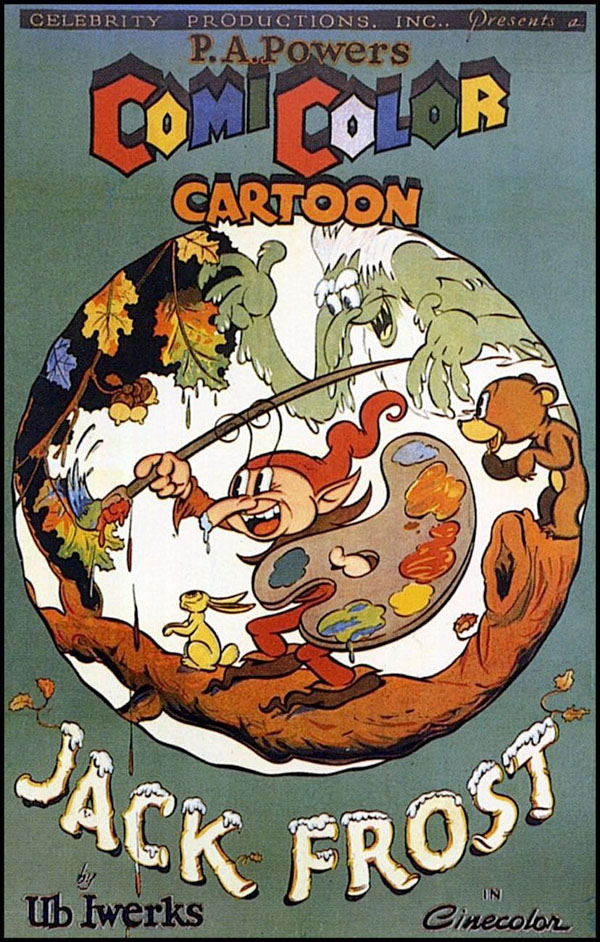


 The trapper is finally revealed as one Jean Batiste – a large, burly, lumberjack-style dog. He easily traces the tracks back to the ranger station, and walks in on the line waiting for Porky’s ironing. Grabbing the iron, he uses it without the aid of insulating towel directly on Porky’s tail, straightening it like a dart, then sticks the rigid tail into the table woodwork, suspending Porky above it, to be punched back and forth like a punching bag. He throws Porky across the room, his tail again piercing the wood of the cabin wall like a dart, placing Porky’s rear end over the escaping hot steam of a whistling tea kettle atop Porky’s stove. Then, Batiste pulls out a sled dog whip, and removes one of his snowshoes. He lassoes Porky with the whip, pulls him out of the wall and back to him, then smacks Porky with the snowshoe, bouncing him off the wall like a tennis ball, and playing a painful one-man tennis game with Porky taking all the hits. Beaver #2 sees all this happening from the doorway, and again retraces his previous steps through the six scenic backgrounds at super-speed, finally coming to a stop below a fuzzy hanging object above, which he pulls. It is the goatee-like fur hanging from the throat of a giant moose, who bellows out a low-pitched wail as an alarm of distress to the forest. In several shots of fine animation detail, rows of bears come charging out of caves, skunks from within trees, a parade of snapping turtles tapping a beat on their shells with drumsticks as a marching band, and of course, hundreds of beavers from dens in the river bed. They converge on the cabin just as Batiste has succeeded in knocking Porky cold. Jean prepares to leave the cabin, but quickly spots the approaching stampede, and tries to bolt the door. No matter. The animals smash it down. Jean speeds out of a rear exit on skis. It’s time to “give him the works” again. Two bears launch the beaver twins at him via crosscut saw catapults, and they slap his head around with their tails as well as wooden sticks. The turtles slide between Jean’s skis, beating his bottom with clubs as they pass under. More beavers launch a barrage of small logs at the back of Jean’s head via slingshots rigged into the antlers of moose. The skunks also launch fitting weapons from their tails – smelly, rotten eggs. Finally, the beaver twins pull the old vine-across-the-path trick, tripping Jean and launching him skyward and off the mountain slope. Jean begins to descend, upside down, and his skis act like whirling propeller blades, spiraling him into a twist, so that he screws himself firmly into the snow-covered ground below, only his ankles and skis left protruding from the snow. The revived Porky, who seems to have recuperated entirely, joins the animals in cheers of victory – then smile at observing what the beaver twins are up to. They have taken advantage of Jean’s downfall and present position, by converting his inverted skis on Jean’s ankles into their new playground attraction – a see-saw (an ending likely “borrowed” from Morty and Ferdie’s similar see-saw atop Mickey Mouse’s head in Mickey’s Steam-Roller of a few seasons back).


 Garfield Gets a Life (Film Roman, 5/8/91), a half-hour prime-time special, could more appropriately be called “Jon Gets a Life”, dealing with the boredom that is Jon’s existence, and its contagious effect upon Garfield as well. The most exciting thing Jon seems to do is organize his sock drawer – two of them – by size, color, materials, blends, and all neatly tucked-in. When not occupied with socks, Jon counts ceiling tiles while flat on his back – and Garfield takes to doing the same thing, as they compare counts between the ceilings in the bedroom and living room. Garfield (perhaps for lack of anything better to do) tries to break Jon out of his rut, remembering an old copy on Jon’s bookshelf of “How To Make Friends and Fool the Rest”. Jon spots a chapter on getting dates, and attempts to follow it to the letter. Efforts to pick up girls in the park, at the beach, in the laundromat and at the video store fail miserably. Jon almost has accidental luck at a singles club (Club Ticky Tacky), as, while badly reading aloud from his book just for practice the line, “Hey there, would you like to dance with me?”, an equally-bored girl at the bar overhears him, and half-heartedly responds, “Sure, why not?” “YES!!”, shouts Jon, escorting her onto the floor. But Jon quickly loses her, by throwing her into a couple of forceful spins that spiral her right off the dance floor, then breaking into his own solo elaborate disco number (predicting Goofy’s in An Extremely Goofy Movie). Patrons of the club momentarily stare at the display, but, as the number reaches its close, the house lights go up, and Jon stands alone in an empty club, with total silence except for Jon’s last footfalls. Nevertheless, Jon strikes a closing Jon Travolta-style pose, only to hear from the rafters the voice of the D.J, yelling, “Hey, jerk. Disco is DEAD!” “What?? When??”, reacts Jon, and trudges away with Garfield, complaining how you learn a new dance, and 14 years later, they change it. “Go figure” responds Garfield in characteristic underplay.
 A television ad by a dweebish-looking guy for his school, Lorenzo’s School For the Personality Impaired, intrigues Garfield and Jon – especially when mentioning such characteristics of the average students he helps as counting ceiling tiles and thinking disco is still in. Jon and Garfield arrive at Lorenzo’s meager institution (a run-down building complete with broken and partially-boarded windows and cracking plaster). They know they’re in the right place when they find every student in attendance looking up to count the ceiling tiles. Lorenzo dispenses rather meaningless advice, such as extend a hand to the one next to you and say, “Hi, my name is so-and-so”. Most of the students quote him verbatim, never including in the sentence their own name. Another suggestion is to make people believe you can speak a foreign language, by only sounding like you do. He thus utters French-sounding gibberish meaning nothing, then teaches Canadian by merely adding the syllable, “eh?” every few sentences.
  Jon’s handshake extension during the class causes him to make the acquaintance of a moderately pretty girl, who is as unsure of herself as Jon is, and certain that she is blowing making a good first impression. Jon and the girl find themselves equally matched in awkwardness and shyness, and begin to open up to each other about it, being themselves – and really hit things off. Garfield is both amazed and puzzled that this is possible, having never thought Jon to have the potential for striking up any serious relationship. The two decide they’ve had enough education for one day, and step out for a bite to eat, then spend the entire evening on Jon’s porch, getting to know each other – and all the time being themselves, without following any of their professor’s advice. Things get personal for Garfield when he overhears Jon, carried away in conversation with the girl, refer to him merely as “his cat”. “Yesterday, I had a name”, Garfield complains to himself, seeing his best buddy and confidant relationship with Jon slipping away. Garfield lapses into a dream of what will happen if Jon marries, a toddler arrives, and the abuse he will endure as the toddler grabs at him and chomps upon his tail. He marches outside, seizing Jon by the collar and trying to shake some sense into him. The girl, taking her first notice of Garfield, reaches out to pet him behind the ear. “She’s trying to get to you by getting to me”. Garfield warns in thought and pantomime – but a few scratches in just the right places, and even Garfield finds himself being won over, resting in her lap as she scratches his back above his tail. However, the girl has pushed her luck, and an old nemesis of hers arises – an allergic sneezing fit when she is around cats. The two humans are heartbroken at this development, but Jon stays faithful to Garfield, giving his pet a hug. Garfield remarks at the value of having seniority. The two humans realize they can’t be a serious part of each other’s lives, but promise to see each other from time to time. Garfield still wants to ensure that things will stay this way, by promising to himself that their meetings will be chaperoned – riding along with the couple as Jon drives her home, not inside the car, but stuck to the rear window by suction cups on his feet and hands, just like so many plush Garfield ornaments decorated real-life car windows of the period.
 My Generation G…G…Gap (Looney Tunes (unreleased, direct to video), Porky Pig, 3/31/04 – Dan Povenmire, dir.) – Hard to say if this one should have ever been produced. It was scrapped for theatrical release when box office on Looney Tunes: Back in Action failed to reach expectations (undeservedly). And it is definitely a departure for Porky, perhaps more jarring than Goofy’s 1950’s transformation to the “everyman”. Somehow, Porky is married? With a hip teenage daughter? (Where did Petunia fit into all of this, as she is never seen nor mentioned in the film.) Porky drives his daughter to her first rock concert, waiting outside the arena at a local coffee shop – where he sees a news story on TV about how out-of-control the concert tour has gotten at its previous venues, and sees a live shot from inside the area of his daughter wildly riding on the shoulders of a burly hunk. Porky spit-takes, and races for the arena, convinced that the performance is unsuitable for the likes of his young girl. A bulky gate attendant with a build reminiscent of construction worker Hercules from Bugs Bunny’s “Homeless Hare” refuses Porky entrance without a ticket, and even the influence of a talking Abe Lincoln on a five-dollar bill Porky offers the guard fails to impress him. Porky scolds Lincoln: “Y-y-you didn’t even try.” Yet, a couple of shapely girls get past the guard just on their good looks without any pass. Porky tries the same thing in drag, but just gets socked in the mush. Porky resorts to hiring a helicopter to lower him to the arena roof – however, the pilot is still giving him instructions when Porky jumps – and has not yet attached Porky’s safety cable. Porky falls through some high-tension wires, then crashes through the arena roof – in three dissected sections.
 Inside, Porky lands inside an open guitar case next to the stage. The performance in progress has a rocker using guitars to smash everything on the stage – and Porky is the next “instrument” wielded. Bruised and battered, he is discovered by the guard. Running backstage, Porky ducks into wardrobe, and emerges wearing rocker’s garb, a mohawk wig, eye makeup resembling a member of Kiss, and two-foot tall platform shoes. Thinking he has spotted his daughter waiting around a dressing room backstage, Porky mistakenly demands that the young lady come home with him. She turns to reveal that she is a total stranger – and the other girls in the line would like to be taken home as well. Porky finds himself in the traditional predicament of all rockers – pursuit by an over-stimulated mob of women. He runs right into the guard, who fails to recognize him, and informs him that he should be on stage. Porky is deposited in the spotlight, while an almost stone-quiet audience tries to guess who he is. Porky tries to back away, but jostles a tall speaker, upon which someone has carelessly left a paper cup full of water. The water lands on a transformer, producing a short circuit, which makes its way up the cord of the microphone next to which Porky is standing. ZAP!! SIZZLE!! Porky engages in the most electrifying series of screams ever presented on stage, while a drummer in the back-up group behind him provides accompanying rhythmic beats. The whole stage blows up, and Porky is revealed next-to-naked. His daughter wails from the audience, “Daddy, how could you…” But the incident provides Porky with a new career, depicted in a mock TV commercial for a mail-away record album featuring 22 or so rock hits of other artists performed by a stuttering pig. As the list of hyphenated song titles scrolls across the screen, we fade out on Porky singing “B-b-b-bad to the bone.”


 World Wide Wabbit (Warner, Wabbit (Bugs Bunny), 9/22/15) – Yosemite Sam’s been in prison for 20 years, but finally tunnels his way out into the big city and freedom. “I’m free, I’m free…I’m broke”, he observes from his empty pants pockets. Conveniently, he has come up just outside the doors of a bank – the easy answer to his cash problems. He observes he has no firepower, but, setting up a running gag for the film, realizes that his pointing fingers pack as much ability to shoot up his surroundings as a pair of pistols. Thus, he marches into the bank, telling everyone to reach for the skies. The modern bank, however, is something absolutely new to him – no tellers, vault, or long lines, just Bugs at an ATM machine. So how do you hold the place up? Bugs tries to explain to him that everything’s gone digital – lots of ones and zeroes. Sam states he wants lots of bills with ones on them – followed by a lot of zeroes. Bugs continues that there’s nothing here to give, as its all on the Internet. “Okay – Hand over the Internet!!”, screams Sam. “Oh, boy”, mutters Bugs, realizing he’s dealing with a hopeless boob. Bugs again begins by informing Sam that the Internet isn’t something you just had over, and is hard to explain. He asks Sam to imagine a big delivery tube. “A big tube – got it!”. jumps Sam to conclusions, then checks outside for a kid’s drinking straw, an inner tube floating at a pool party, and even a girl’s tube top. “Eh, no”, cautions Bugs before he can touch it. Sam finally spots the biggest tube he’s ever seen, and runs into a subway tunnel, to be quickly run down by a train.
  Bugs explains again that “tube” was merely a metaphor, and that digital information is in the cloud. Of course, Sam commandeers a hot air balloon to reach it, and Bugs makes sure he promptly falls out of its basket. Sam orders Bugs at trigger-finger point to take him to the Internet. Bugs leads him through a dark ventilation shaft, into a room where a game of turning on and off a pull-string light switch results in an unexplained change of locale and/or costumes with every pull of the switch (including lion’s dens, train tunnels, and even a gold room to which Sam just can’t return by turning the switch on and off again). Enough shenanigans, declares Sam, shooting away the pull string with a shot from his finger. Bugs finally tells him that the Internet is directly above them. Sam climbs a stepladder and saws a hole in the ceiling, then climbs up. “I’m on the Internet”, he shouts with jubilation – until he looks at his surroundings, and discovers he’s made his way right back into his jail cell, with a mob of police standing ready to capture him. As the sounds of police brutality echo from the hole above Bugs, Bugs climbs the stepladder himself, sticking a cell phone with camera up through the hole, and declaring “You’re on the Internet now, Doc.” As the live video records, the groggy voice of Sam is heard to say from the beating, “I’m up to a million hits already.”
 Hareplane Mode (Warner, Wabbit (Bugs Bunny), 10/15/15) – Bugs is crossing the street, when Yosemite Sam careens down the road, texting while driving. The result is inevitable, with Sam’s car a wreck, and Bugs thrown onto the sidewalk. Sam has no concern for the victim he just collided with – only for his Smart phone, which bounced out of his convertible onto the pavement. Sam blames the rabbit for carelessly walking into the road when he could see Sam was texting, and threatens to sue when he notices a hairline crack in the screen of the phone. “I’m gonna sue the pants off ya”, he shouts, until Bugs points out he’s not wearing any pants – and also points to a billboard, advertising a new model phone available today. “Ya done me a favor”, Sam acknowledges in making him need a new phone, and Sam approaches the line in front of the “Phone Home” store, shoving all others to one side to be first in line. Who should be behind the counter in the store but Bugs, disguised as a typical teenage sales clerk, ready to seek revenge on this menace to society. “Gimme, gimme, gimme”, insists Sam, while Bugs deluges him in paperwork to sign and other red tape. Bugs demonstrates new security features, like a self-defense mode available at the push of a button, causing a gorilla fist to emerge from the phone screen and sock Sam in the jaw. Bugs sets a ringtone to a setting marked “Lion attack”. It goes off, emitting the sounds of a purring kitten. “That don’t sound like no lion attack”, complains Sam – until it signals a real lion to maul him. Bugs suggests switching to vibrator mode, but Sam insists it be nice and strong so he doesn’t miss any calls. Bugs sets the vibrator to “Apocalypse”. At a board meeting, an incoming call vibrates Sam right out of a skyscraper window to a 40-story drop. His mere leaning against a tree and a building when on the ground during phone rings brings down on his head a bee hive and a grand piano.
 Sam returns to the store, demanding to return the phone. Bugs states be can’t understand why Sam is having issues – “That never happens with modern technology.” Bugs convinces Sam to keep the phone or be faced with the shame of using an older model, and resets Sam’s vibration lower. But Bugs isn’t through. That evening, he calls Sam, impersonating someone informing Sam that he’s won a grand sweepstakes prize, but interrupting the conversation with voice impressions of static, as if the signal is breaking up. Sam tries desperately to keep the connection going, first moving the phone all around the room for a stronger signal, then outside, then into the desert, and next the mountains. He finally re-establishes the call, shouting “Hello, hello…”, and brings down upon himself an avalanche. Then, the previous ring tone gets reactivated, and Sam is mauled by lions again. A bedraggled Sam returns to the store, again demanding a refund. Bugs pretends to be willing, but holds up the phone, dripping from melted snow from the avalanche, and states that he can’t take the phone back due to water damage. Sam insists that there’s no damage and he can prove the thing is working right, but everything he presses activates the gorilla punch, until he finally knocks himself out. Removing his disguise, Bugs remarks that this new model still had a few “Bugs” in it, then turns to the audience as if another customer, closing as he did in “Rabbit of Seville”: “Next!”

 Virtual Mortality (Warner, Looney Tunes Cartoons (Bugs Bunny), 11/25/21 – David Gemmill, dir.) – After all these years, Elmer is determined as ever to know the feeling of victory – of finally catching that wascally wabbit. His latest efforts have him axe-swinging over Bugs’ rabbit hole (his latest cartons don’t allow him to use a shotgun – but is axe-swinging any less violent?). Between swings, Bugs asks if he’ll ever give up. Not until he’s felt victory – just once. An idea hatches in Bugs’ head, appearing in the form of a light bulb – but a swing of the axe fractures the bulb’s glass. Nevertheless, the idea remains in Bugs’s noggin, and he runs with it. He and Elmer could go on like this all day, with Elmer accomplishing nothing. Or, Elmer could achieve the feeling of victory – right now. “I’m wistening…”, says a skeptical Elmer. Bugs reminds Elmer that they are now living a modern era of technological marvels, and demonstrates what he means by disappearing into his rabbit hole to tinker loudly with some tools within. Bugs emerges from the hole carrying an old football helmet, fastened to which are a set of yellow safety goggles, and a snorkel. Elmer asks what it is, and Bugs displays it as a virtual reality helmet. With this, Elmer can experience the virtual reality of capturing him – something that in all likelihood will never occur in the real world. Still not sure what to believe, Elmer is at least willing to try the device on. Bugs “activates the simulation function”, by clunking Elmer a resounding blow on the back of the helmet with a hammer. As Elmer’s blurred vision comes into focus through the goggles, he can’t believe the clarity and detail he sees – of course, of the real forest before him. But Bugs reminds him he is viewing a virtual world that “ain’t real”. To prove the point, he hands Elmer a lit “virtual bomb”. “Wow! It wooks so dangewous!” marvels Elmer. Elmer asides to the audience that if this was real, he’d be freaking out about now. But since it’s virtual, he can be fearless. KA-BOOM! Now Elmer marvels at how real the virtual pain feels.
 Bugs giggles to himself at how good a setup that was, and too bad its over so soon. But the rabbit hasn’t counted on Elmer’s recuperative powers, and in a few moments, Elmer has him tied up in rope, thinking he has “virtually caught” the wabbit, and now gets to virtually cook him and find out how good he virtually tastes. As Bugs is twirled on a spit over an open fire, he realizes things are being carried a bit too far. So, in his usual manner, he bluffs, convincing Elmer to not settle for such a small prey in this virtual world, but to go for an even bigger “virtual rabbit” – like the one over there. Slipping out of his bonds, he points out a grizzly bear eating honey from a hive, with his back facing Elmer. Zipping around behind the honey tree, Bugs extends one hand out to simulate, with two fingers, long ears protruding from the bear’s head. Elmer takes the bait, and approaches the bear, grabbing his fur and ordering him to come along quietly. When the beast doesn’t respond, Elmer kicks him. “I’m talking to you”, Elmer shouts, then reminds the beast that this is virtual reality, and Elmer’s in charge. The bear comes face to face with Elmer and snarls. Elmer again marvels at how vicious-looking these virtual wabbits are. Soon, he is experiencing that remarkable virtual pain again.
 Beatnik Boom/Call Out the Kids (Total Television, King Leonardo and His Short Subjects, circa 1960-61) is a typical two-part tale from the “King and Odie” segments of the show. All seems peaceful in Bongo Congo, with the king’s subjects happy, and industrious in the kingdom’s sole manufacturing enterprise of mass-producing bongo drums, with factory operations humming. This is bad news to resident villain Biggy Rat, who currently finds no ideas for fast moneymaking or promoting his own and his partner Itchy Brother’s rise to power. Itchy, the king’s disreputable sibling, is by nature a confirmed beatnik, and Biggy’s announcement that the two of them are out of money, and may actually have to go to work to eat, receives the same shock-wave of response as if you mentioned the word “work” to Maynard G. Krebbs. Itchy points out that he’s just not the working type, and prefers to spend his day sitting around playing the bongos and spouting beat poetry. In fact, Itchy calls himself the pied piper of poetry. A light goes on (not visualized on screen) inside Biggy’s brain. If the people of the kingdom could be convinced to see life in Itchy’s way, they’d have no use for that lunkhead Leonardo as their ruler, and Itchy could rise to power. So, a speechmaking campaign is set into motion. Itchy pours on the poetry, while Biggy promotes a lifestyle of all play and no work. The idea proves attractive to the Congo’s working class, and soon Itchy is indeed a pied piper to his followers, who abandon factory life and royal occupations in droves to take up bongo playing and poetry writing.
  However, there is one group of subjects left who retain a soft-spot for Leonardo – even though they are disenfranchised from the right to vote themselves. The kids of the kingdom remain loyal, button-wearing members of the King Leonardo fan club. They alone have the wisdom to realize that, if their parents don’t work, no one will be bringing in any money. And if there’s no money, then no toys! This is a lifestyle that cannot be stood for, and the kids resolve to commence their own emergency campaign to keep Leonardo on the throne. But how to convince their lazy parents to vote for him? The solution becomes an exercise in “monkey see, monkey do” logic. Hiding their fan club buttons to conceal their true allegiances, the kids present a unified transformation within the households of their parents – each doing their best impression of following in the footsteps of the example of their parents, and becoming beatniks too! Little girls won’t pick up their toys, because, like, Daddy-o, that would mean work. Boys won’t deliver to their fathers his favorite pipe. The kids start reciting hip poetry ansd banging out beats on bongos all day, giving their parents no aural peace. So, when election day rolls round, every disgruntled parent in the kingdom votes unanimously for Leonardo. The king wins by a landslide, while Biggy and Itchy’s campaign racks up only two favorable votes – their own. The kids reveal their efforts to Leonardo, who praises them publicly for their loyal support. The factory and palace return to normal industrious operation, while Biggy and Itchy trudge home in disgrace, carrying a few leftovers of their campaign banners and signs. We are left to wonder what will be their next nefarious scheme – until next time.
 The title Scrooge’s Last Adventure (Disney, Ducktales, 11/17/90) may suggest that this episode was intended to be the wrap-up finale to the original series (although ultimately, a two-part episode, “The Golden Goose”, intended as something of a sequel to the theatrical “Treasure of the Lost Lamp”, aired last). It all starts when a round of Frisbee playing inside the mansion by the nephews wrecks Scrooge’s grandfather’s clock. The nephews take the broken pieces to a clockmaker known as Dr. Quackenshpiel. The clockmaker sees the repair job as hopeless, and at first refuses to even try. Desperate, the boys resort to their standard “Plan B” – throw a mass tantrum on the floor. The clockmaker relents, and promises to try his best. Meanwhile, Scrooge has been out for the day, taking his annual physical checkup – at a free clinic. “A penny scrounged is a penny earned” is Scrooge’s motto when it comes to medical care. Speaking of scrounging, Scrooge thinks he is having a happy day, thanks to a new attachment Gyro Gearloose has installed upon Scrooge’s walking cane – a magnetized tip that allows him to pick up any stray coin found on the street without bending. (A good trick, considering that no U.S. currency is currently made of metal attracted by magnetism – of course, if Scrooge is collecting only wartime steel pennies…) But a telephone call comes in from the “doctor”, informing Scrooge that the “old ticker” has given out, and at most can only run for a few more days. Of course, it is the clockmaker – but Scrooge thinks it is the results of his physical. “What can I do?”, asks a distraught Scrooge. “You could sell me the spare parts”, responds the clockmaker.
 While they are steering a course toward the sector, they are unaware that Gyro has taken a quick break from the screen to grab himself a sandwich, and the nephews have entered Scrooge’s office in his absence, carrying a video game cartridge which Scrooge has previously allowed them to play on his computer. Upon inserting the game, the scenery around Scrooge and Fenton changes abruptly – to a point-of-view inside the pill-filled maze of an ersatz Pac-Man game. However, Pac is nowhere to be found. Instead, Fenton and Scrooge are the targets, and the ghosts are replaced by one huge creature that somewhat resembles a monstrous whale – whom, upon sighting it, Fenton dubs “Moby Glitch”. The chase is on, and Gyro returns to find what the boys have done, the boys not understanding why images of Scrooge and Fenton are appearing in their game. Gyro informs the boys that the images are real, but the boys can see that Fenton and Scrooge have become cornered at one end of the maze. Having no way to steer them into a route of escape, one of the nephews does what he always does when about to lose a video game – pull the plug. The screen goes blank, and Gyro panics that the two voyagers may be lost forever. But inside the system, Fenton and Scrooge somehow re-materialize on board the hard drive, with the maze and all boundaries to their travel disintegrated. As Gyro reconnects the computer’s power and frantically searches the system for them, he somehow determines that the voyagers and the glitch have found a means of escaping the system through the phone modem, and into the telephone wires leading to the mansion. Gyro describes it as trying to “reach out and touch someone” – an old telephone company slogan.
 An Extremely Goofy Movie (2/29/00, direct to video), noted by one of our bloggers, receives honorable mention, though perhaps not precisely fitting the theme of this article series in its primarily-remembered content, as Goofy’s extended musical performance as a surprise whiz at disco dancing is not a transformation aimed at getting with the times, but a throwback to Goofy being himself, to impress a college librarian who is from his era and hooked on the same fads from the past as Goofy is. Perhaps the film’s main plotline more closely matches-up with our theme. Max is off to college with P.J., leaving Goofy with the feeling of an empty nest. Goofy’s mind wanders thinking of Max while doing his work at a toy factory, resulting in an assembly-line disaster that loses him his job. Finding no new jobs of sufficient stature available without a college degree, and Goof being one year short of education to obtain same, Goofy enrolls in the same college as Max and P.J., and tries to fit in with student society and hijinks. Of course, Goofy gets mixed up in the boys’ Extreme Sports competition against a rival fraternity, and has to deal with the realization that his son thinks he is ruining everything, but an ultimate reconciliation results when the chips are down. Meanwhile, Goofy finds new love in the form of the librarian, also mired in love of the past era that Goofy finds his comfort zone. Goofy and Max bring home the gold in the competition, and Goof receives his diploma – only to perplex Max as to what next year will bring, when Goof’s new sheepskin qualifies him for a good job right on campus next year. Another sidelight of the film, unexplained as to how she happens to exist unchanged by modern times, is the setting of a coffee house which is a favorite campus haunt, operated by a black-outfitted and bereted female proprietor who is 100% beatnik and a dean of cool poetry. P.J. finds budding romance with her, and begins to expound verse of a similar nature that even the girl can dig the most. Go fig, ya dig?
 Disney’s Mickey Mouse Works marked the studio’s first full-scale revival of its cast of classic theatrical characters from the golden age of short subjects. While many episodes presented the characters in classic-style story situations which could have as easily fit into the time periods of the 40’s and ‘50’s, some would pit the characters against new and more modern settings and predicaments which did not yet exist in their glory days, attempting to keep the characters fresh and up-to-date. Of course, this didn’t mean that their personalities naturally meshed with their contemporary challenges, and culture shock could often contribute to the comedy of their attempts to face uncharted waters.
 As Donald pops the top of the packed crate open, a speaker on a pole pops out of the packing materials, speaking to him to congratulate him on his purchase, and asking him to speak his name into a microphone for voice recognition. As clearly as his natural speech pattern will allow, our hero states into the microphone “Donald”. The computer misinterprets the name as “Duo”. Off to a great start. Now for the unpacking. Various drives (including a floppy drive consisting of a soggy wilting pizza, and a zap drive which zaps Donald electrically into charred blackness), plus a keyboard, circuit board, surfboard, and ironing board, and a mouse (Mickey in a crate, complaining about not belonging in this picture). Some assembly required. After scanning through instruction charts, dozens of manuals, glossaries, etc., the speaker finally informs the baffled duck that if he still can’t find the proper plug-in, his model requires a mail-away for additional instructions not included with the set. The frustrated fowl tosses the whole contents into the trash can, until another call from Daisy, accompanied by phantom batting of flirtatious eyelashes, puts Donald back on track again. Donald inverts the trash can and dumps the contents back out, which rebound off the floor, and miraculously bounce into place on Donald’s desk, attached and fully assembled. “Now, that’s more like it”, says the surprised duck.
  Donald searches an old high-school yearbook for a photo of himself to send to Daisy. He encounters an atrocious one of himself in an Afro-feather-do, and is sure that’s not the one to send. But the computer scanner makes the decision for him, choosing that moment to suck all the pages out of the yearbook into its rollers. Donald engages in a tug-of-war with the machine over the last page – and is dragged into the scanner himself. What follows may be the first rendering of the duck in CGI, as he appears three-dimensionally on the screen of the computer monitor, and is pursued through a maze of icons by the selector arrow, which seems to have a determined goal of spearing Donald in the rear end, changing the color of his image with every hit. At one point, a drop-down selection menu appears for the pointer to choose from, with options including Smash Duck, Erase Duck, Pinch Duck, Punch Duck, Chase Duck, Pound Duck, Crush Duck, Flip Duck, Flop Duck, Annoy Duck, and Stomp Duck. Does it really make a difference which one of these options is selected? Donald hides out in the computer trash bin, but is selected from within by the arrow, which drag-clicks him over to the printer icon. Back in the real world, Donald rolls off the presses flat as a pancake, but pops back to his normal form, exhausted. Donald again tries to dump all the components into the trash can, but Daisy walks in, pleased that she received his email. How, thinks Donald, as Daisy presses the keyboard, revealing on the monitor that the machine self-sent Donald’s awful photo to Daisy. Daisy has sat up a web-site (appropriate for someone with webbed feet) displaying Donald’s image, which has already received a million hits. “What a dweeb”, remarks Daisy at the photo, but then throws her arms around Donald and kisses him, adding, “…but you’re my dweeb.” Donald gets woozy from the kiss, just as the computer speaker pops up again, to add “And you’re my dweeb, too – Duo!” Donald faints from exhaustion and frustration, for the iris out.
  First, the attire. Goofy’s outfit disappears as if it were the flat raiments of a paper doll, and just as swiftly, a tuxedo takes its place. Goof turns away from the camera, revealing himself still visible in shorts on the backside of the paper cutout, and remarks, “Must be half-price.” Diction lessons have him reciting tongue twisters (presented with a bouncing ball over printed letters, confusing to Goofy as the words are not facing him, so he turns the words around backwards on the screen, then winds up bouncing atop the moving ball). He also practices greetings to a queen – lousing up the words with the classic spoonerism, “Queer old Dean”, and getting “crowned” by the queen’s scepter. His eating habits are to devour everything. Even when told not to use his hands, he still finishes everything in front of him – even devouring the table and the metal candelabra centerpiece (plenty of iron). A lesson in poise has Goofy challenging the narrator to “Do your worst”, resulting in him being smacked by an angry lady’s handbag, bitten by a dog, hit by a falling safe, speared by a knight in armor, run over by an express train, swamped by a tidal wave, and blown up by a cartoon bomb. He remains cool as a cucumber – though he falls apart into segments. He is finally ready for society – excepting forgetting to put on his pants as he re-enters the club – and again gets tossed out on his ear. The nrrator can’t believe he would need to remind Goofy about the trousers, and gives up on the whole idea, remarking, “What was I thinking? You’re Goofy!” Irritated no end, Goofy pulls out his wooden club again, and in POV shot from the narrator’s vantage point, Goofy approaches the camera, and lands three shattering blows upon whoever is behind it. The camera and narrator collapse sideways to the ground, as Goof walks away from our vantage point, while the narrator moans, “Now, that’s what I call a gentleman’s club.”

 An impressive encounter with the world of modern technology is the late Disney theatrical short, How to Hook Up Your Home Theater (12/21/07), starring Goofy, in a well-animated follow-up to his classic “How To” shorts of the past. Beginning with credits copying the traditional sunburst and burlap main titles of old, and the 1950’s Goofy theme and portions of the march from How To Play Football reorchestrated, we are invited by the narrator to witness the age-old tradition of “watching the big game”. Our first scenes are depicted in full color and widescreen live from the football stadium, with cheering squad members in lettered sweaters mistakenly spelling out “Go Meat” instead of “Go Team” until they get their standing placement rearranged. But then we see the game as Goofy is seeing it from his living room – on a portable black-and-white set with six-inch screen, using rabbit-ear antennae with makeshift repairs including the addition of a coat hanger, a pie tin (with one slice of pie still on it), and a partially crushed soda can empty. A fly lands on the screen, and a disgruntled Goofy calls out, “Down in front”. Then, the reception goes bad. As Goofy struggles to shake the miniature set in his bare hands, he happens to glance out the living room window, to witness two moving men carrying into the house next door a humongous packing crate from the van of a home theater system store. Goofy’s eyes turn into miniature footballs, as he envisions what it would be like to own one of these technological marvels. The narrator describes the experience as like being right on the field, and in Goofy’s daydream, he is in the stadium, carrying the ball while sitting in his easy chair, while the team propels him across the goal line for a touchdown. That’s settled – Goofy must have one of these babies.
 The Pain In Spain (Disney, Timon and Pumbaa, 11/3/95) – In their worldly travels that set the theme for their television series, our heroes wind up in España. A billboard in the countryside advertises an upcoming bullfight in the big city featuring El Toro – a bull so mean, the sign includes a scoreboard to keep track of the number of matadors he has gored. Timon gets into a bragging mode, boasting of what he could do if he were to face Toro himself. To demonstrate, Timon dives into their traveling suitcase and comes up dressed in a matador suit. He asks Pumbaa to use those useless tusks and charge at him. Pumbaa does one better, having just happened to pack in the suitcase for just such an occasion a bull costume to wear. Timon asks Pumbaa to go way back before starting his charge – so far back, that Pumbaa disappears beyond the horizon, and has to call Timon from a pay phone to ask if this is far enough. Pumbaa takes a few paces backwards to rev up his feet motors – and repeats the mistake of Ferdinand, backing into the sharp needles of a cactus. As with his Disney bull predecessor, Pumbaa charges with such force as to mow Timon down, and repeatedly trample him about six or seven times on repeated passes. (Timon sees miniature bull horns circling around his head, like so many tweeting bords.) Also as with Ferdinand, Pumbaa’s moves are observed by two bullfighting scouts, who capture and cart Pumbaa away as the new attraction for the bull ring – news that is not taken well by El Toro, who is given the heave-ho from his employment as nothing but a has-been, and swears revenge.
  Timon makes a flamboyant entrance into the ring in matador suit, and entertains the crowd with bad stand-up comedy lines about bulls while Pumbaa prepares for his own entrance. But Pumbaa’s entrance will be delayed – by the return of El Toro, who has “beefed” himself up for the event with a crash body-building course to prove he is still the champion. He attempts to dispose of Pumbaa by flushing him down a toilet, then appears in the ring. Timon isn’t quite sure what hit him, and thinks his pal is overacting – until Pumbaa escapes the plumbing and charges in to try to save his friend. Timon goes through the usual delayed reaction at finding himself in the ring with two bulls, and then Timon’s question, “If you’re Pumbaa, then what Pumbaa is THAT Pumbaa?”. The answer is obvious. Our heroes find themselves cornered, and Toro charges from a long distance, allowing for him to engage in transportation changes every time the camera cuts away to view him – from drag racer to diesel truck to streamlined train to Nasa rocket. Pumbaa finally convinces Timon to fight, reminding him of his boasts and that “You’re the brave one.” Timon asks just how he should do it – perform a flamenco dance? This is precisely what he ultimately does, bamboozling the bull similarly to Bugs Bunny’s impromptu dancing in “Bully for Bugs”, while planting snapping mousetraps on his nostrils, smashing clanging cymbals upon his snout, and having Pumbaa blast him in the face with the sour notes of a tuba. Timon backs the bull away from him, using a plunger to prod him instead of a sword, while Pumbaa rolls a cannon up behind the bull, Timon using the plunger end to stuff the bull inside. The cannon is fired, and the toilet plumbing is pushed into the ring, allowing the bull to land in the same predicament in which he had placed Pumbaa. The film quickly comes to a close as our heroes bow before the crowd and are strewn with flowers, Pumbaa shouting, “Ole”.
  Bull Running on Empty (Warner, The Sylvester and Tweety Mysteries, 11/11/95) is sadly perhaps one of the weakest episodes of this series I have encountered. Made in an early season when one episode spanned the entire half-hour, it provides us with material that would have felt labored in running length even had it been cut to 10 to 12 minutes. Tweety and Hector seem to be given virtually nothing to do (although Tweety inexplicably comes up with a pair of thermal binoculars to give Granny to ultimately locate the stolen item), and Sylvester performs only two functions: mimic for one sequence his “scaredy cat” behavior from the classic cartoon of the same name in observing and keeping out of harms’ way the rest of the gang from the systematic destruction of Granny’s hotel room by saws appearing in the floorboards – and spending the entire remainder of the cartoon running from the bulls of Pamplona. (Sylvester complains, “I’ve heard of a running gag, but this is ridiculous.”) The “mystery”, when unraveled, makes no sense (and not in a funny cartoony way – just isn’t thought out in any manner). A museum artifact known as the Pamplona Periscope is missing, stolen from a hole cut or gnawed through the wooden base of its display case, leading to a crawl space in which only rats seem to reside. A caretaker of the bull ring seems to have had his apartment ransacked, and the ring is left locked, leaving the bulls running in the annual festival with no destination to run to (and free to endlessly pursue Sylvester). Attempts are made to keep Granny out of the way, by sawing her entire hotel room out of the building, then later locking her in the Pamplona public library. All of this boils down to the revealing of a supposedly old (and smelly) adversary of Granny’s – a crook living in the sewers called the Spanish Mole, who has used trained rats to commit theft of the Periscope and his other dirty work. A mere butt from Sylvester’s pack of bulls brings him to justice. It seems that he had disguised himself as the town’s bull ring caretaker for years, living under their noses (yet no one seems to have previously noticed his smell). And just when it seems Granny will reveal the Mole’s master plan to the populace, posing to them the questions why he waited until now to pull his crime, and why he locked the bull ring, Granny performs the ultimate cop-out to reveal how little the writers have thought this through, remarking, “Beats the heck out of me. I was hoping you’d fill me in.” For the quick half-smile this line delivers, it hardly justifies the existence of this episode.
  Very few gags instill any life into this lame venture. One decent laugh is the museum curator’s telephone call from a restroom phone to “The World’s Greatest Detective”, a caricature of Sam Spade who is too busy playing tiddly winks with pennies to respond to the call for help. So instead, the curator takes note of graffiti on the restroom tile, one providing a telephone number and reading, “For a good detective, call Granny.” Granny somehow arrives in Spain via a second-hand rocket car, which jets them there in record time, but continues to sputter with knocks and pings after the ignition key is turned off, Granny remarking that it’ll stop – eventually. Of course, upon escaping from Granny’s runaway hotel room, Sylvester winds up with a red blanket, and an alarm clock ready to go off, waking the bulls from exhausted slumber for another day of chasing Sylvester. The bulls ultimately charge through the locked door of the bull ring in seeking out Sylvester, and Tweety and Hector provide Sylvester with a red jogging suit, ensuring that the running will continue round and round the arena ad infinitum.
  Critters (Warner, Batman, 9/18/98) – One Enoch Brown (affectionately, “Farmer Brown”), an old-timer of country stock who looks and talks like he stepped out of “American Gothic”, but is in reality a highly-skilled biochemist, puts on a presentation with his attractive young country daughter (whom Bullock later refers to as “Elly Mae” for her resemblance to Donna Douglas of The Beverly Hillbillies) at an agricultural expo. Brown presents his solution to world hunger – growth hormones, which have produced a cattle specimen of proportions worthy to provide a meal to King Kong. The bovine is startled by flash photography in the same manner as the legendary ape, and breaks loose, with Commissioner Gordon and Bruce Wayne present in the front row. Bruce finds the creature chasing him, and pulls down a large red theater curtain, which drapes over the beast’s eyes like a cape, causing him to crash into the wall and stun himself, while Brown administers a sedative to leave him dreaming of green pastures. Gordon praises Bruce for his quick thinking, but Bruce covers for his uncharacteristic bravery, informing the Commissioner that he only pulled down the curtain to try to escape through the window.
 Brown receives an injunction to cease his experiments and remove all live specimens from Gotham. Brown protests that this will mean financial ruin, but the judge responds, “You should have thought of that before you started creating these monsters.” Brown exits the courtroom, muttering, “I’ll give them monsters.” Before long, the city receives a “trial run” of giant aphids (or are they some form of mantis?), genetically altered to be immune to insecticide, but self-destructing to provide a warning. Then, a massed attack of Pterodactyl-like giant chickens, and a rampaging cow and bull bigger than the previous prototype. Batgirl and Robin, on prowl patrol in the batmobile, find themselves in the middle of the stampede. “Holy cow”, utters Robin, as Batgirl responds, “You had to say it.” Batgirl leads the cow into a construction yard, then lassos its legs with a batarang and rope, tripping it into a vat of cement mix. The bull of course invades a china shop, but is lured out by Robin waving his cape in matador fashion and shouting “Hey, Ferdinand.” The bull gives chase, as Robin leaps through the plate glass of a building window, and the bull tries to do the same, getting his head caught within the concrete framing. Batgirl assists, commandeering a garbage truck and driving it up against the bull’s hindquarters to prevent it from extricating itself. Robin looks out upon the scene from an upstairs window, and can’t resist the remark, “That’s a lot of bull.”
  Of course, Brown is behind it all, operating from a new secret island lair outside the city limits. He demands a payoff of 50 million in unmarked bills, or the bugs come back for good. Batman and the Commissioner pull a switch, with most of the bills consisting of blank paper, and one of Batman’s homing devices concealed on the stack. The showdown at the island lair contains no further bullfighting, but attempts to place the bat-trio and Bullock in a silo which is really a rocket for launching into Gotham the hive of mutant bugs. Batman not only tricks one of the insects into ripping open the rocket door so as to allow for an escape of the heroes, but aims the armored car in which the money drop-off was made on a collision course with the rocket doorway before liftoff, sabotaging its flight and killing-off the bugs in the explosion. Brown and his daughter are arrested for an anticipated prison term of 10 to 20, with Bullock offering them the encouraging word that maybe he can find them a nice prison farm.
 Pokey Mom (Film Roman, The Simpsons, 1/14/01) is one of two Simpsons episodes to include bullfighting. The setup for this one is both brief and odd. While driving hope from an apron festival, Homer spots a sign advertising a prison rodeo at a local penitentiary. The Simpsons attend the event in a front row of the grandstands, watching various inmates get thrown violently in the events. Among them is a prisoner who gets thrown and wedged into the fence on another side of the arena by a bucking bull. Marge wonders where the rodeo clowns are to keep the bull away from the helpless prisoner. They are still in the dressing rooms, fussing over their clown makeup. So Marge flails her arms wildly, trying to attract the bull’s attention away from the inmate. The waving has no effect. Homer calmly informs Marge that to get a bull’s attention, you need to wave something red at them. So, he picks up Lisa in her red dress, and dangles her precariously over the railing, waving her as a ready target for the bull’s wrath. But Homer isn’t a cruel parent, and pulls Lisa back to her seat as the bull’s charge toward them begins. Now, Homer says, all they need to do is wave something in calming blue at the beast to quiet him down. Homer reaches for Bart, but is aghast to find that Bart is not wearing a blue shirt. This is hardly a surprise, as Bart, who always wears red, points out, “Dad, I don’t even OWN a blue shirt.” The bull continues unabated, smashing into the grandstand, knocking Homer over the railing, then head-butting Homer halfway across the prison yard into the side of a guard tower. Unaware of what caused the impact vibration, the guard above responds reflexively, launching a volley of tear gas bombs into the stands, and dispersing the crowd.
 Million Dollar Abie (4/2/06) is another roundabout script that seems to throw together several short and disparate ideas to fill out a half-hour timeslot. Homer sets his mind to spearheading a campaign to bring the NFL’s latest expansion team to Springfield. The campaign works as if by a miracle, and a new stadium is built, the whole town painted in the jersey colors of the soon-to-be Springfield Meltdowns, and all the streets renamed for various football terms and phrases. This renaming disorients the NFL commissioner in finding directions to the stadium to publicly sign the contract, his old road map only showing the street’s old names. He stops at the Simpsons’ house to phone for directions, finding Grandpa Abe to be the only one home who did not go to the stadium. Grandpa becomes mistakenly convinced that the stranger is a hoodlum intending to rob the house and prey on the elderly – so knocks the commissioner out with a blow from a golf club, and keeps him tied and gagged in a chair until late in the evening, when everyone at the stadium has given up waiting and gone home. The family arrives to discover Abe’s blunder, and release the commissioner, only to hear him swear that he will never return to this crazy town – and neither will the expansion team.
 Abe is treated as an outcast by the town for losing the franchise. Another resident of the retirement home suggests he visit a physician specializing in assisted suicides, to put himself out of his misery, as well as satisfy the urges of the town to kill him. Grandpa ultimately consents to death by a suicide computer (looking much like a giant smart phone) to cut off his vital systems. Things do not go according to plan, as the police break in for a raid two minutes before Abe is to expire, announcing that the assisted suicide law has been repealed. The doctor swears, “I’ll kill you” – that is, once the repealing law is itself repealed. Grandpa revives in an emptied room, and thinks he’s dead. He wanders around in a hospital gown, ignoring busy crosstown traffic and taking other risks, believing he has nothing to fear. However, he spots the Simpson family in a restaurant, and thinks Homer or Bart went berserk and killed them all in a murder spree. They inform him that he is not really dead, and are shocked to find that he nearly suicided. But Abe declares he’s through with thoughts of suicide, observing that these few moments when he felt there was nothing to fear were the happiest moments of his life. He resolves to spend the rest of his life in such fearless manner. So, when a town meeting is called to figure out what to do with the empty football stadium, and the proposal is raised to turn it into a bullfighting arena, Abe volunteers to be the town’s first matador.
 Abe trains in the backyard, using as a bull Bart on a bicycle with a set of horns strapped to the bicycle basket. Abe is too fast for Bart, but Homer is not, and nearly gets speared in the rear while bending over, then turns around to walk right into the horn points, catching him painfully at a key spot between the lower limbs. Lisa, as usual, is completely opposed to the idea – not so much for Grandpa’s safety, but because of the pointless slaughter of helpless bulls. She serenades her pleas for an end to the plan outside the stadium, self-accompanied on Spanish guitar, while the townsfolk merely admire her as cute but ignore altogether her message. Grandpa makes his debut in full matador garb, performs multiple “Veronica” cape passes, and tires the bull out, who lays on the dirt prone and exhausted, while Grandpa, with only momentary hesitancy, follows the crowd’s verdict of “thumbs down” to the bull, and with only the bloodletting kept offscreen, finishes the beast. That night, Grandpa stands admiring himself in the mirror, while Lisa enters, asking him how he could do it. Grandpa explains that for the first time in his life, people were cheering him for what he did, driving him to follow through. Lisa remarks, “I was cheering for you all the time, Grandpa – till now.” As she exits, Grandpa contemplates how she always knows what to say to get to him. At the next bullfight, Grandpa’s performance remains the same as the debut, with the bull again falling to the dirt in exhaustion. But this time, when Grandpa pulls his sword, he tosses it away across the arena, leaving it sticking in the arena fence, then walks to the corrida gates, opening both the main exit and the door holding back all the remaining bulls. Springfield experiences its first-ever running of the bulls, as they stampede down Main Street and everywhere they can find anything red or anyone engaged in selling meat. Only Abe and Lisa rise above the situation, in lawn chairs suspended in mid-air by helium-filled toy balloons. Lisa congratulates Grandpa on turning over a new leaf – but Grandpa’s woes may not be over yet, as two bulls rise into the sky on either side, also suspended by balloons. “Uh oh” moans Grandpa, for an abrupt cut to credits.
  What Goes Around (Dreamworks, The Penguins of Madagascar, 9/19/09) – The Penguins leave the zoo on a secret mission to replace the dolly of a little girl (which they have accidentally caused to be lost down a sewer grating at the zoo). Rico just happens to possess an identical doll as one of his private treasures, and is sweet-talked by Skipper into sacrificing it to prevent the thought of the never-ending weepy-eyes of the little girl. But once the mission is accomplished and the substitute doll left for the little girl to find, the problem remains of returning home cross-town to the zoo – particularly when a psychotic male animal control officer with high-tech capture van spots them on the street, and declaring them strays, says “They’re mine.” (This character may be said to predict the equally determined French female officer who would later appear in Madagascar 3: Europe’s Most Wanted.)
  Throughout the episode, Rico feels dejected that his own dolly was sacrificed to make the girl happy. Private keeps reassuring him that good deeds don’t go unrewarded, and that what goes around, comes around. Yet, the penguins’ luck seems to keep going from bad to worse as the control officer remains hot on their trail. The penguins seem finally cornered, with the van blocking their path to the zoo. The officer wise-cracks that he knows why penguins are from the antarctic – they can’t take the heat. This angers Rico, who coughs up, from his never-ending belly full of useful objects and supplies, a bullfighter’s hat and red cape. He waves the cape before the van, taunting its driver to advance. The van charges Rico at full speed, but the penguin nimbly dodges, again and again, creating a needed diversion. Meanwhile, the other penguins swing down on ropes as the van passes, each of them armed with a monkey wrench. When the van pauses briefly at the end of each charge, the penguins use their wrenches to loosen bolts in the hubs of the van’s wheels. By its final charge, the van’s wheels fall off, capsizing the vehicle on its side. Rico mutters one word of clear dialog: “Ole!”
  While the remainder of the film features no bullfighting, a final stand by the control officer at the zoo gates leads the penguins to notice he is standing just under a pipe connected to the zoo’s sewer line, prompting Rico to spit out a tool large enough to sever the pipe, in hopes of deluging the officer with the pipe’s foul contents. Yet nothing comes out as the pipe is cut. The officer lassos the birds, and calls the office to arrange for a nice tight-fitting cage for the four of them. Then, a rumbling and whistling is heard by Skipper. Looking up, the pipe is vibrating in threatening fashion, and Kowalski realizes something has been blocking the pipe, and it’s gonna blow. Out shoots, with the speed of a bullet, the lost dolly of the little girl, right in the officer’s face. As the doll bounces back, landing at the feet of Rico, the long-anticipated sewer water spews all over the helpless control officer, placing him out of commission. The penguins are able to return to headquarters safely, while the animal control officer is dragged away for causing seven blocks of destruction in his wake, and his remarks about wild penguins treated as the frantic ravings of a lunatic. And Rico hugs his new dolly in replacement of the one he gave up, proving that the universe eventually catches up in providing the return good luck for a deed well done.


 Al Rojo Vivo (translation: “Red Hot”) (Disney, Mickey Mouse Cartoons (TV), 3/27/15 – Dave Wasson, dir.) – A Mickey episode with dialog entirely in Spanish, set in Pamplona, Spain for another running of the bulls. Mickey and Minnie watch on the sidelines, dressed in special white outfits of local design for the occasion – that is, until the wide – er, rear – of Pete looms in front of them to block their view. When Mickey politely asks that Pete step aside, all he receives is a kick in the gut from Pete’s peg leg, landing him in a barrel, and rolling him out into the middle of the street, where he receives a good trampling by a wave of bulls and the members of the crowd running ahead of them. Minnie is hung helplessly by her skirt upon a lamppost, while Pete tries to steal kisses from her. Mickey is peeved, and turns red from head to toe – not a good thing when you are in the middle of a bull run. One of the bulls who has passed him looks over his shoulder, stops, and his eyes turn as red as the color of Mickey’s anatomy. Minnie shouts a warning to Mickey, and the mouse turns white again – this time from fright. The color change is not soon enough to stop the advance of the raging bull, and Mickey flees for his life through the crowd, who parts a wide path for Mickey and the bull to pass.
 Mickey ducks behind a parked van. However, its color is “Rojo!” (red). The bull’s horns emerge, right through the vehicle’s side. Mickey seeks refuge behind a flower cart – also full of “rojo” flowers. More destruction. Wherever Mickey runs, his surroundings seem to provide such objects as a red motor scooter, a red guitar, etc., and finally a whole neighborhood where almost everything seems to be red. Mickey spots one place in the neighborhood not red – a white door – so performs a transformation act, pulling off his black ears and blending into the scenery in camouflage fashion, while the over-stimulated bull tears up everything else in sight. The bull finally departs, and Mickey returns to his old, casual whistling self. But not for long, as it seems that part of the local festivities include a block-wide food fight – with red tomatoes! Mickey is plastered from head to toe with the dripping redness. The bull returns on cue, chasing Mickey through what seems a tidal wave of tomato juice resulting from the fight. He looks down at himself, to also remark with shock, “Rojo!”, as he too is now dripping red everywhere. Before the bull can ponder the question whether he should charge upon himself, who should backtrack to catch up with him but the herd of other bulls. Mickey and the first bull now race side by side, fleeing from the stampede of angry bovines behind them. Finally, Mickey decides he’s had enough, slams on the brakes, and holds up a cautionary hand to the “red bull” beside him to pause for a moment. Pulling out a large red handkerchief from his pocket, Mickey quickly wipes off the tomato goo from his own person, and then from the bull, restoring them to natural colors. The confused bulls behind them skid to a halt, realizing they have nothing more to charge at. Mickey grabs up all of their tails, and gives the herd a few small judo flips to show them who’s boss, then provides the herd with a new target, tossing the tomato-soaked handkerchief onto Pete. Riding atop the head of the lead bull, Mickey order a charge, and the herd knocks Pete for a loop that sails him entirely out of a long shot of the city skyline. Mickey accepts the applause and cheers of the crowd, and releases Minnie, who plants a kiss on his cheek. The bulls all stand behind them, cheering Mickey as their temporary friend. Mickey begins to blush from the kiss, which might be bad enough as the color red begins to flush through his cheeks. But even worse, the pants of his white outfit fall down, revealing that he is wearing his traditional red pants underneath! A scream from Mickey at knowing what’s to come, and a quick cut to credits.
 Brainy spreads news of the tragedy to everyone except Lazy and Papa Smurf. The Smurfs plan to make Lazy’s last days as happy as possible, starting by throwing him a going-away party – hopefully without letting him know he is going away. All hope for secrecy dies quickly, when a Smurf’s ode to Lazy causes him and others to break down in tears, and Clumsy Smurf blurts out the bad news, amplified by Brainy repeating similar phrases in trying to shut him up. Lazy gets it, and his first instinct is to retreat into solitude. His continuing inability to sleep results in a change of plans. He resolves to use his last two days wisely – by doing great things he was always too tired to do. Ride roaring rapids. Conquer the highest mountain. And tame a fierce wild beast. The other Smurfs tag along in hopes of dissuading him, or at least keeping his numbered days from dwindling in number prematurely. Lazy accomplishes the first two tasks, while his friends take the lumps in a wrecked canoe and caught in a rolling snowball. As for the beast, Lazy selects a menacing-looking bull in a cow pasture. The Smurfs get an idea to prevent another disaster, and divert Lazy for a few moments with the suggestion that he needs a few more slices of Baker’s cake to strengthen himself before taking on his foe. In the meanwhile, the Smurfs perform a switcheroo, doctoring and dolling up a cow to serve as the bull’s substitute. Lazy returns, carrying a large red autumn leaf to serve as a cape. He gets some slow responsive action by waving it at the cow, and the cow passes in plodding, non-threatening manner, while Smurfs seated on the cowpasture fence shout “Ole”. Lazy takes bows between passes to his public. The noise of the event is heard by Papa Smurf, who has remained for the day inside his home, tending to the sick plant, and achieving wonders that seem to ensure the plant’s survival. Carrying the plant along to deliver to Vanity, Papa finds the village deserted, and follows the sounds of the cheers to the cowpasture. Of course, the misunderstanding is quickly cleared up, to everyone’s surprise – particularly Lazy, who stammers, “Then what am I battling this fierce beast for?” Lazy turns to run, but the other Smurfs laugh and tell him of the substitution they made. However, a snort of hot breath above their heads tells them the danger isn’t over – the real bull has returned. The Smurfs scatter, every Smurf for themself, as the bull charges, but is stopped by a smack of his head on the pasture fence. By the time they reach the village, Lazy is found – fast asleep. Papa remarks that he told him some good exercise would cure his problem. However, exercise has also been a sure cure for everyone else’s ability to doze, too, and Papa finds the village’s entire population exhausted in the square and snoring everywhere. Papa smiles, and turns to Vanity’s plant, remarking, “Well, little friend, it looks like you and I eat alone tonight.”
 Just Rambling Along (from “The Tom and Jerry Kids Show”, 10/31/92) – Mice have large families. (For example, witness, all those cousins of Herman the Mouse we knew for years at Famous.) We’ve been introduced to Jerry the Mouse’s cousins and uncles since 1951. His family further expanded in the Tom and Jerry Kids Show with the introduction of Slowpoke Antonio – a character who seemed to descend (or steal) in equal parts from Jerry’s Uncle Pecos (“Pecos Pest”), and Speedy Gonzales’s cousin Slowpoke Rodriguez (“Mexicali Shmoes”/“Mexican Boarders”). What, cross-pollination between the products of two rival studios? Next thing you know, some genealogist will find a direct bloodline link between Jerry and Pixie and Dixie!
 The bull makes an ungraceful exit bound in rope, but somehow breaks loose and re-emerges, ready for another charge. Slowpoke is butted into the air, landing on the bull’s back. This suits Slowpoke fine, as he always loves the bucking bronco event. He performs a wild ride, staying upon the bull bareback. Then, gag material begins to get highly derivative of several past cartoons. One gag has Slowpoke opening the bull’s mouth, to play his teeth like a piano keyboard (Tex Avery’s “Bad Luck Blackie”). Slowpoke produces a branding iron, and, as the bull hides behind a wooden barrier, brands him right through the wood (derived from Pixie and Dixie’s “Cousin Tex”). A tug on a triple-looped lariat around the bull turns the bull into a link of sausages (“Popalong Popeye”). Slowpoke finally adapts to toreador cape, and plants an anvil behind it (“Bully For Bugs”, derivative of “The Grey-Hounded Hare”). And the bull can’t stand Slowpoke’s singing (“El Kabong Strikes Again”). Writers (or shall we call them “researchers”?) must have been really hoping the viewing kids had never seen other cartoons before to hope to get away with this many gag thefts unnoticed. Yet, in fairness, the animation is of reasonably high quality, commensurate with the obviously larger budgets H-B was able to obtain for this show, pacing is energetic and more in tune with the classic theatrical days, and, if you can ignore the fact that you’ve seen almost all of it before, it doesn’t play badly. Slowpoke ends the film serenading the Senorita, who acknowledges that she thinks he’s a great bullfighter – if only she could say the same for his singing.
  A late entry nominally-billed as Hanna-Barbera product by Cartoon Network was Johnny Bravo’s Did You See a Bull Run By Here? (7/28/97). It’s a bit of a weak finish to the H-B bullfighting legacy, without much of a plotline. While at the Pamplona running of the bulls trying to pick up Senoritas, Johnny winds up in the way, has his shirt snagged by a charging bull, and is dragged into the bull ring. He still tries to put the make upon a shapely American girl in the stands, but someone hands him a cape, saying he is going to need it standing in the ring. Johnny doesn’t know what it’s for, and throws it over his shoulder, playing cavalier and spouting poetry to the lady in improvised Shakespeare fashion. He is tapped on the shoulder by the hoof of the bull, who says its nothing personal, and agrees that violence isn’t the answer, yet knows the rules. Johnny’s got the cape, so they gotta fight. Johnny gets butted into the air three different times (once as himself, once playing matador, and once attacking the bull with kung fu moves. All his flights into the air result in crashing into the dust below, leaving three identical craters stretched end to end at arms-length. Johnny says it’s getting personal. The bull meanwhile lounges between rounds on a lawn chair with a martini, gets a manicure, and flirts with the American girl, trying to tell her a funny joke. Someone passes the bull a phone in the middle of his flirtation. “Talk to me”, he grunts. A voice says, “Look behind you.” It is Johnny, wearing an oversize red boxing glove. With one punch, he K.O.’s the bull. The American girl leaps into the ring, checking on the bull’s condition, and tells Johnny, “Well, I hope you’re happy.” It seems losing bulls in these parts are eaten by the crowd, and their hooves turned into ash trays. As the folks in the stands raise their knives and forks, and the dazed bull sings a chorus of “Won’t You Come Home, Bill Bailey”, Johnny provides a distraction, by simply pointing to the sky and stating, “Look up there.” While the crowd looks, the girl drives into the arena with a convertible, and she, Johnny and the bull drive away, leaving the crowd asking whether they should order Chinese. The girl turns out to be a Hollywood producer, and signs up the bull for a movie contract, but only on the bull’s condition that Johnny also be signed as his comedy partner. Johnny ends the cartoon in a successful career as the bull’s stooge, remarking to the camera that a guy’s gotta make a living.
  Turning back the clock again to the 1950’s, UPA’s The Boing Boing Show included a bullfighting episode entitled The Matador and the Troubadour (circa 1956?). Only a foreign-language print without subtitles is currently available online, so I can only give details beyond the visuals from memory of a prior screening recorded on VHS which I cannot readily lay hands upon. It tells a simple tale of a village where the local matador reigns supreme in the eyes of the villagers – and especially, the ladies – in popularity, while a small, lonely troubadour strums his guitar alone in the streets, virtually unnoticed (except by a rather plain and homely village girl, who is the only one charmed by his plaintiff ballads). The troubadour believes he has all the moves and grace to match the matador, and indeed is shown in a side-by-side performance behind the matador’s back, matching his every move in miniature. Thus, the troubadour begins training in secret to learn all the passes of the matador, with the local girl assisting by charging at him with a set of bull horns attached to the head of a wheelbarrow. The film attempts to be slightly educational, naming in Spanish several of the passes he perfects, but ending with something that sounds like “El Paseo Ridiculoso” – a move that gets the Troubadour completely wrapped up from head to toe within his own cape.
 The day finally comes when the Troubadour presents himself for a tryout at the bull ring. The Matador, in attendance at one side of the arena, accompanied by a beautiful Senorita, scoffs at the amateur upstart, as does his girl. The bull they release is so mean, he wears a patch over one eye like a pirate. The Troubadour makes a gallant try, but repeatedly gets mowed down by the bull. Even the bull starts to take pity on him as he lays in the dust of the arena, propping him up with his muzzle so that the Troubadour can continue the fight. Finally, the Troubadour repeats his “Paseo Ridiculoso”, swishing his cape repeatedly from one side of the bull to the other, and winds the bull up in fabric, using the cape to hogtie him upside down as if in a rodeo. Cheers go up from the crowd. The matador in the stands utters a half-hearted “Ole”, but is surprised when his Senorita abandons him, and appears in the ring, offering her hand to the Troubadour for a kiss. The Troubadour is about to deliver the kiss, but then has second thoughts. If this girl will so easily dump the matador, would she not someday possibly do the same to him? Is she worth it? The Troubadour concludes, no – and so, without delivering the kiss, releases her hand, bows to her respectfully, and exits the arena. Where does he go? Back into the village, to sit next to the plain and homely girl, who smiles, offers him his old guitar which she has saved, and faithfully sits quietly with him, to listen entranced to his melodies. True beauty runs farther within than skin deep.
 A whole article has been devoted by the columns of Dr. Toon
  Now Gadget can complete her project – a mechanical toreador! Mounted on a wheeled base, the device also features flip-down anchoring boards with metal spikes at the ends, to allow the machine to hold its ground when needed. Its waist consists of a large coiled spring, giving it flexibility during the passes, and a broom handle out of the torso serves to hold out a red tablecloth as a torero’s cape. Everything is operated from several stations within the machine, by pulleys, ropes, and levers. The first charge brought on by waving the cape repeats the old standby gag of positioning the cape in front of a large boulder. The bull is dazed, but not down. Pass number two relies upon the spring-waist, tossing the bull backwards on the rebound, but having almost an equally-jarring effect upon the Rangers within. Plans A and B having not worked quite as Gadget hoped, she asks the others to stall for time, while she works out the coordinates for a plan C with a slide rule. The robot toreador and the rangers take a bit of a beating in the meanwhile, but manage to regain a standing position, while the bull rubs his horns together to sharpen them, ready to finish the job. Planting one anchor of the toreador in the ground, and leaning just so to one side, Gadget induces a side pass that spins the toreador device around at the waist by its mainspring, catching the bull with it into a spiral, then reversing the force of the wound-up spring, to launch the bull upwards into the bell tower of the mission, where he becomes solidly wedged inside to tower’s huge bell. The rangers leave him there, getting the bull wagon rolling downhill toward the village, to arrive just in time to crash, breaking open the wagon pen lock to release the other bulls in time to save the fiesta. El Emenopio (whom Dale, who never can get the name right, refers to as “El Lemonpie-o”) stumbles back into town after having somehow gotten free of the tower, but is so groggy, Monty is able to knock him to the ground with just a flick of one finger upon his nose. The mice clamor around Monty, and carry El Monte Grande in a victory parade upon their shoulders. Dale grumbles at Monty taking all the credit, noting that the rest of them did as much as he did. But a small child in her mother’s arms extends Dale a kiss on the cheek, thanking “El Dale Grande” for saving the day, bringing a quick end to Dale’s complaining, as he blushes and responds bashfully, “Gosh, it was nothin’.”
  Chip, Gadget, and Zipper console Monty, and assure him that, with their unified help, they can better the odds against the villain. But there’s still the matter of Dale. Dale is still outside, thinking the bull is paying possum and just trying to mess up his show of heroism. Dale tries to lasso the bull and drag him off with a rope, but still can’t budge him. Chip emerges, trying to get Dale to follow them inside, and insisting that Dale can’t do the job all by himself. The two chipmunks get into one of their usual verbal debates, while the bull comes to. It is not long before they are both cornered against a wall. Gadget meanwhile has been engaging in her own specialty – trying to construct a mechanical contraption out of the debris in the storage shed, with Monty’s help. They discover upon looking outside that their help may be too little and too late to save their chipmunk friends. But one team member is neither too little nor too late. Little Zipper the fly hits upon an idea, and zips straight into one of the bull’s ears. The bull becomes entirely distracted, pawing at his ear and trying to hit his head on the side with the opposite hoof to get the proverbial bee out of his bonnet. The diversion does the trick, and Chip and Dale join the others inside the shed as Zipper also flies through the crack in the door, leaving the gang in temporary safety.
 The mice’s present plight has resulted from the unexpected return of El Emenopio, days before the festival, making no attempt to attack of interfere with the humans, but singling out the mice for destruction and punishment. A phase two of the bull’s plans is quickly revealed, as the time arrives for the bulls to run – only to leave the populace gazing upon an empty street. The bulls have disappeared! The Rescue Rangers rise to the occasion to conduct investigation, Monterey Jack hesitantly bringing up the rear, as if none-too-anxious to get involved in the situation. The trail of inquiry leads to the corrals of a hacienda where the bulls would usually be maintained – but none to be found. Only fresh wagon tracks, leading several miles away to the gates of an empty mission – and hoofprints pulling it, of humongous size. Monty can tell in an instant that only one animal could have made those prints – El Emenopio. Sure enough, when they enter the mission yard, the missing bulls are immediately spotted in plain sight, locked in a wagon bed, and who should be awaiting their arrival but Monty’s old adversary. El Emenopio snorts his challenge, stating that he knew destroying the mice’s homes and stealing the bulls would bring Monty back – so he can now take sweet revenge. Instead of answering the challenge with bravado, Monty, knowing well that Dale has been itching to get into the action, relinquishes responsibility to Dale and offers him the chance to be the hero. Dale advances on the bull, who gives him virtually no notice, his eyes still glued on Monty. Dale tries to grab the bull’s tail to throw him like in the flashback, then grabs upon his horn in attempt to bulldog him – all with no effect nor recognition from the bull. Seeing that the bull remains unhampered, Monty directs a full-speed retreat of the remaining rangers through a crack in the door of an old building storing a small pile of long-neglected tools and debris, including an old broom, splintered wood, springs, and other bric-a-brac. The bull crashes his head into the wooden door, temporarily knocking himself cold. Explanations are in order from Monty, who finally fills in all but Dale on the details of the past. What the villagers thought they saw several years ago was at a distance. In reality, Monty had just been wandering along the road next to the wall overlooking the bay, after having scouted up one of his favorite pieces of smelly cheese. Upon catching sight of El Emenopio trashing the town, Monty had turned to run – smacking right into the wagon of a mouse clothing vendor. In rolling through the merchandise, Monty had accidentally come up with the toreador cap and suit, and with the red cape dangling on his tail. The bull charged the red cape, and crashed into the wall as in the legend. But instead of throwing the bull into the fishing trawler, El Emenopio’s downfall came from standing up upon reviving, and slipping by placing one hoof upon the squishy wad of cheese Monty had dropped on the pavement during his own tumble. So the legend had been born – from mis-reporting of what had occurred – and Monty was the only one who knew he was in fact no match for the bull’s ferocity.
 Upon arrival at the village in the Ranger Plane, the rangers are surprised to see nothing out of the ordinary among the town’s human population, who are busy gathering and decorating the place for the village’s biggest annual festival – the running of the bulls. Upon turning into a smaller back alley, a different sight awaits them. The small pottery, crates, and other objects that the local mice use as their homes have been well trampled everywhere. The rodent residents come out of hiding among the rubble, and shout praise that “El Monte Grande” has returned to answer their call. The other rangers are genuinely surprised and impressed at the renown of Monty – but the usual braggadocio of the largest ranger seems to have disappeared from him, and only the locals will reveal the story of how Monty became so “Grande”. In a flashback sequence told by them, we learn that several years back, during a prior running of the bulls, the fiercest bull in all Spain, El Emenopio, went without an invitation. The slighted bovine stormed into town despite the lack of welcome, and began tearing up the place, frightening away both the others bulls and the humans in his determined effort to bring a halt to the festival. According to the legend, only one stood his ground against the invader. None other than Monty, wearing mouse-sized toreador hat, yellow suit, and flashing red cape. A wave of the cape, and the bull is lured into smashing face-first into a rock wall bordering the bay. Monty is then shown grabbing the bull by the tail, swinging him around in the air in the manner of Mighty Mouse in “Throwing the Bull”, and tossing the bull into the fish-filled tank of a trawler heading out to sea. As the scene returns to the present, and Dale expresses hero-worship of Monty’s feats, Monte remains tight-lipped and exhibiting a visible degree of embarrassment, and remarks that there’s a good deal of luck involved in any heroic endeavor.
 Muskie and Vincent usher the bull into the watermelon patch for hiding. The matador soon joins them, telling the “chicken” to come out, wherever he is. Deputy follows, but is knocked back by the matador tossing a watermelon at him from his sword tip. The bull sees merit in this strategy, and launches two watermelons at the matador from his horns. Muskie and Vincent lead the bull off in search of a better hiding place, with the bull thanking them, “Muchas gracias”. Vincent doesn’t have the hang of the language yet, and responds, “Oh, yeah, we’ll get ya’ much grass, too.” They hide together in the waters of the creek, in close proximity to a diving board. The matador steps out on the board to look in the water, just as Deputy catches him by the waist. Both Deputy and the matador bounce off of the board, with the matador landing seat first – on the bull’s submerged horns. Springing high into the air, Deputy and the matador begin to sail slowly back to earth, with the matador’s cape billowing out like a parachute to suspend them. (Is this where Tennessee Tuxedo later got the idea in his opening credits?) The bull comments “Ees fun for everyone here, si?” Muskie responds, “Yeah, I see.”
 Chicken Bull (3/30/63) is a fairly-short late season episode of The Deputy Dawg Show from Terrytoons, but packs plenty of action and gags into its running time of only 4:06. Muskie awakens from slumber with Deputy and Van Gopher at their creek fishing hole, to observe a sight the likes of which the South has never seen – a bull in a small sombrero, floating to shore while rowing with the aid of an inner tube. The bull claims to have been paddling for nineteen days, and states he is seeking political asylum. “Nobody by that name around here”, responds Deputy. Clarifying that he merely wishes to stay in this country, the bull is told by Deputy he can stay as long as he wants to. But it seems the bull will stay hidden in a tree stump, as a matador appears in pursuit of the bull, addressing Deputy at sword-point with inquiry as to the bull’s whereabouts. Deputy demands that he remove that pig-sticker from his chest – please – and finds out that the charge against the bull is running away from the bull ring. The matador refers to him as a “chicken bull”, causing the bull to give away his position with the response, “I am not chicken. I just do not weesh to fight.” The matador sticks his sword point into a hole in the stump, forcing the bull into the open, while Deputy hops onto the end of the matador’s cape to prevent his pursuit. “He doesn’t have to fight unless he wants to”, says Deputy. “That’s what you theenk, gringo”, says the matador, pulling the cape out from under Deputy’s feet for a backwards flip of the lawman.