On Monday, El Salvador’s Attorney General announced the beginning of a mass trial of 486 alleged members of the Mara Salvatrucha (MS-13) gang, who are accused of more than 47,000 crimes committed between 2012 and 2022.
Among the defendants, 413 are already detained in different penitentiary centers, while 73 have arrest warrants issued against them.
The Attorney General said that 22 historical kingpins of the Ranfla, MS-13’s top leadership structure, will be prosecuted in the trial, along with 212 other Ranfla members and 152 program coordinators. Charges include aggravated homicide, disappearance of persons, extortion, arms trafficking, and femicide.
MS-13 was founded in Los Angeles as a street gang in the 1980s by Salvadoran refugees who fled the civil war. It spread to Central America when many of its members were deported to their home countries during the 1990s and has been designated as a terrorist organization both by El Salvador and the U.S.
The trial takes place amid El Salvador’s state of emergency, which President Nayib Bukele declared in March 2022 under Article 29 of the country’s Constitution. Under the emergency act, security forces have broader powers to arrest and detain suspects, while certain constitutional protections have been suspended.
Once among the most violent countries in the world, El Salvador has managed to reduce its murder rate to 1.3 homicides per 100,000 inhabitants, one of the lowest in the whole continent.
More than 91,000 suspected gang members have been arrested since the implementation of the state of emergency, according to the government.
These measures have drawn criticism from several human rights organizations, which accuse Bukele’s government of rights violations and abuses.
In a statement published on April 21, the Inter-American Commission on Human Rights expressed concerns that the prolonged state of emergency “suspends the rights to a legal defense and to the inviolability of communications, and also extends administrative detention timelines.” In a report published last March, Salvadoran rights group Cristosal said that critics of the government, including journalists, activists, and opposition figures, have faced increasing criminalization since 2021.
Despite the critics, the latest data published by CID Gallup show that Nayib Bukele has reached a 94% approval rating, the highest level since he came into power in 2019.
Featured image description: MS-13 gang members sat through a mass trial on April 20.
Featured image credit: El Salvador Attorney General’s Office.
A new report published by the International Crisis Group (ICG) identified organized crime as a major obstacle to protecting the Amazon.
Criminal organizations have expanded territorial control in Brazil, Colombia, Venezuela, Ecuador, and Peru, with drug trafficking and illegal gold mining representing the main drivers of violence and deforestation across the region.
At the forefront of this expansion are the Indigenous communities inhabiting the Amazon, who are particularly vulnerable to lethal retaliation from criminal groups.
Below, Latin America Reports analyzes three key takeaways from the report.
Global economic patterns are driving the expansion of criminal groups
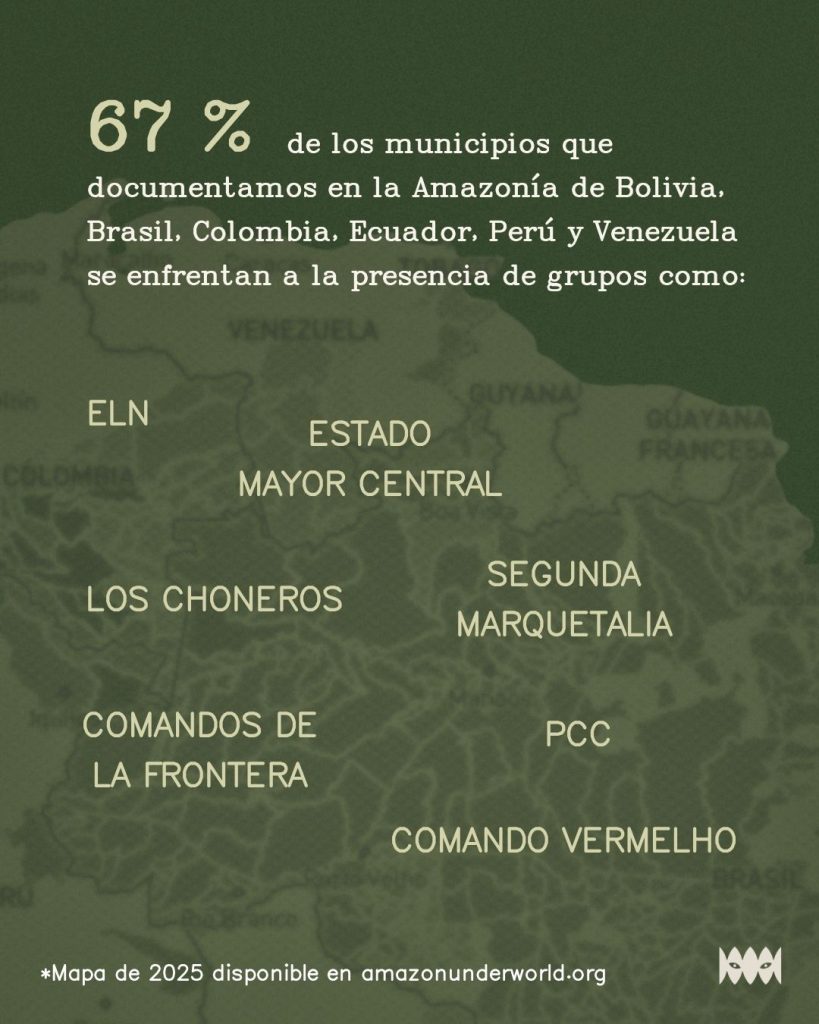
Organized crime groups are now present in at least 67% of Amazon municipalities in Colombia, Brazil, Venezuela, Peru, Ecuador, and Bolivia.
The report listed two main illicit activities behind this criminal expansion: shifting trends in global drug consumption and increasing demand for gold and other minerals.
Recent years have seen record levels of cocaine production in countries like Colombia, Bolivia, and Peru, while Europe has become the largest consumer market in the world. The increasing importance of Brazilian ports like Santos and Barcarena, as well as Guayaquil in Ecuador, as exit points for cocaine bound for Europe, has made the Amazon a central hub in drug trafficking routes.
Surging gold prices have made illegal mining increasingly attractive for criminal groups, and this trade is now more profitable than drug trafficking.
Some of the main criminal organizations operating in the Amazon include Brazil’s Primeiro Comando da Capital (PCC) and Comando Vermelho (Red Command), the Colombian National Liberation Army (ELN) and Comandos de la Frontera, and the Ecuadorian gangs Los Lobos and Los Choneros.
The growing influence of these groups is now prompting policy responses. In Brazil, the government has recently announced a $40 million fund to fight criminal factions in the Amazon and border regions.
Both cocaine production and illegal gold mining have devastating environmental impacts, relying on deforestation and generating harmful chemical waste through the use of substances such as mercury, cyanide, and hydrochloric acid.
In addition, organized crime reinvests its profits in activities such as industrial agriculture, land clearing, and cattle ranching, further fueling environmental degradation.
“Cocaine cannot be legalized, but meat and gold can, which is what makes them so attractive. Drug profits are reinvested in physical gold, mining equipment, land grabbing, and cattle acquisitions”, Bram Ebus, consultant at the International Crisis Group and founder of the journalism project Amazon Underworld, told Latin America Reports.
“Armed and criminal groups routinely use strawmen to control cattle herds, gold pawnshops, or mining operations. The endgame is always to penetrate the business world and co-opt political authorities”, Ebus added.
The ICG study highlights how Indigenous communities in the Amazon are the most exposed to criminal intrusion and violence.
In many of these countries, they constitute the frontline of territorial defense and monitoring. But the lack of coordination with – and distrust from – state authorities has made the role of Indigenous guards particularly risky.
Furthermore, armed groups coerce members of the communities into joining their ranks, either by force or with the promise of higher earnings from illicit activities.
“Rather than protecting the most vulnerable, in some cases state forces have assaulted local communities, who are too often framed as complicit in illicit economies rather than recognized as victims coerced into them”, said Ebus.
Ebus explained that the consequences also deeply affect Indigenous cultures, as local populations are often left with no viable alternative but gold mining, which destroys and contaminates their ancestral lands. Indigenous youth abandon traditional practices such as hunting and fishing, and become increasingly dependent on food supplies bought with income from the only available economic activity: illegal mining.
The violence can also be deadly. Criminal groups don’t hesitate to resort to lethal retaliation against those who oppose environmental exploitation or are suspected of collaborating with authorities.
Latin America is the region with the highest homicide rate in the world, and this statistic is even higher in the Amazon: between 2012 and 2024, a large share of the global murders of environmental and land defenders took place in this area. Colombia and Brazil alone made up 40% of the total number of deaths worldwide, with Indigenous peoples and members of Afro-descendant communities disproportionately affected by the violence.
An urgent need for coordination
The most urgent recommendation emerging from the study is the need to improve cross-border cooperation between Amazon states and to harmonize environmental laws.
“Amazon cooperation depends heavily on electoral outcomes this year in Brazil, Colombia, and Peru. The UNTOC assembly in October is another opportunity, with Brazil and Colombia, in particular, pushing for formal recognition of environmental crimes”, Ebus said.
The massive profits generated by illicit activities allow organized crime to corrupt authorities and capture state institutions, making intelligence sharing even more crucial.
Uneven regulations on environmental crimes enable criminals to exploit loopholes and weaknesses across different jurisdictions, especially where cross-border enforcement is lacking.
One example is the smuggling of mercury, a toxic substance used in the gold extraction process. All Amazon countries have signed the Minamata Convention, which restricts the sale and use of mercury, with Ecuador, Peru, and Colombia fully banning its import. In Bolivia, by contrast, the import and export of the element remain legal, and weak border controls have contributed to making the country a hub for the mercury trade in South America.
Featured image: Destroyed equipment of an illegal gold mine near the border between Brazil and Colombia.
The Mexican military captured Audias Flores Silva, alias ‘El Jardinero’, on Monday – one of the top leaders of the Jalisco New Generation Cartel (CJNG).
Flores Silva was considered to be one of the key candidates to succeed alias ‘El Mencho’, the former leader of the CJNG who was killed by authorities in February.
The drug lord’s arrest comes amid a wider crackdown by Mexican security forces against organized crime, driven partly by pressure from Washington.
According to authorities, Monday’s operation did not involve any shooting, injuries, or collateral damage. The military deployment included 120 direct action troops, four close air support helicopters, four fixed-wing aircraft, and two troop transport helicopters, with 400 naval personnel providing support.
The CJNG leader’s more than 60-strong escort group dispersed in different directions upon the arrival of security forces, attempting a tactical distraction maneuver, but the target was located through air and ground tracking.
Official footage of the operation shared by Omar García Harfuch, Secretary of Security and Citizen Protection of Mexico, shows the moment of the capture, with Flores Silva extracted from a roadside drainage conduit, where he was hiding. The arrest happened near El Mirador, a rural community in the western state of Nayarit.
Hours after the news became public, several stores and vehicles were set on fire across Nayarit. While the unrest fell short of the level of retaliation following the killing of ‘El Mencho’ in February 2026, the Government of Nayarit urged citizens to stay in their homes as a preventative measure.
A major blow to CJNG
The arrest was praised by the U.S. Ambassador to Mexico, Ronald Johnson, who congratulated Mexico’s Security Cabinet and Secretary of the Navy.
In 2021, the U.S. Drug Enforcement Agency offered a US$5 million reward for information leading to Audias Flores Silva’s arrest or conviction. Flores Silva was defined as “closely aligned” with former CJNG leader ‘El Mencho’, whose real name is Nemesio Oseguera Cervantes.
In June 2025, the U.S. Department of the Treasury’s Office of Foreign Assets Control (OFAC) sanctioned Flores Silva, identifying him as a CJNG regional commander in charge of significant portions of territory in the states of Zacatecas, Guerrero, Nayarit, Jalisco, and Michoacán.
According to U.S. authorities, Flores Silva was in control of clandestine laboratories producing methamphetamine and other illicit drugs in central Jalisco and southern Zacatecas. In addition, Silva managed the logistics of cocaine trafficking operations from Central America through Mexico to the United States, including the supervision of several clandestine airstrips.
‘El Jardinero’ was also believed to have coordinated a deadly 2015 attack against Mexican police forces in Jalisco that left 15 agents dead.
Flores Silva’s arrest is a hard hit to CJNG, as security analysts considered him a potential successor to the group’s command after the death of ‘El Mencho’ last February.
“Flores Silva was the closest thing the CJNG had to a chief operating officer, the man who once ran Mencho’s personal security, managed the Pacific corridor’s labs and airstrips, oversaw a timeshare fraud network and U.S. money-laundering pipeline, and brokered the alliance with Los Chapitos after the Sinaloa civil war,” Chris Dalby, director of World of Crime and senior analyst at Dyami Security Intelligence, told Latin America Reports.
Authorities dealt a second blow to CJNG yesterday when the Special Forces of the Mexican Army and the National Guard detained César Alejandro N, alias “El Güero Conta”. He was identified as the main financial operator for ‘El Jardinero’ and accused of laundering money through companies and frontmen.
“Losing Silva alongside his financier on the same day hits the CJNG operationally and financially simultaneously. It doesn’t spell an end to the CJNG, however, and may actually help Juan Carlos Gonzalez Valencia secure leadership by removing a rival,” said Dalby.
Featured image description: Wanted poster for Audias Flores Silva, alias ‘El Jardinero’.
Featured image credit: Omar García Harfuch via Facebook.

 Login
Login