
Reading view

Hanson’s gas policy follows the far-right playbook: attack ‘elites’ and push for drilling
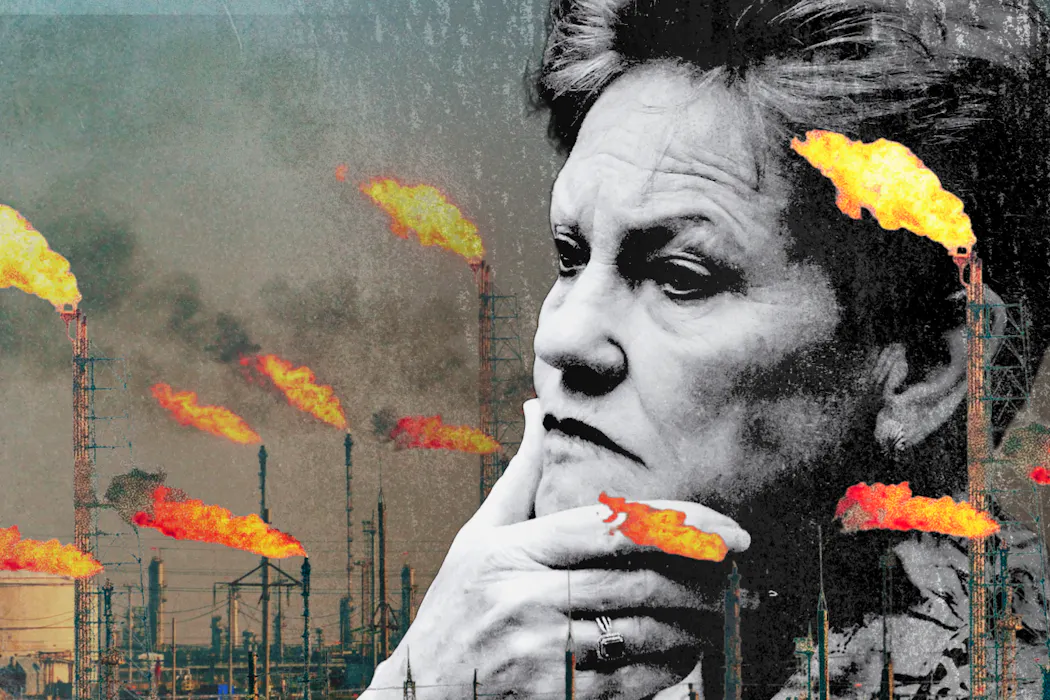
Mick Tsikas/AAP, Hakim/Canva, The Conversation, CC BY

New polling this week put One Nation ahead of Labor in the primary vote for the first time, as the party’s latest policy announcements signal greater political ambition.

One Nation recently unveiled its new oil and gas policy at the Australian Energy Producers Conference in Adelaide. It promises “vastly greater returns” to an electorate “rightly unhappy” with the distribution of Australia’s natural resources.

While One Nation’s gas policy is not entirely new, the party’s growing prominence means announcements will attract greater scrutiny.

So, what is the party proposing?

Embracing government intervention

The Norway-style gas proposal is One Nation’s first substantial intervention in current tax and energy policy debates. It’s a marked shift away from the social and migration issues that have long defined the party.

Norway heavily taxes its oil and gas extraction profits. It reinvests the wealth into the world’s largest sovereign fund to spent on social initiatives.

Echoing the Trump administration’s willingness to buy into resource and technology companies, One Nation’s announcement reflects a broader embrace of economic interventionism: where a government actively modifies a free-market economy.

The announcement shows a stark differentiation between One Nation and The Liberal Party on the economy. And it comes at a time when the parties have increasingly overlapped on issues like migration.

Liberal frontbencher James Paterson attacked the policy as socialist. He described it as “borrowed from Venezuela and Hugo Chávez”.

One Nation’s policy

Despite the splashy announcement, One Nation’s gas policy was not entirely new.

Hanson has pointed to a Norway-style sovereign wealth fund as a model for gas revenue policy since at least 2017. Senator Hanson has also frequently attacked parliament for being “hostage” to multinationals resource companies operating in Australia.

In announcing the policy, Senator Hanson committed One Nation to encouraging more gas and oil exploration and production. Hanson also said taxpayers should get a “fair share” on profits from Australian resources.

Key elements of the policy include replacing the current Petroleum Resource Rent Tax, which places a 40% tax on the profits related to the extraction of petroleum, gas and condensate.

Instead, One Nation would give the government the option to take a 30% stake in future drilling projects, with profits directed into a new sovereign wealth fund.

It’s not the first time this has been suggested. Back in May 2017, Hanson proposed One Nation adopt a system of royalties paid on production, saying such a scheme would raise up to $10 billion per year.

Tapping into public grievance

One Nation’s position sets it apart from both major parties.

Labor and the Coalition hold sharply differing views on energy and Net Zero.

But the two parties share common ground on one point: neither supports increased taxation measures on the gas industry, particularly amid global uncertainty caused by the US-Israel war with Iran.

With its policy, One Nation is tapping into real public grievance. Others, such as The Australia Institute, the Greens, and Independent senator David Pocock have spent years pointing out the same basic unfairness: Australia exports vast quantities of gas, companies profit enormously, and the taxpayer gets very little in return.

But the timing of One Nation’s announcement deserves closer scrutiny. It was not made to a general audience but a gathering of energy industry heavyweights. Reports suggest the announced version was softened after consultations with industry representatives.

Pushing back at the ‘green agenda’

Far-right parties have a distinctive approach to energy policy – they simultaneously cast multinationals as “elites” who take wealth from ordinary people, while advocating for gas drilling expansion themselves.

Hanson has adopted US President Donald Trump’s slogan – “drill, baby, drill” – to spruik her party’s approach to fossil fuels. And she has called on the Labor government to push their “climate change bedwetters” to the side, and expand oil and gas exploration in the interest of energy security.

One Nation blames environmental reforms for triggering an energy crisis, which it claims has cost everyday Australians. Ending net zero is, accordingly, a “massive part” of One Nation’s gas policy, which they claim will safeguard fuel security.

Hanson has described One Nation’s policy as “partnering with the oil and gas industry, rather than treating it as the enemy”.

Internal tensions

This policy debate risks exposing potential tensions between the federal and state branches of One Nation.

Efforts by the South Australian Labor government to repeal a ten-year moratorium on fracking in the south east of the state were blocked by the newly elected One Nation MPs and Liberal Opposition.

The inconsistency between the federal party’s pledge to expand gas exploration and the state branch’s efforts to block it have created headaches for their leader. Hanson distanced herself, dismissing it as a decision for the state branch.

Heading into the next election, One Nation wants contrast with the Liberals on economic interventionism, while setting itself apart from Labor, the Greens and the independents on climate and environmental policy. It is calculated decision from a party that senses its moment.

The Conversation

Emily Foley receives funding from the Australian Research Council.

Jordan McSwiney receives funding from the Australian Research Council, NSW Government, and NSW RNA Research & Training Network.

Kurt Sengul receives funding from the Australian Research Council, NSW Government, and NSW RNA Research & Training Network

  •  

Independent MPs are considering forming a party. The money helps explain why

Federal independent MPs have been in discussions about forming a political party. The irony won’t be lost on some in the Liberal Party, who have long argued the Teal independents already look and act like one.

Many independents already coordinate on policy, vote in similar patterns, and draw on shared fundraising vehicles such as Climate 200. But the independents’ reasons for considering a party may have less to do with political strategy and more to do with money.


Read more: View from The Hill: would a ‘party of independents’ be a contradiction in terms?


Federal member for Warringah Zali Steggall said this week that Australia’s federal donation laws “favour major party structures” and amount to “major parties trying to rig the game for their benefit”. Other crossbenchers, including Senator David Pocock, have signalled openness to the idea, even if several others have already ruled it out.

Much of the debate has centred on whether forming a party would betray the independent brand. In a study published in the Australian Journal of Political Science, we examined funding returns spanning multiple electoral cycles for minor parties, independents, and the major parties. Our findings suggest that Steggall’s complaint reflects something deeper than just the recent donation reforms. The financial disadvantages facing independents are enduring structural features of the political finance regime.

Financial barriers for independents

Consider public funding. After each federal election, the Australian Electoral Commission distributes money to parties and candidates based on the number of votes they receive. This seems relatively neutral, but it has an inbuilt asymmetry.

Parties run candidates across multiple seats and can accumulate votes nationally. Independents contest a single electorate. Even an independent who wins comfortably accumulates a far smaller absolute vote total than a party contesting dozens of seats (successfully or otherwise).

Our research found that public funding makes up a smaller share of independents’ total income than it does for parties. For minor parties, public funding is their single largest funding source.

Corporate donations tell a similar story. Corporate donors often give strategically, directing money toward actors who can offer policy access and influence. Major parties, as parties of government, are the obvious destination.

Independents, who can offer just a single vote – and for those in the House, a single vote in a chamber dominated by government – attract little from corporate donors. Even minor parties with balance-of-power positions in the Senate do marginally better.

The result is that independents are overwhelmingly dependent on individual donations – and mostly on a small scale. In many ways, this funding model is genuinely democratic. But it does leave independents with a narrow funding base, and few alternatives when donations fluctuate.

The volatility problem

The fluctuation in funds for independents can be severe. We measured how much political parties and independents received in donations from year to year, and found independents tend to experience significantly more volatility than parties. One independent in our study showed year-on-year fluctuation more than four times higher than any other electoral actor in our sample.

The explanation is organisational. Parties maintain permanent infrastructure that enables continuous fundraising: membership databases, regular donor programs, associated entities, dedicated staff.

Independents typically lack most, if not all, of these advantages. Their fundraising surges before elections and collapses afterwards, creating a cycle of boom and bust.

Some minor parties, notably the Greens, have built funding operations nearly as sophisticated as the major parties. The gap between an established minor party and a major party is one of scale. Conversely, the gap between an independent and a party of any size is one of structure.

Recent reforms amplify these issues

These structural disadvantages have long existed. But the Electoral Legislation Amendment (Electoral Reform) Act 2025, due to take effect in January 2027, is set to amplify them.

Under the new rules, a single donor can give up to $50,000 a year to an independent candidate. But the same donor could give $50,000 to each branch of a major party, meaning up to $450,000 to the major parties across their state and federal divisions.

National spending is capped at $90 million for parties, but $800,000 per electorate for independents. And while parties can move money from safe seats to flood marginal electorates with general advertising, independents have no equivalent mechanism. Public funding has also increased from $3.50 to $5 per vote, a change that disproportionately benefits parties with large national vote totals.

Former independent federal MPs, Zoe Daniel and Rex Patrick have launched a High Court challenge to these provisions. Whatever the outcome, the reforms illustrate the broader pattern our research identifies: a regulatory framework built around party structures that treats independents as an afterthought.

The independents’ dilemma

The financial logic of forming a party is clear. A party structure would give current independents access to higher donation caps, national spending allowances, shared fundraising infrastructure (including associated entities), and the organisational capacity to cultivate donors between elections.

It would pool electoral support across multiple seats, increasing public funding returns. It could create the kind of permanent organisation that smoothes revenue and reduces the precariousness that currently defines independent finances.

But a significant part of what makes independents attractive to voters (and smaller donors) is precisely that they are not a party. The community and Teal independent movements have mobilised support around local identity, independence from partisan discipline, and a rejection of major party culture.

Climate 200 emerged specifically to support independents without party structures. Would a “party of independents” retain any of that appeal? The split among independents this week suggests there is no immediate answer.

The Conversation

Josh Holloway receives funding from the Australian Research Council.

Emily Foley receives funding from the Australian Research Council Discovery for her work on Hiding in Plain Sight: 'Associated Entities' and Australian Democracy.

Rob Manwaring receives funding from the Australian Research Council - Discovery project on political parties and associated entities

Narelle Miragliotta does not work for, consult, own shares in or receive funding from any company or organisation that would benefit from this article, and has disclosed no relevant affiliations beyond their academic appointment.

  •  
❌