Reading view

Babies with older siblings have a higher infection risk, but are less protected through vaccination

Getty Images

Parents know how easily coughs, colds and other infections can move through a household after a child picks up a bug at childcare or school.

This puts babies with older siblings at greater risk of serious infectious illness, especially while their immune systems are still developing during the critical first months of life. Maternal vaccination during pregnancy helps boost babies’ protection.

But my new research shows a worrying mismatch: vaccination uptake falls during later pregnancies, leaving babies who would benefit most from maternal immunisation less likely to receive that protection.

In Aotearoa New Zealand, vaccination against pertussis, also known as whooping cough, and influenza is publicly funded and recommended during every pregnancy.

These vaccines do not only protect the mother. The maternal antibodies are also transferred to the baby and help protect them.

Previous studies confirm that maternal immunisation substantially reduces babies’ risk of infection and hospitalisation from pertussis and influenza, but my research shows a birth-order pattern of reduced protection.

Immunisation falls with each pregnancy

Vaccination uptake during pregnancy remains far from universal.

Analysis of current Aotearoa Immunisation Register data for births in the year to June 2025 shows 61% of mothers received a pertussis vaccine and 40% received an influenza vaccine during pregnancy.

But these overall figures hide a clear birth-order pattern. Among first pregnancies, uptake was 69% for pertussis and 45% for influenza. In second pregnancies, this decreased to 63% and 41% respectively. By the fourth pregnancy, these figures had fallen to 38% and 24%.
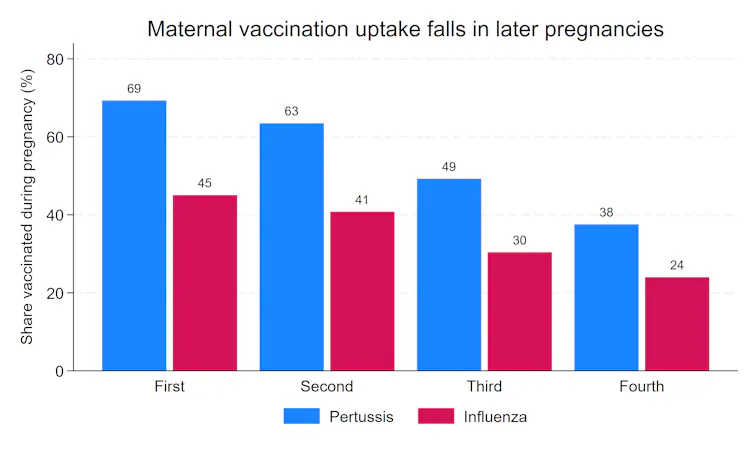
Share of mothers receiving pertussis or influenza vaccination during pregnancy, by birth order. Data cover pregnancies resulting in births in New Zealand from July 2024 to June 2025. CC BY

These recent figures show the birth-order pattern for one year of births. In my research, I examined a longer period, covering births from 2015 to 2023, which allowed me to compare vaccine uptake for the same mother across different pregnancies.

Part of the overall pattern reflects differences between families. Mothers who have more children tend to have lower vaccination uptake overall.

But the pattern also appears within families. The same mother is less likely to be vaccinated in later pregnancies than in earlier ones.

This finding fits with a growing body of evidence showing parents’ health-related decisions can vary with a child’s birth order. Previous studies have found later-born children are breastfed at lower rates and are less likely to attend health checks and receive childhood immunisations. These differences can also begin before birth, with lower use of prenatal care in later pregnancies.

A double disadvantage for later-born babies

While later-born babies receive less protection through vaccination, they may also face a greater risk of infection.

The family environment plays a role in the spread of infectious diseases. Older children can bring infections home, exposing younger siblings. Studies in other countries have found later-born children have higher rates of hospitalisation for respiratory conditions and receive more prescriptions for contagious diseases early in life.

My study shows this pattern also holds in New Zealand for two diseases targeted by maternal immunisation: pertussis and influenza. Later-born babies were more likely to be hospitalised for these diseases than their earlier-born siblings.

This is concerning from a public health perspective. Babies with older siblings face a greater risk of infection, while their mothers are less likely to receive recommended vaccinations during pregnancy.

How health services can respond

There are several possible reasons maternal immunisation and other parental behaviours vary by birth order.

As families grow, parents have to divide their time, attention and other resources among more children. This may influence the care and support available during later pregnancies and early childhood.

Parents may also learn and adapt as they become more experienced, changing how they approach pregnancy and infant care.

These explanations also point to possible solutions. Evidence from New Zealand suggests gaps in awareness, time constraints and difficulty accessing services can contribute to missed maternal immunisation. These barriers may be exacerbated in later pregnancies, when parents are already caring for older children.

Policy and service efforts that provide clearer information and make vaccination easier to access could therefore be particularly effective if they include a focus on later pregnancies.

New Zealand has already been moving in this direction by expanding the settings where immunisation can be delivered, including pharmacies and community midwives. There is evidence that making maternal pertussis vaccination available through pharmacies increased uptake, particularly for Māori women.

If these changes make vaccination easier to access for busy families, they could help protect babies who currently face the double disadvantage of higher infection risk and lower maternal immunisation uptake.

The Conversation

This research was supported by the Health Research Council of New Zealand. These results are not official statistics. They have been created for research purposes from the Integrated Data Infrastructure which is managed by Stats NZ. For more information please visit https://www.stats.govt.nz/integrated-data/.

  •  

Anti-foreigner violence in South Africa is easily sparked: what hasn’t been done to deal with it

Threats and deadly conflict over migration are spreading fast in South Africa. This is hugely worrying and could result in widespread injury and killings, as it has in the past.

The region’s investment prospects could be dimmed too, due to perceptions of political instability.

The need for effective responses is real and urgent. The death toll, while disputed, is rising, and reports of marches, threats, sacking of dwellings and violence are widespread across South Africa.

Anti-foreigner hysteria is being driven by online campaigns which appear to be highly organised. They include the use of faked information and graphics.

It is also being driven by campaign leaders and by politicians who support campaigns to root out foreigners, either actively or simply by justifying the arguments used by the more dangerous activists. The UN secretary general, Amnesty International and several foreign governments, including those of Mozambique, Nigeria and Ghana, have berated South Africa for not responding appropriately to anti-migrant mobilisation.


Read more: South Africans are far less tolerant of migrants than before – hotspots, drivers and solutions


In a televised address on Sunday 7 May 2026, the country’s president, Cyril Ramaphosa, outlined various initiatives to lessen the conflicts over migration. But was this a coherent response, or a missed opportunity to make real progress?

The core of the response was the five-point plan agreed to by a special cabinet committee meeting last week. The points included a law enforcement crackdown (including intensifying deportations), establishing dedicated immigration courts, rooting out employment of undocumented workers, securing borders, and tackling corruption (including a reform of identity systems.)

Ramaphosa admitted that economic conditions and the poor state of many public services explained why people were desperate and that grievances, including grievances about the influx of undocumented migrants, were “real”. Some have interpreted his stance as justifying the association of foreigners with the grievances that poor South Africans have.

Based on my work as a political economist in migration governance over the past decade, I know that virtually all the specific actions mentioned in the five parts of the plan had already been announced by the South African government, though not as a concerted platform to address the current crisis. Yet implementation has been painfully slow.


Read more: South Africa’s new immigration policy takes a digital direction – will it succeed?


Clearly, there needs to be urgent and visible follow-through on these commitments. This should include the promise to clamp down on anti-foreigner agitators and those who have wounded or killed people they believed to be foreign. To my knowledge, very few agitators and attackers have been arrested, let alone charged. None of the leaders inciting dangerous actions have been arrested, or even called out by political leaders.

To help reduce the violence and the perception of risk, a number of additional steps need to be taken. Firstly, the forging of a collective political front of parties in the country against anti-foreigner activities. Secondly, the mobilisation of civic and religious institutions to fight against irresponsible politicking. Third, a renegotiation of colonial-era bilateral labour agreements with South Africa’s five neighbouring countries. And finally, addressing the country’s acute unemployment crisis.

Four steps that could make a difference

Firstly, the head of state – or the head of his political party – should bring together the leaders of all the significant political parties in a forum which commits to agreeing not to incite anti-foreigner sentiment, and also, as a group, condemns such behaviour.

Secondly, leaders of civic and religious institution could be encouraged to do the same – to warn against irresponsible politicking. Further than that, religious and community groupings could be encouraged and even assisted by government to drive programmes to include foreigners into the mainstream of South African society in a constructive way.

There are examples of how to do this in other parts of the world in developed and developing countries. These include South America and other African countries.

National, provincial and local governments could also drive initiatives to include foreigners into the national community. These could be standalone programmes or in cooperation with civil society institutions.

Thirdly, there should be a renegotiation of bilateral labour agreements with five neighbouring countries. In a white paper released in 2025 the government committed to establishing employment quotas for South Africans in various sectors of industry. It also committed to the renegotiation of the bilateral deals. The existing agreements are colonial in origin and form. They withhold virtually all labour and social rights from migrant labourers. And they don’t accommodate long-term labour migration contracts, now common in other parts of the world.

Such reforms could create more manageable as well as fair and equitable systems of migrant labour. South Africa could address its labour needs in a workable way. And the temptation to bypass the system should be lower, with fewer undocumented migrant workers.

It’s not realistic yet to do away with regional labour migration, but it could be far better managed.

Finally, Ramaphosa said he’d be sending out envoys “to seek to find sustainable solutions to these challenges”. But this has already been done, more than 20 years ago. South Africa and some of its neighbours agreed to a protocol on the facilitation of the movement of persons in the southern African region. This initiative was negotiated in the Southern African Development Community.

But since the protocol was signed by several heads of state in the region in 2005, there has been no progress. South Africa, its partners and the Southern African Development Community itself are guilty of negligence and should accept that they could have and can do more to avoid crises such as the present one.

Poorer South Africans are vulnerable to anti-foreigner mobilisation because of their dire economic circumstances: 32.7% unemployment; 37.8% of people classified as very poor. And public services are often very bad.

More growth and more jobs must dampen the powder-keg that is so easily sparked.

But even before that is achieved, there is a great deal that could be done to eliminate the spark itself – tensions over migration.

The Conversation

Alan Hirsch receives research funding from the New South Institute.

  •  

Hanson’s gas policy follows the far-right playbook: attack ‘elites’ and push for drilling

Mick Tsikas/AAP, Hakim/Canva, The Conversation, CC BY

New polling this week put One Nation ahead of Labor in the primary vote for the first time, as the party’s latest policy announcements signal greater political ambition.

One Nation recently unveiled its new oil and gas policy at the Australian Energy Producers Conference in Adelaide. It promises “vastly greater returns” to an electorate “rightly unhappy” with the distribution of Australia’s natural resources.

While One Nation’s gas policy is not entirely new, the party’s growing prominence means announcements will attract greater scrutiny.

So, what is the party proposing?

Embracing government intervention

The Norway-style gas proposal is One Nation’s first substantial intervention in current tax and energy policy debates. It’s a marked shift away from the social and migration issues that have long defined the party.

Norway heavily taxes its oil and gas extraction profits. It reinvests the wealth into the world’s largest sovereign fund to spent on social initiatives.

Echoing the Trump administration’s willingness to buy into resource and technology companies, One Nation’s announcement reflects a broader embrace of economic interventionism: where a government actively modifies a free-market economy.

The announcement shows a stark differentiation between One Nation and The Liberal Party on the economy. And it comes at a time when the parties have increasingly overlapped on issues like migration.

Liberal frontbencher James Paterson attacked the policy as socialist. He described it as “borrowed from Venezuela and Hugo Chávez”.

One Nation’s policy

Despite the splashy announcement, One Nation’s gas policy was not entirely new.

Hanson has pointed to a Norway-style sovereign wealth fund as a model for gas revenue policy since at least 2017. Senator Hanson has also frequently attacked parliament for being “hostage” to multinationals resource companies operating in Australia.

In announcing the policy, Senator Hanson committed One Nation to encouraging more gas and oil exploration and production. Hanson also said taxpayers should get a “fair share” on profits from Australian resources.

Key elements of the policy include replacing the current Petroleum Resource Rent Tax, which places a 40% tax on the profits related to the extraction of petroleum, gas and condensate.

Instead, One Nation would give the government the option to take a 30% stake in future drilling projects, with profits directed into a new sovereign wealth fund.

It’s not the first time this has been suggested. Back in May 2017, Hanson proposed One Nation adopt a system of royalties paid on production, saying such a scheme would raise up to $10 billion per year.

Tapping into public grievance

One Nation’s position sets it apart from both major parties.

Labor and the Coalition hold sharply differing views on energy and Net Zero.

But the two parties share common ground on one point: neither supports increased taxation measures on the gas industry, particularly amid global uncertainty caused by the US-Israel war with Iran.

With its policy, One Nation is tapping into real public grievance. Others, such as The Australia Institute, the Greens, and Independent senator David Pocock have spent years pointing out the same basic unfairness: Australia exports vast quantities of gas, companies profit enormously, and the taxpayer gets very little in return.

But the timing of One Nation’s announcement deserves closer scrutiny. It was not made to a general audience but a gathering of energy industry heavyweights. Reports suggest the announced version was softened after consultations with industry representatives.

Pushing back at the ‘green agenda’

Far-right parties have a distinctive approach to energy policy – they simultaneously cast multinationals as “elites” who take wealth from ordinary people, while advocating for gas drilling expansion themselves.

Hanson has adopted US President Donald Trump’s slogan – “drill, baby, drill” – to spruik her party’s approach to fossil fuels. And she has called on the Labor government to push their “climate change bedwetters” to the side, and expand oil and gas exploration in the interest of energy security.

One Nation blames environmental reforms for triggering an energy crisis, which it claims has cost everyday Australians. Ending net zero is, accordingly, a “massive part” of One Nation’s gas policy, which they claim will safeguard fuel security.

Hanson has described One Nation’s policy as “partnering with the oil and gas industry, rather than treating it as the enemy”.

Internal tensions

This policy debate risks exposing potential tensions between the federal and state branches of One Nation.

Efforts by the South Australian Labor government to repeal a ten-year moratorium on fracking in the south east of the state were blocked by the newly elected One Nation MPs and Liberal Opposition.

The inconsistency between the federal party’s pledge to expand gas exploration and the state branch’s efforts to block it have created headaches for their leader. Hanson distanced herself, dismissing it as a decision for the state branch.

Heading into the next election, One Nation wants contrast with the Liberals on economic interventionism, while setting itself apart from Labor, the Greens and the independents on climate and environmental policy. It is calculated decision from a party that senses its moment.

The Conversation

Emily Foley receives funding from the Australian Research Council.

Jordan McSwiney receives funding from the Australian Research Council, NSW Government, and NSW RNA Research & Training Network.

Kurt Sengul receives funding from the Australian Research Council, NSW Government, and NSW RNA Research & Training Network

  •  

When your workplace doesn’t match your ethical outlook – the problem of ‘moral injury’

KieferPix/Shutterstock

When earthquakes struck Turkey and Syria in February 2023, more than 50,000 people were killed and thousands more were injured.

One month after the disaster, a bank employee named Efe Demir died by suicide in İstanbul. Before his death, he had sent an email to colleagues questioning the actions and motivations of his employer, saying he felt that the organisation prioritised profit over caring for clients who were victims of the tragedy.

The bank strongly denied the allegations, but Demir’s accusation highlights a broader, and often invisible, problem: how a corporate approach, especially in times of crisis, can cause employees to experience psychological harm.

Sometimes referred to as “moral injury” or “ethical suffering”, it often involves feelings of distress that arise when workers are compelled to act solely in the interest of profit.

The psychiatrist Christophe Dejours, who specialises in work and mental health, has argued that the complexities of work require employees to constantly expend emotional and cognitive energy navigating moral dilemmas.

Those dilemmas could be to do with a company’s environmental record for example, or how it relates to a country engaged in a military conflict. Moral injury does not arise only from what workers are required to do.

It can also take the form of intense feelings of isolation when an employee feels what a company is doing is wrong, but nobody is doing anything about it.

Eventually, moral injury can become a deep crisis, with workplace suicide as its most tragic manifestation.

Disasters amplify moral harm

Moral injury is commonly used to describe the experiences of workers in care-giving professions such as medicine or nursing, where decisions can carry life or death consequences. But moral injury can appear in many occupations, especially during disasters, when individuals suddenly feel a heightened responsibility for others.

For employees like Demir, the earthquake in Turkey was not only a national tragedy – it was a moment when the employer’s values were put to the test. For Demir, among other allegations was an accusation that the bank had not looked after customers who have been affected by the earthquake, in terms of their ability to repay loans or be given credit.

Rubble and ruins from collapsed buildings.
The 2023 earthquake in Turkey and Syria was the worst to hit the region in decades and left more than 50,000 people dead. Doga Ayberk Demir/Shutterstock

Such cases are rarely publicised. Employers often move quickly to protect their reputation, while colleagues fear retaliation and families hesitate to link suicide to work.

The connection can be difficult or even impossible to prove. There research which suggests that employee suicide can serve as a final attempt to expose injustice.

Modern work often involves tasks that are legal but morally questionable, whether it’s carefully manipulating clients, competing unfairly or remaining silent about harm. Employees may become unwilling participants in practices that violate ethical standards – and this is precisely what makes these experiences difficult for the employee to talk about.


Read more: Why OpenAI is a prime example of the ethical limits of capitalism


Even though physical dangers in the workplace are recognised, psychological dangers such as ethical conflict and feelings of loss of integrity often remain unacknowledged. Long-term exposure to ethically ambiguous environments can reshape someone’s character, moral sensibilities and sense of self. Over time, Dejours argues, workers numb themselves to others’ suffering – and eventually, to their own.

In countries such as France and Japan, work-related suicides are part of public debate, thanks to labour activists. In France, unions such as the CFE-CGC actively fight workplace bullying and at a global level, the International Trade Union Confederation Ituc named work-related suicide as a priority issue in a campaign on psychosocial hazards.

To confront moral injury at work, especially in an era of overlapping crises, whether it’s environmental, geopolitical or natural, research suggests that many organisations need to pay more attention to the ethical integrity of their employees. Professional dignity is not just about the terms of work – the hours, the pay and conditions – but also what we produce at work.

This also means expanding occupational safety to include not just physical risks but moral and psychological hazards – and talking more openly about the ethically questionable tasks that people may be asked to commit at work.

If you’re struggling with suicidal thoughts, the following services can provide you with support:

In the UK and Ireland – call Samaritans UK at 116 123.

In the US – call the National Suicide Prevention Lifeline at 1-800-273-TALK (8255) or IMAlive at 1-800-784-2433.

In Australia – call Lifeline Australia at 13 11 14.

In other countries – visit IASP or Suicide.org to find a helpline in your country.

The Conversation

Ebru Işıklı does not work for, consult, own shares in or receive funding from any company or organisation that would benefit from this article, and has disclosed no relevant affiliations beyond their academic appointment.

  •  

Lawsuit seeks to block Trump’s UFC fight at White House

A lawsuit filed Saturday is seeking to block the Trump administration’s UFC fight scheduled to take place at the White House next week on President Trump’s birthday, June 14. Plaintiffs' attorneys argue the event is “deeply corrupt” and have accused Trump of benefitting from the event financially, citing reporting that says the president purchased up...

  •  

Republican lawmaker says Trump can save FISA by canceling plans to put Pulte as acting DNI

Rep. Don Bacon (R-Neb.) on Monday urged President Trump to save surveillance powers authorized under the Foreign Intelligence Surveillance Act (FISA) by canceling Federal Housing Finance Agency (FHFA) Director Bill Pulte’s appointment to serve as acting Director of National Intelligence (DNI).  “FISA gives us over 50 percent of our most sensitive intelligence and has enabled...

  •  

From exporting spyware to surveilling activists – how democracies became the new digital authoritarians

“Digital authoritarianism” refers to governments using technology for surveillance and censorship to repress dissent.

China remains the master practitioner. There, sweeping surveillance and censorship at home is combined with cyber-espionage and disinformation, censorship and influence campaigns abroad.

But this problem is no longer confined to Moscow or Beijing. Democracies, too, are beginning to repress their citizens with the same tools, and export them abroad.

Two countries in particular – India and Israel – reveal how democracies are drifting toward the very digital authoritarianism they once opposed.

Israel: exporting spyware

Israel, a democracy, permits private firms to export spyware under a state-regulated system.

Pegasus spyware, developed by the Israeli firm NSO Group, is marketed as a tool licensed to government agencies for counterterrorism and serious crime investigations.

However, investigations have linked it to the surveillance of journalists, activists, lawyers and political opponents.

Pegasus spyware can infiltrate smartphones without the user clicking on a link. It can grant access to messages, calls, microphones and cameras.

It has been linked to the surveillance of journalists in Mexico, opposition politicians in India and civil society groups in Hungary.

Israel tightened export rules in 2021, insisting sales go only to trusted governments for legitimate purposes. Yet the problem has not disappeared.

In early 2025, it was revealed Paragon Solutions, an Israeli spyware firm cofounded by former Prime Minister Ehud Barak, developed a powerful surveillance tool capable of potentially compromising encrypted communications.

WhatsApp said last year nearly 100 journalists and members of civil society had been targeted using Paragon spyware.

Reporters at Citizen Lab later identified the spyware as a Paragon product, Graphite, and confirmed it had been used against journalists. It remains unclear who exactly the perpetrators were.

Through its export control system for offensive cyber tools, Israel is still allowing Israeli firms such as NSO Group and Paragon Solutions to sell spyware abroad, including Pegasus and Graphite.

This has contributed to concerns about the normalisation of commercial spyware.

India: Pegasus turned inward

In India, Amnesty International’s Security Lab reported forensic evidence of Pegasus being used on the phones of high-profile journalists.

Earlier reporting alleged Indian journalists, activists, lawyers and opposition figures appeared among potential targets. Following a petition, the Supreme Court will soon decide whether there should be an investigation into “India’s alleged use of Pegasus spyware on journalists, activists and public officials”.

The perpetrator has not been conclusively identified in those forensic reports, but NSO Group says Pegasus is licensed only to law enforcement and the intelligence agencies of sovereign states and government agencies.

The Indian government has denied wrongdoing, with IT Minister Ashwini Vaishnaw saying such surveillance was not possible under Indian law. The government later declined to file a detailed affidavit before the Supreme Court, citing national security.

These allegations sit within a wider pattern of democratic erosion in India. Critics have linked the Pegasus controversy to broader state practices, including:

  • frequent internet shutdowns and online censorship
  • legal pressure on journalists and activists
  • online harassment of journalists, activists and members of marginalised groups
  • and the stifling of dissent.

In 2023, Apple warned at least 20 Indian opposition politicians and journalists that their iPhones may have been targeted by “state-sponsored attackers”, reviving allegations the Indian government was using electronic surveillance against domestic critics. The Indian government has rejected the implication, but has announced an investigation.

Social media platforms have also been pressured by Indian government agencies and regulators to remove posts critical of the government. And supporters of the ruling party are known to organise online harassment campaigns of government critics.

A global problem

Other democracies – from Hungary to Turkey to Mexico – have experimented with spyware and aggressive online controls.

Technologies once hailed as enabling protest, connecting citizens and amplifying marginalised voices are now being redeployed for surveillance and control.

In 2024, global internet freedom declined for the 14th consecutive year. This was driven by censorship, surveillance, disinformation, platform restrictions and controls on internet access.

Governments of all types are blocking platforms, expanding monitoring, and deploying trolls and bots to tilt online debate.

For instance, Russia’s state-linked online influence operations have used coordinated troll farms to manipulate political discussions at home and abroad. Turkey’s pro-government “AKtroll” networks have also been accused of amplifying official narratives and harassing opposition voices online.

Gradual erosion of freedoms

Digital authoritarianism does not arrive overnight. It advances through normalisation: spyware licensed as “security”, platforms nudged into silencing dissent, internet shutdowns excused as “temporary”.

These measures, taken alone, may appear minor. Together, they gradually erode freedoms until democratic life itself is hollowed out.

Reversing this requires democracies to commit to strict controls on spyware exports. These controls must be backed by transparency, accountability and robust oversight.

Surveillance powers and online restrictions must be publicly justified and subject to independent review.

Equally vital is the protection of civil society. Journalists, activists and opposition groups need guarantees they can operate freely.

The Conversation

The authors do not work for, consult, own shares in or receive funding from any company or organisation that would benefit from this article, and have disclosed no relevant affiliations beyond their academic appointment.

  •  

What would it take for Pauline Hanson to become prime minister?

There has been a lot of speculation lately, not least from Pauline Hanson, about the possibility of the One Nation leader riding her surging polling figures into the Lodge at the next election.

So what are the rules around who can be prime minister? What would need to happen first? Is it likely Hanson will ever hold the position, or is this just hype?

What are the rules?

While the prime minister has historically come from the House of Representatives and not the Senate, where Hanson is, this is not actually stipulated in the Constitution.

This means many of our rules are mostly conventions inherited from the Westminster traditions of the United Kingdom, rather than legal requirements.

By these conventions, the prime minister has historically been the leader of the party or parties that can maintain the confidence of the House of Representatives. To be eligible, section 64 of the Constitution requires only that all government ministers have a seat either in the Senate or House within three months of being appointed to the role.

So, given Hanson holds a seat in the Senate, she’s eligible to be a government minister and will remain so unless she loses her seat and can’t get it back.

By convention, prime ministers have traditionally been drawn from the House of Representatives. This convention is so strong that when Senator John Gorton was voted by the Liberals to become their leader in 1968, he resigned and moved to the lower house almost immediately.

Having the prime minister in the lower house means they are directly accountable to the people of an individual electorate, can face more scrutiny during question time, and helps to show they’re better in control of their own ministers and backbenchers. It also means they share in the three-year electoral cycle with the majority of MPs, rather than six-year terms of senators.


Read more: The new leader of the Greens sits in the Senate. Why is that so unusual in Australian politics?


What would need to happen?

First, One Nation would need to get a large enough share of seats in the lower house to ensure Hanson could survive a vote of no confidence. This would need to be either a majority (76 of the 150 seats up for grabs) or a large enough share to persuade other parties to join a coalition or at least guarantee her confidence.

An example of this in practice occurred after the 2010 election, when Prime Minister Julia Gillard needed to negotiate with independents and Greens to form government.

It is likely Hanson would want to move from the Senate (where she’s very safe) to a lower house seat, either by resigning and running herself in 2028 or persuading another member to vacate the seat. In the latter scenario, she would still need to win a byelection in that seat. If her party or coalition could obtain the right numbers, either by election or defection from other parties, she could then make a case to the governor-general for appointment to the top job.

What is likely to happen?

The reason we are asking these questions is because One Nation for the first time in its history has been polling better than the Liberal-National Coalition federally (and with a higher primary than Labor in two recent polls).

This comes as the conservative parties, after several leadership changes and election defeats, are at one of their lowest ebbs. It is also reflective of an environment in which none of the major parties is attracting as enthusiastic support as in the past. Similarly, Albanese and Labor are at a point in the electoral cycle where incumbents are generally in decline.

History may prove me wrong, but I think Hanson’s ambitions are unlikely to be achieved for three reasons.

First, although the Liberal and National parties are struggling at the moment, they may bounce back in the coming years. Polling outside of an election period is also different from when an election is looming – and the next federal election is not due until 2028.

Low satisfaction with Albanese in 2024 didn’t translate to a win for his opponent Peter Dutton in 2025. The polls reversed just before the election when people were paying more attention, and Albanese was elected with a large majority.

Voters closer to an election may put more scrutiny on One Nation’s policies around economic management, or their positions on vaccines, abortion and gun control. With migration falling, the importance of their core issue area may have lessened as well, although much will depend on how people are feeling about the state of the economy, and how much they connect migration with other pressing issues such as housing.


Read more: What does One Nation actually believe in?


Second, despite some recent polling suggesting as many as 18 Labor seats were potentially under threat from One Nation, the main contest – at least for now – will be between One Nation and the Coalition for rural and regional seats.

Unless Hanson’s appeal can spread much further than it has in the past into the seats where most people live in cities with a more multicultural electorate, it’s unlikely One Nation would win more seats than Labor. The centrist independents who are doing well in these areas where Labor struggles would be unlikely to team up with her.

Finally, Hanson has historically been both the party’s greatest strength, and its greatest weakness. Her initial win in Oxley in 1996 was as a disendorsed Liberal candidate. By 1998 she was voted out again. When she was out of politics (and contemplating a move to the UK), the party struggled, despite an initial surge of enthusiasm at the 1998 Queensland state election (winning 11 seats from around 22% of the primary vote). By the next election, none of those elected were still with the party.

She has famously fallen out with other MPs in the past, including former Labor leader Mark Latham, who led the party in New South Wales, and the longstanding member for Mirani in Queensland, Stephen Andrews. One Nation has reportedly been aiming to create a more stable and traditional party branch structure recently. However, the party has often been run from the top down while lacking the organisational discipline of other parties.

Until the Farrer byelection last month, they had never won a federal lower house seat under their own label. It remains to be seen whether recent success in South Australia and the inclusion of high-profile but divisive figures such as Barnaby Joyce and Cory Bernardi will make the party more or less stable in the long term.

The Conversation

Pandanus Petter is employed with funding received from The Australian Research Council.

  •  

Independent MPs are considering forming a party. The money helps explain why

Federal independent MPs have been in discussions about forming a political party. The irony won’t be lost on some in the Liberal Party, who have long argued the Teal independents already look and act like one.

Many independents already coordinate on policy, vote in similar patterns, and draw on shared fundraising vehicles such as Climate 200. But the independents’ reasons for considering a party may have less to do with political strategy and more to do with money.


Read more: View from The Hill: would a ‘party of independents’ be a contradiction in terms?


Federal member for Warringah Zali Steggall said this week that Australia’s federal donation laws “favour major party structures” and amount to “major parties trying to rig the game for their benefit”. Other crossbenchers, including Senator David Pocock, have signalled openness to the idea, even if several others have already ruled it out.

Much of the debate has centred on whether forming a party would betray the independent brand. In a study published in the Australian Journal of Political Science, we examined funding returns spanning multiple electoral cycles for minor parties, independents, and the major parties. Our findings suggest that Steggall’s complaint reflects something deeper than just the recent donation reforms. The financial disadvantages facing independents are enduring structural features of the political finance regime.

Financial barriers for independents

Consider public funding. After each federal election, the Australian Electoral Commission distributes money to parties and candidates based on the number of votes they receive. This seems relatively neutral, but it has an inbuilt asymmetry.

Parties run candidates across multiple seats and can accumulate votes nationally. Independents contest a single electorate. Even an independent who wins comfortably accumulates a far smaller absolute vote total than a party contesting dozens of seats (successfully or otherwise).

Our research found that public funding makes up a smaller share of independents’ total income than it does for parties. For minor parties, public funding is their single largest funding source.

Corporate donations tell a similar story. Corporate donors often give strategically, directing money toward actors who can offer policy access and influence. Major parties, as parties of government, are the obvious destination.

Independents, who can offer just a single vote – and for those in the House, a single vote in a chamber dominated by government – attract little from corporate donors. Even minor parties with balance-of-power positions in the Senate do marginally better.

The result is that independents are overwhelmingly dependent on individual donations – and mostly on a small scale. In many ways, this funding model is genuinely democratic. But it does leave independents with a narrow funding base, and few alternatives when donations fluctuate.

The volatility problem

The fluctuation in funds for independents can be severe. We measured how much political parties and independents received in donations from year to year, and found independents tend to experience significantly more volatility than parties. One independent in our study showed year-on-year fluctuation more than four times higher than any other electoral actor in our sample.

The explanation is organisational. Parties maintain permanent infrastructure that enables continuous fundraising: membership databases, regular donor programs, associated entities, dedicated staff.

Independents typically lack most, if not all, of these advantages. Their fundraising surges before elections and collapses afterwards, creating a cycle of boom and bust.

Some minor parties, notably the Greens, have built funding operations nearly as sophisticated as the major parties. The gap between an established minor party and a major party is one of scale. Conversely, the gap between an independent and a party of any size is one of structure.

Recent reforms amplify these issues

These structural disadvantages have long existed. But the Electoral Legislation Amendment (Electoral Reform) Act 2025, due to take effect in January 2027, is set to amplify them.

Under the new rules, a single donor can give up to $50,000 a year to an independent candidate. But the same donor could give $50,000 to each branch of a major party, meaning up to $450,000 to the major parties across their state and federal divisions.

National spending is capped at $90 million for parties, but $800,000 per electorate for independents. And while parties can move money from safe seats to flood marginal electorates with general advertising, independents have no equivalent mechanism. Public funding has also increased from $3.50 to $5 per vote, a change that disproportionately benefits parties with large national vote totals.

Former independent federal MPs, Zoe Daniel and Rex Patrick have launched a High Court challenge to these provisions. Whatever the outcome, the reforms illustrate the broader pattern our research identifies: a regulatory framework built around party structures that treats independents as an afterthought.

The independents’ dilemma

The financial logic of forming a party is clear. A party structure would give current independents access to higher donation caps, national spending allowances, shared fundraising infrastructure (including associated entities), and the organisational capacity to cultivate donors between elections.

It would pool electoral support across multiple seats, increasing public funding returns. It could create the kind of permanent organisation that smoothes revenue and reduces the precariousness that currently defines independent finances.

But a significant part of what makes independents attractive to voters (and smaller donors) is precisely that they are not a party. The community and Teal independent movements have mobilised support around local identity, independence from partisan discipline, and a rejection of major party culture.

Climate 200 emerged specifically to support independents without party structures. Would a “party of independents” retain any of that appeal? The split among independents this week suggests there is no immediate answer.

The Conversation

Josh Holloway receives funding from the Australian Research Council.

Emily Foley receives funding from the Australian Research Council Discovery for her work on Hiding in Plain Sight: 'Associated Entities' and Australian Democracy.

Rob Manwaring receives funding from the Australian Research Council - Discovery project on political parties and associated entities

Narelle Miragliotta does not work for, consult, own shares in or receive funding from any company or organisation that would benefit from this article, and has disclosed no relevant affiliations beyond their academic appointment.

  •  

Senate Republican casts doubt on Pulte as long-term DNI pick

Sen. James Lankford (R-Okla.) on Sunday said Federal Housing Finance Agency (FHFA) Director Bill Pulte is “not qualified” to permanently serve as Director of National Intelligence pointing to his lack of experience in the realm of national security.  “He's not qualified for the long-term position, that's been clear on this. He has no national security...

  •  

19 Boutique-Inspired Dresses Flying Off Amazon's Shelves — From $10

We love the idea of shopping at the same boutiques East Coast socialites do. The elite have a way of piecing together an outfit that looks effortlessly cool yet incredibly rich, and we want in. The great news is you don’t need to have a Billionaire’s Isle budget, not when you can browse these boutique-worthy dresses on Amazon. They’re so trendy and chic, people will think you nabbed it at a shop off Main Street.

These breezy summer dresses are the easiest way to give off pure rich mom vibes, without sending your wallet to the ER. We picked up everything from no-nonsense minis to wedding guest dresses you can wear to outdoor ceremonies, starting at just $10. Designed with lightweight fabrics, pretty patterns and polished details, these Amazon dress picks absolutely scream ‘high-end style.’

Psst, some of our favorites are from popular brands, too. Think: Cupshe, Astr the Label and Petal & Pup!

19 Boutique-Inspired Dresses on Amazon

1. Our Favorite: Say ‘hello’ to your new go-to dress this summer. The eyelet details, exaggerated sleeves, V-neckline and cinched waist give it elegant flair with a flattering twist.

2. Best Value: It’s kind of remarkable to find a mini swing dress that looks this good for just $10, but we’re not questioning it. We especially love the ruffle sleeves and European-esque pattern that’s giving Greece vibes.

3. Laid-Back Luxe: Can’t you envision yourself on a boat, sipping champagne while wearing this maxi shirtdress? Yeah, the vision is clearly there. This boutique-like option is luxe in just about any color, but opt for the blue stripes for that coastal appearance.

4. Designer-Inspired: Whenever we see this relaxed maxi dress, we automatically think it’s a style from Lilly Pulitzer. Grab it in this fun, geometric pattern and see how many people in your friend group will think the same.

5. Playful Pattern: You simply can’t create a summer wardrobe without adding some gingham in the mix. This cute mini sundress is just the thing to wear to picnics, boardwalk strolls and farmers’ market outings.

I'm 5'2" — And I'm So Impressed by Quince's Petite Girl Summer Dresses

6. Quite the Charmer: If you have a garden party, outdoor wedding or baby shower on the agenda, you’ll also want to have this pretty chiffon-like dress in your closet. The Petal & Pup find looks extremely elegant with a light fabric, floral print and ruffle details, and we wouldn’t expect anything less.

7. LBD: Your little black dress from 2001 needs an upgrade, and this boutique-style option is up for the challenge. It has a simple silhouette, which makes the ruffle-hem sleeves stand out.

8. Pop of Color: This ruffle cap-sleeve mini comes in so many bright prints and colors, including this teal blue hue that belongs in your vacation wardrobe.

9. Resortwear Must: Beachside dinners and romantic events call for something with high-end style, like this option from Astr the Label. It features a unique floral pattern and an almost neutral color palette, setting it apart from most on our list.

10. Flirty Fun: If you like the gingham-print mini from above, you’ll love this popular long maxi. The same checked pattern is the star of the show, but the smocked bodice and ruffle sleeves give it a flirty nod.

11. Rich Mom: We can almost guarantee that you’ll spot a beach-chic dress style like this in Southampton (but our find will be far cheaper). The puffed sleeves, button front and bold pattern will make you second-guess the $34 price tag.

12. Boho Babe: Trendy off-shoulder dresses are totally back for summer 2026, which is why you’ll want to grab this one before it sells out. The floor-length Cupshe dress features everything we’d want in a bohemian-style getup, including a tropical pattern and an easygoing silhouette.

13. Greece Maven: The moment we saw this simple yet gorgeous maxi, we immediately thought of Greece. The white and blue combo feels on-trend with Santorini style, so you can look like you belong before you even arrive!

14. Instant Upgrade: Us Weekly shopping editors love Petal & Pup dresses, and this one is no exception. The various blue floral patterns, bow-tie straps and flowy skirt look like a dream. We also love a smocked bodice, which accommodates larger busts nicely.

15. Sporty-Chic: It may be a little unconventional, but this sporty-chic dress is one all the ‘It’ girls are wearing this summer. The playful red and blue combination works well together, especially on this collegiate-style pick.

16. Summer Staple: Forgo tight dresses and opt for something a little more practical . . . and a whole lot more polished. This spaghetti strap midi dress is loose and light, skimming over the body with ease. Oh, and the rickrack trim totally elevates it.

17. Game Changer: Scoring a wedding guest dress for less than $50 seems impossible, and yet, we found this one-shoulder dress as proof. The floral pattern and bow-tie accent will make you stand out in a sea of boring dresses.

18. Two-in-One: We love clothes that have more than one function, like this mini quarter-sleeve pick that doubles as a swimsuit coverup. You can slip it on after taking a dip, and head straight to lunch without changing in the hotel room.

19. Pretty Pick: Soft and feminine, this gorgeous mini dress is just what you need to nail the cool-girl babydoll trend. In addition to the waist-cinching detail, this puff-sleeve number has cute bow accents that ‘up’ the dainty factor.

Amazon's New Summer Pieces Are Perfect for Petites — Starting at $3

Us Weekly has affiliate partnerships. We receive compensation when you click on a link and make a purchase. Learn more!

© Moritz Scholz/Getty Images

  •  

Shoppers Say Their 'Skin Feels Tighter' After Using This Chin-Lifting Mask (On Sale!)

Your mom was right — your neck is one of the first places that show signs of aging (aside from your hands, that is). It’s why applying anti-aging creams to just your face simply isn’t enough. To get that full-on youthful glow, it’s wise to give your face and neck some love. This bestselling chin-lifting mask gives your neck an extra boost to smooth, lift and even out the skin, so you can look like you aged backwards (without a single procedure).

Over 2,300 shoppers are obsessed with Maree V Line-Lifting Mask on Amazon due to its quick results, hydrating properties and ease of use. Unlike creams that claim to lift drooping skin, this one actually does, thanks to the over-the-ear strap design. It’s just like any other leave-on face mask, except it doubles down to thwart both wrinkles and that pesky ‘turkey neck.’ This popular pick is on sale for $20 right now, making it the perfect time to try it out!

Get the Maree 24k Gold V Line Lifting Mask for $20 (was $30) at Amazon! Please note, prices are accurate as of the publishing date but are subject to change.

The reason your neck can look wrinkled and saggy is often due to a loss of elasticity, which happens as we age. That’s where this chin-lifting mask comes in. Formulated with a mix of moisturizing hyaluronic acid, collagen-boosting retinol and brightening vitamin E, it helps eliminate deep wrinkles and double chins with consistent use.

Improve Lines and Wrinkles in Just 7 Days With This New PDRN Serum

This specific option is made with 24k gold, which can help calm inflamed spots and help with skin regeneration. Additionally, the mask is available in plumping PDRN salmon and hyaluronic acid options, so you can pick one that best meets your needs. Just a heads up: This gold option is the cheapest of the bunch.

Simply wash your face and pat it dry before putting on the mask. To keep the mask snuggly in place, loop it around your ears and then smooth it out on the skin to make sure it’s covering everything from the neck to your jawline, stretching it slightly for the best results. Let the mask sit for about 30 minutes and then remove it. The brand recommends applying your usual creams and serums after use for an extra dose of hydration.

After a few uses, you’ll start to see results, per shoppers. One Amazon reviewer who saw “noticeable firming” wrote in a review, “I’ve been using these chin lifting masks for a few days now, and I’m really impressed with the results. My skin feels tighter and more refreshed after each use. The mask fits comfortably around the chin and neck area, and it’s easy to apply without slipping.”

Another person used the mask specifically for the neck. “I saw a visible difference right away! My jawline looked more defined and everything felt a bit tighter after just one use,” they wrote. “The whole experience feels kind of like a mini spa treatment. Super impressed with the instant results; definitely something I’ll keep using!”

Now’s your chance to see what everyone is talking about . . . without paying an arm and a leg. The Maree chin-lifting mask is currently on sale ahead of Memorial Day weekend, but not for much longer.

Get the Maree 24k Gold Line Lifting Mask for $20 (was $30) at Amazon! Please note, prices are accurate as of the publishing date but are subject to change.

Hilary Duff’s Beachy Hair Secret Is $29 on Amazon

Us Weekly has affiliate partnerships. We receive compensation when you click on a link and make a purchase. Learn more!

© Getty Images

  •  
❌