Reading view

Another political prisoner dies in custody in Venezuela 

Caracas, Venezuela — Another political prisoner in Venezuela has died, NGO Foro Penal reported last Saturday.

The news came just days after the Venezuelan government admitted that another political prisoner, Víctor Hugo Quero Navas, had died months earlier from medical complications while in state custody. 

The deaths bring renewed attention to the plight of over 450 political prisoners that remain behind bars months after U.S. special forces captured strongman Nicolás Maduro. 

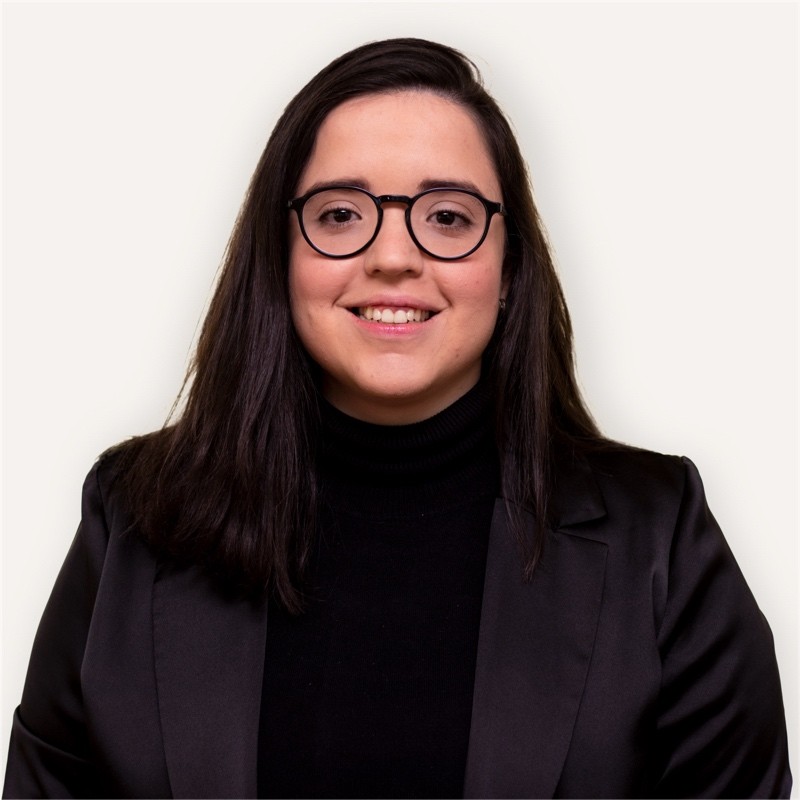
José Manuel García Sabino, 31, was a former councilman from the northeastern city of Anaco and part of the ruling United Socialist Party of Venezuela (PSUV).

Before being jailed, he had denounced corruption inside the Mayor’s Office and the City Council to the disparagement of party officials. 

Local news outlets reported that García Sabino died on May 9 inside a police station. 

Initial reports indicated that he had taken his own life by self strangulation. However, after conducting a forensic examination, authorities determined that the cause of death was mechanical asphyxiation, leading the case to be classified as a homicide.

The Scientific, Penal, and Criminal Investigations Corps (CICPC) arrested 12 officers from the Anaco Municipal Police for their alleged involvement in the case. Following a hearing, six officers were detained.

In addition, they ordered the removal of Pedro Parra, who had served as director of the local police agency since 2022 and is now in custody.

García Sabino, the former councilman, was arrested on February 23 related to an investigation into alleged fraud involving an informal savings scheme known as Susú, used for the purchase of motorcycles.

That same day, his wife, Scarlet Ortiz, was also arrested related to the fraud investigation. Following García Sabino’s death, Ortiz was released from prison, where she had reportedly given birth to the couple’s child while she was being held. 

La esposa del exconcejal José García Sabino, asesinado en el retén de Polianaco, en El Tigre, estado Anzoátegui, fue liberada la noche de este martes. Scarlet Ortiz estaba recluida desde el 23 de febrero y dio a luz mientras era procesada por estafa agravada.

🎤 @susanaquijadac pic.twitter.com/8IBDNyXOV7

— El Noticiero Televen (@El_Noticiero) May 13, 2026

She posted a message on social media thanking God for her freedom and her lawyers for their efforts.

So far this year, the Venezuelan Prison Observatory has reported 16 deaths of detainees in state custody.

These deaths occurred amid deplorable conditions such as medical neglect, overcrowding, violence, institutional opacity, and the absence of basic safeguards for life.

The observatory stated on X that “behind this figure are men who fell ill without medical care, prisoners who died in overcrowded cells and prisons, families forced to pay for medicine, food, and supplies, and a state that maintains absolute control over these people but does not guarantee their lives.”

They are demanding that authorities conduct thorough and impartial investigations into the deaths.

Featured image: José Manuel García Sabino

The post Another political prisoner dies in custody in Venezuela  appeared first on Latin America Reports.
  •  

Why is Delcy Rodríguez’s government erasing Nicolás Maduro’s image across Venezuela?

Caracas, Venezuela — Propaganda featuring Nicolás Maduro is disappearing from various public spaces and institutions in Venezuela. According to some analysts, it’s a sign of interim President Delcy Rodríguez’s attempt to distance herself from her predecessor and rebrand her government for political survival.

Five months after the authoritarian president’s capture by U.S. special forces, murals, posters, and other symbols associated with Maduro — including the anti-imperialist cartoon character Súper Bigote — have been gradually removed by the interim administration. 

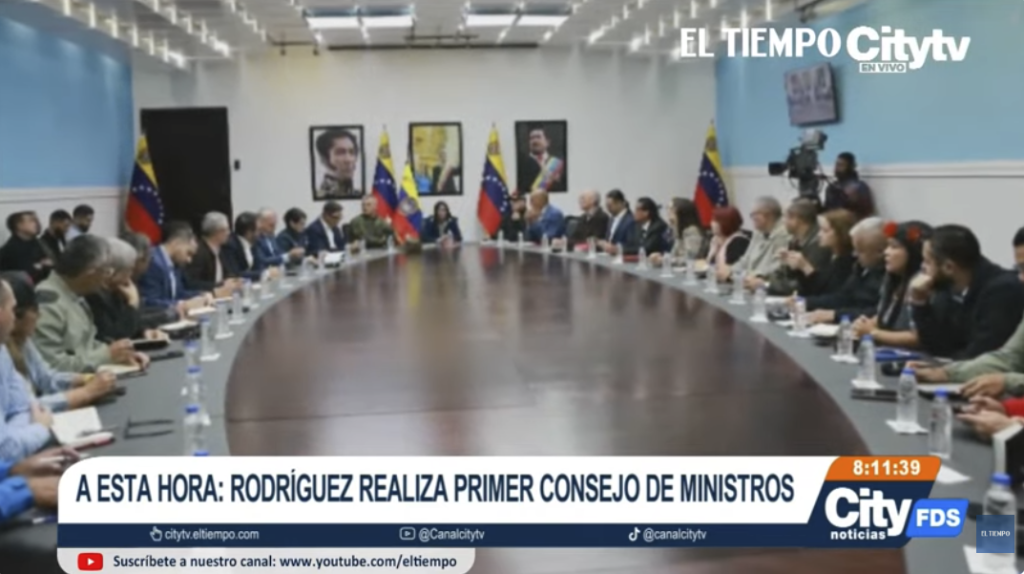
Social media posters have spotted Maduro’s image removed from toll roads, financial institutions including the Banco de Venezuela (BDV), even inside the Cabinet Room at the Miraflores Palace, home of Venezuela’s presidency, where pictures of Maduro and his wife, Cilia Flores, that hung on the wall after his capture, have since been replaced by a palace seal. 

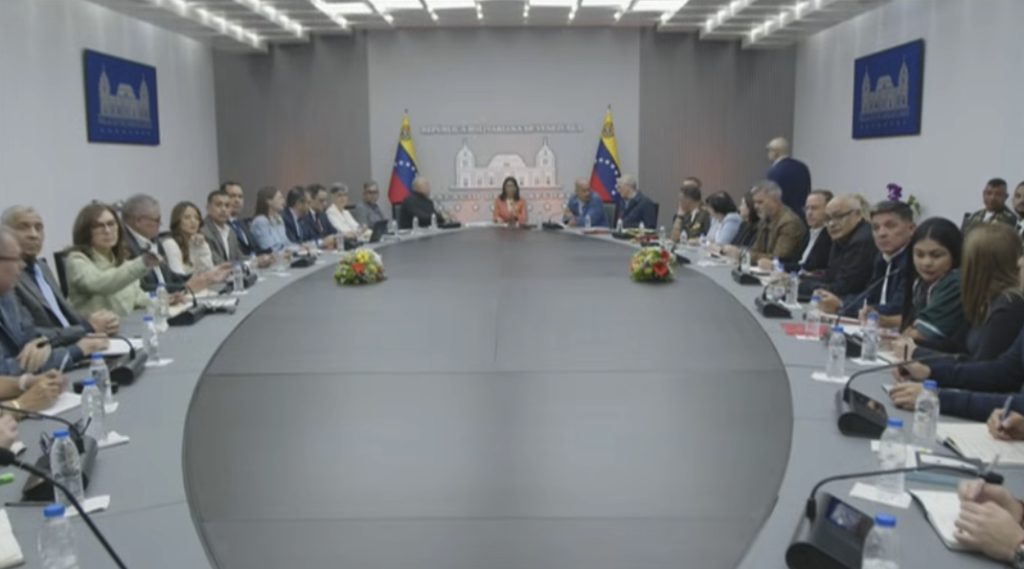
Screenshot of cabinet meeting inside Miraflores Palace on January 4, 2026. Pictures of Nicolás Maduro, his wife Cilia Flores, and Simón Bolivar hang on a wall behind interim President Delcy Rodríguez. Image credit: CityTV & El Tiempo via YouTube.
Screenshot of cabinet meeting in Miraflores Palace on May 26, 2026. Behind interim President Delcy Rodríguez is a seal of the presidential palace. Image credit: Venezolana de Televisión via YouTube.

“Maduro is a figure with a very poor image. The revolution turned out to be one of the worst things that has happened to the country, and now they are seeking to disassociate themselves from that image conveyed by people who ultimately caused great harm to the country,” José Vicente Carrasquero, a Venezuelan political consultant and adjunct professor at Miami Dade College, told Latin America Reports

In late May, a Bloomberg and Atlas Intel poll showed 68% of Venezuelans surveyed had a negative perception of Maduro. Other influential members of the regime, such as Minister of Interior, Justice and Peace Diosdado Cabello and National Assembly President Jorge Rodríguez also received 68% disapproval ratings while 59% of Venezuelans perceived Delcy Rodríguez in a negative light. 

Carrasquero suggests that the erasure of Maduro-related propaganda could be an attempt to rebrand the political project known as Chavismo — which gets its named from Maduro’s predecessor and the deceased leader of the Bolivarian Revolution, former President Hugo Chávez. 

“Something that is disappearing — and hopefully will disappear forever from Venezuelan politics — is the cult of personality. The attempt to associate the political project and its progress with individuals,” he explained. “It is a mistake, especially when those individuals are as mediocre as Chávez and Maduro. Clearly, we must return to institutionalized politics, centered on a project, on parties, on things that endure over time and do not vanish.” 

Chavismo’s new look 

Carrasquero argues that Rodríguez’s administration is “very pragmatic” and desperately wants to remain in power because “power is what keeps them from being held accountable” for offenses committed during Maduro’s presidency. 

As part of this pragmatic shift, the government, the professor said, is showing concern for issues it previously would ignore, including corruption and basic services for ordinary Venezuelans.

Rodríguez recently announced that her team is establishing a hotline to report corruption amongst authorities. “I want to put an end to the harassment and extortion,” she said. 

In April, she also announced negotiations with Siemens and General Electric to resolve the electricity crisis in the Zulia state.

“They’re trying to stabilize the situation to see if they can stay in power as long as possible,” Carrasquero said.

Despite the fresh paint job, Carrasquero believes Chavismo will have a tough time winning any future elections, should they occur.

Rodriguez remains interim president despite her 90-day emergency mandate expiring in April. The country’s opposition has called for elections but government officials have pushed back, saying that they need to stabilize the economy before any political transition takes place. 

Congressman Nicolás Maduro Guerra, Maduro’s son, told the Spanish newspaper ABC, “When I walk down the street, I don’t get the feeling that Venezuelans want to vote yet this year. People need to breathe, they need a plan that leads to economic growth.” 

Read more: Delcy Rodríguez’s term as acting president has expired. Why haven’t new elections been called in Venezuela?

The same Bloomberg/Atlas Intel poll showed opposition leader Maria Corina Machado with a 55% approval rating and her political stand-in, Edumundo Gonzalez Urrieta, with 47% approval. U.S. President Donald Trump and Secretary of State Marco Rubio also saw mostly positive perceptions amongst Venezuelans, with 45% and 49% approval ratings respectively. 

“In my view, it is almost impossible for [Chavismo] to win an election again in the near future, basically because they are responsible for what Venezuela is going through,” he stated.

Featured image credit: SuperBigoteOficial via YouTube

The post Why is Delcy Rodríguez’s government erasing Nicolás Maduro’s image across Venezuela? appeared first on Latin America Reports.
  •  

U.S. reopens embassy in Venezuela, career diplomat Laura Dogu to head mission

Caracas, Venezuela — The United States resumed operations at its embassy in Venezuela on Monday after it had been shuttered for seven years. 

The announcement follows weeks of rapid rapprochement between the administration of President Donald Trump and the interim government of Delcy Rodríguez, who took power following the U.S. military capture of Nicolás Maduro and his wife, Cilia Flores, on January 3.

The U.S. State Department confirmed the move in a statement noting that the resumption of activities marks “a new chapter” in the U.S. diplomatic presence in the country.

“The resumption of operations at U.S. Embassy Caracas is a key milestone in implementing the President’s three‑phase plan for Venezuela and will strengthen our ability to engage directly with Venezuela’s interim government, civil society, and the private sector,” a statement read. 

Relations between Washington and Caracas had been suspended since January 2019, when Maduro accused the U.S. government (during Trump’s first presidential term) of “interventionism” for recognizing congressman Juan Guaidó as Venezuela’s interim president.

In early March, both administrations formalized the restoration of diplomatic ties.

The diplomatic mission is led by Chargé d’Affaires Laura Dogu, who arrived in Venezuela in January to lead the process. According to the State Department, her team is currently working on restoring the embassy to allow for the full return of staff “as soon as possible” and the resumption of consular services.

In a video message shared on social media, Dogu, said in Spanish, “we’re starting a new chapter in our bilateral relations.” 

Desde 2019, el compromiso diplomático de los Estados Unidos con Venezuela se ha llevado a cabo a través de la Oficina Externa de los EE.UU. para Venezuela (VAU) en Bogotá, Colombia. Hoy, estamos reanudando formalmente las operaciones en la Embajada de los Estados Unidos en… pic.twitter.com/apXyeucQ6u

— Embajada de los EE.UU. en Caracas (@usembassyve) March 30, 2026

According to the embassy, the team in Caracas will restore basic diplomatic functions, such as engaging with political actors, civil society, and the private sector, as well as fostering ties between business leaders from both countries.

“We’re just getting started, and there is a lot to do while continuing to execute the three-step plan by the Trump administration,” Dogu said, referring to a plan outlined by the administration in January including “stabilization,” “recovery” and “transition.”

Secretary of State Marco Rubio recently stated that the country has already entered the second phase.

For their part, embassy officials emphasized that the return to Caracas will allow for expanded engagement with various sectors of the country, as well as the creation of employment opportunities within the diplomatic mission.

The reopening comes just days after a delegation, led by Félix Plasencia, Venezuela’s chargé d’affaires, traveled to Washington to meet with U.S. officials and take control of the Venezuelan diplomatic mission in that country, which had remained under the custody of the State Department since 2023.

During the years of diplomatic rupture, U.S. diplomatic activity regarding Venezuela was conducted through an office based at the U.S. Embassy in Bogotá, Colombia.

Featured image: Screenshot of Chargé d’Affaires Laura Dogu announcing the reopening of the U.S. embassy in Caracas on social media.

Image credit: Embajada de los EE.UU. en Caracas via X.

The post U.S. reopens embassy in Venezuela, career diplomat Laura Dogu to head mission appeared first on Latin America Reports.

  •  

New attorney general, ombudsman appointments in Venezuela draw criticism 

Caracas, Venezuela — Acting President Delcy Rodríguez’s government continues to make significant shake-ups within Venezuela’s institutions. Late last week, her administration announced the appointment of Larry Devoe as attorney general and Eglée González Lobato as the new ombudsman.

Various NGOs have questioned the appointments on whether or not they show a willingness towards true political transition in the country following the United States’ capture of Nicolás Maduro on January 3. 

The organization Transparencia Venezuela (Transparency Venezuela), dedicated to promoting transparency within public administration and exposing cases of corruption, noted on X that Devoe does not meet the necessary requirements for this position. 

“His professional background does not include experience as a judge nor prosecutor. His career has unfolded primarily at the Ombudsman’s Office and the National Human Rights Council, in addition to his role as the state’s representative before international bodies,” the NGO wrote.

1/8
Larry Devoe como fiscal general y Eglée González Lobato como defensora del Pueblo, ¿cumplen realmente con los requisitos para el cargo? https://t.co/FmHwdvhaIS pic.twitter.com/vwODVjrs1F

— Transparencia Vzla (@NoMasGuiso) April 10, 2026

Devoe has held various positions within the Chavista government. One of the most significant was as head of Venezuela’s National Human Rights Council, which supports “compliance with the instructions of the President of the Republic regarding national public policies on human rights.”

He also served as the State’s representative to the Inter-American Human Rights System, representing the government before the Inter-American Commission on Human Rights (IACHR), and defending Venezuela against its many human rights abuse allegations.

Devoe replaced outgoing Attorney General Tarek William Saab, who had served in that role for around eight years.

The organization also pointed out what they say is another key problem: “He does not hold a doctoral degree in criminal law, but rather a Master’s degree in Constitutional Law from the University of Valencia, Spain.”

In the case of González Lobato, the NGO argues she also does not meet the requirements of Article 280 of the Constitution for the position of Ombudsman: an official who “demonstrates proven competence in human rights matters.” 

Before entering politics, González Lobato served as legal counsel for the National Electoral Council (CNE). She is a sought-after voice for her expertise on electoral matters and has delivered critical statements against the opposition, which she has labeled “traitors.”

Ahead of disputed elections in 2024, she often went on television to argue that Maduro could win elections in the country without electoral fraud. The CNE would later certify elections in favor of Maduro, despite Venezuela’s opposition and international observers presenting evidence to the contrary. 

González Lobato replaces Alfredo Ruiz, who had held the position since 2017.

Transparencia Venezuela believes that neither of these appointments represents a change for these institutions, which are central to how the country functions.

“Without guarantees or fundamental reforms, reinstitutionalization is not possible,” they explained.

In a document signed by 60 NGOs, they denounced the selection process for lacking transparency, citizen participation, and independence, violating constitutional principles.

🇻🇪 Más de 60 organizaciones cuestionamos la legitimidad de la designación del Fiscal General y la Defensora del Pueblo en #Venezuela. Advertimos que las deficiencias del proceso no deben normalizarse, y exigimos una actuación independiente y respeto a los derechos humanos. pic.twitter.com/h6z3saqV8V
— Due Process of Law Foundation (@DPLF_info) April 10, 2026

Furthermore, they criticize Devoe’s track record due to his prior ties to bodies involved in political persecution, and point out González Lobato’s lack of experience in human rights.

Despite the objections, the NGOs urged new officials of their ethical and legal obligation to act independently of political power and to guarantee human rights without discrimination.

Specific demands also include the immediate cessation of political persecution, the release of arbitrarily detained prisoners, and the effective investigation of crimes against humanity identified by international organizations. 

Likewise, the NGOs urged both government institutions to cooperate fully with the International Criminal Court (ICC) and the United Nations (UN), conduct transparent visits to detention centers, and promote Venezuela’s re-entry into the Inter-American Human Rights System, in order to reverse the pattern of criminalizing dissent and restore public trust.

The political appointments come at a time when the government is seeking to project an image of “reinstitutionalization” and modernization to the international community. 

However, critics believe that they do not truly represent a sign of change in Venezuela, given that those appointed are still very much linked to the government of Delcy Rodríguez.

Featured image: Larry Devoe and Eglée González Lobato.

Image credit: Transparencia Venezuela via X.

The post New attorney general, ombudsman appointments in Venezuela draw criticism  appeared first on Latin America Reports.

  •  

Venezuela, United States resume commercial flights after 7 years

Caracas, Venezuela — Relations between Venezuela and the United States have taken a dramatic turn following the capture of Nicolás Maduro on January 3. As of last Thursday, those changes include the resumption of flights between Miami and Caracas, putting an end to a seven-year span without commercial flights between the two countries. 

An American Airlines jet departed from Miami’s international airport at 10:16 a.m. ET and landed near Caracas at Simón Bolívar International Airport at 1:36 p.m. local time. 

1:15 aterrizó el avión de American Airlines en el Aeropuerto Internacional Simón Bolívar de Maiquetía pic.twitter.com/Jeb0HUvTqU

— Ana Rodríguez Brazón (@anarodriguez_b) April 30, 2026

Several officials from Delcy Rodríguez’s government attended the inaugural ceremony, including Transportation Minister Jacqueline Faría and Oliver Blanco, Venezuela’s Vice Minister for Europe and North America. 

Representing the U.S. administration were John Barrett, U.S. Chargé d’Affaires, and Jarrod Agen, Director of the U.S. National Energy Council.

In the U.S., there was also great fanfare for the resumption of flights. The White House shared on its Instagram account an image created with artificial intelligence showing an airplane against a backdrop of several iconic Venezuelan landmarks, such as Angel Falls, Los Roques, and Mount Ávila, among others.

Accompanying the post, they wrote: “American Airlines is resuming direct flights from the U.S. to Venezuela for the first time in seven years. This would not be possible without President Trump’s courageous leadership in Operation Absolute Resolution.”

The U.S. Department of State commented that this change was made possible by the military intervention Trump ordered in Caracas to capture Maduro, who faces trial in New York for crimes linked to alleged drug trafficking.

‘They’re here to stay’

Jacqueline Faría, Minister of Transportation in Delcy Rodríguez’s government, commented that American Airlines’ return to the country is intended to expand and that they are pleased to welcome this major airline.

“They haven’t visited the country in over seven years, and they’re here to stay with two daily flights,” she stated at a press conference at Simón Bolívar International Airport.

She said they hope other airlines will join the Venezuelan airspace to strengthen the country’s connectivity. She also noted that they expect 1,000 passengers on the route this year.

On May 15, 2019, the U.S. Department of Transportation issued an order suspending all commercial passenger and cargo flights between the two countries. This decision was based on a report from the Department of Homeland Security (DHS) that determined conditions in Venezuela threatened the safety of passengers, aircraft, and crews.

Shortly after the Federal Aviation Administration (FAA) announcement in 2019, Venezuela’s National Institute of Civil Aeronautics (INAC) also officially banned U.S. aircraft operations in its airspace “for safety reasons,” although in practice this was merely a formalization of the severance that Washington had already implemented.

Featured image: Screenshot of video shared by the U.S. State Department of the first commercial flight leaving Miami in seven years on April 30.

Image credit: U.S. State Department via X.

The post Venezuela, United States resume commercial flights after 7 years appeared first on Latin America Reports.

  •  

What María Corina Machado’s possible return to Venezuela means for the country

Caracas, Venezuela — María Corina Machado, Venezuela’s opposition leader, says she will return to the country after leaving last December to attend the 2025 Nobel Peace Prize ceremony in Oslo, Norway. 

Machado, who vocally supported U.S. military attacks on Venezuela ahead of the January 3 operation that captured President Nicolás Maduro, has since been sidelined by the Trump administration who lent its support to Maduro’s Vice President Delcy Rodríguez.

With Machado’s return to Venezuela increasingly more likely, her supporters are anxious as to what role — if any — she’ll play in the political transition of the country. 

Machado was in hiding inside Venezuela for nearly a year before being spirited away on go-fast boats on a December night with the aid of a non-profit staffed by former U.S. military members. 

Analysts who spoke to Latin America Reports said that if she returns and no attempts are made on her life, it could be a clear sign from the Rodríguez government that they are willing to open up political participation in the country. 

Alejandro Armas Díaz, a journalist and political researcher, believes that if Machado’s possible return goes smoothly, it will be a giant step forward for the country. 

“We are talking about the leader of the majority opposition. On the other hand, if she returns but suffers any reprisals, it would be an equally big setback,” he told Latin America Reports

Historian and political analyst Alejandra Martínez Cánchica, director for Latin America at the Freedom and Development Foundation, agrees. She believes that Machado’s return is a litmus test to show whether Venezuela is truly in a process of transition.

She told Latin America Reports that the politician’s safe return would be “the definitive proof that Venezuela is indeed on a path towards a democratic transition.”

Alejandro Armas Díaz via LinkedIn.

U.S. pressure, said Armas, could also force the Venezuelan government to create the right conditions for her return. 

“In Venezuela, we have seen changes that until recently were unthinkable. The source of these changes is pressure from the United States,” Armas said. “Will Washington push for Machado to be able to return without any problems? We don’t know. It may not. It may consider that it is better to leave it for later, when the country is more stable.” 

The U.S. has formulated a three-stage plan for Venezuela, with stabilisation and economic recovery coming before political transition. 

“Given that Machado has suggested that her return is imminent, we will know sooner rather than later whether she [Machado] will actually do so. I find it hard to believe that she will do so without certain guarantees,” Armas added. “If she does not, it could cause some disappointment among her supporters, for announcing something she could not do.”

Martínez sees this as an ideal moment for the opposition leader’s return. 

“Since at least mid or late January of this year, we have been seeing political leaders and activists in Venezuela take to the streets to engage in politics. Many were in hiding, many were imprisoned, and they are now protected under the Amnesty Law,” she said, referring to a law that frees political prisoners, but has also been criticized as exclusionary. 

Read more: Families of military members criticize Venezuela’s new amnesty law as exclusionary  

María Corina Machado’s leadership would be strengthened

Experts agree that one inevitable effect if Machado returned would be an even greater appreciation from her base.

Martínez said that María Corina “still has the majority preference among the population and also continues to have the highest voting intention … So, the fact that she can come to Venezuela to engage in politics on the ground will undoubtedly reconfigure the balance of power and the Venezuelan political map.”

The analyst cited a poll from Gold Glove Consulting, which estimates that the Venezuelan opposition leader has a mathematical advantage of 67% over interim President Rodríguez, should elections be held in the coming months.

Alejandra Martínez Cánchica via LinkedIn

She also said that Machado’s return could help her recapture her political base which helped her win 92% of votes during the 2023 primaries and — after he was sidelined by Maduro — helped propel her candidate, Edmundo González, to win disputed 2024 elections, according to voter tallies published by the opposition. 

“In January-February 2023, the political landscape in Venezuela, at least on the opposition side, was completely deserted. There was great demoralization, people were demobilized. And yet, from the beginning of 2023, María Corina fuelled a movement within Venezuelan society that by July 2024, a year and a half later, was an unstoppable force,” Martínez added. 

Returning from exile too, could help shore up her image among voters, said Armas. 

“Many people are left with the impression that [those in exile] have comfortable lives while the masses in Venezuela continue to suffer. This is not necessarily the case in reality, but that is the impression that, I repeat, remains. So it is in Machado’s best interest to return to the country as soon as possible. Whether she can do so is another matter,” he said.

Featured image: María Corina Machado and former presidential candidate Edmundo González in 2024.

Image credit: Edmundo González Via X.

The post What María Corina Machado’s possible return to Venezuela means for the country appeared first on Latin America Reports.

  •  

Delcy Rodríguez’s term as acting president has expired. Why haven’t new elections been called in Venezuela?

Caracas, Venezuela — Nearly a month has passed since the 90-day limit on Delcy Rodríguez’s term as acting president of Venezuela expired. Now, various opposition groups are calling for presidential elections amid political uncertainty in the country. 

The matter of how elections should proceed — if at all — is complicated by a number of issues including disputed results in Venezuela’s 2024 elections and the United States’ capture and arrest of President Nicolás Maduro on January 3. 

Roberto Abdul, a political activist who helped organize primary elections for Venezuela’s opposition movement in 2023 and was detained by the government that same year, told Latin America Reports that the legitimacy of Maduro’s presidency plays a role in the current debate surrounding Rodríguez, who was Maduro’s vice president at the time of his capture. 

He said that “While the [National Electoral Council] did not present the [voter] tally sheet” to prove Maduro’s victory in elections, the opposition did manage “to present nearly 83% of the tally sheets issued by the machines” showing their candidate, Edmundo González, won the elections. 

Because Venezuelan vice presidents are not elected but rather appointed by the president, as a Maduro appointee, the question around the legitimacy of Rodríguez’s position within the government further muddies the waters. 

“Therein lies the problem from a constitutional standpoint,” he said. 

Further, Article 233 of the country’s Constitution distinguishes between the temporary and permanent absence of a president, while Article 234 outlines the procedure for governing the country in the president’s absence. 

According to Article 234, in the event of a temporary absence, the vice president takes control of the government for a period of 90 days — a period which can be extended by the legislature for another 90 days. 

However, if the president’s temporary absence lasts for more than 90 days, the National Assembly (Venezuela’s legislature) must decide by a majority vote whether the president’s absence should be considered permanent, which would initiate new elections within a 30-day period. 

Abdul explained that the unprecedented circumstances surrounding Maduro’s absence are frustrating the very definition of his absence. 

On January 3, U.S. special forces teams assaulted Venezuela’s capital, Caracas, and captured Maduro and his wife, Cilia Flores, and took them by sea and air to New York to face drug trafficking charges. The legality of the dictator’s rendition has been questioned by international legal experts. 

Maduro’s trial could take months, if not years, far exceeding the time limit for a temporary absence (maximum 180 days) afforded by Venezuela’s Constitution.

Due to this unique circumstance, there is a debate over how to apply Articles 233 and 234 to Maduro’s absence. Furthermore, Abdul points out that, given the lack of separation of powers, the interpretations of the Supreme Court and other bodies tend to be “biased” in favor of the Chavista government, rather than strictly adhering to the spirit of Constitutional law. 

Nicolás Maduro and Delcy Rodríguez at an event in 2023. Image credit Delcy Rodríguez via X.

The National Assembly slow rolling the debate 

The National Assembly, which is controlled by government loyalists, was supposed to begin debates around the expiration of Rodríguez’s first term as acting president between April 6 and 10. The debate has yet to take place, even though her term expired on April 5. 

Jorge Rodríguez, president of the National Assembly and Delcy’s brother, has made comments suggesting that the legislature’s main focus is restarting Venezuela’s economy, and not new elections. 

“The most important thing right now is the economy. It’s essential that the Venezuelan economy grows so dynamically that the population feels this entire process has been worthwhile,” the parliamentary leader told Spanish newspaper El País. “Furthermore, we are engaged in a profound dialogue with all opposition groups that remain within the bounds of the Constitution, including those living abroad. I couldn’t tell you exactly when, or even what the first election will be, because there’s so much to do.”

Other Maduro loyalists are also pushing back on holding elections. Diosdado Cabello, Minister of the Interior and Justice, said last week during an event, “Now they’re [the opposition] calling for elections because President Nicolás Maduro is completely absent. Well, you were telling us that Nicolás Maduro didn’t win [elections in 2024], so how is it that now you’re demanding the complete absence of someone who didn’t win?”

Even if the legislature declares Maduro’s absence permanent, Abdul argues there is much to do to ensure free and fair elections in Venezuela. 

First, he said, the National Electoral Council (CNE) must appoint a new board which is the result of a bipartisan agreement. “We must try to ensure it adheres as closely as possible to the rules to generate the greatest credibility and the highest possible levels of legitimacy,” he stated.

Another important consideration, Abdul argued, is whether to hold only presidential elections, or a wider “mega-election” that would decide National Assembly seats, governorships, and mayoral offices.

Among other challenges facing any impending elections would be facilitating voting for the 4.5 to 5 million eligible Venezuelans living abroad; technical assistance from a foreign body like the United Nations to facilitate observation; and reversing political disqualifications and reinstating political parties that were banned during Maduro’s administration. 

“It is a complex process, but it is achievable; it’s not like you’re sending someone to the moon out of thin air—it’s something we’ve already gone through,” Abdul concluded.

Featured image: Venezuela’s National Assembly votes on a law to streamline administrative procedures in March 2026.

Image credit: The National Assembly of Venezuela via X.

The post Delcy Rodríguez’s term as acting president has expired. Why haven’t new elections been called in Venezuela? appeared first on Latin America Reports.

  •  

What Delcy Rodríguez’s reshuffling of ministers means for Venezuela

Caracas, Venezuela — The cabinet of Venezuela’s interim president, Delcy Rodríguez, has seen some shake ups in recent days, with the appointments of a handful of new ministers in an apparent attempt to consolidate power just months after her predecessor, Nicolás Maduro, was captured by the United States. 

The reshuffling of officials in the ministries of Defense, Transportation, Housing, Culture, Electric Power, and Higher Education is a move by Rodríguez to buy time and remain in power longer, according to Benigno Alarcón, founder of the Center for Political and Government Studies at Andrés Bello Catholic University in Caracas. 

“I believe that what Delcy Rodríguez is trying to do is a political reshuffle within the government, aiming to stay in power as long as possible so that when an election is held, it will be one that she can control to some extent,” he told Latin America Reports

Alarcón believes that the roadmap proposed by the Trump administration after its January 3 attacks has not yet entered its most critical phase — a political transition — precisely because of resistance from diehards in the Chavismo movement. 

“We are seeing that the political deadlock continues, so we cannot say we are facing a transition at this moment. It is important to remember that [U.S. Secretary of State] Marco Rubio’s plan outlined a three-phase strategy, with the third phase being the transition. Well, clearly we haven’t entered that phase yet, and clearly Delcy Rodríguez is trying to prevent us from entering it,” he commented.

Ministerial changes lacking in scope

The recent appointments do not send a clear signal that a democratic reinstitutionalization is actually taking place in the country, according to the professor, since those who have been named ministers so far are part of the Chavista inner circle.

“What they’re basically doing is placing people whose merits, let’s say, are essentially their closeness to and the trust of those in power, right? In other words, in that sense, nothing has changed; everything remains more or less the same,” he stated.

Alarcón explained that there is a “recycling” of Chavista figures. “Some people from a faction within Chavismo are leaving, and others are coming in — let’s say because in the past they were either marginalized, overlooked, or had their chance and then were left out, and now they’re coming back,” he added.

He juramentado a los integrantes del Alto Mando Militar renovado de nuestra República, quienes asumen con absoluta lealtad y el más alto sentido del deber de defender la soberanía nacional, preservar la paz y resguardar la integridad territorial de Venezuela. pic.twitter.com/mYbEgbWZCj

— Delcy Rodríguez (@delcyrodriguezv) March 20, 2026

Recycling Chavismo 

The new ministers appointed by Rodríguez are: 

  • Gustavo González López as Minister of Defense; 
  • Jorge Márquez Monsalve as Minster of Housing; 
  • The engineer Rolando Alcalá as the Minister Energy and Electricity;
  • Jacqueline Faría as Transport Minister; 
  • Magistrate Carlos Alexis Castillo as the Minister of Social Process of Labor; 
  • Editor Raúl Cazal as Culture Minister;
  • Professor Ana María Sanjuán as Minister of University Education, Science and Technology.

A clear example of Alarcón’s so-called Chavista recycling is Gustavo González López, who now heads the Ministry of Defense, replacing Vladimir Padrino López — a key figure in Maduro’s government who held that position for over 10 years, making him the longest-serving minister in in that ministry’s history. 

Before joining the Ministry of Defense, González López was appointed in January 2026 by Rodríguez to lead the direct security of the presidency and military counterintelligence.

Additionally, in late 2024, he played a key role in the oil industry as Director of Strategic Affairs and Production Control.

The military officer is also known for having led the Bolivarian National Intelligence Service (SEBIN) for two terms (2014–2018 and 2019–2024). Under his command, the agency centralized much of the internal political control.

“I believe that what Maduro did at the time was to place, so to speak, the military component in the hands of a general he trusted, Vladimir Padrino López, and leave the military to him, making him a bridge between the civilian political sector and the military sector. Well, at this point, the bridge was changed, so to speak. So now you have González López as Delcy’s right-hand man, because he worked with her in the past, first as director of SEBIN,” Alarcón said. 

The reconfiguration of Rodríguez’s cabinet seems to respond more, according to Alarcón, to a strategy of internal protection than to a democratic opening. 

While the names in the portfolios are being recycled and the bridges with the military sector are being reinforced with figures of extreme trust, the true transition proposed by the international community remains in limbo.

Featured image: Delcy Rodríguez at a recent naval ceremony.

Image credit: Vice Presidency of Venezuela

The post What Delcy Rodríguez’s reshuffling of ministers means for Venezuela appeared first on Latin America Reports.

  •  

Carmen Navas, the Venezuelan mother who died 9 days after finding out her son died in state custody

Caracas, Venezuela — Venezuelans have been closely following the case of Carmen Navas, an 82-year-old woman who spent a year and a half searching for her son, Víctor Hugo Quero Navas, who was imprisoned by security forces in January 2025.

Initially unable to locate her son, the octogenarian searched for him in various detention centers, morgues, and hospitals—a struggle that moved many because of her persistence and strength, despite the pain she endured.

After so much pressure and the case going viral on social media, the government, led by Delcy Rodríguez, confirmed in a statement that Víctor Quero Navas, who had been accused of alleged terrorism, had died in state custody and therefore ordered an investigation to determine what happened.

Read more: Another political prisoner dies in custody in Venezuela

In the statement, they noted that the detainee “did not provide personal identification details, and no family member came forward to request a formal visit.” 

They explained that following his death, his “formal burial took place on July 30, 2025,” due to the alleged “absence of his family members.”

The news rocked Venezuelans and opposition members who have been protesting the government to release some 429 political prisoners that remain behind bars in the country. 

In a heartbreaking turn of events, just nine days after receiving the news of her son’s fate, Carmen Navas died on May 17 following her harrowing search. 

There is widespread outrage in the country over this case, as the state is being held responsible for Quero Navas’s death and for the suffering inflicted on a Venezuelan mother.

Opposition political leaders such as María Corina Machado have demanded justice. On her X account, the national coordinator of Vente Venezuela wrote: “It was not just a mother who died; a woman who turned pain into courage and despair into a cry for justice has passed away.”

She added, “Her voice became the voice of thousands of Venezuelan mothers who today are searching for their children who have disappeared, been imprisoned, persecuted, or murdered by the criminal regime.”

The Committee for the Freedom of Political Prisoners (CLIPPVE) also posted a message on X in which they highlighted that Carmen Navas’s struggle will be remembered for the determination she showed in seeking news of her son.

“Her story was marked by the unwavering love of a mother who never stopped seeking truth and justice for her son, Víctor Hugo Quero Navas, who died while in state custody,” they wrote.

ENTIERRO | Entre lágrimas, flores y abrazos, familiares y allegados dieron el último adiós a la Sra. Carmen Teresa Navas.

Su historia quedó marcada por el amor inquebrantable de una madre que nunca dejó de buscar verdad y justicia para su hijo, Víctor Hugo Quero Navas, muerto… pic.twitter.com/wg7JebGhkD

— Comité por la Libertad de los Presos Políticos (@clippve) May 19, 2026

U.S. politicians have also weighed in on the matter. Florida Senator Rick Scott said, “Carmen is the face of the brutality of the Venezuelan dictatorship. They kidnapped her son, hid his death for months and forced a mother to search prison after prison while they already knew he was dead.”

He added: “We won’t rest until they face the justice they deserve and ALL POLITICAL PRISONERS ARE RELEASED.”

What has Venezuela’s government said?

Amid the pressure generated by this incident, Rodríguez’s government issued a statement following Carmen Navas’s death. 

In the document, they stated: “From the moment the complaint regarding the case of her son Víctor Hugo Quero was received, the presidency ordered a thorough investigation to clarify what happened and requested the cooperation of the Ombudsman’s Office and the Public Prosecutor’s Office.”

They assured that once the investigation is concluded, they will inform the country of what happened regarding the death of this political prisoner.

The statement was questioned by journalist Maryorin Méndez, who accompanied Carmen Navas for months in her search. “Fact: from the moment she (Carmen) found out, she ordered an investigation,” Méndez wrote on social media. 

In Venezuela, according to figures from the Venezuelan Prison Observatory, five mothers died before seeing their loved ones released or within days after their release.

“Freedom that comes after the death of a loved one is not justice. The Venezuelan Prison Observatory demands that the Venezuelan regime provide full health guarantees and support for those who are now facing this grief in freedom,” they stated on X.

For this reason, they demand an end to the psychological torture that, they allege, is inflicted on political prisoners and their families, and that full freedom be granted to all.

Featured image: Carmen Navas being consoled at a mass in honor of her dead son just two days before she died on May 17.

Image credit: Julio Blanca for Latin America Reports

The post Carmen Navas, the Venezuelan mother who died 9 days after finding out her son died in state custody appeared first on Latin America Reports.

  •  

What can Venezuelans expect from Delcy Rodríguez’s proposed minimum wage hike? 

Caracas, Venezuela — The minimum wage in Venezuela, which stands at 130 Bolívares (VES) or about $0.28 USD, is one of the population’s main pain points, as people have seen their incomes—and consequently their quality of life—plummet.

Acting President Delcy Rodríguez last week promised a “responsible” increase to the minimum wage by May 1 (Venezuela’s Labor Day), but didn’t elaborate on specifics. 

Latin America Reports spoke with economist Aarón Olmos from the Instituto de Estudios Superiores de Administración in Caracas who outlined some of the effects a wage increase could have in the country amid continued political uncertainty following the January 3 capture of Nicolás Maduro by U.S. forces. 

“Whatever the amount, it will be welcomed by households in Venezuela because income levels have indeed fallen sharply; they are meager, they are poor. The Bolívar’s purchasing power has been lost. A foreign currency is used as the basis for calculating prices, and that erodes purchasing power,” Olmos said. 

The professor noted that it remains unclear whether this will be a direct increase in wages or in the bonuses the government allocates to certain public employees.

Based on data released by the Central Bank of Venezuela, which indicates the country earned $18.2 billion in oil revenues, Olmos believes there is a significant foundation for funding a substantial public payroll. 

“We’re talking about nearly nine million people—roughly seven million public sector workers and two million retirees,” he said. 

Aarón Olmos. Image credit: LinkedIn

But he cautions that the economic conditions should not be dependent solely on oil sales. “It is essential to recognize that Venezuela would have to diversify, that is, to generate revenue through different channels, not just oil. It has to be oil, mining, raw materials, semi-finished products, and finished goods; in other words, Venezuela would have to activate its entire productive apparatus so as not to depend solely on crude oil sales. The idea is not to depend on the volatility of the energy market but to revive the economy,” he said.

The economist noted that at the production level, some changes would also be necessary, such as revising Venezuela’s Labor Law to ensure that the wage increase works more effectively.

In the case of private companies, Olmos believes there will be adjustments to pay scales, even though this sector has always paid more than the minimum wage. 

“If you raise wages, well, you’ll see a price effect where the price-setter wants to appropriate this person’s surplus—this new income. And well, that appropriation of the surplus will affect both those who earn more and those who earn less,” he said. 

Companies will be on “high alert” he noted, acknowledging that they will have to adjust their pay scales in response to government sector wage increases. “Perhaps not in the same proportions, but clearly some tax adjustment should follow,” he added. 

Wage increases in recent years

The last minimum wage increase in Venezuela was decreed in March 2022, setting it at 130 Bolívars per month. Since then, this nominal amount has remained frozen, although the executive branch has applied adjustments to the “comprehensive minimum income” through non-wage bonuses.

For example, in May 2023, the food voucher (Cestaticket) was increased to the equivalent of $40 USD and the Economic War Bonus to $30 USD (for active workers), resulting in a minimum income of $70 USD per month indexed to the official exchange rate.

Subsequently, in January 2024, a new adjustment to these bonuses was announced to raise the comprehensive income to $100 USD, while still keeping the base salary at the same 130 Bolívars.

A year later, an increase in the total minimum income indexed to $160 USD per month was ordered for active public sector workers. 

This amount was achieved by adjusting the two non-wage benefits: the Cestaticket, which remained at the equivalent of $40 USD, and the Economic War Bonus, which was raised to $120 USD.

Featured image: Delcy Rodriguez.

Image credit: Government of Russia via Wikimedia Commons

The post What can Venezuelans expect from Delcy Rodríguez’s proposed minimum wage hike?  appeared first on Latin America Reports.

  •  

Venezuelans get “moment of escape” with World Baseball Classic win

Caracas, Venezuela — Venezuela’s 3-2 victory over the United States in Tuesday’s World Baseball Classic final has provided a welcome respite for Venezuelans, who have been mired in a severe political, social, and economic crisis for years and have found a moment of joy and pride in winning the world title. 

Having not collectively experienced a festive atmosphere for a long time, citizens took to the streets on the night of March 17 to celebrate this major achievement in their sporting history.

According to experts consulted by Latin American Reports, Venezuela’s victory in one of the world’s most important baseball events represents the most significant milestone in the country’s sporting history, without downplaying all the feats achieved in the past.

Venezuela es el mejor país del MUNDO, por lo tanto tenemos la celebración más épicas y random en este hilo. Comenzamos con ¡Quejesto vale! 🤣😂🤣 se montaron solos. pic.twitter.com/yJqpcafdqB

— Franjolys Borges (@FranjolysBorges) March 18, 2026

Sports journalist Julio Sorondo believes it is an unparalleled achievement with significant implications. “It’s a title that eluded us for a very long time, and winning it gives the sense that we’ve reached the pinnacle of Venezuelan sports,” he told Latin America Reports

For his part, his colleague Alfredo Di Cesare believes this achievement marks a turning point in sports, as it secured unqualified glory and confirmed that Venezuela is a baseball powerhouse, joining the tournament’s roster of champions: Japan, with three titles; the Dominican Republic and the United States, with one each.

Experts feel that this title will bring great benefits to the sports sector, especially in terms of mindset. “Sports in Venezuela are facing many problems due to a lack of investment, corruption, and the socioeconomic crisis that is hitting families and spilling over into sports. However, the greatest gift from the feat achieved at LoanDepot Park is the mindset,” said Di Cesare, referring to the ballpark in Miami where the championship game was held. 

In this regard, he added, “Every young person who plays a sport saw yesterday that the favorite doesn’t always win. That stars are men who make mistakes, fail, and can strike out three times, just like New York Yankees star Aaron Judge.

“So the greatest legacy this victory will leave for posterity is that the ‘Cinderella’ label should never weigh them down again.”

Sorondo said he feels that baseball, one of the great passions of Venezuelans, will receive a significant boost following the win. “Venezuela not only won the World Baseball Classic yesterday, but also qualified for the next Olympic Games, which will be held in 2028. So, well, over the next five years or the next decade, there’s going to be a lot of talk about baseball. This means that, well, brands will surely also use this sport to target that audience, to promote their products,” he said. 

These contributions could also lead to Major League Baseball games or World Baseball Classic matches in Venezuelan stadiums and, above all, cement the passion for this sport in the DNA of the population.

In their analysis of the significance of this achievement, journalists agreed that it serves as a great escape for those who want to step away for a moment from the political and social turmoil the nation is facing.

“When we apply this to the World Baseball Classic, we feel represented by a victorious Venezuela; it’s quite positive, even on a psychological level, to be able to celebrate victories after having gone through such tense times. What we experienced yesterday in the streets of Venezuela was a collective release filled with positivity and joy—something we hadn’t felt in a long time,” said Sorondo, highlighting the irony that the tournament final was against the United States, the country responsible for ousting Nicolás Maduro on January 3.

Di Cesare believes this achievement represents the country’s unity, but also a sense of liberation. 

“Venezuela’s first title in the World Baseball Classic is a vindication of destiny; a pat on the back for a people who have spent decades loving, suffering, and waiting for something good. 2026 is turning out to be a year with more good news than bad for Venezuela,” he commented.

Featured image credit: @AlbertCardozoAG via X.

The post Venezuelans get “moment of escape” with World Baseball Classic win appeared first on Latin America Reports.

  •  

Venezuela’s amnesty law comes to an end, alarming families of political prisoners

Caracas, Venezuela — Venezuela’s interim President Delcy Rodríguez announced that the country’s so-called amnesty law, which aims to free political prisoners detained during the regime of Nicolás Maduro, will come to an end just two months after its approval in February.

During an April 24 event at Miraflores Palace, the presidential headquarters, the president said, “This amnesty law is coming to an end. For those cases that were not covered, or rather, were expressly excluded, there are other avenues through which they can be addressed.”

She also noted, “In the Democratic Coexistence and Peace Program—from which some members have moved to the Executive Branch—there is a forum for addressing cases related to justice. The same applies to the Commission for Criminal Justice Reform.”

At the meeting, Rodríguez said that some 8,616 people had been freed under the amnesty law, the BBC reported.  

According to Foro Penal, an NGO that monitors political detentions in the country, 473 political prisoners remain in jail. (Other NGOs have counted as many as 670 political prisoners still in custody). Many of their family members are worried about their fates as the sun goes down on the amnesty law. 

Other NGOs, such as the Venezuelan Program for Education and Action on Human Rights (Provea), have been more forceful, rejecting Rodríguez’s statements and characterizing the move as a major setback for the country.

“This constitutes an arbitrary and unconstitutional measure that does not contribute to the process of coexistence and peace that has been announced,” the organization wrote.

It added that, despite its limitations, “the Amnesty Law is a first step toward dismantling the repressive framework that has stifled the rights of the Venezuelan people in recent years.”

The organization argues that an instrument such as amnesty for political prisoners must be part of any process of reinstitutionalization in the country. 

“It should be a first step in that direction, but it is not a prerequisite for the full release of all those deprived of their liberty for political reasons,” Provea noted.

Featured image: Families of political prisoners protest in Caracas in February 2026.

Image credit: Julio Blanca for Latin America Reports

The post Venezuela’s amnesty law comes to an end, alarming families of political prisoners appeared first on Latin America Reports.

  •  
❌