
Reading view

Trump hypocritically accuses others of forced labour to justify tariffs. Sadly, the accusation is not false.


Children shovelling dirt in Sierra Leone.

The Trump administration is hypocritical when it accuses Canada and many other countries of failing to do enough to end forced and child labour around the world.

Such abuse is not a trivial matter. 

Canadians should remember the 2013 collapse of the Rana Plaza building in Bangladesh, home to five large garment factories, which supplied cheap goods to companies in the West.

Over 1,100 people died and more than 2,500 were injured in that event. Many of them were garment workers, and some produced clothing for Canadian companies, including Loblaw subsidiary Joe Fresh.

That was an abusive situation which rose to the level of an international scandal. 

But daily, beyond the headlines, many thousands of involuntary workers produce all or parts of goods we consume, in miserable and sometimes dangerous conditions.

The use of prisoners, political and otherwise, in international supply chains is routine in parts of the world (including the U.S.). 

This writer has observed children painstakingly making carpets by hand in Egypt and India. That sort of labour is, at least, relatively safe, something we could not say about all child or forced labour.

In its most recent reporting, UNICEF relates that there are over 138 million child labourers in the world. 

In one country alone, the West African nation of Sierra Leone, UNICEF reports “almost 1 in 5 children are engaged in child labour.” 

“Child labour compromises children’s education, limiting future opportunities and perpetuating an inter-generational cycle of deprivation.”

And so, the U.S. administration is not off-base in drawing the world’s attention to the scandal of forced and child labour.

However, the Trump government’s real motive is not to achieve justice; it is to find a legal way for the U.S. executive branch to bypass Congress and impose tariffs on goods from many countries, including Canada. 

The U.S. constitution clearly assigns the power to levy tariffs to the legislative branch, to Congress, not to the President.

An earlier effort denied by courts

Early in his current term Trump tried to use the 1974 U.S. International Economic Emergency Act (IEEA) as a fig leaf for his unconstitutional tariffs. 

That was a big stretch, in part because the IEEA never even mentions the word tariff. When Congress passed that IEEA it did not foresee tariffs as one of the arrows in the president’s quiver in the event of an economic emergency. 

Lower courts ruled the U.S President’s invocation of the IEEA to be entirely unfounded.

The U.S. Supreme Court, which is normally highly deferential to Trump, upheld those rulings, rendering Trump’s tariffs based on the IEEA null and void.

And so, Donald Trump and his advisors have come up with another loophole to enable them to impose tariffs without Congressional agreement: the forced labour issue.

It is hard to believe the current U.S. President cares a whit about forced labour. 

In fact, Trump’s administration has trashed the entire U.S. foreign policy and foreign aid establishment, which, in theory, could have had the expertise to monitor and document the prevalence of what is, in essence, modern-day slavery.

Shortly after assuming office, Trump cut 69 U.S. programs that deal with child labour. 

Last year, in 2025, the U.S.-based Economic Policy Institute reported on the current U.S. Labour Department’s cuts to programs that fight international human trafficking and promote labour rights.

Those cuts, says the Institute, “undermine the U.S.‘s ability to monitor foreign governments’ compliance with U.S. trade agreements, and ensure that U.S. workers will compete on an uneven international playing field, fueling a race to the bottom in the global economy.”

On June 2 of this year, in announcing the new U.S. tariffs based on forced labour in supply chains, Trump’s trade representative Jamieson Greer used almost the exact same words as did the Economic Policy Institute a year earlier.

But Greer wasn’t issuing a mea culpa for his own country. He was accusing other countries of tolerating labour abuses, as an excuse for imposing illegal tariffs on them:

“The failure of our most important trading partners to address the importation of goods made with forced labor is unacceptable. This creates a dynamic where American workers are forced to compete globally on an unlevel playing field”

Evidently a sense of irony is a quality in short supply in the current U.S. administration.

The U.S. judicial system will no doubt have its chance to rule on this ploy. 

In all likelihood, the courts will find it to be as disingenuous as Trump’s earlier effort to invoke the IEEA as justification for tariffs. 

But even if the motives for Greer’s accusation are monumentally dishonest, sadly they ring true when it comes to many countries, including Canada.

A weak law and vague reporting system

The federal New Democrats foreign affairs critic Heather McPherson has pointed out that “Canada has lagged on measures to make sure there is not forced or child labour in supply chains for decades, while other governments have acted.” 

And the Edmonton MP has added: “Past Liberal governments repeatedly promised mandatory supply chain due diligence legislation and never delivered on it.”

Canada does have the Fighting Against Forced Labour and Child Labour in Supply Chains Act, which Parliament passed in 2023.

But advocates and experts all say the legislation is ineffective.

The 2023 law includes a reporting requirement. Corporations have to report annually on their due diligence concerning forced and child labour in their supply chains – chains which sometimes stretch around the world.

Anyone can look up the reports. There are over 12,000 of them for 2025, from corporations and from other organizations. They are all available online .

If you do look, you will find numerous reports from giant Canadian and foreign companies, such as Bombardier, Loblaw, Carhatt, Levi Strauss, Walmart, Winners, and Lacoste.

Plus, there are thousands of reports from government departments and agencies, and many small and medium sized operations, such as the Pincher Creek Cooperative Association. 

Sadly, all of that verbiage amounts to rather little. 

One characteristic of almost all 12,000 plus reports is a high level of generality. 

The more than 12,000 reports almost all make a rhetorical commitment to the principles of various conventions banning modern-day slavery.

And almost all state, in a high-level fashion, the companies’ or organizations’ commitments – via training, information sharing, audits and monitoring – to faithfully uphold those principles.

But virtually none of the reports include very much in the way of facts and figures. Many do not even list all the countries that are part of their supply chains. 

To cite just one example, the multinational fashion corporation Lacoste tells us it produces and sells over 50 million items a year. Those items include clothing, footwear and accessories, and account for sales of 2.8 billion euros, or about 4.5 billion Canadian dollars.

Lacoste says it employs more than 8,500 people in 98 (!) countries. But its report does not specify whether those are directly employed or through suppliers. Nor does it name the countries. 

The report says Lacoste has a supply chain of more than 1,200 factories worldwide. Those factories specialize in everything from raw material processing to final production of garments. 

And there you have it. 

Those few numbers are pretty much the only tangible facts and figures in the Lacoste report. The rest of it consists of bland and platitudinous statements about audits, compliance, assessing, and monitoring, with nary a tangible detail. 

We have to take it all on faith. 

The only specific references in the Lacoste report to anything resembling a problem or pattern of abuse concern the production of cotton and what the report vaguely calls an “alert” concerning suppliers in Vietnam.

Lacoste says it resolved the cotton issue by limiting its suppliers to six countries, among them the U.S., Greece and Spain.

As for the Vietnam situation, Lacoste reports that when it received the (non-specific) complaint it hired the consulting firm Ulula to investigate.

Lacoste’s report does not tell us what Ulula has been investigating or what the investigation has turned up so far. Nor does it list any other action in response to the Vietnam complaint.  

So much for transparency. And Lacoste is typical in this regard. Read as many of the reports as you can and see for yourself. 

Although the 2023 Canadian legislation requires organizations and corporations to make available some sort of annual report on forced and child labour, it does not require much else. 

It is up to companies and organizations to decide what details they will put in their reports, and with how much precision. 

It is in no corporation’s interest to divulge any information that could damage its reputation or have an impact on its bottom line. In this case, the government of Canada is getting what it asks for – which is not much.

There are provisions in the 2023 Canadian law for inspections. And the government can even impose sanctions on companies and organizations that allow child and forced labour in their supply chains.

To date, the government has not provided any information on any inspections its officials might have conducted, and, so far, no sanctions have been imposed on any company or other entity.

The post Trump hypocritically accuses others of forced labour to justify tariffs. Sadly, the accusation is not false. appeared first on rabble.ca.
  •  

Mark Carney favours the wealthy and privileged over working-class Canadians

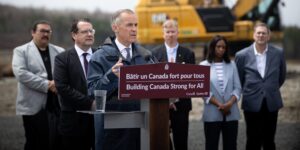
Mark Carney announcing a new graphite mine in Quebec in May of 2026.

Canada’s Prime Minister Mark Carney continues to achieve high scores in public opinion polls. 

Environmentalists believe he has betrayed them. 

Indigenous leaders wonder what happened to the PM who appointed three Indigenous women to his cabinet.

British Columbia premier David Eby openly chides his erstwhile political friend for rewarding Alberta’s separatists and separatist fellow travellers with the promise of a new bitumen pipeline that would slice through B.C. to the Pacific.

Canadians who believe defending our sovereignty must include an adequately-resourced CBC wonder what happened to the Carney government’s oft-delayed plans for the public broadcaster.

The international development community, here and abroad, worry Carney is cutting Canadian support at the worst time possible, just as U.S. president Trump has pulled his country out of the foreign aid business entirely.

Canadians concerned with poverty, inequality, and social services, including child care and health, are dismayed to see the Carney government freeze in place the not-yet-fully-realized gains of Justin Trudeau’s government. 

Fourteen Liberal MPs have written to Carney to warn him against weakening this country’s hard-earned environmental protections, as the PM pursues Canada becoming an “energy super-power”.

Three former Liberal environment ministers have expressed similar alarms. 

One of them, Catherine McKenna, writes “we now live in a petrostate, where rich oil and gas companies have convinced politicians that fossil fuels are better than renewable.” She characterises that as “bonkers”. 

Some mainstream media folk, notably the Toronto Star’s Althia Raj, are taking Carney to task for environmental policies that are worse than Conservative Stephen Harper’s. 

There is growing disappointment and alarm in the land, from east to west, with Carney’s continued dance to the Right. 

But little of it seems to have any impact on public opinion, not yet in any case.

Pay the rich more; the poor, less

Right now, Carney can do no wrong. 

Even many of those who are critical of him say, given what they call “the alternatives”, they would probably vote for Carney and his Liberals again. 

The majority of Canadians appear to believe everything Carney is doing (or failing to do) is necessary and unavoidable because of the still very real and very frightening threat of Donald Trump’s nakedly aggressive imperialism.

Natural Resources Minister Tim Hodgson has used that argument when justifying an accelerated process for approving mega-projects.

And Health Minister Marjorie Michel invoked it when explaining why the government had lost interest in pursuing pharmacare or any other expansion of universal healthcare. 

Unprecedented threats, the Carney folks say, mean the government must make tough choices.

We cannot afford to favour the environment, Indigenous rights, or the expansion of the social safety net as we thought we could in the Justin Trudeau era.

We have to focus on hard stuff – mines, mills, transport infrastructure.

And to build a more resilient economy we have to not only work with (and, at times, get out of the way of) the private, corporate sector, we have to facilitate it with generous subsidies and tax benefits.

We also must build up our military capacity – and fast.

All of that means sacrifices must be made.

But those sacrifices will not fall evenly on all Canadians. 

In his government’s reaction to the Trump challenge, Carney has yet again proven economist John Kenneth Galbraith had it right when he wrote:

“When we want the rich to work harder, we pay them more. When we want the poor work harder, we pay them less.”

Carney signalled his intentions even before he became Prime Minister. 

During the Liberal Party leadership campaign, he casually pledged to scrap what had been one of the Trudeau Liberals’ signature measures to, ever so slightly, tilt the inequality board from those who have to those who have not.

In the spring of 2024, the Justin Trudeau government had increased what is called the inclusion rate for taxing capital gains from 50 per cent to two thirds, for all gains over $250,000.

Most people earn their income by working for wages and salaries. Some earn commissions or tips. All of that is earned income. 

After basic, minimal deductions, the vast majority of Canadians pay tax on all of their earned income.

A capital gain is not earned income. It is the profit people and corporations make when they sell assets.

Those assets could include equipment or machinery or a whole business. They could include property other than a person’s principal residence (which is not taxable), and that includes vacation property.

The vast majority of capital gains in Canada come from the sale of financial assets, such as shares in publicly traded corporations. 

Canadians with money invested for their retirement usually have some stocks and bonds. When they sell any of those, at any sort of profit, half of that income is taxable.

Very few of those folks would be touched by the 2024 changes. That’s because the Trudeau government only planned to increase the taxable amount from 50 per cent to two thirds for capital gains over $250,000. Such gains are far beyond the wildest dreams of the average Canadian investor.

In 2024 then-Finance Minister Chrystia Freeland pointed out that the increased inclusion rate would only affect 0.13 per cent of taxpayers – that’s about one in a thousand. 

Most of those folks’ capital gains resulted from stock speculation, not from high-risk, job-creating economic activity. 

In the 1980s, the Conservative government of Brian Mulroney had instituted an inclusion rate of three quarters, 75 per cent, for all capital gains. At the time, the business community considered Mulroney to be a friend and ally, and did not object.

Nobody, in the 1980s, complained about capital gains taxes acting as a disincentive to investment.

But when Mark Carney promised he would kill Trudeau’s modest inclusion rate increase he said he did not want to penalize “risk takers”. 

Chrystia Freeland was one of Carney’s rivals in that leadership race, and she quickly shifted her position and said she too would kill the capital gains increase.

Major groups in the business community, such as the Canadian Chamber of Commerce and the Canadian Council of Chief Executives, had earlier vigorously opposed the Trudeau government capital gains changes. 

Those critics did not focus on stock speculators. 

Rather, they cited the example of the money some Canadians who are not wealthy earn by selling vacation cottages (some of which have been in the family for generations). 

The business groups did not mention that those family-cottage-profits form only a tiny proportion of total capital gains in Canada.

Neither the business community, nor politicians such as Carney and Freeland, ever propose any alternatives to the capital gains increase, such as a wealth tax, which could give the government increased revenue at a time of great need.

Nor did they suggest any carve-outs to the proposed inclusion rate changes, to avoid potentially harmful and unintended consequences for genuine risk-taking Canadian entrepreneurs, for instance. 

As John Kenneth Galbraith famously wrote ….

An eloquent Liberal defence of tax fairness

Mere months before the Liberal leadership race in the spring of 2025, Chrystia Freeland had given an eloquent defence of the capital gains inclusion rate increase. 

Her words in 2024 are still relevant today, even if talk about social justice, fairness and equality has largely gone out of fashion in this country. 

Have a look:

When someone sells an investment that has appreciated in value—like a portfolio of stocks or a rental property—they accrue a capital gain.

In Canada, these gains are taxed below the rate that we all pay on regular income.

Today, in fact, only half of the capital gain is taxed at all.

So, if someone makes a $2 million profit on a stock sale, they pay tax on only $1 million of that gain.

That’s a big advantage.

And there are consequences to this preferential treatment of capital gains:

Many of the wealthiest Canadians make most of their money through investments—not income.

But because of how investment gains are taxed, well-off Canadians can wind up paying a lower marginal tax rate than a nurse or a carpenter.

That’s not fairness; that’s favouritism.

In the end—and this is key—we estimate that only 0.13 per cent of Canadians—with an average annual income of $1.4 million—will be affected by this change in any given year. But millions more, especially younger Canadians, will benefit from it.

Taxing capital gains is not an inherently partisan idea. It’s an idea that everyone who cares about fairness should support.

In fact, the idea of taxing capital gains in Canada was first broached by the government of Prime Minister John Diefenbaker and his Royal Commission on Taxation, chaired by Kenneth Carter.

In the Royal Commission’s report, Carter said that fairness should be the foremost objective of the tax system, and he memorably insisted, “a buck is a buck is a buck”.

I would also like to ask Canada’s one per cent—in fact, Canada’s 0.13 per cent—to consider this: What kind of a Canada do you want to live in?

Do you want to live in a country where kids go to school hungry?

Do you want to live in a country where a teenage girl gets pregnant just because she doesn’t have the money to buy birth control?

Do you want to live in a country where the only young Canadians who can buy their own homes are those with parents who can help with the down payment?

Do you want to live in a country where we make the investments we need—in health care, in housing, in old age pensions—but we lack the political will to pay for them, and choose instead to pass a ballooning debt onto our children?

Do you want to live in a country where those at the very top live lives of luxury, but must do so in gated communities behind ever higher fences, using private health care and airplanes, because the public sphere is so degraded, and the wrath of the vast majority of their less privileged compatriots burns so hot?

Every Canadian across our great country needs to ask themselves these same questions.

Because the stakes could not be higher.

Democracy is not inevitable. It has succeeded and succeeds because it has delivered a good life for the middle class. When democracy fails to deliver on that most fundamental social contract, we should not be surprised if the middle class loses faith in democracy itself.

And this writer says: I could not have put it better myself.

The post Mark Carney favours the wealthy and privileged over working-class Canadians appeared first on rabble.ca.

  •  
❌