Reading view

Iran’s attacks on Israel were an attempt to shape the region on its own terms – and it might just do so

Iran fired barrages of missiles at Israel for the first time in two months on June 7. The initial trigger was an Israeli strike against a Hezbollah target in the Lebanese capital of Beirut earlier that day, an attack that Donald Trump had only recently asked the Israeli prime minister, Benjamin Netanyahu, to avoid carrying out.

Israel’s military soon launched retaliatory strikes on targets in western and central Iran, again defying calls by Trump for restraint. Iran subsequently launched fresh strikes of its own, before the Iranian military announced it was bringing its attacks to an end. In a statement, Iran warned it would carry out a “more severe” response if Israel’s attacks on Lebanon continue.

What caught my attention about this round of fighting is the geopolitical context in which it has occurred. Iran is trying to establish a new regional order, based on new rules. And it might just pull it off.

The first notable feature of this order is that Iran dictates to Israel and the US what they may and may not do. Iran started this latest round of fighting not because of an attack on Iranian territory, but as an attempt to dictate Israeli military actions in Lebanon.

Six months ago, Israel could do as it pleased in Lebanon without Iranian intervention. Now, thanks to Trump and Netanyahu’s war, Tehran feels empowered enough to try and place limits on Israeli action on Israel’s own borders.

We have seen, somewhat more obliquely, the same principle apply in the Strait of Hormuz over the past month or so. Iran established a chokehold over the vital waterway shortly after the start of the war in late February. And it has no intention of letting its control go.

This, too, is part of Iran’s new regional order. It is telling its opponents: do as we say or we tighten our stranglehold on the global economy. For now at least, US actions show that Washington would rather accept the continued existence of this reality than fight to change it.

A second aspect of the new regional order is Iran’s expanding ways of inflicting pain on its enemies in order to force acceptance of this new world. Iran has established that it can rain missiles on Israel, strike infrastructure across the Gulf states, kill American soldiers and choke the global economy of oil, all without facing a realistic attempt at regime change.

Iran also still has many cards in its pocket. These range from expanding the scope of energy and desalination targets it hits across the Gulf to activating the Houthis to block energy traffic in the Red Sea. The Houthis have announced a ban on Israeli shipping in the Red Sea following the latest escalation.

The US has threatened many times now to attack Iranian civilian infrastructure, invade its Kharg island export terminal or to escort ships through Hormuz. However, it has backed down from all of them out of fear of the consequences.

Strained US-Israeli ties

The third feature of the new regional order is that Israel and the US no longer march in lockstep. Trump responded to Iran’s attack on Israel by emphasising that his priority was to stop Israel from retaliating. “I am going to call Bibi right now and tell him not to retaliate,” he said following the initial Iranian strikes.

Netanyahu has managed to manoeuvre Israel into a position in which a Republican president is telling him not to respond to incoming Iranian missile barrages targeting Israeli civilians. This situation would scarcely have been believable six months ago.

Separating Israel from the US is a longstanding dream of Tehran. So far at least, there is no hint that Trump is threatening to withhold missile interceptor defences from Israel over the resumption in hostilities. But even while keeping American defensive aid, it would be very difficult for Israel to sustain further conflict with Iran.

Hunting missiles launchers would alone prove a challenge, because Israeli air power would be stretched much more thinly without American assistance in hitting targets. If the northern front against Hezbollah remains active as well, the Israeli military’s resources will be even more strained.

And for how long is the US going to accept running down its missile interceptor stocks in order to defend Israel from a bout of warfare that its famously mercurial president told the country not to start? In the short term, perhaps for a while. But over the longer term, it is not sustainable for the US to dedicate a substantial portion of its missile defences to protecting Israel.

The fourth and final feature of the new regional order is that peace seems impossible to imagine. Netanyahu cannot accept an Iranian veto over Israel’s actions in Lebanon, nor absorb the implications for Israeli deterrence if he lets attacks from Iran go unanswered.

Trump cannot get his peace deal with Iran while Israel is bombing Lebanon. And Iran has the incentive to keep pushing for more, inflicting more costs on its opponents, because in the new regional order it can do so without many consequences.

This is the result of a disastrous war of choice which will go down as one of the most ill-conceived in American history.

The Conversation

Andrew Gawthorpe is affiliated with the Foreign Policy Centre in London. He is the author of America Explained (https://amerex.substack.com/), a newsletter covering US politics, foreign policy and history, which features regular analysis of the Iran war.

  •  

Astronomers found a galaxy in the throes of death – and they know what’s killing it

Powerful galaxy winds that blast gas into space may be a common killer of massive galaxies in the early universe. Joshua Worth, CC BY

At the start of cosmic history, galaxies were big clouds of gas, and they grew by turning that gas into stars. If a galaxy runs out of gas, it will stop forming stars and die.

Present-day galaxies have had more than 10 billion years to grow old and die. But this is not true in the early universe: we expect to see very few dead galaxies in the first billion years of cosmic time.

In 2022, the James Webb Space Telescope gave us our first clear glimpse of galaxies in the early universe. What we saw completely defied our expectations: there were too many big, dead galaxies, far earlier than expected.

Astronomers came up with many possible explanations. Some suggested that dark energy – the mysterious phenomenon believed to be driving the universe’s expansion – may have been stronger in the early universe than current theories predict. This would allow galaxies to grow (and die) faster. However, the real solution may be much simpler.

Our new study, published today in the Monthly Notices of the Royal Astronomical Society, reveals an early massive galaxy in the throes of death: its gas is being rapidly blasted into space by a powerful “galaxy wind”, and it may very soon run out of gas. This galaxy offers a new solution to the mystery of what killed big galaxies in the early universe.

Prime suspects for massive galaxy death

There are two ways to eject gas from galaxies: exploding stars (called supernovae) that push gas away, and supermassive black holes that accelerate gas to such high speeds that it escapes the gravitational pull of the galaxy. Both produce fast-moving gas streams that astronomers call galaxy winds.

These winds have long been considered one of the main causes of galaxy death.

Black holes produce faster winds than exploding stars, making them the favoured means for ejecting gas from the largest, most massive galaxies. Many theories suggest that only the powerful winds driven by supermassive black holes can kill the largest galaxies.

However, testing these predictions is hard. As the gas in the wind leaves a galaxy, it becomes very faint very quickly, making galaxy winds difficult to see even in nearby galaxies.

In distant galaxies, they were almost invisible until recently.

Transforming our view of the early universe

Designed to look deeper in space than any telescope before it, the James Webb Space Telescope has transformed our view of the early universe. It allows us to see things that were previously undetectable – including hot, fast-moving gas ejected from early massive galaxies.

For our new study, we paired observations from the James Webb Space Telescope with data from the Atacama Large Millimeter Array, the world’s most powerful radio telescope, which measures cold star-forming gas swept out of galaxies by winds.

Together, these telescopes give us the most complete picture yet of galaxy winds in the early universe.

One galaxy, called CRISTAL-02, stood out to us immediately. We noticed it was forming stars twice as fast as other similar-sized galaxies. Our extremely sensitive observations revealed a huge plume of cold gas extending far away from CRISTAL-02. This plume was almost as long as the galaxy itself – a telltale sign the gas was being driven out of the galaxy.

The wind from CRISTAL-02 was ejecting twice as much gas as the galaxy converts into stars, and this gas was likely travelling fast enough to escape the galaxy. If the wind kept ejecting gas at the same rate, the galaxy would run out of fuel in less than 100 million years – a blink of an eye in cosmic terms – forming a massive dead galaxy less than 1.5 billion years after the Big Bang.

Paradoxically, the wind appeared to be driven by the same intense star formation that was making the galaxy grow so quickly.

A patch of orange, green and purple light against a black background.
The cold gas plume (white contours) extends away from CRISTAL-02, revealing a galaxy wind. Rebecca Davies

Cosmic collisions may hold the answer

To complete the picture, we need to understand why CRISTAL-02 was growing so fast in the first place.

The answer may lie in the fact that CRISTAL-02 is not a single galaxy, but multiple galaxies in the final stages of a cosmic collision. During such collisions, gas funnels towards the galaxy centres, triggering strong bursts of star formation.

In the present-day universe, galaxy collisions are relatively rare: they are seen in only a few percent of galaxies. But one billion years after the Big Bang, the universe was far more compact, meaning galaxies were packed much closer together.

Recent studies suggest around 40% of big galaxies in the early universe are in the process of merging. Some of these galaxies will likely face a similar fate to CRISTAL-02: undergoing frenzied bursts of star-formation, followed by powerful winds that lead to their deaths.

Our findings show that powerful winds capable of killing galaxies do not originate exclusively from supermassive black holes: they can also be triggered by the intense star-formation that causes galaxies to grow rapidly.

If many early galaxies collide and experience rapid growth, then it may not be surprising at all that we see so many dead galaxies in the early universe. CRISTAL-02 offers a natural solution to the mystery of why these massive galaxies live fast and die young.

The Conversation

Rebecca Davies receives funding from the Australian Research Council.

Deanne Fisher receives funding from Australian Research Council.

  •  

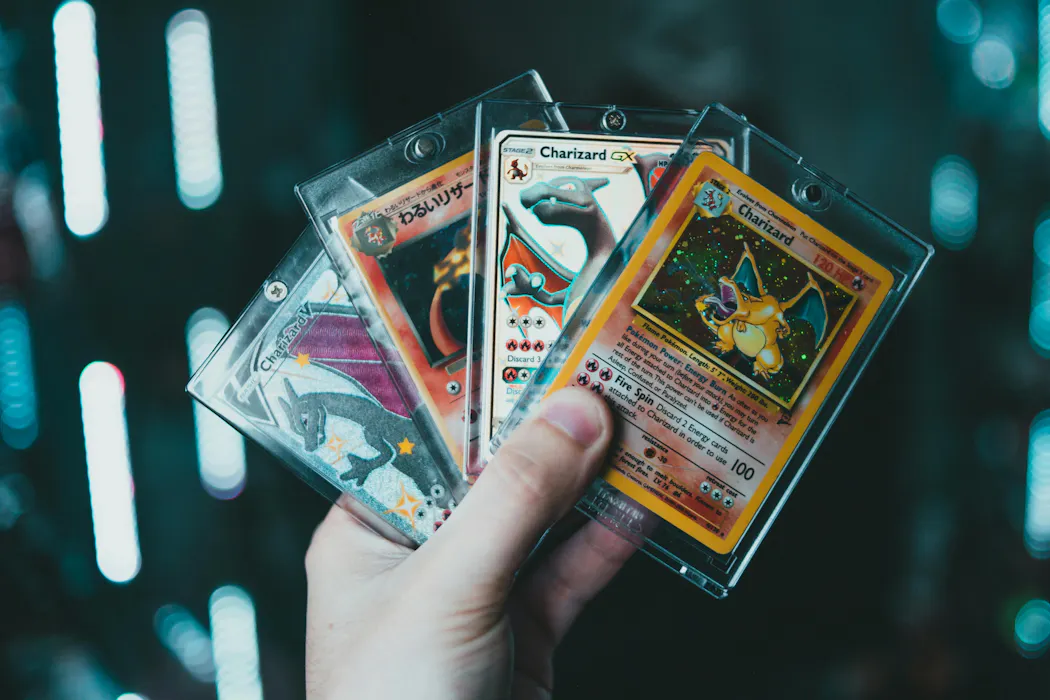
Why are people obsessed with (and stealing) Pokemon cards again?

Pexels/Erik Mclean, CC BY

In 1973, Japanese food company Calbee started attaching free collectable baseball player cards to its potato chip packets (and continues to do so today). It was mimicking a trend that had already taken off in tobacco markets in Japan and overseas. Baseball, Japan’s national sport, was an obvious choice for Calbee to attract consumers.

Some four years later, rival company Lotte joined the trend, launching a chocolate wafer snack with Bikkuriman “surprise man” stickers. These stickers quickly caught on – and eventually spawned an entire fantasy world that made its way to anime and manga.

Both Calbee and Lotte helped set a template for how children’s collectables could become objects of desire, competition and, later, nostalgia. Bikkuriman is still sold today, with rare 1980s Super Zeus stickers going for thousands of dollars to adult collectors.

It was against this backdrop that Satoshi Tajiri (born 1965) grew up. He would have been about 12 when the first Bikkuriman card was released. Satoshi himself would end up creating one of the most popular collectable card games in the world: Pokémon.

These cards are now so highly coveted they are driving international crime, getting banned from schools, and locked behind glass cabinets in stores.

Creating the cultural conditions for a hit

Satoshi drew on a childhood memory when he created Pokémon (short for “Pocket Monsters”): catching insects and trading them with friends.

He imagined a Nintendo Game Boy game where players could collect and exchange monsters. After seven years in development, Pocket Monsters Red and Green launched in February 1996. This was followed by a trading card game in October.

In 1997, the anime began airing on Japanese television, with a protagonist also named Satoshi (the name still used in Japan today). Pikachu – originally just one of 151 monsters – became the face of the franchise.

Like Bikkuriman, Pocket Monster spread rapidly across games, TV and print media. But unlike Bikkuriman, it also aimed to cross borders.

The English-language version of the game was released in 1998, with its name changed to Pokémon. “Pocket Monsters” may have sounded awkward, or even suggestive, to English speakers. Although it remains the official name in Japan, most Japanese fans also use the portmanteau, Pokémon.

Character names were also adapted and anglicised for overseas audiences.

For instance, Satoshi became Ash. Nyarth, a bipedal cat thought to be inspired by the Japanese lucky charm maneki-neko, became Meowth, to match the English-language cat sound. (Pikachu, drawing on the Japanese onomatopoeia of “pika” and “chu”, was retained.)

Soon enough, the character names, types and Pokédex numbers became shared internationally, allowing players the world over to connect through a shared Pokémon language. In 2004, the first World Championship for the Pokémon Trading Card Game was held in the United States.

Squirtle in your neighbourhood

It’s difficult for any single commodity to maintain popularity over decades. During the early 2010s, Nintendo suffered significantly, even falling into deficit, and the Pokémon franchise faced competition from rivals such as Yu-Gi-Oh! and Yo-Kai Watch.

The old-school model of marketing through traditional media was no longer enough for global dominance. To survive, Pokémon would need to adopt the logic of new media platforms – and catch the eye of the online generation. Then came Pokémon GO.

The 2016 smartphone app was developed by American software company Niantic, in collaboration with Nintendo and The Pokémon Company.

Through augmented reality, parks, shopping streets and neighbourhoods gained new meaning as potential locations for your next Pokémon catch. One grandfather in Taiwan made the news for using 64 smartphones at once.

Some players even travelled internationally to capture region-exclusive Pokémon, such as Kangaskhan in Australia, which was clearly modelled on a kangaroo.

Downloaded more than 500 million times, the enormous success of Pokémon GO played a key role in re-energising the global Pokémon fandom. Many players sought out the cards they had collected as children.

Interest was further amplified by the release of Pokémon TCG Pocket. Released in 2024, this app digitised the old-school Japanese tabletop to make it accesible for all.

Chasing profits and childhood memories

Then there was another, less predictable factor that drove the popularity of Pokémon cards: COVID lockdowns. With more time at home, people dug out old binders and rediscovered their childhood cards – many of which had high value – and began trading to make money.

This has led to a renewed interest in rare cards such as the Pikachu Illustrator, which was distributed in 1998 to the winners of an illustration contest. The card features artwork by Atsuko Nishida, Pikachu’s original designer. With only 39 copies known to exist, collectors call it the “holy grail” of Pokémon cards.

Earlier this year, influencer Logan Paul sold his Pikachu Illustrator for US$16.492 million, setting a record for the most expensive trading card ever sold.

This potential for profit has led to a surge in Pokémon card-related crime, as the cards are easy to carry, hide and move internationally. We’ve seen a wave of burglaries targeting hobby shops all over the world, including in Australia, the US and Japan.

Many fans may now find themselves unable to purchase cards due to the economic bubble. Still, it seems demand is high; roughly 10.2 billion cards were printed from 2024 to 2025.

Pokémon cards are a rare kind of tangible object. They connect the digital to the physical – the past to the present – and Japan to the world. They aren’t just collectables; they are a cultural currency, which, unfortunately, can be stolen.

The Conversation

Tets Kimura does not work for, consult, own shares in or receive funding from any company or organisation that would benefit from this article, and has disclosed no relevant affiliations beyond their academic appointment.

  •  

Activism, complicated sexualities, and rural Oklahoma: what to stream this Pride Month

Pride Month takes place in June each year, prompting increased attention on the LGBTQIA+ community, key issues affecting us and our stories.

Some streaming services have previously curated prominent Pride Month categories, although these saw a downturn in 2025.

Queer “storyworlds” – television series that emphasise the social connections between LGBTQIA+ people – first emerged in the 1990s. These queer series were often products of experimentation in response to disruption, such as the proliferation of cable television.

In new research, we explore how queer storyworlds use the serial nature of television to present complex and nuanced portrayals of queer identities, experiences and community.

These storyworlds emphasise queer social connection, through friends and relationships. They move away from representations of the lone queer character in an otherwise straight world, who may occasionally have a love interest. And they use distinctly queer settings that include the spaces where community is formed, both in public – bars, cafes, nightclubs – and private homes.

Whether the 1990s or the 2020s, centrally queer stories on television remain revolutionary. They offer a glimpse into the ways we create liveable lives despite the dominance of heterocentric society. And for that, they remain a powerful and radical source of meaning making for our community.

We have found more than 70 queer storyworlds since the 1990s, created in the United States, the United Kingdom, Australia and Canada, but there are more queer storyworlds to explore. Here is just a small selection you should be streaming this June.

Queer as Folk

Prime Video

Russel T. Davies’ Queer as Folk (1999–2000) was the first fully queer storyworld in mainstream television. It centres the lives of gay men, and a few lesbians, in Manchester, and the scene on the infamous nightclub strip, Canal Street.

This bold, sexy series is also highly political. It critiques the UK’s oppressive Section 28 laws, which suppressed open discussion of homosexuality for those under 18 from 1988–2003 (2001 in Scotland).

The first episode features a 15-year-old Nathan Maloney (Charlie Hunnam) seeking and finding his first sexual experience on Canal Street, in a UK where it was also illegal for him to explore such desires with someone his own age in 1999.

The L Word

Stan (Australia), Prime Video (NZ and Australia)

Ilene Chaiken’s The L Word (2004–09) is the first all-lesbian (and bisexual woman) storyworld. It gained worldwide popularity early in its run, and is likely one of the most seen series on this list.

The L Word is sexy, dramatic and unafraid to tackle complex issues around relationships, infidelity, family and identity. As a central setting, the cafe/bar The Planet showcases a site of lesbian community-building.

In Our Blood

ABC iview and Stan

In recent years, period dramas have been a key feature of queer storyworlds. Australia’s own powerful contribution is In Our Blood (2023).

The miniseries focuses on queer community activist and government responses to the AIDS Epidemic in Australia. It highlights the diversity of Australia’s LGBTQIA+ community and the vital role of lesbians who led activism and care movements.

Importantly, In Our Blood has moments of levity, where the community comes together. Whether to celebrate progress towards their cause or to mourn loss, they are able to use spaces such as Oxford Street to find connection and joy.


Read more: The ABC’s In Our Blood shines a light on lesbian activism during the AIDS crisis – but there’s more to their story


Pose

Disney+

Another period drama, Pose (2018–21) celebrates the Black and Hispanic trans and queer voices at the centre of New York’s infamous ball culture in the 1980s and 1990s.

The series is groundbreaking for its casting of out trans and queer actors, the depth of storytelling, and the unflinching look at the impact of the AIDS epidemic on the community.

Pose boasts outstanding performances, and Dominique Jackson’s iconic reads – the act of throwing out witty, dismissive insults that originated on this scene – have become the subject of cultural listicle articles.

With 26 episodes over three seasons, Pose gives space to stories often overlooked in mainstream distribution.

Sort Of

ABC iview and Stan

Sort Of (2021–23) is a smart, funny series centring on non-binary Pakistani-Canadian Sabi (Bilal Baig), as they navigate between queer and non-queer spaces.

With three seasons and 24 episodes, Sort Of gives space to explore the complexity of trans and non-binary identity, including bisexual/pansexual attraction.

Sort Of also provides some hard hitting moments as Sabi finds a way to forge a liveable life.

Throughout the series, they learn how to understand and be understood by their family, how to be a good friend and how to make choices that are best for them.

But the series is about more than identity. It highlights the ways queer people build both literal and metaphorical community spaces, and how those remain vital today.

Eastsiders

Netflix

Starting on YouTube, Eastsiders (2012–19) is an independent web series that made the leap to streaming.

The first season of this dark comedy follows Cal (Kit Williamson) and Thom (Van Hansis) as they navigate a shift in what their relationship looks like after Thom is caught cheating.

As the seasons progress, the story expands to include a larger ensemble of LGBTQIA+ characters and community spaces.

The third and fourth season premiered on Netflix where all four seasons are now available.

Faking It

10Play

An astute teen comedy-drama that explores the “incoherence of identity”, Faking It (2014–16) follows Amy (Rita Volk) and Karma (Katie Stevens) who pretend to be queer to gain popularity at their progressive school.

As Amy begins to realise her sexuality might be more complicated, it prompts an important examination of the pressure to apply labels to our identity.

This series speaks to teen – and adult – audiences grappling with expectations to label themselves.

Smoggie Queens

Binge

Smoggie Queens (2024–) is all about the ways queer people find one another and build community wherever we are.

Set in the North Yorkshire port town of Middlesborough, this scrappy, queer chosen family ensemble shows off the beating heart of low-budget comedy as a place for sharp writing by new voices.

Smoggie is a term for people from Middlesborough, and this series gives us the queens of that community. It is packed full of acerbic wit, pop culture references and heartfelt moments.

Q-Force

Netflix

Q-Force (2021) blends the “chosen family” and “crack team of secret agents” tropes that stays on the funny side of stereotype.

The team features a type-A personality gay leader, a drag queen mistress of disguise, a trans hacker, a lesbian mechanic who is revealed to have a house full of rescue pitbulls, and a token straight guy (of course).

The series examines how we find community, sometimes despite our differences, as we are brought together under the LGBTQIA+ banner.

Iggy & Ace

SBS OnDemand

Part of the SBS Digital Originals initiative, Iggy and Ace (2021) follows its titular best friends (played by Sara West and Josh Virgona) as they navigate addiction within the queer community.

This short series examines the ways our community can find connection in bars and nightclubs, places intrinsically tied to alcohol, and the challenges this can bring.


Read more: Iggy & Ace: a zany Aussie comedy about two gay best friends — and alcohol abuse


Key highlights include the scenes set in Ace’s all-queer Alcoholics Anonymous group, led by Australian comedy legend Roz Hammond as Gwen. She brings heartfelt moments, and calls out Ace’s excuses, hitting at the heart of what makes queer community connection so powerful.

Special

Netflix

Created by Ryan O'Connell, Special (2019–21) is a semi-autobiographical comedy series about being a gay man with cerebral palsy in Los Angeles.

Special does more than putting an underrepresented story onscreen. It examines the life of a disabled gay man and his desire for friendships, relationships and sex.

The series gives us genuine, laugh-out-loud moments and shows how authentic writing can be irreverent and meaningful all at once.

Reservation Dogs

SBS OnDemand and Disney+

Reservation Dogs (2021–23) is a coming-of-age comedy about four Indigenous teenagers in a small town in the Muscogee Nation in rural Oklahoma. The series has been celebrated for its inclusive queer and trans Indigenous representation, both on screen and behind the scenes.

Over three seasons, the show reflects on community and culture, following Bear, Elora, Cheese and Willie Jack as they navigate the messiness, humour, and heartbreak of adolescence. One of the most refreshing aspects of Reservation Dogs is that it approaches LGBTQIA+ and Two-Spirit identities as a natural part of everyday life.

The Conversation

The authors do not work for, consult, own shares in or receive funding from any company or organisation that would benefit from this article, and have disclosed no relevant affiliations beyond their academic appointment.

  •  

Rhino horn: why South Africa wants to revive the international trade, and why critics fear the consequences

Jason Gilchrist

South Africa wants to expand exports of rhino hunting trophies and other wildlife products. The move relies on an exemption process within the international treaty that has largely restricted rhino horn trade since 1977.

It’s a shift that could reopen one of global conservation’s fiercest debates: does a legal trade protect endangered species – or hasten their decline?

International trade in rhino horn exports remains heavily restricted under Cites – the Convention on International Trade in Endangered Species of Wild Fauna and Flora. However, countries can obtain permits for certain exports if they provide scientific evidence that trade will not harm the species’ survival chances.

The South African government has released a new assessment, signed by environment minister Willie Aucamp, arguing that this condition has been met. It concludes that exports of protected species, including rhino, elephant and lion would not threaten their survival in South Africa. The assessment argues that the ban on rhino horn trade has been counterproductive, linking it to increased poaching, organised wildlife crime and higher black-market prices for rhino horn.

The policy shift follows a change in ministerial leadership. Aucamp replaced Dion George, who had spoken out against captive wildlife breeding and the commercialisation of endangered species. Critics cite concerns over Aucamp’s background as a wildlife farmer and argue the change signals a broader shift towards policies favoured by South Africa’s wildlife and hunting industries and their well-organised lobby. Aucamp’s government profile states he has been actively involved in the conservation sector.

The dramatic policy change brings into focus the conflict between traditional conservationists and the wildlife ranching and trophy hunting industry in South Africa, an industry that is reputedly worth more than US$1.5 billion (£1 billion) per year

The case for trading rhino horn

Poaching of rhino for their horn is thought to be the single greatest threat to the future of African rhino (the black rhino and white rhino species). Rhino are poached because rhino horn is worth so much on the illegal market.

Anti-poaching patrols, infrastructure and surveillance are expensive. Supporters argue that the income generated through exports will act as an incentive to private land owners to better protect rhino.

Enabling international export of rhino will additionally bring economic benefits to wildlife ranchers, breeders, and companies that profit from trophy hunting.

The rhino horn trade could lead to more poaching

However, if the rhino horn trade is legitimised and even facilitated, market demand could increase. A previous one-off legal sale of elephant ivory in 2008 was associated with a elephant poaching spike and a dramatic increase in the illegal ivory trade. A legal supply of rhino horn may support a continuation or increase in poaching, endangering the survival of rhino species in South Africa and beyond.

There are fewer than 50 individuals left in two of the three Asiatic rhino species: the Javan and Sumatran rhino. The effects of international trade in African rhino on Asian rhino species should not be overlooked.

Wildlife charities have been calling for “demand reduction” campaigns for years. Re-opening and legalising the international trade in rhino could fatally undermine these attempts to make horn consumption and ownership socially unacceptable.

In my opinion the optimal route to conserving rhino is to reduce the market demand for rhino horn, to discourage people from wanting rhino horn, not to fuel desire for rhino products by legalising trade.

What this means for rhinos themselves

Rhinos are an intrinsic part of their native ecosystems. But when owners and breeders can benefit economically from exports, there is a risk rhinos become valued primarily for what they can be sold for. This could mean these wild beasts are bred and managed akin to domesticated cattle. “Wild” rhino could become an afterthought or sideshow to the global trade.

South African rhino baron John Hume was the owner of the world’s largest private herd. He built up a population of over 2,000 rhino that were farmed as livestock with their horns harvested. Hume lobbied intensively for a re-opening of the trade in rhino horn, arguing that it would be for the good of the rhino. Ultimately, Hume went bankrupt, and the herd had to be rescued by rewilding charity African Parks.

Hume is now under investigation for allegedly exporting 964 rhino horns to Southeast Asia. Hume denies the allegations and insists he has “nothing to hide”.

Now another South African rhino rancher has asked the court for permission to legally sell 479 stockpiled rhino horns overseas.

Killing to conserve

Additionally, there is the moral and ethical question of whether endangered species including rhino can or should be saved by killing individuals for trophy or sport. Can we kill to conserve? That question is not unique to rhino but applies to wildlife conservation generally, across multiple species, and internationally.

Trophy hunting is not universally accepted as a morally or ethically defensible conservation tool. In November 2025, Namibia asked Cites to scrap the global ban on rhino horn trade, but was defeated by 120 votes to 30. The move by South Africa to increase rhino trophy export permits could damage the nation’s reputation on the international stage.

South Africa also planned to end captive lion breeding and “canned lion hunting”, which both contribute to the lion bone trade. Recent political changes mean this commitment is being questioned.

The about turn in wildlife policy, supporting commodification of rhino, lion and numerous other endangered species, means that South Africa may be backing itself into an uncomfortable corner on the world stage when it comes to valuing and caring for its biodiversity.

The Conversation

Jason Gilchrist does not work for, consult, own shares in or receive funding from any company or organisation that would benefit from this article, and has disclosed no relevant affiliations beyond their academic appointment.

  •  

We desperately need skilled workers. So why is vocational education treated as the ‘back-up plan’ for school leavers?

Design Pics/ Getty Images

At the end of each school year, we see the same ritual play out. Year 12 results are released and newspapers publish league tables, ranking schools by their exam results.

What you almost never see on the front page is a student who finished a vocational program and walked straight into skilled work.

This doesn’t make sense. There is constant commentary from governments and employers that the country needs more skilled workers in construction, nursing, aged care, early childhood, teaching and trades.

Yet we still treat the pathways that produce these workers as the option you take when the “real” one doesn’t work out.

Why is this? And how can we fix it?

What is a vocational pathway?

A vocational pathway means developing workplace-specific skills and qualifications for a particular occupation or industry. Students can begin vocational learning while still at school, including as part of a senior secondary certificate or through a school-based apprenticeship or traineeship. After school, they might continue through TAFE, another registered training provider, an apprenticeship, a traineeship or a private registered college.

This is different from a “higher education”, where the focus is on giving you thinking tools to perform in a role (although unis can also focus on practical skills).

You might do vocational training to be a hairdresser, chef, electrician or dental hygienist, for example.

Vocational pathways can start before students leave school. In 2024, more than 266,000 Australian school students undertook vocational training as part of their senior secondary certificate. This was about 26% of Year 12 completers.

You can also start your vocational training – with no prior experience – after school.


Read more: Help! I’m almost finished school but don’t know what I want to do next


A paradox decades in the making

For at least 40 years, governments of every stripe have warned about skills shortages. As of 2025, 29% of occupations are in shortage. This involves almost 50% of trade roles and about 40% of professional occupations. But when it comes to life after Year 12, the focus keeps flowing toward universities and the ATAR.

Students can absorb the message early. From the first years of high school, the academic route is presented as the aspiration and vocational study as the fallback.

This is despite the strong opportunities many vocational pathways can provide. In 2024, 95.4% of trade apprentices were employed after completing their apprenticeship or traineeship. Some trade occupations also pay above the all-occupation median. For example, electricians have median full-time earnings of about A$2,191 a week, well above median weekly full-time earnings of about $1,852.

A current Victorian parliamentary inquiry has heard evidence from students of the “stigma” around taking a vocational pathway in the senior years of school, noting it’s not seen as the “smart way”.

A 2024 federal parliamentary inquiry similarly found many students still see vocational pathways as a “last resort” for those who do not get the marks for university.

It also heard many schools are institutionally structured to channel students toward university. This can include limited provision of vocational options, inadequate information about non-university career pathways, and a lack of trained career counsellors and educators with industry knowledge.

It also noted how high ATAR scores are used to rank schools, while schools are “rarely if ever” ranked by the number of students who succeed through VET pathways.

Vocational learning seen as ‘residual’ by school leaders

This doesn’t mean students lack interest in vocational learning. It means they are often making choices in a system where university entrance, ATAR results and academic achievement remain the most visible signs of “school success”. Meanwhile, vocational achievement is less publicly recognised.

In our research on vocational and applied learning (which includes workplace learning, projects and community activities), we found school systems often make vocational learning less visible and less secure.

In a project with school leaders across 23 Victorian high schools, applied learning was repeatedly described as “additional”, “extra” or “residual” work. Leaders pointed to timetabling pressures, staffing instability and school systems that still privilege academic performance.

When vocational learning is treated as peripheral inside schools, students are more likely to view their pathway is also peripheral.

The teachers no one talks about

Students aren’t the only ones affected.

Teachers in applied and vocational settings do some of the most demanding work in schools. They connect classroom learning to what’s happening in industry, build partnerships with employers, and teach some of the most diverse groups of students.

That work takes real expertise. Yet our research also found it is routinely treated as a “lesser” role in the profession. This judgement shows up in concrete ways in timetabling, funding, and in who gets resourced and recognised.

Why marketing won’t fix it

Three structural changes can help this situation.

1. Change how we measure and report success. If a school’s public worth is summarised by its top ATARs, everything else is invisible. Recognising and reporting achievement in vocational pathways would begin to shift what counts.

2. Stop treating vocational and academic pathways as separate worlds. Schooling, vocational education and higher education are still too often governed, funded, and discussed through different systems. This reinforces the idea that they are different kinds of learning – with different levels of importance – rather than connected parts of a broader education and training system.

3. Build more useful evidence. Government-funded bodies such as the Australian Education Research Organisation give schools research-based advice. Applied and vocational pathways need the same attention, so schools are not left to build programs on goodwill alone. They need clearer evidence about what works, how to implement it, and how to recognise successful outcomes beyond ATAR results.

Signs of change

It isn’t all bleak. For example, in Victoria, students can now do a vocational major as part of the Victorian Certificate of Education. This means there is a clear place within the schooling system and recognition of distinct contributions they make to schools.

Educators and young people already know the value of this learning, they live it. The shift still to come is among policymakers, the media and the public.

The next time the ATAR league tables appear, it is worth asking who they leave out, and what we would have to change to put them back in.

The Conversation

Kellie McGlynn has received Victorian Department of Education funding for research and partnership work related to applied learning, vocational education and senior secondary pathways. Some of the research informing this article draws on that broader program of work. The views expressed in this article are those of the authors.

Shaun has received Victorian Department of Education funding for research and partnership work related to applied learning, vocational education and senior secondary pathways. Some of the research informing this article draws on that broader program of work. The views expressed in this article are those of the authors.

  •  

In a tight NZ budget, will money go where it’s needed most – or to political priorities?

Dean Purcell/Getty Images

As New Zealand’s budget day looms closer, the government has already revealed one important figure – NZ$2.1 billion – that offers an insight into its approach to spending this year.

That’s the government’s tight operating allowance – or the new money available for ongoing spending. And that’s already been trimmed back from $2.4 billion since its budget strategy was announced in December.

The $300 million cut is small relative to total operating expenses, but still significant.

Operating spending funds ongoing commitments, such as public servants’ salaries, benefits and superannuation payments. It also covers the costs of keeping services running: think medicines for hospitals, or electricity for school classrooms.

Operating allowances, meanwhile, determine how much room the government has for new policies and for meeting cost pressures in these areas.

Ahead of Thursday’s budget, those pressures are already intensifying. The outlook now points to higher near-term inflation than was anticipated when the budget strategy was released five months ago, driven in part by rising oil prices following the US-Iran conflict.

If costs rise faster than operating funding, the government faces increasingly difficult choices over what it can continue to fund, expand or cut back.

The risks behind the cuts

We also now know a little about what some of those choices will look like.

Last week, it was announced government agencies’ operating budgets will be cut by 2% in the coming year, followed by a further 5% in each of the following two years.

The government’s wider reform programme also includes reducing core public service employment to no more than 55,000 full-time equivalent roles by July 2029.

The savings will be redirected to health, education, building infrastructure, defence and police. All of these are worthy causes for extra funding, and in principle, there is nothing wrong with asking whether existing spending delivers value and reallocating spending to where it makes the greatest impact.

But, as always, the devil is in the detail – and this is not yet known. It matters where in health, education or policing the extra money goes. It also matters which public service roles are cut, because so-called “back-office functions” can still be essential to delivering frontline services.

Finance Minister Nicola Willis has suggested greater use of artificial intelligence could help the public service do more with less. But some international studies have found higher AI adoption has yet to translate into higher productivity.

If AI does not deliver substantial productivity gains in the public sector, restraint in government spending will ultimately show up somewhere: in deferred maintenance, scaled-back programmes or lower service levels.

Inflation, resilience and the politics of spending

Rising operating costs are not the only impact that inflation has on the government’s books.

In some ways, it can help. Higher prices and wages can lift tax revenue through the goods and services tax (GST), income tax and company tax receipts. Inflation can also inflate nominal gross domestic product – the dollar value of economic activity – which in turn can make government debt appear smaller relative to the size of the economy.

In other ways, however, inflation adds pressure. Interest costs can rise as government debt is refinanced at higher rates, while benefit payments and other spending tied to inflation or wages also increase.

Meanwhile, the government has announced it is increasing capital spending, which funds long-lived assets such as roads, hospitals, schools, defence equipment and infrastructure.

This would appear a sensible move, given that New Zealand faces an infrastructure deficit in many areas. Addressing it could help bring a much-needed improvement in productivity.

There is also the wider question of New Zealand’s economic resilience.

Independent economist and commentator David Skilling has argued global supply chains are being rewired. Where efficiency and just-in-time delivery once took priority for nations, a more unstable geopolitical environment is now shifting the focus toward resilience and security.

In this context, government capital investment can help address vulnerabilities in New Zealand’s critical supply chains – even if its small-economy status means it will always remain dependent on overseas trade.

At the same time, capital spending can also come with political and economic risks. For instance, projects might be chosen more for their political appeal than for whether they genuinely strengthen productivity or supply chain resilience.

Budget 2026 will therefore represent a test of priorities.

Reprioritisation, allocations from the smaller operating allowance and new capital spending should all face the same question: where will public money produce the greatest value?

The answer should be based on economic and strategic need, rather than political visibility or electoral advantage.

The Conversation

Michael Ryan does not work for, consult, own shares in or receive funding from any company or organisation that would benefit from this article, and has disclosed no relevant affiliations beyond their academic appointment.

  •  

Why are people obsessed with (and stealing) Pokemon cards again?

Pexels/Erik Mclean, CC BY

In 1973, Japanese food company Calbee started attaching free collectable baseball player cards to its potato chip packets (and continues to do so today). It was mimicking a trend that had already taken off in tobacco markets in Japan and overseas. Baseball, Japan’s national sport, was an obvious choice for Calbee to attract consumers.

Some four years later, rival company Lotte joined the trend, launching a chocolate wafer snack with Bikkuriman “surprise man” stickers. These stickers quickly caught on – and eventually spawned an entire fantasy world that made its way to anime and manga.

Both Calbee and Lotte helped set a template for how children’s collectables could become objects of desire, competition and, later, nostalgia. Bikkuriman is still sold today, with rare 1980s Super Zeus stickers going for thousands of dollars to adult collectors.

It was against this backdrop that Satoshi Tajiri (born 1965) grew up. He would have been about 12 when the first Bikkuriman card was released. Satoshi himself would end up creating one of the most popular collectable card games in the world: Pokémon.

These cards are now so highly coveted they are driving international crime, getting banned from schools, and locked behind glass cabinets in stores.

Creating the cultural conditions for a hit

Satoshi drew on a childhood memory when he created Pokémon (short for “Pocket Monsters”): catching insects and trading them with friends.

He imagined a Nintendo Game Boy game where players could collect and exchange monsters. After seven years in development, Pocket Monsters Red and Green launched in February 1996. This was followed by a trading card game in October.

In 1997, the anime began airing on Japanese television, with a protagonist also named Satoshi (the name still used in Japan today). Pikachu – originally just one of 151 monsters – became the face of the franchise.

Like Bikkuriman, Pocket Monster spread rapidly across games, TV and print media. But unlike Bikkuriman, it also aimed to cross borders.

The English-language version of the game was released in 1998, with its name changed to Pokémon. “Pocket Monsters” may have sounded awkward, or even suggestive, to English speakers. Although it remains the official name in Japan, most Japanese fans also use the portmanteau, Pokémon.

Character names were also adapted and anglicised for overseas audiences.

For instance, Satoshi became Ash. Nyarth, a bipedal cat thought to be inspired by the Japanese lucky charm maneki-neko, became Meowth, to match the English-language cat sound. (Pikachu, drawing on the Japanese onomatopoeia of “pika” and “chu”, was retained.)

Soon enough, the character names, types and Pokédex numbers became shared internationally, allowing players the world over to connect through a shared Pokémon language. In 2004, the first World Championship for the Pokémon Trading Card Game was held in the United States.

Squirtle in your neighbourhood

It’s difficult for any single commodity to maintain popularity over decades. During the early 2010s, Nintendo suffered significantly, even falling into deficit, and the Pokémon franchise faced competition from rivals such as Yu-Gi-Oh! and Yo-Kai Watch.

The old-school model of marketing through traditional media was no longer enough for global dominance. To survive, Pokémon would need to adopt the logic of new media platforms – and catch the eye of the online generation. Then came Pokémon GO.

The 2016 smartphone app was developed by American software company Niantic, in collaboration with Nintendo and The Pokémon Company.

Through augmented reality, parks, shopping streets and neighbourhoods gained new meaning as potential locations for your next Pokémon catch. One grandfather in Taiwan made the news for using 64 smartphones at once.

Some players even travelled internationally to capture region-exclusive Pokémon, such as Kangaskhan in Australia, which was clearly modelled on a kangaroo.

Downloaded more than 500 million times, the enormous success of Pokémon GO played a key role in re-energising the global Pokémon fandom. Many players sought out the cards they had collected as children.

Interest was further amplified by the release of Pokémon TCG Pocket. Released in 2024, this app digitised the old-school Japanese tabletop to make it accesible for all.

Chasing profits and childhood memories

Then there was another, less predictable factor that drove the popularity of Pokémon cards: COVID lockdowns. With more time at home, people dug out old binders and rediscovered their childhood cards – many of which had high value – and began trading to make money.

This has led to a renewed interest in rare cards such as the Pikachu Illustrator, which was distributed in 1998 to the winners of an illustration contest. The card features artwork by Atsuko Nishida, Pikachu’s original designer. With only 39 copies known to exist, collectors call it the “holy grail” of Pokémon cards.

Earlier this year, influencer Logan Paul sold his Pikachu Illustrator for US$16.492 million, setting a record for the most expensive trading card ever sold.

This potential for profit has led to a surge in Pokémon card-related crime, as the cards are easy to carry, hide and move internationally. We’ve seen a wave of burglaries targeting hobby shops all over the world, including in Australia, the US and Japan.

Many fans may now find themselves unable to purchase cards due to the economic bubble. Still, it seems demand is high; roughly 10.2 billion cards were printed from 2024 to 2025.

Pokémon cards are a rare kind of tangible object. They connect the digital to the physical – the past to the present – and Japan to the world. They aren’t just collectables; they are a cultural currency, which, unfortunately, can be stolen.

The Conversation

Tets Kimura does not work for, consult, own shares in or receive funding from any company or organisation that would benefit from this article, and has disclosed no relevant affiliations beyond their academic appointment.

  •  

There are different types of fitness. An exercise expert explains

Jonathan Chng/Unsplash

You probably have at least one “super fit” friend. Maybe they’re a marathon runner, a footy player or a keen hiker.

To keep themselves healthy, they may stick to a strict exercise regimen and only eat certain foods.

But in most cases, these people would likely struggle to play a sport or do an activity they’re unaccustomed to.

So, what does “fitness” even mean? And is there more than one kind?

Defining ‘fitness’

When you hear the word “fitness”, you probably picture someone who looks physically strong and athletic. But fitness can take many forms.

This includes cardiovascular endurance, which is how well your heart and lungs use oxygen to create energy.

There’s also muscular strength or your ability to move and lift objects in a single effort, for instance picking up a heavy box.

Body composition, or the amount of muscle you have relative to the amount of fat, is another aspect of fitness.


Read more: The dreaded beep test: outdated or still a valid assessment of your fitness?


Aerobic or anaerobic fitness. What’s the difference?

While we can understand fitness in many ways, exercise scientists commonly break it down into two broad categories.

Aerobic

Aerobic fitness refers to your ability to use oxygen to create energy. This allows you to physically exert yourself for longer periods of time, for example, running a marathon.

Researchers assess aerobic fitness using a measurement known as “VO₂max”. This records the maximum amount of oxygen your body can take in and use to create energy. Existing evidence shows people with a higher VO₂max score may have better aerobic fitness, a lower disease risk and a longer lifespan.

Anaerobic

Anaerobic fitness has to do with how well you perform short, high-intensity movements. Examples include jumping as high as you can or running a 100-metre sprint. Research shows anaerobic fitness relies on factors such as muscle mass, strength and explosive power, or how much force you can produce in a short period of time.

Some sports mainly require one type of fitness, say aerobic fitness for long-distance running. But most use a combination of the two. For instance, a football player needs explosive anaerobic power to sprint for the ball, but must also have enough aerobic fitness to keep running for a whole game.


Read more: Taller, leaner, faster: the evolution of the ‘perfect’ AFL body


Importantly, your body will adapt to the specific type of training you do. So if you run regularly, your heart, lungs and legs will learn to run very efficiently.

However, running involves a movement pattern that is quite specific. That’s why a runner may initially find it hard to pick up other sports, such as swimming or cycling.

But if you are “running fit” you will have an easier time switching to another sport, compared with someone who is not fit at all. That’s because you’ve already developed your aerobic and anaerobic systems and just need to “transfer” them to your new activity, rather than start from scratch.

These factors can affect your fitness

There are several factors that shape your level of fitness.

One is genetics. There is much research to suggest your genes play a key role in how you respond to exercise. Some people may build muscle more quickly and easily, while others seem to improve their aerobic fitness without much effort. This doesn’t mean that your genes stop you from getting very fit. But it does suggest that not everyone will be able to become an elite athlete.

Another factor is training. The type of exercise you do, and how well you do it, directly impacts how fit you get. Research shows high-intensity interval training – which intersperses short bursts of activity with quick recovery periods – is especially effective for improving aerobic fitness. But if you’re keen to get more anaerobically fit, you can prioritise strength training.

Lifestyle choices also affect fitness. You can train as much as you want, but if you’re not eating and sleeping enough, you may not get the results you want. That’s because good nutrition and consistent sleep ensure your body properly recovers from exercise.


Read more: Days are getting shorter and colder. 6 tips for sticking to your fitness goals


How can fitness impact my health?

The evidence is clear that if you want to live a long, healthy life, you need both aerobic and anaerobic fitness.

Higher aerobic fitness is one of the strongest predictors of overall health. Research shows it protects against illness such as heart disease, type 2 diabetes, dementia, and some cancers. It also prevents early death.

Importantly, being more anaerobically fit may lower your risk of getting type 2 diabetes and dying prematurely. Research also shows having stronger and more powerful muscles helps older people avoid falls and stay independent for longer.

In short, high aerobic fitness may help you live longer, while high anaerobic fitness will ensure you stay strong during your twilight years.

So, how can I improve my overall fitness?

Based on the World Health Organization’s physical activity guidelines, you should aim to do at least 150 minutes of moderate aerobic activity each week. This may look like running, cycling or even brisk walking, and doing weight training at least two days each week.

If you are short on time, high-intensity interval training, also known as HIIT, is an effective way to do more exercise in less time.

When it comes to fitness, there are no quick fixes. But regardless what exercise you choose, what matters most is that you do it consistently.


Read more: Can you ‘microdose’ exercise?


The Conversation

Hunter Bennett does not work for, consult, own shares in or receive funding from any company or organisation that would benefit from this article, and has disclosed no relevant affiliations beyond their academic appointment.

  •  

An AI solution to an 80-year-old problem has shocked mathematicians

A representation of one version of the new best arrangement of points on a plane with pairs separated by a unit distance. Álvaro Lozano-Robledo

Last week, OpenAI shocked the mathematical community by revealing that one of its internal artificial intelligence (AI) models had found a counterexample to a famous conjecture made by legendary Hungarian mathematician Paul Erdős in 1946.

The planar unit distance problem, or Erdős problem 90, has intrigued mathematicians for decades. The new result is no mere curiosity. Canadian mathematician Daniel Litt described it as “the first result produced autonomously by an AI that I find interesting in itself”.

The breakthrough, produced with a general-purpose AI model rather than one specialised for mathematics, also highlights how AI is changing mathematical research itself. Days after OpenAI’s paper, US mathematician Will Sawin followed the same line of reasoning to an improved result. Also last week, a team from Google DeepMind used one of their own models to resolve nine lesser open problems left by Erdős.

At the same time, results like this show us what kind of mathematics current AI models are good at – and where their capabilities are still uncertain.

Dots and lines

Paul Erdős was one of the most prolific mathematicians of the twentieth century. He was famous for asking deceptively simple questions whose solutions often resisted decades of effort.

At first glance, the underlying problem seems relatively straightforward. Suppose you have some number of points – call the number n – drawn on an infinitely large piece of paper. Given you can arrange the points any way you like, how many pairs of points can be positioned exactly one unit of distance away from each other?

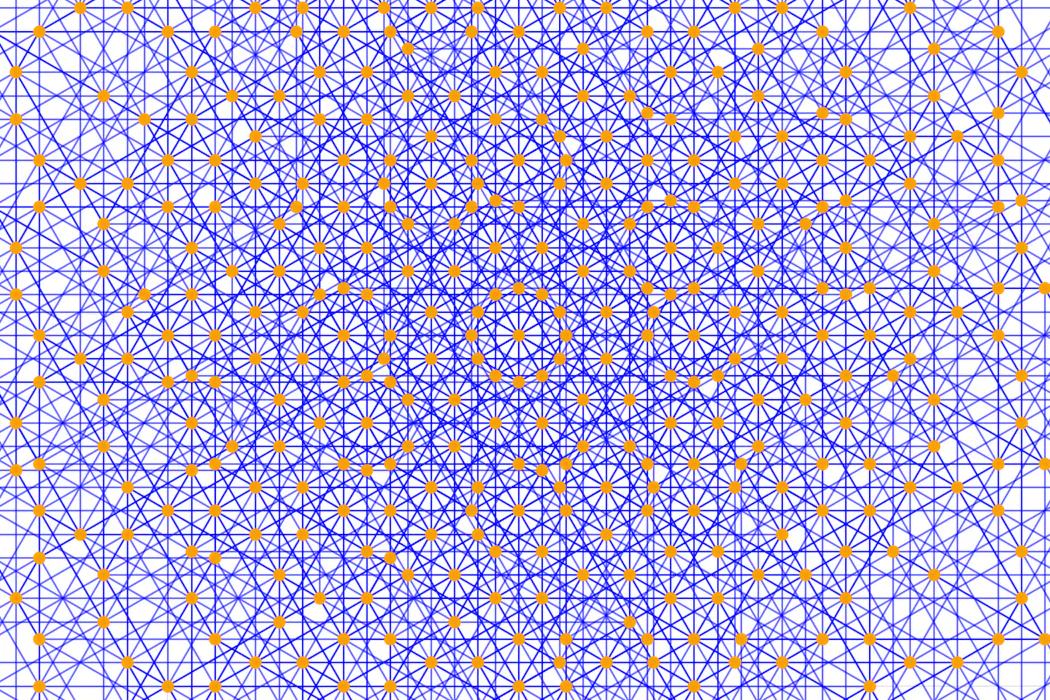
If you try this problem yourself (on a presumably finite piece of paper), you may quickly gravitate towards a square grid as a promising candidate for the best arrangement. The spacing of the grid naturally creates many pairs at a regular distance apart.

Grid of dots connected by lines
A square grid intuitively looks like a good solution to the planar unit distance problem. OpenAI

This intuition influenced much of the early thinking about the problem. As the number of points grows, grid-like arrangements continue to appear to be remarkably effective.

For decades it was widely believed these highly regular structures were about as good as it gets. Erdős himself conjectured that no construction could improve substantially on these intuitive arrangements, even for an extremely large number of points. (The new best result, by Sawin, reportedly only starts to yield improvements for around 102000000 points – that’s a one followed by two million zeroes.)

Over the past 80 years, mathematicians have tried to prove Erdős either right or wrong. Their efforts have linked the problem to other areas of mathematics called incidence geometry, graph theory and extremal combinatorics. While a full proof remained elusive, there was a general feeling that Erdős’ conjecture was probably true.

However, OpenAI’s recent breakthrough proved Erdős’ intuition wrong. The new result uses tools from an area of mathematics called algebraic number theory to show there are patterns of dots that involve many more unit-distance pairs than the square grid, for infinitely many values of n.

No hesitation

In an article OpenAI published alongside the new paper, several leading mathematicians remarked on the result.

Fields Medallist Timothy Gowers wrote that if a human researcher had submitted the paper with this result to the prestigious journal Annals of Mathematics, he would have recommended publication “without any hesitation”. He also added that no previous AI-generated proof had come close to this level of sophistication.

This breakthrough also represents the first major mathematical open problem solved with AI with minimal human intervention beyond the initial prompt. The accompanying paper shows the prompt given to the model, as well as a recount of the “chain of thought” conducted by the model.

This has renewed broader questions about the capabilities of AI to aid in, and perform, mathematical research.

Three keys to mathematical research

Research mathematicians have been using computers for a long time, but their work is rarely driven by computation alone. Most major breakthroughs emerge from a delicate combination of three things: expertise developed over years, sustained effort to apply that expertise creatively to explore ideas (many of which turn out to be dead ends), and occasional conceptual leaps that suddenly reorganise how a problem is understood.

The first two are domains where AI models excel: as noted by Gowers, large language models such as ChatGPT have an “encyclopaedic knowledge of mathematics”. Moreover, they can follow huge numbers of speculative lines of enquiry, even those unlikely to lead anywhere, without human time constraints.

The latter seems to be what provided the key to success here. In hindsight, it seems an expert given a small number of hints would be likely to be able to reach the same proof. As Gowers notes:

Many of the ideas needed for the proof were present in the literature already, and for such ideas either no hint is needed, since the expert is aware of that piece of literature, or a highly generic “look it up” hint would be enough.

Lightbulb moments

The harder question is how much AI can contribute to genuine conceptual leaps. These acute moments of insight, where a lightbulb moment reframes a problem in an entirely new way, are often seen as the most human part of mathematics.

These leaps are hard to formalise and even harder to predict. It remains unclear whether AI models can replicate them, even with recent advances.

What is clear is that AI models are causing a seismic shift in the way mathematics is discovered.

For centuries, progress in mathematics depended almost entirely on human creativity and persistence. Now, for the first time, researchers are working alongside systems capable of autonomously exploring enormous spaces of ideas and contributing to problems once thought accessible only to human insight.

The Conversation

Melissa Lee receives funding from the Australian Research Council.

  •  

As SpaceX, OpenAI and Anthropic plan blockbuster launches, will it make AI giants more accountable?

A huge change is coming to the world’s booming artificial intelligence (AI) sector.

Starting with Elon Musk’s SpaceX, with OpenAI and Anthropic preparing to follow, all three private companies are set to sell shares of their stock to the general public for the first time. These are what’s known as initial public offerings (IPOs).

SpaceX – the first of them to launch this Friday, June 12 – expects to raise $US75 billion from selling just 4% of the company’s shares.

Musk is already the world’s richest man, worth around US$800 billion. He owns around 42% of SpaceX now, plus options to buy more shares at a fraction of the US$135 a share price ordinary investors are being asked to pay. Given his existing wealth, after this Friday’s listing Musk looks likely to become the world’s first trillionaire.

Together, these three companies are valued at almost $US4 trillion and are expected to raise a record-breaking $US200 billion, despite well-founded concerns that big AI stocks are now hugely overvalued.

While most of the news coverage has focused on the money involved, there’s actually another side to these sales that could be a big deal in the longer run.

At a time when everyone from the Pope to people from all walks of life worldwide are concerned about AI’s growing role in our lives, these stock exchange listings have the potential to finally bring some extra transparency to the inner workings of the AI giants.

Why SpaceX, OpenAI and Anthropic matter to you

Once these companies list, hundreds of millions of investors around the world will be exposed to these companies. That could be directly, if you buy these stocks, or else through index funds, which hold shares on behalf of investors – including big retirement and superannuation funds.

Even for those who don’t consider themselves investors, these three share offerings could easily affect your savings too.

Here’s what we know about these IPOs so far.

SpaceX’s most recent June 3 filing amendment with the United States Securities and Exchange Commission added a notable new line. It said SpaceX “may issue a significant amount of equity in connection with future transactions”.

US business outlet Fortune is reading this as a signal for a possible future Tesla merger, bringing another of Musk’s companies into the fold. That could be the biggest merger in history.


Read more: Switzerland’s entire GDP: visualising Elon Musk’s record-breaking pay deal


Investors can sue over failures to disclose

Once publicly listed, the AI labs of SpaceX – xAI – as well as Anthropic and Open AI would be subject to public market scrutiny for the first time.

This would push these companies to disclose more AI risks than they have had to as private companies – or risk being sued for misleading investors.

US securities laws are among the most enforceable in the world. Under US law, investors can sue a company for securities fraud if it fails to disclose a risk that later materialises.

One regulation commonly used in securities fraud lawsuits is Rule 10b-5 under the Securities Exchange Act of 1934.

This has been successfully used in the past many times. For example, Bank of America paid US$2.43 billion settle a lawsuit related to its purchase of investment bank Merrill Lynch in 2008. Countrywide Financial paid US$600 million for failing to disclose the mounting risks of its subprime mortgage business.

Only last month, the International Monetary Fund warned “financial stability risks mount as artificial intelligence fuels cyberattacks”, pointing out:

Anthropic’s recent controlled release of its Claude Mythos Preview, an advanced AI model with exceptional cyber capabilities, underscored how quickly risks are increasing […] This foreshadows how fast‑moving, AI‑driven cyber risks could destabilize the financial system if not managed carefully.

There are good reasons to be concerned about the increasing dominance of tech companies and what happens to economies around the world if the AI share bubble bursts.

Having more of the biggest AI companies forced into greater disclosure would offer one silver lining amid those AI fears.

AI and chip stocks have been surging in 2026. What happens if the AI bubble bursts?

What difference could public disclosure make?

Just as an example, let’s suppose Anthropic accidentally leaked its Claude Mythos source code (like a leak that actually happened earlier this year). Then let’s say North Korean hackers used that code to hack into US government systems.

If that happened when Anthropic was a public company, its share price would very likely fall in response.

Investors could then sue Anthropic for failing to disclose the risk of code leak, which later caused the share price to fall.

This mechanism has its limitations: it only works if AI harms are eventually reflected in stock prices of Anthropic.

In other words, the mechanism only protects the general public from AI risks indirectly – though protecting Anthropic’s investors first.


Read more: Musk’s SpaceX is shaping up as the biggest IPO on record. It’s also bending the rules to do so


How much more accountability should we expect?

The market is meant to incorporate all public information to arrive at the fair price of a public company.

In doing so, market listings should make it easier for investors to police AI safety. After all, it’s in investors’ interests to not drive humanity to the verge of collapse.

But is the market delivering on this function so far with AI?

So far, you’d have to say it’s not. For instance, the world’s second-largest stock exchange, the New York-based Nasdaq, controversially changed its own rules for SpaceX to join its Nasdaq 100 index after just 15 trading days, not the usual three months.

But perhaps there is still hope that investors’ own desire to survive AI will make them push companies to manage AI’s risks more responsibly.

Will it be enough? Probably not on its own. The risks most people worry about with AI – diffuse, slow-moving, hard to pin to a single quarter – may never register clearly in an earnings report.

But more disclosure is better than less. And more disclosure is exactly what these listings will finally force.

The Conversation

Marta Khomyn does not work for, consult, own shares in or receive funding from any company or organisation that would benefit from this article, and has disclosed no relevant affiliations beyond their academic appointment.

  •  

Brushing your teeth in hospital could reduce the chance of catching pneumonia

South_agency/Getty Images

You go to hospital for treatment and to get better. But sometimes, you get something much less welcome: an infection.

Pneumonia, an infection of the lungs, is one of the most common and deadly infections people develop in hospital. Around 50,000 patients contract pneumonia in Australian hospitals every year. Around 1,900 of them die from it.

It’s rarely monitored and rarely reported. And to date, few studies have looked at how it can be prevented.

But our new trial, published today in The Lancet Infectious Diseases, shows a surprisingly simple action can make a major difference: brushing patients’ teeth.

We found this can reduce the chance of getting this type of pneumonia, called non-ventilator hospital-acquired pneumonia, by 60%.

What is this type of pneumonia?

Non-ventilator hospital-acquired pneumonia occurs in patients who aren’t on a ventilator, usually outside of intensive care settings.

Patients are infected when bacteria from the mouth or throat are breathed into the lungs.

Patients who develop this type of pneumonia stay in hospital between ten and 48 days longer, and are around eight times more likely to die during their admission.

A simple intervention made a big difference

We studied 8,870 patients across three Australian hospitals to see whether improving oral care – which included tooth-brushing – could reduce this type of pneumonia.

Usually, when patients go to hospital, they don’t pack a toothbrush – especially in emergencies.

In busy hospital wards, oral care isn’t always given the attention it needs, nor are oral care products always readily available. Patients don’t always get reminders to brush their teeth and many patients need help with their oral care.

The intervention in our study was deliberately simple. We:

  • gave patients in hospital a toothbrush and toothpaste in a bag when they were admitted

  • educated patients and hospital staff about the importance of tooth-brushing. The toothbrush also had a written prompt on it – “Brush away pneumonia”

  • assisted patients who needed help with tooth-brushing

  • audited how oral care was being delivered and gave feedback to hospital wards.

We introduced the intervention into one ward at a time over 12 months at each hospital. This gradual roll-out is known as a stepped-wedge cluster randomised trial. It can test new health interventions when it’s too difficult to randomise individuals without revealing who is receiving the intervention and who isn’t.

We found that this relatively simple intervention increased the proportion of people who cleaned their teeth from 16% to 62%.

This increasing oral care led to a 60% reduction in the risk of acquiring pneumonia, from the equivalent of eight infections per month on a typical ward of 30 patients, to less than four infections per month.

This is the largest trial of its kind and the first completed across multiple hospitals.

Why does brushing teeth help?

The mouth is home to billions of bacteria. Oral hygiene often deteriorates when people are unwell, sedated, immobile, or taking certain medications.

When this happens, bacteria build up on the teeth, gums and tongue. If these bacteria are breathed in – even in tiny amounts – they can cause pneumonia.

Daily tooth-brushing reduces this bacteria. It’s a simple mechanical action with a powerful protective effect.

Yet in busy hospitals, oral care is often overlooked. Patients may not know just how important oral care is. Staff are often busy with competing priorities and oral care can be de-prioritised. There is also a general lack of understanding about the importance of oral care.

Patients can help protect themselves

One of the most important messages from our research is patients aren’t powerless. While health-care staff such as nurses play a crucial role, patients who are able to brush their own teeth can meaningfully reduce their own risk.

If you or a loved one is admitted to hospital, you can:

  • bring your own toothbrush and toothpaste
  • brush your teeth twice a day if you’re able
  • ask staff for help if you can’t
  • remind staff if oral care has been missed.

These small actions can reduce the risk of a serious, life-threatening infection.

What happens next?

Pneumonia is costly – in lives, hospital days and the financial cost of care. But because non-ventilator hospital-acquired pneumonia isn’t routinely reported, it’s often invisible.

Our research challenges the assumption that hospital-acquired pneumonia is an unavoidable complication when you go to hospital.

It also highlights the need for hospitals to monitor non-ventilator hospital-acquired infections, in the same way they monitor falls, pressure injuries and other preventable harms.

Finally, our study strengthens the case for including oral care in national infection-prevention guidelines and nursing practice.

Oral care isn’t glamorous, expensive or technologically advanced – but it works. Sometimes, the simplest interventions are the most powerful.

The Conversation

Brett Mitchell receives funding from the Medical Research Future Fund which helped fund the reported study. Brett also receives funding from the National Health and Medical Research Council through an Investigator grant. He is affiliated with Avondale University and the Hunter Medical Research Institute. Brett is Editor-in-Chief of Infection, Disease and Health.

Allen Cheng receives funding from the National Health and Medical Research Council and the Australian Government for research studies and surveillance systems. He is a member of the Infection Prevention and Control Advisory Committee for the Australian Commission for Safety and Quality in Healthcare - the views expressed in this article may not reflect the views of the committee.

Nicole White receives funding from the Medical Research Future Fund which helped fund the reported study. She is a member of the Statistical Society of Australia and holds editorial roles with the Infection, Disease and Health journal and Significance magazine.

Philip Russo is an NHMRC Early Career Research Fellow at Monash University and Director of Nursing Research at Cabrini Health.

Peta Ellen Tehan does not work for, consult, own shares in or receive funding from any company or organisation that would benefit from this article, and has disclosed no relevant affiliations beyond their academic appointment.

  •  
❌