Reading view

A draft African charter on ‘family values’ is on the cards: why it’s flawed and dangerous

A series of conferences held in Entebbe, Uganda, between 2023 and 2025 have resulted in a draft African Charter on Family, Sovereignty and Values. The meetings were organised by the Inter-parliamentary Network on African Sovereignty and Values, which organises continental conferences for African legislators and faith-based advocates. Supported by international conservative groups like Family Watch International and heavily promoted by Ugandan president Yoweri Museveni, the aim of the drafters of the charter is to convince African governments to sign on to it.

The draft charter is situated within the current global movement to the right, which prioritises nationalism, tougher immigration policies and an erosion of social values like gender equity. Framed as an effort to “protect” the family, it urges governments to adopt a series of regressive measures.

These include:

  • opposing comprehensive sexuality education

  • rejecting the sexual and reproductive health and rights agenda, especially abortion (under any circumstance)

  • establishing African “sovereignty” over health, food, education and economic development

  • preserving African cultural values, traditions and the role of elders.

Several legal responses have been set out by African rights institutions, such as Afya Na Haki. These show the clash of many of the draft charter’s proposals with continental legal provisions.

We are researchers with extensive experience in sexual and reproductive health and rights. Here, we address the inaccuracies contained in the charter. We are particularly concerned about the implications if it is adopted.

Decades of scientific evidence produced on the African continent and elsewhere suggest that the measures, if adopted, will cause significant harm.

Reproductive health and rights

The draft charter declares, among other things, that African countries shouldn’t ratify any agreements that reference sexual and reproductive health and rights. It also calls for eliminating comprehensive sexuality education and any form of abortion service provision.

At a very basic level, disregarding sexual and reproductive health undermines obstetric and gynaecological care, childbirth and fertility treatments. It also affects the prevention and treatment of HIV and sexually transmitted infections. It harms access to contraceptive services and family planning, as well as reproductive cancer care. No African country would sensibly contemplate this.

Additionally, the draft falsely claims that the sexual and reproductive health rights “agenda” promotes abortion on demand. Yet, the UN’s definition of “reproductive health” encompasses comprehensive abortion care within countries’ legal frameworks.

The draft charter encourages states to define all related terms to clearly exclude any rights to abortion. No exceptions are specified. This would include cases where the pregnant person’s life is at risk, as well as pregnancies resulting from rape or incest.

This stance contradicts understandings of abortion within African countries. A 2025 survey conducted across 38 African countries found that nearly two-thirds (63%) of citizens say abortion is justified if the woman’s health or life is at risk. Nearly half (48%) justified abortion in the case of rape or incest.

The draft also flies in the face of recent changes in African law. Globally, Africa, compared with other regions, has had the largest number of countries liberalising abortion laws since 1994.

Implementing the draft charter would additionally lead to a significant increase in maternal mortality from unsafe abortions. It’s important to note that the proportion of unwanted and unsupportable pregnancies that end in abortion is consistently similar across countries with liberal or restrictive abortion laws. This means that restrictive laws don’t reduce abortion rates. They merely drive abortion underground, rendering it unsafe.

Already, sub-Saharan Africa accounts for 29% of the global unsafe abortions and 62% of abortion-related deaths. Further restrictions on comprehensive abortion care (including post-abortion care) would drive up maternal morbidity and mortality.

Comprehensive sexuality education

The draft charter argues for abstinence-focused sexuality education. It falsely claims that comprehensive education would sexualise African children, undermine their innocence and violate parental rights.

Comprehensive sexuality education is a curriculum-based, scientifically accurate process of teaching and learning about the cognitive, emotional, physical and social aspects of sexuality. It encourages abstinence but also provides teaching, in an age-appropriate manner, on contraception and ways to avoid sexual risks. These risks include infections and unplanned pregnancies.

Research conducted over three decades indicates that comprehensive sexuality education provides more positive outcomes than abstinence-based sexuality education. These outcomes include reducing early and unintended pregnancies and sexually transmitted diseases (including HIV). It also helps delay early initiation of sexual activity and reduces intimate partner violence.

In claiming that comprehensive sexuality education undermines children’s innocence, the draft charter conflates “innocence” with ignorance. Children have a natural curiosity regarding sexual issues once they reach puberty. They will seek out information where they can (including social media). One of the ways of protecting them from sex-related harms is to empower them with age-appropriate knowledge about sexual issues. And the skills to avoid sexual risks.

Comprehensive sexuality education also recognises that parents often struggle with talking to their children about sexual matters. It therefore offers an important source of trustworthy information for children and adolescents. Further, while the family is of pre-eminent importance in society, it can also be the site of child abuse, child neglect and intimate partner violence.

Definition of family

Finally, the draft charter defines the family as based on marriage between a man and a woman. This definition of family as nuclear and heterosexual is not an originally African one.

In precolonial Africa, the practice of polygyny/polyandry was prevalent. This presented a clear contrast to the nuclear, monogamous model. In reality, family structures are highly diverse in Africa. They include many multigenerational, single-parent, re-constituted and same-sex parent families.

The draft charter dresses up its provisions in the language of ubuntu. This is a relational, inclusive and dynamic ethical philosophy. In doing so, it distorts the essence of ubuntu by converting this philosophy into a rigid, exclusionary and state-focused ideology.

What next

The draft charter threatens to undermine the rule of law and the shared legal principles that underpin the international treaty system. It claims to defend African sovereignty.

But true sovereignty means honouring the treaties governments have freely adopted. These include the Maputo Protocol, which guarantees women extensive rights, including reproductive health choices and protection from violence. The African Children’s Charter similarly enshrines children’s rights to protection, development and well-being.

The draft charter is not defence of African values. It’s a legal coup against them. It should be dismissed outright by all African governments.

The Conversation

Catriona Macleod receives funding from the National Research Foundation of South Africa.

Godfrey Kangaude and Nicola Jearey-Graham do not work for, consult, own shares in or receive funding from any company or organisation that would benefit from this article, and have disclosed no relevant affiliations beyond their academic appointment.
  •  

The US Constitution and laws do not protect oil companies from being sued over the harm they cause to the climate

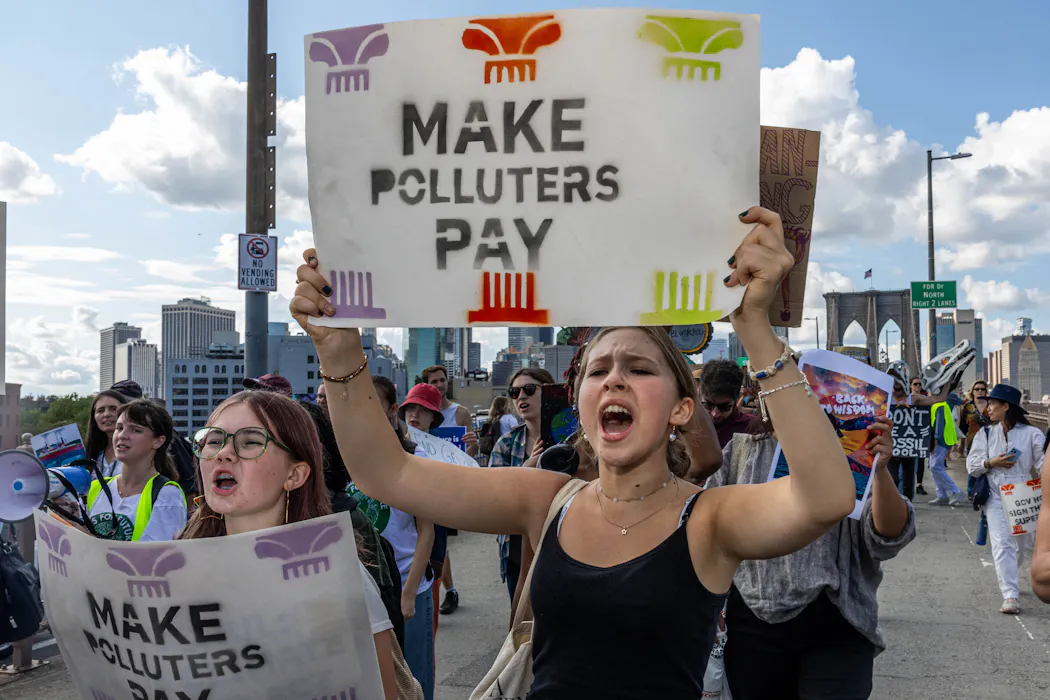
Across the U.S., people are calling for companies to pay for the damage they have done to the environment. Alex Kent/AFP via Getty Images

In recent years, at least two dozen local and state governments have sued petroleum companies to recover the billions in costs they have incurred responding to and rebuilding after flooding, storms and wildfires – all of which have been worsened by changes to the climate resulting from burning fossil fuels.

Most of these lawsuits, often filed in state courts, make a simple claim: Fossil fuel companies knew for decades that their products were harmful but concealed that fact to protect their profits. The lawsuits ask judges to order companies that have profited from the extraction and sale of fossil fuels to pay for the costs their products have imposed on the taxpaying public.

Recently, the U.S. Supreme Court agreed to hear one of these cases, Suncor Energy v. Boulder County, in the term beginning in October 2026. In their appeal to the Supreme Court, the oil companies are asking the nation’s highest court to block state courts from even considering holding the companies liable for climate-related damages.

The effort to block liability is part of a decades-long strategy by the conservative legal movement to limit victims’ ability to seek reimbursement for damage caused by corporate irresponsibility. In fact, this type of orchestrated campaign to abuse corporate power goes back well over a century in U.S. environmental legal history.

As professors with decades of experience analyzing environmental law, we believe this effort misreads the U.S. Constitution, misunderstands judicial precedent and misrepresents the role of courts in a federal system.

An aerial view of a neighborhood with muddy water filling streets and yards.
In a lawsuit, Boulder County, Colo., claims petroleum companies’ actions contributed to the climate change that exacerbated heavy rains and flooding. The lawsuit also alleges that the companies knew their products were dangerous to the environment, and sold them anyway. Matt Jonas/Digital First Media/Boulder Daily Camera via Getty Images

Foreign relations and national security justifications

One type of argument companies are using to try to limit their liability involves the federal government’s authority to conduct foreign affairs and protect national security. Federal courts have long applied a “customary policy of deference to the President” in matters of foreign affairs because the Constitution gives the president powers to enter treaties, appoint ambassadors, and the like.

Some prominent conservative legal scholars have tried to extend this concept by claiming that allowing lawsuits seeking compensation for climate-related damages to proceed would penalize multinational corporations doing business in the United States. They say such cases would interfere with the federal government’s ability to conduct the nation’s foreign affairs.

The Office of the Solicitor General – the government’s top litigation attorney – is making that argument to the Supreme Court in the Suncor case. It claims that by lodging authority over the nation’s foreign affairs in the federal government, the Constitution limits local governments’ ability to sue multinational corporations. Some legal academics support this claim by relying on a 2015 Supreme Court decision that states the nation must “speak with one voice” on foreign affairs.

But that case concerned the president’s narrow power to formally recognize foreign governments, which differs from corporate liability in state court for harms occurring in the U.S. As scholars at the Transnational Litigation Blog have noted, elimination of state law based on the federal government’s power to determine the nation’s foreign affairs is a “controversial and mostly moribund” doctrine. Applying it to suits in which defendants caused harm within the state is a stretch.

More troubling, the argument could prevent any lawsuit against energy, asbestos, pharmaceutical, or other multinational corporations. Unsurprisingly, both the Colorado and Hawaii Supreme Courts have rejected this reasoning. The Colorado court stated that Boulder’s suit involves areas of traditional state responsibility. It denied that Boulder was “seeking to implement foreign policy” or that its claims “intrude(d) on any power over foreign policy … reserved to the federal government.”

The Trump administration and its energy company allies have also tried to invoke national security as a a reason to dismiss these suits. The administration and the companies claim that forcing oil companies to defend these suits would reduce production of needed energy supplies. But that claim is completely unsubstantiated.

A fire truck drives by a burned-out home.
Wildfires like the one in Fourmile Canyon, Colo., in 2010, have been made more likely and worse by greenhouse gas emissions, which increase air temperatures and dry out vegetation. AP Photo/Jae C. Hong

Clean Air Act preemption

The oil companies also argue that the federal Clean Air Act preempts local claims in state courts like those made by Boulder County.

Many local claims are based on longstanding doctrines that allow court-ordered remedies for infringements like “nuisance,” which involve interfering with the public’s interest in health, safety, and welfare or enjoyment of private property.

In 2011, the Supreme Court found that the Clean Air Act blocks federal claims that air pollution is a nuisance. But it left open whether the act would also prevent similar state law cases. Numerous other Supreme Court decisions have declared that courts should presume that federal laws do not block claims in areas of traditional state authority. Since the nation’s founding, state courts have had jurisdiction over cases, like Suncor, that deal with liability for damage caused by a defendant’s wrongdoing.

In fact, the Clean Air Act includes a provision that explicitly preserves rights and remedies created and administered by state courts. Rather than seeking to regulate pollution, lawsuits like Suncor claim that the oil industry knew for decades that its product was dangerous but concealed that fact to protect its profits. The Clean Air Act does not regulate corporate fraud or deception, and no federal statute has ever preempted state law deception claims.

Even if the Supreme Court were to find that liability for fraudulent marketing is functionally equivalent to regulating emissions, that should not block state-level lawsuits. In 1984, the Supreme Court found that even the Atomic Energy Act – which comprehensively regulates management of nuclear materials and facilities, a matter of recognized federal concern – did not prevent state lawsuits to recover damages caused by a company with a federal license to operate a nuclear plant. The court stated it was “inconceivable that Congress intended to leave victims” without a remedy.

The same logic applies in these climate-damage cases. The Clean Air Act provides no compensation to communities that bear wildfire, flood, and infrastructure costs due to climate change. Preventing local governments from suing would leave local governments and the constituents they represent with no way to seek compensation for harms they have suffered. As the Supreme Court said in 2005, “If Congress had wanted to deprive injured parties of a long available form of compensation, it surely would have expressed that intent more clearly.” It did not do so in the Clean Air Act.

More generally, federal environmental laws protect wide-ranging public interests by regulating future behavior. State court damage claims seek to compensate specific victims for past harms. In building the modern environmental regulatory framework, Congress undeniably assumed that longstanding state laws that impose civil liability for irresponsible behavior would continue to be available to compensate those harmed by such actions.

People stand on a road that has been eroded by water, which still runs nearby.
Climate-related natural disasters have caused billions of dollars in damage in the U.S. alone. Marc Piscotty/Getty Images

A back-up plan

The energy industry and its political allies are already planning for the possibility that the Supreme Court will reject their pleas for immunity. U.S. Rep. Harriet Hageman, a Wyoming Republican, and Sen. Ted Cruz, a Republican from Texas, have introduced legislation that would block any lawsuits in state or federal courts based on state laws requiring energy businesses to pay for climate-related damage.

The bills are in the early stages in Congress. However, they are also based on the flawed idea that the federal government’s power over national security and foreign affairs bars the rights of local communities and individuals to seek redress for harms they have experienced.

Conservative legal scholars and practitioners have long sought to shield irresponsible corporations from answering for the harms they cause.

We believe people and communities who have suffered harm from companies deserve their day in court. Claiming that the Constitution requires local taxpayers to endure these harms without a chance to prove their case is not a defense of national security. It is a defense of corporate impunity.

The Conversation

The authors do not work for, consult, own shares in or receive funding from any company or organization that would benefit from this article, and have disclosed no relevant affiliations beyond their academic appointment.

  •  

The US Constitution and laws do not protect oil companies from being sued over the harm they cause to the climate

Across the U.S., people are calling for companies to pay for the damage they have done to the environment. Alex Kent/AFP via Getty Images

In recent years, at least two dozen local and state governments have sued petroleum companies to recover the billions in costs they have incurred responding to and rebuilding after flooding, storms and wildfires – all of which have been worsened by changes to the climate resulting from burning fossil fuels.

Most of these lawsuits, often filed in state courts, make a simple claim: Fossil fuel companies knew for decades that their products were harmful but concealed that fact to protect their profits. The lawsuits ask judges to order companies that have profited from the extraction and sale of fossil fuels to pay for the costs their products have imposed on the taxpaying public.

Recently, the U.S. Supreme Court agreed to hear one of these cases, Suncor Energy v. Boulder County, in the term beginning in October 2026. In their appeal to the Supreme Court, the oil companies are asking the nation’s highest court to block state courts from even considering holding the companies liable for climate-related damages.

The effort to block liability is part of a decades-long strategy by the conservative legal movement to limit victims’ ability to seek reimbursement for damage caused by corporate irresponsibility. In fact, this type of orchestrated campaign to abuse corporate power goes back well over a century in U.S. environmental legal history.

As professors with decades of experience analyzing environmental law, we believe this effort misreads the U.S. Constitution, misunderstands judicial precedent and misrepresents the role of courts in a federal system.

An aerial view of a neighborhood with muddy water filling streets and yards.
In a lawsuit, Boulder County, Colo., claims petroleum companies’ actions contributed to the climate change that exacerbated heavy rains and flooding. The lawsuit also alleges that the companies knew their products were dangerous to the environment, and sold them anyway. Matt Jonas/Digital First Media/Boulder Daily Camera via Getty Images

Foreign relations and national security justifications

One type of argument companies are using to try to limit their liability involves the federal government’s authority to conduct foreign affairs and protect national security. Federal courts have long applied a “customary policy of deference to the President” in matters of foreign affairs because the Constitution gives the president powers to enter treaties, appoint ambassadors, and the like.

Some prominent conservative legal scholars have tried to extend this concept by claiming that allowing lawsuits seeking compensation for climate-related damages to proceed would penalize multinational corporations doing business in the United States. They say such cases would interfere with the federal government’s ability to conduct the nation’s foreign affairs.

The Office of the Solicitor General – the government’s top litigation attorney – is making that argument to the Supreme Court in the Suncor case. It claims that by lodging authority over the nation’s foreign affairs in the federal government, the Constitution limits local governments’ ability to sue multinational corporations. Some legal academics support this claim by relying on a 2015 Supreme Court decision that states the nation must “speak with one voice” on foreign affairs.

But that case concerned the president’s narrow power to formally recognize foreign governments, which differs from corporate liability in state court for harms occurring in the U.S. As scholars at the Transnational Litigation Blog have noted, elimination of state law based on the federal government’s power to determine the nation’s foreign affairs is a “controversial and mostly moribund” doctrine. Applying it to suits in which defendants caused harm within the state is a stretch.

More troubling, the argument could prevent any lawsuit against energy, asbestos, pharmaceutical, or other multinational corporations. Unsurprisingly, both the Colorado and Hawaii Supreme Courts have rejected this reasoning. The Colorado court stated that Boulder’s suit involves areas of traditional state responsibility. It denied that Boulder was “seeking to implement foreign policy” or that its claims “intrude(d) on any power over foreign policy … reserved to the federal government.”

The Trump administration and its energy company allies have also tried to invoke national security as a a reason to dismiss these suits. The administration and the companies claim that forcing oil companies to defend these suits would reduce production of needed energy supplies. But that claim is completely unsubstantiated.

A fire truck drives by a burned-out home.
Wildfires like the one in Fourmile Canyon, Colo., in 2010, have been made more likely and worse by greenhouse gas emissions, which increase air temperatures and dry out vegetation. AP Photo/Jae C. Hong

Clean Air Act preemption

The oil companies also argue that the federal Clean Air Act preempts local claims in state courts like those made by Boulder County.

Many local claims are based on longstanding doctrines that allow court-ordered remedies for infringements like “nuisance,” which involve interfering with the public’s interest in health, safety, and welfare or enjoyment of private property.

In 2011, the Supreme Court found that the Clean Air Act blocks federal claims that air pollution is a nuisance. But it left open whether the act would also prevent similar state law cases. Numerous other Supreme Court decisions have declared that courts should presume that federal laws do not block claims in areas of traditional state authority. Since the nation’s founding, state courts have had jurisdiction over cases, like Suncor, that deal with liability for damage caused by a defendant’s wrongdoing.

In fact, the Clean Air Act includes a provision that explicitly preserves rights and remedies created and administered by state courts. Rather than seeking to regulate pollution, lawsuits like Suncor claim that the oil industry knew for decades that its product was dangerous but concealed that fact to protect its profits. The Clean Air Act does not regulate corporate fraud or deception, and no federal statute has ever preempted state law deception claims.

Even if the Supreme Court were to find that liability for fraudulent marketing is functionally equivalent to regulating emissions, that should not block state-level lawsuits. In 1984, the Supreme Court found that even the Atomic Energy Act – which comprehensively regulates management of nuclear materials and facilities, a matter of recognized federal concern – did not prevent state lawsuits to recover damages caused by a company with a federal license to operate a nuclear plant. The court stated it was “inconceivable that Congress intended to leave victims” without a remedy.

The same logic applies in these climate-damage cases. The Clean Air Act provides no compensation to communities that bear wildfire, flood, and infrastructure costs due to climate change. Preventing local governments from suing would leave local governments and the constituents they represent with no way to seek compensation for harms they have suffered. As the Supreme Court said in 2005, “If Congress had wanted to deprive injured parties of a long available form of compensation, it surely would have expressed that intent more clearly.” It did not do so in the Clean Air Act.

More generally, federal environmental laws protect wide-ranging public interests by regulating future behavior. State court damage claims seek to compensate specific victims for past harms. In building the modern environmental regulatory framework, Congress undeniably assumed that longstanding state laws that impose civil liability for irresponsible behavior would continue to be available to compensate those harmed by such actions.

People stand on a road that has been eroded by water, which still runs nearby.
Climate-related natural disasters have caused billions of dollars in damage in the U.S. alone. Marc Piscotty/Getty Images

A back-up plan

The energy industry and its political allies are already planning for the possibility that the Supreme Court will reject their pleas for immunity. U.S. Rep. Harriet Hageman, a Wyoming Republican, and Sen. Ted Cruz, a Republican from Texas, have introduced legislation that would block any lawsuits in state or federal courts based on state laws requiring energy businesses to pay for climate-related damage.

The bills are in the early stages in Congress. However, they are also based on the flawed idea that the federal government’s power over national security and foreign affairs bars the rights of local communities and individuals to seek redress for harms they have experienced.

Conservative legal scholars and practitioners have long sought to shield irresponsible corporations from answering for the harms they cause.

We believe people and communities who have suffered harm from companies deserve their day in court. Claiming that the Constitution requires local taxpayers to endure these harms without a chance to prove their case is not a defense of national security. It is a defense of corporate impunity.

The Conversation

The authors do not work for, consult, own shares in or receive funding from any company or organization that would benefit from this article, and have disclosed no relevant affiliations beyond their academic appointment.

  •  

Video shows ICE violently arresting Oregon farm workers and using facial recognition

Exclusive: Body-cam footage shared with the Guardian shows agents forced workers out of a van in what a judge has called ‘unlawful’ arrest

Newly released body-camera footage shows US immigration officers stopping a van of farm workers in Oregon, smashing their windows and using facial recognition software to try to identify one of them.

Videos from a 30 October 2025 operation were disclosed in court as part of an ongoing class-action lawsuit challenging Immigration and Customs Enforcement’s (ICE) arrest tactics and racial profiling by agents. Lawyers for one of the detained farm workers shared the footage with the Guardian.

Continue reading...

© Photograph: Innovation Law Lab

© Photograph: Innovation Law Lab

© Photograph: Innovation Law Lab

  •  

Did Trump really rescue Venezuela? – podcast

Tom Phillips on life in the country four months after the US abduction of the former president Nicolás Maduro

“The last time I flew out of Venezuela was right at the start of August 2024, just after the disputed presidential election,” the Guardian’s Latin America correspondent, Tom Phillips, tells Annie Kelly.

“It was a moment of real turmoil. There was a huge wave of repression that was unfolding as Nicolás Maduro tried to silence any kind of dissent to his bogus claim to have won that election. Thousands were thrown in prison, many were going underground, and journalists were racing to get out of the country.”

Continue reading...

© Photograph: Andrea Hernández Briceño/The Guardian

© Photograph: Andrea Hernández Briceño/The Guardian

© Photograph: Andrea Hernández Briceño/The Guardian

  •  

From beef ribs to a ‘heavenly’ walk: Xi-Trump summit symbolism underscored American power and Chinese tradition

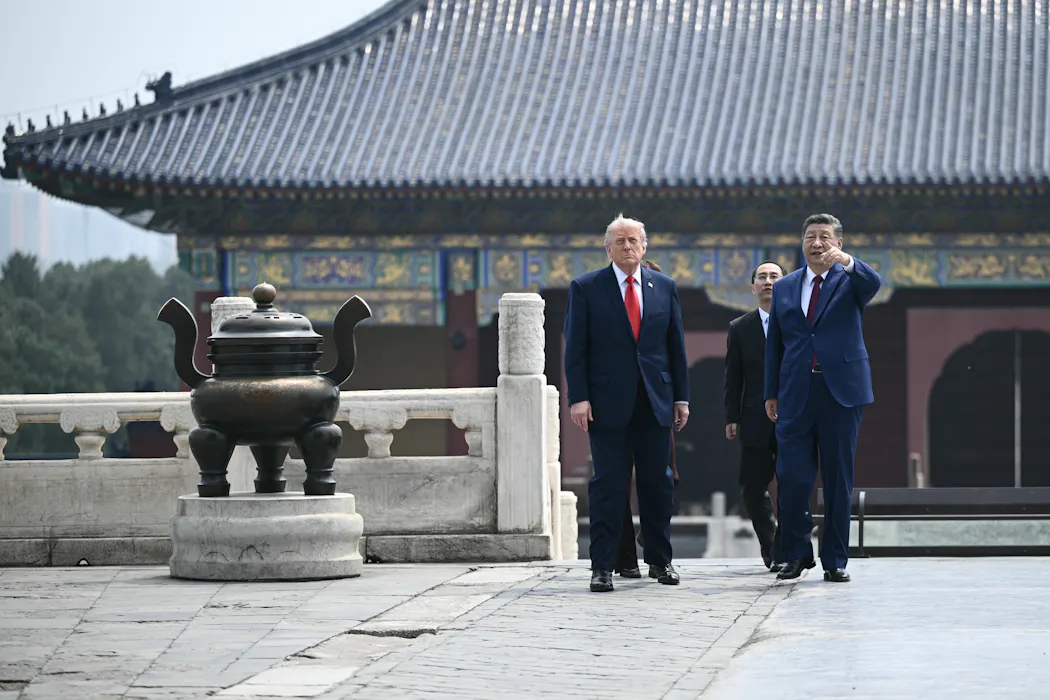
China's President Xi Jinping and U.S. President Donald Trump visit the Temple of Heaven in Beijing on May 14, 2026. Brendan Smialowski/Getty Images

Diplomacy often masquerades as theater. And nearly nine years after his first state visit to China, Donald Trump returned to Beijing with an extended cast of characters.

Alongside the U.S. president on his May 2026 visit was a senior delegation of politicians including his secretary of defense, and a phalanx of business leaders and technology executives. It was a traveling display of American political and corporate power.

Not that the hosting Chinese were short of symbolic gestures themselves. Trump’s first China visit in 2017 had already shown how far Beijing was willing to go to turn diplomacy into theater. On that occasion, Chinese President Xi Jinping and his wife Peng Liyuan personally accompanied Donald and Melania Trump through the Forbidden City, Beijing’s former imperial palace, drinking tea inside the palace walls and taking in a Peking opera at the Belvedere of Pleasant Sounds, a Qing imperial theater built for court entertainment.

So what was being conveyed this time around? As a cultural historian of modern China, I took a peek beyond the official statements and trade headlines of the Xi-Trump summit and into the images, gestures and cultural symbolism on display.

Two men in suits look away from the cabinet.
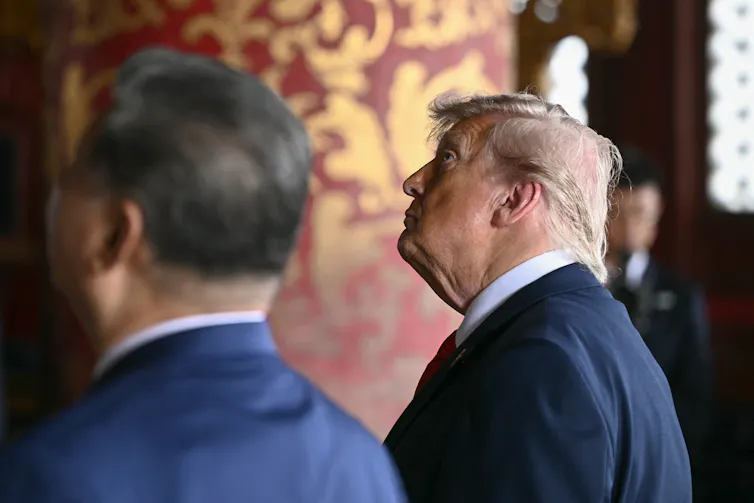
China’s President Xi Jinping and U.S. President Donald Trump at the Temple of Heaven in Beijing on May 14, 2026. Brendan Smialowski/ AFP via Getty Images

The weight of heaven

The formal choreography began at Beijing’s Great Hall of the People, where the two leaders exchanged views on the Iran conflict, the war in Ukraine and the Korean Peninsula, among other items.

But the more interesting story of the visit, to me, was told outside the meeting room.

After their two-hour bilateral meeting, Trump and Xi paid a cultural visit to the Temple of Heaven in Southern Beijing. Built in the early 15th century, the temple is China’s most complete surviving imperial religious complex. For nearly five centuries, emperors of the Ming and Qing dynasties came here to worship Heaven and pray for good harvests.

Its most recognizable structure, the Hall of Prayer for Good Harvests, rises in three tiers of blue-glazed tiles above a marble platform, its circular form and crimson columns translating cosmology into architecture. UNESCO inscribed the site as a World Heritage Site in 1998, recognizing it as “a masterpiece of architecture and landscape design.”

When Trump and Xi posed for photographs, they were standing in a place long associated with cosmic order and the welfare of the people. To bring a foreign leader there is to invite a particular reading of the relationship: not simply as a bargain between states, but as a relationship that Beijing hopes to associate with order, abundance and peace.

There was also a more practical layer to this symbolism. The Temple of Heaven links political authority to agricultural abundance. Emperors came here to pray not for abstract harmony but for grain. That made it a pointed setting for a visit in which American agricultural exports — soybeans, grains and beef among them — were expected to matter.

For Trump, any Chinese commitment to buy more U.S. farm goods would have clear domestic political value. For Xi, the setting allowed a hard bargaining issue — farm purchases — to be translated into an older symbolic language of harvest that spoke to both domestic and international audiences.

Before Trump, Kissinger

Trump was not the first American statesman to be brought to the Temple of Heaven.

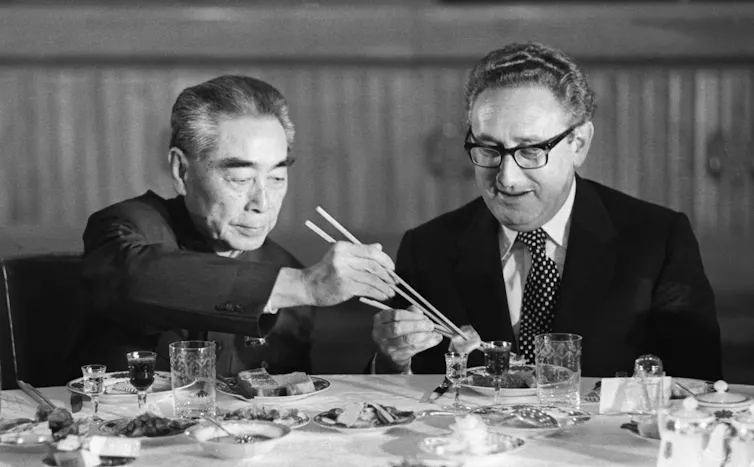
In July 1971, Henry Kissinger, then national security adviser to President Richard Nixon, arrived in Beijing on his famous secret mission — the back-channel visit that helped re-open the door between two countries that had little direct contact for more than two decades. Between tense negotiations with Chinese premier Zhou Enlai, Kissinger made time to visit the temple.

There, standing amid the old cypress groves, he was said to have been deeply moved by the timeless atmosphere of the hall and its surroundings.

A man uses chopsticks to transfer food to another man's dish
Henry Kissinger accepts food from Chinese Premier Zhou Enlai during a state banquet in the Great Hall of the People in Beijing in 1973. Bettman/Getty Images

The motif of old trees and deep time returned on May 15, when Xi gave Trump a rare walk through Zhongnanhai, the walled compound that now houses the core of China’s party-state leadership. Reuters reported that a hot mic captured Xi drawing Trump’s attention to the age of the trees around them — some centuries old, some said to be more than a thousand years old. When Trump asked whether Xi had taken other presidents on similar walks, Xi replied that he had only rarely.

Together, the Kissinger anecdote and the Zhongnanhai walk reveal a recurring logic in Chinese-American diplomacy: America’s fast-moving economy is invited to look at China’s sense of tradition. Xi has used this tactic with other leaders, too. When French President Emmanuel Macron visited China in 2023, he attended a guqin performance invoking the classical idea of the zhiyin — the rare listener who truly understands one’s music.

Basketball and roast duck

Trump’s visit was not staged only through imperial grandeur, however. It also moved into a more familiar register: food, sports and popular culture.

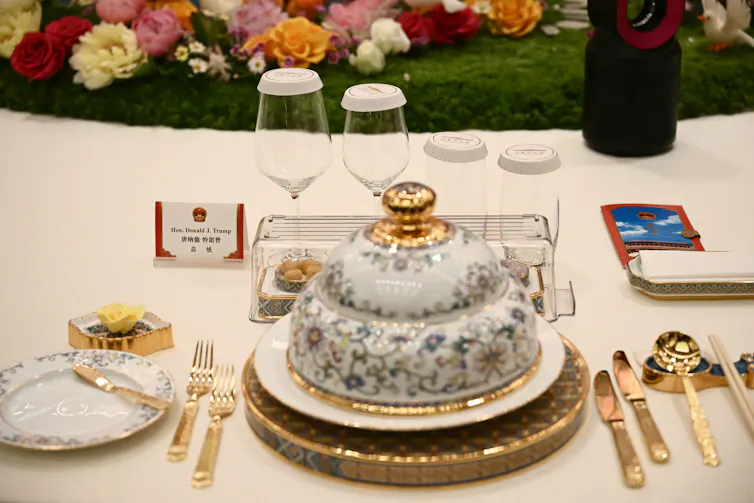
The state dinner on May 14 was another study in careful hospitality. Chefs designed the menu to honor both Chinese culinary prestige and Americans’ — and Trump’s — known preferences: Peking roast duck, crispy beef ribs, pan-fried pork bun, tiramisu and fruit and ice cream.

The table setting for U.S. President Donald Trump at a state banquet with China’s President Xi Jinping at the Great Hall of the People in Beijing on May 14, 2026. Brendan Smialowski/AFP via Getty Images

Trump thanked Xi for a “magnificent welcome like none other,” then replied in a language more recognizably his own. He spoke not only of power politics but of people-to-people ties: Chinese workers who helped build America’s railroads, Chinese enthusiasm for basketball and blue jeans and the sheer presence of Chinese restaurants across the U.S.

The examples were characteristically Trumpian — simple, vivid and easy to grasp. But they pointed to something important. U.S.–China relations have never been made only by presidents, diplomats and official communiques. They have also been shaped by athletes, musicians, restaurant owners, students and tourists.

The basketball reference was especially resonant. Sports have long offered a softer language for U.S.–China relations. In April 2026, just weeks before Trump’s visit, China and the U.S. marked the 55th anniversary of ping-pong diplomacy — the famous 1971 exchange in which a “little ball” helped move the “big ball” of world politics.

Basketball now plays a similar role. For many Chinese fans, the NBA is a deeply familiar world of players, teams and memories that represents the spirit of America: Michael Jordan, Kobe Bryant, LeBron James and Yao Ming. That reservoir of affection has survived even periods of political tension. Trump, in invoking it, was drawing on something real.

A second act in the US?

The main lesson of all this symbolism is that, in U.S.–China relations, atmosphere has never been secondary.

Diplomatic theater cannot settle disputes over technology or Taiwan, or determine the future of the global order. But it can shape the mood in which rivalries are managed, and the stories that leaders tell their public about what the relationship means.

And on that front, the summit worked on several levels. To the Chinese audience, it presented their leaders as confident and capable of managing a tense relationship with the U.S. on China’s own cultural terms.

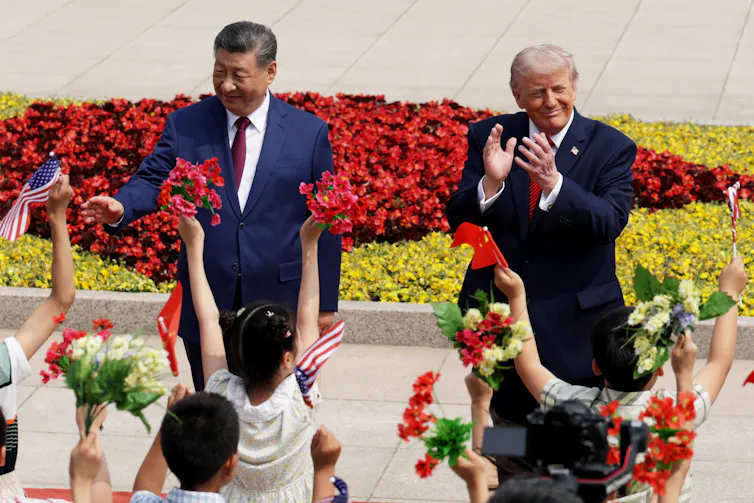
Two men in suits wave and clap hands in front of children.
U.S. President Donald Trump and Chinese President Xi Jinping attend a welcome ceremony at the Great Hall of the People on May 14, 2026, in Beijing, China. Alex Wong/Getty Images

For Trump and the American delegation, it offered a lesson in Chinese traditions and culture that promotes deeper understanding across political divides. And for both societies, the references for food, sports and popular culture created a more neutral ground on which connection could still be imagined.

From the 1970s opening to Trump’s 2017 visit to the Forbidden City, and from the Temple of Heaven photo-op to the walk among old trees at Zhongnanhai in 2026, cultural staging remains central to how China presents itself to America — and how America is invited to imagine China. It was announced on May 15 that Xi will pay a state visit to the U.S. in September at the invitation of Trump. If that happens, the theater of diplomacy will move to American soil, and the question will be how Washington chooses to stage China in return.

The Conversation

Xianda Huang does not work for, consult, own shares in or receive funding from any company or organization that would benefit from this article, and has disclosed no relevant affiliations beyond their academic appointment.

  •  

From beef ribs to a ‘heavenly’ walk: Xi-Trump summit symbolism underscored American power and Chinese tradition

China's President Xi Jinping and U.S. President Donald Trump visit the Temple of Heaven in Beijing on May 14, 2026. Brendan Smialowski/Getty Images

Diplomacy often masquerades as theater. And nearly nine years after his first state visit to China, Donald Trump returned to Beijing with an extended cast of characters.

Alongside the U.S. president on his May 2026 visit was a senior delegation of politicians including his secretary of defense, and a phalanx of business leaders and technology executives. It was a traveling display of American political and corporate power.

Not that the hosting Chinese were short of symbolic gestures themselves. Trump’s first China visit in 2017 had already shown how far Beijing was willing to go to turn diplomacy into theater. On that occasion, Chinese President Xi Jinping and his wife Peng Liyuan personally accompanied Donald and Melania Trump through the Forbidden City, Beijing’s former imperial palace, drinking tea inside the palace walls and taking in a Peking opera at the Belvedere of Pleasant Sounds, a Qing imperial theater built for court entertainment.

So what was being conveyed this time around? As a cultural historian of modern China, I took a peek beyond the official statements and trade headlines of the Xi-Trump summit and into the images, gestures and cultural symbolism on display.

Two men in suits look away from the cabinet.
China’s President Xi Jinping and U.S. President Donald Trump at the Temple of Heaven in Beijing on May 14, 2026. Brendan Smialowski/ AFP via Getty Images

The weight of heaven

The formal choreography began at Beijing’s Great Hall of the People, where the two leaders exchanged views on the Iran conflict, the war in Ukraine and the Korean Peninsula, among other items.

But the more interesting story of the visit, to me, was told outside the meeting room.

After their two-hour bilateral meeting, Trump and Xi paid a cultural visit to the Temple of Heaven in Southern Beijing. Built in the early 15th century, the temple is China’s most complete surviving imperial religious complex. For nearly five centuries, emperors of the Ming and Qing dynasties came here to worship Heaven and pray for good harvests.

Its most recognizable structure, the Hall of Prayer for Good Harvests, rises in three tiers of blue-glazed tiles above a marble platform, its circular form and crimson columns translating cosmology into architecture. UNESCO inscribed the site as a World Heritage Site in 1998, recognizing it as “a masterpiece of architecture and landscape design.”

When Trump and Xi posed for photographs, they were standing in a place long associated with cosmic order and the welfare of the people. To bring a foreign leader there is to invite a particular reading of the relationship: not simply as a bargain between states, but as a relationship that Beijing hopes to associate with order, abundance and peace.

There was also a more practical layer to this symbolism. The Temple of Heaven links political authority to agricultural abundance. Emperors came here to pray not for abstract harmony but for grain. That made it a pointed setting for a visit in which American agricultural exports — soybeans, grains and beef among them — were expected to matter.

For Trump, any Chinese commitment to buy more U.S. farm goods would have clear domestic political value. For Xi, the setting allowed a hard bargaining issue — farm purchases — to be translated into an older symbolic language of harvest that spoke to both domestic and international audiences.

Before Trump, Kissinger

Trump was not the first American statesman to be brought to the Temple of Heaven.

In July 1971, Henry Kissinger, then national security adviser to President Richard Nixon, arrived in Beijing on his famous secret mission — the back-channel visit that helped re-open the door between two countries that had little direct contact for more than two decades. Between tense negotiations with Chinese premier Zhou Enlai, Kissinger made time to visit the temple.

There, standing amid the old cypress groves, he was said to have been deeply moved by the timeless atmosphere of the hall and its surroundings.

A man uses chopsticks to transfer food to another man's dish
Henry Kissinger accepts food from Chinese Premier Zhou Enlai during a state banquet in the Great Hall of the People in Beijing in 1973. Bettman/Getty Images

The motif of old trees and deep time returned on May 15, when Xi gave Trump a rare walk through Zhongnanhai, the walled compound that now houses the core of China’s party-state leadership. Reuters reported that a hot mic captured Xi drawing Trump’s attention to the age of the trees around them — some centuries old, some said to be more than a thousand years old. When Trump asked whether Xi had taken other presidents on similar walks, Xi replied that he had only rarely.

Together, the Kissinger anecdote and the Zhongnanhai walk reveal a recurring logic in Chinese-American diplomacy: America’s fast-moving economy is invited to look at China’s sense of tradition. Xi has used this tactic with other leaders, too. When French President Emmanuel Macron visited China in 2023, he attended a guqin performance invoking the classical idea of the zhiyin — the rare listener who truly understands one’s music.

Basketball and roast duck

Trump’s visit was not staged only through imperial grandeur, however. It also moved into a more familiar register: food, sports and popular culture.

The state dinner on May 14 was another study in careful hospitality. Chefs designed the menu to honor both Chinese culinary prestige and Americans’ — and Trump’s — known preferences: Peking roast duck, crispy beef ribs, pan-fried pork bun, tiramisu and fruit and ice cream.

The table setting for U.S. President Donald Trump at a state banquet with China’s President Xi Jinping at the Great Hall of the People in Beijing on May 14, 2026. Brendan Smialowski/AFP via Getty Images

Trump thanked Xi for a “magnificent welcome like none other,” then replied in a language more recognizably his own. He spoke not only of power politics but of people-to-people ties: Chinese workers who helped build America’s railroads, Chinese enthusiasm for basketball and blue jeans and the sheer presence of Chinese restaurants across the U.S.

The examples were characteristically Trumpian — simple, vivid and easy to grasp. But they pointed to something important. U.S.–China relations have never been made only by presidents, diplomats and official communiques. They have also been shaped by athletes, musicians, restaurant owners, students and tourists.

The basketball reference was especially resonant. Sports have long offered a softer language for U.S.–China relations. In April 2026, just weeks before Trump’s visit, China and the U.S. marked the 55th anniversary of ping-pong diplomacy — the famous 1971 exchange in which a “little ball” helped move the “big ball” of world politics.

Basketball now plays a similar role. For many Chinese fans, the NBA is a deeply familiar world of players, teams and memories that represents the spirit of America: Michael Jordan, Kobe Bryant, LeBron James and Yao Ming. That reservoir of affection has survived even periods of political tension. Trump, in invoking it, was drawing on something real.

A second act in the US?

The main lesson of all this symbolism is that, in U.S.–China relations, atmosphere has never been secondary.

Diplomatic theater cannot settle disputes over technology or Taiwan, or determine the future of the global order. But it can shape the mood in which rivalries are managed, and the stories that leaders tell their public about what the relationship means.

And on that front, the summit worked on several levels. To the Chinese audience, it presented their leaders as confident and capable of managing a tense relationship with the U.S. on China’s own cultural terms.

Two men in suits wave and clap hands in front of children.
U.S. President Donald Trump and Chinese President Xi Jinping attend a welcome ceremony at the Great Hall of the People on May 14, 2026, in Beijing, China. Alex Wong/Getty Images

For Trump and the American delegation, it offered a lesson in Chinese traditions and culture that promotes deeper understanding across political divides. And for both societies, the references for food, sports and popular culture created a more neutral ground on which connection could still be imagined.

From the 1970s opening to Trump’s 2017 visit to the Forbidden City, and from the Temple of Heaven photo-op to the walk among old trees at Zhongnanhai in 2026, cultural staging remains central to how China presents itself to America — and how America is invited to imagine China. It was announced on May 15 that Xi will pay a state visit to the U.S. in September at the invitation of Trump. If that happens, the theater of diplomacy will move to American soil, and the question will be how Washington chooses to stage China in return.

The Conversation

Xianda Huang does not work for, consult, own shares in or receive funding from any company or organization that would benefit from this article, and has disclosed no relevant affiliations beyond their academic appointment.

  •  

From beef ribs to a ‘heavenly’ walk: Xi-Trump summit symbolism underscored American power and Chinese tradition

China's President Xi Jinping and U.S. President Donald Trump visit the Temple of Heaven in Beijing on May 14, 2026. Brendan Smialowski/Getty Images

Diplomacy often masquerades as theater. And nearly nine years after his first state visit to China, Donald Trump returned to Beijing with an extended cast of characters.

Alongside the U.S. president on his May 2026 visit was a senior delegation of politicians including his secretary of defense, and a phalanx of business leaders and technology executives. It was a traveling display of American political and corporate power.

Not that the hosting Chinese were short of symbolic gestures themselves. Trump’s first China visit in 2017 had already shown how far Beijing was willing to go to turn diplomacy into theater. On that occasion, Chinese President Xi Jinping and his wife Peng Liyuan personally accompanied Donald and Melania Trump through the Forbidden City, Beijing’s former imperial palace, drinking tea inside the palace walls and taking in a Peking opera at the Belvedere of Pleasant Sounds, a Qing imperial theater built for court entertainment.

So what was being conveyed this time around? As a cultural historian of modern China, I took a peek beyond the official statements and trade headlines of the Xi-Trump summit and into the images, gestures and cultural symbolism on display.

Two men in suits look away from the cabinet.
China’s President Xi Jinping and U.S. President Donald Trump at the Temple of Heaven in Beijing on May 14, 2026. Brendan Smialowski/ AFP via Getty Images

The weight of heaven

The formal choreography began at Beijing’s Great Hall of the People, where the two leaders exchanged views on the Iran conflict, the war in Ukraine and the Korean Peninsula, among other items.

But the more interesting story of the visit, to me, was told outside the meeting room.

After their two-hour bilateral meeting, Trump and Xi paid a cultural visit to the Temple of Heaven in Southern Beijing. Built in the early 15th century, the temple is China’s most complete surviving imperial religious complex. For nearly five centuries, emperors of the Ming and Qing dynasties came here to worship Heaven and pray for good harvests.

Its most recognizable structure, the Hall of Prayer for Good Harvests, rises in three tiers of blue-glazed tiles above a marble platform, its circular form and crimson columns translating cosmology into architecture. UNESCO inscribed the site as a World Heritage Site in 1998, recognizing it as “a masterpiece of architecture and landscape design.”

When Trump and Xi posed for photographs, they were standing in a place long associated with cosmic order and the welfare of the people. To bring a foreign leader there is to invite a particular reading of the relationship: not simply as a bargain between states, but as a relationship that Beijing hopes to associate with order, abundance and peace.

There was also a more practical layer to this symbolism. The Temple of Heaven links political authority to agricultural abundance. Emperors came here to pray not for abstract harmony but for grain. That made it a pointed setting for a visit in which American agricultural exports — soybeans, grains and beef among them — were expected to matter.

For Trump, any Chinese commitment to buy more U.S. farm goods would have clear domestic political value. For Xi, the setting allowed a hard bargaining issue — farm purchases — to be translated into an older symbolic language of harvest that spoke to both domestic and international audiences.

Before Trump, Kissinger

Trump was not the first American statesman to be brought to the Temple of Heaven.

In July 1971, Henry Kissinger, then national security adviser to President Richard Nixon, arrived in Beijing on his famous secret mission — the back-channel visit that helped re-open the door between two countries that had little direct contact for more than two decades. Between tense negotiations with Chinese premier Zhou Enlai, Kissinger made time to visit the temple.

There, standing amid the old cypress groves, he was said to have been deeply moved by the timeless atmosphere of the hall and its surroundings.

A man uses chopsticks to transfer food to another man's dish
Henry Kissinger accepts food from Chinese Premier Zhou Enlai during a state banquet in the Great Hall of the People in Beijing in 1973. Bettman/Getty Images

The motif of old trees and deep time returned on May 15, when Xi gave Trump a rare walk through Zhongnanhai, the walled compound that now houses the core of China’s party-state leadership. Reuters reported that a hot mic captured Xi drawing Trump’s attention to the age of the trees around them — some centuries old, some said to be more than a thousand years old. When Trump asked whether Xi had taken other presidents on similar walks, Xi replied that he had only rarely.

Together, the Kissinger anecdote and the Zhongnanhai walk reveal a recurring logic in Chinese-American diplomacy: America’s fast-moving economy is invited to look at China’s sense of tradition. Xi has used this tactic with other leaders, too. When French President Emmanuel Macron visited China in 2023, he attended a guqin performance invoking the classical idea of the zhiyin — the rare listener who truly understands one’s music.

Basketball and roast duck

Trump’s visit was not staged only through imperial grandeur, however. It also moved into a more familiar register: food, sports and popular culture.

The state dinner on May 14 was another study in careful hospitality. Chefs designed the menu to honor both Chinese culinary prestige and Americans’ — and Trump’s — known preferences: Peking roast duck, crispy beef ribs, pan-fried pork bun, tiramisu and fruit and ice cream.

The table setting for U.S. President Donald Trump at a state banquet with China’s President Xi Jinping at the Great Hall of the People in Beijing on May 14, 2026. Brendan Smialowski/AFP via Getty Images

Trump thanked Xi for a “magnificent welcome like none other,” then replied in a language more recognizably his own. He spoke not only of power politics but of people-to-people ties: Chinese workers who helped build America’s railroads, Chinese enthusiasm for basketball and blue jeans and the sheer presence of Chinese restaurants across the U.S.

The examples were characteristically Trumpian — simple, vivid and easy to grasp. But they pointed to something important. U.S.–China relations have never been made only by presidents, diplomats and official communiques. They have also been shaped by athletes, musicians, restaurant owners, students and tourists.

The basketball reference was especially resonant. Sports have long offered a softer language for U.S.–China relations. In April 2026, just weeks before Trump’s visit, China and the U.S. marked the 55th anniversary of ping-pong diplomacy — the famous 1971 exchange in which a “little ball” helped move the “big ball” of world politics.

Basketball now plays a similar role. For many Chinese fans, the NBA is a deeply familiar world of players, teams and memories that represents the spirit of America: Michael Jordan, Kobe Bryant, LeBron James and Yao Ming. That reservoir of affection has survived even periods of political tension. Trump, in invoking it, was drawing on something real.

A second act in the US?

The main lesson of all this symbolism is that, in U.S.–China relations, atmosphere has never been secondary.

Diplomatic theater cannot settle disputes over technology or Taiwan, or determine the future of the global order. But it can shape the mood in which rivalries are managed, and the stories that leaders tell their public about what the relationship means.

And on that front, the summit worked on several levels. To the Chinese audience, it presented their leaders as confident and capable of managing a tense relationship with the U.S. on China’s own cultural terms.

Two men in suits wave and clap hands in front of children.
U.S. President Donald Trump and Chinese President Xi Jinping attend a welcome ceremony at the Great Hall of the People on May 14, 2026, in Beijing, China. Alex Wong/Getty Images

For Trump and the American delegation, it offered a lesson in Chinese traditions and culture that promotes deeper understanding across political divides. And for both societies, the references for food, sports and popular culture created a more neutral ground on which connection could still be imagined.

From the 1970s opening to Trump’s 2017 visit to the Forbidden City, and from the Temple of Heaven photo-op to the walk among old trees at Zhongnanhai in 2026, cultural staging remains central to how China presents itself to America — and how America is invited to imagine China. It was announced on May 15 that Xi will pay a state visit to the U.S. in September at the invitation of Trump. If that happens, the theater of diplomacy will move to American soil, and the question will be how Washington chooses to stage China in return.

The Conversation

Xianda Huang does not work for, consult, own shares in or receive funding from any company or organization that would benefit from this article, and has disclosed no relevant affiliations beyond their academic appointment.

  •  
❌