Reading view

This election year budget is a political tightrope walk for Willis and National

Mark Mitchell/NZ Herald via Getty Images

An election year budget is a government’s pitch for reelection. For opposition parties, it’s a chance to make their case for change.

Unfortunately for Finance Minister Nicola Willis, her National Party can’t campaign on two of its three big fiscal policy promises from the previous election: to achieve a surplus, reduce debt and cut spending on bureaucracy.

With surplus forecasts moved out by years and government debt having risen, that only leaves the bureaucracy as a viable target.

Willis took the initiative last week with a pre-budget speech in Auckland where she announced three major goals based on National’s 2023 pledge to “reduce spending on bureaucracy”:

  • cut the number of public service agencies through amalgamations
  • embed AI into all public entities
  • return core public servant numbers to a historic norm of 1% of the population.

That would mean, by July 2029, 8,700 fewer public service employees than in December 2025. Willis claims that wouldn’t affect wider state sector employees such as teachers, nurses, doctors or police.

Speaking to Auckland business owners and managers, her message was clear: Wellington is getting serious about value for taxpayers’ money.

Using figures from the Public Service Commission, Willis pointed out that public servants had, since 1993, been around 1% of the population, but grew to 1.2% under the previous Labour government.

Bureaucrats are always a soft political target for the right, and Willis’ taxpaying business audience was apparently receptive to her message.

She chose a sharp wedge issue, however, forcing Labour and the Greens to react by defending public sector employees and attacking “austerity” policies.

Moreover, the economy has been hit by an unexpected energy crisis because of the Middle East situation.

In December, Westpac was forecasting 3.0% growth in 2026 and a decline in the unemployment rate. By this month, they’d revised that to 1.5% growth and a rise in unemployment, none of which is good for a government’s budget or its electoral prospects.

National’s fiscal challenge

Willis’ pre-budget speech was getting in ahead of any bad news she may deliver on budget day. Before the 2023 election, the National Party had offered voters a fiscal plan to “deliver the turnaround the government’s books need”, pledging to:

  • achieve a surplus in 2026/27
  • reduce government debt
  • reduce spending on bureaucracy.

Willis has refreshed that third goal, but what about the other two?

Rather than return to surplus in 2026/27 as promised, the Treasury’s December 2025 update shifted the goalpost to 2029/30. So National faces November’s election still in deficit, and the war in Iran has only made things worse.

Accordingly, government debt has risen in the past three years. The Treasury forecast net core Crown debt to rise and peak at 46.9% of GDP in 2027/28, then decline to 46.1% by 2030.

If the Superannuation Fund is included, as economist Susan St John recommends, the net debt-to-GDP figures are much lower, but they’ve still risen since 2023.

Officially, the Superannuation Fund is excluded from the calculation of net debt because it’s not available for current expenditure, and is invested in growth assets and hence volatile.

By National’s own standards, though, the government has failed to deliver on some key fiscal policies in its first term. In November, voters will determine whether it’s to be its last.

The government’s opponents can argue National’s goals were wrong to begin with.

The assumption the government is somehow “broke” and has to stop borrowing and cut spending can be challenged. But there is no political consensus about what would be a fiscally prudent “ceiling” above which public debt shouldn’t rise.

The Treasury’s “recommended prudent limit for net core Crown debt” is 50% of GDP. Other countries have gone much higher. But New Zealand is a small, almost irrelevant economy in the eyes of international investors and credit-rating agencies, so cross-country comparisons may not be helpful.

Debt and doubt

In the 1990s and 2000s, both National and Labour governments reduced net core Crown debt, starting from a level higher than at present, down to below 10%. After the global financial crisis hit in 2008, this allowed the next National government to run deficits for a few years while the economy recovered.

Willis says “the interest bill on our debt has soared to about $9 billion a year”, or about 6% of expenses. That’s a long way from being broke or unable to service loans, let alone default.

But there has to be a prudent limit to borrowing, especially for a small economy vulnerable to economic shocks. No government wants to turn their country into one of history’s sovereign debt defaulters. The consequences of that are catastrophic.

Government debt may sound boring, but it’s a vital political question for this budget and for the coming election.

The Green, Labour and NZ First parties are promising public investment funds, and they should advise voters how much they’d need to borrow overall. All taxpayers help repay the debts, after all, so they should be able to weigh borrowing up against the benefits of proposed investments.

Get ready for the usual political bunfight on budget day. But think critically about where the government – and its opponents – might lead the country.

The Conversation

Grant Duncan does not work for, consult, own shares in or receive funding from any company or organisation that would benefit from this article, and has disclosed no relevant affiliations beyond their academic appointment.

  •  

People are using AI to communicate without disclosing it. Is this morally wrong?

Imagine you have used a generative artificial intelligence (AI) tool such as ChatGPT to tidy up notes you took while in a meeting. Your colleague comments on how clear they are. You don’t disclose it was the AI that made the notes clear and not you.

Now consider a different scenario. You are at your mother’s funeral. Her best friend of many years delivers a heartfelt eulogy, wishing her well in the afterlife. But later you discover her friend did not actually write the eulogy in any way – AI did.

The undisclosed use of generative AI in these two scenarios is deceptive. But is it morally wrong?

It’s worth considering this philosophical question in detail, given the rapid uptake of generative AI and the fact research has found people may be strongly incentivised to not disclose their use of generative AI because it may impact their relationships.

This is because people take generative AI outputs, generally, to be less valuable, and regard those who use the technology as less competent and authentic.

Distinguishing different kinds of deception

Roughly speaking, if you’re engaging in a “deceptive act”, you’re trying to get someone to believe something you know is false. However, deception can come in different varieties.

Philosopher John Danaher provides a useful framework to distinguish between three forms of deception by AI or robots. This framework is useful because, just as robots might convincingly mimic human behaviours, generative AI technologies are allowing humans to do the same.

Some deceptions involve lying or misrepresenting the external world, such as telling someone you saw a horse in the street, even though you didn’t. Danaher calls these “external state” deceptions.

Other deceptions involve lying or misrepresenting facts about ourselves, such as making someone believe you’re an accomplished artist, even though the artwork you showed them was generated by AI. Danaher calls these “superficial state” deceptions.

We can also deceive others into believing we lack thoughts, feelings or competencies we actually possess, such as pretending to not understand a language we speak in order to eavesdrop. Danaher calls these “hidden state” deceptions.

So, when is deception immoral?

To go back to the first example, by not disclosing you used AI to tidy up meeting notes, you’ve allowed your colleague to believe you have the capacity to do the work, which might be true. However, you also allowed your colleague to believe that you demonstrated that capacity by doing the work, which is false. This would fall into the category of an “external state deception”.

While this deception is morally objectionable, it’s arguably ethically permissible. Trivial deceptions like this happen all the time – and surely we aren’t obligated to always disclose everything about what we do and why we do it.

For example, we don’t blink an eye at undisclosed use of spell-checking software because, in most situations, being a good speller isn’t important. But triviality depends on context. If someone used spell-checking software at a spelling bee, we might be less forgiving.

The scenario about the funeral speech is similar to the first scenario, but less trivial. Your belief over your mother’s friend’s superficial state – that they wish her well – may or may not be false. However, your belief over the external state of affairs – that the eulogy is a demonstration of those well-wishes – is certainly false.

This is more morally problematic. When we claim an AI-generated output as our own – and particularly one that aims to reflect something about ourselves – we signal to others that we not only endorse the output, but that we have authored it. In this case it matters to us that the friend is the source of the eulogy – and not AI. The external state deception is deceptive in a non-trival way.

We imply the output was directly caused by our thoughts, feelings or competencies. When we don’t disclose our use of AI, we deprive others of the kinds of information needed to form true beliefs about how the world is and how others are. This is wrong if people deserve to have such information.

However, the eulogy example can still show how not disclosing our use of AI can – all things considered – sometimes be permissible. Perhaps, for example, the friend was so wracked with grief, that having AI write the eulogy on their behalf was the only way for them to get the speech written in time for the funeral. So they endorsed the generated output as their own.

In such cases, not disclosing the use of AI may be permissible, even though still a morally objectionable kind of deception. This is because, like triviality in the first scenario, other reasons might sufficiently outweigh the wrongness of non-disclosure.

Using AI more ethically

So, how can people use generative AI more ethically?

If we are to avoid immorally deceiving others, we ought to disclose our use of it in non-trivial cases.

What makes undisclosed AI use non-trivial is malleable and context-dependent. It changes in response to social norms couched within particular social practices.

Being open about AI use gives others the opportunity to form more accurate beliefs about what we are communicating – and the internal states our communication demonstrates.

The Conversation

Siavosh Sahebi is supported by an Australian Government Research Training Program scholarship.

Thomas Montefiore receives funding from the Australian Government through the Australian Research Council.

  •  

What a list of Black Death survivors reveals about the way people recovered from plague

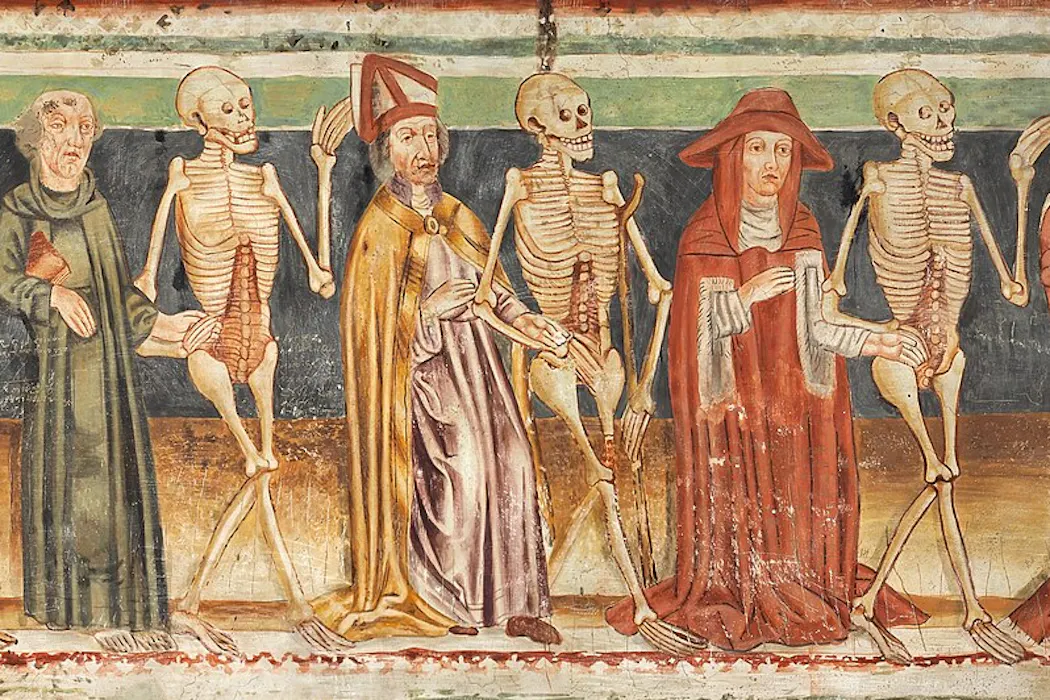
The Dance of Death by John of Kastav (1490). National Gallery of Slovenia

In our research in the British Library’s medieval collections, we have identified a previously unnoticed document that provides fresh insights into the survivors of the outbreak of plague known as the Black Death (1346–53).

The document – a scrap of parchment inserted into an account of the Ramsey Abbey manor of Warboys in Huntingdonshire – records how much time peasants were absent from work when struck down by the plague. It also reveals the names of those who survived and how long their employers believed recovery could take.

In our recent paper with Barney Sloane we shed new light on a group of 22 tenants who probably contracted plague, languished on their sickbeds for several weeks, and then recovered.

As one of the deadliest pandemics in recorded history, it has been estimated that between a third and two-thirds of the population of medieval Europe died during the Black Death.

Painting of a grim landscape destroyed by plague
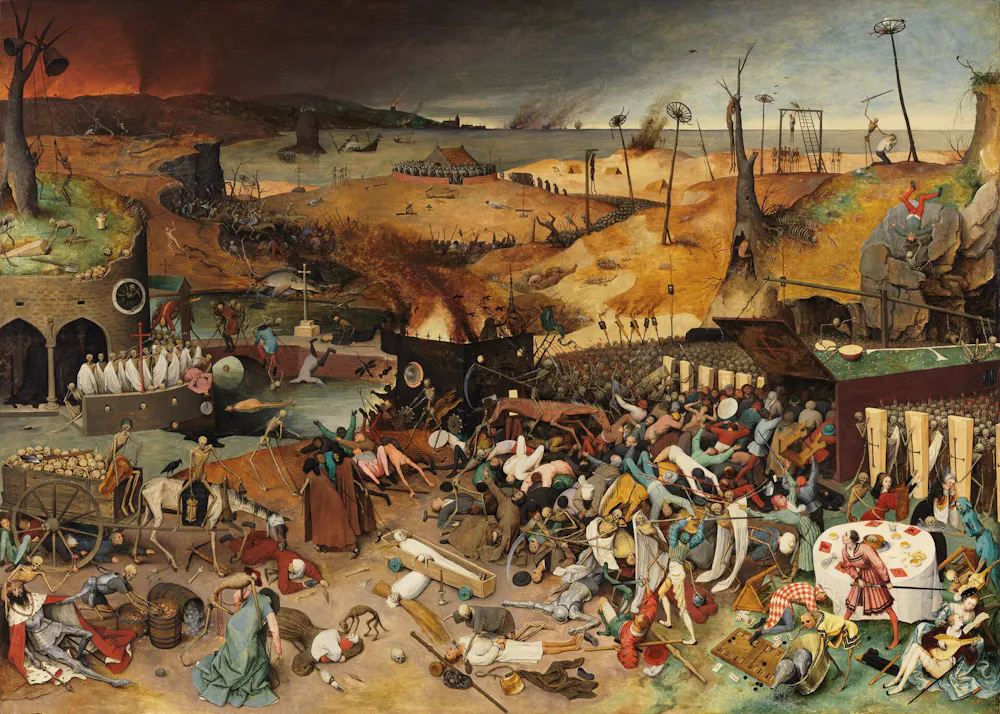
The Triumph of Death by Pieter Bruegel the Elder (1562) shows the social upheaval that followed the plague. Museo del Prado

Given the sheer scale, many historians have focused on discovering details about those who died. Yet this has left the histories of those who contracted plague and recovered largely untold.

Despite the deadliness of the disease, it was possible to recover from plague, and medieval chroniclers mention the possibility – however unlikely – of survival. For example, Geoffrey le Baker, a clerk of Swinbrook in Oxfordshire, wrote in the following decade that he thought recovery depended on people’s symptoms:

People who one day had been full of happiness, on the next were found dead. Some were tormented by boils which broke out suddenly in various parts of the body, and were so hard and dry that when they were lanced hardly any liquid flowed out. Many of these people escaped, by lancing the boils or by long suffering. Other victims had little black pustules scattered over the skin of the whole body. Of these people very few, indeed hardly any, recovered life and health.

But who recovered? Why did so many succumb to the disease when others survived? And just how long was this “long suffering”? Unfortunately, there is remarkably little documentary evidence because most medieval sources record information about mortality rather than ill health.

Unique list of plague survivors

A unique inclusion in the account of the manor of Warboys details a group of people who fell ill between the end of April and the start of August 1349. The monks of Ramsey Abbey wrote a list of their tenants who had fallen sufficiently sick that they could not work on the lord’s lands and detailed the length of time that they were absent.

People were clearly affected differently by their experience of plague.

The quickest recovery was that of Henry Broun who missed just a single week of work. By contrast, John Derworth and Agnes Mold had much more protracted illnesses and were both absent for nine weeks.

The average length of illness was between three and four weeks, with three-quarters of people returning to work in under a month. The speed of their recoveries is all the more surprising given that they were entitled to up to a year and a day of sick leave from work.

This list of survivors includes a preponderance of tenants who occupied larger holdings on the manor. It has long been debated by historians and archaeologists whether the plague killed indiscriminately, with no regard to status, sex or age, or whether the poor and elderly were more vulnerable.

The survival of so many wealthier tenants could indicate that their higher living standards enabled them to recover more readily than their poorer neighbours, perhaps because they were able to stave off secondary infections and complications. We should not read any significance into the fact that 19 out of the 22 people were men: this reflects the gender bias of manorial landholding rather than any sex-selectivity of plague.

Although 22 people may not seem like many, in a regular year during the 1340s, only two or three absences were recorded during the summer months. It, therefore, represents a tenfold increase in regular illnesses on the manor. Put another way, these sick tenants were absent for 91 weeks’ worth of labour services during just a 13-week period.

Medieval drawing of men harvesting wheat
Medieval peasants at work harvesting wheat (circa 1310). Queen Mary's Psalter (Ms. Royal 2. B. VII)

Our understanding of the impact of the Black Death has been influenced by the appalling scale of death. Yet it is only when we add those who fell ill and recovered back into the picture that we can truly understand the seismic shock the pandemic had on society. The dead, dying and sick must have considerably outnumbered the living in villages and cities across Europe.

The consequences of this can be seen in medieval accounts and chronicles, one of which records that “there was so great a shortage of servants and labourers that there was no one who knew what needed to be done”. As a result of this combination of high mortality, unprecedented illness and abysmal weather, the two harvests of 1349 and 1350 have been described as the worst experienced in medieval England, worse even than those that caused the great famine of 1315-17.

This archival discovery allows us to write the history of sickness and recovery back into the Black Death, demonstrating that recovery was possible even during one of the worst pandemics in recorded history.

This new evidence reveals the remarkable resilience of medieval peasants. Many of them lay languishing on their sickbeds, exhibiting buboes (the painful, swollen and inflamed lymph nodes on the groin and neck that were typical of the Black Death), vomiting blood and wracked by fevers and not only survived but returned to work in just a few short weeks.

The Conversation

Research for this article was conducted thanks to funding from a Leverhulme Trust research project grant, 'Modelling the Black Death and Social Connectivity in Medieval England'.

Dr Grace Owen is a postdoctoral research associate on the Leverhulme-Trust funded project, 'Modelling the Black Death and Social Connectivity in Medieval England'.

  •  

Why was an Egyptian mummy stuffed with a fragment of Homer’s Iliad?

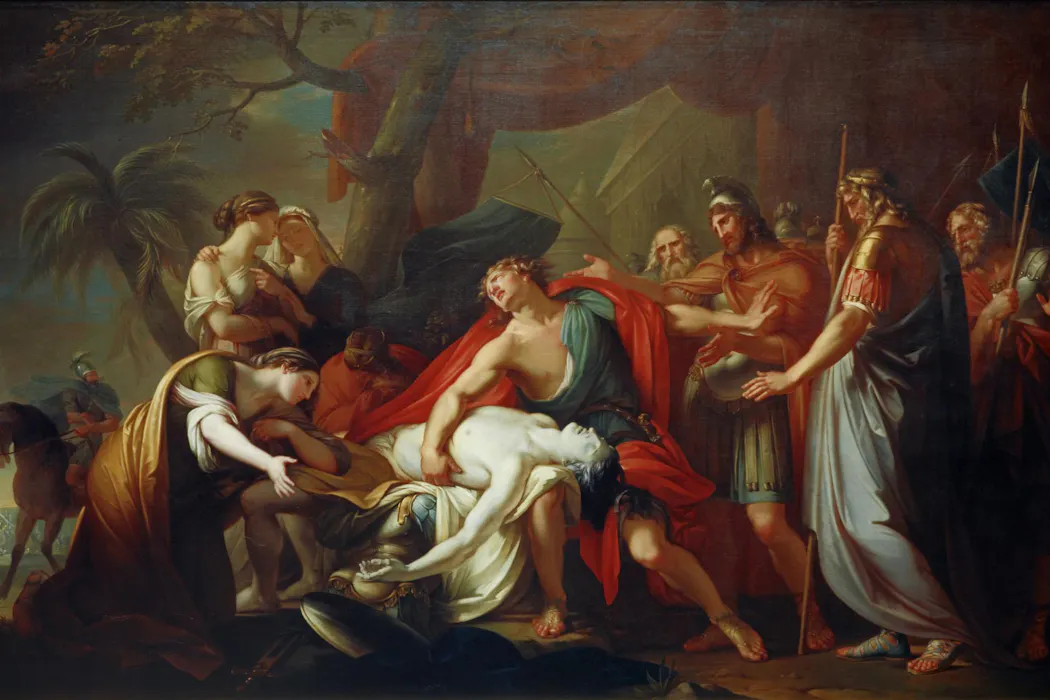
Achilles Lamenting the Death of Patroclus by Gavin Hamilton (1760-1763). National Galleries of Scotland Collection

Archaeologists have found something unexpected inside a 1,600-year-old Roman-era Egyptian mummy: a fragment of Homer’s Iliad. It wasn’t placed beside the body, but inside the mummy’s abdomen. But the real surprise isn’t just where the fragment was found. It’s how it got there. To understand, we must go back – to the Iliad itself, and to what it became in the Roman world.

In The Iliad, a poem shaped in the 8th century BC and attributed to Homer, the Trojan war does not end in triumph or renewal. It ends in devastation. The poem closes at the edge of collapse, with Troy reduced to a landscape of heroic ruin. And yet, this is not where the story ends.

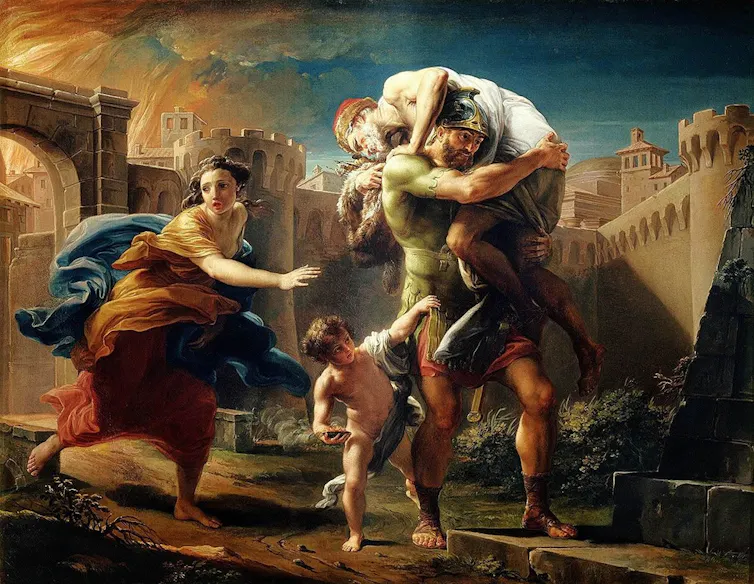
According to later Roman tradition, one Trojan escaped. Aeneas – son of Anchises and the goddess Aphrodite – fled the burning city carrying his father on his shoulders and the household gods in his hands. He moved west, across the Mediterranean, towards Italy, where he became the ancestor of Rome.

This continuation did not come from the Iliad itself. It was shaped centuries later, most famously in Virgil’s Aeneid. But it changed the meaning of the Trojan war entirely. The past, in other words, was actively reorganised – through stories that could be reworked, extended and connected across time and space.

Painting by Pompeo Batoni (1753), depicting Aeneas fleeing the burning city of Troy with his father Anchises and the household gods, as the fall of Troy is recast as the beginning of a journey toward the foundation of Rome.
Painting by Pompeo Batoni (1753), depicting Aeneas fleeing the burning city of Troy with his father Anchises and the household gods, as the fall of Troy is recast as the beginning of a journey toward the foundation of Rome. Galleria Sabauda

Turning defeat into origin

For Roman audiences, the Trojan war was more than a distant Greek legend. It became a way of thinking about origins, identity and power.

Claiming descent from Troy was more than a matter of tracing a lineage. It required constant cultural work – through storytelling, education and shared knowledge. The Iliad provided the raw material: characters, events and genealogies that could be reshaped and redeployed across generations.

Across the Roman Empire, educated elites learned Homer as part of their schooling. They quoted him in speeches, analysed him in classrooms and used him to signal cultural authority. To know the Iliad was to speak a language that others across the empire understood.

A senator in Rome, a teacher in Asia Minor or a student in Egypt could all draw on the same stories. The poem created a shared frame of reference – one that allowed very different people to situate themselves within a common past.

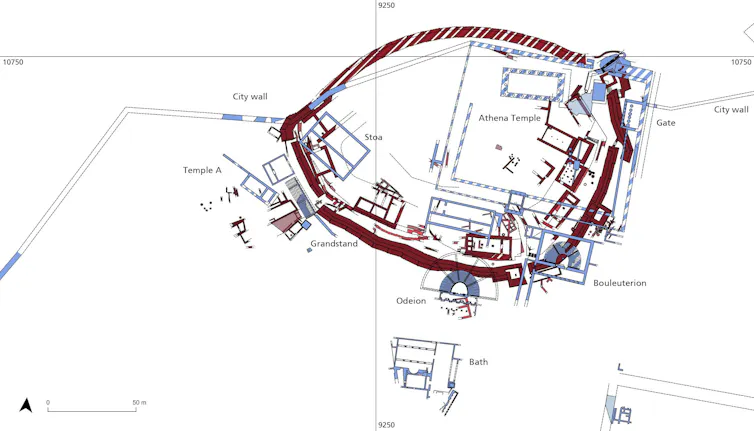
Plan of the late bronze age citadel of Troy
Plan of the late bronze age citadel of Troy (c. 1300–1109BC) shown in red, with Roman-period structures in blue, integrated into the ancient fortification in such a way that the surviving walls functioned as a theatrical backdrop of ‘authentic antiquity’, transforming archaeological depth into a deliberately scenographic experience. University of Tübingen, CC BY-SA

In the Roman imperial period, the site of ancient Troy – located in modern-day Turkey – became a destination. Emperors invested in its development, tying it directly to Rome’s claimed Trojan origins. Under Emperor Augustus, Troy was folded into the political language of empire. And under Emperor Hadrian, it became part of a wider culture of travel, memory and heritage.

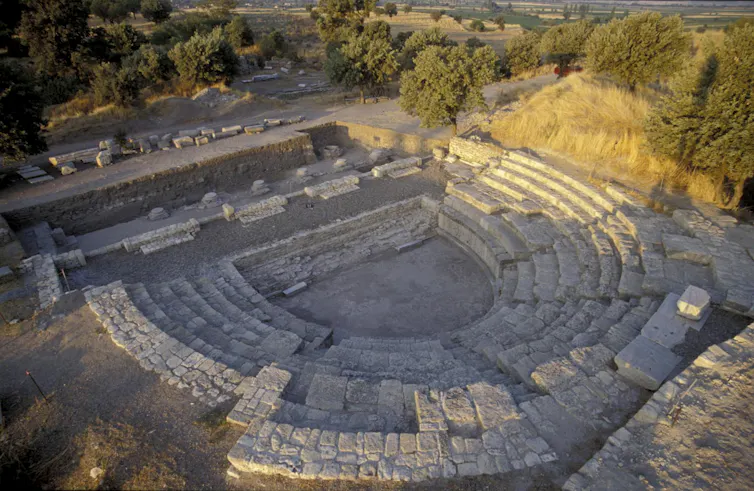
A visitor to Troy in the 2nd century AD would have arrived at a curated landscape. There were baths, places to stay and spaces for performance. A small theatre – the Odeion – was built directly into the ancient citadel, so that the remains of the bronze age city, understood as the setting of the legendary battles around Troy, formed a dramatic backdrop.

Visitors could walk through what was presented as the setting of Homeric epic, experiencing the Trojan war as something anchored in the ground beneath their feet.

From Troy to Egypt

Across the Roman Empire, the Iliad circulated as a living text: copied, taught and read. Egypt, one of Rome’s most important provinces, was no exception. Yet here, Homer circulated within a cultural landscape that differed in important ways from the Greek literary world in which the poem had first taken shape.

For Roman observers, Egypt often appeared as a place where antiquity was materially preserved as well as remembered – through temples, monuments and practices that emphasised continuity with the past. At the same time, it was a deeply hybrid society, where Egyptian, Greek and Roman traditions interacted in complex ways.

Homer was among the most widely copied authors in Roman Egypt – read and taught as a marker of education and cultural belonging and deeply embedded in everyday literary culture.

A small covered Roman theatre
The Odeion of Troy, a small covered theatre inserted into the fabric of the ancient citadel and constructed in the early 2nd century AD, exemplifies the Roman reconfiguration of the site’s urban and cultural landscape. University of Tübingen, CC BY-SA

The Homeric version of the Trojan War was particularly prominent among the Greek-speaking elite, especially in urban centres such as Oxyrhynchus, where the mummy was found. Other versions of the story – which placed greater emphasis on Paris and Helen’s stay in Egypt, as reported by Herodotus based on accounts from Egyptian priests – were probably more widespread among the broader Egyptian population.

The initial media coverage of the discovery of the fragment inside the Egyptian mummy suggested the text was deliberately chosen to accompany the deceased. As a personally meaningful object, perhaps reflecting their education or cultural identity.

The most telling explanation, however, may be the most straightforward. Discarded or damaged papyri could be reused as inexpensive material. The fragment may therefore have functioned as stuffing – bundled together and inserted into the body cavity without particular regard for its literary content.

The very fact that a scrap of the Iliad could end up as disposable filling, however, speaks to how deeply Homer had penetrated everyday life in Roman Egypt.

A text in motion

To make sense of the past in the Roman world meant moving between story and monument, between genealogy and deep time. Each perspective made the others more intelligible.

The Iliad helped create a world in which different pasts could be connected, compared and reshaped. By linking stories, places and traditions across the Mediterranean, the Roman world turned the past into a flexible resource – one that could generate identity, authority and belonging in shifting contexts.

This is why the Iliad mattered: it circulated across many different settings. It shaped elite education, but it was also part of everyday reading culture. At Troy, it helped transform the city into a place of cultural memory. The text itself also had a long material afterlife, surviving not only as an authoritative story, but through manuscripts and writing materials that were copied, passed on – or even reused for entirely different purposes.

Its most enduring insight is therefore this: the past is not something simply preserved, but something continuously made and remade – through the stories, practices and materials that carry it across time.

This article features references to books that have been included for editorial reasons, and may contain links to bookshop.org. If you click on one of the links and go on to buy something, The Conversation UK may earn a commission.

The Conversation

The authors do not work for, consult, own shares in or receive funding from any company or organisation that would benefit from this article, and have disclosed no relevant affiliations beyond their academic appointment.

  •  

Australia’s huge ‘forever chemical’ lawsuit focuses on the cleanup – not human health. Why?

CRC CARE, CC BY-NC-ND

The Australian government has launched its largest-ever lawsuit, suing American chemical giant 3M and its local subsidiary. The government is seeking A$2 billion in damages for the past and future cost of investigating and managing “forever chemicals” contamination from firefighting foams on almost 30 Defence sites.

The government alleges the company withheld internal testing that showed these foams did significant environmental damage. 3M has vowed to defend itself.

What’s interesting is the scope. State-owned facilities, such as public water utilities, are unlikely to be included. The case also avoids any mention of possible impacts on human health. This is at least in part because the impacts of forever chemicals are a live topic of scientific debate and inquiry.

What is the case based on?

Forever chemicals are properly known as PFAS, or per- and polyfluoroalkyl substances. They are also known as “forever chemicals” because they take a very long time to break down in the environment.

The Commonwealth case focuses on the use of PFAS-containing firefighting foams manufactured by 3M and used on Defence bases from the 1970s until the mid 2000s. These aqueous film-forming foams have been slowly phased out in Australia.

Several communities near affected Defence facilities have sued the Commonwealth, with class actions and other claims amounting to around $400 million in legal settlements.

Until now, the government hasn’t sought to recover these costs, but is doing so now to remediate the sites, pay out class actions and cover future remediation.

While full court documents are not yet public, multiple government statements and the court file suggest the claim is mainly based on the Australian Consumer Law.

The Commonwealth may argue 3M engaged in misleading or deceptive conduct by failing to disclose what it knew about the environmental risks of these firefighting foams.

In the United States, many state attorneys-general have sought to recover clean-up and monitoring costs from manufacturers allegedly promoting PFAS products as safe, despite knowing their risks.

How likely is a settlement?

While both sides appear to have adopted a firm public position committing to the case, this isn’t guaranteed. Large lawsuits like this frequently reach a settlement before trial.

This is because reaching a settlement allows parties to agree on compensation without a judicial finding of liability.

Australian courts encourage alternative dispute resolution, which can enable settlements and reduce costs and uncertainty, while allowing defendants to avoid formal findings of wrongdoing. Class actions against Defence have all settled before trial.

In the US, municipal governments and water authorities sued 3M and other PFAS manufacturers for selling products they knew would contaminate the environment, seeking payments to “help clean up the mess that they created”. These claims became part of a larger case.

In response, 3M agreed to pay about A$14 billion (US$10 billion) to assist with testing and treatment costs while denying liability.

Settlements have also been reached in personal injury litigation, including one against another manufacturer, DuPont, worth A$953 (US$670) million across 3,550 claims.

What’s in and what’s out of the case?

The proceedings have been framed as an effort to recover past and future costs from almost 30 Defence sites.

Yet PFAS contamination isn’t limited to these sites. Other sites of concern include state-operated firefighting facilities, industrial sites and public water supplies. This case is unlikely to directly address those locations.

It’s not clear whether any funds recovered would support measures sought by affected communities, such as routine blood testing or long-term medical monitoring. Residents of Katherine in the Northern Territory have questioned whether any potential settlement would compensate losses not covered by earlier class actions. Many civilian and military firefighters exposed to these PFAS foams for decades have not been involved in compensation schemes or major litigation.

Notably, the case doesn’t mention any possible effects on human health. Assistant Minister for Defence Peter Khalil has cited advice from health authorities that evidence of health impacts from forever chemicals remains limited.

In 2023, the cancer agency of the World Health Organization found one forever chemical, PFOA, was carcinogenic. But there are many different types of PFAS. The WHO is now conducting a systematic review of key PFAS compounds and health outcomes, such as cancer and reproductive toxicity.

The PFAS class actions against Defence similarly excluded personal injury claims, focusing instead on property, business and cultural losses. Even so, evidence about possible health effects was raised because contamination affected property values.

It will be interesting to see whether the Commonwealth can separate environmental contamination from health concerns, while maintaining its position that evidence of human health impacts remains limited.

fighter planes about to take off from runway.
PFAS contamination has affected almost 30 Defence sites, including NSW’s RAAF Williamtown base. Jungle Jack/Flickr, CC BY-NC-ND

What’s next?

If the lawsuit goes to a trial and the government succeeds in its claim, it would likely open the door to further claims against 3M by fire services, water suppliers and other affected groups.

This could also happen if the claim is settled out of court.

Regardless of the result, more legal action and advocacy is likely from communities affected by PFAS around Australia.

The Conversation

Cameron Holley receives funding from the Australian Research Council (DP260103099).

Carley Bartlett receives funding from the Australian Research Council (DP260103099). Her PhD was supported by an Australian Government Research Training Program scholarship.

  •  

As Japan’s popularity booms, a new survey shows strong anti-foreigner sentiment

Japan is experiencing historically high numbers of foreigners. Its population is shrinking, and its workforce is ageing, driving foreign labour to historic levels.

In addition, the number of international tourists has also reached record highs, reshaping everyday life across the country. In fact, Japan now rivals, and sometimes outstrips, Bali as Australians’ favourite holiday destination.

Yet, despite the expansion of channels for migrant labour and settlement over the past two decades, successive governments have avoided describing the country as an immigration society. They have also been reluctant to adopt broader frameworks for immigrant integration and social inclusion.

However, given the recent surge, questions about foreigners have moved from a policy footnote to a genuinely contested issue. So what do the Japanese people really think?

Generational differences

A nationally representative survey of 1,500 Japanese adults was conducted immediately after the lower house election in February 2026. It revealed striking findings on how the Japanese public views foreigners.

Nearly two thirds of respondents support both tighter regulations on foreign land purchases and the expectation that foreigners follow Japanese rules and customs. These restrictive views hold across gender, education and income groups. The major exception is age: younger generations tend to express more tolerant views toward foreigners.

The recent influx of foreigners – as workers and tourists – appears to be prompting a change in attitude among Japanese people.

The 2025 upper house election marked a turning point. Sanseito, a nationalist party that made immigration restriction its central platform, achieved a strong result, claiming 14 seats on a “Japanese first” platform.

This result signalled that explicitly anti-immigrant positions could attract meaningful public support. This in turn placed pressure on mainstream parties to address the issue more directly.

That momentum carried into the 2026 lower house election. The Liberal Democratic Party (LDP), under Prime Minister Sanae Takaichi, won a landslide victory while tightening its stance on immigration policies. This included raising the requirements for permanent residency and naturalisation, and tightening regulations on foreign land purchases.

Against this political backdrop, understanding how Japanese citizens view foreigners and what identities and values shape those views has become increasingly important.

The post-election survey provides timely evidence on these questions.

My analysis of the data finds a broad consensus on foreigners among most demographics. When asked whether Japan should strengthen regulations on land purchases by foreign nationals and foreign capital, 66.5% of respondents either agreed or somewhat agreed.

When asked whether foreign nationals should place the highest priority on following Japanese rules, etiquette and customs, 62.9% agreed or somewhat agreed. Less than 7% disagree on either item.

It is notable these numbers hold across demographic groups. University and high school graduates express similarly restrictive views; men and women hold nearly identical attitudes; and higher-income respondents are no more tolerant than those on lower incomes.

However, as mentioned, the one important exception to this consensus is age. Younger Japanese are measurably more tolerant of foreigners than their older counterparts. This suggests attitudes toward foreigners in Japan may be slowly shifting.

Party politics play a role

Party support does structure anti-foreigner attitudes to some degree. Sanseito voters record the most restrictive views on both questions. Centrist Reform Alliance voters are the least restrictive. However, party supporters differ only in the intensity of restrictive attitudes, not whether they endorse them.

The survey also included questions measuring traditional values, which capture deference to authority and social norms, and authoritarian values, which capture acceptance of force and coercion.

Traditional values show little variation by age, gender, education or income. In contrast, authoritarian values vary by age, with young people actually showing more authoritarian values. This resonates with a survey of junior high school students in the Tokyo metropolitan area, where the proportion agreeing that “people who break the rules should be punished strictly” rose from 59% in 2018 to 79% in 2025.

At the same time, LDP voters score highest on both measures. This is consistent with the party’s longstanding position as the vehicle of conservative values in postwar Japanese politics.

Both traditional and authoritarian values correlate significantly with anti-foreigner attitudes. Respondents who are more sceptical of authority, less committed to social norms, and less accepting of force tend to hold more tolerant views toward foreigners.

A changing Japan

My analysis reveals a society where restrictive attitudes toward foreigners are widespread, generationally inflected, and grounded in traditional and authoritarian values. This reflects a tension that Japanese policymakers and the public have struggled to resolve: the economic case for accepting more foreign workers is clear, yet it sits uneasily alongside deep-rooted ideas of cultural cohesion and ethnic homogeneity.

Future research could sharpen this picture by distinguishing among Japanese people’s views of foreign tourists, short-term workers and long-term residents.

How the Japanese public views its growing foreign population will continue to matter in future Japanese elections. Similarly, how the government responds will offer an important test case for neighbouring East Asian societies grappling with similar tensions.

The Conversation

Peter Chai does not work for, consult, own shares in or receive funding from any company or organisation that would benefit from this article, and has disclosed no relevant affiliations beyond their academic appointment.
  •  

Most people don’t know what they don’t know, but think they do – correcting your metaknowledge can make you a better teacher and learner

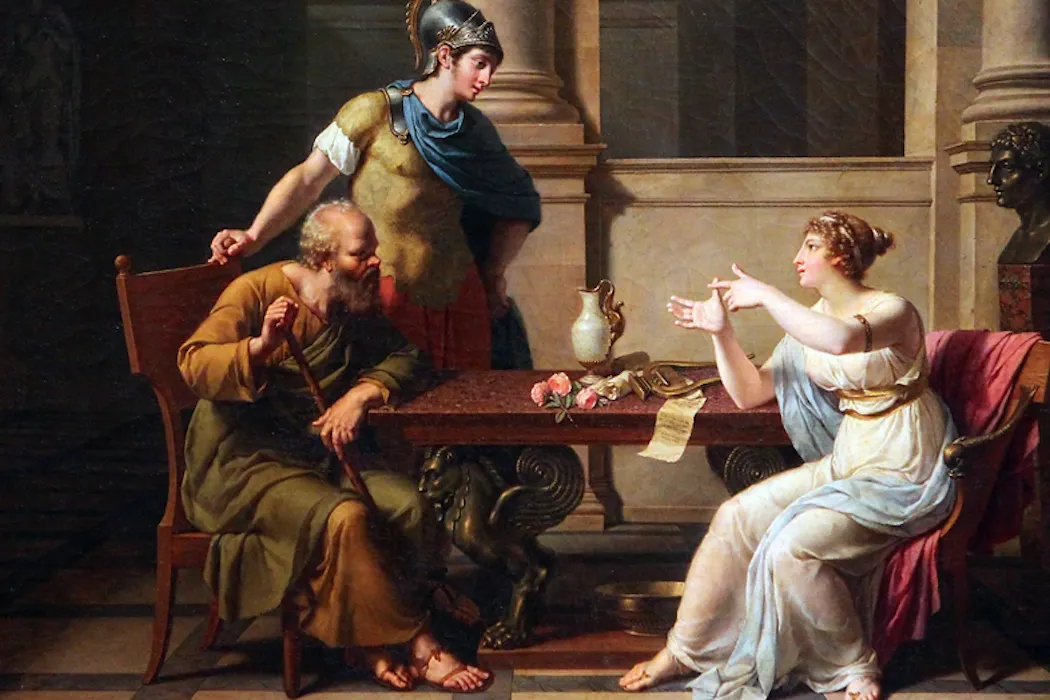
The ability to say 'I know that I know nothing' could be considered a sign of wisdom. Nicolas-André Monsiau/Pushkin Museum of Fine Arts via Wikimedia Commons

Do you know what the Apple logo looks like?

Chances are, you think you do. It’s ubiquitous and iconic. How could you not know it?

But when tested, it turns out very few people can remember all the features of the logo. One study of 85 people found that only about half could pick the correct logo out of a lineup of similar ones. And only one person could correctly draw it.

This isn’t an isolated example. A classic study from 1979 found that people similarly couldn’t draw a penny accurately or pick out a correctly drawn penny from incorrect ones.

People aren’t just bad at remembering things they see all the time, but also in actually knowing how they work. In a 2006 study, many people made significant errors when drawing a bicycle, like putting the chain around the front wheel as well as the back wheel. More than just a forgotten detail, putting the chain around both wheels shows a deeper misunderstanding of how a bicycle works. A bicycle with a chain around both wheels wouldn’t be able to turn.

Illustration of bike with different components labeled
Do you truly know how a bicycle works? Al2/Grandiose via Wikimedia Commons, CC BY-SA

It turns out people’s knowledge of how the world works is often fragmented and sketchy at best. They systematically overestimate their understanding of everyday devices and natural phenomena. People will tend to give themselves high ratings on how well they understand something, such as how bicycles or zippers work. But when they’re asked to actually explain the mechanics of these objects, their ratings of their understanding typically drop.

Just like how your knowledge of the world around you is imperfect, your knowledge about your own knowledge – also called metaknowledge – is often flawed. My field of cognitive science has been uncovering various gaps in human metaknowledge for decades.

If people are systematically overconfident about how well they understand things, why don’t they notice when they don’t understand something? And what can people do to better recognize the limits of their own knowledge?

Why you think you know more than you do

Researchers have identified several factors behind people’s overconfidence in their knowledge.

One is that people confuse environmental support with understanding: The information is out in the world but not actually in your head. With a bicycle or a zipper, all of the parts are visible to you, and you may confuse this transparency for an internal understanding of how they work. But until you go to use that knowledge by attempting to explain how they work, you may not recognize that you don’t understand how those parts interact.

A second factor is confusing different levels of analysis. People can often describe how something works at a very high level. You know that the engine of a car makes the car go, and the brakes slow and stop the vehicle. But confidence in your high-level understanding of the car may bias you to think you also have a good grasp of the finer details, like how the engine pistons and brake pads work.

Additionally, people can be blind to the ways their knowledge shapes their own perception. In one study, researchers had participants tap out the tune to a popular song. On average, the tappers thought listeners would be able to identify the song about 50% of the time. But when listeners had to identify the tapped song, they actually could identify it only 2.5% of the time. The tappers didn’t realize how much their knowledge was making identifying the song seem easy to them.

A teacher talks to a student before a chalkboard wall filled with equations, chemical structures and graphs
Intellectual humility can help you see your expert blind spot. Vitaly Gariev/Unsplash, CC BY-SA

This disconnect has consequences beyond whether someone else can understand your Morse code version of a song. When teaching people, whether in formal classroom settings or through casual mentorship, you can sometimes have an expert blind spot: the inability to recognize the difficulties beginners face when learning something you have expertise in.

Building expertise often involves internalizing knowledge to the point where it becomes invisible to you. You draw on knowledge you don’t realize you have, making it hard to relate to learners who lack this knowledge – and, of course, hard for learners to relate to your teaching. You might have experienced this when you’ve gotten partway through explaining something, only to realize you’ve been using jargon you forgot isn’t common knowledge and lost your listener.

How to address metaknowledge failures

Your metaknowledge can fail in two directions: You can think you know more than you do, and you can be blind to how much you’re relying on knowledge you do have. Each calls for a different response to correct it.

When you’re overconfident in your knowledge, the remedy is using that knowledge. You’ll quickly realize how much you actually understand and dial down your confidence. Challenging yourself to actually try to walk through how something works is a great exercise in intellectual humility – that is, recognizing that you may be wrong – and can keep you from getting out over your skis.

Building a greater appreciation for what you know is more difficult. You can’t simply unlearn what you’ve internalized. But what this challenge shows is that, to some extent, knowing a subject and knowing how to teach it are two separate skills. Some experts are great teachers, but not simply by virtue of being experts. Recognizing that you have to approach teaching with humility, and that your expertise doesn’t automatically make you a skilled teacher, can go a long way toward making you a better teacher and mentor.

These aren’t easy and quick fixes to failures of metaknowledge. Both require ongoing intellectual humility and a willingness to distrust your own confidence. But acknowledging the fallibility of your own metaknowledge is a good place to start.

The Conversation

Tommy Blanchard does not work for, consult, own shares in or receive funding from any company or organization that would benefit from this article, and has disclosed no relevant affiliations beyond their academic appointment.

  •  

The market moves before Trump posts

It has long been the case that when a US President speaks, financial markets react.

But recently oil markets have been behaving a bit differently: sometimes the stock price moves before Trump posts. Millions of dollars are changing hands with some traders seeming to have made incredibly well-timed bets. Did some of them know something the rest of the market didn’t?

@realDonaldTrump made 1,341 Truth Social posts from January 25 to April 8. Our analysis of that 73-day window reveals 15 distinct events with unusual trading activity around Trump’s posts. In several of those events — including the most striking ones — the price had already moved sharply in the minutes before he posted.

➡️ Read the interactive story here

The Conversation

Timothy Graham receives funding from the Australian Research Council for the Discovery Project "Understanding and Combatting 'Dark Political Communication'", from the Universities Australia-German Academic Exchange Service Joint Research Cooperation Scheme, and from Meta Platforms Technologies.

Ella Chorazy receives funding from the Australian Research Council (ARC), for the Discovery Project 'Understanding and Combatting "Dark Political Communication"'.

Stephen Harrington receives funding from the Australian Research Council, for the Discovery Project 'Understanding and Combatting "Dark Political Communication"', and for the Discovery Project "Understanding Twenty-First Century Media Uses and Purposes".

  •  

Why was an Egyptian mummy stuffed with a fragment of Homer’s Iliad?

Achilles Lamenting the Death of Patroclus by Gavin Hamilton (1760-1763). National Galleries of Scotland Collection

Archaeologists have found something unexpected inside a 1,600-year-old Roman-era Egyptian mummy: a fragment of Homer’s Iliad. It wasn’t placed beside the body, but inside the mummy’s abdomen. But the real surprise isn’t just where the fragment was found. It’s how it got there. To understand, we must go back – to the Iliad itself, and to what it became in the Roman world.

In The Iliad, a poem shaped in the 8th century BC and attributed to Homer, the Trojan war does not end in triumph or renewal. It ends in devastation. The poem closes at the edge of collapse, with Troy reduced to a landscape of heroic ruin. And yet, this is not where the story ends.

According to later Roman tradition, one Trojan escaped. Aeneas – son of Anchises and the goddess Aphrodite – fled the burning city carrying his father on his shoulders and the household gods in his hands. He moved west, across the Mediterranean, towards Italy, where he became the ancestor of Rome.

This continuation did not come from the Iliad itself. It was shaped centuries later, most famously in Virgil’s Aeneid. But it changed the meaning of the Trojan war entirely. The past, in other words, was actively reorganised – through stories that could be reworked, extended and connected across time and space.

Painting by Pompeo Batoni (1753), depicting Aeneas fleeing the burning city of Troy with his father Anchises and the household gods, as the fall of Troy is recast as the beginning of a journey toward the foundation of Rome.
Painting by Pompeo Batoni (1753), depicting Aeneas fleeing the burning city of Troy with his father Anchises and the household gods, as the fall of Troy is recast as the beginning of a journey toward the foundation of Rome. Galleria Sabauda

Turning defeat into origin

For Roman audiences, the Trojan war was more than a distant Greek legend. It became a way of thinking about origins, identity and power.

Claiming descent from Troy was more than a matter of tracing a lineage. It required constant cultural work – through storytelling, education and shared knowledge. The Iliad provided the raw material: characters, events and genealogies that could be reshaped and redeployed across generations.

Across the Roman Empire, educated elites learned Homer as part of their schooling. They quoted him in speeches, analysed him in classrooms and used him to signal cultural authority. To know the Iliad was to speak a language that others across the empire understood.

A senator in Rome, a teacher in Asia Minor or a student in Egypt could all draw on the same stories. The poem created a shared frame of reference – one that allowed very different people to situate themselves within a common past.

Plan of the late bronze age citadel of Troy
Plan of the late bronze age citadel of Troy (c. 1300–1109BC) shown in red, with Roman-period structures in blue, integrated into the ancient fortification in such a way that the surviving walls functioned as a theatrical backdrop of ‘authentic antiquity’, transforming archaeological depth into a deliberately scenographic experience. University of Tübingen, CC BY-SA

In the Roman imperial period, the site of ancient Troy – located in modern-day Turkey – became a destination. Emperors invested in its development, tying it directly to Rome’s claimed Trojan origins. Under Emperor Augustus, Troy was folded into the political language of empire. And under Emperor Hadrian, it became part of a wider culture of travel, memory and heritage.

A visitor to Troy in the 2nd century AD would have arrived at a curated landscape. There were baths, places to stay and spaces for performance. A small theatre – the Odeion – was built directly into the ancient citadel, so that the remains of the bronze age city, understood as the setting of the legendary battles around Troy, formed a dramatic backdrop.

Visitors could walk through what was presented as the setting of Homeric epic, experiencing the Trojan war as something anchored in the ground beneath their feet.

From Troy to Egypt

Across the Roman Empire, the Iliad circulated as a living text: copied, taught and read. Egypt, one of Rome’s most important provinces, was no exception. Yet here, Homer circulated within a cultural landscape that differed in important ways from the Greek literary world in which the poem had first taken shape.

For Roman observers, Egypt often appeared as a place where antiquity was materially preserved as well as remembered – through temples, monuments and practices that emphasised continuity with the past. At the same time, it was a deeply hybrid society, where Egyptian, Greek and Roman traditions interacted in complex ways.

Homer was among the most widely copied authors in Roman Egypt – read and taught as a marker of education and cultural belonging and deeply embedded in everyday literary culture.

A small covered Roman theatre
The Odeion of Troy, a small covered theatre inserted into the fabric of the ancient citadel and constructed in the early 2nd century AD, exemplifies the Roman reconfiguration of the site’s urban and cultural landscape. University of Tübingen, CC BY-SA

The Homeric version of the Trojan War was particularly prominent among the Greek-speaking elite, especially in urban centres such as Oxyrhynchus, where the mummy was found. Other versions of the story – which placed greater emphasis on Paris and Helen’s stay in Egypt, as reported by Herodotus based on accounts from Egyptian priests – were probably more widespread among the broader Egyptian population.

The initial media coverage of the discovery of the fragment inside the Egyptian mummy suggested the text was deliberately chosen to accompany the deceased. As a personally meaningful object, perhaps reflecting their education or cultural identity.

The most telling explanation, however, may be the most straightforward. Discarded or damaged papyri could be reused as inexpensive material. The fragment may therefore have functioned as stuffing – bundled together and inserted into the body cavity without particular regard for its literary content.

The very fact that a scrap of the Iliad could end up as disposable filling, however, speaks to how deeply Homer had penetrated everyday life in Roman Egypt.

A text in motion

To make sense of the past in the Roman world meant moving between story and monument, between genealogy and deep time. Each perspective made the others more intelligible.

The Iliad helped create a world in which different pasts could be connected, compared and reshaped. By linking stories, places and traditions across the Mediterranean, the Roman world turned the past into a flexible resource – one that could generate identity, authority and belonging in shifting contexts.

This is why the Iliad mattered: it circulated across many different settings. It shaped elite education, but it was also part of everyday reading culture. At Troy, it helped transform the city into a place of cultural memory. The text itself also had a long material afterlife, surviving not only as an authoritative story, but through manuscripts and writing materials that were copied, passed on – or even reused for entirely different purposes.

Its most enduring insight is therefore this: the past is not something simply preserved, but something continuously made and remade – through the stories, practices and materials that carry it across time.

This article features references to books that have been included for editorial reasons, and may contain links to bookshop.org. If you click on one of the links and go on to buy something, The Conversation UK may earn a commission.

The Conversation

The authors do not work for, consult, own shares in or receive funding from any company or organisation that would benefit from this article, and have disclosed no relevant affiliations beyond their academic appointment.

  •  

Colorado voted to end forced prison labor in 2018 – so why are incarcerated people in the state still working for less than $2 an hour?

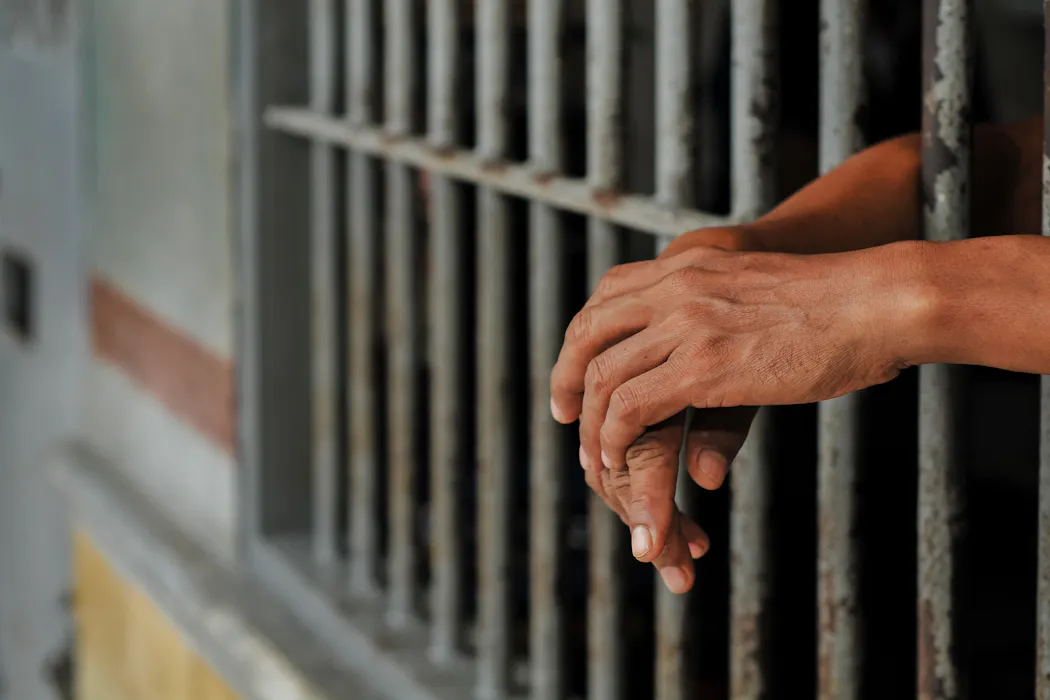
Incarcerated people in Colorado make less than $2 an hour for their labor. Hari Sucahyo/Getty Images

Colorado voters passed Amendment A, a ballot measure touted as an end to slavery in state prisons in 2018. The amendment eliminated the penal exception clause, which allowed the state to use forced labor in addition to incarceration as a punishment for crime.

Colorado was the first of eight states to repeal its penal exception clause. Advocates for the policy change hoped it would prevent forced labor for little pay. Colorado pays incarcerated workers between US$0.33 and $1.61 per hour for maintenance jobs such as cooking, cleaning and groundskeeping.

Nationally, the elimination of state penal exception clauses has had little impact on incarcerated workers. Lawsuits in Colorado and Alabama have alleged that forced labor continues despite the policy change.

My research examines prison conditions and programming, including work programs. I wrote my doctoral dissertation on state and federal prison industries, which sell goods produced by incarcerated workers to government agencies.

Colorado lawsuit alleges abuse

In 2022, the plaintiffs who brought a class action lawsuit, Mortis v. Polis, alleged that the Colorado Department of Corrections violated the amended state constitution by punishing incarcerated people who refused mandatory work programs. The punishments included solitary confinement and use of force.

Incarcerated people also reported the loss of good time and earned time credit, which are two sentence reduction incentives based on participating in work programs. Additionally, they reported loss of privileges like phone calls and family visits.

Colorado prisoners say the state is violating an antislavery law by requiring forced labor, according to an August 2023 CBS Colorado report.

During the trial, David Lisac, deputy director of the Colorado Department of Corrections prison operations, testified. He said the department had neither changed its policies in response to the amendment nor attempted to ascertain whether the department was in compliance with the amendment.

In February 2026, the court ruled that the department and Gov. Jared Polis violated the state constitution by forcing people to work. The ruling specified that use of force and isolation for failure to work were unconstitutional. On the other hand, the court dismissed the plaintiffs’ claims that withholding privileges or credits constituted involuntary servitude.

Whether the decision will have an impact on work conditions in Colorado prisons remains to be seen.

History of the penal exception clause

When the 13th Amendment to the U.S. Constitution abolishing slavery passed in 1865, the penal exception clause allowed for slavery only as punishment for a crime. Along with Jim Crow laws that criminalized Blackness, the loophole allowed for the legal re-enslavement of Black Americans to financially benefit the state. The penal exception clause also allowed prisons to continue to operate as they had prior to the 13th Amendment. Historically, prisons in Colorado and across the U.S. used the labor of incarcerated workers and paid them little to nothing.

This included the establishment of state penal farms on former slave plantations and widespread convict leasing of incarcerated workers’ labor to private companies. Chain gangs to build railroads were also established during this time.

A black-and-white photo of men in striped clothing shoveling the ground.
A group of incarcerated men, known as a prison chain gang, work on a railroad in Florida. The photo was taken sometime around 1920. FPG/Hulton Archive/Getty Images

The Colorado Constitution, drafted and approved a decade later in 1876, included a provision that mirrored the 13th Amendment. Article II, Section 26, Colorado’s penal exception clause, stated: “Slavery prohibited. There shall never be in this state either slavery or involuntary servitude, except as a punishment for crime, whereof the party shall have been duly convicted.”

Opposition to forced labor in prison took many forms. Those include the Attica uprising in 1971, attempts to unionize incarcerated workers and prison labor strikes.

Colorado’s penal exception clause was eliminated in 2018. Following Colorado, legislation and ballot measures were introduced in many states and at the federal level.

Incarcerated people need work

Colorado and states across the country use incarcerated workers to do almost all the jobs of running the prison. Paying prevailing wages would significantly increase operating expenses. A cost-benefit analysis of paying incarcerated workers full wages for their work, by Edgeworth Economics, an economic consultancy firm, estimated the increase of expenses to fall between $8.5 billion to $14.5 billion nationwide.

Incarcerated people use earnings from their work to purchase food and hygiene products from the commissary. In addition, many derive meaning and purpose from work, which is important for mental health.

Incarcerated workers produce $2 billion in goods and $9 billion in services every year, but those workers are often underpaid or not paid at all, according to a March 2025 CBS News report.

Refusing to work can also lead to harsh consequences. The Colorado lawsuit plaintiffs alleged that they experienced solitary confinement, isolation in their cells, loss of phone calls and visits, and loss of good time and earned time credits for failure to work. Solitary confinement harms mental health, and phone calls and visits are essential for family connectedness. Good time and earned time credits accrued through work can speed up release and are an important motivator to work, regardless of working conditions.

Simultaneously, incarcerated people risk retaliation for speaking out about prison conditions. For example, the incarcerated men who started the Free Alabama Movement to end forced labor in 2013, and featured in the popular 2025 documentary film “The Alabama Solution,” were later transferred to solitary confinement.

Incarcerated workers rarely considered employees

Some prison labor is recognized as employment and paid the minimum wage – in theory. Nationally, private-sector Prison Industry Enhancement Certification Program and work release employers are required to pay the prevailing minimum wage to their incarcerated employees. However, states always take deductions for room and board, transportation, victims services, court fees and the like. In some cases, up to 80% of an incarcerated person’s wages are deducted. That means take-home pay often remains low.

But 97.4% of incarcerated workers labor for government entities directly and are paid less than a dollar an hour.

They also lack protections. They are not covered by the Fair Labor Standards Act, which provides minimum wage rights and provisions for overtime pay. Nor are they covered by the Occupational Safety and Health Administration, which enforces worker’s compensation and rights to safe working conditions. If an incarcerated worker is injured on the job, they are entitled to medical care, like anyone else in prison, but they have no right to financial compensation or sick days.

Adapting the private-sector pay structure for all work in prison could result in fair wages – that’s if deductions are revised to be fair as well. Researchers estimate that paying fair wages to incarcerated workers could produce up to $20.3 billion annually in income to them directly, and benefits to families, crime victims and the economy through child support payments, restitution payments and taxes. Furthermore, fair wages would allow people to support themselves during incarceration and save for when they are released, which could have a meaningful impact on well-being during and after incarceration.

Reforms, such as adjusting pay structures or removing the penal exception clause, may improve working conditions for incarcerated people. But researchers have asserted that prison labor will always be inherently coercive. Incarcerated workers have limited options to earn money and work toward an earlier release date, which undoubtedly influences their choice to work.

Read more of our stories about Colorado.

The Conversation

Julia Bowling does not work for, consult, own shares in or receive funding from any company or organization that would benefit from this article, and has disclosed no relevant affiliations beyond their academic appointment.

  •  

People are using AI to communicate without disclosing it. Is this morally wrong?

Imagine you have used a generative artificial intelligence (AI) tool such as ChatGPT to tidy up notes you took while in a meeting. Your colleague comments on how clear they are. You don’t disclose it was the AI that made the notes clear and not you.

Now consider a different scenario. You are at your mother’s funeral. Her best friend of many years delivers a heartfelt eulogy, wishing her well in the afterlife. But later you discover her friend did not actually write the eulogy in any way – AI did.

The undisclosed use of generative AI in these two scenarios is deceptive. But is it morally wrong?

It’s worth considering this philosophical question in detail, given the rapid uptake of generative AI and the fact research has found people may be strongly incentivised to not disclose their use of generative AI because it may impact their relationships.

This is because people take generative AI outputs, generally, to be less valuable, and regard those who use the technology as less competent and authentic.

Distinguishing different kinds of deception

Roughly speaking, if you’re engaging in a “deceptive act”, you’re trying to get someone to believe something you know is false. However, deception can come in different varieties.

Philosopher John Danaher provides a useful framework to distinguish between three forms of deception by AI or robots. This framework is useful because, just as robots might convincingly mimic human behaviours, generative AI technologies are allowing humans to do the same.

Some deceptions involve lying or misrepresenting the external world, such as telling someone you saw a horse in the street, even though you didn’t. Danaher calls these “external state” deceptions.

Other deceptions involve lying or misrepresenting facts about ourselves, such as making someone believe you’re an accomplished artist, even though the artwork you showed them was generated by AI. Danaher calls these “superficial state” deceptions.

We can also deceive others into believing we lack thoughts, feelings or competencies we actually possess, such as pretending to not understand a language we speak in order to eavesdrop. Danaher calls these “hidden state” deceptions.

So, when is deception immoral?

To go back to the first example, by not disclosing you used AI to tidy up meeting notes, you’ve allowed your colleague to believe you have the capacity to do the work, which might be true. However, you also allowed your colleague to believe that you demonstrated that capacity by doing the work, which is false. This would fall into the category of an “external state deception”.

While this deception is morally objectionable, it’s arguably ethically permissible. Trivial deceptions like this happen all the time – and surely we aren’t obligated to always disclose everything about what we do and why we do it.

For example, we don’t blink an eye at undisclosed use of spell-checking software because, in most situations, being a good speller isn’t important. But triviality depends on context. If someone used spell-checking software at a spelling bee, we might be less forgiving.

The scenario about the funeral speech is similar to the first scenario, but less trivial. Your belief over your mother’s friend’s superficial state – that they wish her well – may or may not be false. However, your belief over the external state of affairs – that the eulogy is a demonstration of those well-wishes – is certainly false.

This is more morally problematic. When we claim an AI-generated output as our own – and particularly one that aims to reflect something about ourselves – we signal to others that we not only endorse the output, but that we have authored it. In this case it matters to us that the friend is the source of the eulogy – and not AI. The external state deception is deceptive in a non-trival way.

We imply the output was directly caused by our thoughts, feelings or competencies. When we don’t disclose our use of AI, we deprive others of the kinds of information needed to form true beliefs about how the world is and how others are. This is wrong if people deserve to have such information.

However, the eulogy example can still show how not disclosing our use of AI can – all things considered – sometimes be permissible. Perhaps, for example, the friend was so wracked with grief, that having AI write the eulogy on their behalf was the only way for them to get the speech written in time for the funeral. So they endorsed the generated output as their own.

In such cases, not disclosing the use of AI may be permissible, even though still a morally objectionable kind of deception. This is because, like triviality in the first scenario, other reasons might sufficiently outweigh the wrongness of non-disclosure.

Using AI more ethically

So, how can people use generative AI more ethically?

If we are to avoid immorally deceiving others, we ought to disclose our use of it in non-trivial cases.

What makes undisclosed AI use non-trivial is malleable and context-dependent. It changes in response to social norms couched within particular social practices.

Being open about AI use gives others the opportunity to form more accurate beliefs about what we are communicating – and the internal states our communication demonstrates.

The Conversation

Siavosh Sahebi is supported by an Australian Government Research Training Program scholarship.

Thomas Montefiore receives funding from the Australian Government through the Australian Research Council.

  •  

Tightening NDIS eligibility will disproportionately affect women – in more ways than you’d expect

Public hearings are underway this week to highlight the impacts of the government’s new National Disability Insurance Scheme (NDIS) bill to tighten eligibility and save costs.

Over the past two days, the Senate inquiry heard that if the bill passes in its current form, it risks entrenching gender inequities in the NDIS and further excluding women and girls.

We have long known the NDIS has a gender problem.

Women and girls only make up 38% of the scheme. Men outnumber women in every age category (except for 55 and over) and dominate nearly every disability type within the scheme.

From the age of 15, access requests from men are also approved at a higher rate than access requests for women.

Tighter eligibility

From January 1 2028, the bill will require scheme applicants to access all “appropriate” treatments (meaning known, evidence-based and available in Australia) likely to “materially” (meaning noticeably) improve or alleviate the impact of the impairment, before NDIS access is granted.

Applicants have always been asked to demonstrate they’ve tried other treatments before applying for the NDIS. But this new rule is likely to place an even higher burden on people with impairments that are difficult to diagnose and medically complex to treat.

Under the new permanency rules, people may have to try lots of potentially marginal treatments that might slightly improve functioning, even if their conditions are not understood, or the treatment is expensive or difficult to access.

Women are more likely than men to have medically unexplained or chronic conditions, such as myalgic encephalomyelitis/chronic fatigue syndrome and fibromyalgia, which causes chronic pain.

These “pay to prove” dynamics also disproportionately affect those with fewer financial resources. Women with disability are more likely than men with disability to live on lower incomes. They also have higher expenses and lower earning capacity due to greater caring responsibilities.

Tightening access to the scheme in this way – without first addressing costly and difficult-to-access treatment pathways – risks excluding these women and girls from key supports.

Support can only be provided for approved conditions

If the bill passes, the NDIS will only fund supports for needs that directly relate to NDIS-recognised impairments.

This reverses changes to NDIS legislation introduced two years ago, which better recognised the complex way people actually experience impairments.

We have spoken to people in our current study about chronic pain who have explained that pain from one condition (for example, a connective tissue disorder) can affect the functional impacts of another impairment (for example, autism or a psychosocial disability, for which they receive NDIS support). For them, it’s impossible to distinguish between support needs “arising directly” from their NDIS-recognised impairment and support needs that are indirectly related to that impairment.

Women are also more likely than men to experience multiple chronic health conditions and disabilities, especially in age groups under the NDIS cut-off of 65.

Narrowing the lens of assessment and restricting access in this way also has gendered consequences.

Cuts to social participation funding

The bill gives the minister power to make cuts to entire categories of supports in the future, without introducing legislation or consultation.

We got a taste of what this could look when the government announced it would cut participants’ social and community participation budgets.

The 50% across-the-board cuts will shift these responsibilities back onto informal carers – largely women.

There are more than twice as many female primary carers as male primary carers. Of those providing primary care to children with disability, the overwhelming majority (84.7%) are women.

Some 43.8% of primary carers also have disability themselves. This means that when it comes to carers, we are often talking about women with disability who are the primary carers for children with disability.

These cuts will increase unpaid caring responsibilities. The bill’s explanatory memorandum acknowledges this:

Due to the gendered nature of caring, women are more likely to be impacted by changes to the supports available […].

These changes may lead carers to cut back on paid employment, deepening women’s socioeconomic exclusion.

Cuts to social and community participation funding are also likely to increase social isolation and reduce natural safeguards of community connection for people with disability.

Women with disability are disproportionately likely to experience violence, so cutting them off from vital community participation supports poses an unacceptable risk.

What needs to be done?

The bill’s explanatory memorandum says:

opportunities to increase gender equality will be considered as part of the design and evaluation of future market reforms to delivering social and community participation and capacity building activities.

However, no timeframes, benchmarks or accountability mechanisms are provided for when or how this work will occur.

The Australian government’s approach to gender-responsive budgeting requires new policy proposals to include gender analysis proportionate to the scale, scope and likely impact of the reform.

Given the scale and implications of the proposed NDIS reforms, we need a comprehensive and publicly available gender impact analysis before this bill is passed.

We also need more certainty on what can be done for those outside the scheme who need foundational supports. The Australian government has announced the Thriving Kids initiative. However, there is limited detail on planned foundational supports for other participant groups.

Researchers and advocates have been calling for an NDIS gender strategy for years. The National Disability Insurance Agency (NDIA) began work on this in early 2025, but by 2026 this work had been paused to prioritise broader scheme reforms. Advocates, such as Women with Disabilities Australia, continue to draw attention to the gendered issues of these reforms.

The likely consequences of these reforms show a gender strategy is needed more than ever.

The Conversation

Sophie Yates receives funding from the National Health and Medical Research Council.

Molly Saunders does not work for, consult, own shares in or receive funding from any company or organisation that would benefit from this article, and has disclosed no relevant affiliations beyond their academic appointment.
  •  
❌