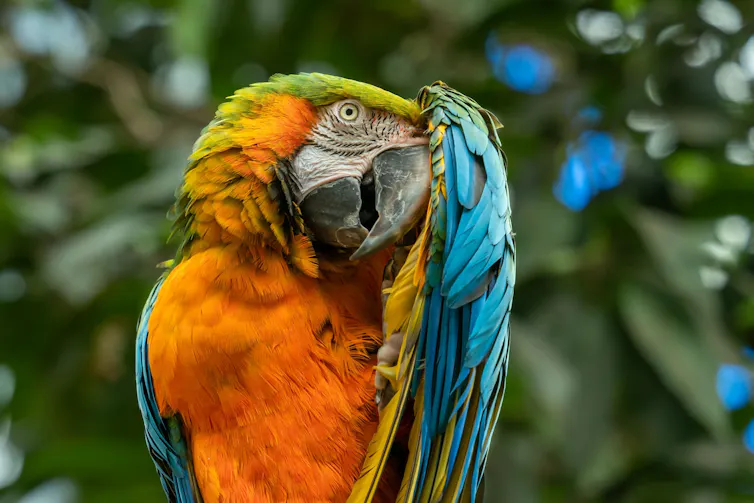
For captive animals, engaging in natural behaviour is a pillar of the animal welfare framework. But when it comes to sex, one important behaviour has
been largely ignored, and sometimes even punished: masturbation.
Solo sex is surprisingly common across the animal kingdom. It is well documented in primates. Tortoises are surprisingly vocal during their solo lovemaking endeavours, if not very graceful. Camels masturbate by rubbing their penises in the sand and porcupines make inventive use of all sorts of objects.
Our new study could change how other scientists view masturbation in birds and improve their welfare.
Masturbation also seems to be common in birds. A quick internet search brings up an abundance of video clips on social media and dedicated posts on bird-keeping forums, largely from worried or bemused hobbyist bird keepers.
It has often been treated as an abnormal problem behaviour in captive birds (particularly parrots). Folklore husbandry has assumed it is the undesirable outcome of stress, bad health or poor environment. Bird keepers often therefore discourage masturbation via punishment or veterinary interventions such as diet or care changes and, sometimes, even drugs and surgery. Despite the welfare implications, masturbation in birds had been largely unexplored by the scientific community.
We set out to change that, by investigating the distribution and evolutionary history of masturbation in birds for the first time. We studied 120 species of bird across 22 major groups, gathering data from the scattered scientific literature, online reports and community forums, and surveys of bird experts.
Our study found that masturbation is widespread across birds with a strong evolutionary history, meaning that it’s an ancient trait probably similar in closely related species. Although we found more records of masturbation in male birds, it occurs in both sexes and across all age groups.
Solo sex also seems to be linked to species that mate with multiple partners, supporting the idea that it might help to increase reproductive success when there is a high degree of competition over fertilisation. For instance, in males it may flush out old sperm to leave newer (better condition) sperm for mating. In females it may increase sexual arousal to help with sneak mating with males other than their partner.
Wild behaviour
Crucially, we discovered that masturbation is actually less common in captivity than the wild, and more common in birds reared by their own parents than by humans.
What this tells us is that masturbation in birds is neither an unnatural
behaviour, nor a consequence of captivity. Given this finding, it is important
that birds are not prevented from masturbation. Of course, as with any behaviour, there may be extreme cases where chronic masturbation could indicate underlying health or husbandry issues.
Avian self-pleasure is usually a rather inelegant affair, in which a bird rubs their cloaca (a shared orifice for both excretion and reproduction) against an object, like a branch, twig or toy. This is often accompanied by a lot of flapping and self-satisfied vocalisation.
One potential reason for the lack of scientific studies exploring avian masturbation may be because the cloaca is thought to have fewer nerve clusters, and therefore lower sensitivity, than our own genitals.
Clearly however, birds are getting some satisfaction from masturbation, so perhaps there is more to a bird’s sensations during sex than has previously been recognised. Further exploration of this could have important implications for both welfare and captive breeding programmes. While sexual pleasure may not be exactly the same experience as for mammals, it is wildly premature to dismiss the idea that birds also feel pleasure.
The authors do not work for, consult, own shares in or receive funding from any company or organisation that would benefit from this article, and have disclosed no relevant affiliations beyond their academic appointment.
During the final season of Lena Dunham’s acclaimed comedy drama series, Girls, the character she plays, Hannah Horvath, says her ambition as a writer is to make people laugh about painful things. In real life, this is exactly what Dunham has achieved with her second memoir, Famesick which opens with a prime example.
“It’s very hard to remember a time – aside from brief flashes of adrenaline on a set or a date or at a fashion party where people are inadvertently dressed like kids in a school play about Greek gods – when being in my body didn’t feel like towing a wrecked car across town at midnight,” she writes.
A searingly funny, bare-hearted exploration of the cost of success, Dunham’s book charts her meteoric rise as a young screenwriter, director and actor with brutal honesty.
Review: Famesick by Lena Dunham (4th Estate)
Smart, sassy and highly entertaining, Famesick is ultimately a painfully astute analysis of the ways a dream job can morph into a perilous nightmare. Particularly for someone who is neurodivergent, barely out of college, emotionally dependent on their parents and suffering from a rare, undiagnosed chronic disease.
Throughout the first decade of her glittering career, Dunham balanced precariously between adulation and critical attacks. Her intelligent, sharply observed humour defined her public and professional image, but her personal boundaries were all too permeable. The demands of her job bled into her life with devastating consequences for her body.
Careering from one disastrous man to another, leaning hard on colleagues and friends, Dunham looked to others for the psychological stability she hadn’t yet developed. Her heart dangerously exposed on her sleeve, she poured the events of her life into screenplays, medicated her stress and crashed her way through stardom, unprotected by the industry that relied on her.
The price of Dunham’s success was exorbitant, involving much more than long hours and hard work. Yet while parts of her story are harrowingly visceral, she refuses self-pity and keeps away from the confessional traps of trauma porn.
There is nothing gratuitous or exploitative in these pages and Dunham refrains from blaming others for her chaos. Instead, she frames her drug addiction, unhealthy relationship patterns and debilitating chronic health issues as the cost of her own ambition, with a central question in mind. Was it worth it?
A cursed, well-connected fairy tale
Dunham’s narrative begins like a modern-day fairy tale with the story of her name, chosen by her mother “because it sounded like the name of someone who could be a movie star or a lawyer with an equal measure of success”. As a legacy, this turned out to be something of a curse.
Raised within privileged and well connected New York circles, by artist parents, Dunham began experimenting with film-making while attending liberal arts college Oberlin. Her first breakthrough was in 2010, with the award-winning semi-autobiographical movie, Tiny Furniture. She was just 23.
Six months after her film premiere, Dunham’s career skyrocketed when HBO contracted her to write and direct the pilot episode of Girls. Aiming to reflect the messy, early twenties stage of life, “when you don’t even know enough to even know what you’re looking for”, the show, like her film, starred herself and her childhood friend Jemima Kirke, with Allison Williams and Zosia Mamet completing the quartet of titular girls.
The series’ most intriguing character was arguably Hannah’s oddball boyfriend, Adam Sackler, played with unnerving conviction by Adam Driver in his first major role. Sackler, a misanthropic alcoholic, was based on Dunham’s real-life abusive lover in the first season. Later, the character evolved into a tender and devoted partner.
Off screen, Driver and Dunham’s relationship was, according to the book, also intense. The two actors skirted each other as Dunham tried to fathom her co-star’s unpredictable, occasionally explosive behaviour.
On one occasion, rehearsing a fight scene, he threw a chair at a wall when she couldn’t remember her lines. But while she recalls his verbal aggression and short temper, she also remembers spending “an inordinate amount of time wondering if Adam liked me”. Given the obvious strength of her seemingly unresolved feelings for Driver, it’s hard to know how to read her interpretation of him, though she clearly never figured him out.
With its frank, often hilarious, sometimes uncomfortable, all too relatable depictions of troubled friendship, awkward sex, career missteps and the fraught struggle for identity, Girls made a huge impact. From 2012, it ran for six seasons and five years, by which time all four main actors were turning 30. According to Dunham, the ending was planned to avoid losing “the creative clarity and specificity that gave it value”.
The show established Dunham as a sharp-sighted, uniquely talented visionary, but also attracted pernicious criticism that took her many years to process.
Accused of exploiting her nepo baby status, reviled for daring to expose her perfectly average physique, branded a myopic millennial, Dunham was both pummelled and pressurised for assuming the voice of her generation. “Or a voice,” as Dunham remembers her high-powered co-showrunner, Jenni Konner quipping. “Of a generation.”
Body as battleground
The irony of her situation was ridiculous. The whole point of Girls was to satirise the hot, flawed, contradictory tangle of young, white female adulthood experienced by Dunham and her friends. But like countless other women, Dunham was vilified for daring to give herself a platform. Worse – again, like so many other women – she experienced every mistake as an abject failure that filled her with shame.
Dunham’s extraordinary trajectory served as both example and warning to her peers, but behind the scenes of her controversial story, her body had become a battleground.
Between the pilot of Girls, when a colitis attack landed her in hospital, and the final season, when she shattered her elbow, collapsed from endometriosis and suffered a massive internal haemorrhagic cyst that caused so much pain she could barely walk, Dunham had chosen to “ignore my body’s noisy signals in favour of this thing I wanted so badly”.
In 2019, Dunham was diagnosed with Ehlers-Danlos syndrome, a rare genetic connective tissue disorder that explained many of her symptoms. Prior to this, her faltering health was often just another source of shame. Hospital stays and bed rest delayed production, which was expensive and upset Konner. So Dunham numbed herself with prescription pills and kept going.
On the brink of her career, Dunham was in thrall to Konner. Brought in by HBO, the 38-year-old supervisor was already a television heavyweight and represented a big sister figure for the less experienced creator, who was her junior by 14 years.
Within days of their first meeting, Konner began divulging intimate details of her life and making extremely personal remarks to Dunham, all while teaching her how to write a pilot. But once filming started, she began exercising her authority “on a more sinister note”, telling her protegee she had to gain weight and look dowdy in order to stay funny.
Years later, when working with younger women herself, Dunham could see “how absurd it would seem to link myself to them in ways beyond the playful support system an on-set adult provides”. But as the ingenue, Dunham placed all her faith in Konner, and immersed herself in a lopsided relationship that grossly transgressed professional boundaries.
Together with Kirke, and Dunham’s long-term partner, music mogul Jack Antonoff, Konner became one of the author’s “three Js”; effectively a triumvirate who “defined my world, and in relation to whom I defined myself”. Caught up in this circle of co-dependency, Dunham was invariably left with an overwhelming sense of inadequacy. She felt she was
always in trouble with one of them for something: A dinner I arrived late for and left early. A messy breakdown I couldn’t predict or control … and the endless cycle of reassurance I required afterward. The only thing I could promise was to never miss a deadline.
Dunham is more circumspect when it comes to her parents. However, it’s impossible not to speculate over her enmeshed relationships in light of her family dynamic. Supportive, but also overprotective and possessive, her mother (“the original frenemy”) and father tended to burden her with “unreasonable expectations”.
And they appeared to have been threatened by her success, as Dunham explains, “because it forced them to admit how much of their own self-image rode on their own highly specific public identities”.
Other telling details are scattered throughout the book, including the death of her beloved anorexic grandmother and her estranged brother, Cyrus, who couldn’t bear the attention his older sister’s fame commanded. (A media storm over a passage in Dunham’s first book had resulted in claims she had sexually abused Cyrus when they were both children, and though Dunham strenuously denied this and issued an apology, damage was done.)
There is enough here to know that Dunham’s comparatively untold family story has been a difficult and complicated one, with firmly embedded roots and a pretty long shadow.
After Girls, Dunham’s life imploded. Her physical suffering culminated in a hysterectomy. She broke up with Antonoff after five years. And her addiction to benzodiasepines, taken to suppress her anxiety, finally landed her in rehab.
Her recovery, chronicled in the third part of the book, was slow and incremental as she learned to reappraise her work ethic, to accept her body and to learn to live with chronic illness. She also had to let go of Konner, which broke her heart, but helped her become more forgiving towards her younger, needier self.
As the book moves towards its poignant conclusion, which sees Dunham married to British musician Luis Felber and settled into a more sustainable rhythm of work and life, the price she has paid for fame becomes clear.
“Hollywood’s culture has always been permissive toward everything but human frailty,” she writes. And with this final insight, she points her reader back to the front of her book, and the long, tragic list of now-dead stars to whom her memoir is dedicated, along with “anyone else who was too Famesick to be cured”.
Liz Evans does not work for, consult, own shares in or receive funding from any company or organisation that would benefit from this article, and has disclosed no relevant affiliations beyond their academic appointment.
Focusing on the word “rights” hides something more serious underneath: how people live and survive in this situation. What’s unfolding in Afghanistan is not just a women’s rights crisis, but a humanitarian disaster.
It affects how people access health care, education, food systems and basic supports and whether these system can function at all when half the population has been systematically removed from them. It forces families to deal with women’s limited access to work and services, often pushing households into deeper economic and social vulnerability.
The Taliban has steadily removed women from public spaces including work, health care and education. Recently, for example, female health-care workers were stopped at the gates of a United Nations office and banned from entering the facility by Taliban authorities.
These ongoing removals are incrementally creating a system that determines who has the right to exist, to provide assistance and to receive assistance.
What’s happening in Afghanistan is not simply gender discrimination; rather, it’s pushing an entire gender out of public systems altogether. The predicament of Afghan women is less a social problem and more a structural crisis that shapes institutions and everyday life.
Gender apartheid
This is why the situation in Afghanistan is increasingly referred to as a form of gender apartheid rather than a women’s rights crisis. The exclusion of women reveals how institutions are built and will be maintained in the future.
Gender apartheid refers to a situation in which people are banned from certain spaces or activities based on their gender identity.
Its effects are also accumulative, with each restriction reinforcing others and deepening the overall crisis. These systemic rights violations would be increasingly difficult to reverse even if political bodies and the ruling government changed tomorrow.
That’s because removing women from professional spaces leads to schools losing teachers, hospitals losing trained staff and aid networks losing access to half the population. And this loss isn’t temporary; it limits how systems can respond to the growing needs around them.
When women get barred from institutions, the problem isn’t just that these organizations suffer in their service delivery and performance. It also results in the loss of institutional memory — the skills, professional knowledge and experience that is no longer transferred to future generations.
Over time, institutions also scale down or suspend certain services due to a shortage of female workers. As services shrink, significant gaps appear in the networks of care and support leaving entire groups of people without consistent access to support.
Blocking aid and support
The Taliban refusal to allow female workers into UN and UNICEF offices is one of many examples happening today in Afghanistan that ban qualified women from entering places where they can deliver urgent care and assistance.
Taliban rule consequently delays or prevents life-saving interventions for women and children, a violation of the human right to survive.
It’s not just UN and UNICEF offices where women workers are banned from entry: they’re being turned away at other aid organizations, hospitals, schools and various public institutions in a widespread erosion of human rights. The Taliban has put in place a network of human rights violations across the entire humanitarian system.
Humanitarian aid also depends on access to information and correct data: who is hungry, who is unsafe and who needs protection. In Afghanistan, where women are limited in who they can interact with and where female staff are largely absent from outreach, surveys and home visits, this information becomes incomplete.
Poor data leads to incomplete distribution of assistance and mismatched allocation of aid. As a result, the most vulnerable populations can remain invisible in official assessments.
This invisibility especially affects households headed by women and those living in remote or rural areas with already limited access.
Normalizing crises
The impact of Aghanistan’s gender apartheid might not be visible to many outside the country, but in the near future, humanitarian systems will break down.
UNICEF estimates the ban could cost Afghanistan 25,000 teachers and health-care workers. In a country where women are prohibited from receiving care from male providers, banning women from both education and health-care work creates a profound medical emergency.
Over time, systems will be redesigned without women as providers even as they remain central as recipients. As gender restrictions disrupt the flow of resources, knowledge and care, the capacity to deliver services is declining every day despite high demand. Many women are also pushed into informal or hidden work that is insecure and vulnerable to exploitation and abuse.
Gender apartheid in Afghanistan will not end through recognition alone. Naming systemic terror does not stop it and, without action, repeated exposure to crisis can instead normalize it through compassion fatigue. Humanitarian organizations now face a stark choice: operate under restrictive conditions and risk legitimizing them, or withdraw and leave people without support.
The longer the situation persists, the more the exclusion of women in Afghanistan risks becoming a normalized structure rather than an emergency. The question is no longer only how to restore what’s been lost, but whether systems once dependent on women’s participation can be rebuilt at all.
Sepita Hatami does not work for, consult, own shares in or receive funding from any company or organisation that would benefit from this article, and has disclosed no relevant affiliations beyond their academic appointment.
A teenager scrolls through their phone at the dinner table, barely looks up and answers questions with one-word replies. For many adults, that image has come to stand for a larger fear: that today’s young people are disconnected from others and may be uninterested in the world around them. Concerns about declining civic participation often deepen that worry.
As researchers whostudy adolescent development, we believe this picture is incomplete. Adults help shape the environments in which young people learn to contribute, or learn not to. In worrying that young people are disengaged from participating in civic society, adults may overlook both their own role in fostering engagement and the many ways young people are already contributing.
Youth civic and community engagement matters because it helps build skills, relationships and habits of participation that carry into adulthood. How do teens actually express their care for the world around them, and what helps them to do so?
What does engagement really look like?
When adults talk about “engaged” teens, they often picture a narrow set of activities: volunteering, joining clubs, leading student government, maybe attending a rally or organizing a fundraiser. Those forms of contribution to society matter. But they are not the whole story.
In two recent studies, we surveyed 723 American adolescents, with an average age of 15, to understand what predicts whether teens will contribute to society and what their contribution looks like.
In the first study, we identified four distinct patterns: Some teens were generally less engaged; this group represented 21% of our sample. Another 19% we called “Digital Advocates,” highly active online but less involved in face-to-face settings. A third group, 33% of our sample, we termed “Local Helpers,” more engaged in interpersonal and community-based helping. “Contributors” were our fourth profile type, making up 26% of our sample; they reported high engagement across all domains.
Our finding pushes back against a common adult assumption that “real” engagement has to look a certain way. It doesn’t. A teen sharing information online about where local families can access food assistance and a teen quietly checking in on a struggling friend are both contributing – just differently. Digital participation is not automatically shallow; for many young people, online spaces are where they learn about issues, form opinions and connect with others who share their concerns.
Crucially, these profiles were shaped less by demographics – age, gender or race and ethnicity – and more by whether our teen respondents had the personal and contextual supports that helped them act on what they cared about.
We were especially interested to see that purpose mattered not only when it was self-focused – wanting to succeed, build a career and so on – but also when it extended beyond the self, such as wanting to help others or contribute to something larger than one’s own interests.
That may sound obvious, but it has real implications. Adults often tell teens to “get involved” without helping them connect that involvement to a meaningful why. Our findings suggest young people are more likely to contribute when they feel hopeful about the future and when they see their lives as connected to others.
What adults can do
To help young people make a difference, first broaden your definition of contribution. The teenager organizing a school drive, the one helping a neighbor and the one making informative videos about a community issue are all contributing in real ways. Notice these efforts and support them in their chosen contribution.
You can also support adolescents in building the traits that make it easier for them to get involved and make a difference:
Help young people develop a sense of purpose that goes beyond themselves. Ask questions like: What do you care about? What kind of difference do you want to make? Purpose-driven engagement tends to be more durable than participation that’s driven by obligation.
Nurture hope. Young people are less likely to act when they feel that nothing will change. Adults can support hope by helping teens see realistic pathways for success and giving them opportunities to speak up or solve real problems in their schools and communities.
Make space for critical consciousness. After-school programs, classrooms and youth groups can create environments where conversations about social issues are taken seriously and connected to real action. Young people need chances to talk about the world they see – and the world they want.
Teens often make a difference in ways that reflect both what they care about and how they are beginning to understand the world around them. Contributing is about more than just involvement in civic institutions; it can also look like helping a neighbor, speaking up for others or creating social media content that raises awareness about an issue. Instead of expecting teens to be checked out, caring adults can help them develop the skills and resources to contribute in any and all of these meaningful ways.
The authors do not work for, consult, own shares in or receive funding from any company or organization that would benefit from this article, and have disclosed no relevant affiliations beyond their academic appointment.
The Architecture, Engineering and Construction (AEC) sector has suffered four decades of productivity stagnation. Complex permitting regimes, fragmented governance, and an industry structure built around one-off projects have prevented it from delivering affordable, liveable, and sustainable homes at scale.
By late 2025, the supply of new housing units in the EU met only 50 percent of actual demand, compounded by soaring costs for labour and materials and a construction sector that has historically struggled with low innovation and productivity.
At the same time, buildings account for roughly 40 percent of Europe’s energy consumption and 36 percent of its CO₂ emissions.
The EU Green Deal, the Circular Economy Action Plan, and the EU taxonomy for sustainable activities are demanding deep decarbonisation – but as theWorld Economic Forum’s Reimagining Real Estate framework (2024) makes clear, technology and sustainability commitments alone are insufficient without a reconfiguration of who builds, who owns, and who governs the built environment. The WEF’s earlier Framework for the Future of Real Estate (2021) similarly warned that affordability and decarbonisation would only align if the industry fundamentally changed its business models and governance structures. Neither framework, however, mapped the concrete alternative pathways by which this transformation might actually unfold.
To address this gap, we conducted a multi-year strategic foresight study with over 30 senior industry experts from across Europe, architects, developers, material suppliers, energy companies, and real estate services firms. Published in the journal Futures our study combines a horizon scan, impact-uncertainty analysis, and three rounds of expert workshops to construct four consistent scenarios for the European AEC industry by 2040.
The scenarios are not predictions. They are structured explorations of four plausible development pathways, each with a distinct logic for how decarbonisation, circularity, and housing affordability might interact under different governance arrangements.
In the first scenario, Giants rule the AEC industry, Big Tech firms and OEM-like construction companies dominate through data-driven, off-site, industrialised building. Homes become subscription services; platforms set the standards and productivity rises sharply. But affordability and tenant agency remain contested, and small firms struggle to survive.
In the second, the Circular Future: a coalition of regulators, financial institutions, and pioneering firms embeds circular principles into planning law, procurement, and finance. Buildings become documented material banks; biomaterials replace concrete; renovation dominates. Progress on carbon and resource targets is strong, but urban affordability challenges persist without deliberate policy attention to housing typologies and ownership models.
In the third, public sector leadership: governments take direct control after market mechanisms fail to deliver at scale. Binding targets, standardised typologies, and public investment programmes drive rapid decarbonisation and housing supply, but at the cost of private innovation and creative experimentation.
In the fourth, the Green energy revolution whereby the rapid decarbonisation of the electricity grid reshapes the entire housing question. Buildings become active nodes in bidirectional smart grids, and operational carbon largely disappears. But attention shifts to embodied carbon, energy poverty, and the distributional effects of a transition that benefits some households far more than others.
Scenarios for a net positive, regenerative construction sector to tackle Europe’s housing shortage.
The call for action
What our scenario analysis makes clear is that there is no automatic alignment between building more homes, decarbonising the stock, and making housing affordable. The same headline instruments, green finance, circular procurement, digitalisation, lead to very different outcomes, depending on who orchestrates the system and which governance logic dominates. This has direct implications for policymakers, investors, and industry leaders right now.
Three no-regret priorities emerge across all four futures:
Deep renovation of the existing building stock is non-negotiable in every pathway; the question is only who pays and who profits.
Digital infrastructure for monitoring energy and material performance is needed regardless of which actor is in charge.
And new skills and organisational capabilities for industrialised construction and lifecycle thinking must be built now, not after the transition has arrived.
The EU’s first Affordable Housing Plan, launched in late 2025, and the upcoming first-ever EU Housing Summit in 2026 offer a rare political window. The question is whether policymakers will use it to address the structural governance failures our scenarios reveal, or simply add more instruments to a system whose fundamental tensions remain unresolved.
The building industry has a decade and a half to get this right. The futures exist; the choices are ours.
A weekly e-mail in English featuring expertise from scholars and researchers. It provides an introduction to the diversity of research coming out of the continent and considers some of the key issues facing European countries. Get the newsletter!
Les auteurs ne travaillent pas, ne conseillent pas, ne possèdent pas de parts, ne reçoivent pas de fonds d'une organisation qui pourrait tirer profit de cet article, et n'ont déclaré aucune autre affiliation que leur organisme de recherche.
Astronomers using the MeerKAT radio telescope in South Africa have discovered the most distant hydroxyl megamaser ever detected, opening a new radio astronomy frontier. A hydroxyl megamaser is a natural space laser, and this one is located in a violently merging galaxy more than 8 billion light-years away.
We spoke to the astronomers, Thato Manamela, a postdoctoral researcher at the University of Pretoria, and Roger Deane, director of the Inter-University Institute for Data Intensive Astronomy and a professor at the universities of Cape Town and Pretoria, about their study.
What you’ve found has been described as a ‘new frontier’ in space research. Why is it extraordinary?
This discovery is extraordinary because of the record distance at which we’ve detected it, over eight billion light-years away. That places it deep into the early universe. This means that we aren’t seeing the galaxy as it exists today. We are seeing it as it was 8 billion years ago. Since the Big Bang happened about 13.8 billion years ago, we are looking at a “toddler” version of the universe. At that stage where the maser signal was transmitted by the host galaxy, galaxies were much more “chaotic”, they collided more often and were much more active than the stable, mature galaxies we see nearby today.
It gives us a rare glimpse of galaxy interactions and extreme star-forming environments when the cosmos was less than half its current age. Think of light like a letter in the mail. If a friend sends a letter from overseas, by the time you read it, the news is old. In space, light is the letter. The “news” from this galaxy took 8 billion years to reach us. We see the galaxy as a “toddler” even though, in its own time, it has already grown up or changed.
We detected this megamaser, which operates on a scale of power millions of times greater than a typical galactic maser. Both megamasers and gigamasers are cosmic radio lasers. While a megamaser is a million times more luminous than a standard maser found in the local universe, a gigamaser is a billion times more luminous, making it 1,000 times more powerful than a megamaser.
In just five hours of observing time we found a signal that typically requires hundreds of hours of observation, given its distance and rarity. But gravitational lensing boosted the signal enough to detect it. Additionally, while we were targeting neutral hydrogen, MeerKAT’s wide bandwidth enabled the surprise discovery of the megamaser signal in the same data.
This rapid detection suggests that future surveys with MeerKAT and the upcoming SKA Observatory could uncover many more such distant, extreme objects. Its ability to find this so quickly proves that we finally have the technology to see faint signals from the very distant past. It’s a preview of what the upcoming Square Kilometre Array (SKA), a unique, one-of-a-kind international mega-project, might achieve.
But a highly complementary next-generation facility called the next-generation Very Large Array (ngVLA) is being planned and designed for construction in the US. The SKA Observatory (SKA-Low and SKA-Mid) focuses on low-to-mid radio frequencies. The ngVLA will operate at much higher frequencies. Together, they will form two of the major pillars of next-generation global radio astronomy. The finding gives astronomers a new way to study how galaxies evolved in the early universe.
What technologies or capabilities made this possible?
The discovery was made possible by the sensitivity and wide frequency coverage of the MeerKAT radio telescope. Its ability to detect faint signals over a broad frequency range allows us to search for spectral lines across large cosmic volumes. A spectral line is a cosmic chemical fingerprint. Every atom or molecule emits electromagnetic waves at specific frequencies. Detecting those frequencies tells astronomers what the gas is made of.
In this case, MeerKAT’s wide bandwidth allowed us to detect both the hydroxyl line and neutral hydrogen absorption in a single observation. Previously, with older technology, this would have taken two separate observations.
Equally important are advances in data processing and computing. The data were processed using high-performance computing resources at the Inter-University Institute for Data Intensive Astronomy (IDIA).
Processing such massive amounts of data is like trying to drink from a firehose. MeerKAT collects gigabytes of information every second, resulting in files far too large for a standard computer to handle. To find a signal from 8 billion years ago, which is millions of times fainter than a cell phone signal, we must use robust calibration pipelines. These act like an automated high-tech car wash to scrub away digital noise and sharpen the telescope’s focus. This “cleaning” process requires trillions of mathematical calculations, necessitating the use of supercomputers that work for days to transform raw radio interference into a clear scientific discovery.
Gravitational lensing also played a key role. A massive foreground object, like a star or galaxy, for example, amplified the signal from the distant galaxy, effectively acting as a natural telescope and boosting our ability to detect it.
How does what you’ve found change our understanding of the universe?
It’s rare that a single astrophysical system, a collection of celestial objects, in this case, two galaxies forming a lens system, can change our understanding of the universe. We typically need large sample sizes to do that. But the combination of the recording-breaking distance and the speed of the discovery was impressive.
It suggests that systematic searches – such as those conducted by deep MeerKAT surveys – could convert these once-rare finds into powerful probes of extreme, yet highly obscured star formation in the distant universe. As a result of this observation, the SKA Observatory and other future telescopes won’t just be looking for more of the same; they will be looking for hidden history.
Hydroxyl megamasers are usually associated with galaxy mergers. We expect some galaxy mergers to host pairs of supermassive black holes. Almost every large galaxy has a supermassive black hole at its centre. When galaxies merge, the supermassive black holes at their centres can eventually spiral towards each other, producing gravitational waves, ripples in space-time. Finding systems like this helps astronomers study an important stage in galaxy evolution and the environments where these extreme events occur.
By using megamasers to find these pairs, we can study the final stages of how the largest objects in the universe are built. This is a major milestone in a galaxy’s life. By finding these galaxies now, we are catching them at a key evolutionary stage, the final countdown before they collide and release a massive burst of energy that our next generation of detectors will be able to hear.
The strength of the MeerKAT-detected hydroxyl signal after such a short observation time therefore implies that astronomers will be able to detect large numbers of these systems across most of cosmic time.
What does the discovery say about South Africa’s place in data-intensive radio astronomy?
This discovery highlights South Africa’s leading role in radio astronomy. Facilities such as MeerKAT, combined with data-intensive platforms like IDIA, provide world-class capabilities for both observation and analysis. It also demonstrates strong local expertise in handling large, complex datasets.
Discoveries like this rely on advanced data processing, signal extraction and scientific interpretation. These are all key strengths within the South African research community. As we move from using current scout telescopes like MeerKAT to building and operating the world’s largest radio observatory, the SKAO, South Africa is well positioned to remain a hub for data-intensive astronomy. Results like this reinforce the country’s role in shaping the future of the field.
Thato Manamela works for the University of Pretoria. He receives funding from the National Research Foundation (NRF SARAO). He is affiliated with UP and IDIA.
Roger P. Deane previously held an SKA Research Chair in Radio Astronomy, funded by the South African Radio Astronomy Observatory, which is a facility of the National Research Foundation (NRF), an agency of the Department of Science, Technology and Innovation (DSTI).
Europe is once again eyeing international energy markets with unease. The war in Ukraine, geopolitical tensions in the Middle East and the extreme volatility of gas prices are all stark reminders of a painful truth: the continent’s energy security is still at the mercy of external factors.
The standard response to energy crises is to hunt for new suppliers, bolster reserves, or accelerate the roll-out of renewables. While necessary, these strategies often overlook a less visible but equally critical lever: reducing how much energy our buildings actually use in the first place.
But there’s a major roadblock to making this happen, as Europe does not accurately measure thermal and energy properties. Instead, the continent’s energy efficiency ratings rely on generic data, usually derived from averages or regulatory default values of construction materials as opposed to a building’s actual thermal behaviour.
This makes it almost impossible to clearly predict how well energy-saving measures will work. What buildings need is something akin to the nutritional information we find on food packaging, which rigorously lists ingredients and nutrients. Just as we know exactly what we’re buying and eating, we should also know exactly how every building behaves – as opposed to an estimated average.
Buildings account for a massive share of Europe’s energy consumption, and every improvement in insulation or design translates directly into less external dependency for heating or cooling.
Today, tools like Building Energy Modelling (BEM) allow us to simulate performance before construction begins. But these simulations are only as good as the information we feed them. If the data is generic or outdated, the resulting decisions are fundamentally flawed.
In practice, most digital libraries represent materials using average values, creating a precision gap that undermines strategic goals. We should think of materials as the DNA of a structure. Just as personalised medicine uses a patient’s specific genetic map to prevent disease, architecture needs the exact physical and hygrothermal “map” of its materials.
Without this, we are essentially treating buildings blind, relying on generic diagnoses that fail to predict thermal bridges or hidden inefficiencies. If we use generic data, a simulation might promise a high-performance building, but the finished reality often performs as much as 10% or 20% worse.
For decades, material data has been trapped in static PDF catalogues, making it useless for modern digital simulation. The solution is digital traceability. The EU is already pushing for the Digital Product Passport (DPP), a tool designed to provide electronically accessible information on products to improve sustainability and circularity throughout their life cycle.
This initiative works alongside the Construction Products Regulation (CPR), the EU’s legal framework that ensures all construction products speak the same technical language through standardised performance declarations, and the newly revised Energy Performance of Buildings Directive (EPBD), which mandates strict efficiency targets to reach zero-emission goals.
Together, these measures mark a clear path from static data derived from averages to machine-readable precision.
When designing a building, one single ill-informed material choice can lock it into excess costs and inefficient energy demand for its entire half-century lifespan. And in a landscape of high energy prices and uncertain supply, design deviations carry even more weight than they did in the past.
What once seemed like minor technical details have been transformed by geopolitical reality into a strategic imperative. Energy security is not just fought over in pipelines or ports, but also in the millions of technical choices made by architects and engineers every year.
Every energy crisis reminds us to secure our supply. But it should also remind us of something equally vital: the most secure, cheapest, cleanest energy is the energy we never have to consume in the first place.
To achieve true energy sovereignty, we must design and retrofit our buildings with greater technical precision. Just as no one would plan a rigorous medical diet using only approximate nutritional values, it makes little sense to project the future of our cities using materials described as mere averages. A truly efficient building does not start on the construction site; it starts with the quality of the data we use to design it.
A weekly e-mail in English featuring expertise from scholars and researchers. It provides an introduction to the diversity of research coming out of the continent and considers some of the key issues facing European countries. Get the newsletter!
Andrés Jonathan Guízar Dena is a researcher at the University of Navarra. He receives funding from the European Union’s Horizon Europe research and innovation programme under the EXPLOIT4INNOMAT project (Grant Agreement No. 101058514). Within this project, he provides expertise in product characterisation for digital modelling, BIM environments, and energy simulation.
In April 2026, Sudan marked three years of civil war – one of the most ignored humanitarian crises in the world.
This conflict began between two factions that seized power after a coup in 2021: the Sudanese Armed Forces (SAF), led by Abdel Fattah al-Burhan, and the Rapid Support Forces (RSF), a paramilitary group led by Mohamed Hamdan “Hemedti” Dagalo.
The actions of these men have thrown Sudan into the worst humanitarian crisis in the world. It has involved crimes against humanity, genocide, the death of potentially more than 150,000 people, the forced displacement of more than 15 million civilians and 19 million people facing acute hunger.
In one of the most dangerous places in the world, local leaders are putting their lives at risk to provide humanitarian assistance within their communities.
These volunteers have formed Emergency Response Rooms or غرف الطواريء to coordinate, resource and carry out life-saving assistance. They describe being motivated by nafeer – a Sudanese tradition focused on a “deep sense of social responsibility” and “collective volunteerism”.
This concept is grounded in the idea that one must “lift your bowl to your neighbour”. Diaspora communities around the world have been funding and coordinating this work for years.
As one 25-year-old female volunteer told us:
The success of emergency rooms stems from the spirit of volunteerism and the desire to help others. This motivation keeps people working despite the challenges they face, like lack of funding, security threats from authorities and working in active war zone.
However, nafeer, by its nature, should only last for a limited period. After three years, these crisis leaders are exhausted, and the international humanitarian system is not stepping up to support them.
In fact, our recent research shows the system’s own structures are making their work harder.
Our research
We spoke to 20 local leaders from Emergency Response Rooms, civil society organisations and women’s associations. These interviewees were based in Darfur, Greater Khartoum, Gezira, Kassala, Al-Qadarif, Kordofan and the Nuba Mountains.
Interviews were conducted online in Arabic by Mayada Elmaki, a Sudanese-British researcher living between Europe and Qatar.
Responders’ names, organisations and locations were taken out, due to safety concerns. Of the 20 leaders we spoke with, only a quarter received a salary. The remainder were unpaid volunteers.
Because these community organisations have not been formally recognised as “humanitarian” by the international humanitarian system itself, their people are not considered “humanitarian workers”. This means they are not given the legal protection afforded those conferred on humanitarian workers under international law, including the Geneva Conventions. This puts them at extra risk of harm from military and paramilitary forces.
The Sudanese emergency workers say funders from within the humanitarian system – including governments, nongovernmental organisations and UN agencies – are often more focused on managing perceived risk than on what the community actually needs.
Funding is often so inflexible, it takes an “extremely, extremely long time” to access. Getting money from funders require negotiating quite different templates and procedures.
As one person told us:
when our priority is saving lives first, it’s problematic when donors dictate what we should focus on.
Sudan is one of the most dangerous places in the world to deliver humanitarian assistance. It is also home to one of the most chronically underfunded humanitarian crises.
The number of organisations in Sudan getting money from these major humanitarian funders has fallen dramatically in recent years. This isn’t because things have improved, but because the priorities of many international organisations have shifted elsewhere.
As one Sudanese humanitarian leader put it:
When one crisis receives more attention and support than another, it means some people’s lives matter more than others.
At the heart of the international humanitarian system’s ethical foundation is the idea that assistance should be based on need alone – not factors such as geopolitical interest. But this is not what many of our interviewees have experienced.
The international community has taken some notice. Sudan’s Emergency Response Rooms were awarded major humanitarian prizes in 2025 and have been twice nominated for the Nobel Peace Prize.
But awards are not protection, funding, or recognition within the humanitarian system.
As Sudanese leaders, community members and volunteers endure one of the world’s worst humanitarian crises, the international system needs to step up.
Local priorities
Our research seeks to amplify the priorities of local Sudanese responders.
They are calling for:
better protection and compensation for those on the front lines
more flexible agreements with major funding bodies
direct funding that acknowledges operational costs
funding for long-term rebuilding of Sudan (not just the emergency response).
Otherwise, the international humanitarian system and the major players in it will, as one person told us, continue “ploughing the sea”, and “keep going in circles without real progress”. They added:
I hope my words reach them and make them reconsider their policies and establish long-term strategies for developing local communities.
Max Kelly recevies funding from the Norwegian Refugee Council. This research is funded in part by Deakin University, and the Norwegian Refugee Council (NRC).
Julia Hartelius and Mayada Elmaki do not work for, consult, own shares in or receive funding from any company or organisation that would benefit from this article, and have disclosed no relevant affiliations beyond their academic appointment.
We have been on a years-long campaign of satellite remote sensing of the vast desert landscapes in Eastern Sudan.
This involved using satellite aerial imagery to systematically and painstakingly search for archaeological features in Atbai Desert of Eastern Sudan, a small part of the much larger Sahara.
Our team – which includes archaeologists from Macquarie University, France’s HiSoMA research unit, and the Polish Academy of Sciences – wanted to tell the story of this desert region between the Nile and the Red Sea, without having to excavate.
One mysterious archaeological feature stood out. We kept finding large, circular mass graves filled with the bones of people and animals, often carefully arranged around a key person at the centre.
Likely built around the fourth and third millennia BCE, all these “enclosure burial” monuments have a large round enclosure wall, some up to 80 metres in diameter, with humans and their cattle, sheep and goats buried inside.
Our new research, published in the journal African Archaeological Review, reveals how we found 260 previously unknown enclosure burials east of the Nile River, across almost 1,000km of desert.
Who built them?
Already known from a few excavated examples in the Egyptian and Sudanese deserts, these large circular burial monuments have long puzzled scholars.
What seemed once isolated examples emerge now as a consistent pattern. It is suggestive of a common nomadic culture stretching across a vast stretch of desert.
Most are within the borders of modern Sudan on the slopes of the Red Sea Hills. Unfortunately, satellite imagery alone cannot communicate the whole story of these enclosure burial builders.
The carbon dates and pottery from the few excavated monuments tell us these people lived roughly 4000–3000 BCE, just before Egyptians formed a territorial kingdom we know of as Pharaonic Egypt.
But these “enclosure burial” nomads had little to do with urbane and farming Egyptians.
Living in the desert and raising herds, these were Saharan desert nomads through and through.
A new elite?
Some enclosures show “secondary” burials arranged around a “primary” burial of a person at the centre – perhaps a chief or other important member of the community.
For archaeologists, this is important data for discerning class and hierarchy in prehistoric societies.
The question of when Saharan nomads became less egalitarian has plagued archaeologists for decades, but most agree it was around this time of the fourth millennium BCE that a distinctive “elite” class emerged.
This is still a far cry from the sort of huge divisions between ruler and ruled as seen in societies such as Egypt, with its pharaohs and farmers. However, it ushers in the first traces of inequality.
Animals held in high esteem
Cattle seem very important to these prehistoric nomads (a theory also supported by ancient local rock art in the area).
Burying themselves alongside their herd, these nomads show they held their animals in esteem.
Thousands of years later, local nomads chose to reuse these now “ancient” enclosures for their burial plots – sometimes almost 4,000 years after they were first built.
In other words, the prehistoric nomads created cemetery spaces that lasted for millennia.
What happened to these people?
No one can say for sure.
The few dates we have for these monuments cluster between 4000–3000 BCE, nearing the end of a period when the once-greener Sahara was drying, a phase scientists call the “African Humid Period”.
From north to south, the summer monsoon gradually retreated, reducing rainfall and shrinking pastures. This led nomads to abandon thirsty cattle, increase the mobility of their herds, migrate to the south or flee to the Nile.
The monuments are overwhelmingly located near what were then favourable watering spots; near rocky pools in valley floors, lakebeds and ephemeral rivers.
This tells us that when the monuments were being built, the desert was already quite challenging and dry.
At some point, as grass and bush made way for sand and rocks, keeping their prized cattle became unsustainable.
Having large herds of cattle in this desert, at this period, may have been a way of showing off an expensive and rare possession – a prehistoric nomad’s equivalent to having a Ferrari. This may help explain why cattle were frequently buried alongside their owners in enclosure burial monuments.
A bigger story
These enclosure burials are only one part of the greater story of human adaptation to climate change across North Africa.
From the Central Sahara, to Kenya and Arabia, keeping cattle, goats and sheep transformed societies. It changed the food they ate, the way they moved around, and community hierarchies.
It’s no coincidence communities changed how they buried their dead at the same time as they adopted herding lifestyles.
These burial enclosures tell us even scattered nomads were extremely well-organised people, and expert adapters.
Our discovery reshapes the story of the Sahara deserts and the prehistory of the Nile.
They provide a prologue for the monumentalism of the kingdoms of Egypt and Nubia, and an image of this region as more than pharaohs, pyramids and temples.
Sadly, many of these enclosure monuments are currently being destroyed or vandalised as a result of unregulated mining in the region. These unique burials have survived for millennia, but can disappear in less than a week.
Maria Gatto (Polish Academy of Sciences) was an author on our paper. We also want to acknowledge Alexander Carter, Tung Cheung, Kahn Emerson, Jessica Larkin, Stuart Hamilton and Ethan Simpson from Macquarie University for their contribution. We are also grateful to the National Corporation of Antiquities and Museums (Sudan).
Julien Cooper receives funding from the Australian Research Council, (Future Fellowship, FT230100067).
Maël Crépy receives funding from the CNRS (HiSoMA) and the Ifao (NOMADES research program).
Marie Bourgeois receives funding from Ifao (NOMADES research program).
Early this week, Iranian state-linked media floated a plan to charge the operators of undersea internet cables in the Strait of Hormuz for access to what they say is Iran’s offshore territory.
The suggestion comes after Iranian warnings that several important cables in the strait were a vulnerable point for economies in the Middle East.
Iran’s comments expose an invisible foundation of the internet and globalisation itself: the web of more than 500 undersea cables that carries more than 95% of international data traffic.
We may think the internet lives in a kind of virtual cloud. But its physical underpinnings are vulnerable – and that vulnerability is becoming a very real geopolitical concern.
Gulfs, straits and cables
Several of the world’s most critical submarine cable routes run through the Middle East. Narrow sealanes through the Red Sea, Bab el-Mandeb Strait, Suez Canal, and the Strait of Hormuz also function as “digital chokepoints”.
These maritime corridors connect major economic centres in Europe, Asia and Africa. In 2024, submarine cable incidents in the Red Sea disrupted around 25% of the internet traffic between Europe and Asia.
The strategic importance of submarine cables is not lost on Iran. Damage to these cables, whether accidental or deliberate, would have significant consequences.
In the bigger picture, the message is unmistakable. Digital infrastructure can give states strategic leverage, but it’s also a potential target.
Digital infrastructure
Critical infrastructure used to mean oil pipelines, ports, or power grids. But data infrastructure has become just as important for national and economic security.
The core problem of undersea cables lies in the concentration of infrastructure. Many of the cables are bundled together along the same seabed routes and funnelled through a small number of maritime chokepoints.
This creates dangerous single points of failure. A cable cut – whether deliberate or accidental – can degrade connectivity across multiple regions simultaneously.
While cable breaks are not uncommon, repairs are difficult – especially in contested or militarised waters. Repair vessels require safe access, international coordination, and time.
Fragmentation and disruption
A serious submarine cable disruption could have profound consequences. One immediate effect would be the fragmentation of global connectivity. The ability to communicate with anyone anywhere that we now take for granted could take a significant hit.
Regions which depend heavily on vulnerable cable routes might experience degraded internet performance, communications blackouts, or financial instability. Countries with little backup infrastructure, particularly developing states across parts of Africa, the Middle East, and South Asia, would be disproportionately affected.
Financial markets too are vulnerable. Extremely fast and reliable data flows underpin high-frequency trading systems, global payment networks, and international banking transactions.
Even brief disruptions can make markets fluctuate rapidly, delay transactions, and make investors uncertain. Because so much of the global economy is so thoroughly interconnected, digital instability in one region can rapidly create worldwide financial shockwaves.
If cable disruptions coincided with conflict or instability along major maritime trade routes such as the Strait of Hormuz or the Suez Canal, insurance markets, shipping industries, and energy supply chains would also face increased uncertainty.
The military domain
The military and strategic consequences of cable disruption may prove even more serious. Armed forces rely on secure long-range communications and real-time coordination.
When you get down to it, everything from command-and-control systems to drone operations and logistics planning relies on undersea cables. Damage to these networks would make forces less effective, make it harder to coordinate with allies, and make miscalculations more likely.
Cable sabotage is not as clear-cut a provocation as a conventional attack on a military target. It’s hard to work out who did it – in cases such as cable breakages in the Baltic Sea often attributed to Russian action – and the legal situation is ambiguous. This ambiguity creates a risk that conflict will escalate, as states may struggle to determine whether disruptions are accidental, criminal, or acts of war.
The digital world has physical foundations
The US–Iran conflict has already delayed construction of new undersea cables. It also highlights a broader reality: the foundations of the digital world are real and concrete, and they are not invulnerable.
Any deliberate targeting or sabotage would not just be a local event. It would reverberate across global communications, economies, and security systems. The seabed has become a zone of geopolitical competition – and the consequences of disruption could affect the world’s stability for years to come.
Meredith Primrose Jones does not work for, consult, own shares in or receive funding from any company or organisation that would benefit from this article, and has disclosed no relevant affiliations beyond their academic appointment.
Have you ever eaten a green potato, or a bunch of rhubarb leaves?
Hopefully not, because these two plant parts can be toxic to humans. While they may seem edible, they contain chemicals that can make you seriously ill.
Over centuries, humans have learnt which plants are safe to eat and which are not, often by combining ancient knowledge with modern science.
The power of plants
Without plants, we would struggle to get the nutrients we need.
Crops such as wheat and rice provide carbohydrates, the body’s main source of energy. Fruits and vegetables contain a wide range of vitamins that help us stay healthy.
Plants are also chemical factories. To survive, they produce compounds that deter insects and animals that might eat them. They may also release chemicals that protect them from disease. One example is the tobacco plant which produces nicotine, a natural alkaloid that helps protect the plant from insect attacks.
Globally, there are tens of thousands of plants that contain toxic compounds. In Australia, we have more than 1,000 native and introduced plant species that can be toxic to humans and animals, under certain conditions. However, humans only consume a small fraction of the world’s edible plant species.
What makes a plant toxic?
A key principle of toxicology – the study of what makes something poisonous – is “it’s the dose that makes the poison”. This means certain toxic compounds are safe to consume, as long as you don’t eat too much of them.
Table salt is one example. You likely eat it everyday, but this substance can be harmful in excessive amounts.
And many plant compounds that sound dangerous are actually safe, when consumed in small amounts. For instance, green potatoes contain glycoalkaloids, a group of chemicals that can cause symptoms such as vomiting, fever and diarrhea when consumed in large amounts. Oxalates are a type of toxin found in rhubarb leaves. They too can make you sick, but only if you eat lots of them.
Preparation is key
At first, humans learnt which plants were nourishing and which were harmful through years of observation and experimentation. For instance, cassava was first domesticated in South America where Indigenous communities developed processing methods to remove cyanide, a poisonous chemical found in the plant’s roots and leaves.
Many other First Nations peoples developed sophisticated ways of preparing plants that contained toxins. Some Aboriginal communities in northern Australia would soak, grind or cook cycad seeds to remove naturally occurring toxins before consumption.
This knowledge soon became embedded in each community’s culture, as it was passed down through generations.
Today, we use various techniques to reduce or remove harmful compounds from plants. For example, raw or undercooked kidney beans contain a natural toxin called phytohaemagglutinin, which can cause illness. But by soaking and thoroughly boiling kidney beans, you can easily get rid of this toxin.
Fermentation is another way to remove poisonous chemicals from plants. This is because fermentation changes the plant’s chemistry in ways that can reduce or remove toxic compounds. For example, during soybean fermentation, microbes break down harmful compounds such as phytates and trypsin inhibitors, making the soybeans safer and easier to digest.
In some cases, scientists have modified toxic plants to make them safe to eat.
Faba beans, also known as broad beans, are one example. Faba beans are an increasingly important crop for Australian farmers, as they can attract high prices and help manage weeds.
Like many plants, faba beans naturally contain vicine and convicine, two compounds that generally don’t affect humans. But in people with a genetic condition called G6PD deficiency, they can trigger a serious reaction called favism. This condition can be life-threatening as it causes your red blood cells to rapidly break down.
Rather than abandoning this crop, scientists have used modern chemistry and plant breeding to develop new faba bean varieties with lower concentrations of these compounds. And farmers are already planting low-vicine varieties as part of their crop rotations.
Over millenia, humans have unpacked the complex chemistry of plants to learn what is safe to eat. But how we consume these plants, and how much of them we eat, also affects how toxic they may be.
Joel Johnson receives scholarship funding from the Australian government for his PhD program.
Mani Naiker does not work for, consult, own shares in or receive funding from any company or organisation that would benefit from this article, and has disclosed no relevant affiliations beyond their academic appointment.
What would attending your own wake be like? To say goodbye to the people in your life in person? What stories would you tell in your own eulogy?
While still relatively uncommon, living wakes are an emerging end-of-life rite in Australia. They may not be everyone’s cup of tea, but for those who want to share one more cuppa before they go, they offer a final opportunity to come together.
My ongoing ethnographic research has involved extensive interviews and time spent with families and deathcare workers around Australia, particularly those involved with living wakes.
My findings show people are becoming more confident and willing to discuss, plan and craft these personalised end-of-life rituals.
What is a living wake?
A living wake goes by many names, and sometimes no name at all. It can be called a living funeral, a celebration of life, an “awakening”, a bon voyage party, or even a creatively personalised name such as the “Festival of Barry’s Life”.
Regardless of the name used, it is a deliberate coming together around a person who is dying, in order to say goodbye and celebrate their life.
One of my interviewees described why her mum wanted a living wake:
she wanted to have a chance to tell her stories, and see the friends and family that she hadn’t seen […] she wanted to see everyone together again.
The late Australian radio broadcaster James Valentine held his own living wake, before his death last month. His celebration, on Valentine’s day, became part of a documentary tracing his last year.
Sharing stories such as James’, as well as those of less public figures, is vital in bringing living wakes into the public imagination.
Bringing personality to end-of-life rituals
Timing can be one of the challenges with a living wake. These events are typically hosted by people who have a terminal illness and are aware of their imminent death.
Many death doulas – non-medical deathcare workers who support the dying person and their families – advise that people who would like to have one should have it as early as they can, while they still feel up to it.
Living wakes are part of a growing trend of ritual creativity. This includes newer ritual elements, such as coffin decorating, alongside the personalisation of familiar funerary traditions – which could be as simple as holding a memorial at the person’s favourite place.
The event may incorporate religious or cultural elements, such as prayers or cultural ritual, or may be more secular with activities that best represent the dying person, such as karaoke or ice-cream tasting. Hosts and guests at living wakes tend to have few rigid expectations, as it’s usually everyone’s first time taking part in one.
There are no guidelines, no set structure and no need for formalities. A barbeque in the backyard with the dying person’s favourite beers is as legitimate as an event with a formal celebrant and speeches.
“We made it up as we went along, really” is a common refrain from family and friends. This doesn’t make the rituals less meaningful. Rather, it creates opportunities for authentic and memorable gatherings.
An Australian irreverence and practicality can sometimes colour the event with playful and unexpected flair, without denying the very real feelings of anticipatory grief.
Shared storytelling, including from the dying person, is often described as the highlight for guests: an opportunity to laugh and cry alongside each other and make new memories.
Families who choose to host living wakes are often creating unique events tailored entirely around their person.Getty Images
An increasingly accepted practise
Living wakes have gained traction in recent years as part of a broader shift towards more celebratory and personalised funerals that aim to offer the bereaved a goodbye that feels authentic.
As Melbourne-based death doula told me:
You know, people walk away from funerals and say ‘she would have loved that’. A living wake is a chance to say instead ‘it was great that Granny was there to hear those stories and feel loved’.
My research has found only a few reported examples of living wakes in Australia before the 1980s. A scattering of events in the 1990s started to show global rising interest, and since then media reports have helped further expose these events to the general public.
That said, most living wakes go entirely unrecorded by anyone other than attendees. With only a few deathcare professionals present, such as funeral directors and celebrants, these intimate events become stories held in the family, rather than in public archives.
Cindy Stocken receives funding from the Commonwealth through an Australian Government Research Training Program Scholarship. She is studying with University of Melbourne and the Death Tech Research Team ( https://arts.unimelb.edu.au/research/deathtech ).

 Login
Login