Reading view

Today’s bans on DIY repairs of everything from cell phones to tractors grew out of Hollywood’s fear of videotaping
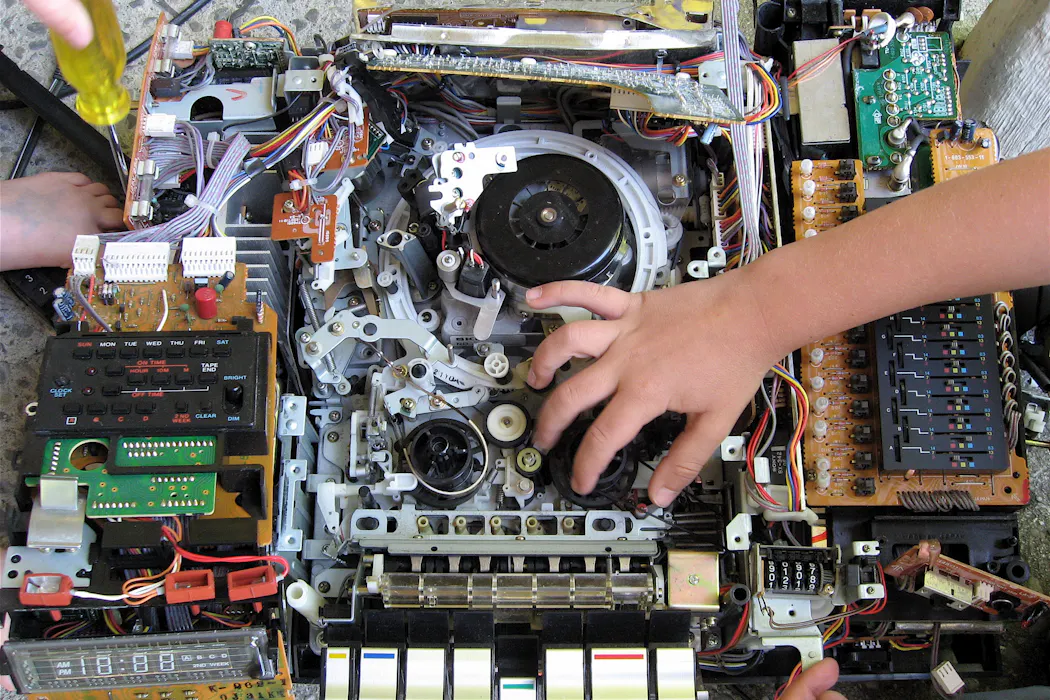
Betamax video recorders like this one helped set off a chain of events leading to bans on repairing your own devices. Steve Jurvetson/Wikimedia Commons, CC BY

If you have ever tried to repair something, realized that it was beyond your financial or technical means, and ended up buying a new one, you are not alone. Repairing electronics and household appliances has not been a real option in the United States for decades now, particularly for items that have proprietary software in them.

Absurd situations have proliferated. It can cost about the same to buy a new printer as it does to replace the ink cartridge. The U.S. Department of Defense cannot repair the weapons systems it purchases because the intellectual property rights remain with the manufacturer. John Deere, the farming equipment company, doesn’t allow farmers to access the software needed to repair their own combines and tractors because, while the purchase covers the physical machinery, it does not cover the software.

One consequence, in addition to cost and frustration for consumers, is environmental harm. The U.S. is the world’s second producer of electronic waste after China, to the tune of about 43 lbs (19.5 kg) of electronic waste annually per person. Only 25% of this e-waste is recycled.

The right-to-repair movement emerged in response, calling for people to be able to repair what they purchase, or have third parties do the repair work, without unnecessary financial, legal or technical barriers. Right to repair seems to be a rare area of bipartisanship in Congress. The Warrior Right to Repair Act – introduced in 2025 by a Democrat – and the Repair Act – introduced by a Republican – are two ongoing legislative initiatives to create a federal legal framework that would make it easy and cheap for American users to repair their devices. Both bills are fiercely opposed by industry groups.

As a scholar of American culture, I found through my research that the origins of the legal and technical obstacles to product repairs lie in debates in the 1980s over new media and copyright guardrails.

Hollywood and VCRs

The rapid rise and popularity of video cassette recorders, or VCRs, in the late 1970s transformed films and TV shows from transient experiences into tangible consumer goods. As I show in my book, “Videotape,” despite the potential for extra revenue, Hollywood was alarmed by the fact that users were now able to copy films on videotape, and tried to stop the technology. Today’s repair bans are part of that story.

The first U.S. copyright provisions were embedded in the 1790 Constitution. Over time, the law was amended to include new technologies, but at the core of future legal arrangements remained the initial intent: to protect the financial rights of creators while giving enough access to information for society as a whole to progress.

Until the second half of the 20th century, the American doctrine of fair use, which allows the unlicensed use of protected works under specific conditions, allowed judges to prevent copyright law from negatively affecting public interest. Organizations such as public libraries, book clubs, universities and news organizations benefited from this legal approach. The concept was codified into American law in the Copyright Act of 1976.

When the film studios took Sony to court to stop the production and sale of video recorders in 1976, they argued that Sony’s product encouraged copyright infringement. But the U.S. Supreme Court ruled in 1984 that taping TV content for personal use did not violate copyright law, expanding the understanding of fair use.

The industry then focused on finding a technological solution to the piracy problem and on securing stricter legal protections for its products.

They identified the digital versatile disc, or DVD, as a safer alternative to the VHS tape. Initially, the DVD was a read-only format. It took a few more years of engineering before affordable recording was possible. Even then, the process was far more complicated for users than videotape recording. In 1997, barely one year after the video disc was launched, all of the Motion Picture Association of America member studios joined the DVD Forum, collectively adopted the new format and started to phase out films released on videotape.

Manufacturers use several tactics to block consumers and third-party repair shops from fixing their products.

Copyright and virtual locks

Then came digital rights management. Collectively, the term refers to the battery of technological tools that the industry developed in order to control user access to content. These include encryption software and various forms of authentication or enforcement software that limit which types of digital activities users can perform. For instance, some mechanisms block the option to download or share a digital file.

The Digital Millennium Copyright Act, or DMCA, signed into law by President Bill Clinton in 1998, provided the broad legal framework that allowed these technological locks to expand far beyond entertainment, including to software. The Digital Millennium Copyright Act reflected a new alignment in interests between the entertainment and software industries. It increased existing penalties for copyright infringement online and criminalized any technology used to bypass technological locks. The law was adopted although at the time – and since then – critics warned that it could stifle innovation and increase costs for consumers.

Since 1998, more and more consumer products, from toys to dishwashers, use microchips and proprietary software protected by copyright. Because of the Digital Millennium Copyright Act, third party repairers cannot alter or bypass the proprietary software. If they did so, they would be liable for infringing the manufacturer’s intellectual property rights, as is the case for John Deere farm equipment. Some electronics are even designed to make tampering with the product impossible.

Manufacturers maintain that only they or authorized personnel can and should repair their products. These repairs are often quite costly. When getting a product repaired becomes almost as expensive as buying a new one, many consumers will choose to buy and throw repairable items away.

Rising resentment over repair bans

Technology tends to outpace existing legal arrangements. With over 80% of Americans supporting the right to repair, it remains to be seen when or if American law will catch up with the unexpected consequences of a law meant to protect the intellectual rights of the creative industries, but which is now hurting consumers’ pocket books.

The Conversation

Oana Godeanu-Kenworthy does not work for, consult, own shares in or receive funding from any company or organization that would benefit from this article, and has disclosed no relevant affiliations beyond their academic appointment.

  •  

TMZ descends on Washington in a test of whether tabloid tactics can serve the public interest

Will the Hollywood gossip outlet be able to hold those in power to account? Gabriel Bouys/AFP via Getty Images

Headlines on sex, drugs, sports and divorce always attract eyeballs. In fact, the entire tabloid industry has been built on the public’s hunger for scandal and schadenfreude.

TMZ is no exception. Through the years, it has become the go-to source for celebrity gossip, salacious affairs and public meltdowns.

So what to make of TMZ’s decision to recently launch a Washington bureau – TMZ DC – to cover the Beltway’s feuds, scandals and power struggles?

While some congressional staffers have been apprehensive about this new venture, I’m excited to see how it plays out. I’ve studied and written about how aspects of TMZ’s business model and audience engagement tactics can be replicated by local media to serve the public good.

Now that the outlet is setting its sights on the nation’s political actors, there will be an opportunity to see whether its controversial methods translate into holding those in power to account.

You are now entering the ‘thirty mile zone’

Celebrity journalism had been around since the creation of 18th-century scandal sheets, which published gossip about European aristocrats, royals and political elites. In the 19th century, the penny press emerged in the U.S. – cheap newspapers that competed for the public’s attention by running articles detailing crimes, scandals and lurid accounts of city life. Newspaper publishers William Randolph Hearst and Joseph Pulitzer supercharged this approach through what became known as “yellow journalism,” a sensational, emotionally charged style of reporting that flourished in the late 1800s.

TMZ repackaged this model for the digital age.

After a three-year stint as host of the syndicated TV show “Celebrity Justice,” Harvey Levin founded TMZ in 2005 with backing from Warner Bros. The name is a nod to Hollywood’s “thirty mile zone” – the roughly 30-mile radius around Hollywood that the entertainment industry uses to determine whether film and TV productions are considered “local” shoots or “on location.”

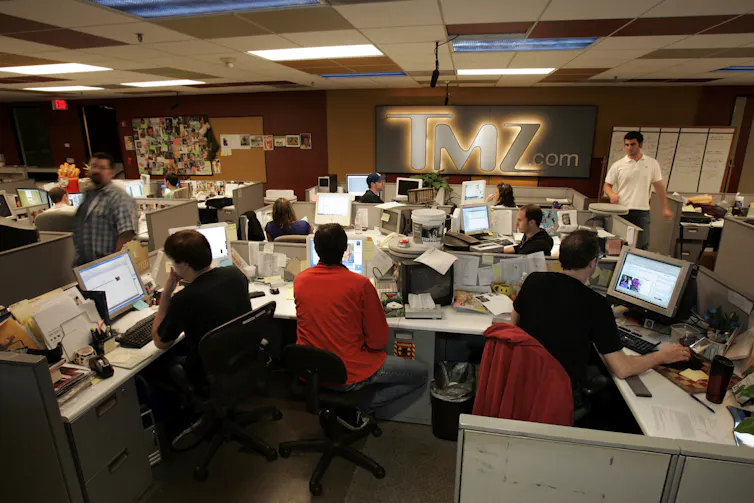
A crowded newsroom with cubicles and desktop computers.
TMZ’s former newsroom in Glendale, Calif., pictured in 2007. Ann Johansson/Corbis via Getty Images

From the start, TMZ has come under fire for its aggressive reporting tactics and its prioritization of speed over sensitivities.

Many of its posts hypersexualize women. Its articles often lack bylines, which allows it to promote its brand over the work of its reporters. The outlet has also allegedly cultivated a network of paid informants, which violates journalistic ethical norms. And it treats any and all celebrities as fodder for clicks, no matter how humiliating or intrusive the story.

TMZ has covered celebrity deaths in ways that most mainstream media outlets wouldn’t consider. It posted Michael Jackson’s autopsy report in an accessible PDF file. It published an article about Kobe Bryant’s death in 2020 before authorities had widely confirmed the news. And after One Direction member Liam Payne fell to his death in 2024, TMZ published a cropped photo of the corpse with identifying features. The ensuing outrage compelled the outlet to remove the images.

TMZ takes its talents to DC

TMZ’s content and approach were shaped by the web’s demand for speed, visuals and clicks.

However, while yellow journalism often resulted in articles that were exaggerated or misleading, TMZ usually takes pains to be rigorous and accurate in its reporting. The outlet’s journalists have become experts at records-based reporting, which involves scouring publicly available information or filing public records requests to build stories via court filings, property and tax records, police reports, financial disclosures, corporate filings or government databases.

TMZ’s attention to the dockets in Los Angeles-area courthouses has long given the outlet an edge in being the first to report on divorces – from those of Angelina Jolie and Brad Pitt and Britney Spears and Sam Asghari to, more recently, Nicole Kidman and Keith Urban’s split.

But more importantly, this type of document-based, investigative reporting is just the sort of approach that I think is needed to produce more public interest journalism. The focus simply needs to move from face-lifts and custody battles to lobbyists and insider trading.

Media scholar Patrick Ferrucci and I have explored how TMZ engages and holds its audience through a mix of original multimedia content, document-based reporting, sports-themed coverage and sensational headlines.

Yes, the outlet primarily focused on celebrities. But we wondered why traditional news organizations weren’t taking a page from TMZ’s book and covering elected officials like the paparazzi covered celebrities.

A reality show worth covering

This isn’t TMZ’s first attempt at covering national politics.

In 2007, there was a proposal for a Washington branch. However, its parent company, Time Warner, nixed the venture, deeming it too risky to mess with the bureaucrats that regulate its empire.

But with spectacle, personality clashes and corruption increasingly defining American politics – not to mention a former reality TV show host serving as president – it was only a matter of time before TMZ would have a second go at it. Plus, as TMZ DC Co-Managing Editor Charlie Cotton told Politico, the public deserves to know as much about public officials as they know about “The Real Housewives.”

TMZ already had a history of covering politics and bad actors. During the 2008 financial crisis, the outlet was able to channel its mean-girl energy into populist rage: After Congress approved US$700 billion to bail out banks, the outlet circulated images of bank employees partying with their bonus money.

In March 2026, before launching its Washington bureau, TMZ did something similar: It asked its audience to find photographs of members of Congress on vacation during a partial government shutdown that was forcing TSA employees to work without pay.

The call-out soon bore fruit. The outlet posted images of Sen. Lindsey Graham at Disney World that went viral, subjecting the South Carolina Republican to a news cycle’s worth of ridicule.

TMZ’s descent on Washington has also coincided with the rise of news influencers: social media users with hundreds of thousands – sometimes millions – of followers who post regularly about news and politics. They include V Spehar, Aaron Parnas and Heather Cox Richardson.

Quick to post and churn out content, their segments often go viral. In a nod to their digital clout, the Trump White House has even held influencer briefings.

TMZ’s reporters share similarities with these influencers. They don’t necessarily have a traditional journalism background, nor do they strictly adhere to journalistic values. Ethics can be cast aside for clout or virality. Both understand the power of bite-sized content, with TMZ pioneering the short-form blog post to break news, and influencers using their own authentic voice to gain audience trust.

Now, TMZ is pulling from the best practices of these influencers: Its staff will increasingly post short videos of themselves on social media breaking down stories. Talking directly to the camera via vertical video feels more like personal interaction instead of a stagnated and removed broadcast. This can be a key driver of audience engagement and trust.

Though it hasn’t been a paragon of ethics, TMZ has largely earned the trust of the public and – perhaps begrudgingly – of legacy media.

Time will tell if TMZ DC can become a watchdog in today’s fractured media environment. But with today’s political ecosystem now driven as much by virality as policy, I think TMZ is well positioned to go hard after the hypocrisy, backroom deals and scandals of the nation’s elected officials.

The Conversation

Angelica Kalika does not work for, consult, own shares in or receive funding from any company or organization that would benefit from this article, and has disclosed no relevant affiliations beyond their academic appointment.

  •  

Russia’s pared-down Victory Day parade tells a story: Away from the pomp, war in Ukraine is not going to Putin’s plan

A police boat patrols the waters of the Moskva River near Red Square, which is decorated for the celebration of the 81st anniversary of the Soviet Union's victory over Nazi Germany in World War II. AP Photo/Alexander Zemlianichenko

Victory Day in Russia, which marks the surrender of Nazi Germany to the Soviet Union, has long held particular importance in Vladimir Putin’s Russia.

Yet this year the May 9 celebration – usually replete with extensive parades across the country and a demonstration of military hardware in Moscow – is expected to be significantly pared down. That’s due to Kyiv’s ongoing long-range military capabilities. For the first time in two decades, Russian officials have said, there will be no lavish display of tanks and missiles.

The reality for Putin is that the war in Ukraine, now in its fifth year, continues to be a grueling drain on Russian men, its economy and resources – and may continue to be for some time.

That was underscored by the European Union’s April 23 approval of a US$106 billion loan package to Ukraine. The aid, which will be a boon to Ukraine’s war-torn economy, had been stymied by EU-member Hungary under its former president, Viktor Orban, who was ousted in April 12 elections.

The resumption of EU aid and the removal of a pro-Moscow European voice at the EU represent major blows to Russia’s regional strategy. Perhaps trying to reset the narrative, Russia declared it would mark this Victory Day with a two-day ceasefire with Ukraine. Ukrainian President Volodymyr Zelenskyy responded by saying his country would also observe a ceasefire, starting two days earlier on May 6.

But there remain few immediate signs of a breakthrough in the conflict – and Russia appears chiefly interested in negotiating Ukraine’s future not with Kyiv but with U.S. President Donald Trump, who has been sympathetic to Russian interests.

As a scholar of contemporary politics in Eastern Europe, I see that as part of a pattern of Russian miscalculations and consistent denial of the will of citizens in democratic societies in Eastern Europe. Indeed, it reflects a dominant imperial mindset among Russia’s political elites, which the Kremlin has not altered since the collapse of the Soviet Union in 1991.

Losing hold of the old Soviet bloc?

While formally recognizing the independence of former Soviet republics in 1991, Moscow has continued to treat those countries as part of its sphere of influence.

For more than 25 years, Russia has pursued a hybrid approach of influencing former Soviet countries, along with others in Eastern Europe. That has included supporting electoral fraud, economic machination, media manipulation and use of force and violence.

Indeed, suspected Russian interference in politics and elections has been a frequent occurrence in Armenia, Georgia, Moldova, Romania and most recently Hungary.

A man in a suit gestures on a stage.
Hungary’s former Prime Minister Viktor Orban was Russia’s most stalwart ally in Europe. AP Photo / Petr David Josek

But Hungary and Armenia are recent and powerful examples that show the limits of Russian operations. Orban’s loss in Hungary immediately dislodged Russia’s most powerful point of leverage in European politics.

Meanwhile, in Yerevan on May 5, Armenia hosted a bilateral summit with the EU where the country established stronger economic and defense ties to the bloc. It was a stark diplomatic event for the country that has long been a junior ally of Russia’s but which has increasingly moved away from Moscow.

Ukraine: A test of Russian policy

Yet Ukraine remains the focal point of both the extent and limits of Russian external interference.

Putin has been attempting to have a loyal proxy government in the country ever since being spurned by Leonid Kuchma – the second president of Ukraine, who was in office until 2005 – who proclaimed that “Ukraine is not Russia.”

In Ukraine’s 2004 presidential elections, Putin’s Kremlin threw its substantial resources behind Kuchma’s prime minister, Viktor Yanukovich, who was seen as more friendly to Russian interests.

Since then, its relationship with the country has been one of external interference. Putin’s message throughout has been clear: The West, in its fights against Russia, has sought to colonize and destroy Ukraine by supporting nationalist forces against Moscow’s interests.

Facing consistently strong Ukrainian civil society and sovereignty movements, Russia found it difficult to fully implement its goals through political subversion or influence. So Moscow increasingly turned to military options.

In March 2014, Russia moved to annex Crimea and began a war in Ukraine’s eastern border regions of Luhansk and Donetsk.

That war in the east ground on for years, until in 2022 Putin made the decision to double down yet again, this time opting for a full invasion. The goal of the war was in Putin’s own words to “de-militarize” and “de-nazify” Ukraine. Yet, four years later, Putin’s desire for regime change has not yielded the desired results.

The human cost of Russian pursuits

Over the past year, Trump’s commitment to a peace deal between Ukraine and Russia, without first establishing a durable ceasefire, has moved the U.S. position toward Putin’s. That has included Trump’s support for Ukraine territorial concession as the grinding war continues.

Without significant territorial gains, Russia has continued and intensified its campaign of mass airstrikes and drone attacks on Ukrainian population centers. Indeed, 2025 was the deadliest year since the start of the full-scale invasion; civilian deaths were up 26% in 2025 over the previous year.

A rescue worker walks among rubble.
A rescue worker walks inside apartments destroyed by a Russian strike in Odesa, Ukraine, on April 27, 2026. AP Photo/Michael Shtekel

In the especially cold winter of 2025-26, Russia consistently targeted the energy grids vital to the millions of Ukrainians. Across Ukraine, at the record-low freezing temperatures, people endured daily attacks by drones and artillery, while trying to survive without electricity, heat and running water.

The Kremlin’s plan to put maximum pressure on Ukrainian civilians in the hope that Ukrainians would start blaming their leadership for refusing peace on Putin’s terms has not worked. For its part, the Ukrainian leadership has refused Russia’s maximalist war aims while cautiously continuing a commitment to the U.S.-mediated peace process.

Zelenskyy’s approval ratings remain steady at around 60%. The public opposition to Moscow’s demands on territorial concessions have not budged either, with a majority of Ukrainians continuing to categorically reject territorial concessions. Those numbers have not changed significantly since 2024.

Yet, war and surviving it takes a toll. And the experience of the year of negotiations has left many disillusioned, with some 70% doubting that peace talks will lead to a lasting solution.

A murky future

The last rounds of U.S.-mediated talks between Russia and Ukraine took place Feb. 16, 2026.

While Zelenskyy insists that the talks are not stalled, Russian’s top diplomat, Sergey Lavrov, has said the negotiations are not Russia’s top priority.

Buoyed by high oil prices as a result of the U.S. war in Iran, Russia has pursued a spring offensive and not relinquished its demands on Ukraine’s territories.

Yet this demand remains a nonstarter for Ukraine and Zelenskyy. As the Trump administration embraces the Russian “land for security” plan, Russia and its allies are likely to continue to put pressure on Zelenskyy, portraying him as an obstacle to peace talks.

But especially given Moscow’s recent woes, from losing a reliable ally in Hungary to the related EU loan guarantee, it’s unlikely that a continued grinding war will convince Ukrainians to abandon their sovereignty – or serve Russia’s own security.

The Conversation

Lena Surzhko Harned does not work for, consult, own shares in or receive funding from any company or organization that would benefit from this article, and has disclosed no relevant affiliations beyond their academic appointment.

  •  

‘Debate me!’ doesn’t work. Here are better ways to disagree – and maybe change minds

In a deeply divided America, what passes for 'debate' seems designed to fuel polarization, not to exchange ideas and really change minds. Brendan Smialowski/AFP via Getty Images

Spend time on social media and you will see debates with titles like “I destroy MAGA mom on vaccines” or “Conservative philosopher owns feminist student.” These popular videos focus on clip-worthy gotcha questions, one-line zingers and screaming matches edited for virality.

These “debates” would be unrecognizable to the Founding Fathers, who enshrined debate as a primary tool of legislative deliberation. Even the passionate exchanges of Abraham Lincoln and Stephen Douglas, whose 1858 “great debates” about slavery drew crowds of thousands, are tame compared with today’s vitriolic exchanges. While Lincoln and Douglas exchanged insults, played to the crowd and took a few logical leaps, they could still communicate respectfully.

Then, as now, Americans were deeply divided. But today’s wars of words seem designed to fuel intense polarization, not to change minds.

Debate is broken as a tool to inform, explore ideas and persuade an audience. It’s time to find another way.

That’s a difficult conclusion for me. As a communications professor, I believe presenting an argument, listening thoughtfully to the response and responding with a rebuttal is excellent critical thinking and public speaking practice. However, when I assign a shortened Lincoln-Douglas structure, many students ask when they get to “really” debate – meaning the ruthless online back and forth.

Research says that persuasion is possible in other ways. But the process requires understanding, perspective-taking and collaboration. People must choose communication, not competition.

A black and white illustration of around a dozen men in suits, including a standing Abraham Lincoln, on a platform amid a crowd outdoors.
The Lincoln-Douglas debates inspired a format still used today – but in such a polarized society, traditional debate rarely changes minds. Cool10191/Wikimedia Commons

Us vs. them

How did even presidential debates become so combative, so filled with personal insults, that moderators have to mute microphones to stop constant interruptions?

Political scientist Lilliana Mason says a major factor is that political affiliation has become central to Americans’ personal identity. Her 2018 book, “Uncivil Agreement,” argues that in the wake of the Civil Rights Movement, political parties started aligning less with specific policies and more with social identities, such as race, class, religion and sexual orientation.

As the parties became less diverse, both demographically and ideologically, political affiliation became an umbrella-like mega-identity that stacks different aspects of personal identities together and has created two large teams: conservative and liberal. In some ways, the two parties form different cultures, though no group is a monolith. There are surface differences, such as where liberals and conservatives tend to live, and deeper ones about values and beliefs. Ultimately, mega-identity creates a sense that the “other side” is a threat.

These identities contribute to a person’s sense of self and shape how they see others too. The more someone aligns with a political party’s constituent identities, the more partisan they become, and the stronger the influence of mega-identity.

When political affiliation becomes tied to self-concept, it links to a person’s deepest values: their sense of right and wrong. That’s why conversations about controversial issues frequently elicit defensiveness. Hearing conflicting ideas feels like you are being attacked, as though you need to defend yourself and your community or lose face.

Want to talk?

With tensions this high, avoiding politics in conversation is tempting – but often hard to avoid. And sidestepping tough topics could do just as much harm as tackling them, since deep conversations are important for the health of our relationships.

So, what can be done to sway someone on controversial issues? One successful method with research behind it is called deep canvassing. The technique was originally built for door-knockers advocating for ballot initiatives but can be adapted to other kinds of fraught conversations.

First, decide which topics you can really be civil about. If something feels so personal that any contrary opinion makes you throw up internal walls, it may not be the right topic for bridge building.

Next, cordially invite the other person into a conversation, building rapport without putting them on the spot. Something like, “I saw your post on Facebook about immigration and I wanted to talk with you about it. Are you up for that?” or “I’m curious about why you think that way. Care to talk about it?” The tone should be friendly and casual.

A middle-aged woman in a purple shirt stands in a garden speaking with a tall, younger man in a white collared shirt.
Try to go into the conversation with real curiosity about someone’s opinions. Koldunova_Anna/iStock via Getty Images Plus

If they accept, gauge where they are on the topic. Canvassers start by asking a person on a 1-10 scale where they stand on an issue and why. This allows the person to articulate their position and gives them time to process how they feel and why.

Often, the initial statements and opinions they’ll share are inflammatory ones they’ve heard elsewhere, including politicians’ talking points and media sound bites. It can be tempting to start building a counterargument or to interrupt.

Don’t. Stay open and let them talk. Remember, these issues might touch on their sense of identity and can easily trigger defensiveness, so saying, “Well, actually …” could shut down the conversation.

Sharing stories

As the conversation deepens, the goal is to move past talking points into storytelling. Journalist Mónica Guzmán, in her 2022 book “I Never Thought of It That Way,” suggests questions like, “What shaped your views on this?” or “Do you know someone who…” or “What experiences have you had that make you think this way?”

Listen for connection points, such as shared values, emotions and experiences. In a conversation about voting rights, fairness could be a shared value, no matter where you stand on a given policy. Talking about gun control? Safety could be a starting point. Canvassers link that underlying value to a story or experience of theirs that shows the other side of the issue.

For example:

“I hear what you’re saying about wanting everyone to have an ID to vote. I can see we agree on wanting elections to be fair. However, I remember when REAL ID came out, I had to go to one county to get a copy of my first marriage license, another to get a copy of my divorce decree, and then dig out my new marriage license and all the other required documents. If I couldn’t take time off, or if I didn’t have reliable transportation, I might have just given up.”

Exchanging stories can go around defensive walls and open people up to conversation, making us more open-minded and curious about each other – a moment of humanization.

“I worry that this proposal could make it hard for everyone to have a voice, and that feels unfair to me. I’m curious, do you think there might be a better way to prevent fraud and make sure the process is accessible?”

Notice the lack of sources and statistics? Not focusing on data can drive a traditional debater crazy. But someone’s political stance can actually change how they interpret raw data, a process called motivated numeracy. Statistics that contradict a strongly held belief are often discarded as “fake news.”

The conversation usually ends with the canvasser asking the other person whether their rating on the issue has moved at all. If it took 21 hours for Lincoln and Douglas to talk through their issues, it is unrealistic to assume one short conversation will make a dramatic difference. But civil experiences with someone who holds a different opinion can stick with the person long after the conversation ends.

I think debate, with its competitive point scoring, no longer serves us, but techniques drawn from deep canvassing can build bridges. Perhaps with patience and practice, conversations like these can build empathy, promote compromise and begin to disassemble the walls dividing us.

The Conversation

Lisa Pavia-Higel is a trained Braver Angels volunteer facilitator, though she is not currently active in the organization. Last fall, she helped co-facilitate a People's Supper event as a volunteer. She has also undergone one training session in deep canvassing from PROMO, a St. Louis-based LGBTQIA organization, and occasionally gives her time to the organization.

  •  

Should we ‘stream’ school students based on ability? New research suggests yes – but we need to be cautious

SolStock/ Getty Images

Educators have long debated whether students should be “streamed” – or organised into different classes based on their academic performance.

Is it better for students to be learning with students of a similar “ability”, or a mix?

In Australia, most high schools stream students according to their ability, especially for maths. Streaming can also occur in the primary years.

New research from the United Kingdom suggests streaming can help some students. What does this mean for Australian schools?

Concerns about streaming

Education researchers have been raising concerns about streaming for decades.

Some scholars argue seemingly objective ideas around ability unintentionally favour white, privileged students. Students from minority racial groups and disadvantaged backgrounds are more likely to find themselves in the lowest streams.

Research suggests a student’s natural “ability” may be less important for academic success than a student’s background, or their motivation and approach to learning

What happens in the lower streams?

Students streamed into “lower” groups often end up doing lower-level work and miss out on the challenges they would need to develop more advanced skills.

The intent of easier work might be to protect low-stream students from repeated experiences of failure. But research suggests students end up stuck in a vicious cycle of low achievement. They get fewer opportunities to extend themselves, so they don’t perform as well and continue to get fewer opportunities.

Streaming can also impact students’ self-confidence. Some researchers have linked being in a lower class with students experiencing shame and not enjoying school.

This means streaming can widen achievement gaps already linked to social class and race. This concern has spurred “de-streaming” movements in New Zealand and Ontario, Canada.

In Australia, some schools have stopped streaming in a bid to be more inclusive, but streaming is still the norm.

A new UK study

Despite these concerns, a new UK study, involving Becky Taylor, one of the authors of this article, has just found high-achieving maths students in England achieved better results when streamed.

The study examined the maths results and self-belief of students in years 7 and 8. It did this by comparing schools (which were matched for background and other demographic factors). This included 28 that used mixed-ability grouping and 69 that used streaming.

It found streaming Year 7–8 students was beneficial for higher-ability students. These students made three months’ more progress in schools that streamed students for maths that those that did not. Streaming also did not damage the results or self-belief of students from disadvantaged backgrounds.

In fact, this study found students who were not streamed made only one month less progress overall than students who were, after two years. Students with disadvantage and students with low prior achievement made similar amounts of progress regardless of how they were grouped.

These findings were surprising because they seem to contradict previous claims streaming can harm some students without benefiting others. This new study can and has been interpreted as showing streaming benefits some students while creating no harm to others.

However, the findings do reinforce previous research suggesting streaming is inequitable and widens achievement gaps. The new study found high-achieving students made much more progress than low-achieving students when streaming was used.

What are the lessons for Australia?

Educators in Australia often look to the UK for policy and evidence in education. So they might interpret the latest findings as encouragement to stream students in Australia.

But we need to be cautious.

The teaching in most mixed classes in the study looked more like low-stream than high-stream teaching. There were no appropriate opportunities for extension. So the findings might not generalise to mixed classes that include challenging work.

Most examples of effective mixed “ability” maths teaching gives all students access to challenging, rigorous tasks, and teaches to the “top”.

The researchers also found a similar structure was widely used in all year 7 and 8 maths classes observed for the study. This involved teacher input, student practice, and a bit of feedback of the end. There was very little small-group work and almost no differentiation – where teachers vary their methods for different students’ needs. Research tells us small-group work and differentiation are important for helping students reach their potential.

Australia also has a different educational context. Many schools in the UK study were very large – Australia has many small rural and remote schools that can’t stream.

Finally, results also only cover streaming in mathematics, and it could be different for other subjects.

What now?

We encourage schools and policymakers to continue to approach streaming with caution.

Research still suggests streaming or mixed groupings can be done well or done poorly. It often comes down to the teaching – and whether schools keep evaluating how different students’ needs are being met.

The Conversation

Becky Taylor receives funding from the Education Endowment Foundation. She is an author of the UK study reported in this article.

David Pomeroy receives funding from the Teaching and Learning Research Initiative (TLRI). He is a member of the Kōkirihia implementation team, a New Zealand collective working to challenge streaming.

Olivia Johnston does not work for, consult, own shares in or receive funding from any company or organisation that would benefit from this article, and has disclosed no relevant affiliations beyond their academic appointment.

  •  

Is my brain wired to never see a ghost? A psychologist on three factors that make a paranormal experience more likely

When you experience something that can't easily be explained, do you think of the supernatural? Zeferli/iStock via Getty Images Plus

Around 1 in 5 Americans say they’ve seen a ghost. I’m not one of them, and I probably never will be. I blame my brain.

Let me explain. No one can say definitively that ghosts exist, but many people believe they do. Roughly three-quarters of Americans believe in some form of paranormal activity – not only ghosts, but psychic abilities, precognitive dreams, mediums and anything else that conventional explanations can’t account for.

As a psychology professor, I often think about the subjectivity people use when interpreting experiences. I wonder, then, if there are perfectly ordinary explanations for seemingly extraordinary experiences. Maybe a perfect storm of everyday factors can converge and trigger the sensation of a paranormal experience.

In my new book, “Science of the Supernatural,” I explore the idea that the human brain might be creating an experience of the supernatural by misinterpreting the external world. Here are three factors that might trick your brain into creating a fake ghost:

Haunted factor #1: Environmental stimuli

Anyone who’s ever watched a ghost hunting show has seen the paranormal investigator mutter something like “The EMF’s going crazy” when there’s purported supernatural activity afoot. Electromagnetic fields, or EMFs, are invisible areas of energy created by electrically charged particles.

At present, there is no direct evidence that humans can consciously sense EMF the same way we can touch, see or hear things in our environment. But with a handheld device purchased at a local hardware store, you can measure them anywhere. An EMF detector picks up electrical or magnetic activity, whether human-made or otherworldly. But do EMF fluctuations relate to paranormal activity?

The scientific method might help answer this question. In one study, conducted in the South Street vaults underneath Edinburgh, Scotland, EMFs fluctuated more in areas with a history of ghostly happenings. Another study found greater variability of EMFs in the more “haunted” areas of Hampton Court Palace in England.

People might unknowingly be detecting changes in environmental stimuli, like electromagnetic fields. The question then becomes: Did the ghost cause the EMF, or did the EMF cause the ghost?

To date, only one research group has attempted to experimentally manipulate environmental factors, including complex EMF, and measure subsequent perceptions of the paranormal.

Participants did report many peculiarities, ranging from feeling dizzy to feeling like they were detached from their bodies and even sensing a presence – but these experiences didn’t correspond to how the researchers varied environmental conditions, like EMF intensity. Interestingly, the people who described anomalous experiences were the same people who believed more strongly in the paranormal.

Do environmental factors like EMF lead to perceptions of the paranormal? On the one hand, there is a correlation between reportedly haunted places and EMF variability. And there are some indications that humans can detect magnetism. On the other hand, experimental manipulation of EMF did not relate to weird perceptions in a lab setting.

I think we need to look into other haunted factors.

Haunted factor #2: Neurological mix-ups

By applying a small electrical current to the side of the head, usually to evaluate a patient for a clinical procedure, researchers have observed some strange effects. One case study described a patient who experienced an “illusory shadow figure” that was mimicking, and even interfering, with their movements. Other people have reported out-of-body experiences.

diagram of brain with lobes labeled and TPJ region circled in the middle
The temporoparietal junction is on each side of the brain; this region helps you feel that you are within your own body. John A Beal/Wikimedia Commons, CC BY

Experimental evidence suggests that this brain area, the temporoparietal junction, is probably crucial for the feeling of embodiment – that you inhabit your own body. Disrupting this brain area seems to trigger a sensation of disembodiment.

Neuroscientists aren’t completely sure how the sense of embodiment is built in the brain. The brain probably integrates bodily senses, like balance and position, with other internal processes, like a sense of self and agency. When this integration is altered, a person will experience very strange sensations.

Sometimes, misinterpretation of sensations from the body can happen during sleep, when your brain shuts out the external world. During rapid eye movement, or REM, sleep, when most vivid dreams occur, the brain sends messages that prevent movement of skeletal muscles. This inhibition causes complete paralysis during REM sleep. It is a neurological safeguard; without it, you would be likely to act out your dreams.

woman lying in bed with transparent image of woman rising away from her reclined body
Mixed-up sensory input during sleep paralysis can lead to the perception of an out-of-body experience. Ralf Nau/The Image Bank via Getty Images

Some people, though, wake up during REM sleep and find that they cannot move. They may simultaneously experience rich hallucinations – the remnants of their dream. This experience passes quickly. But in that moment of sleep paralysis, the neural signals that control skeletal muscle movement are inhibited, resulting in a mismatch of feedback from the body to the brain. Most people respond to the missing sensory information with fear, which makes them more likely to experience the sights and sounds from their dreams as reality.

Haunted factor #3: Personality traits

Living through a paranormal encounter requires that a person label their experience as such. If a believer were exposed to fluctuating EMFs, for example, they might be quick to categorize the strange sensation as paranormal. A skeptic might note they felt weird or off, but probably not point to a paranormal explanation.

There’s a growing body of research that suggests people with certain personality traits are more likely to believe in the paranormal.

For instance, some people are hyperaware of unconscious perceptions and ideas, which then permeate their consciousness. Often, these traits are associated with magical thinking, distorted or unusual thoughts, disorganized behavior and, sometimes, trouble forming close relationships.

Psychologists refer to this set of traits as schizotypy. They’re related to schizophrenia, although being high in schizotypy doesn’t mean you will be diagnosed with the disorder of schizophrenia. People with high levels of schizotypy are more likely to believe in the paranormal. They’re also more likely to experience disembodiment and spontaneous sensory perceptions and have trouble discriminating between self and others.

All of these traits relate to the function of the temporoparietal junction – the brain area that helps you know you’re located within your own body.

transparent outline of a girl in a creepy hallway
A perfect storm of factors can make a ghost seem like the only explanation. urbazon/E+ via Getty Images

When haunted factors add up to a ghost

While I cannot say for sure whether ghosts exist, I can propose a plausible explanation for why some people might be more prone to apparent paranormal experiences than others.

Consider a person who believes in paranormal phenomena who experiences a natural change in electromagnetic fields or an episode of sleep paralysis. Those experiences induce unusual sensations that this person cannot explain. Searching for meaning in ambiguity, this person distorts their distinction between internally and externally generated sensations. They settle on the only explanation that makes sense to them – that this strange feeling they experienced was a ghost.

My guess is that belief in the paranormal is the glue that holds the haunted factors together to create the (mis)perception of a ghost.

One experiment asked participants to walk through a disused theater in Decatur, Illinois. Some were told that the theater was haunted, and some were not. Several participants noted weird sensations that they attributed to paranormal activity – but only those who believed that the theater was haunted reported these sensations.

Belief alone might not create a ghost, but belief combined with at least one haunted factor – environmental stimuli, neurological hiccups or psychological conditions – might be enough to make a ghost real.

This becomes a chicken-or-the-egg riddle – or in this case, the ghost or the EMF. Someone who is more likely to be sensitive to environmental factors or who experiences sleep paralysis might create belief from their experiences. When someone cannot explain these experiences with any “natural” explanation, a supernatural explanation might be the only one that makes sense.

I’ve never noticed EMF. I’ve never experienced sleep paralysis. I’m pretty sure I don’t have personality traits like schizotypy. I don’t believe in the paranormal. And I don’t think I’ll ever see a ghost.

The Conversation

Melissa Maffeo does not work for, consult, own shares in or receive funding from any company or organization that would benefit from this article, and has disclosed no relevant affiliations beyond their academic appointment.

  •  

As an American, should you feel guilty about rooting against the US in the World Cup?

The 2026 World Cup promises to be the planet’s most-watched sporting event. It’s also poised to generate its fair share of controversy.

Taking into account the history of corruption in FIFA, the sport’s governing body, it would be hard to blame anyone who decided to ignore this year’s competition.

However, some viewers of this summer’s tournament may face an additional dilemma.

Political tensions are high in the U.S., where most of the tournament’s matches will be played. The Trump administration is historically unpopular, and its critics are already concerned about sportswashing: when governments use the spectacle of athletic competition to burnish their image and distract the public.

As I point out in my 2022 book, “The Ethics of Sports Fandom,” fans who are critical of their country’s behavior sometimes feel ambivalent about rooting for their national sports teams – and may even feel compelled to root against them.

After all, it’s one thing to pull for your national team when patriotism feels uncomplicated. It’s quite another when you aren’t feeling very proud to be an American.

The Cold War made it easy for many Americans to rally behind the 1980 U.S men’s hockey team in its victory over the Soviet Union in the “Miracle on Ice.” But what do you do when you don’t see your country as the “good guys”?

Patriotism doesn’t mean blind loyalty

Some fans might double down on their patriotic commitments during the tournament. They’ll use the occasion to champion America in all things, whether it’s the country’s battles in the Middle East or its national team taking on Paraguay at SoFi Stadium in Los Angeles.

Sports have a way of fueling nationalistic passions, and I fully expect plenty of people who don’t care much about soccer to channel their patriotic sentiments into the tournament.

However, rooting for your country’s national soccer team doesn’t mean that you endorse everything your country does, any more than wanting a friend to get a promotion at work requires you to support all of their behavior. As the philosopher Eamonn Callan has argued, a proper love of country requires citizens to be clear-eyed about its faults. The true patriot highlights problems and works to correct them, independent of how much they want the national team to win their next match.

By the same token, I think a deep love of country can coexist with ambivalent feelings about how the national team performs on the field. If patriots can disapprove of their country’s military adventurism – either because they see it as flatly unjust or because it casts their country in an unfavorable light on the international stage – there is nothing fundamentally unpatriotic about not wanting the U.S. to do well in the World Cup.

Other fans might invoke the mantra that it’s important to simply keep politics out of sports – that the games should be a refuge from the controversies that plague so many other aspects of civic life.

But as I argue in my book, fully separating politics and sports is almost impossible. It requires fans to view athletes as nothing more than bodies who exist to perform on the field. It means team executives and owners do little more than sign paychecks. And it ignores the reality that sports are woven into the social, economic and political life of communities.

Outcomes don’t change a thing

For fans who choose to watch, then, my suggestion is to view the action on the field as you would any other sporting event.

Root for whomever you want to win, for more or less any reason that moves you.

Because for all the political significance attached to the World Cup, the winner or loser of any given contest has essentially no broader political significance. The problems that existed before the tournament will still demand attention when it is over, no matter who happens to win.

Success or failure on the pitch isn’t likely to bring about meaningful political change. After all, whether a government has the right legislative agenda or approach to foreign policy is totally divorced from its national soccer team’s ability to score goals.

Viewed in this way, rooting for your country’s national soccer team doesn’t imply blind loyalty to your country or ignorance of its flaws. It simply means that you want the athletes who represent your country to win the game they are playing on that particular day.

Athletes have long been able to navigate this ambivalence. You’ll regularly hear them trying to separate a love of their country and its people from support of problematic regimes.

When Iranian soccer player Mehdi Taremi refused to celebrate a goal in a January 2026 Greek Super League match, he embraced precisely such a position. Thousands of people had been killed during protests of the Iranian regime, and the moment called for a different reaction.

“There are problems between the people and the government,” he said. “The people are always with us, and that’s why we are with them.” For Teremi, publicly celebrating as an Iranian citizen abroad felt too much like endorsing the current regime, something he had no desire to do. If the athletes who wear their national colors can maintain such nuanced views, surely fans can, too.

Young Middle Eastern man wearing a green, dry-fit shirt and a backpack.
Mehdi Taremi arrives at an Iran national soccer team practice in Antalya, Turkey, ahead of the 2026 FIFA World Cup. Sinan Ozmus/Anadolu via Getty Images

Of course, nuance can be difficult in today’s political climate, and the rhetoric around the World Cup likely won’t change that. When the U.S. men’s hockey team won gold at the Olympics back in February, Donald Trump attempted to turn it into a personal political victory by inviting the team to his State of the Union address.

“Our country is winning again,” Trump said, devoting nearly six minutes of his speech to the team’s victory.

The outlook for the U.S. men in this year’s World Cup is not quite as bright, but chances are good that someone will try to co-opt their success or failure for political purposes. Fans don’t have to fall into the trap.

The Conversation

Adam Kadlac does not work for, consult, own shares in or receive funding from any company or organization that would benefit from this article, and has disclosed no relevant affiliations beyond their academic appointment.

  •  

Philadelphia’s 2026 sports calendar is packed – but fans are being priced out

A 16-ounce beer at Lincoln Financial Field in Philadelphia costs over $11. Robbie Jay Barratt/AMA via Getty Images

Sports have been part of America’s big birthday celebrations in Philadelphia dating back to the Centennial Exposition of 1876, which featured an international regatta and helped establish Philadelphia as a global center for rowing.

During the bicentennial festivities in 1976, the NHL, NBA and MLB all held their all-star games in Philadelphia, along with the NCAA Men’s Final Four. The city also hosted an exhibition between the Philadelphia Flyers and the Soviet Red Army hockey team, as well as the annual Army-Navy game.

For the semiquincentennial events in 2026, which have been branded America 250, Philadelphia is an epicenter of sports again.

This kicked off with the PGA Championship in May. Soon, the FIFA World Cup, MLB All-Star Game, golf’s U.S. Amateur Championship and the Philadelphia Cycling Classic, which comes back after a 10-year hiatus, will also descend upon the city.

As a researcher who studies and teaches about sports and the economics of fandom, I see the events coming to Philadelphia for America 250 as an opportunity to reflect on the growing financial inaccessibility of sports.

If excitement over these events feels reserved, it might be because so many Philadelphians have been priced out of them.

Exterior of large sports stadium
Lincoln Financial Field, home of the Philadelphia Eagles, will host six World Cup 2026 matches. Mitchell Leff via Getty Images

Live sports events are more unaffordable

Early signs of Philadelphia sports fans opting out of the growing unaffordability of sporting events came during the PGA Championship.

The tournament took place at the Aronimink Golf Club in Newtown Square, about 15 miles (24 kilometers) outside of Philadelphia. Prices to attend ranged from about US$79 for an early-week practice round to $299 for the third and fourth rounds. An all-inclusive ticket cost $1,433.

The tournament sold out nearly a year ago, but as the event approached, tickets on the resale market were being sold below face value. This shows both the impact on fan’s direct access to tickets and potential cooling of the resale market and fans.

With the first 2026 World Cup match approaching, thousands of tickets to U.S. matches remain unsold. These include group stage – or early tournament – matches featuring the U.S. team. A select number of $60 tickets were made available to national soccer federations for supporters, but the lowest price for tickets available to the general public for a group stage match in Philadelphia is $380.

While Philadelphia, unlike other U.S. cities, has not further inflated fans’ expenses by price gouging on public transportation and hotels, the costs are still too high for many if not most sports fans to afford.

Ticket prices, combined with a political climate not conducive to attracting international fans, has led to slower than expected sales for U.S. matches. According to the American Hotel and Lodging Association, FIFA has canceled up to 70% of the hotel reservations it had made in Philadelphia and other U.S. host cities.

A $6 All-Star Game ticket in 1976

Back in 1976, ticket prices for the all-star games and the Flyers’ exhibition topped out at $15. That’s the equivalent of about $88 today when adjusted for inflation.

Some tickets, like for the 1976 MLB All-Star Game, sold for as low as $6, or the equivalent of $35 today.

Face-value ticket prices for the 2026 MLB All-Star Game, however, range from $220 to $700 and are currently available only to full-season ticket holders. That’s just to attend the game. Fans who also want to attend the Home Run Derby or other events will have to pay more.

Adjusted for inflation, the cheapest MLB All-Star Game ticket today costs more than three times the highest-priced ticket cost 50 years ago.

Why tickets prices have soared

There are a number of reasons ticket prices for live events, including sports, have skyrocketed. The monopolistic practices of venue operator Live Nation, and its subsidiary Ticketmaster have contributed to this increase. In addition to service fees, Live Nation uses dynamic pricing, which raises ticket prices based on demand throughout the sale period.

The resale market is another contributing factor. Brokers and individual resellers use multiple accounts and artificial intelligence to snatch up tickets before fans can, and then resell them at a higher cost to make a profit.

Sports teams also continue to test the market and push ticket prices higher.

And finally, the size and composition of stadiums has changed dramatically in the past half-century in a way that leaves fewer affordable tickets for fans.

For example, Veterans Stadium, which opened in 1971 and served as the home for both the Philadelphia Eagles football team and the Philadelphia Phillies baseball team for over 30 years, offered more affordable tickets than the current Philadelphia stadiums. The Eagles moved into Lincoln Financial Field in 2003, and although it has a capacity slightly larger than the Vet, it has fewer seats when the luxury boxes are taken into account. In 2004 the Phillies moved into Citizens Bank Park, which featured nearly 20,000 fewer seats and an expanded club section.

Parking, hot dogs and beers add up

Beyond ticket prices, the entire fan experience also costs significantly more today.

In 1976, it cost $2 to park at Veterans Stadium. That equates to about $12 today. Standard parking for a Phillies game is now $30, and $50 for an Eagles game.

For the World Cup, parking passes are listed at between $115 and $155 for the group stage and $165 for the knockout stage. On the resale market, some parking passes are listed at over $600 for a single game.

Stadium concessions have also dramatically risen. A beer cost fans $1 in 1976 – the equivalent of $6 in today’s prices. Today a stadium beer in Philadelphia costs between $11.25 and $18. A hot dog back then cost about 75 cents, compared to $7-$10 today, with an expanding menu of food options costing $20 or more.

With tickets, parking and food, a family of four can expect to spend over $2,000 to attend an Eagles game.

Men in football jerseys wear cardboard boxes for Philadelphia cream cheese on their heads
Philadelphia Eagles fans tailgate before a game against the Green Bay Packers in Green Bay, Wis., on Nov. 10, 2025. AP Photo/Mike Roemer

Stadium upgrades lead to fewer cheap seats

Modern stadiums and arenas typically have a 25-year lifespan before they undergo a major renovation or teams decide to build a new stadium. All three venues at the Sports Complex in South Philadelphia are either undergoing or considering a major renovation or new construction.

The Sixers, Flyers and the new WNBA franchise are preparing to begin construction on a new stadium as a part of a larger $2.5 billion redevelopment plan at the complex. Citizens Bank Park is undergoing a $600 million renovation, while the Eagles are considering whether they will renovate Lincoln Financial Field or build a new stadium that could conceivably host the Super Bowl and more major events. It’s likely these renovations will usher in even more luxury boxes and another jump in ticket prices for Philadelphia sports fans.

Read more of our stories about Philadelphia and Pennsylvania, or sign up for our Philadelphia newsletter on Substack.

The Conversation

Jared Bahir Browsh does not work for, consult, own shares in or receive funding from any company or organization that would benefit from this article, and has disclosed no relevant affiliations beyond their academic appointment.

  •  

National Science Foundation cuts mean researchers like me are losing grants – but impacts extend far beyond academia

The National Science Foundation's Washington headquarters seen in July 2025. Alex Wong/Getty Images

As a university researcher focused on education, I have spent hundreds of hours designing studies to help the field and that might attract the National Science Foundation’s attention.

When I received my first National Science Foundation funding award – after many failed attempts – I joined a list of scholars whose work has led to innovations like the smartphone, high-speed fiber-optic networks and educational television shows like “Bill Nye the Science Guy.”

Congress created the National Science Foundation, or NSF, in 1950, to fund scientific and technological discoveries that benefit Americans.

In the academic world, few things signal success like receiving one of the approximately 11,000 grants the NSF gives out to researchers each year. These grants are typically worth an average of US$200,000, dispersed over several years. The foundation gives out about $8.5 billion annually in total.

The National Science Foundation’s work, though, has been upended under the current Trump administration – making it harder for researchers to secure funding that is necessary to complete our work.

Here’s what is most important to understand about what the National Science Foundation does, and why its work matters far beyond academic and scientific research circles:

Changes at NSF

Sethuraman Panchanathan, the National Science Foundation’s former director, resigned in April 2025, offering little explanation. The foundation remains without formal leadership.

Even with its fiscal year 2026 budget largely protected by Congress, the NSF has awarded grants at roughly 20% of its historical rate this fiscal year.

And in April, the Trump administration, without explanation, fired all 22 members of the National Science Board, an independent advisory group that supports the foundation’s work and also advised the president and Congress on science.

A cartoon image shows a person shining a light on molecules.
The National Science Foundation typically gives out approximately $8.5 billion annually in grants for scientific and other kinds of research. Westend61/Stock Illustrations/Getty Images

Not just an academic problem

After eight years of teaching high school science, I decided to get a Ph.D. to help improve the way science is taught. As a single father, though, I couldn’t have done it without the financial stipend my adviser gave me – thanks to his NSF funding – and some additional teaching on the side.

Eventually, I graduated, got my first job and received my first National Science Foundation funding award, which I used to support several students I worked with, similar to what had been done for me.

I’ve spent the past decade as a university researcher studying how family interactions shape the personal connections children make with science and engineering. This includes studying how children develop false stereotypes about who can become a scientist.

The Biden administration awarded me the Presidential Early Career Award for Scientists and Engineers for this work.

Today, however, my research would likely not get funded.

This is in part because the now dismantled Department of Government Efficiency directed the cancellation of more than 1,700 NSF grants worth approximately $1.4 billion in 2025.

Some observer groups suggest the numbers may be much larger, in part because the National Science Foundation stopped updating its list of cancellations in June 2025.

Many projects were flagged and terminated for using words like “women,” “bias,” “stereotype” and “race”.

Two of my NSF-funded research projects were terminated in 2025. One study examined how short social media videos can support healthy parenting in families facing extreme weather events. The second was a national study of how children from different cultures and races participate in out-of-school science learning activities.

A competitive process

The National Science Foundation accepts roughly 1 in 5 applications.

First, funding proposals have to meet or exceed the highest standards of scientific rigor. Second, a person or team’s proposed research must show great promise for benefiting society.

The NSF funds physics, engineering and other kinds of scientific research. It also funds research focused on sociology, linguistics, education and economics.

The National Science Foundation has funded projects that developed the mathematics behind how kidneys get matched to donors and research tracking how extreme weather reshapes communities.

Most of the funding the agency distributes goes to university-based researchers. Approximately 25% of all the federal funding that U.S. colleges and universities receive to conduct scientific studies comes from the National Science Foundation.

Funding discoveries that benefit all

When Congress passed the National Science Foundation Act in 1950, paving the way for the foundation itself, it also set up the National Science Board. The president appoints the board’s 24 members, who are typically highly regarded scientists and industry leaders. Members of the board serve six-year terms as part-time advisers – not government employees – to ensure independence.

While board members typically don’t decide what gets funded, they help set up rules and standards the National Science Foundation uses to select the most promising research funding applications.

Before 2025, the foundation also recruited outside experts – typically university researchers – to weigh in on the merits of nearly every funding proposal. Five to 12 of these experts, who received a small stipend, reviewed each application.

Experts then send certain applications to National Science Foundation employees. These employees then ultimately decide whether to approve an application.

This all changed in December 2025, when the foundation made this external review process optional. Some National Science Board members openly questioned these changes. Four months later, all of the board members were fired.

Some critics argue that the terminations themselves were unlawful because National Science Board members are appointed to fixed terms under federal law, and the statute does not clearly authorize the president to remove them before those terms expire.

While House Democrats have questioned the legality of firing the board members, there’s been no legal action to reinstate the board members.

A few members of the National Science Board have suggested that the terminations would give the current administration more control over what research gets funded and leave little room for independent scientific experts to weigh in.

A white older man wearing a blue blazer and a bow tie stands at a podium that says 'Save NASA Science' in front of the US Capitol building, with a group of people dressed formally standing behind him.
Bill Nye, better known as ‘The Science Guy,’ speaks during an October 2025 news conference in Washington, urging Congress to protect funding for NASA and the National Science Foundation. Saul Loeb/AFP/via Getty Images

Playing by different rules

Additional changes might be in store for the National Science Foundation.

The White House Office of Management and Budget proposed a major overhaul of the rules for all federal grants on May 29, 2026.

The new rules would give individual political appointees power to hide competitive grant opportunities from the public so only those with direct knowledge could apply. Political appointees could also cancel grants at any point for almost any reason, even if an optional review panel of 12 outside experts believe the funding is in the best interest of the American people.

These rules would apply to all federal grants, whether research-related or not. For the National Science Foundation, the new rules don’t eliminate the National Science Board’s oversight on paper, but they would make that oversight practically meaningless, even if the members are reinstated.

The proposed rules, which do not require congressional approval, are expected to be finalized by Oct. 1, 2026. Some legal experts anticipate the change will face immediate court challenges.

A loss of trust

For decades, despite knowing that most NSF proposals fail, researchers have been willing to commit countless hours to applying for research grants because it represented a gold standard in science funding.

They trusted that multiple experts would impartially assess their projects, based on their merit. But the past year’s changes have thrown that process into disarray. This shift means that many people who might have benefited from NSF-funded innovations never will experience the effect of new discoveries that could improve their lives.

The Conversation

Remy Dou received funding from the National Science Foundation.

  •  

Your bank’s AI just blocked your payment – what can you do?

AI can detect financial fraud more efficiently than previous technology did, but it also flags legitimate transactions that it shouldn't. CardMapr.nl on Unsplash, CC BY

Imagine you’re at the supermarket checkout. Your cart is full. The line behind you is long. You tap your card. Declined.

You try again. Declined.

You haven’t overspent. You haven’t done anything suspicious. But somewhere inside your bank’s computer systems, a machine made a decision about you in less time than it takes to blink – and it made a mistake.

What just happened? And why does it keep happening to people who haven’t done anything wrong?

This isn’t a rare glitch, but something that happens to millions of people every day. And most of us have no idea why it happens or what we can do about it. The answer lies inside a fraud detection system powered by AI.

As a data science teaching professor and former financial-services data scientist, I understand how this system works and can explain why it sometimes fails the very customers it’s meant to protect. Just as important, I can help you find out what you need to know and what you can do if you or your loved ones are unfairly flagged.

A decision in milliseconds

When you tap your card, a signal travels to your bank’s fraud detection system in the time it takes to blink. The transaction processing at your checkout is fully automated, operating within AI systems that handle millions of payments simultaneously, and computes a risk score based on dozens of features extracted from that single moment. Those features might include the transaction amount relative to your recent spending average; the type of merchant; your geographic location; the time of day; the device used for online purchases; and how this purchase compares to your historical patterns.

Once those factors are plugged in, an algorithm scores your purchase in real time. A model trained on millions of past transactions then assigns each combination of features a probability on how likely it is that this transaction would be fraudulent. If that probability crosses a threshold, the transaction is blocked or flagged for review. The whole process takes less than 200 milliseconds.

‘99% accurate’ still fails millions of people

What sets this technology apart is speed. Financial institutions process millions of transactions every day, which is far greater than any human team can effectively monitor. Banks also have fraud analysts, but their work happens at a different layer entirely – reviewing patterns, investigating cases, and handling disputes that the automated system escalates to them.

To their credit, these new systems are usually accurate at catching fraud. Banks lose far less money due to card fraud today than they did before machine learning – one of the foundational technologies that power today’s AI systems – became standard.

Still, the word “accurate” conceals a problem. Consider the numbers. The Federal Trade Commission reported that Americans lost more than $12.5 billion to fraud in 2024 – a 25% increase from the year before. As banks process more transactions than ever, fraudsters are keeping pace, too.

And here is the part that is especially worth noting: According to Stripe, one of the world’s largest payment processors, “false declines” (legitimate transactions wrongly rejected) are a structural problem across the entire industry, and industry research consistently suggests they cost the financial system more than actual fraud does.

These errors aren’t random. They cluster around people and situations that the algorithm wasn’t properly trained to expect. Buying gas in a city you’ve never visited or making a large rent payment for the first time aren’t inherently suspicious. But to a machine trained on past patterns, they can look that way.

There’s something even more troubling. These algorithms learn from historical data, which is almost always imbalanced. Because fraudulent transactions are rare on a per-transaction basis, the model has seen relatively few examples of what fraud looks like across every type of customer.

What does this mean? Research has found that customers in lower-income areas and communities of color face higher rates of erroneous declines. When a model hasn’t seen enough transactions from a particular group of people or in a given situation, it has less data to build an accurate baseline for them. So when something slightly unusual happens, it flags it. Not out of intent, but out of unfamiliarity.

The model isn’t necessarily explicitly discriminating against anyone. But its outputs can still produce what researchers call disparate impact – unequal harm, distributed unequally.

As researchers at MIT explain in their book “Fairness and Machine Learning,” this is a known limitation. A model trained on incomplete representation will perform less reliably for the groups it saw least. The fix isn’t to blame the algorithm, but to train it on better, more representative data, and to test its error rates across different customer groups before deployment.

An upset young woman talks on the phone to dispute something she sees on her computer screen.
When machine learning declines a payment, you’re faced with a black box that isn’t designed for human interpretation. Vitaly Gariev on Unsplash, CC BY

Why you don’t have the right to an explanation

What makes these cases worse is the lack of any information.

When a loan officer denies your mortgage application, the law requires a written explanation. But when an algorithm declines your debit card, you get “flagged by our system” message. If you’re lucky enough to connect with a human representative, they can’t tell you much more.

This gap isn’t an accident. Most high-performing fraud models are black boxes. Their internal logic isn’t designed for human interpretation. A bank may genuinely be unable to articulate plainly why your transaction was stopped. That’s not because it’s hiding something, but because the model itself doesn’t produce a reason. It produces a number.

In response, some financial institutions are moving toward tools that make their algorithms more transparent. Known in the industry as “explainable AI,” these systems are designed to surface the most influential factors behind a given decision – flagging, for instance, that a transaction was blocked because of an unusual location combined with an atypically large amount. It’s a meaningful step toward accountability.

However, these adoptions are uneven, and the explanations that do exist are rarely surfaced to customers.

Meanwhile, those pressures haven’t yet translated into a consistent, enforceable right to a meaningful explanation when your card gets declined. Challenging a decision made by AI can be enormously difficult, and most of us don’t even know we have the right to try.

For most people, the path of least resistance is simply to move on, switch to another card, take their business elsewhere or say nothing. Research suggests a quarter of consumers who experience a false decline never return to that merchant at all.

Some people go further and close the account entirely. That instinct is understandable. However, it carries a hidden cost. A declined transaction won’t appear on your credit report, but closing the card can. Shutting down an account reduces your available credit and can shorten your credit history, which can directly affect your credit score.

What you can actually do right now?

You have more power here than the banks would like you to think.

Call your bank immediately: A fraud flag is probabilistic, not final. A bank representative can override a declined transaction in real time. The model made a guess, but a human can correct it. Do not wait.

Set alerts if you’re planning to make unusual purchases: Most banks allow you to notify them of upcoming travel, large purchases, or changes in your spending pattern. This doesn’t override the model, but it gives it new information to work with, which can prevent the flag from triggering in the first place.

Know your rights: Under the Fair Credit Billing Act, you can dispute erroneous transaction blocks and request an explanation. If you believe you’ve been systematically and unfairly blocked, the Consumer Financial Protection Bureau accepts consumer complaints.

Ask your bank what appeal processes are available: Increasingly, banks are building more customer-facing appeal services. Visa reported 106 million disputes globally in 2025, a 35% rise since 2019, and has called dispute management a “strategic priority.” Improper declines are expensive for payment companies and financial institutions, too, through customer service costs, lost revenue and eroded trust.

The bigger picture

The algorithm that blocked your payment isn’t all-knowing or neutral. It’s a machine making a statistical guess about you, based on data that was probably never perfectly fair to begin with.

As AI spreads further into our daily lives, the question of who controls these decisions, and whether we can challenge them, becomes ever more urgent. The technology will keep expanding into new realms. The rules, and our own financial fluency, need to keep up.

The Conversation

Pragati Awasthi does not work for, consult, own shares in or receive funding from any company or organization that would benefit from this article, and has disclosed no relevant affiliations beyond their academic appointment.

  •  

Spice Girls at 30: how girl power changed pop

The Spice Girls (L-R) Melanie C, Emma Bunton, Mel B, Victoria Beckham and Geri Halliwell. Featureflash Photo Agency/Canva

Thirty years ago, five young women from the UK redefined what a pop group could be. When the Spice Girls burst onto the scene in 1996 with their debut single Wannabe, they helped to reshape discussions around gender, sexuality, power and pop culture.

At first glance, their formula seemed straightforward; catchy music, bold personalities and an explicitly commercial brand. This helped the Spice Girls to dominate the pop charts of the 1990s and 2000s. But their approach was very rare for British female artists – most girlbands relied on matching outfits and a unified look as opposed to the Spice Girls brand of individual personalities. The strategy resulted in huge success but also reflected, and arguably was the catalyst for, deeper shifts in the music industry and society at large.

The Spice Girls arrived at a moment when “girl power” (a phrase they popularised globally and now features in the dictionary) tapped into a growing appetite for female autonomy and visibility.

Unlike many pop acts before them, each member of the Spice Girls had a distinct identity: Mel B (Melanie Brown) as Scary Spice, Melanie C (Melanie Chisholm) as Sporty Spice, Emma Bunton as Baby Spice, Geri Halliwell as Ginger Spice and Victoria Beckham as Posh Spice. These personas were often caricatured, but they provided a lens through which fans (particularly young girls) could see multiple versions of femininity represented in mainstream media.

The music video for Wannabe, the Spice Girls’ breakthrough single.

Another significant element of the Spice Girls’ audience is the LGBTQ+ community. The group has often pointed to the importance of this audience for their success. Many of their LGBTQ+ fans have pointed to the loud and proud message of the band as an important part of their self-acceptance and positive self-esteem.

Later generations of female and LGBTQ+ artists have attributed Spice Girls as inspirational figures including Adele, Billie Eilish, Olly Alexander, Charli XCX and Dua Lipa. These artists in turn continued to keep the Spice Girls legacy alive with younger audiences, helped by the easy access of legacy music catalogues on digital streaming platforms.

The Spice Girls legacy

The band’s debut album, Spice, is the best-selling album by a girl group in history. Their global reach helped solidify the late 1990s and early 2000s as a peak era of British pop culture exports. Throughout their career the band had nine UK number one singles as a group, and eight solo number ones. No other girl group comes close to that total.

But the band’s significance cannot be measured by sales alone. The Spice Girls helped normalise the idea that female acts could dominate the global market on their own terms, without conforming to male-defined industry expectations. For example, they sacked a male manager in the maelstrom of their success and managed themselves while enjoying several more number one singles, platinum album sales and sold-out tours.

The Spice Girls reunion at the 2012 London Olympic Games.

The Spice Girls also exerted an unusual degree of control over their music; notably cowriting all of their songs and challenging the industry norms that often sidelined female artists in decision-making processes. In doing so, they anticipated later debates about authorship, authenticity and agency in pop – decades ahead of modern conversations about music ownership and power such as Taylor Swift’s journey to owning her own master recordings.

The legacy of the Spice Girls is not without tension, however. “Girl power” has been both celebrated in that it made feminism accessible to young people and critiqued as a commodified slogan that reduced complex political ideas to marketable soundbites. At their last reunion tour in 2019 Geri repackaged “girl power” into “people power”.

Beyond the music, the Spice Girls have become an omnipresent element of British pop culture in recent years with Royal Mail stamps, Royal Mint official British currency and a collaboration with the English female rugby team. This shows that the Spice Girls’ iconic imagery is well and truly canonified in the British pop culture vernacular much like The Rolling Stones, Oasis and The Beatles.

Three decades on, the Spice Girls continue to be revisited in ways that alternate between celebration, nostalgia and critique, reflecting ongoing debates about gender, commerce and pop culture in the 1990s.

The Conversation

Joel Gray does not work for, consult, own shares in or receive funding from any company or organisation that would benefit from this article, and has disclosed no relevant affiliations beyond their academic appointment.

  •  

SpaceX is poised to go public and test the latest version of its massive Starship rocket amidst criticism about its environmental impact

An earlier version of SpaceX's Starship rocket launched from the Starbase facility in Boca Chica, Texas during a test in November 2024. AP Photo/Eric Gay

SpaceX is proceeding with two major milestones with consequences that could be, at a minimum, global. The company, owned by Elon Musk and valued at upwards of US$1.5 trillion, released its financial details on May 20, 2026 in advance of an IPO scheduled for June 12 and anticipated to be the largest in history. Meanwhile, as soon as this evening, May 21, SpaceX plans to test the latest version of its Starship rocket – also the largest of its kind in history – and designed to facilitate a human migration to the Moon and Mars.

But underlying SpaceX’s surges forward are tensions between the company’s activities and concerns about the effects they may be having on the environment.

These tensions were on display in April 2026 as protests by environmental activists took place outside Starbase, its development and testing facility in South Texas, while SpaceX was courting investors.

The Starbase facility is located in a sensitive wetland area along the Gulf Coast that serves as a habitat for birds and a nesting site for sea turtles. Concerned about pollution and launch debris damaging these species and others, environmental groups have filed multiple lawsuits against the company. Federal and state agencies have also fined SpaceX for polluting local waterways.

This conflict is a microcosm of a larger issue: whether the space ambitions of Silicon Valley and Wall Street are fundamentally at odds with the concerns of environmental activists.

Activists protested outside SpaceX’s Starbase facility ahead of the company’s IPO.

Space and conservation at odds?

On the one hand, technologies developed for space often have benefits on Earth. And Musk has argued that SpaceX’s long-term goal of building a city on Mars would help protect life, including humans and other species, by ensuring their survival in the event of an Earthly disaster. But space exploration can also do environmental harm, from space debris causing damage to marine or terrestrial ecosystems to rockets producing pollutants and greenhouse gases, which can contribute to climate change.

As an evolutionary ecologist who spent years studying rainforest insects and more than a decade considering the consequences of space settlement, I can understand both sides of this argument.
I’ve been to Starbase to watch a Starship launch and seen the sensitive wetlands surrounding the launch pad. But I’ve also studied the fossil record and understand how events like the asteroid impact 66 million years ago devastated many of the dominant life forms alive at the time, like most dinosaurs. So I understand the motivation to become a multiplanetary species to help avoid that fate.

A large rocket sits on a launch pad in the midst of a wetland
SpaceX’s Starbase facility, where its Starship rockets are built and where test launches occur, is surrounded by coastal wetlands that provide habitat for animals including birds and sea turtles. Scott Solomon

Environmental costs of space travel

But does the very act of going to space cause more environmental harm than good?

Depending on the type of fuel used, rocket launches can release pollutants such as black carbon, chlorine gas, methane and carbon dioxide that can contribute to ozone depletion and climate change. However, some liquid fuels like methane – which is what SpaceX uses for its massive Starship rocket – are cleaner-burning, producing mainly water and carbon dioxide as byproducts.

There can also be local ecological impacts, including damage to nearby vegetation or harm to wildlife, such as the destruction of bird nests. Noise pollution from the sound of a launch can stress some animals or interfere with their natural behaviors.

As the frequency of rocket launches increases, these potential impacts are becoming a greater concern. In 2025, there were a total of 324 launches worldwide, which sent a staggering 4,510 objects into space. Both were new records. And these numbers don’t include suborbital launches – those that involve a shorter, up-and-down trajectory – or test launches, such as those for SpaceX’s Starship.

Benefits of space exploration

But there can also be ways in which space exploration directly benefits people back on Earth.

Technological innovations created for living in space have already directly benefited some sustainability efforts on Earth. These include methods for recycling water and managing waste.

Space technologies such as satellites have also become essential tools for researchers who study and monitor our planet’s ecosystems and how they are changing.

NASA is working with SpaceX and other commercial space companies to build a base on the Moon within the next decade. Having people live on the Moon will require further technological developments that could have helpful spinoffs to use back on Earth.

For example, finding ways to grow food in such an austere environment could lead to new ways to feed people in regions on Earth where agriculture has traditionally been limited by environmental constraints.

Looking back at the Earth

Another way space exploration could benefit conservation efforts is by motivating people to be more environmentally minded.

The environmental movement that began in the 1970s was inspired in part by the perspective offered by the Earthrise photo taken during the Apollo 8 mission in 1968. Seeing the Earth with your own eyes can be even more moving, according to those who have experienced it. They point out that borders between nations are largely invisible, but that human impacts on the planet like deforestation, wildfires and the bright lights of cities at night can be quite evident.

The white and blue cloudy Earth is visible above a gray edge of the Moon's surface
The Apollo 8 ‘Earthrise’ image, showing the Earth over the horizon from the Moon. This image, acquired by William Anders, became famous for its portrayal of the Earth in its planetary context. NASA

Also visible from space is a thin, blue line that seems to hover just above our planet’s surface: the atmosphere. It’s a reminder that there is only a narrow zone that allows life on Earth to flourish, and that we must protect it.

Astronauts frequently come back to Earth more motivated to protect the environment. Some, like Scott Kelly and Nicole Stott, became dedicated environmentalists after the experience of being in space. As space becomes more accessible and a greater number of people have these transformative experiences, there could be more support for conservation and sustainability.

Do these benefits outweigh the environmental costs? Ultimately, whether going to space is a net benefit or a cost to the environment may come down to individual choices. The choice of rocket fuel matters. But so does the location of launch sites. Those near the coast are better for human safety because falling debris is more likely to come down over the ocean than a city. But some coastal locations host more significant wildlife habitats than others.

What goes up…

Decisions about what to send to space are also important. After all, what goes up must come down. Debris from space, such as defunct satellites, can burn up during reentry, but occasionally pieces reach the ground intact. When they do they can create litter, not to mention the potential for causing damage to people, property and wildlife.

Objects that remain in orbit also contribute to concerns about polluting the space environment, potentially making it more dangerous to travel into space because of the risk of high speed collisions.

Perhaps new technologies to help advance human pursuits in space, like living on the Moon, will help solve some of our environmental challenges. The increasing number of people who get the opportunity to travel to space may be so profoundly affected by the experience that they take actions with environmental benefits.

As the space economy continues to develop, the balance between expanding humanity’s presence beyond our home planet and concerns about protecting it will only intensify.

The Conversation

Scott Solomon has received funding from the National Science Foundation. He is the author of the book "Becoming Martian: How Living in Space Will Change Our Bodies and Minds" published by MIT Press.

  •  
❌