
Reading view

Curb that Yellow Dog! Private Members Bill targets employer-collusive unions

Heather McPherson holding a press conference to discuss her anti-employer-influenced union bill on June 4, 2026.

Heather McPherson wants to outlaw the targets of her private member’s bill. She refers to them politely  as “employer influenced unions.” Many workers know these repellent bodies as “yellow dog unions,” ugly creatures that pretend to be unions but put most of their energy into helping employers, often against the interests of the actual workers they purportedly represent. Think Colonel  Sanders claiming he can negotiate on behalf of the chickens or Dracula acting as a blood donor broker.

Unsurprisingly, the head of one of the unions that McPherson singled out for criticism, the Christian Labour Association of Canada, (CLAC) founded in 1952, objected to the proposed legislation. Wayne Prins, CLAC’s Executive Director, said “Nothing in this bill advances the interests of everyday working Canadians, and nothing in it provides protections that don’t already exist in every labour code in Canada……McPherson’s comments are a desperate attempt to garner favour with rival unions to CLAC, and they expose a remarkable lack of understanding of real labour relations in Canada.”

Speaking of lack of understanding of Canadian labour relations, it is worth noting that CLAC’s understanding of labour relations led them within living memory to form a lobbying alliance in BC with  the Progressive Contractors Association, the Independent Contractors and Business Associations, the BC Chamber of Commerce, the Canadian Federation of Independent Business, the Canada West Construction Union (CWCU).   With the exception of the CWCU, which appears to be closely aligned with CLAC, these are all employer side organizations. I guess the folks at CLAC haven’t got the memo yet about being judged by the company you keep. 

On June 4, McPherson’s bill had its first hour of debate, with a second hour slated for October. To those of us who see CLAC as the prime example of yellow dog unionism in Canada, seems like a glacially slow time line, but private members bills (proposed by MPs who are not cabinet members or cabinet secretaries) are often slow to move, often taking several years to be resolved, and in many cases they are where good intentions go to die in Ottawa. 

One of the speakers scheduled to speak at the June 4 press conference being held to mark the first hour of debate on the McPherson bill, is BC heavy equipment operator and human rights advocate Mike Pearson. Pearson’s advocacy for a family whose son, Sam Fitzpatrick, died because of  management recklessness in 2009 at a Peter Kiewit Sons ULC construction site at Toba Inlet in BC, where workers allegedly were represented by CLAC, gave him his own reasons to oppose the pseudo union. Pearson is outraged that CLAC wrote a letter of support for the multinational construction firm when BC’s Worksafe BC issued a then-record fine against the lethal employer, claiming that Kiewit had  a “prior demonstrated commitment to safety.” 

This is a questionable claim, given how often Kiewit  has been cited in worker deaths, injuries  and shoddy workmanship at its projects (see my Tyee story linked above.) With CLAC support, Kiewit got the reduced fine it sought,  in what many observers, including this one, saw as an insulting-to-workers slap on the wrist.

Despite this reduced fine, Worksafe noted “In these circumstances, we would describe it as ‘heedless,’ ‘wanton,’ ‘extreme,’ ‘gross,’ and ‘highly irresponsible’ for the employer to have known that there was a potential for rocks to roll through the worksite but not take adequate steps to contain this risk by way of a detailed and carefully monitored scaling program.”

“My task is to laser focus on the CLAC supporting a smaller fine for the American corporation, rather than advocating for the dues paying (now dead) worker. I’m not here for the politics, I’m doing this to further support worker safety and rights on the jobsite,” Pearson told me in a recent email. 

(Full disclosure, I spent years covering the Fitzpatrick death and Worksafe BC’s fine reduction and through that reporting came to know and respect Pearson)  I am not a neutral on this topic, or on the question of CLAC’s dubious legitimacy. 

Neither are spokespeople for organized labour in Canada and abroad. CLAC, which currently claims to represent over 60,000 Canadian workers (https://www.clac.ca/About-us) was suspended from the International Trade Union Confederation (ITUC) in 2011 and does not belong to Canadian labour bodies like the Canadian Labour Congress, which hailed McPherson’s bill in a January social media post that read: 

Canadian Labour Congress – Congrès du travail du Canada January 2:

“We applaud  @heathermacnow for introducing Bill C-259, the Fair Representation Act, taking on employer-dominated “company unions” and standing up for real collective bargaining 

This bill gives the Canada Industrial Relations Board stronger tools to protect workers’ right to independent, democratic unions  Canada’s Unions supports this bill because workers deserve a real voice and real power on the job.”

Other union bodies that offered early support for C-259 include the Edmonton and District Labour Council  IUOE local 955( IUOE Local 955 support) and  IBEW local 424 (IBEW Local 424 support.) 

Avi Lewis, the newly elected NDP leader, has voiced his support for this initiative, saying “Workers fought for generations to build strong, independent unions. Those gains shouldn’t be taken for granted. Protecting union independence means protecting workers’ ability to stand together and fight for better wages, safer workplaces, and more dignity on the job.”

Heather McPherson has called on every member of Parliament who claims to support labour rights and worker safety to support her bill. She  told the Tyee at the end of 2025:

One of the things I like best about the anti-CLAC legislation is, if Pierre Poilievre really wants to show himself as being opposed to company unions, if he’s really on it for the side of workers, his folks will support that bill. Otherwise, his cards are on the table and it’ll be pretty clear that’s not who he’s here for.” 

In my view, that goes for every MP, not just the Poilievre posse. I urge every reader to let their MP know you want them to support this bill, and get your union local, labour council, faith group, book  or bowling club to tell Parliament that bill C-259 should be passed and implemented. Some people are worried, too often rightly these days, about the phenomenon of “fake news.” We should also beware of “fake unions”.

The post Curb that Yellow Dog! Private Members Bill targets employer-collusive unions appeared first on rabble.ca.

  •  

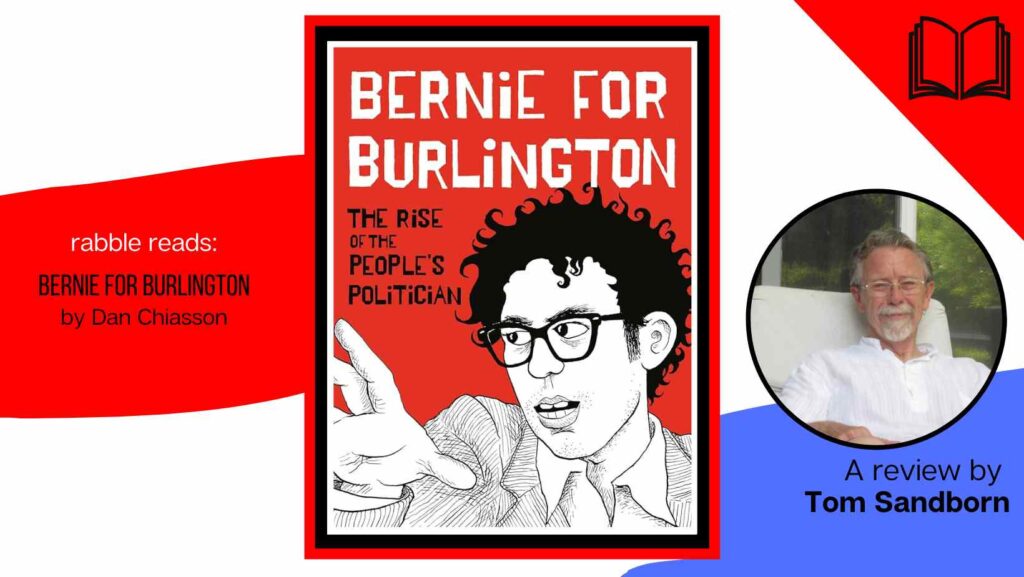
Bernie’s backstory: Life in a city with a socialist mayor

Few Americans or outside observers of the Excited States are neutral about Bernie Sanders, the long- serving independent Senator from Vermont. For many, he is the best President America never had, after two failed attempts to win the Democratic Party presidential nomination in 2016 and 2020. For others he is the heroic standard bearer and one of the key spokespeople for a resurgent progressive tendency in US politics and a leader in the struggles to oppose Donald Trump and his wannabe stormtroopers.

Sanders has critics both on the Right, where he is viewed as a dangerous radical, and on the Left, where he is sometimes attacked for being too willing to compromise with the forces of capital. Other critics caricature him as a crabby old man in a cardigan, out of touch with realities of the 21st century. Love him or hate him, Sanders is a true American giant.

Poet Dan Chiasson’s new book, Bernie for Burlington, about the years that Sanders served as the 37th Mayor of Burlington (1981-1989) is a welcome addition to a growing body of Sanders literature. Well written and accessible, it is not only a portrait of the Burlington years, which brought Sanders to national attention; it is also a sharply observed and well written love letter to the unique and cranky virtues of Vermont, and of Burlington, where Chiasson grew up during the Sanders years. This is a book that will please Sanders’ many fans around the world and will serve as a rich resource for scholars and political junkies who write about Bernie in the future.

Chiasson is the author of six other books: The Afterlife of Objects (University of Chicago Press, 2002), Natural History (Alfred A. Knopf, 2005), One Kind of Everything: Poem and Person in Contemporary America (University of Chicago Press, 2007), Where’s the Moon, There’s the Moon (Alfred A. Knopf, 2010), Bicentennial (Alfred A. Knopf, 2014), The Math Campers (Alfred A. Knopf, 2020). He writes frequently for The New Yorker and The New York Review of Books. He is a professor of poetry at Wellesley College and has been called “the country’s most visible poet-critic.”  

So, who is Bernie Sanders, and what can an account of his time as mayor of Burlington tell us about him and about America in our time? Chiasson sets out to answer these questions, and does it from the perspective of someone who came of age in the years Bernie was mayor of Burlington.

Two anecdotes from early in the book give a sense of the distinctive poet and city native’s narrative method. In one, the nine-year-old Chiasson sees two figures approaching the front door of his family home. When the visitors, canvassing for votes,  knock on the door, and his grandmother calls out “It’s Sanders,” Chiasson’s grandfather booms “DON’T OPEN THE DOOOR!”

In the second glimpse, drawn from a 1988 community access TV show Bernie produced while mayor, called, unimaginatively, “Bernie Speaks: The Mayor’s Show,”  the bemused mayor/host is shown interviewing skate punks about their outlandish hair styles, piercings and heavily zippered leather jackets. Chiasson grew up with the featured interviewees, and was just outside the frame when the video was shot, he tells us. This sets the tone for the entire narrative. The author knows almost everyone he writes about in Burlington, and remains present, if just off camera, throughout his  Bernie and Burlington story. This, plus the poet’s eye for humanizing detail and felicitous sentence making ensure that  the book is not only useful but also a distinct pleasure for the reader.

With the pleasures of the text come lots of information. We learn about Bernie’s impoverished childhood and the soul-wounding impacts of poverty on his parents. We learn about his college years, first in New York and then in Chicago, and his first forays into social justice activism as he campaigned with other University of Chicago students to force the school to integrate residential buildings it owned. We see the young Bernie’s fascination with the theories of rogue psychoanalyst Wilhelm Reich and his sexual function enhancing orgone boxes. We learn of Bernie’s growing interest in Vermont, an interest that began with visits to a Vermont tourism office in downtown Manhattan with his older brother Larry. We see him marry for the first time and scrape together money to buy a derelict farm property in Vermont, where he eventually settled and pursued his political interests.

Sanders became a “perennial candidate,” at first as part of Liberty Union, an anti-war party, but mainly as an independent. We see him forge his national identity as mayor of Burlington, where he drew support reliably from low income neighborhoods and less reliably from the liberals, academics and back to the land hippies who were changing the demographic face of Vermont in those days. In a 1972 campaign diary, Sanders wrote “Of all the groups a candidate talks before, I prefer ostensibly to talk to low income people. They “know” a lot more than most people because their lives are constantly on the line and they can’t escape behind 10,000 a year incomes- as can the good liberals.” 

As mayor, Sanders fought hard to protect Burlington’s poorest neighborhoods from “urban renewal” and to make developers and the University of Vermont, located within Burlington’s city limits but immune to civic taxes and regulations, more accountable to the city.

Throughout his long march to Burlington and then to DC, Sanders was fierce in his criticism of the oligarchs who even then dominated American politics and public discourse. He had a particular focus on the Rockefellers, seeing the liberal wing of the Republican party, led by Nelson Rockefeller as part of the American problem, not a solution. He was scathing in his critiques of Democrats as well, and during his political career, often received support from conservatives who shared his skepticism about liberalism.

Bernie improved the lives of low income Burlington residents and fulfilled many of his campaign promises. He went on to an important role in the emergence of a new anti-MAGA progressive movement in this century, and continues actively in that role. Chiasson’s book is a literary success and a treasure trove of information that will help any reader come to their own conclusions  about what the Bernie story means.

Highly recommended.

The post Bernie’s backstory: Life in a city with a socialist mayor appeared first on rabble.ca.

  •  

The heroic life of Betty Baxter, athlete and activist

On a snowy Canadian night in 1981, the athlete and coach Betty Baxter attended a mysterious meeting at a motel outside Montreal with senior administrators of the Canadian Volleyball Association. The body had made her the first woman to coach the national women’s team only a year before.

“There are rumours that you are gay, “ said one of the three men in the room sternly. “Do you deny it?” When Baxter confirmed her sexual orientation and challenged the old men convened to decide her professional fate to justify why the question was relevant, pointing out her successes as national coach, one of them, his face contorted with rage, turned and struck the wall with his fist, shouting “You never would have been given this job if I’d known that.” Baxter  became another victim of the anti-gay purges that had swept through so many dimensions of Canadian life.

Baxter left that darkly miasmic, morally squalid motel room with one chapter of her life over, and about to begin a new chapter, one that saw her become a public icon for queer communities in Canada and around the world, an eloquent spokeswoman for equality and inclusion both in sport and in civil society. She had already come a long way from her 1952 birth in small town Alberta, and was about to go even further.

Outspoken is the story of that transformation. It is also a love letter to the strenuous joys of competitive sport, and to the 2SLGBTQIA+ community that has emerged around the world in her lifetime, courageously confronting  the kind of prejudice that drove her from her first love, coaching and playing competitively,  and into the arena of public political advocacy.

Along the way, this remarkable book provides a brief and vivid account of what one of her book’s blurbs ( this one from former Olympian and U of T professor emeritus Bruce Kidd ) describes as “…the helter-skelter creation of the Canadian sports system in the frantic build up to the 1976 Olympics in Montreal…” . It also tells the story of her involvement in organizing the transformative civic events as Vancouver hosted  the third ever Gay Games in 1990.

Although Brooks, Alberta was not a hot bed of progressive politics when Baxter grew up there, she shares one memory that prefigured the leadership role she later played in the struggle for equality. Her brother John returned from time working as a tutor in Mexico to tell stories about the 1968 Olympics held in the Mexican capitol, stories that included the striking visual of two black US competitors, Tommy Smith and John Carlos standing on the medals podium with downcast heads and fists thrust into the air in what Baxter describes as “the first televised athletes’ protest against racial inequality.”

As she listened to her brother’s stories about a city lit up by Olympic enthusiasm, Baxter knew she wanted to become an Olympian. It was only later that she realized she would need to stand up for her rights and the rights of other gay athletes in exactly the way the two black athletes had stood up for theirs.

This book is an important historic document, a first person account from one of the key players in the drama of how Canada began its long and still incomplete progress toward equality and inclusion for queer people in sports and in the public square. It is also, and this will make it more impactful, beautifully written. Baxter generously names many of her first readers, friends and editors who helped her polish her text, and the collective work on the manuscript, like the collective work organizing the Gay Games and the many other equality projects that have filled her life, has been impressively successful.

Baxter writes beautifully and movingly about the joys of athletic training and achievement, in passages that reflect her life long commitment to fitness and excellence. Anyone who has ever experienced the sublime pleasure of being “in the zone” on a long run or in the midst of a hard fought game will recognize how powerfully Baxter has captured that pleasure, and the painful price the athlete pays to achieve it. She also conveys the pleasures or solidarity and shared effort on the socio-political front. All in all, this book is both beautiful to read and powerfully instructive.

In a time when authoritarian political opportunists here and abroad have mounted the ghastly apocalyptic horses of homophobia, misogyny and transphobia and are galloping the world toward a dark cliff that may take us all into the abyss, this is an important and timely book. Highly recommended.

The post The heroic life of Betty Baxter, athlete and activist appeared first on rabble.ca.

  •  
❌