
❌

Reading view

US territories have a voice in Congress but no vote – here’s why

Pictured are warships during the 1898 Spanish-American War, after which the U.S. acquired from Spain new territories thousands of miles from the mainland. Bettmann/Getty Images

As the U.S. celebrates its 250th anniversary, millions of Americans who live outside the 50 states are excluded from full participation in its democracy.

Roughly 3.6 million residents of U.S. territories – including Puerto Rico, Guam, American Samoa, the Northern Mariana Islands and the U.S. Virgin Islands – have no senators and only nonvoting representation in the House. These Americans, who can vote in presidential primaries but not the general election, are excluded because of where they live.

This year marks the 125th anniversary of the Insular Cases, a notorious series of Supreme Court decisions beginning in May 1901 that indelibly shaped the nation’s democracy. In these cases, the court decided that some territories were not, and would never be, an equal part of the U.S.

As political scientists who study the history of Congress, we’ve researched how lawmakers wrestled with the question of what rights to extend to the residents of overseas territories. Their answer shapes American democracy today.

The Insular Cases

After the Spanish-American War, fought over four months in 1898, the U.S. acquired vast new territories from Spain – including Guam, Puerto Rico and the Philippines – increasing its population by some 8 million people overnight with new residents thousands of miles from the mainland. Suddenly, the country was faced with a constitutional conundrum: What political status should these new residents have? Should they be fully integrated into American democracy – or should they be governed as colonial subjects, with no elected representation in the halls of Congress?
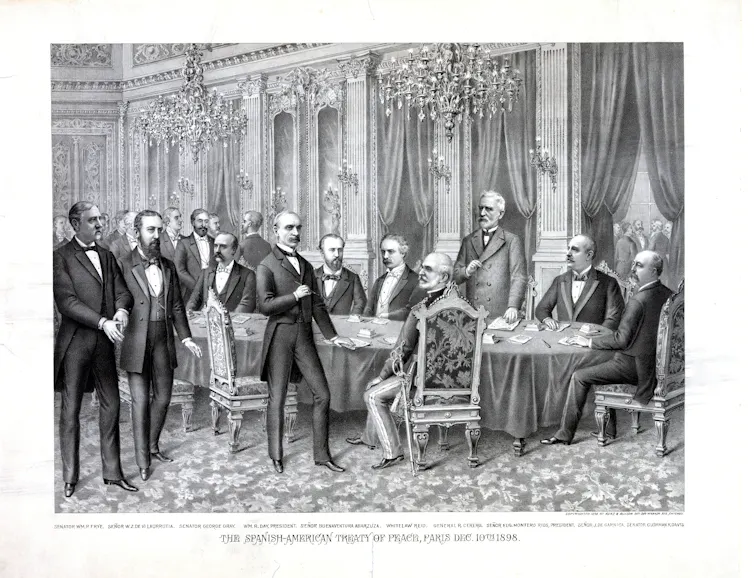
Pictured are several people in suits standing around a table
The Spanish-American Treaty of Peace was signed in Paris in 1898. HUM Images/Universal Images Group via Getty Images

In a series of cases, the Supreme Court distinguished between β€œincorporated” U.S. territories destined for eventual statehood and β€œunincorporated” territories not destined for statehood, like Puerto Rico and Guam. Part of the impetus was economics: Congress had applied tariffs to Puerto Rican goods, despite knowing that this would be unconstitutional if Puerto Rico was indeed part of the U.S. It then tasked the Supreme Court with sorting out the rest.

In turn, the Supreme Court decided these new territories belonged to the U.S. but were not part of it. This meant that 8 million new residents – a contingent nearly equal in size to the Black American population at the time – would exist outside the Constitution. Chief Justice Melville Fuller, dissenting, warned they would exist β€œlike a disembodied shade, in an intermediate state of ambiguous existence for an indefinite period.”

The exclusion of the territories was explicitly tied to race. Justice Henry Billings Brown, in the opinion of the court, wrote that β€œif those possessions are inhabited by alien races, differing from us in religion, customs, laws, methods of taxation, and modes of thought, the administration of government and justice according to Anglo-Saxon principles may for a time be impossible.”

Unequal representation

Since 1794, Congress had included nonvoting delegates, generally tasked with representing territories en route to statehood. That changed in 1898. Members of Congress overwhelmingly opposed statehood for these newly acquired places, in part because the largely nonwhite populations of Puerto Ricans and Filipinos were considered racially and culturally inferior and incapable of fully participating in a democracy. Representative John Dalzell, a Republican from Pennsylvania, articulated this argument in 1900 on the floor of the House, said β€œthe methods of government prescribed by the principles of Anglican liberty as practiced in the United States would be grotesque in the Philippine Islands and would bring to their people no advantage.”

For territories that would never achieve statehood, Congress designed a new position: the resident commissioner to the United States. At first, the position was more like an ambassador than a member of Congress. The resident commissioner, for example, was not allowed to access the House floor, much less speak on it. Eventually, the position became almost indistinguishable from that of a territorial delegate, gaining the right to debate but never to vote. Resident commissioners would go on to represent Puerto Rico and the Philippines in Congress.

Today, the resident commissioner is a second-class lawmaker. Like the delegates from the other territories and Washington, the resident commissioner may introduce legislation, serve and vote on committees and speak on the House floor – but they cannot vote on whether a bill becomes law. Even though Puerto Rico is more populous than over a dozen states, it has just one lawmaker, the resident commissioner.
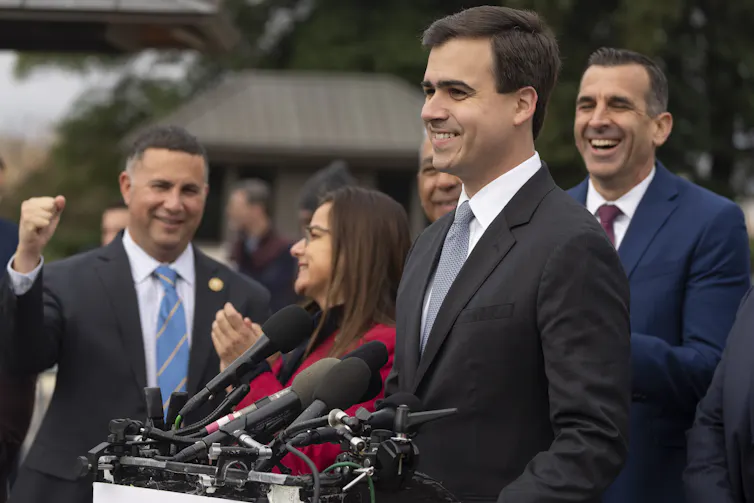
Puerto Rico's Resident Commissioner-elect Pablo JosΓ© HernΓ‘ndez Rivera speaks during a news conference on Capitol Hill in 2024.
Even though Puerto Rico is more populous than over a dozen states, it has just one lawmaker: Resident Commissioner Pablo JosΓ© HernΓ‘ndez Rivera, pictured here in 2024. AP Photo/Mark Schiefelbein

125 years later

The Insular Cases have faced increasing public criticism in recent years, including from Supreme Court Justice Neil M. Gorsuch, who wrote that they β€œhave no foundation in the Constitution and rest instead on racial stereotypes. They deserve no place in our law.”

A growing body of legal scholarship and activism has echoed Gorsuch and urged the Supreme Court to overrule the Insular Cases, to no avail.

Less attention, however, has been paid to the legacy of post-1898 territorial expansion in the halls of Congress. Puerto Rico is still represented by a resident commissioner, serving the only four-year term in Congress – as compared with the two-year terms for representatives and delegates.

The resident commissioner – alongside delegates who represent Guam, the U.S. Virgin Islands, American Samoa, the Northern Mariana Islands and Washington – serves with a voice but not a vote.

The Conversation

The authors do not work for, consult, own shares in or receive funding from any company or organization that would benefit from this article, and have disclosed no relevant affiliations beyond their academic appointment.

  •  

Delta-8, delta-9, THCA? What sets the different THC forms available in regulated cannabis products apart

Commercially available THC products are displayed at a dispensary in New York. AP Photo/Angelina Katsanis

Hemp products have exploded across the United States, even in the majority of states where recreational marijuana remains illegal. This surge came after the 2018 Farm Bill removed hemp from the Controlled Substances Act and made cannabis products derived from hemp, defined as those containing less than 0.3% delta-9 tetrahydrocannabinol – commonly known as THC – legal. But the types of THC products available and the regulations around them, which vary by state, can be confusing.

A common question I get as a chemist is about the differences between the various delta THCs, and about the actual amounts of THC in the available products. There’s delta-8, delta-9, delta-10 and THCA. The amounts of THC in legally infused drinks and edibles also varies, with products most often containing 5 or 10 milligrams.

Knowing the difference between these compounds, and how much THC is in what you’re buying, goes a long way toward making informed choices as a consumer.

THCA and delta-9 THC

THC compounds are a subset of cannabinoids, which include any compound that interacts with the cannabinoid receptors in your body. THC is technically a family of compounds including delta-8, delta-9 and delta-10 THC, which all have similar chemical structures and are psychoactive – meaning they can alter your mood and perception and produce a β€œhigh.”

However, not all cannabinoids are psychoactive. For example, cannabidiol, or CBD, interacts with the same receptors, but through different mechanisms, so it does not produce a high.

9-tetrahydrocannabinolic acid, THCA, is the major cannabinoid found in the cannabis plant. THCA itself does not produce a high, however. It first needs to undergo a chemical reaction that generates a psychoactive compound: delta-9 THC.

These two compounds have different chemical structures. THCA has an extra group of atoms attached that must be removed to produce delta-9 THC. Under heat, this group breaks away from the rest of the compound, creating delta-9 THC. So, when the plant is burned or cooked, THCA transforms into delta-9 THC.

The 2018 Farm Bill measured only the delta-9 THC – not THCA – present in a hemp plant. So a hemp plant could have, say, 25% THCA and only 0.2% delta-9 THC and still be legal, as it has less than 0.3% delta-9 THC. But as soon as you heat it, the THCA will convert to psychoactive delta-9 THC.

However, in November 2025, the Agriculture Appropriations Act redefined hemp by limiting the total THC, including THCA, to 0.3% on a dry weight basis.

Changing regulations

This new rule will go into effect in November 2026 and significantly affect the potency of smokable hemp products. In the plant itself, the cannabinoids make up a large percentage of the flower’s dry weight. High-potency cannabis strains have THCA concentrations from 20% to 30% by dry weight – far above the 0.3% total THC threshold. This redefinition would effectively render the majority of these products illegal under federal law.

The math for edibles like gummies and seltzers is different, so the dry weight rule alone does not affect these products.

Consider a 12-ounce THC-infused drink: The total dry weight of the product would only need to be about 3.3 grams per 10 milligrams of delta-9 THC – a common higher-end dosage – to fall at exactly the 0.3% threshold. A 12-ounce can of seltzer weighs around 355 grams, so 10 milligrams of delta-9 THC in a 12-ounce drink easily passes the weight threshold.

Even a very small edible like a gummy easily meets this weight threshold. For instance, a single Starburst candy weighs 5 grams, well above the 3.3-gram minimum needed for a 10-milligram dose to be under the 0.3% limit.

To close this loophole, the new law adds a separate rule: Any final hemp-derived product containing more than 0.4 milligrams of THC per container is no longer legal. That’s well below a single dose of any commercially marketed THC beverage or edible.

However, the debate isn’t over. Lawmakers introduced amended legislation in April 2026 that will give states autonomy in hemp regulation as opposed to a blanket federal ban.

What about delta-8 and delta-10 THC?

Delta-8 and delta-10 THC are what chemists call isomers of the delta-9 THC. They have the same chemical formula but different chemical structures. It’s hard to even tell the difference looking at the molecules. One of the double bonds just shifts its position by one spot in the ring.

Like delta-9, delta-8 and delta-10 THC are also psychoactive and bind cannabinoid receptors in the body in a similar way.

While they do occur naturally in cannabis plants, the concentrations are far lower than THCA and delta-9 THC. For commercial products, they must be produced synthetically, which has raised concerns about chemical contamination from manufacturing.

Some evidence suggests that these alternate forms are less potent than delta-9, but scientists will need to conduct more research to determine whether that’s true.

These compounds fell outside the original calculation in the 2018 Farm Bill, which limited only delta-9 – effectively acting as another loophole. But the recently proposed total THC standard closes it by accounting for all types of THC. State legislation still varies substantially when it comes to hemp-derived products.

In April 2026, the Trump administration rescheduled medical marijuana from Schedule I to Schedule III. This move could potentially add to the regulatory confusion, but it will lower research barriers and help scientists address basic questions about THC’s potency, how the body metabolizes it and its therapeutic potential.

Underlying all these complex debates around the legality of hemp versus marijuana and recreational versus medical uses at the state and federal levels lies a single molecule: delta-9 THC.

The Conversation

Aaron W. Harrison does not work for, consult, own shares in or receive funding from any company or organization that would benefit from this article, and has disclosed no relevant affiliations beyond their academic appointment.

  •  
❌